CLASS 6
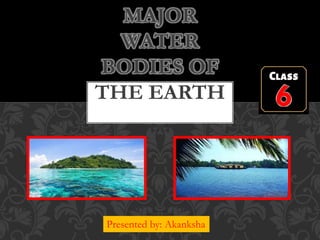
MAJOR
WATER
BODIES OF
THE EARTH
Presented by: Akanksha
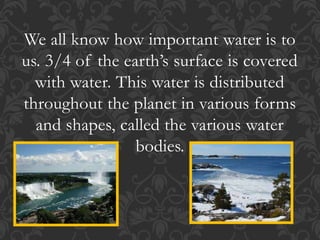
We all know how important water is to
us. 3/4 of the earth’s surface is covered
with water. This water is distributed
throughout the planet in various forms
and shapes, called the various water
bodies.
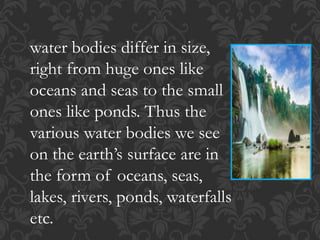
water bodies differ in size,
right from huge ones like
oceans and seas to the small
ones like ponds. Thus the
various water bodies we see
on the earth’s surface are in
the form of oceans, seas,
lakes, rivers, ponds, waterfalls
etc.
The oceans are vast and
deep bodies of water.
Usually, it is these oceans
that separate continents
from one another. The
oceans are bodies of salt
water.
Seas are also big water
bodies but are definitely
smaller than oceans. They
are partly enclosed by a
land mass and open into
the ocean.
OCEANS SEAS
MAJOR WATER BODIES
Largest water bodies on the earth are
oceans and there are five oceans:
1. Pacific ocean
2. Atlantic ocean
3. Indian ocean
4. Arctic ocean
5. Antarctic ocean
OCEANS
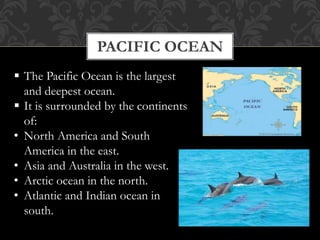
PACIFIC OCEAN
 The Pacific Ocean is the largest
and deepest ocean.
 It is surrounded by the continents
of:
• North America and South
America in the east.
• Asia and Australia in the west.
• Arctic ocean in the north.
• Atlantic and Indian ocean in
south.
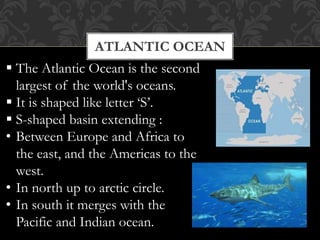
ATLANTIC OCEAN
 The Atlantic Ocean is the second
largest of the world's oceans.
 It is shaped like letter ‘S’.
 S-shaped basin extending :
• Between Europe and Africa to
the east, and the Americas to the
west.
• In north up to arctic circle.
• In south it merges with the
Pacific and Indian ocean.
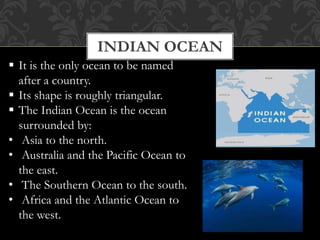
INDIAN OCEAN
 It is the only ocean to be named
after a country.
 Its shape is roughly triangular.
 The Indian Ocean is the ocean
surrounded by:
• Asia to the north.
• Australia and the Pacific Ocean to
the east.
• The Southern Ocean to the south.
• Africa and the Atlantic Ocean to
the west.
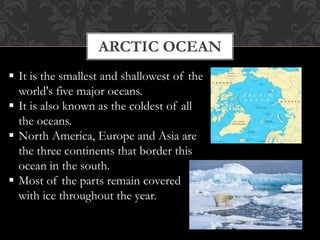
ARCTIC OCEAN
 It is the smallest and shallowest of the
world's five major oceans.
 It is also known as the coldest of all
the oceans.
 North America, Europe and Asia are
the three continents that border this
ocean in the south.
 Most of the parts remain covered
with ice throughout the year.
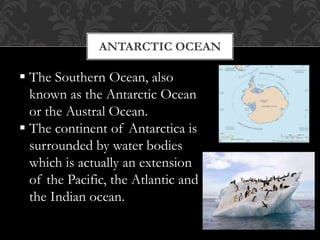
ANTARCTIC OCEAN
 The Southern Ocean, also
known as the Antarctic Ocean
or the Austral Ocean.
 The continent of Antarctica is
surrounded by water bodies
which is actually an extension
of the Pacific, the Atlantic and
the Indian ocean.
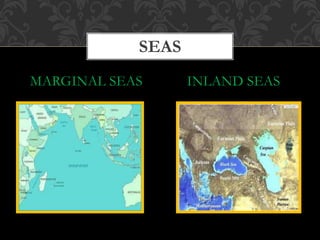
A marginal sea is a division
of an ocean, partially
enclosed by islands, or
peninsulas.
For example:
Barents sea, East Siberian
sea, Caribbean sea, Bay of
Bengal etc.
A sea that covers a
central area of a
landmass.
For example:
Black sea, Dead sea,
Caspian sea etc.
Marginal sea Inland sea
SEAS
SEAS
MARGINAL SEAS INLAND SEAS
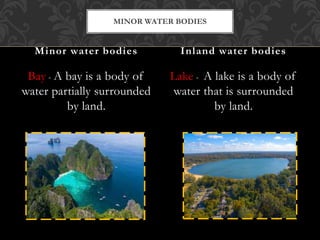
Bay - A bay is a body of
water partially surrounded
by land.
Lake - A lake is a body of
water that is surrounded
by land.
Minor water bodies Inland water bodies
MINOR WATER BODIES
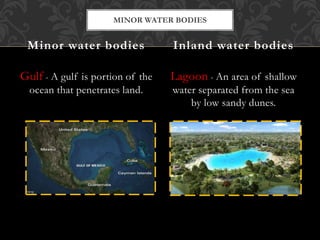
Gulf - A gulf is portion of the
ocean that penetrates land.
Lagoon - An area of shallow
water separated from the sea
by low sandy dunes.
Minor water bodies Inland water bodies
MINOR WATER BODIES
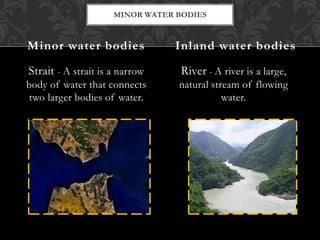
Strait - A strait is a narrow
body of water that connects
two larger bodies of water.
River - A river is a large,
natural stream of flowing
water.
Minor water bodies Inland water bodies
MINOR WATER BODIES
Water bodies

Water bodies

  • 1.
    CLASS 6 MAJOR WATER BODIES OF THEEARTH Presented by: Akanksha
  • 2.
    We all knowhow important water is to us. 3/4 of the earth’s surface is covered with water. This water is distributed throughout the planet in various forms and shapes, called the various water bodies.
  • 3.
    water bodies differin size, right from huge ones like oceans and seas to the small ones like ponds. Thus the various water bodies we see on the earth’s surface are in the form of oceans, seas, lakes, rivers, ponds, waterfalls etc.
  • 4.
    The oceans arevast and deep bodies of water. Usually, it is these oceans that separate continents from one another. The oceans are bodies of salt water. Seas are also big water bodies but are definitely smaller than oceans. They are partly enclosed by a land mass and open into the ocean. OCEANS SEAS MAJOR WATER BODIES
  • 5.
    Largest water bodieson the earth are oceans and there are five oceans: 1. Pacific ocean 2. Atlantic ocean 3. Indian ocean 4. Arctic ocean 5. Antarctic ocean OCEANS
  • 6.
    PACIFIC OCEAN  ThePacific Ocean is the largest and deepest ocean.  It is surrounded by the continents of: • North America and South America in the east. • Asia and Australia in the west. • Arctic ocean in the north. • Atlantic and Indian ocean in south.
  • 7.
    ATLANTIC OCEAN  TheAtlantic Ocean is the second largest of the world's oceans.  It is shaped like letter ‘S’.  S-shaped basin extending : • Between Europe and Africa to the east, and the Americas to the west. • In north up to arctic circle. • In south it merges with the Pacific and Indian ocean.
  • 8.
    INDIAN OCEAN  Itis the only ocean to be named after a country.  Its shape is roughly triangular.  The Indian Ocean is the ocean surrounded by: • Asia to the north. • Australia and the Pacific Ocean to the east. • The Southern Ocean to the south. • Africa and the Atlantic Ocean to the west.
  • 9.
    ARCTIC OCEAN  Itis the smallest and shallowest of the world's five major oceans.  It is also known as the coldest of all the oceans.  North America, Europe and Asia are the three continents that border this ocean in the south.  Most of the parts remain covered with ice throughout the year.
  • 10.
    ANTARCTIC OCEAN  TheSouthern Ocean, also known as the Antarctic Ocean or the Austral Ocean.  The continent of Antarctica is surrounded by water bodies which is actually an extension of the Pacific, the Atlantic and the Indian ocean.
  • 11.
    A marginal seais a division of an ocean, partially enclosed by islands, or peninsulas. For example: Barents sea, East Siberian sea, Caribbean sea, Bay of Bengal etc. A sea that covers a central area of a landmass. For example: Black sea, Dead sea, Caspian sea etc. Marginal sea Inland sea SEAS
  • 12.
  • 13.
    Bay - Abay is a body of water partially surrounded by land. Lake - A lake is a body of water that is surrounded by land. Minor water bodies Inland water bodies MINOR WATER BODIES
  • 14.
    Gulf - Agulf is portion of the ocean that penetrates land. Lagoon - An area of shallow water separated from the sea by low sandy dunes. Minor water bodies Inland water bodies MINOR WATER BODIES
  • 15.
    Strait - Astrait is a narrow body of water that connects two larger bodies of water. River - A river is a large, natural stream of flowing water. Minor water bodies Inland water bodies MINOR WATER BODIES