Berwin Jacob Kurian
Xth A
27
IIS
What are mineral and energy resources?
 The term 'resources' is usually used in the context of
natural resources which are un-exhaustible and
renewable. Mineral resources, as the name
suggests, are resources that come from
minerals. Energy resources, on the other hand,
encompass all sources of energy, both renewable
and non-renewable.
 What is a mineral?
 Minerals are substances that are formed naturally in the Earth.
There are around 4000 minerals on the earth's surface. Minerals are
usually solid and inorganic with a crystal structure and form naturally
by geological processes. The study of minerals is called mineralogy.
 origin of minerals
 Minerals can be found throughout the world in the earth's
crust but usually in such small amounts that they not worth extracting.
Only with the help of certain geological processes are minerals
concentrated into economically viable deposits.
 Igneous rocks and minerals solidify from molten rock, called
magma below the Earth's crust and lava when flowing above
ground. These rocks and their mineral components, presented below,
are the result of processes that formed Earth and other rocky planets.
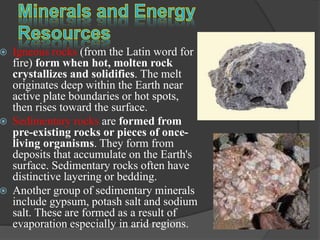
 Igneous rocks (from the Latin word for
fire) form when hot, molten rock
crystallizes and solidifies. The melt
originates deep within the Earth near
active plate boundaries or hot spots,
then rises toward the surface.
 Sedimentary rocks are formed from
pre-existing rocks or pieces of once-
living organisms. They form from
deposits that accumulate on the Earth's
surface. Sedimentary rocks often have
distinctive layering or bedding.
 Another group of sedimentary minerals
include gypsum, potash salt and sodium
salt. These are formed as a result of
evaporation especially in arid regions.
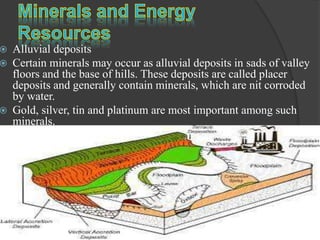
 Alluvial deposits
 Certain minerals may occur as alluvial deposits in sads of valley
floors and the base of hills. These deposits are called placer
deposits and generally contain minerals, which are nit corroded
by water.
 Gold, silver, tin and platinum are most important among such
minerals.
Minerals and Energy
Resources
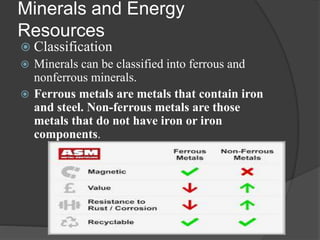
 Classification
 Minerals can be classified into ferrous and
nonferrous minerals.
 Ferrous metals are metals that contain iron
and steel. Non-ferrous metals are those
metals that do not have iron or iron
components.
Minerals and Energy
Resources
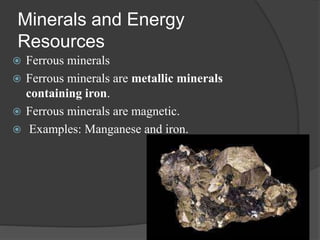
 Ferrous minerals
 Ferrous minerals are metallic minerals
containing iron.
 Ferrous minerals are magnetic.
 Examples: Manganese and iron.
Minerals and Energy
Resources
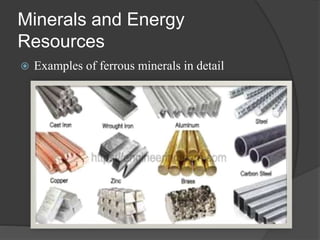
 Examples of ferrous minerals in detail
Minerals and Energy
Resources
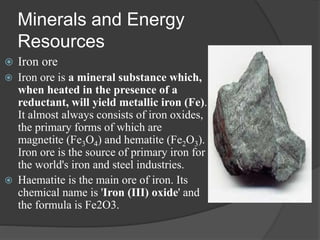
 Iron ore
 Iron ore is a mineral substance which,
when heated in the presence of a
reductant, will yield metallic iron (Fe).
It almost always consists of iron oxides,
the primary forms of which are
magnetite (Fe3O4) and hematite (Fe2O3).
Iron ore is the source of primary iron for
the world's iron and steel industries.
 Haematite is the main ore of iron. Its
chemical name is 'Iron (III) oxide' and
the formula is Fe2O3.
Minerals and Energy
Resources
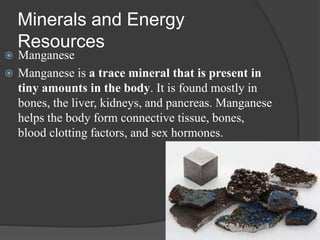
 Manganese
 Manganese is a trace mineral that is present in
tiny amounts in the body. It is found mostly in
bones, the liver, kidneys, and pancreas. Manganese
helps the body form connective tissue, bones,
blood clotting factors, and sex hormones.
Minerals and Energy
Resources
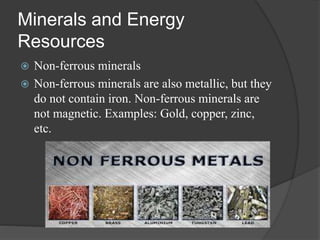
 Non-ferrous minerals
 Non-ferrous minerals are also metallic, but they
do not contain iron. Non-ferrous minerals are
not magnetic. Examples: Gold, copper, zinc,
etc.
Minerals and Energy
Resources
 Examples of non-ferrous minerals in detail,

Minerals and Energy
Resources
 Copper
 Copper is a mineral and an
element essential to our
everyday lives. It is a major
industrial metal because of its
high ductility, malleability,
thermal and electrical conductivity
and resistance to corrosion. It is an
essential nutrient in our daily diet.
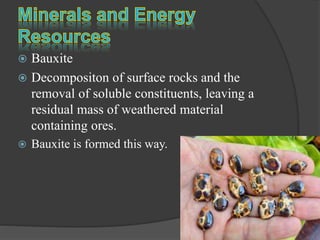
 Bauxite
 Decompositon of surface rocks and the
removal of soluble constituents, leaving a
residual mass of weathered material
containing ores.
 Bauxite is formed this way.
Minerals and Energy
Resources
 ROCK MINERALS
 A mineral is a naturally occurring substance with
distinctive chemical and physical properties,
composition and atomic structure. Rocks are
generally made up of two of more minerals, mixed up
through geological processes.
 Common minerals include quartz, feldspar, mica,
amphibole, olivine, and calcite. A rock is an aggregate
of one or more minerals, or a body of undifferentiated
mineral matter. Common rocks include granite, basalt,
limestone, and sandstone.
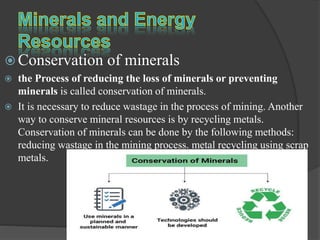
 Conservation of minerals
 the Process of reducing the loss of minerals or preventing
minerals is called conservation of minerals.
 It is necessary to reduce wastage in the process of mining. Another
way to conserve mineral resources is by recycling metals.
Conservation of minerals can be done by the following methods:
reducing wastage in the mining process. metal recycling using scrap
metals.
 Energy resources
 The term energy resource refers to any material that can be used
as a basis or source of energy. Energy resources are used to
generate electricity and other forms of power for human use.
There are two kinds of energy resources - Renewable Energy
Resources and Non-Renewable Energy Resources.
TYPES OF ENERGY RESOURCES
 Coal
 Petroleum
 Natural gas
 Electricity
Coal is a combustible black or brownish-black sedimentary rock, formed as rock
strata called coal seams. Coal is formed when dead plant matter decays
into peat and is converted into coal by the heat and pressure of deep burial over
millions of years.
Petroleum, also known as crude oil, or simply oil, is a naturally occurring
yellowish-black liquid mixture of mainly hydrocarbons,[1] and is found
in geological formations. The name petroleum covers both naturally occurring
unprocessed crude oil and petroleum products that consist of refined crude oil.
A fossil fuel, petroleum is formed when large quantities of dead organisms,
mostly zooplankton and algae, are buried underneath sedimentary rock and
subjected to both prolonged heat and pressure.
Natural gas (also called fossil gas or simply gas) is a naturally occurring mixture of
gaseous hydrocarbons consisting primarily of methane in addition to various
smaller amounts of other higher alkanes. Usually low levels of trace gases
like carbon dioxide, nitrogen, hydrogen sulfide, and helium are also present.
Natural gas is a fossil fuel and non-renewable resource that is formed when
layers of organic matter (primarily marine microorganisms[3]) decompose
under anaerobic conditions and are subjected to intense heat and pressure
underground over millions of years.
Electrical energy as the energy generated by the movement of electrons from one
point to another. The movement of charged particles along/through a medium
(say wire) constitute current or electricity.
MINERALS AND ENERGY RESOURCES
 NON-CONVETIONAL SOURCES OF ENERGY
Tidal, Wind, Solar, Nuclear, Biomass, and other natural resources geothermal
energy, are referred to as “non-conventional resources.” Because they are
pollution-free, we can use them to generate clean energy with minimal waste.
Nuclear energy, also called atomic energy, energy that is released in significant
amounts in processes that affect atomic nuclei, the dense cores of atoms. It is
distinct from the energy of other atomic phenomena such as ordinary chemical
reactions, which involve only the orbital electrons of atoms.
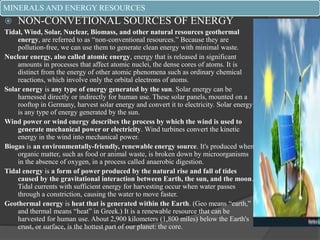
Solar energy is any type of energy generated by the sun. Solar energy can be
harnessed directly or indirectly for human use. These solar panels, mounted on a
rooftop in Germany, harvest solar energy and convert it to electricity. Solar energy
is any type of energy generated by the sun.
Wind power or wind energy describes the process by which the wind is used to
generate mechanical power or electricity. Wind turbines convert the kinetic
energy in the wind into mechanical power.
Biogas is an environmentally-friendly, renewable energy source. It's produced when
organic matter, such as food or animal waste, is broken down by microorganisms
in the absence of oxygen, in a process called anaerobic digestion.
Tidal energy is a form of power produced by the natural rise and fall of tides
caused by the gravitational interaction between Earth, the sun, and the moon.
Tidal currents with sufficient energy for harvesting occur when water passes
through a constriction, causing the water to move faster.
Geothermal energy is heat that is generated within the Earth. (Geo means “earth,”
and thermal means “heat” in Greek.) It is a renewable resource that can be
harvested for human use. About 2,900 kilometers (1,800 miles) below the Earth's
crust, or surface, is the hottest part of our planet: the core.
MINERALS AND ENERGY RESOURCES
 CONSERVATION OF ENERGY RESOURCES
 Energy conservation is the decision and practice of using less energy. Turning off
the light when you leave the room, unplugging appliances when they're not in use
and walking instead of driving are all examples of energy conservation.

Minerals and Energy Resources.pptx

  • 1.
  • 2.
    What are mineraland energy resources?  The term 'resources' is usually used in the context of natural resources which are un-exhaustible and renewable. Mineral resources, as the name suggests, are resources that come from minerals. Energy resources, on the other hand, encompass all sources of energy, both renewable and non-renewable.
  • 3.
     What isa mineral?  Minerals are substances that are formed naturally in the Earth. There are around 4000 minerals on the earth's surface. Minerals are usually solid and inorganic with a crystal structure and form naturally by geological processes. The study of minerals is called mineralogy.  origin of minerals  Minerals can be found throughout the world in the earth's crust but usually in such small amounts that they not worth extracting. Only with the help of certain geological processes are minerals concentrated into economically viable deposits.  Igneous rocks and minerals solidify from molten rock, called magma below the Earth's crust and lava when flowing above ground. These rocks and their mineral components, presented below, are the result of processes that formed Earth and other rocky planets.
  • 4.
     Igneous rocks(from the Latin word for fire) form when hot, molten rock crystallizes and solidifies. The melt originates deep within the Earth near active plate boundaries or hot spots, then rises toward the surface.  Sedimentary rocks are formed from pre-existing rocks or pieces of once- living organisms. They form from deposits that accumulate on the Earth's surface. Sedimentary rocks often have distinctive layering or bedding.  Another group of sedimentary minerals include gypsum, potash salt and sodium salt. These are formed as a result of evaporation especially in arid regions.
  • 5.
     Alluvial deposits Certain minerals may occur as alluvial deposits in sads of valley floors and the base of hills. These deposits are called placer deposits and generally contain minerals, which are nit corroded by water.  Gold, silver, tin and platinum are most important among such minerals.
  • 6.
    Minerals and Energy Resources Classification  Minerals can be classified into ferrous and nonferrous minerals.  Ferrous metals are metals that contain iron and steel. Non-ferrous metals are those metals that do not have iron or iron components.
  • 7.
    Minerals and Energy Resources Ferrous minerals  Ferrous minerals are metallic minerals containing iron.  Ferrous minerals are magnetic.  Examples: Manganese and iron.
  • 8.
    Minerals and Energy Resources Examples of ferrous minerals in detail
  • 9.
    Minerals and Energy Resources Iron ore  Iron ore is a mineral substance which, when heated in the presence of a reductant, will yield metallic iron (Fe). It almost always consists of iron oxides, the primary forms of which are magnetite (Fe3O4) and hematite (Fe2O3). Iron ore is the source of primary iron for the world's iron and steel industries.  Haematite is the main ore of iron. Its chemical name is 'Iron (III) oxide' and the formula is Fe2O3.
  • 10.
    Minerals and Energy Resources Manganese  Manganese is a trace mineral that is present in tiny amounts in the body. It is found mostly in bones, the liver, kidneys, and pancreas. Manganese helps the body form connective tissue, bones, blood clotting factors, and sex hormones.
  • 11.
    Minerals and Energy Resources Non-ferrous minerals  Non-ferrous minerals are also metallic, but they do not contain iron. Non-ferrous minerals are not magnetic. Examples: Gold, copper, zinc, etc.
  • 12.
    Minerals and Energy Resources Examples of non-ferrous minerals in detail, 
  • 13.
    Minerals and Energy Resources Copper  Copper is a mineral and an element essential to our everyday lives. It is a major industrial metal because of its high ductility, malleability, thermal and electrical conductivity and resistance to corrosion. It is an essential nutrient in our daily diet.
  • 14.
     Bauxite  Decompositonof surface rocks and the removal of soluble constituents, leaving a residual mass of weathered material containing ores.  Bauxite is formed this way.
  • 15.
    Minerals and Energy Resources ROCK MINERALS  A mineral is a naturally occurring substance with distinctive chemical and physical properties, composition and atomic structure. Rocks are generally made up of two of more minerals, mixed up through geological processes.  Common minerals include quartz, feldspar, mica, amphibole, olivine, and calcite. A rock is an aggregate of one or more minerals, or a body of undifferentiated mineral matter. Common rocks include granite, basalt, limestone, and sandstone.
  • 16.
     Conservation ofminerals  the Process of reducing the loss of minerals or preventing minerals is called conservation of minerals.  It is necessary to reduce wastage in the process of mining. Another way to conserve mineral resources is by recycling metals. Conservation of minerals can be done by the following methods: reducing wastage in the mining process. metal recycling using scrap metals.
  • 17.
     Energy resources The term energy resource refers to any material that can be used as a basis or source of energy. Energy resources are used to generate electricity and other forms of power for human use. There are two kinds of energy resources - Renewable Energy Resources and Non-Renewable Energy Resources. TYPES OF ENERGY RESOURCES  Coal  Petroleum  Natural gas  Electricity
  • 18.
    Coal is acombustible black or brownish-black sedimentary rock, formed as rock strata called coal seams. Coal is formed when dead plant matter decays into peat and is converted into coal by the heat and pressure of deep burial over millions of years. Petroleum, also known as crude oil, or simply oil, is a naturally occurring yellowish-black liquid mixture of mainly hydrocarbons,[1] and is found in geological formations. The name petroleum covers both naturally occurring unprocessed crude oil and petroleum products that consist of refined crude oil. A fossil fuel, petroleum is formed when large quantities of dead organisms, mostly zooplankton and algae, are buried underneath sedimentary rock and subjected to both prolonged heat and pressure. Natural gas (also called fossil gas or simply gas) is a naturally occurring mixture of gaseous hydrocarbons consisting primarily of methane in addition to various smaller amounts of other higher alkanes. Usually low levels of trace gases like carbon dioxide, nitrogen, hydrogen sulfide, and helium are also present. Natural gas is a fossil fuel and non-renewable resource that is formed when layers of organic matter (primarily marine microorganisms[3]) decompose under anaerobic conditions and are subjected to intense heat and pressure underground over millions of years. Electrical energy as the energy generated by the movement of electrons from one point to another. The movement of charged particles along/through a medium (say wire) constitute current or electricity.
  • 19.
    MINERALS AND ENERGYRESOURCES  NON-CONVETIONAL SOURCES OF ENERGY Tidal, Wind, Solar, Nuclear, Biomass, and other natural resources geothermal energy, are referred to as “non-conventional resources.” Because they are pollution-free, we can use them to generate clean energy with minimal waste. Nuclear energy, also called atomic energy, energy that is released in significant amounts in processes that affect atomic nuclei, the dense cores of atoms. It is distinct from the energy of other atomic phenomena such as ordinary chemical reactions, which involve only the orbital electrons of atoms. Solar energy is any type of energy generated by the sun. Solar energy can be harnessed directly or indirectly for human use. These solar panels, mounted on a rooftop in Germany, harvest solar energy and convert it to electricity. Solar energy is any type of energy generated by the sun. Wind power or wind energy describes the process by which the wind is used to generate mechanical power or electricity. Wind turbines convert the kinetic energy in the wind into mechanical power. Biogas is an environmentally-friendly, renewable energy source. It's produced when organic matter, such as food or animal waste, is broken down by microorganisms in the absence of oxygen, in a process called anaerobic digestion. Tidal energy is a form of power produced by the natural rise and fall of tides caused by the gravitational interaction between Earth, the sun, and the moon. Tidal currents with sufficient energy for harvesting occur when water passes through a constriction, causing the water to move faster. Geothermal energy is heat that is generated within the Earth. (Geo means “earth,” and thermal means “heat” in Greek.) It is a renewable resource that can be harvested for human use. About 2,900 kilometers (1,800 miles) below the Earth's crust, or surface, is the hottest part of our planet: the core.
  • 20.
    MINERALS AND ENERGYRESOURCES  CONSERVATION OF ENERGY RESOURCES  Energy conservation is the decision and practice of using less energy. Turning off the light when you leave the room, unplugging appliances when they're not in use and walking instead of driving are all examples of energy conservation.