Mind the Gap:
Optimising Impact of CPD
Dr. Jo Smedley
Associate Dean (Learning & Teaching)
Newport Business School
Impact of knowledge management
using technology
• Organisations often identify aspects of related weakness
and address them strategically
• Centrally organised knowledge management initiatives
often leave “gaps” in personalised knowledge management
– Reduces the impact of overall progress.
• Theoretical quantitative model for impact of organisational
approach in knowledge management using technology
– Provides a measure of personalised knowledge management
from organisational initiatives
Evaluating organisational learning
through technology
• Bacsich (2005) focused on benchmarking in
universities
– Oriented to benchmarking administrative processes
• UK national Benchmarking and Pathfinder
programme between 2003-2008 provided
UK Universities with a structured approach
• Involved five methodologies:-
– ELTI (Embedding Learning Technologies Institutionally)
– eMM (e-Learning Maturity Model)
– MIT90s
– OBHE/ACU
– Pick and Mix
Using eMM
• Marshall and Mitchell (2005)
– Learning
– Development
– Support
– Evaluation
– Organization
• Organisational and individual perspectives
Modelling impact
• Organisational learning
• Individual learning
OOOOOO OESDLI 
936710
9
1
3
1
6
1
7
1
10
1
 
 i
Oi
i
Oi
i
Oi
i
Oi
i
Oi
O
OESDL
I
936710
9
1
3
1
6
1
7
1
10
1
 
 i
Ii
i
Ii
i
Ii
i
Ii
i
Ii
I
OESDL
I
Applying the model:
CPD across an HE organisation
• 104 staff and 193 students
• Question categories for staff and students
– U: Aspects of usability of a learning management system by staff (4
questions) and student (3 questions) users
– T: Appropriateness of training provided to staff (1 question) and student
(1 question) users
– C: Discussion of learning through technology by staff (1 question)
– S: Use of plagiarism software by staff (1 question) and students (1
question)
Developing the impact equations
Impact Equation: Staff
Impact Equation: Students
Analysing Gaps
Impact Equations: Gaps
Usability Software
Training
Impact: Staff and students
Impact:
Usability, Software and Training
Impact across areas
Staff impact factors across areas
Student impact factors across areas
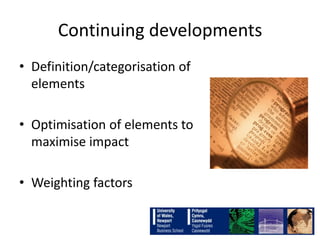
Continuing developments
• Definition/categorisation of
elements
• Optimisation of elements to
maximise impact
• Weighting factors
Questions
Email: jo.smedley@newport.ac.uk
http://wiki.newport.ac.uk/index.php?title=Jo_Smedley%27s_wiki

Mind The Gap: optimising impact of CPD

  • 1.
    Mind the Gap: OptimisingImpact of CPD Dr. Jo Smedley Associate Dean (Learning & Teaching) Newport Business School
  • 2.
    Impact of knowledgemanagement using technology • Organisations often identify aspects of related weakness and address them strategically • Centrally organised knowledge management initiatives often leave “gaps” in personalised knowledge management – Reduces the impact of overall progress. • Theoretical quantitative model for impact of organisational approach in knowledge management using technology – Provides a measure of personalised knowledge management from organisational initiatives
  • 3.
    Evaluating organisational learning throughtechnology • Bacsich (2005) focused on benchmarking in universities – Oriented to benchmarking administrative processes • UK national Benchmarking and Pathfinder programme between 2003-2008 provided UK Universities with a structured approach • Involved five methodologies:- – ELTI (Embedding Learning Technologies Institutionally) – eMM (e-Learning Maturity Model) – MIT90s – OBHE/ACU – Pick and Mix
  • 4.
    Using eMM • Marshalland Mitchell (2005) – Learning – Development – Support – Evaluation – Organization • Organisational and individual perspectives
  • 5.
    Modelling impact • Organisationallearning • Individual learning OOOOOO OESDLI  936710 9 1 3 1 6 1 7 1 10 1    i Oi i Oi i Oi i Oi i Oi O OESDL I 936710 9 1 3 1 6 1 7 1 10 1    i Ii i Ii i Ii i Ii i Ii I OESDL I
  • 6.
    Applying the model: CPDacross an HE organisation • 104 staff and 193 students • Question categories for staff and students – U: Aspects of usability of a learning management system by staff (4 questions) and student (3 questions) users – T: Appropriateness of training provided to staff (1 question) and student (1 question) users – C: Discussion of learning through technology by staff (1 question) – S: Use of plagiarism software by staff (1 question) and students (1 question)
  • 7.
    Developing the impactequations Impact Equation: Staff Impact Equation: Students
  • 8.
    Analysing Gaps Impact Equations:Gaps Usability Software Training
  • 9.
  • 10.
  • 11.
  • 12.
  • 13.
  • 14.
    Continuing developments • Definition/categorisationof elements • Optimisation of elements to maximise impact • Weighting factors
  • 15.