1
Building Bridges Through Partnership
Dr. Jo Smedley
j.k.smedley@aston.ac.uk
(jo.smedley@newport.ac.uk)
Combined Honours, Aston University, Birmingham, UK
(Newport Business School, University of Wales, Newport, Wales)
Conference participation supported by a UK Operational Research Society award
2
Overview
• Building and strengthening partnerships
• Consider:-
– Approaches
– Challenges
– Opportunities
– Reflections
• Outcomes
– Emerging “trust”
– Enhanced information sharing
– Deeper cross-organisation perspectives
– Informing future initiatives
Keywords:
Modelling Systems&Languages, International Collaboration, Knowledge Engineering&Management
3
Case Studies
• Swedish Double Degree Programme
– Halmstad University, Sweden
– Worcester University, UK
• Student work-placement programme
– Halmstad University, Sweden
– Aston University, UK
– Hogeschool Gent, Belgium
• Academy/JISC Collaboration Initiative
– Higher Education Academy, UK
– JISC, UK
4
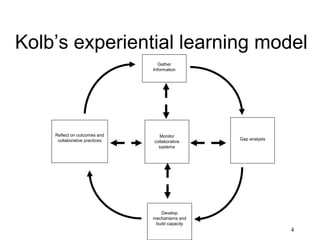
Kolb’s experiential learning model
Gap analysis
Reflect on outcomes and
collaborative practices
Monitor
collaborative
systems
Gather
Information
Develop
mechanisms and
build capacity
5
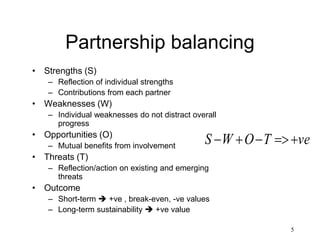
Partnership balancing
• Strengths (S)
– Reflection of individual strengths
– Contributions from each partner
• Weaknesses (W)
– Individual weaknesses do not distract overall
progress
• Opportunities (O)
– Mutual benefits from involvement
• Threats (T)
– Reflection/action on existing and emerging
threats
• Outcome
– Short-term  +ve , break-even, -ve values
– Long-term sustainability  +ve value
veTOWS 
6
Stage 1 Information
• Expectations
– Approaches
– Culture
– Pace
• Information flows
– Communication
– Applications
• “Champions”
• External influences
7
Case Study 1:
Swedish Double Degree Programme
• Stage 1: Gathering information
– Comparable institutions
• Stage 2: Gap analysis
– Worcester: Student numbers
– Halmstad: European links
• Stage 3: Developing practices
– Curriculum: Business, IT, Psychology
– Associated administrative practices
• Stage 4: Reflect on progress
– Student support
8
Case Study 2:
Student work-placement programme
• Stage 1: Gathering information
– Existing networks
– Similar sized institution bases
• Stage 2: Gap analysis
– Aston: Additional staff
– Ghent: Student placements (IT)
– Halmstad: Student placements (Business)
• Stage 3: Developing practices
– Links
– Associated administrative practices
• Stage 4: Reflect on progress
– Quantity of students
– Support available
9
Case Study 3:
Academy/JISC Collaboration
• Stage 1: Gathering information
– Existing “communities of practice”
– Managing expectations
• Stage 2: Gap analysis
– Information sharing
– Relationship balancing
• Stage 3: Developing practices
– Collaborative events/developments
• Stage 4: Reflections on progress
– Pace
– Organisational experience
10
Lessons learned
• Mutual benefits
• Managing expectations
• Information sharing
– Appropriate “language”
• Balancing

Building Partnerships Through Partnerships

  • 1.
    1 Building Bridges ThroughPartnership Dr. Jo Smedley j.k.smedley@aston.ac.uk (jo.smedley@newport.ac.uk) Combined Honours, Aston University, Birmingham, UK (Newport Business School, University of Wales, Newport, Wales) Conference participation supported by a UK Operational Research Society award
  • 2.
    2 Overview • Building andstrengthening partnerships • Consider:- – Approaches – Challenges – Opportunities – Reflections • Outcomes – Emerging “trust” – Enhanced information sharing – Deeper cross-organisation perspectives – Informing future initiatives Keywords: Modelling Systems&Languages, International Collaboration, Knowledge Engineering&Management
  • 3.
    3 Case Studies • SwedishDouble Degree Programme – Halmstad University, Sweden – Worcester University, UK • Student work-placement programme – Halmstad University, Sweden – Aston University, UK – Hogeschool Gent, Belgium • Academy/JISC Collaboration Initiative – Higher Education Academy, UK – JISC, UK
  • 4.
    4 Kolb’s experiential learningmodel Gap analysis Reflect on outcomes and collaborative practices Monitor collaborative systems Gather Information Develop mechanisms and build capacity
  • 5.
    5 Partnership balancing • Strengths(S) – Reflection of individual strengths – Contributions from each partner • Weaknesses (W) – Individual weaknesses do not distract overall progress • Opportunities (O) – Mutual benefits from involvement • Threats (T) – Reflection/action on existing and emerging threats • Outcome – Short-term  +ve , break-even, -ve values – Long-term sustainability  +ve value veTOWS 
  • 6.
    6 Stage 1 Information •Expectations – Approaches – Culture – Pace • Information flows – Communication – Applications • “Champions” • External influences
  • 7.
    7 Case Study 1: SwedishDouble Degree Programme • Stage 1: Gathering information – Comparable institutions • Stage 2: Gap analysis – Worcester: Student numbers – Halmstad: European links • Stage 3: Developing practices – Curriculum: Business, IT, Psychology – Associated administrative practices • Stage 4: Reflect on progress – Student support
  • 8.
    8 Case Study 2: Studentwork-placement programme • Stage 1: Gathering information – Existing networks – Similar sized institution bases • Stage 2: Gap analysis – Aston: Additional staff – Ghent: Student placements (IT) – Halmstad: Student placements (Business) • Stage 3: Developing practices – Links – Associated administrative practices • Stage 4: Reflect on progress – Quantity of students – Support available
  • 9.
    9 Case Study 3: Academy/JISCCollaboration • Stage 1: Gathering information – Existing “communities of practice” – Managing expectations • Stage 2: Gap analysis – Information sharing – Relationship balancing • Stage 3: Developing practices – Collaborative events/developments • Stage 4: Reflections on progress – Pace – Organisational experience
  • 10.
    10 Lessons learned • Mutualbenefits • Managing expectations • Information sharing – Appropriate “language” • Balancing