EXPLORING INNOVATIVE AND
EFFECTIVE METHODS FOR
IQA
– RESEARCH FRAMEWORK
CIES Conference, Vancouver
6-10 March 2016
MICHAELA MARTIN,
IIEP Programme Specialist
An IIEP research project
THIS PANEL
 The IIEP research project on « Exploring
innovative and effective solutions for
internal quality assurance (IQA)»
 The case of IQA at Xiamen University
 A comparative overview on the research
findings
 A commentary on the project
1. Introduction
 « Quality crisis » in higher education since
1980s
 International trend : External Quality
Assurance (EQA)
 Since 2000, EQA is a major focus of
research and capacity development at the
UNESCO/IIEP
 But without IQA, no sustainable quality
improvement
 IQA therefore is a major reform strand
 in HE worldwide
2. Variation in definition of IQA
 Internal Quality Assurance: procedures and
instruments which measure whether a higher
education institution is in line with external
standards and its own development goals in its
fields of activities (UNESCO).
 IQA refers to quality enhancement processes if
they are directly derived from measurement
procedures and instruments (ESG)
 IQA systems are an integrated whole which
together support quality policy and institutional
goals (IIEP).
3. Major Challenges
 Articulation of IQA instruments among each other
 Articulation of IQA with strategic planning,
management
 Balance between centralized and decentralized
structures
 Information systems, data management and
analytical capacities
 Human and financial resource constraints
4. Three major research
questions
 What are innovative and effective options for IQA
policy, structures, processes and instruments ?
 What are the effects of such IQA systems on
 the quality and relevance of academic programmes
(employability of graduates), and
 managerial effectiveness ?
 What internal and external factors condition the
effective functioning of IQA systems?
6. Research methodology
Case study research design
 Better understand IQA systems within
their national and institutional contexts
 Exploratory and descriptive design
 Mixed methods data collection process
to study the effects
7. IIEP’s role in the project
 IIEP set the research framework
 IIEP selected identified the universities
selected as case studies and the research
teams
 IIEP prepared the research instruments and
discussed methodology with the research
teams
 IIEP accompanied the preparation of the case
studies, organized a research validation
workshop
8. Primary Data sources
Integrated qualitative and quantitative design
 Online surveys of academic and administrative staff on
perceptions of the local IQA system, their effects and
conditioning factors
 Semi-structured interviews with key actors
 Central and middle level academic and
administrative decision-makers
 Focus group discussions
 Head of departments with selected programme
directors
 Students
9. Secondary Data sources
 Content analysis of official documents to
document effects
 EQA Reports (e.g. institutional or programme
accreditation)
 University annual reports
 University statistics
 Reports produced by IQA structure
 Triangulation of different actors’ perspectives
 Triangulation of perceptions and secondary
data sources
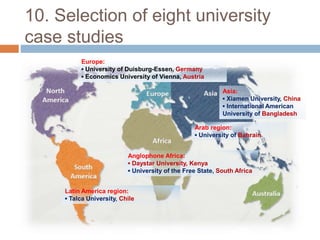
10. Selection of eight university
case studies
Europe:
▪ University of Duisburg-Essen, Germany
▪ Economics University of Vienna, Austria
Asia:
▪ Xiamen University, China
▪ International American
University of Bangladesh
Anglophone Africa:
▪ Daystar University, Kenya
▪ University of the Free State, South Africa
Latin America region:
▪ Talca University, Chile
Arab region:
▪ University of Bahrain
11. Scope and limitations
 Focus on IQA mainly in the domain of T&L and
management, not on research
 Actors’ perceptions only a proxy for change,
not impact assessment
 Case study design does not produce
generalizable results, however insights into the
effective functioning of IQA methods in specific
contexts

Exploring Innovative and Effective Methods for IQA - Research Framework

  • 1.
    EXPLORING INNOVATIVE AND EFFECTIVEMETHODS FOR IQA – RESEARCH FRAMEWORK CIES Conference, Vancouver 6-10 March 2016 MICHAELA MARTIN, IIEP Programme Specialist An IIEP research project
  • 2.
    THIS PANEL  TheIIEP research project on « Exploring innovative and effective solutions for internal quality assurance (IQA)»  The case of IQA at Xiamen University  A comparative overview on the research findings  A commentary on the project
  • 3.
    1. Introduction  «Quality crisis » in higher education since 1980s  International trend : External Quality Assurance (EQA)  Since 2000, EQA is a major focus of research and capacity development at the UNESCO/IIEP  But without IQA, no sustainable quality improvement  IQA therefore is a major reform strand  in HE worldwide
  • 4.
    2. Variation indefinition of IQA  Internal Quality Assurance: procedures and instruments which measure whether a higher education institution is in line with external standards and its own development goals in its fields of activities (UNESCO).  IQA refers to quality enhancement processes if they are directly derived from measurement procedures and instruments (ESG)  IQA systems are an integrated whole which together support quality policy and institutional goals (IIEP).
  • 5.
    3. Major Challenges Articulation of IQA instruments among each other  Articulation of IQA with strategic planning, management  Balance between centralized and decentralized structures  Information systems, data management and analytical capacities  Human and financial resource constraints
  • 6.
    4. Three majorresearch questions  What are innovative and effective options for IQA policy, structures, processes and instruments ?  What are the effects of such IQA systems on  the quality and relevance of academic programmes (employability of graduates), and  managerial effectiveness ?  What internal and external factors condition the effective functioning of IQA systems?
  • 7.
    6. Research methodology Casestudy research design  Better understand IQA systems within their national and institutional contexts  Exploratory and descriptive design  Mixed methods data collection process to study the effects
  • 8.
    7. IIEP’s rolein the project  IIEP set the research framework  IIEP selected identified the universities selected as case studies and the research teams  IIEP prepared the research instruments and discussed methodology with the research teams  IIEP accompanied the preparation of the case studies, organized a research validation workshop
  • 9.
    8. Primary Datasources Integrated qualitative and quantitative design  Online surveys of academic and administrative staff on perceptions of the local IQA system, their effects and conditioning factors  Semi-structured interviews with key actors  Central and middle level academic and administrative decision-makers  Focus group discussions  Head of departments with selected programme directors  Students
  • 10.
    9. Secondary Datasources  Content analysis of official documents to document effects  EQA Reports (e.g. institutional or programme accreditation)  University annual reports  University statistics  Reports produced by IQA structure  Triangulation of different actors’ perspectives  Triangulation of perceptions and secondary data sources
  • 11.
    10. Selection ofeight university case studies Europe: ▪ University of Duisburg-Essen, Germany ▪ Economics University of Vienna, Austria Asia: ▪ Xiamen University, China ▪ International American University of Bangladesh Anglophone Africa: ▪ Daystar University, Kenya ▪ University of the Free State, South Africa Latin America region: ▪ Talca University, Chile Arab region: ▪ University of Bahrain
  • 12.
    11. Scope andlimitations  Focus on IQA mainly in the domain of T&L and management, not on research  Actors’ perceptions only a proxy for change, not impact assessment  Case study design does not produce generalizable results, however insights into the effective functioning of IQA methods in specific contexts