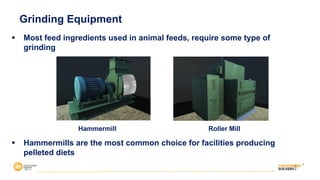
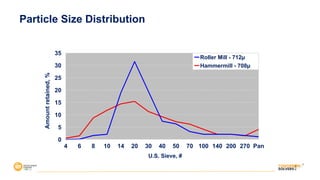
Hammermill Roller Mill
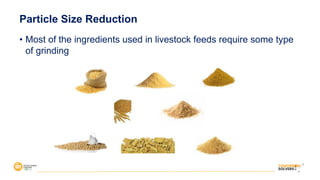
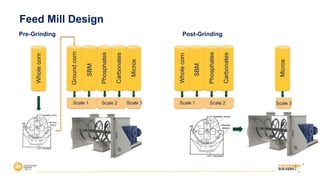
§Most feed ingredients used in animal feeds, require some type of
grinding
§ Hammermills are the most common choice for facilities producing
pelleted diets
Grinding Equipment
5.
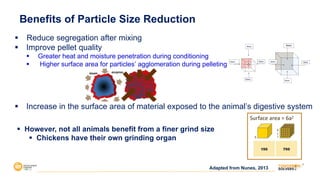
§ Reduce segregationafter mixing
§ Improve pellet quality
§ Greater heat and moisture penetration during conditioning
§ Higher surface area for particles’ agglomeration during pelleting
§ Increase in the surface area of material exposed to the animal’s digestive system
Surface area = 6a2
§ However, not all animals benefit from a finer grind size
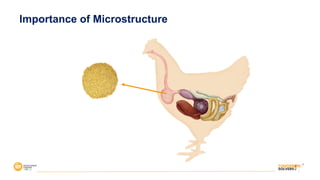
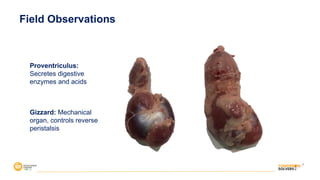
§ Chickens have their own grinding organ
Adapted from Nunes, 2013
Benefits of Particle Size Reduction
6.
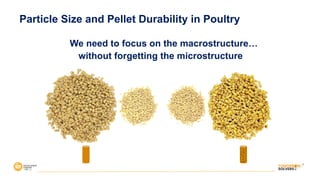
We need tofocus on the macrostructure…
without forgetting the microstructure
Particle Size and Pellet Durability in Poultry
9
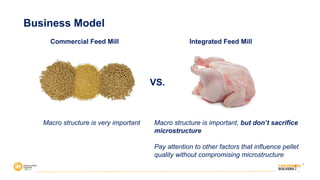
Business Model
VS.
Macro structureis very important Macro structure is important, but don’t sacrifice
microstructure
Pay attention to other factors that influence pellet
quality without compromising microstructure
Commercial Feed Mill Integrated Feed Mill
10.
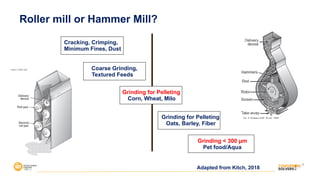
Cracking, Crimping,
Minimum Fines,Dust
Coarse Grinding,
Textured Feeds
Grinding for Pelleting
Corn, Wheat, Milo
Grinding for Pelleting
Oats, Barley, Fiber
Grinding < 300 µm
Pet food/Aqua
Adapted from Kitch, 2018
Roller mill or Hammer Mill?
11.
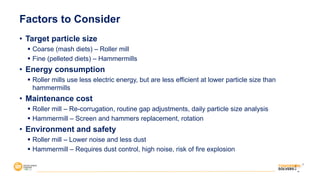
Factors to Consider
•Target particle size
§ Coarse (mash diets) – Roller mill
§ Fine (pelleted diets) – Hammermills
• Energy consumption
§ Roller mills use less electric energy, but are less efficient at lower particle size than
hammermills
• Maintenance cost
§ Roller mill – Re-corrugation, routine gap adjustments, daily particle size analysis
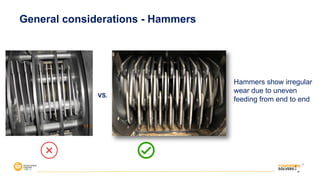
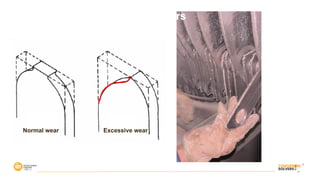
§ Hammermill – Screen and hammers replacement, rotation
• Environment and safety
§ Roller mill – Lower noise and less dust
§ Hammermill – Requires dust control, high noise, risk of fire explosion
11
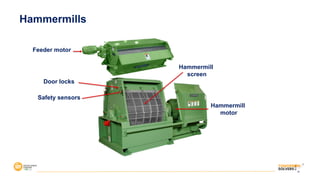
Hammermills
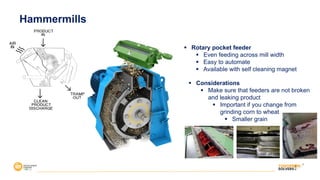
§ Rotary pocketfeeder
§ Even feeding across mill width
§ Easy to automate
§ Available with self cleaning magnet
§ Considerations
§ Make sure that feeders are not broken
and leaking product
§ Important if you change from
grinding corn to wheat
§ Smaller grain
14.
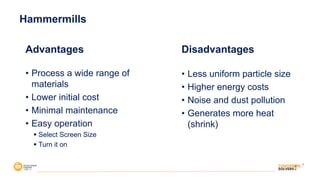
Advantages
• Process awide range of
materials
• Lower initial cost
• Minimal maintenance
• Easy operation
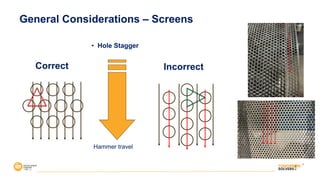
§ Select Screen Size
§ Turn it on
Disadvantages
• Less uniform particle size
• Higher energy costs
• Noise and dust pollution
• Generates more heat
(shrink)
Hammermills
15.
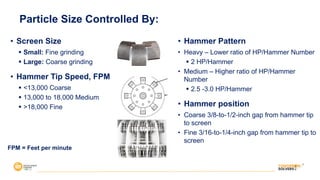
• Screen Size
§Small: Fine grinding
§ Large: Coarse grinding
• Hammer Tip Speed, FPM
§ <13,000 Coarse
§ 13,000 to 18,000 Medium
§ >18,000 Fine
Particle Size Controlled By:
• Hammer Pattern
• Heavy – Lower ratio of HP/Hammer Number
§ 2 HP/Hammer
• Medium – Higher ratio of HP/Hammer
Number
§ 2.5 -3.0 HP/Hammer
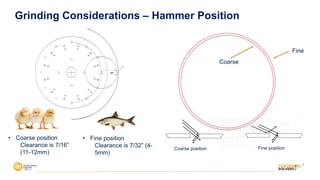
• Hammer position
• Coarse 3/8-to-1/2-inch gap from hammer tip
to screen
• Fine 3/16-to-1/4-inch gap from hammer tip to
screen
FPM = Feet per minute
16.
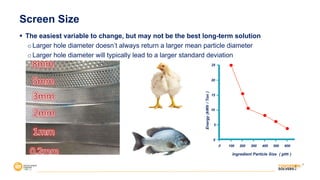
0
0
100 200 300400 500 600
Ingredient Particle Size ( µm )
5
10
15
20
25
Energy
(kWh
/
Ton
)
Screen Size
§ The easiest variable to change, but may not be the best long-term solution
o Larger hole diameter doesn’t always return a larger mean particle diameter
o Larger hole diameter will typically lead to a larger standard deviation
17.
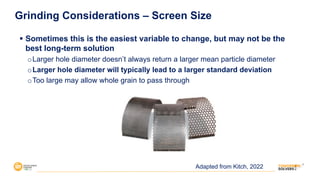
§ Sometimes thisis the easiest variable to change, but may not be the
best long-term solution
oLarger hole diameter doesn’t always return a larger mean particle diameter
oLarger hole diameter will typically lead to a larger standard deviation
oToo large may allow whole grain to pass through
*
Adapted from Kitch, 2022
Grinding Considerations – Screen Size
18.
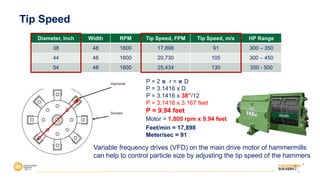
P = 2� r = � D
P = 3.1416 x D
P = 3.1416 x 38”/12
P = 3.1416 x 3.167 feet
P = 9.94 feet
Diameter, Inch Width RPM Tip Speed, FPM Tip Speed, m/s HP Range
38 48 1800 17,898 91 300 – 350
44 48 1800 20,730 105 300 – 450
54 48 1800 25,434 130 350 - 500
18
Motor = 1,800 rpm x 9.94 feet
Feet/min = 17,898
Meter/sec = 91
Hammer
Screen
Width
Variable frequency drives (VFD) on the main drive motor of hammermills
can help to control particle size by adjusting the tip speed of the hammers
Tip Speed
19.
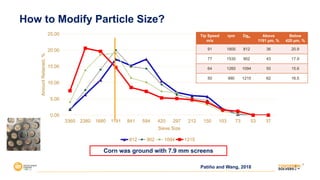
Patiño and Wang,2018 19
0.00
5.00
10.00
15.00
20.00
25.00
3360 2380 1680 1191 841 594 420 297 212 150 103 73 53 37
Amount
Retained,
%
Sieve Size
812 902 1094 1215
Tip Speed
m/s
rpm Dgw Above
1191 µm, %
Below
420 µm, %
91 1800 812 36 20.9
77 1530 902 43 17.9
64 1260 1094 55 15.6
50 990 1215 62 16.5
Corn was ground with 7.9 mm screens
How to Modify Particle Size?
20.
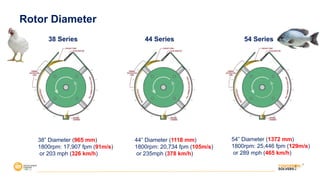
38” Diameter (965mm)
1800rpm: 17,907 fpm (91m/s)
or 203 mph (326 km/h)
44” Diameter (1118 mm)
1800rpm: 20,734 fpm (105m/s)
or 235mph (378 km/h)
54” Diameter (1372 mm)
1800rpm: 25,446 fpm (129m/s)
or 289 mph (465 km/h)
38 Series 44 Series 54 Series
Rotor Diameter
21.
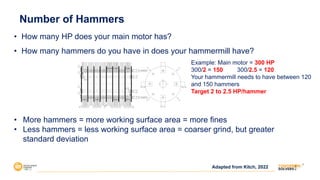
• How manyHP does your main motor has?
• How many hammers do you have in does your hammermill have?
• More hammers = more working surface area = more fines
• Less hammers = less working surface area = coarser grind, but greater
standard deviation
Example: Main motor = 300 HP
300/2 = 150 300/2.5 = 120
Your hammermill needs to have between 120
and 150 hammers
Target 2 to 2.5 HP/hammer
Adapted from Kitch, 2022
Number of Hammers
22.
Grinding Considerations –Hammer Position
• Coarse position
Clearance is 7/16”
(11-12mm)
• Fine position
Clearance is 7/32” (4-
5mm)
Coarse
Fine
Coarse position Fine position
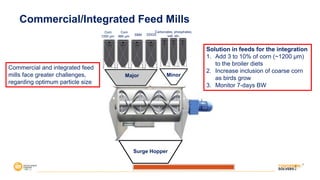
Major Minor
Surge Hopper
Corn
880µm SBM DDGS
Carbonates, phosphates,
salt, etc.
Corn
1200 µm
Solution in feeds for the integration
1. Add 3 to 10% of corn (~1200 µm)
to the broiler diets
2. Increase inclusion of coarse corn
as birds grow
3. Monitor 7-days BW
Commercial and integrated feed
mills face greater challenges,
regarding optimum particle size
Commercial/Integrated Feed Mills
28.
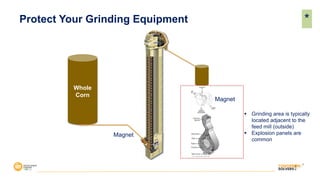
Whole
Corn
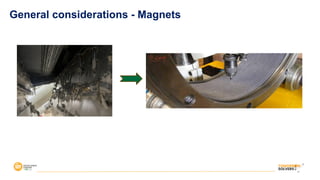
Protect Your GrindingEquipment
Magnet
Magnet
§ Grinding area is typically
located adjacent to the
feed mill (outside)
§ Explosion panels are
common
*
29.
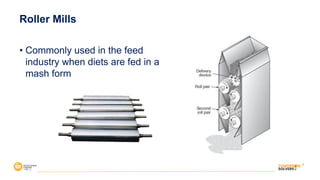
• Commonly usedin the feed
industry when diets are fed in a
mash form
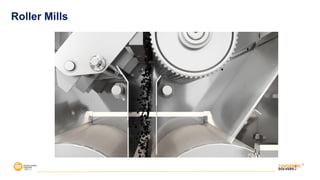
Roller Mills
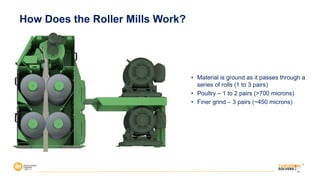
• Material isground as it passes through a
series of rolls (1 to 3 pairs)
• Poultry – 1 to 2 pairs (>700 microns)
• Finer grind – 3 pairs (~450 microns)
31
How Does the Roller Mills Work?
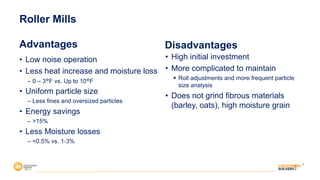
Advantages
• Low noiseoperation
• Less heat increase and moisture loss
– 0 – 3°F vs. Up to 10°F
• Uniform particle size
– Less fines and oversized particles
• Energy savings
– >15%
• Less Moisture losses
– <0.5% vs. 1-3%
Disadvantages
• High initial investment
• More complicated to maintain
§ Roll adjustments and more frequent particle
size analysis
• Does not grind fibrous materials
(barley, oats), high moisture grain
Roller Mills
34.
34
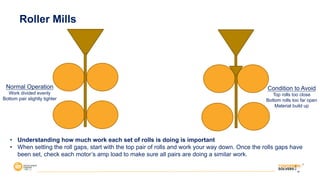
Roller Mills
Normal Operation
Workdivided evenly
Bottom pair slightly tighter
Condition to Avoid
Top rolls too close
Bottom rolls too far open
Material build up
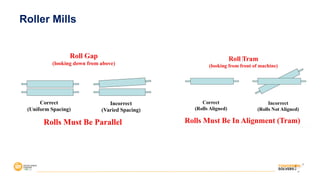
• Understanding how much work each set of rolls is doing is important
• When setting the roll gaps, start with the top pair of rolls and work your way down. Once the rolls gaps have
been set, check each motor’s amp load to make sure all pairs are doing a similar work.
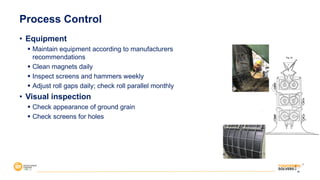
Process Control
• Equipment
§Maintain equipment according to manufacturers
recommendations
§ Clean magnets daily
§ Inspect screens and hammers weekly
§ Adjust roll gaps daily; check roll parallel monthly
• Visual inspection
§ Check appearance of ground grain
§ Check screens for holes
36
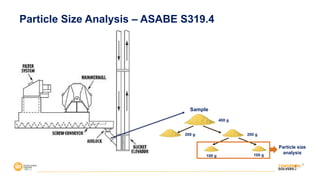
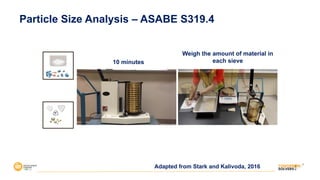
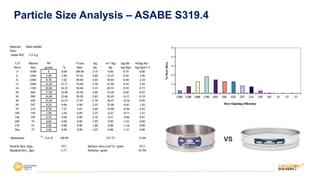
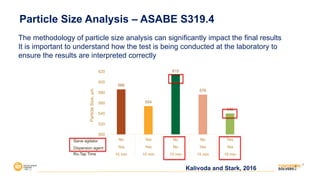
Particle Size Analysis– ASABE S319.4
The methodology of particle size analysis can significantly impact the final results
It is important to understand how the test is being conducted at the laboratory to
ensure the results are interpreted correctly
586
554
615
576
540
500
520
540
560
580
600
620
No Yes No No Yes
Yes Yes No Yes Yes
10 min 10 min 15 min 15 min 15 min
Particle
Size,
µm
Kalivoda and Stark, 2016
Sieve agitator
Dispersion agent
Ro-Tap Time
42.
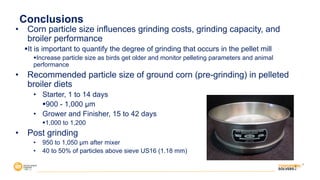
• Corn particlesize influences grinding costs, grinding capacity, and
broiler performance
§It is important to quantify the degree of grinding that occurs in the pellet mill
§Increase particle size as birds get older and monitor pelleting parameters and animal
performance
• Recommended particle size of ground corn (pre-grinding) in pelleted
broiler diets
• Starter, 1 to 14 days
§900 - 1,000 µm
• Grower and Finisher, 15 to 42 days
§1,000 to 1,200
• Post grinding
• 950 to 1,050 µm after mixer
• 40 to 50% of particles above sieve US16 (1.18 mm)
Conclusions
43.
Thank You!
Wilmer JavierPacheco, MSc., PhD.
Extension Specialist and Associate Professor
Auburn University
wjp0010@auburn.edu