ELEMENTS OF MECHANICAL 
ENGINEERING 
HOW STUFF WORKS 
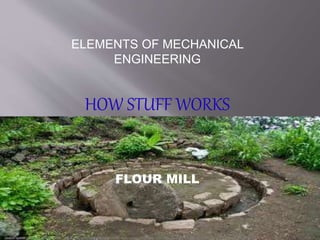
FLOUR MILL
 Flour mills are the among the most 
traditional unit. 
 Flour mill is a unit operation designed to 
break a solid material into smaller pieces. 
 Grinding of solid matter occurs under the expose 
of mechanical forces that trench the structures by 
overcoming of interior bonding forces .
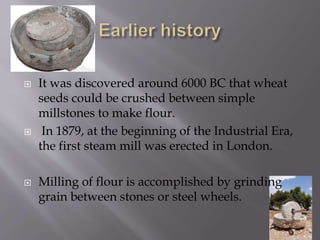
 It was discovered around 6000 BC that wheat 
seeds could be crushed between simple 
millstones to make flour. 
 In 1879, at the beginning of the Industrial Era, 
the first steam mill was erected in London. 
 Milling of flour is accomplished by grinding 
grain between stones or steel wheels.
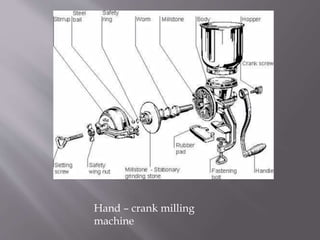
Hand – crank milling 
machine
Raw material (eg.wheat) 
Grinding 
collector 
Modern flour milling 
machine 
belt
 Raw material which is used in flour milling has 
to undergo number of processes like: 
1. To store a reserve of wheat. 
2. To remove all the impurities from the wheat 
and prepare it for milling. 
3. To mill the wheat and separate flour from the 
bran and skins of the wheat (MILLING) 
4. To store the milled products before dispatch
 "stone-ground ” usually means that the grain has 
been ground in a mill in which a revolving stone 
wheel turns over a stationary stone wheel, vertically 
or horizontally with the grain in between. 
 Many small appliance mills are available, both hand-cranked 
and electric. The mill stones frequently rub 
against each other resulting in small stone particles 
chipping off and getting into flour, but they are 
removed before the flour is solid
• Modern flour mills are very highly automated and 
all parts of the process are easily adapted to 
computer control. 
•In general, grinding processes require a relatively 
large amount of energy 
•Flour milling parts contains cotton sifter pads, 
nylon filter mesh, elevator bucket, acrylic tube, 
sieve cleaner, etc.
• Raw material is fed at the top of the machine. It as to 
pass through 3 floors slowly A grinding mill is a unit 
operation designed to break a solid material into smaller 
pieces. 
• There are many different types of grinding mills and 
many types of materials processed in them. 
• Historically mills were powered by hand (mortar and 
pestle), working animal (horse mill), wind (windmill) or 
water (watermill). 
• Today they are also powered by electricity.
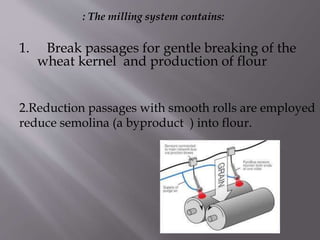
: The milling system contains: 
1. Break passages for gentle breaking of the 
wheat kernel and production of flour 
2.Reduction passages with smooth rolls are employed 
reduce semolina (a byproduct ) into flour.
:Taking example of wheat
3. separation of fine flour particles from the 
conveying air. 
4.Flour milling machine grinding, cutting uniform, 
broken less, low temperature, final product is 
bright and clean, high wheat yield that is gradually 
widely used.
Presented by, 
Madhwanand ,Vedavyas 
Thank you

Flour mill

  • 1.
    ELEMENTS OF MECHANICAL ENGINEERING HOW STUFF WORKS FLOUR MILL
  • 2.
     Flour millsare the among the most traditional unit.  Flour mill is a unit operation designed to break a solid material into smaller pieces.  Grinding of solid matter occurs under the expose of mechanical forces that trench the structures by overcoming of interior bonding forces .
  • 3.
     It wasdiscovered around 6000 BC that wheat seeds could be crushed between simple millstones to make flour.  In 1879, at the beginning of the Industrial Era, the first steam mill was erected in London.  Milling of flour is accomplished by grinding grain between stones or steel wheels.
  • 4.
    Hand – crankmilling machine
  • 5.
    Raw material (eg.wheat) Grinding collector Modern flour milling machine belt
  • 6.
     Raw materialwhich is used in flour milling has to undergo number of processes like: 1. To store a reserve of wheat. 2. To remove all the impurities from the wheat and prepare it for milling. 3. To mill the wheat and separate flour from the bran and skins of the wheat (MILLING) 4. To store the milled products before dispatch
  • 7.
     "stone-ground ”usually means that the grain has been ground in a mill in which a revolving stone wheel turns over a stationary stone wheel, vertically or horizontally with the grain in between.  Many small appliance mills are available, both hand-cranked and electric. The mill stones frequently rub against each other resulting in small stone particles chipping off and getting into flour, but they are removed before the flour is solid
  • 8.
    • Modern flourmills are very highly automated and all parts of the process are easily adapted to computer control. •In general, grinding processes require a relatively large amount of energy •Flour milling parts contains cotton sifter pads, nylon filter mesh, elevator bucket, acrylic tube, sieve cleaner, etc.
  • 9.
    • Raw materialis fed at the top of the machine. It as to pass through 3 floors slowly A grinding mill is a unit operation designed to break a solid material into smaller pieces. • There are many different types of grinding mills and many types of materials processed in them. • Historically mills were powered by hand (mortar and pestle), working animal (horse mill), wind (windmill) or water (watermill). • Today they are also powered by electricity.
  • 10.
    : The millingsystem contains: 1. Break passages for gentle breaking of the wheat kernel and production of flour 2.Reduction passages with smooth rolls are employed reduce semolina (a byproduct ) into flour.
  • 11.
  • 12.
    3. separation offine flour particles from the conveying air. 4.Flour milling machine grinding, cutting uniform, broken less, low temperature, final product is bright and clean, high wheat yield that is gradually widely used.
  • 13.
    Presented by, Madhwanand,Vedavyas Thank you