MILLENNIUM DEVELOPMENT GOAL
•• The Millennium Development Goals were the eight international development goals for
the year 2015 that had been established following the Millennium Summit of the United
Nations in 2000, following the adoption of the United Nations Millennium Declaration.
3.
GOAL:-
• • TheMDGs were developed out of several commitments set forth in the Millennium
Declaration, signed in September 2000.There are eight goals with 21 targets, and a series
of measurable health indicators and economic indicators for each target.
4.
8 GOAL OFMDG
To eradicate extreme poverty and hunger
To achieve universal primary education
To promote gender equality and empower women
To reduce child mortality
To improve maternal health
To combat HIV/AIDS, malaria, and other diseases
To ensure environmental sustainability
• To develop a global partnership for development
5.
GOAL 1: ERADICATEEXTRE POVERTY AND HUNER
1.Target 1A: Halve, between 1990 and 2015, the proportion of people living on less than $1.25 a
day
Poverty gap ratio [incidence x depth of poverty] Share of poorest quintile in national
consumption
2.Target 1B:Achieve Decent Employment forWomen, Men, andYoung People
GDP Growth per Employed Person
Proportion of employed population below $1.25 per day (PPP values)
Employment Rate
Proportion of family-based workers in employed population
3.Target 1C: Halve, between 1990 and 2015, the proportion of people who suffer from hunger
. Prevalence of underweight children under five years of age
Proportion of population below minimum level of dietary energy consumption
6.
GOAL 2 ACHIEVEUNIVERSAL PRIMARY EDUCATION
• Target 2A: By 2015, all children can complete a full course of primary schooling, girls and
boysEnrollment in primary education
Completion of primary education
7.
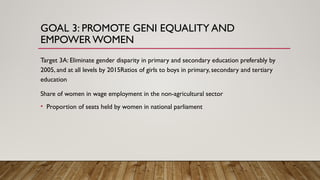
GOAL 3: PROMOTEGENI EQUALITY AND
EMPOWER WOMEN
Target 3A: Eliminate gender disparity in primary and secondary education preferably by
2005, and at all levels by 2015Ratios of girls to boys in primary, secondary and tertiary
education
Share of women in wage employment in the non-agricultural sector
• Proportion of seats held by women in national parliament
8.
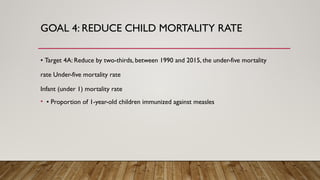
GOAL 4: REDUCECHILD MORTALITY RATE
• Target 4A: Reduce by two-thirds, between 1990 and 2015, the under-five mortality
rate Under-five mortality rate
Infant (under 1) mortality rate
• • Proportion of 1-year-old children immunized against measles
9.
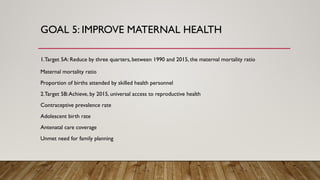
GOAL 5: IMPROVEMATERNAL HEALTH
1.Target 5A: Reduce by three quarters, between 1990 and 2015, the maternal mortality ratio
Maternal mortality ratio
Proportion of births attended by skilled health personnel
2.Target 5B:Achieve, by 2015, universal access to reproductive health
Contraceptive prevalence rate
Adolescent birth rate
Antenatal care coverage
Unmet need for family planning
10.
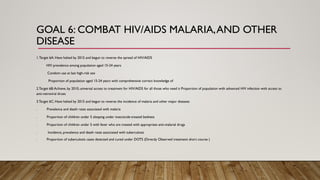
GOAL 6: COMBATHIV/AIDS MALARIA,AND OTHER
DISEASE
1.Target 6A: Have halted by 2015 and begun to reverse the spread of HIV/AIDS
HIV prevalence among population aged 15-24 years
Condom use at last high-risk sex
Proportion of population aged 15-24 years with comprehensive correct knowledge of
2.Target 6B:Achieve, by 2010, universal access to treatment for HIV/AIDS for all those who need it Proportion of population with advanced HIV infection with access to
anti-retroviral drues
3.Target 6C: Have halted by 2015 and begun to reverse the incidence of malaria and other major diseases
. Prevalence and death rates associated with malaria
. Proportion of children under 5 sleeping under insecticide-treated bednets
. Proportion of children under 5 with fever who are treated with appropriate anti-malarial drugs
. Incidence, prevalence and death rates associated with tuberculosis
. Proportion of tuberculosis cases detected and cured under DOTS (Directly Observed treatment short course )
11.
GOAL 7: ENSUREENVIRONMENT SUSTAINABILITY
口
Target 7A: Integrate the principles of sustainable development into country policies and programs; reverse loss of environmental resources
Target 78: Reduce biodiversity loss, achieving, by 2010, a significant reduction in the rate of loss Proportion of land area covered by forest
CO. emissions, total, per capita and per $1 GDP (PPP)
Consumption of ozone-depleting substances Proportion of fish stocks within safe biological limits
Proportion of total water resources used
Proportion of terrestrial and marine areas protected Proportion of species threatened with extinction
Target 7C: Halve, by 2015, the proportion of the population without sustainable access to safe drinking water and basic sanitation
Proportion of population with sustainable access to an improved water source, urban and rural Proportion of urban population with access to
improved sanitation
• Target 7D: By 2020, to have achieved a significant improvement in the lives of at least 100 million slum-dwellers Proportion of urban population
living in suma
12.
GOAL 8: DEVELOPA GLOBAL PARTNERSHIP FOR
DEVELOPMENT
Millennium development goal 8 has 6 targets that seek to develop global A GLOBAL PARTNERSHIP FOR DEVELOPMENT
partnership for development, namely:
• To further develop an open, predictable, rule-based, non- discriminatory trading and economic system
• To address the special needs of the least developed countries
• To address the special needs of small island developing Statesand landlocked developing countries
• To deal exhaustively with the debt problems of developing nations
• To provide access to affordable essential drugs in the developing world – in collaboration with pharmaceutical companies.
• To avail benefits of new technologies, especially information and communications, in collaboration with the private sector

![GOAL 1: ERADICATE EXTRE POVERTY AND HUNER
1.Target 1A: Halve, between 1990 and 2015, the proportion of people living on less than $1.25 a
day
Poverty gap ratio [incidence x depth of poverty] Share of poorest quintile in national
consumption
2.Target 1B:Achieve Decent Employment forWomen, Men, andYoung People
GDP Growth per Employed Person
Proportion of employed population below $1.25 per day (PPP values)
Employment Rate
Proportion of family-based workers in employed population
3.Target 1C: Halve, between 1990 and 2015, the proportion of people who suffer from hunger
. Prevalence of underweight children under five years of age
Proportion of population below minimum level of dietary energy consumption](https://image.slidesharecdn.com/presentation1-250928173414-871f46e1/85/Presentation-1-pptx-bbbbbbbbbbbbbbbbbbbb-5-320.jpg)