8 MILLENNIUM DEVELOPMENT GOALS
JUSTINE ROSE L. FERRER
10 – JOULE
PRESENTED TO : SIR. JANER
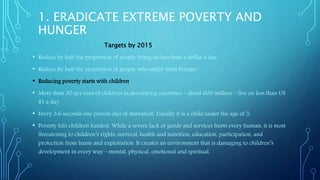
1. ERADICATE EXTREME POVERTY AND
HUNGER
Targets by 2015:
• Reduce by half the proportion of people living on less than a dollar a day.
• Reduce by half the proportion of people who suffer from hunger.
• Reducing poverty starts with children.
• More than 30 per cent of children in developing countries – about 600 million – live on less than US
$1 a day.
• Every 3.6 seconds one person dies of starvation. Usually it is a child under the age of 5.
• Poverty hits children hardest. While a severe lack of goods and services hurts every human, it is most
threatening to children’s rights: survival, health and nutrition, education, participation, and
protection from harm and exploitation. It creates an environment that is damaging to children’s
development in every way – mental, physical, emotional and spiritual.
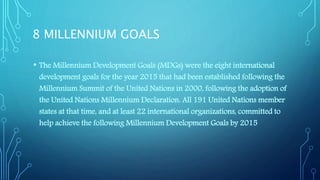
8 MILLENNIUM GOALS
• The Millennium Development Goals (MDGs) were the eight international
development goals for the year 2015 that had been established following the
Millennium Summit of the United Nations in 2000, following the adoption of
the United Nations Millennium Declaration. All 191 United Nations member
states at that time, and at least 22 international organizations, committed to
help achieve the following Millennium Development Goals by 2015
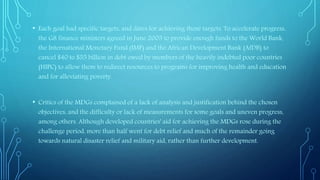
• Each goal had specific targets, and dates for achieving those targets. To accelerate progress,
the G8 finance ministers agreed in June 2005 to provide enough funds to the World Bank,
the International Monetary Fund (IMF) and the African Development Bank (AfDB) to
cancel $40 to $55 billion in debt owed by members of the heavily indebted poor countries
(HIPC) to allow them to redirect resources to programs for improving health and education
and for alleviating poverty.
• Critics of the MDGs complained of a lack of analysis and justification behind the chosen
objectives, and the difficulty or lack of measurements for some goals and uneven progress,
among others. Although developed countries' aid for achieving the MDGs rose during the
challenge period, more than half went for debt relief and much of the remainder going
towards natural disaster relief and military aid, rather than further development.
8 MILLENNIUM DEVELOPMENT GOALS
• To eradicate extreme poverty and hunger
• To achieve universal primary education
• To promote gender equality and empower women
• To reduce child mortality
• To improve maternal health
• To combat HIV/AIDS, malaria, and other diseases
• To ensure environmental sustainability[1]
• To develop a global partnership for development[2]
2. ACHIEVE UNIVERSAL PRIMARY
EDUCATION
• Target by 2015:
• Ensure that all boys and girls complete a full course of primary schooling.
• As of 2001 estimates around 115 million children of primary school age, the majority of them
girls, do not attend school.
• Educating girls advances development for all.
• Meeting the Education Goal will speed progress toward every other Millennium Goal. Educating
children helps reduce poverty and promote gender equality. It helps lower child mortality rates
and promote concern for the environment. It is inextricably linked to Goal 3 – gender parity – as
universal primary education by definition requires gender parity. Gender parity in primary
education, meanwhile, is of limited worth if few children of either sex participate.
• Further, education – specifically free primary school for all children – is a fundamental right to
which governments committed themselves under the 1989 Convention of the Rights of the Child.
3. PROMOTE GENDER EQUALITY AND EMPOWER
WOMEN
• Advancing the rights of women and children advances humanity.
• Two-thirds of the world’s 799 million illiterate adults ages 15 and over are women.
• Many children in developing countries start life without adequate means of nutrition, learning, and
protection. Women and girls are particularly challenged.
• Some 67 countries have primary school attendance and enrolment rates for girls less than 85 per
cent. Globally, there are just 96 girls for every 100 boys in primary school, with disparities at the
secondary level even more acute. Yet uneducated girls are more at risk than boys to become
marginalized. They are more vulnerable to exploitation. They are more likely than educated girls to
contract HIV/AIDS, which spreads twice as quickly among uneducated girls than among girls that
have even some schooling. Nearly a third of all adults living with HIV/AIDS are under the age of 25,
and almost two thirds of these people are women.
4. REDUCE CHILD MORTALITY
• About 29,000 children under the age of five – 21 each minute – die every day, mainly from preventable causes.
• More than 70 per cent of almost 11 million child deaths every year are attributable to six causes: diarrhoea,
malaria, neonatal infection, pneumonia, preterm delivery, or lack of oxygen at birth.
• These deaths occur mainly in the developing world. An Ethiopian child is 30 times more likely to die by his or her
fifth birthday than a child in Western Europe. Among deaths in children, South-central Asia has the highest
number of neonatal deaths, while sub-Saharan Africa has the highest rates. Two-thirds of deaths occur in just 10
countries.
• And the majority are preventable. Some of the deaths occur from illnesses like measles, malaria or tetanus. Others
result indirectly from marginalization, conflict and HIV/AIDS. Malnutrition and the lack of safe water and
sanitation contribute to half of all these children’s deaths.
• But disease isn’t inevitable, nor do children with these diseases need to die. Research and experience show that six
million of the almost 11 million children who die each year could be saved by low-tech, evidence-based, cost-
effective measures such as vaccines, antibiotics, micronutrient supplementation, insecticide-treated bed nets and
improved family care and breastfeeding practices.
5. IMPROVE MATERNAL HEALTH
• Healthy children need healthy mothers.
• A woman dies from complications in childbirth every minute – about 529,000 each year -- the vast majority of them in
developing countries.
• A woman in sub-Saharan Africa has a 1 in 16 chance of dying in pregnancy or childbirth, compared to a 1 in 4,000 risk in a
developing country – the largest difference between poor and rich countries of any health indicator.
• This glaring disparity is reflected in a number of global declarations and resolutions. In September 2001, 147 heads of states
collectively endorsed Millennium Development Goals 4 and 5: To reduce child mortality rate by 2/3 and maternal mortality ratio
by 3/4 between 1990 and 2015. Strongly linked to these is Goal 6: To halt or begin to reverse the spread of HIV/AIDS, malaria and
other diseases.
• The direct causes of maternal deaths are haemorrhage, infection, obstructed labour, hypertensive disorders in pregnancy, and
complications of unsafe abortion. There are birth-related disabilities that affect many more women and go untreated like injuries
to pelvic muscles, organs or the spinal cord. At least 20% of the burden of disease in children below the age of 5 is related to poor
maternal health and nutrition, as well as quality of care at delivery and during the newborn period. And yearly 8 million babies
die before or during delivery or in the first week of life. Further, many children are tragically left motherless each year. These
children are 10 times more likely to die within two years of their mothers' death.
6. COMBAT HIV/AIDS, MALARIA AND OTHER
DISEASES
• Millions of children are dying needlessly.
• Malaria kills a child somewhere in the world every 30 seconds.
• Disease is a cruelly potent child killer, especially when combined with the poverty in which much of the
developing world lives. In the absence of good nutrition, sanitation and health care, HIV/AIDS, malaria, measles,
polio and tuberculosis mean certain end to millions of children who would survive and flourish elsewhere.
• AIDS alone has taken more than 20 million lives and may take millions more if trends continue. Roughly 500,000
children younger than 15 years died of the disease last year alone, and children accounted for 13 percent of new
infections in 2004 (640,000 cases). And mothers and pregnant women are ill; as of November 2004, women
accounted for nearly 50 per cent of the more than 37 million people living with HIV worldwide and for 60 per
cent in sub-Saharan Africa.
• The pandemic hits all sectors of society in a cycle of illness and wasted lives; ill parents are unable to work and
support the family, children drop out of school to help, orphans fall prey to violence, disease and, perhaps later,
HIV/AIDS; a poverty-stricken country is even less able to support its citizens.
7. ENSURE ENVIRONMENTAL
SUSTAINABILITY
• Safe water and sanitation are critical for survival.
• A child dies every 15 seconds from disease attributable to unsafe drinking water,
deplorable sanitation and poor hygiene.
• As of 2002, one in six people worldwide – 1.1 billion total – had no access to clean
water. About 400 million of these are children. Four of ten people worldwide don't
have access to even a simple latrine. And more than 614 million children have to live
in dwellings with more than five people per room or that have mud flooring.
• In sub-Saharan Africa in countries such as Ethiopia, Rwanda and Uganda, four out of
five children either use surface water or have to walk more than 15 minutes to find a
protected water source.
• This urgent unmet need is the basis for other problems. Unclean water spreads
diseases such as cholera and infant diarrhoea, which kill five million people per year,
mainly children. More than half of Africans suffer from such water-related diseases.
And poor health harms children’s learning potential. For example, 400 million
school-aged children a year are infected by intestinal worms that sap their cognitive
abilities.
8. DEVELOP A GLOBAL PARTNERSHIP FOR
DEVELOPMENT
• Develop further an open trading and financial system that includes a commitment to good governance, development and poverty
reduction — nationally and internationally.
• Address the least developed countries’ special needs, and the special needs of landlocked and small island developing states.
• Deal comprehensively with developing countries’ debt problems.
• Develop decent and productive work for youth.
• In cooperation with pharmaceutical companies, provide access to affordable essential drugs in developing countries.
• In cooperation with the private sector, make available the benefits of new technologies — especially information and
communications technologies.
• Non-governmental and private sector organizations contributed 31 per cent of UNICEF’s income in 2003, more than $515 million
dollars.
• UNICEF is uniquely positioned to generate knowledge about the situation of children’s and women’s rights, and to advocate and
promote partnerships for their fulfilment.
• A founding member of the United Nations Development Group, UNICEF has since its origins collaborated with other UN agencies,
global health initiatives, governments, donor agencies, humanitarian and non-profit groups, media networks, universities, faith-
based groups, communities and children themselves, coordinating a global effort to advance young people’s rights. UNICEF also
created The Office of Public Partnerships in 2003 to build new global relationships and fully utilize alliances.

8 millennium development goals

  • 1.
    8 MILLENNIUM DEVELOPMENTGOALS JUSTINE ROSE L. FERRER 10 – JOULE PRESENTED TO : SIR. JANER
  • 2.
    1. ERADICATE EXTREMEPOVERTY AND HUNGER Targets by 2015: • Reduce by half the proportion of people living on less than a dollar a day. • Reduce by half the proportion of people who suffer from hunger. • Reducing poverty starts with children. • More than 30 per cent of children in developing countries – about 600 million – live on less than US $1 a day. • Every 3.6 seconds one person dies of starvation. Usually it is a child under the age of 5. • Poverty hits children hardest. While a severe lack of goods and services hurts every human, it is most threatening to children’s rights: survival, health and nutrition, education, participation, and protection from harm and exploitation. It creates an environment that is damaging to children’s development in every way – mental, physical, emotional and spiritual.
  • 3.
    8 MILLENNIUM GOALS •The Millennium Development Goals (MDGs) were the eight international development goals for the year 2015 that had been established following the Millennium Summit of the United Nations in 2000, following the adoption of the United Nations Millennium Declaration. All 191 United Nations member states at that time, and at least 22 international organizations, committed to help achieve the following Millennium Development Goals by 2015
  • 4.
    • Each goalhad specific targets, and dates for achieving those targets. To accelerate progress, the G8 finance ministers agreed in June 2005 to provide enough funds to the World Bank, the International Monetary Fund (IMF) and the African Development Bank (AfDB) to cancel $40 to $55 billion in debt owed by members of the heavily indebted poor countries (HIPC) to allow them to redirect resources to programs for improving health and education and for alleviating poverty. • Critics of the MDGs complained of a lack of analysis and justification behind the chosen objectives, and the difficulty or lack of measurements for some goals and uneven progress, among others. Although developed countries' aid for achieving the MDGs rose during the challenge period, more than half went for debt relief and much of the remainder going towards natural disaster relief and military aid, rather than further development.
  • 5.
    8 MILLENNIUM DEVELOPMENTGOALS • To eradicate extreme poverty and hunger • To achieve universal primary education • To promote gender equality and empower women • To reduce child mortality • To improve maternal health • To combat HIV/AIDS, malaria, and other diseases • To ensure environmental sustainability[1] • To develop a global partnership for development[2]
  • 6.
    2. ACHIEVE UNIVERSALPRIMARY EDUCATION • Target by 2015: • Ensure that all boys and girls complete a full course of primary schooling. • As of 2001 estimates around 115 million children of primary school age, the majority of them girls, do not attend school. • Educating girls advances development for all. • Meeting the Education Goal will speed progress toward every other Millennium Goal. Educating children helps reduce poverty and promote gender equality. It helps lower child mortality rates and promote concern for the environment. It is inextricably linked to Goal 3 – gender parity – as universal primary education by definition requires gender parity. Gender parity in primary education, meanwhile, is of limited worth if few children of either sex participate. • Further, education – specifically free primary school for all children – is a fundamental right to which governments committed themselves under the 1989 Convention of the Rights of the Child.
  • 7.
    3. PROMOTE GENDEREQUALITY AND EMPOWER WOMEN • Advancing the rights of women and children advances humanity. • Two-thirds of the world’s 799 million illiterate adults ages 15 and over are women. • Many children in developing countries start life without adequate means of nutrition, learning, and protection. Women and girls are particularly challenged. • Some 67 countries have primary school attendance and enrolment rates for girls less than 85 per cent. Globally, there are just 96 girls for every 100 boys in primary school, with disparities at the secondary level even more acute. Yet uneducated girls are more at risk than boys to become marginalized. They are more vulnerable to exploitation. They are more likely than educated girls to contract HIV/AIDS, which spreads twice as quickly among uneducated girls than among girls that have even some schooling. Nearly a third of all adults living with HIV/AIDS are under the age of 25, and almost two thirds of these people are women.
  • 8.
    4. REDUCE CHILDMORTALITY • About 29,000 children under the age of five – 21 each minute – die every day, mainly from preventable causes. • More than 70 per cent of almost 11 million child deaths every year are attributable to six causes: diarrhoea, malaria, neonatal infection, pneumonia, preterm delivery, or lack of oxygen at birth. • These deaths occur mainly in the developing world. An Ethiopian child is 30 times more likely to die by his or her fifth birthday than a child in Western Europe. Among deaths in children, South-central Asia has the highest number of neonatal deaths, while sub-Saharan Africa has the highest rates. Two-thirds of deaths occur in just 10 countries. • And the majority are preventable. Some of the deaths occur from illnesses like measles, malaria or tetanus. Others result indirectly from marginalization, conflict and HIV/AIDS. Malnutrition and the lack of safe water and sanitation contribute to half of all these children’s deaths. • But disease isn’t inevitable, nor do children with these diseases need to die. Research and experience show that six million of the almost 11 million children who die each year could be saved by low-tech, evidence-based, cost- effective measures such as vaccines, antibiotics, micronutrient supplementation, insecticide-treated bed nets and improved family care and breastfeeding practices.
  • 9.
    5. IMPROVE MATERNALHEALTH • Healthy children need healthy mothers. • A woman dies from complications in childbirth every minute – about 529,000 each year -- the vast majority of them in developing countries. • A woman in sub-Saharan Africa has a 1 in 16 chance of dying in pregnancy or childbirth, compared to a 1 in 4,000 risk in a developing country – the largest difference between poor and rich countries of any health indicator. • This glaring disparity is reflected in a number of global declarations and resolutions. In September 2001, 147 heads of states collectively endorsed Millennium Development Goals 4 and 5: To reduce child mortality rate by 2/3 and maternal mortality ratio by 3/4 between 1990 and 2015. Strongly linked to these is Goal 6: To halt or begin to reverse the spread of HIV/AIDS, malaria and other diseases. • The direct causes of maternal deaths are haemorrhage, infection, obstructed labour, hypertensive disorders in pregnancy, and complications of unsafe abortion. There are birth-related disabilities that affect many more women and go untreated like injuries to pelvic muscles, organs or the spinal cord. At least 20% of the burden of disease in children below the age of 5 is related to poor maternal health and nutrition, as well as quality of care at delivery and during the newborn period. And yearly 8 million babies die before or during delivery or in the first week of life. Further, many children are tragically left motherless each year. These children are 10 times more likely to die within two years of their mothers' death.
  • 10.
    6. COMBAT HIV/AIDS,MALARIA AND OTHER DISEASES • Millions of children are dying needlessly. • Malaria kills a child somewhere in the world every 30 seconds. • Disease is a cruelly potent child killer, especially when combined with the poverty in which much of the developing world lives. In the absence of good nutrition, sanitation and health care, HIV/AIDS, malaria, measles, polio and tuberculosis mean certain end to millions of children who would survive and flourish elsewhere. • AIDS alone has taken more than 20 million lives and may take millions more if trends continue. Roughly 500,000 children younger than 15 years died of the disease last year alone, and children accounted for 13 percent of new infections in 2004 (640,000 cases). And mothers and pregnant women are ill; as of November 2004, women accounted for nearly 50 per cent of the more than 37 million people living with HIV worldwide and for 60 per cent in sub-Saharan Africa. • The pandemic hits all sectors of society in a cycle of illness and wasted lives; ill parents are unable to work and support the family, children drop out of school to help, orphans fall prey to violence, disease and, perhaps later, HIV/AIDS; a poverty-stricken country is even less able to support its citizens.
  • 11.
    7. ENSURE ENVIRONMENTAL SUSTAINABILITY •Safe water and sanitation are critical for survival. • A child dies every 15 seconds from disease attributable to unsafe drinking water, deplorable sanitation and poor hygiene. • As of 2002, one in six people worldwide – 1.1 billion total – had no access to clean water. About 400 million of these are children. Four of ten people worldwide don't have access to even a simple latrine. And more than 614 million children have to live in dwellings with more than five people per room or that have mud flooring. • In sub-Saharan Africa in countries such as Ethiopia, Rwanda and Uganda, four out of five children either use surface water or have to walk more than 15 minutes to find a protected water source. • This urgent unmet need is the basis for other problems. Unclean water spreads diseases such as cholera and infant diarrhoea, which kill five million people per year, mainly children. More than half of Africans suffer from such water-related diseases. And poor health harms children’s learning potential. For example, 400 million school-aged children a year are infected by intestinal worms that sap their cognitive abilities.
  • 12.
    8. DEVELOP AGLOBAL PARTNERSHIP FOR DEVELOPMENT • Develop further an open trading and financial system that includes a commitment to good governance, development and poverty reduction — nationally and internationally. • Address the least developed countries’ special needs, and the special needs of landlocked and small island developing states. • Deal comprehensively with developing countries’ debt problems. • Develop decent and productive work for youth. • In cooperation with pharmaceutical companies, provide access to affordable essential drugs in developing countries. • In cooperation with the private sector, make available the benefits of new technologies — especially information and communications technologies. • Non-governmental and private sector organizations contributed 31 per cent of UNICEF’s income in 2003, more than $515 million dollars. • UNICEF is uniquely positioned to generate knowledge about the situation of children’s and women’s rights, and to advocate and promote partnerships for their fulfilment. • A founding member of the United Nations Development Group, UNICEF has since its origins collaborated with other UN agencies, global health initiatives, governments, donor agencies, humanitarian and non-profit groups, media networks, universities, faith- based groups, communities and children themselves, coordinating a global effort to advance young people’s rights. UNICEF also created The Office of Public Partnerships in 2003 to build new global relationships and fully utilize alliances.