OPERATIONS IN MILK PROCESSING
PLANT: OVERVIEW
Nusrat Ali Bhat
Chinmai R Dastikop
MILK PROCESSING
Nusrat Ali Bhat
Chinmai R Dastikop
Milk being most value protein food (ideal food) is also highly perishable
because it is an excellent medium for growth of micro-organism –
particularly bacterial pathogens – that can cause spoilage and disease in
consumers.
Milk processing plant allows the preservation of milk for days, weeks or
months and reduce food-borne illness.
The milk processing plant include a range of milk processing equipment
to perform or handling the various operations of milk like heat
treatments, pasteurization, homogenization and some others.
The milk plant include the fluid milk production, cheese production,
yoghurt production, ice-cream production to make huge variety of milk
products like cheese, butter, cream, skimmed milk, double-toned milk
and many more.
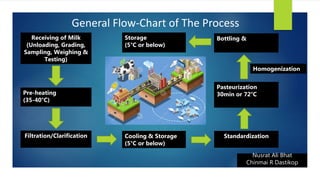
General Flow-Chart of The Process
Nusrat Ali Bhat
Chinmai R Dastikop
Receiving of Milk
(Unloading, Grading,
Sampling, Weighing &
Testing)
Pre-heating
(35-40°C)
Filtration/Clarification Cooling & Storage
(5°C or below)
Standardization
Pasteurization
30min or 72°C
Bottling &
Homogenization
Storage
(5°C or below)
I. Receiving of Milk
Nusrat Ali Bhat
Chinmai R Dastikop
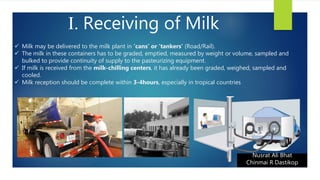
 Milk may be delivered to the milk plant in ‘cans’ or ‘tankers’ (Road/Rail).
 The milk in these containers has to be graded, emptied, measured by weight or volume, sampled and
bulked to provide continuity of supply to the pasteurizing equipment.
 If milk is received from the milk-chilling centers, it has already been graded, weighed, sampled and
cooled.
 Milk reception should be complete within 3-4hours, especially in tropical countries
Milk Reception Operations
Nusrat Ali Bhat
Chinmai R Dastikop
1. UNLOADING
Milk cans are unloaded manually from truck.
If the level of truck is in line with the platform, the unload requires least effort.
If the milk tanker is being used, it is first properly positioned so that
connections can be made conveniently.
2. GRADING
It refers to the classification of milk on the basis of quality for the price fixing
purposes.
Milk grader is used for proper selection of milk.
Principle of grading is based on organoleptic test (smell, taste, appearance &
acidity, sediment etc. which are included in Platform test.
1. Unloading
2. Grading
3. Sampling
4. Weighing
5. Testing
Nusrat Ali Bhat
Chinmai R Dastikop
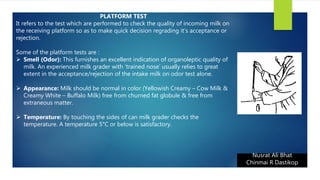
PLATFORM TEST
It refers to the test which are performed to check the quality of incoming milk on
the receiving platform so as to make quick decision regrading it’s acceptance or
rejection.
Some of the platform tests are :
 Smell (Odor): This furnishes an excellent indication of organoleptic quality of
milk. An experienced milk grader with ‘trained nose’ usually relies to great
extent in the acceptance/rejection of the intake milk on odor test alone.
 Appearance: Milk should be normal in color (Yellowish Creamy – Cow Milk &
Creamy White – Buffalo Milk) free from churned fat globule & free from
extraneous matter.
 Temperature: By touching the sides of can milk grader checks the
temperature. A temperature 5°C or below is satisfactory.
Nusrat Ali Bhat
Chinmai R Dastikop
 Sediment: It shows the visible foreign matter
 Acidity: Natural/apparent viscosity does not affect the milk quality but developed acidity adversely affect
the quality of milk. Titrable acidity(TA) of milk cannot serve quality of milk today due to the supplier are
freely adding neutralizer to milk to reduce its acidity.
 Lactometer reading: It is mainly used for detection of adulteration of milk with water. It gives the specific
gravity of milk. If SNF is high Lactometer reading is more.
 Other tests are: Alcohol test, Clot on boiling test(COP) & Resazurin Test(RT)
3.SAMPLING
Nusrat Ali Bhat
Chinmai R Dastikop
It is very important in any quality testing of food material either milk or
any other.
PREREQUISTS OF SAMPLING OF MILK
• Thorough mixing of the milk by using stirrer/agitator in the can/tanker.
• Representative samples can also be taken during dumping of milk can
into weigh tank, whereby milk gets mixed so thoroughly.
Collected composite samples were placed in wide narrow mouthed glass
bottles with a rubber stopper.
Before transferring the sample into bottle first add the preservatives
(formalin, mercuric chloride, potassium dichromate) to avoid subsequent
contamination of the sample
4. WEIGHING
Nusrat Ali Bhat
Chinmai R Dastikop
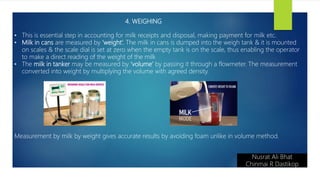
• This is essential step in accounting for milk receipts and disposal, making payment for milk etc.
• Milk in cans are measured by ‘weight’. The milk in cans is dumped into the weigh tank & it is mounted
on scales & the scale dial is set at zero when the empty tank is on the scale, thus enabling the operator
to make a direct reading of the weight of the milk
• The milk in tanker may be measured by ‘volume’ by passing it through a flowmeter. The measurement
converted into weight by multiplying the volume with agreed density.
Measurement by milk by weight gives accurate results by avoiding foam unlike in volume method.
5.TESTING
Nusrat Ali Bhat
Chinmai R Dastikop
Apart from platform test in order to provide good quality of milk in-terms shelf-life, payment based
on fat content etc. milk is tested in laboratory.
E.g. Dye reduction test
DMC – Direct Microscopic Count
SPC – Standard Plate Count
Fat/SNF content
II. PRE-HEATING
Nusrat Ali Bhat
Chinmai R Dastikop
• The term pre-heating refers to heating before the operation which follows immediately.
• The milk is preheated for efficient filtration/clarification.
• Pre-heating is essential, if incoming milk is cold as otherwise the flow of milk is hampered.
• As the temperature of milk increases, the viscosity decreases and more efficient filtration/clarification
results.
• The usual temperature is 35-40°C
• Equipment used may be plate/tubular heater
III.FILTRATION/CLARIFICATION
Nusrat Ali Bhat
Chinmai R Dastikop
Filtration removes the suspended, foreign particles by straining process.
Clarification removes the suspended, foreign particles by centrifugal sedimentation
Clarifier removes sediment much more efficiently than filtration & even clarifier remove still finer particles
that escape from filter.
Removal of clarifier slime does not affect the composition of milk to a significant extent usually it may be
0.01%
Bactofugation is the process of removing 99% of the bacteria in the milk
by centrifugal force.
Nusrat Ali Bhat
Chinmai R Dastikop
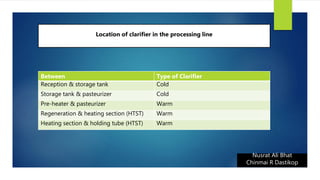
Location of clarifier in the processing line
Between Type of Clarifier
Reception & storage tank Cold
Storage tank & pasteurizer Cold
Pre-heater & pasteurizer Warm
Regeneration & heating section (HTST) Warm
Heating section & holding tube (HTST) Warm
IV. COOLING & STORAGE
Nusrat Ali Bhat
Chinmai R Dastikop
As soon as milk is received from the plant, it is chilled at 5°C/below and stored because to prevent
deterioration in its bacteriological quality during storage period.
Methods of Cooling
• Surface Cooler
• Plate Cooler
• Inter tubular Cooler
• Jacketed Cooler
Nusrat Ali Bhat
Chinmai R Dastikop
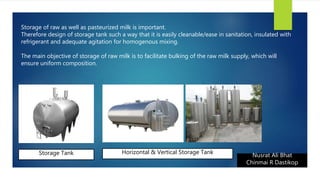
Storage of raw as well as pasteurized milk is important.
Therefore design of storage tank such a way that it is easily cleanable/ease in sanitation, insulated with
refrigerant and adequate agitation for homogenous mixing.
The main objective of storage of raw milk is to facilitate bulking of the raw milk supply, which will
ensure uniform composition.
Storage Tank Horizontal & Vertical Storage Tank
V. STANDARDIZATION
Nusrat Ali Bhat
Chinmai R Dastikop
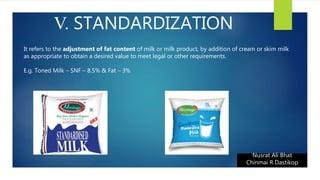
It refers to the adjustment of fat content of milk or milk product, by addition of cream or skim milk
as appropriate to obtain a desired value to meet legal or other requirements.
E.g. Toned Milk – SNF – 8.5% & Fat – 3%
VI. PASTEURIZATION
Nusrat Ali Bhat
Chinmai R Dastikop
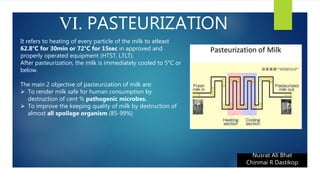
It refers to heating of every particle of the milk to atleast
62.8°C for 30min or 72°C for 15sec in approved and
properly operated equipment (HTST, LTLT).
After pasteurization, the milk is immediately cooled to 5°C or
below.
The main 2 objective of pasteurization of milk are:
 To render milk safe for human consumption by
destruction of cent % pathogenic microbes.
 To improve the keeping quality of milk by destruction of
almost all spoilage organism (85-99%)
VII. HOMOGENIZATION
Nusrat Ali Bhat
Chinmai R Dastikop
It refers to the process of forcing the milk through a homogenizer with the objective of subdividing
the fat globules.
The homogenizer may be located immediately after regenerative heating, or between final heating and
holding or before regenerative cooling.
VIII. COOLING
Nusrat Ali Bhat
Chinmai R Dastikop
After homogenization of milk, it is cooled to a low temperature of 5°C or below
IX. BOTTLING & PACKING
Milk after undergoing number of
processing like pasteurization,
homogenization etc. is packed in
bottles/packets followed by storage.
Then stored at low temperature.
(of 5°C or below )
Nusrat Ali Bhat
Chinmai R Dastikop
Nowadays, the various modern high advanced milk processing machines are beneficial for any milk
processing plants.
 It increases the quality of the products.
 It reduces the workload of farmers and dependency on workers.
 It helps for making products faster and easier.
 The highly advanced machines are easy to clean with less physical effort due to that milk plants always
get clean.
 These advanced machines can be operated 24 hours for making good quality products.
 It helps to get more output with few workers.
 It helps to keep product quality maintain.
 With the help of advanced machines, it is easy to provide low-cost product to the people
Nusrat Ali Bhat
Chinmai R Dastikop

Operations in milk processing plant

  • 1.
    OPERATIONS IN MILKPROCESSING PLANT: OVERVIEW Nusrat Ali Bhat Chinmai R Dastikop
  • 2.
    MILK PROCESSING Nusrat AliBhat Chinmai R Dastikop Milk being most value protein food (ideal food) is also highly perishable because it is an excellent medium for growth of micro-organism – particularly bacterial pathogens – that can cause spoilage and disease in consumers. Milk processing plant allows the preservation of milk for days, weeks or months and reduce food-borne illness. The milk processing plant include a range of milk processing equipment to perform or handling the various operations of milk like heat treatments, pasteurization, homogenization and some others. The milk plant include the fluid milk production, cheese production, yoghurt production, ice-cream production to make huge variety of milk products like cheese, butter, cream, skimmed milk, double-toned milk and many more.
  • 3.
    General Flow-Chart ofThe Process Nusrat Ali Bhat Chinmai R Dastikop Receiving of Milk (Unloading, Grading, Sampling, Weighing & Testing) Pre-heating (35-40°C) Filtration/Clarification Cooling & Storage (5°C or below) Standardization Pasteurization 30min or 72°C Bottling & Homogenization Storage (5°C or below)
  • 4.
    I. Receiving ofMilk Nusrat Ali Bhat Chinmai R Dastikop  Milk may be delivered to the milk plant in ‘cans’ or ‘tankers’ (Road/Rail).  The milk in these containers has to be graded, emptied, measured by weight or volume, sampled and bulked to provide continuity of supply to the pasteurizing equipment.  If milk is received from the milk-chilling centers, it has already been graded, weighed, sampled and cooled.  Milk reception should be complete within 3-4hours, especially in tropical countries
  • 5.
    Milk Reception Operations NusratAli Bhat Chinmai R Dastikop 1. UNLOADING Milk cans are unloaded manually from truck. If the level of truck is in line with the platform, the unload requires least effort. If the milk tanker is being used, it is first properly positioned so that connections can be made conveniently. 2. GRADING It refers to the classification of milk on the basis of quality for the price fixing purposes. Milk grader is used for proper selection of milk. Principle of grading is based on organoleptic test (smell, taste, appearance & acidity, sediment etc. which are included in Platform test. 1. Unloading 2. Grading 3. Sampling 4. Weighing 5. Testing
  • 6.
    Nusrat Ali Bhat ChinmaiR Dastikop PLATFORM TEST It refers to the test which are performed to check the quality of incoming milk on the receiving platform so as to make quick decision regrading it’s acceptance or rejection. Some of the platform tests are :  Smell (Odor): This furnishes an excellent indication of organoleptic quality of milk. An experienced milk grader with ‘trained nose’ usually relies to great extent in the acceptance/rejection of the intake milk on odor test alone.  Appearance: Milk should be normal in color (Yellowish Creamy – Cow Milk & Creamy White – Buffalo Milk) free from churned fat globule & free from extraneous matter.  Temperature: By touching the sides of can milk grader checks the temperature. A temperature 5°C or below is satisfactory.
  • 7.
    Nusrat Ali Bhat ChinmaiR Dastikop  Sediment: It shows the visible foreign matter  Acidity: Natural/apparent viscosity does not affect the milk quality but developed acidity adversely affect the quality of milk. Titrable acidity(TA) of milk cannot serve quality of milk today due to the supplier are freely adding neutralizer to milk to reduce its acidity.  Lactometer reading: It is mainly used for detection of adulteration of milk with water. It gives the specific gravity of milk. If SNF is high Lactometer reading is more.  Other tests are: Alcohol test, Clot on boiling test(COP) & Resazurin Test(RT)
  • 8.
    3.SAMPLING Nusrat Ali Bhat ChinmaiR Dastikop It is very important in any quality testing of food material either milk or any other. PREREQUISTS OF SAMPLING OF MILK • Thorough mixing of the milk by using stirrer/agitator in the can/tanker. • Representative samples can also be taken during dumping of milk can into weigh tank, whereby milk gets mixed so thoroughly. Collected composite samples were placed in wide narrow mouthed glass bottles with a rubber stopper. Before transferring the sample into bottle first add the preservatives (formalin, mercuric chloride, potassium dichromate) to avoid subsequent contamination of the sample
  • 9.
    4. WEIGHING Nusrat AliBhat Chinmai R Dastikop • This is essential step in accounting for milk receipts and disposal, making payment for milk etc. • Milk in cans are measured by ‘weight’. The milk in cans is dumped into the weigh tank & it is mounted on scales & the scale dial is set at zero when the empty tank is on the scale, thus enabling the operator to make a direct reading of the weight of the milk • The milk in tanker may be measured by ‘volume’ by passing it through a flowmeter. The measurement converted into weight by multiplying the volume with agreed density. Measurement by milk by weight gives accurate results by avoiding foam unlike in volume method.
  • 10.
    5.TESTING Nusrat Ali Bhat ChinmaiR Dastikop Apart from platform test in order to provide good quality of milk in-terms shelf-life, payment based on fat content etc. milk is tested in laboratory. E.g. Dye reduction test DMC – Direct Microscopic Count SPC – Standard Plate Count Fat/SNF content
  • 11.
    II. PRE-HEATING Nusrat AliBhat Chinmai R Dastikop • The term pre-heating refers to heating before the operation which follows immediately. • The milk is preheated for efficient filtration/clarification. • Pre-heating is essential, if incoming milk is cold as otherwise the flow of milk is hampered. • As the temperature of milk increases, the viscosity decreases and more efficient filtration/clarification results. • The usual temperature is 35-40°C • Equipment used may be plate/tubular heater
  • 12.
    III.FILTRATION/CLARIFICATION Nusrat Ali Bhat ChinmaiR Dastikop Filtration removes the suspended, foreign particles by straining process. Clarification removes the suspended, foreign particles by centrifugal sedimentation Clarifier removes sediment much more efficiently than filtration & even clarifier remove still finer particles that escape from filter. Removal of clarifier slime does not affect the composition of milk to a significant extent usually it may be 0.01% Bactofugation is the process of removing 99% of the bacteria in the milk by centrifugal force.
  • 13.
    Nusrat Ali Bhat ChinmaiR Dastikop Location of clarifier in the processing line Between Type of Clarifier Reception & storage tank Cold Storage tank & pasteurizer Cold Pre-heater & pasteurizer Warm Regeneration & heating section (HTST) Warm Heating section & holding tube (HTST) Warm
  • 14.
    IV. COOLING &STORAGE Nusrat Ali Bhat Chinmai R Dastikop As soon as milk is received from the plant, it is chilled at 5°C/below and stored because to prevent deterioration in its bacteriological quality during storage period. Methods of Cooling • Surface Cooler • Plate Cooler • Inter tubular Cooler • Jacketed Cooler
  • 15.
    Nusrat Ali Bhat ChinmaiR Dastikop Storage of raw as well as pasteurized milk is important. Therefore design of storage tank such a way that it is easily cleanable/ease in sanitation, insulated with refrigerant and adequate agitation for homogenous mixing. The main objective of storage of raw milk is to facilitate bulking of the raw milk supply, which will ensure uniform composition. Storage Tank Horizontal & Vertical Storage Tank
  • 16.
    V. STANDARDIZATION Nusrat AliBhat Chinmai R Dastikop It refers to the adjustment of fat content of milk or milk product, by addition of cream or skim milk as appropriate to obtain a desired value to meet legal or other requirements. E.g. Toned Milk – SNF – 8.5% & Fat – 3%
  • 17.
    VI. PASTEURIZATION Nusrat AliBhat Chinmai R Dastikop It refers to heating of every particle of the milk to atleast 62.8°C for 30min or 72°C for 15sec in approved and properly operated equipment (HTST, LTLT). After pasteurization, the milk is immediately cooled to 5°C or below. The main 2 objective of pasteurization of milk are:  To render milk safe for human consumption by destruction of cent % pathogenic microbes.  To improve the keeping quality of milk by destruction of almost all spoilage organism (85-99%)
  • 18.
    VII. HOMOGENIZATION Nusrat AliBhat Chinmai R Dastikop It refers to the process of forcing the milk through a homogenizer with the objective of subdividing the fat globules. The homogenizer may be located immediately after regenerative heating, or between final heating and holding or before regenerative cooling.
  • 19.
    VIII. COOLING Nusrat AliBhat Chinmai R Dastikop After homogenization of milk, it is cooled to a low temperature of 5°C or below IX. BOTTLING & PACKING Milk after undergoing number of processing like pasteurization, homogenization etc. is packed in bottles/packets followed by storage. Then stored at low temperature. (of 5°C or below )
  • 20.
    Nusrat Ali Bhat ChinmaiR Dastikop Nowadays, the various modern high advanced milk processing machines are beneficial for any milk processing plants.  It increases the quality of the products.  It reduces the workload of farmers and dependency on workers.  It helps for making products faster and easier.  The highly advanced machines are easy to clean with less physical effort due to that milk plants always get clean.  These advanced machines can be operated 24 hours for making good quality products.  It helps to get more output with few workers.  It helps to keep product quality maintain.  With the help of advanced machines, it is easy to provide low-cost product to the people
  • 21.