 Introductionabout milk
 Milk compounds
 Protein
 Fats
 Separation process
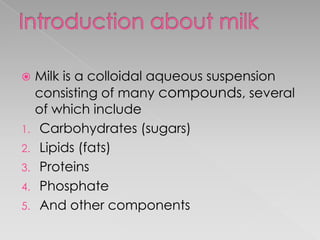
 Milk is a colloidal aqueous suspension
  consisting of many compounds, several
  of which include
1. Carbohydrates (sugars)
2. Lipids (fats)
3. Proteins
4. Phosphate
5. And other components
 Proteins are large, polymeric structures
  made up of amino acids. An amino acid
  is a generic name for one of twenty
  different molecules.
 When placed in an aqueous
  solution, protein will fold up on itself to
  form what is called a “3ry" .
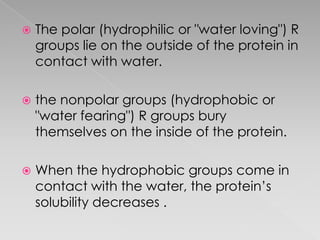
   The polar (hydrophilic or "water loving") R
    groups lie on the outside of the protein in
    contact with water.

   the nonpolar groups (hydrophobic or
    "water fearing") R groups bury
    themselves on the inside of the protein.

   When the hydrophobic groups come in
    contact with the water, the protein’s
    solubility decreases .
   Fats are a type of lipid composed of a
    tryhydroxy alcohol (glycerol) and long
    chain fatty acids (RCOOH) as shown in
    Figure .
 As in the case of the proteins, the R
  groups determine the identity and
  properties of the particular fat. Plant
  oils, for instance, have a large portion of
  unsaturated fatty acids (double bonds
  between many of their carbon atoms).
 Oleic acid:
  CH3(CH2)7CH=CH(CH2)7COOH.

   Linoleic acid:
    CH3(CH2)4(CH=CHCH2)2(CH2)6COOH.
   Animal fats, on the other hand, contain
    a greater portion of saturated fatty acids
    (single bonds between carbon atoms).

   Palmitic acid: CH3(CH2)14COOH.

   Steric acid: CH3(CH2)16COOH.
Milk

Phosphate
                                    Protein
             Carbohydrates
                             Fats
    Other Compounds
Milk


              Protein
       Fats
1.    50 ml of Milk.
2.   1 ml of 8 M Acetic acid.
3.   Stirring while heating for
     5 min.
4.   Cooling for 10 min in ice
     bath.
1.   Includes the phosphate
     and carbohydrate.

2.   Includes the protein and
     fats .
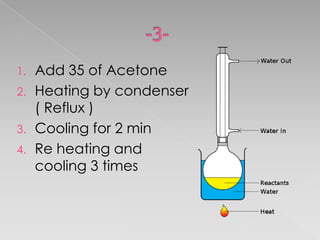
1.   Add 35 of Acetone
2.   Heating by condenser
     ( Reflux )
3.   Cooling for 2 min
4.   Re heating and
     cooling 3 times
Filtration
Wash it with 5 ml of
Acetone

1- Fats

2 -Protein
 Calculation
1. Fat
% Fat = W fat/ W sample * 100%

2. Protein
%Protein = W protein / W sample * 100%
Milk analysis
Milk analysis

Milk analysis

  • 2.
     Introductionabout milk Milk compounds  Protein  Fats  Separation process
  • 3.
     Milk isa colloidal aqueous suspension consisting of many compounds, several of which include 1. Carbohydrates (sugars) 2. Lipids (fats) 3. Proteins 4. Phosphate 5. And other components
  • 8.
     Proteins arelarge, polymeric structures made up of amino acids. An amino acid is a generic name for one of twenty different molecules.  When placed in an aqueous solution, protein will fold up on itself to form what is called a “3ry" .
  • 9.
    The polar (hydrophilic or "water loving") R groups lie on the outside of the protein in contact with water.  the nonpolar groups (hydrophobic or "water fearing") R groups bury themselves on the inside of the protein.  When the hydrophobic groups come in contact with the water, the protein’s solubility decreases .
  • 13.
    Fats are a type of lipid composed of a tryhydroxy alcohol (glycerol) and long chain fatty acids (RCOOH) as shown in Figure .
  • 14.
     As inthe case of the proteins, the R groups determine the identity and properties of the particular fat. Plant oils, for instance, have a large portion of unsaturated fatty acids (double bonds between many of their carbon atoms).  Oleic acid: CH3(CH2)7CH=CH(CH2)7COOH.  Linoleic acid: CH3(CH2)4(CH=CHCH2)2(CH2)6COOH.
  • 15.
    Animal fats, on the other hand, contain a greater portion of saturated fatty acids (single bonds between carbon atoms).  Palmitic acid: CH3(CH2)14COOH.  Steric acid: CH3(CH2)16COOH.
  • 17.
    Milk Phosphate Protein Carbohydrates Fats Other Compounds
  • 18.
    Milk Protein Fats
  • 19.
    1. 50 ml of Milk. 2. 1 ml of 8 M Acetic acid. 3. Stirring while heating for 5 min. 4. Cooling for 10 min in ice bath.
  • 20.
    1. Includes the phosphate and carbohydrate. 2. Includes the protein and fats .
  • 21.
    1. Add 35 of Acetone 2. Heating by condenser ( Reflux ) 3. Cooling for 2 min 4. Re heating and cooling 3 times
  • 22.
    Filtration Wash it with5 ml of Acetone 1- Fats 2 -Protein
  • 23.
     Calculation 1. Fat %Fat = W fat/ W sample * 100% 2. Protein %Protein = W protein / W sample * 100%