Analysis of Milk and Butter
1
Azma Fakhar
contents
Learning outcomes:
• Milk analysis
• Milk analysis process
• Preparation of sample
• Test for milk analysis
• Butter analysis
• Test for butter
2
Azma Fakhar
Milk Analysis
• To obtain a final well-qualified product, the milk should present some
physiochemical characteristics. The characteristics of the product can be
performed by applying the tests required in the milk analysis.
3
Azma Fakhar
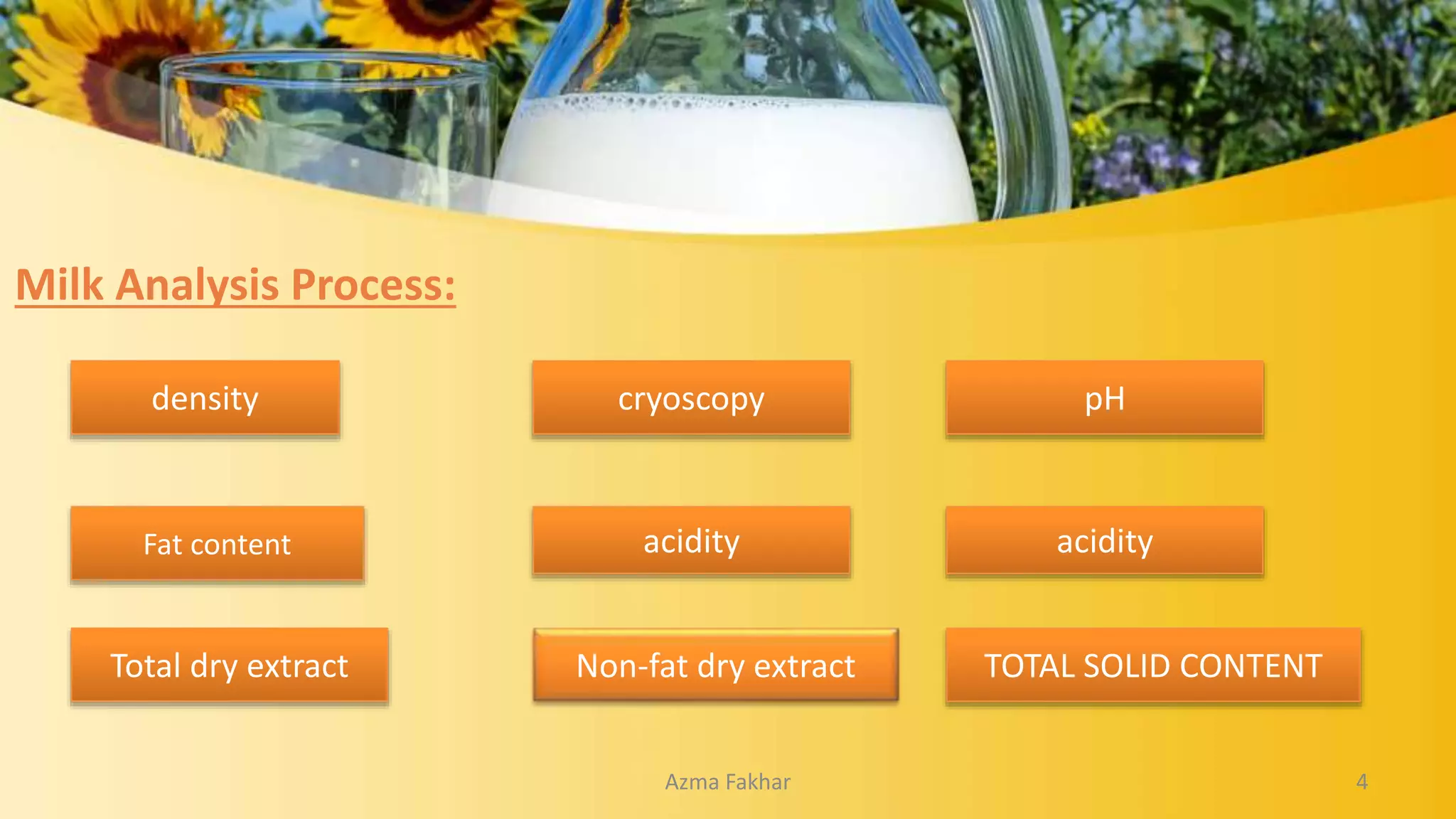
density
Fat content
Total dry extract Non-fat dry extract
cryoscopy
acidity
Milk Analysis Process:
pH
acidity
TOTAL SOLID CONTENT
4
Azma Fakhar
Preparation of sample :
Warm the sample to 370 – 400 C by transferring it to
the beaker & keep it in a water bath maintained at
400 – 450C. Stir slowly for proper homogenization.
Mix sample thoroughly by pouring back into the
bottle, mixing to dislodge any residual fat sticking to
the sides and pour it back in the beaker.
Allow the sample to come to room temperature (260
- 280 C) and withdraw immediately for analysis.
5
Azma Fakhar
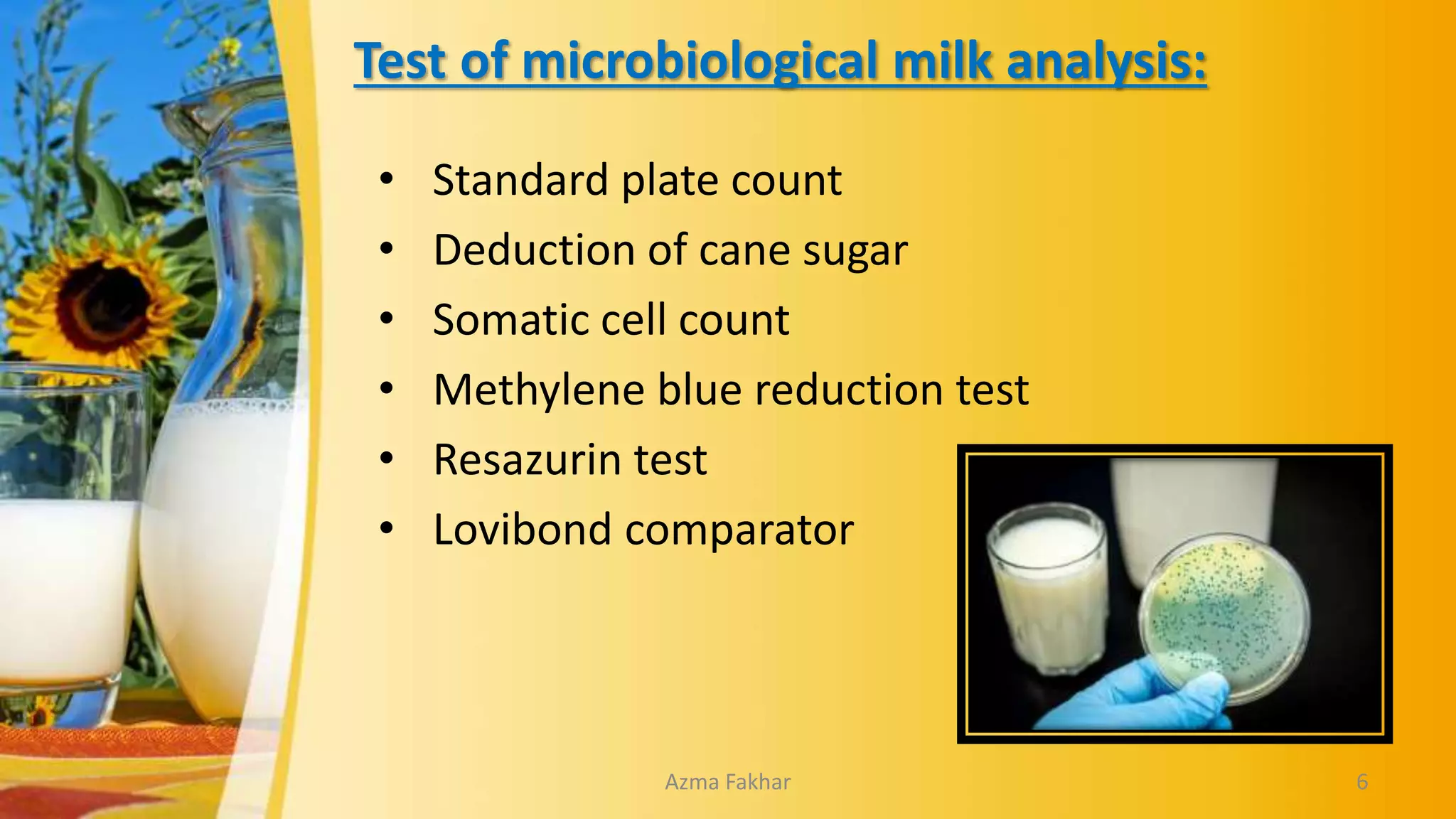
Test of microbiological milk analysis:
• Standard plate count
• Deduction of cane sugar
• Somatic cell count
• Methylene blue reduction test
• Resazurin test
• Lovibond comparator
6
Azma Fakhar
Detection of Cane Sugar in Milk:
• PRINCIPLE:
• Fructose + resorcinol in HCl Red color
Procedure:
 Add milk + conc. HCl and wait for 10min ppts will
formed
 Filter the mixture and take 1 ml of milk serum & 5
ml modified resorcinol - HCl reagent
 Placed in water bath for 1min
 Withdraw the tube &observe the red colour
 Cane sugar dedected.
Azma Fakhar 7
Methylene blue Reduction test
• Methylene Blue is blue coloured dye.
• Aerobic bacteria are common contaminates of
milk.Such bacteria release respiratory burst
metabolites as a result of active metabolism.
• These metabolites reduce the methylene blue
that intimately turns in white colour.
• Rate of reduction of methylene Blue is directly
related to with bacterial load in milk.
8
Azma Fakhar
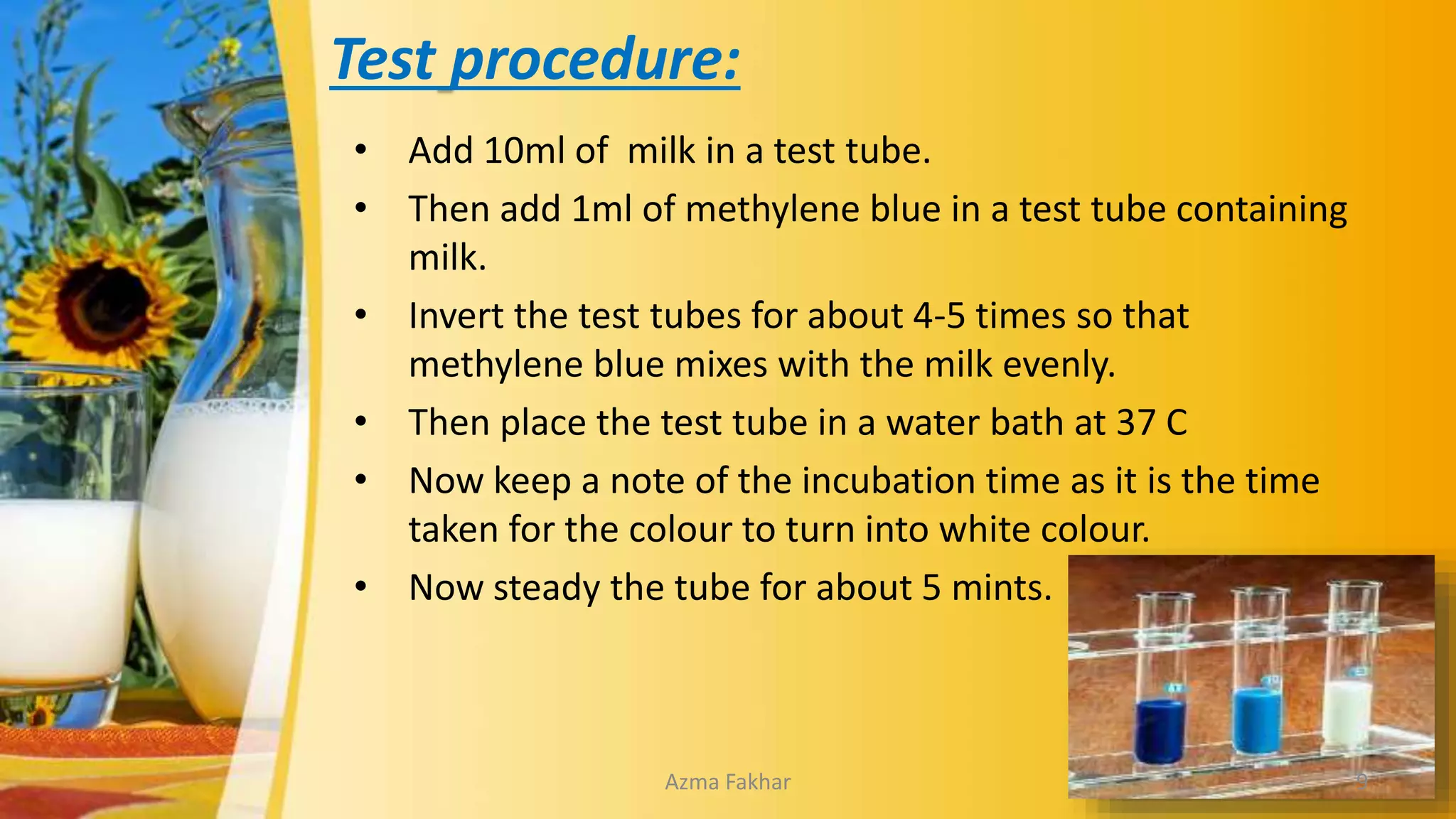
Test procedure:
• Add 10ml of milk in a test tube.
• Then add 1ml of methylene blue in a test tube containing
milk.
• Invert the test tubes for about 4-5 times so that
methylene blue mixes with the milk evenly.
• Then place the test tube in a water bath at 37 C
• Now keep a note of the incubation time as it is the time
taken for the colour to turn into white colour.
• Now steady the tube for about 5 mints.
9
Azma Fakhar
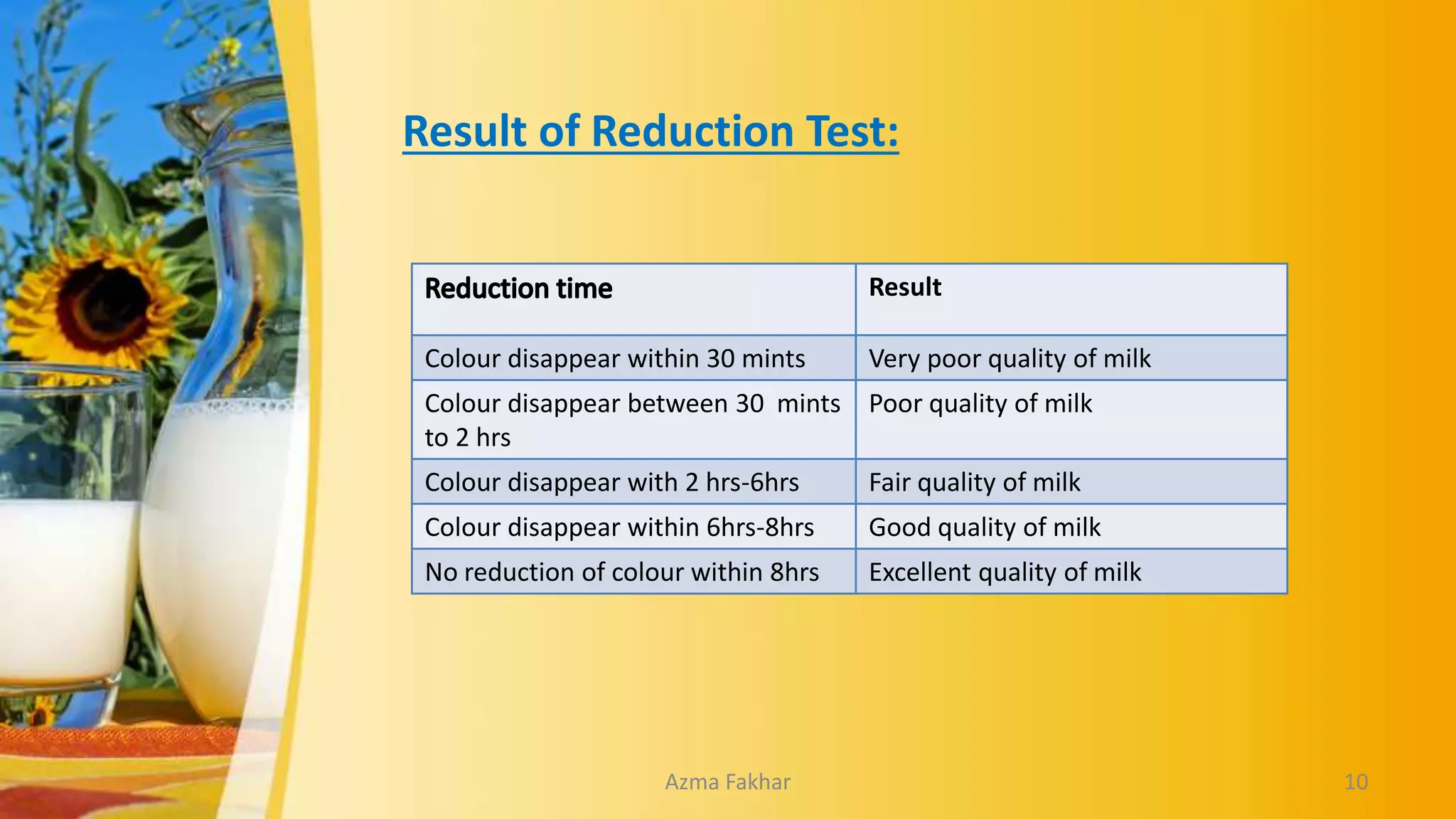
Result of Reduction Test:
Result
Colour disappear within 30 mints Very poor quality of milk
Colour disappear between 30 mints
to 2 hrs
Poor quality of milk
Colour disappear with 2 hrs-6hrs Fair quality of milk
Colour disappear within 6hrs-8hrs Good quality of milk
No reduction of colour within 8hrs Excellent quality of milk
10
Azma Fakhar
Resazurin test :
• The Resazurin test is designed for assessing
the quality of raw bulked milk.
• Resazurin gives milk a characteristic blue
colour and the test is based on the ability of
bacteria in the milk to reduce the blue dye.
11
Azma Fakhar
Procedure of the test:
• Take 2 test tube and add 10ml of milk in both the
test tube and labeled it as A and B.
• At one test tube such as A, we will add resazurin
solution and close the test tube gentely with
stopper allow milk to thoroughly mix in the dye.
• At another test tube B we will not add dye, it’s
called blank test tube.
• Then place both the test tube in a Lovibond
comparator with Resazurin disk and compare it
colourimetrically.
12
Azma Fakhar
Result of Resazurin test
Resazurin Disc
Number
Colour Milk grade Action
06 Blue Excellent Accept
05 Purple Good Accept
04 Pink Bad Reject
03 white Very bad reject
13
Azma Fakhar
Total dry extract (TDE
• The dry extract may be defined as “all components of milk
except water”.
• They determine the nutritional quality and industrial yield of
the milk products.
• Material:
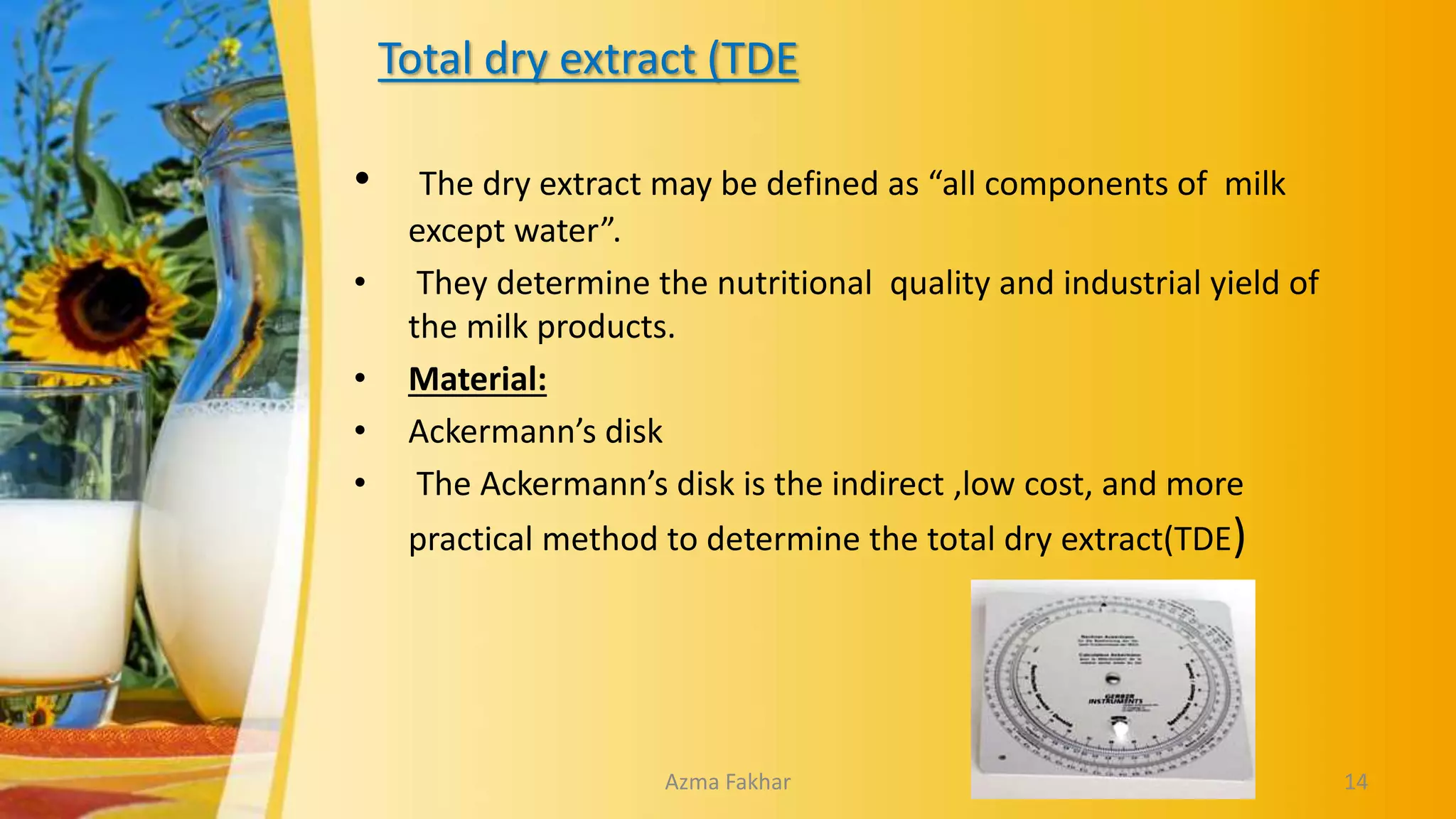
• Ackermann’s disk
• The Ackermann’s disk is the indirect ,low cost, and more
practical method to determine the total dry extract(TDE)
14
Azma Fakhar
Non-fat dry extract (NFDE)
• The non-fat dry extract may be defined as being “all
components of the milk ,except water and fat”.
• Its measure is important for verification of the water content
in the milk . It is more convenient than the total dry extract
because the fat can widely vary , therefore making the
comparison a difficult one.
• Determination methods
• The non-fat dry extract is determined , by subtracting the
content of fat from the
• Total dry extract : NFDE= TDE-fat
15
Azma Fakhar
DETERMINATION OF pH:
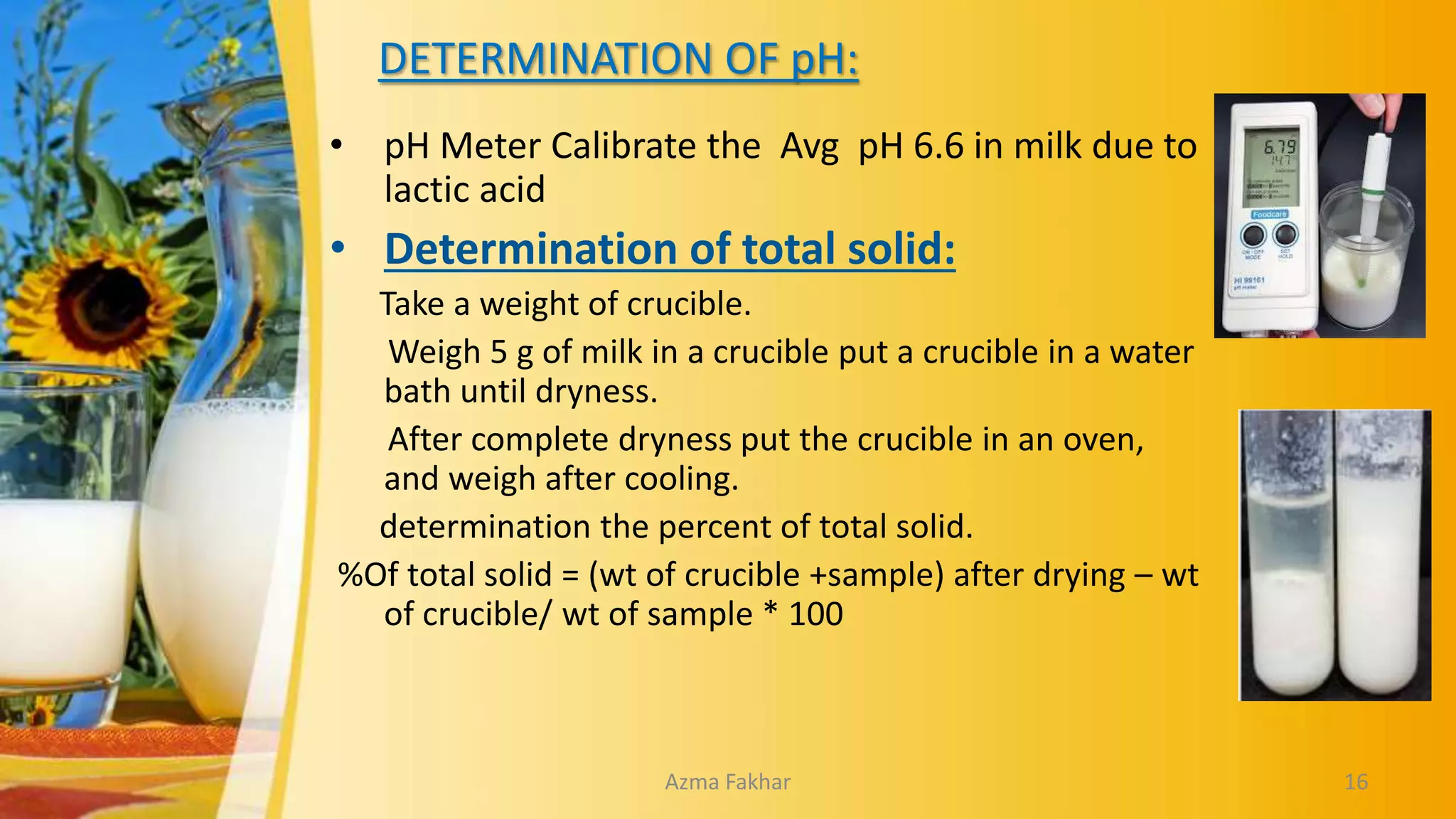
• pH Meter Calibrate the Avg pH 6.6 in milk due to
lactic acid
• Determination of total solid:
Take a weight of crucible.
Weigh 5 g of milk in a crucible put a crucible in a water
bath until dryness.
After complete dryness put the crucible in an oven,
and weigh after cooling.
determination the percent of total solid.
%Of total solid = (wt of crucible +sample) after drying – wt
of crucible/ wt of sample * 100
16
Azma Fakhar
Acidity
• The acidity determination is a
fundamentally important test for the
industry because it indicates the
convenience or inconvenience of using the
milk . The acidity of the milk can be
determined by the ‘Alizarol test.’
• Material and reagents
 Salut acidimeter
 76% Alizarol solution
17
Azma Fakhar
Method of determining acidity
 Mix 2ml of the milk to be analyzed with
2ml of the alizarol solution.
 Observe both the coloration and texture of
the mixture
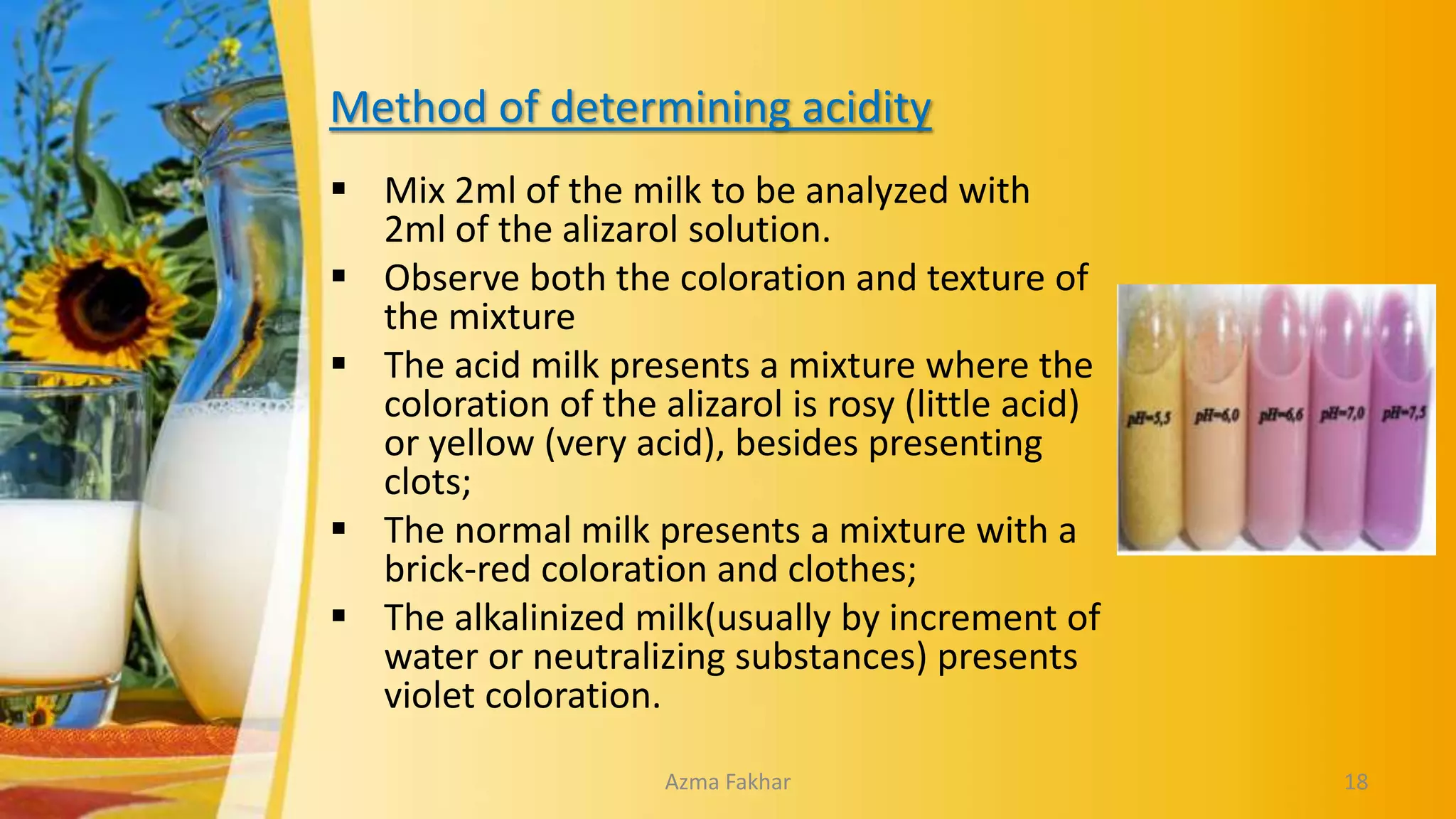
 The acid milk presents a mixture where the
coloration of the alizarol is rosy (little acid)
or yellow (very acid), besides presenting
clots;
 The normal milk presents a mixture with a
brick-red coloration and clothes;
 The alkalinized milk(usually by increment of
water or neutralizing substances) presents
violet coloration.
18
Azma Fakhar
Butter
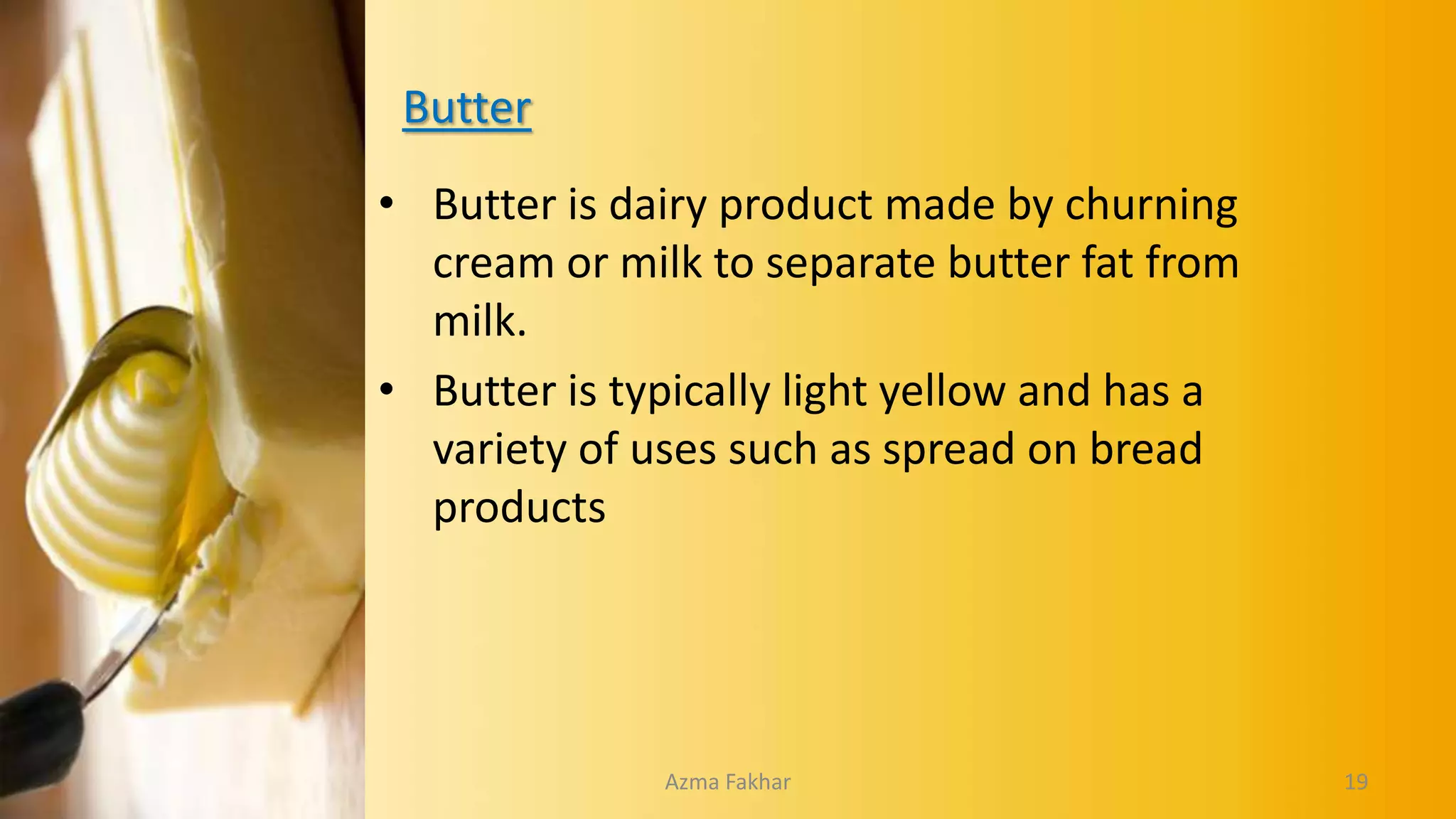
• Butter is dairy product made by churning
cream or milk to separate butter fat from
milk.
• Butter is typically light yellow and has a
variety of uses such as spread on bread
products
19
Azma Fakhar
Butter analysis
 Chemical Analysis of butter.
 Colour analysis of butter.
 Determination of titarateable acidity.
 Rancidity
 Organoleptic test
 Sediment test
 MBR test
 Total bacterial count
 Yeast and Mold count
20
Azma Fakhar
Chemical analysis of butter
• Total solids content of butter samples
was measured by recording the weight
lost from samples after drying in an
oven at 102°C for at least 15 h.
• Fat content of cream and butter
samples was analyzed by the Röse–
Gottlieb method (International Dairy
Federation, 1996)
21
Azma Fakhar
Colour analysis of butter
• Color measurements were taken from the surface
of newly opened cups of butter following;
1 week, 1 month, 3 month and 6 month
storage at 5C
• Five replications of
(lightness)
(red-green color), and (yellow-blue color) values
were taken at random locations across the surface
of the butters using a Minolta Chroma meter.
22
Azma Fakhar
Determination of titarateable acidity
Principle:
The butter is melted in hot water and the hot solution
is titrated with standard alkali till neutral to
phenolphthalein
Procedure:
• Weigh accurately about 20 g of the butter sample in a
dry 250-ml conical flask.
• Add 90 ml of hot, previously boiled water and shake
the contents.
• While still hot, titrate with 0·02 N sodium hydroxide,
using one millilitre of the phenolphthalein as an
indicator.
23
Azma Fakhar
Rancidity:
• Butter gets rancid due to microbial, enzymatic or chemical
degradation of fat constituents. The fat hydrolysis in butter
mainly due to the activity of microbial lipases.
SENSORY ANALYSIS:
A sour-bitter taste is identifiable with rancidity (i.e.
blue cheese). Rancid butter becomes yellow to brown
and the flavor becomes harsh:
24
Azma Fakhar
25
Azma Fakhar

Analysis of milk and butter

  • 1.
    Analysis of Milkand Butter 1 Azma Fakhar
  • 2.
    contents Learning outcomes: • Milkanalysis • Milk analysis process • Preparation of sample • Test for milk analysis • Butter analysis • Test for butter 2 Azma Fakhar
  • 3.
    Milk Analysis • Toobtain a final well-qualified product, the milk should present some physiochemical characteristics. The characteristics of the product can be performed by applying the tests required in the milk analysis. 3 Azma Fakhar
  • 4.
    density Fat content Total dryextract Non-fat dry extract cryoscopy acidity Milk Analysis Process: pH acidity TOTAL SOLID CONTENT 4 Azma Fakhar
  • 5.
    Preparation of sample: Warm the sample to 370 – 400 C by transferring it to the beaker & keep it in a water bath maintained at 400 – 450C. Stir slowly for proper homogenization. Mix sample thoroughly by pouring back into the bottle, mixing to dislodge any residual fat sticking to the sides and pour it back in the beaker. Allow the sample to come to room temperature (260 - 280 C) and withdraw immediately for analysis. 5 Azma Fakhar
  • 6.
    Test of microbiologicalmilk analysis: • Standard plate count • Deduction of cane sugar • Somatic cell count • Methylene blue reduction test • Resazurin test • Lovibond comparator 6 Azma Fakhar
  • 7.
    Detection of CaneSugar in Milk: • PRINCIPLE: • Fructose + resorcinol in HCl Red color Procedure:  Add milk + conc. HCl and wait for 10min ppts will formed  Filter the mixture and take 1 ml of milk serum & 5 ml modified resorcinol - HCl reagent  Placed in water bath for 1min  Withdraw the tube &observe the red colour  Cane sugar dedected. Azma Fakhar 7
  • 8.
    Methylene blue Reductiontest • Methylene Blue is blue coloured dye. • Aerobic bacteria are common contaminates of milk.Such bacteria release respiratory burst metabolites as a result of active metabolism. • These metabolites reduce the methylene blue that intimately turns in white colour. • Rate of reduction of methylene Blue is directly related to with bacterial load in milk. 8 Azma Fakhar
  • 9.
    Test procedure: • Add10ml of milk in a test tube. • Then add 1ml of methylene blue in a test tube containing milk. • Invert the test tubes for about 4-5 times so that methylene blue mixes with the milk evenly. • Then place the test tube in a water bath at 37 C • Now keep a note of the incubation time as it is the time taken for the colour to turn into white colour. • Now steady the tube for about 5 mints. 9 Azma Fakhar
  • 10.
    Result of ReductionTest: Result Colour disappear within 30 mints Very poor quality of milk Colour disappear between 30 mints to 2 hrs Poor quality of milk Colour disappear with 2 hrs-6hrs Fair quality of milk Colour disappear within 6hrs-8hrs Good quality of milk No reduction of colour within 8hrs Excellent quality of milk 10 Azma Fakhar
  • 11.
    Resazurin test : •The Resazurin test is designed for assessing the quality of raw bulked milk. • Resazurin gives milk a characteristic blue colour and the test is based on the ability of bacteria in the milk to reduce the blue dye. 11 Azma Fakhar
  • 12.
    Procedure of thetest: • Take 2 test tube and add 10ml of milk in both the test tube and labeled it as A and B. • At one test tube such as A, we will add resazurin solution and close the test tube gentely with stopper allow milk to thoroughly mix in the dye. • At another test tube B we will not add dye, it’s called blank test tube. • Then place both the test tube in a Lovibond comparator with Resazurin disk and compare it colourimetrically. 12 Azma Fakhar
  • 13.
    Result of Resazurintest Resazurin Disc Number Colour Milk grade Action 06 Blue Excellent Accept 05 Purple Good Accept 04 Pink Bad Reject 03 white Very bad reject 13 Azma Fakhar
  • 14.
    Total dry extract(TDE • The dry extract may be defined as “all components of milk except water”. • They determine the nutritional quality and industrial yield of the milk products. • Material: • Ackermann’s disk • The Ackermann’s disk is the indirect ,low cost, and more practical method to determine the total dry extract(TDE) 14 Azma Fakhar
  • 15.
    Non-fat dry extract(NFDE) • The non-fat dry extract may be defined as being “all components of the milk ,except water and fat”. • Its measure is important for verification of the water content in the milk . It is more convenient than the total dry extract because the fat can widely vary , therefore making the comparison a difficult one. • Determination methods • The non-fat dry extract is determined , by subtracting the content of fat from the • Total dry extract : NFDE= TDE-fat 15 Azma Fakhar
  • 16.
    DETERMINATION OF pH: •pH Meter Calibrate the Avg pH 6.6 in milk due to lactic acid • Determination of total solid: Take a weight of crucible. Weigh 5 g of milk in a crucible put a crucible in a water bath until dryness. After complete dryness put the crucible in an oven, and weigh after cooling. determination the percent of total solid. %Of total solid = (wt of crucible +sample) after drying – wt of crucible/ wt of sample * 100 16 Azma Fakhar
  • 17.
    Acidity • The aciditydetermination is a fundamentally important test for the industry because it indicates the convenience or inconvenience of using the milk . The acidity of the milk can be determined by the ‘Alizarol test.’ • Material and reagents  Salut acidimeter  76% Alizarol solution 17 Azma Fakhar
  • 18.
    Method of determiningacidity  Mix 2ml of the milk to be analyzed with 2ml of the alizarol solution.  Observe both the coloration and texture of the mixture  The acid milk presents a mixture where the coloration of the alizarol is rosy (little acid) or yellow (very acid), besides presenting clots;  The normal milk presents a mixture with a brick-red coloration and clothes;  The alkalinized milk(usually by increment of water or neutralizing substances) presents violet coloration. 18 Azma Fakhar
  • 19.
    Butter • Butter isdairy product made by churning cream or milk to separate butter fat from milk. • Butter is typically light yellow and has a variety of uses such as spread on bread products 19 Azma Fakhar
  • 20.
    Butter analysis  ChemicalAnalysis of butter.  Colour analysis of butter.  Determination of titarateable acidity.  Rancidity  Organoleptic test  Sediment test  MBR test  Total bacterial count  Yeast and Mold count 20 Azma Fakhar
  • 21.
    Chemical analysis ofbutter • Total solids content of butter samples was measured by recording the weight lost from samples after drying in an oven at 102°C for at least 15 h. • Fat content of cream and butter samples was analyzed by the Röse– Gottlieb method (International Dairy Federation, 1996) 21 Azma Fakhar
  • 22.
    Colour analysis ofbutter • Color measurements were taken from the surface of newly opened cups of butter following; 1 week, 1 month, 3 month and 6 month storage at 5C • Five replications of (lightness) (red-green color), and (yellow-blue color) values were taken at random locations across the surface of the butters using a Minolta Chroma meter. 22 Azma Fakhar
  • 23.
    Determination of titarateableacidity Principle: The butter is melted in hot water and the hot solution is titrated with standard alkali till neutral to phenolphthalein Procedure: • Weigh accurately about 20 g of the butter sample in a dry 250-ml conical flask. • Add 90 ml of hot, previously boiled water and shake the contents. • While still hot, titrate with 0·02 N sodium hydroxide, using one millilitre of the phenolphthalein as an indicator. 23 Azma Fakhar
  • 24.
    Rancidity: • Butter getsrancid due to microbial, enzymatic or chemical degradation of fat constituents. The fat hydrolysis in butter mainly due to the activity of microbial lipases. SENSORY ANALYSIS: A sour-bitter taste is identifiable with rancidity (i.e. blue cheese). Rancid butter becomes yellow to brown and the flavor becomes harsh: 24 Azma Fakhar
  • 25.