Introduction to Migration presented by
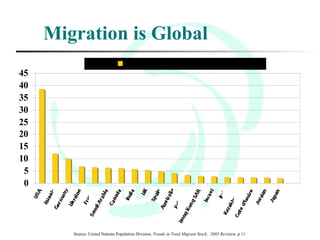
Migration is Global In 2005, 191 million people were counted as living outside the country of their birth The number of migrants worldwide has doubled since World War II If they lived in the same place, international migrants would form the 5th most populous country in the world
Migration is Global Source: United Nations Population Division.  Trends in Total Migrant Stock,  2005 Revision . p 11.
Why do people migrate? Economics ( push/pull factors ) Politics ( push factors ) Social Forces ( pull factors )
Economic Causes of Migration Migration in search of better economic conditions, employment, etc.  Migration to escape overpopulation and its effects Migration to escape poor climate conditions such as drought, el Niño, etc.  Migration to escape natural disasters
Political Causes of Migration Migration to escape war, invasion, military takeover, etc.  Migration to escape persecution on ethnic, political, religious, or other grounds Migration to escape prosecution for crimes committed
Political Causes of Migration Migration as punishment for crimes committed Migration as a result of enslavement Forced migration, with or without political agreement
Social Causes of Migration Migration to spread a religion  Migration to reunite with family, friends, etc. who have previously migrated  Migration to spread a political philosophy, such as Marxism, democracy, etc.  Migration to find personal freedom, to live a certain lifestyle, or to hold certain beliefs, not necessarily as the result of persecution
What are the effects of migration? Effects on the immigrants Effects on the host country Effects on the home country Multi-national issues
Effects on the Immigrants Issues of identity Issues of adaptation and assimilation  Differing cultural values between generations
Effects on the Host Country Economic impacts positive and negative real and perceived Welfare issues  Social attitudes
Effects on the Home Country Remittances Loss of revenue
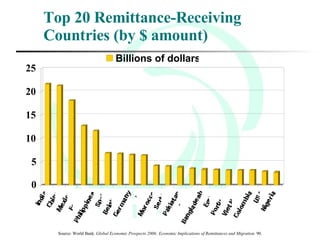
Top 20 Remittance-Receiving Countries (by $ amount) Source: World Bank.  Global Economic Prospects 2006: Economic Implications of Remittances and Migration.  90.
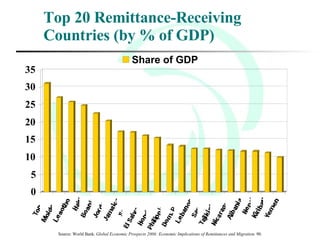
Top 20 Remittance-Receiving Countries (by % of GDP) Source: World Bank.  Global Economic Prospects 2006: Economic Implications of Remittances and Migration.  90.
Effects on the Home Country Families left behind “ Brain drain” Population decrease
Multi-National Issues “ Open border” policies Immigration policies Security issues Human trafficking/slavery
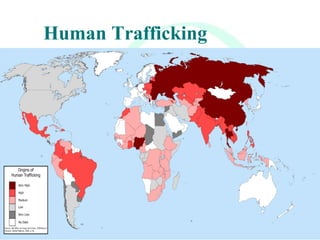
Human Trafficking
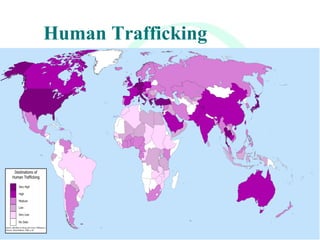
Human Trafficking

Migrations

  • 1.
  • 2.
    Migration is GlobalIn 2005, 191 million people were counted as living outside the country of their birth The number of migrants worldwide has doubled since World War II If they lived in the same place, international migrants would form the 5th most populous country in the world
  • 3.
    Migration is GlobalSource: United Nations Population Division. Trends in Total Migrant Stock, 2005 Revision . p 11.
  • 4.
    Why do peoplemigrate? Economics ( push/pull factors ) Politics ( push factors ) Social Forces ( pull factors )
  • 5.
    Economic Causes ofMigration Migration in search of better economic conditions, employment, etc. Migration to escape overpopulation and its effects Migration to escape poor climate conditions such as drought, el Niño, etc. Migration to escape natural disasters
  • 6.
    Political Causes ofMigration Migration to escape war, invasion, military takeover, etc. Migration to escape persecution on ethnic, political, religious, or other grounds Migration to escape prosecution for crimes committed
  • 7.
    Political Causes ofMigration Migration as punishment for crimes committed Migration as a result of enslavement Forced migration, with or without political agreement
  • 8.
    Social Causes ofMigration Migration to spread a religion Migration to reunite with family, friends, etc. who have previously migrated Migration to spread a political philosophy, such as Marxism, democracy, etc. Migration to find personal freedom, to live a certain lifestyle, or to hold certain beliefs, not necessarily as the result of persecution
  • 9.
    What are theeffects of migration? Effects on the immigrants Effects on the host country Effects on the home country Multi-national issues
  • 10.
    Effects on theImmigrants Issues of identity Issues of adaptation and assimilation Differing cultural values between generations
  • 11.
    Effects on theHost Country Economic impacts positive and negative real and perceived Welfare issues Social attitudes
  • 12.
    Effects on theHome Country Remittances Loss of revenue
  • 13.
    Top 20 Remittance-ReceivingCountries (by $ amount) Source: World Bank. Global Economic Prospects 2006: Economic Implications of Remittances and Migration. 90.
  • 14.
    Top 20 Remittance-ReceivingCountries (by % of GDP) Source: World Bank. Global Economic Prospects 2006: Economic Implications of Remittances and Migration. 90.
  • 15.
    Effects on theHome Country Families left behind “ Brain drain” Population decrease
  • 16.
    Multi-National Issues “Open border” policies Immigration policies Security issues Human trafficking/slavery
  • 17.
  • 18.