Line, Circle Drawing algorithm
Prepared & Compiled by
Prof. Abhijit Sarkar
IEM, Salt Lake
Digital Differential Analyzer Algorithm(DDA)
Cartesian slope-intercept equation for a straight line,
y=mx+b (m=slope, b= y-intercept)
m=dy/dx= y/ x
∆ ∆
b= y1-mx1
Now, case 1:- (|m|<1)
yi=mxi+b
yi+1=m(xi+1)+b
=mxi+m+b
= yi+m
Case 2:- (|m|>1)
xi=(yi-b)/m
xi+1=(yi+1-b)/m
=[(yi-b)/m] + [1/m]
= xi+1/m
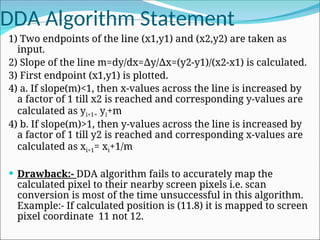
DDA Algorithm Statement
1) Two endpoints of the line (x1,y1) and (x2,y2) are taken as
input.
2) Slope of the line m=dy/dx= y/ x=(y2-y1)/(x2-x1) is calculated.
∆ ∆
3) First endpoint (x1,y1) is plotted.
4) a. If slope(m)<1, then x-values across the line is increased by
a factor of 1 till x2 is reached and corresponding y-values are
calculated as yi+1= yi+m
4) b. If slope(m)>1, then y-values across the line is increased by
a factor of 1 till y2 is reached and corresponding x-values are
calculated as xi+1= xi+1/m
 Drawback:- DDA algorithm fails to accurately map the
calculated pixel to their nearby screen pixels i.e. scan
conversion is most of the time unsuccessful in this algorithm.
Example:- If calculated position is (11.8) it is mapped to screen
pixel coordinate 11 not 12.
Problem on DDA Algorithm
Problem:-
Two endpoints of line are (10,10) and (20,16). Find all
coordinates of pixels over the line using DDA algorithm.
Solution:-
Slope of line(m) = y/ x =16-10/ 20-10=6/10=0.6
∆ ∆
Points are as follows:- [xi+1= xi+1 and yi+1= yi+m]
<10,10>
<11,10+0.6>=<11,10.6>
<12,10.6+0.6>=<12,11.2>
<13,11.2+0.6>=<13,11.8>
<14,11.8+0.6>=<14.12.4>
<15,12.4+0.6>=<15,13>
<16,13+0.6>=<16,13.6>
<17,13.6+0.6>=<17,14.2>
<18,14.2+0.6>=<18,14.8>
<19,14.8+0.6>=<19,15.4>
<20,15.4+0.6>=<20,16>
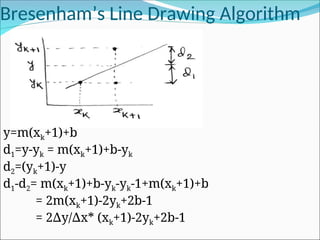
Bresenham’s Line Drawing Algorithm
y=m(xk+1)+b
d1=y-yk = m(xk+1)+b-yk
d2=(yk+1)-y
d1-d2= m(xk+1)+b-yk-yk-1+m(xk+1)+b
= 2m(xk+1)-2yk+2b-1
= 2 y/ x* (x
∆ ∆ k+1)-2yk+2b-1
Bresenham’s Line Drawing Algorithm
∆x(d1-d2)= 2 yx
∆ k+2 y -2 xy
∆ ∆ k+2 xb- x
∆ ∆
Now, Pk=2 yx
∆ k-2 xy
∆ k+c where, c=2 y+ x(2b-1) [P
∆ ∆ k= x(d
∆ 1-d2)]
Pk+1=2 yx
∆ k+1-2 xy
∆ k+1+c where, xk+1=xk+1
Pk+1-Pk=2 yx
∆ k+2 y-2 xy
∆ ∆ k+1-2 yx
∆ k+2 xy
∆ k
Pk+1=Pk+2 y-2 x(y
∆ ∆ k+1-yk) Now, yk+1= yk or yk+1
Either 0 or 1
P0=2 yx
∆ k-2 xy
∆ k+c y0=mx0+b= y/ x*x
∆ ∆ 0+b
=2 yx
∆ k-2 xy
∆ k+2 y+ x(2b-1)
∆ ∆ xy
∆ 0= yx
∆ 0+ xb
∆
=2 yx
∆ 0-2 xy
∆ 0+2 y+ x(2b-1)
∆ ∆
=2 yx
∆ 0-2 yx
∆ 0-2 xb+2 y+2 xb- x
∆ ∆ ∆ ∆
= 2 y- x
∆ ∆
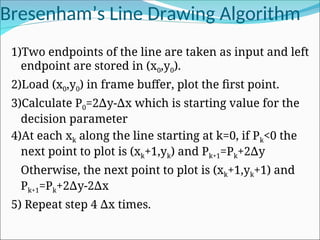
Bresenham’s Line Drawing Algorithm
1)Two endpoints of the line are taken as input and left
endpoint are stored in (x0,y0).
2)Load (x0,y0) in frame buffer, plot the first point.
3)Calculate P0=2 y- x which is starting value for the
∆ ∆
decision parameter
4)At each xk along the line starting at k=0, if Pk<0 the
next point to plot is (xk+1,yk) and Pk+1=Pk+2 y
∆
Otherwise, the next point to plot is (xk+1,yk+1) and
Pk+1=Pk+2 y-2 x
∆ ∆
5) Repeat step 4 x times.
∆
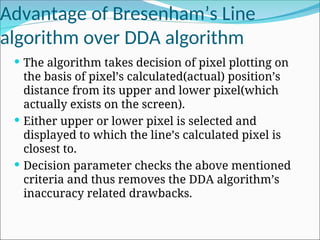
Advantage of Bresenham’s Line
algorithm over DDA algorithm
 The algorithm takes decision of pixel plotting on
the basis of pixel’s calculated(actual) position’s
distance from its upper and lower pixel(which
actually exists on the screen).
 Either upper or lower pixel is selected and
displayed to which the line’s calculated pixel is
closest to.
 Decision parameter checks the above mentioned
criteria and thus removes the DDA algorithm’s
inaccuracy related drawbacks.
Mathematical Problem on Bresenham’s
Line algorithm
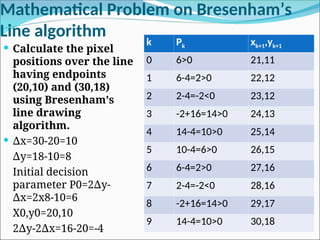
 Calculate the pixel
positions over the line
having endpoints
(20,10) and (30,18)
using Bresenham’s
line drawing
algorithm.
 ∆x=30-20=10
∆y=18-10=8
Initial decision
parameter P0=2 y-
∆
x=2x8-10=6
∆
X0,y0=20,10
2 y-2 x=16-20=-4
∆ ∆
k Pk xk+1,yk+1
0 6>0 21,11
1 6-4=2>0 22,12
2 2-4=-2<0 23,12
3 -2+16=14>0 24,13
4 14-4=10>0 25,14
5 10-4=6>0 26,15
6 6-4=2>0 27,16
7 2-4=-2<0 28,16
8 -2+16=14>0 29,17
9 14-4=10>0 30,18
Mathematical Problem on
Bresenham’s Line algorithm
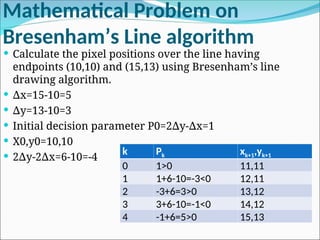
 Calculate the pixel positions over the line having
endpoints (10,10) and (15,13) using Bresenham’s line
drawing algorithm.
 ∆x=15-10=5
 ∆y=13-10=3
 Initial decision parameter P0=2 y- x=1
∆ ∆
 X0,y0=10,10
 2 y-2 x=6-10=-4
∆ ∆
k Pk xk+1,yk+1
0 1>0 11,11
1 1+6-10=-3<0 12,11
2 -3+6=3>0 13,12
3 3+6-10=-1<0 14,12
4 -1+6=5>0 15,13
Midpoint Circle Drawing Algorithm
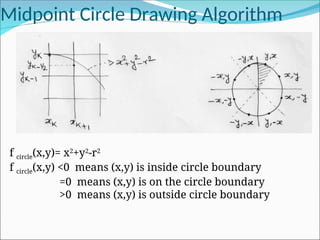
f circle(x,y)= x2
+y2
-r2
f circle(x,y) <0 means (x,y) is inside circle boundary
=0 means (x,y) is on the circle boundary
>0 means (x,y) is outside circle boundary
Midpoint Circle Drawing Algorithm
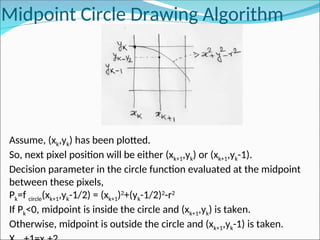
Assume, (xk,yk) has been plotted.
So, next pixel position will be either (xk+1,yk) or (xk+1,yk-1).
Decision parameter in the circle function evaluated at the midpoint
between these pixels,
Pk=f circle(xk+1,yk-1/2) = (xk+1)2
+(yk-1/2)2
-r2
If Pk<0, midpoint is inside the circle and (xk+1,yk) is taken.
Otherwise, midpoint is outside the circle and (xk+1,yk-1) is taken.
Midpoint Circle Drawing Algorithm
 Pk+1=f circle(xk+1+1, yk+1-1/2)
= [(xk+1)+1]2
+ [yk+1-1/2]2
-r2
Pk+1-Pk= (xk+1)2
+1+2(xk+1)+yk+1
2
+1/4-yk+1-r2
-(xk+1)2
-yk
2
-
1/4+yk+r2
= 2(xk+1) + (yk+1
2
-yk
2
)-(yk+1-yk)+1
So, Pk+1=Pk+2(xk+1)+(yk+1
2
-yk
2
)-(yk+1-yk)+1
Midpoint Circle Drawing Algorithm
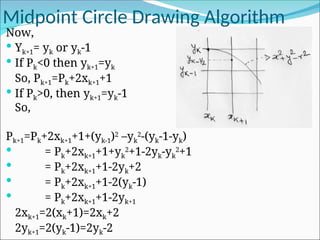
Now,
 Yk+1= yk or yk-1
 If Pk<0 then yk+1=yk
So, Pk+1=Pk+2xk+1+1
 If Pk>0, then yk+1=yk-1
So,
Pk+1=Pk+2xk+1+1+(yk-1)2
–yk
2
-(yk-1-yk)
 = Pk+2xk+1+1+yk
2
+1-2yk-yk
2
+1
 = Pk+2xk+1+1-2yk+2
 = Pk+2xk+1+1-2(yk-1)
 = Pk+2xk+1+1-2yk+1
2xk+1=2(xk+1)=2xk+2
2yk+1=2(yk-1)=2yk-2
Midpoint Circle Drawing Algorithm
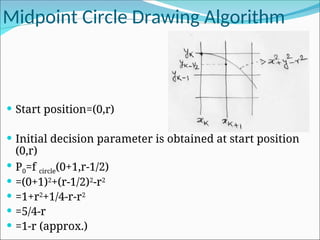
 Start position=(0,r)
 Initial decision parameter is obtained at start position
(0,r)
 P0=f circle(0+1,r-1/2)
 =(0+1)2
+(r-1/2)2
-r2
 =1+r2
+1/4-r-r2
 =5/4-r
 =1-r (approx.)
Midpoint Circle Drawing Algorithm
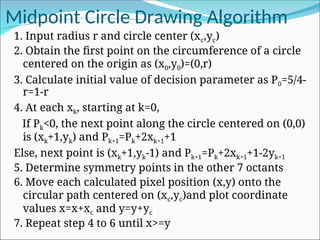
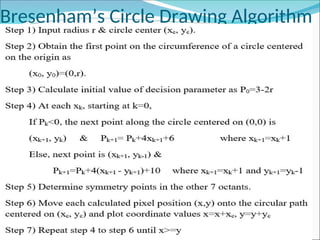
1. Input radius r and circle center (xc,yc)
2. Obtain the first point on the circumference of a circle
centered on the origin as (x0,y0)=(0,r)
3. Calculate initial value of decision parameter as P0=5/4-
r=1-r
4. At each xk, starting at k=0,
If Pk<0, the next point along the circle centered on (0,0)
is (xk+1,yk) and Pk+1=Pk+2xk+1+1
Else, next point is (xk+1,yk-1) and Pk+1=Pk+2xk+1+1-2yk+1
5. Determine symmetry points in the other 7 octants
6. Move each calculated pixel position (x,y) onto the
circular path centered on (xc,yc)and plot coordinate
values x=x+xc and y=y+yc
7. Repeat step 4 to 6 until x>=y
Midpoint Circle Drawing Algorithm
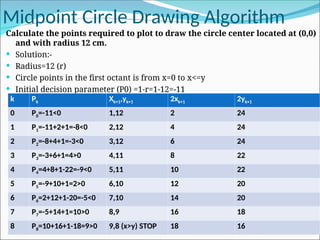
Calculate the points required to plot to draw the circle center located at (0,0)
and with radius 12 cm.
 Solution:-
 Radius=12 (r)
 Circle points in the first octant is from x=0 to x<=y
 Initial decision parameter (P0) =1-r=1-12=-11
k Pk Xk+1,yk+1 2xk+1 2yk+1
0 P0=-11<0 1,12 2 24
1 P1=-11+2+1=-8<0 2,12 4 24
2 P2=-8+4+1=-3<0 3,12 6 24
3 P3=-3+6+1=4>0 4,11 8 22
4 P4=4+8+1-22=-9<0 5,11 10 22
5 P5=-9+10+1=2>0 6,10 12 20
6 P6=2+12+1-20=-5<0 7,10 14 20
7 P7=-5+14+1=10>0 8,9 16 18
8 P8=10+16+1-18=9>0 9,8 (x>y) STOP 18 16
Midpoint Circle Drawing Algorithm
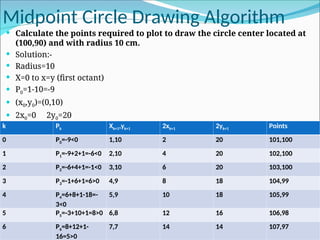
 Calculate the points required to plot to draw the circle center located at
(100,90) and with radius 10 cm.
 Solution:-
 Radius=10
 X=0 to x=y (first octant)
 P0=1-10=-9
 (x0,y0)=(0,10)
 2x0=0 2y0=20
k Pk Xk+1,yk+1 2xk+1 2yk+1 Points
0 P0=-9<0 1,10 2 20 101,100
1 P1=-9+2+1=-6<0 2,10 4 20 102,100
2 P2=-6+4+1=-1<0 3,10 6 20 103,100
3 P3=-1+6+1=6>0 4,9 8 18 104,99
4 P4=6+8+1-18=-
3<0
5,9 10 18 105,99
5 P5=-3+10+1=8>0 6,8 12 16 106,98
6 P6=8+12+1-
16=5>0
7,7 14 14 107,97
Bresenham’s Circle Drawing Algorithm
Parametric equation of Circle
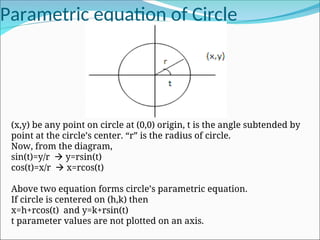
(x,y) be any point on circle at (0,0) origin, t is the angle subtended by
point at the circle’s center. “r” is the radius of circle.
Now, from the diagram,
sin(t)=y/r  y=rsin(t)
cos(t)=x/r  x=rcos(t)
Above two equation forms circle’s parametric equation.
If circle is centered on (h,k) then
x=h+rcos(t) and y=k+rsin(t)
t parameter values are not plotted on an axis.

2.Line,circle drawing.ppt line circlw drawing algorith

  • 1.
    Line, Circle Drawingalgorithm Prepared & Compiled by Prof. Abhijit Sarkar IEM, Salt Lake
  • 2.
    Digital Differential AnalyzerAlgorithm(DDA) Cartesian slope-intercept equation for a straight line, y=mx+b (m=slope, b= y-intercept) m=dy/dx= y/ x ∆ ∆ b= y1-mx1 Now, case 1:- (|m|<1) yi=mxi+b yi+1=m(xi+1)+b =mxi+m+b = yi+m Case 2:- (|m|>1) xi=(yi-b)/m xi+1=(yi+1-b)/m =[(yi-b)/m] + [1/m] = xi+1/m
  • 3.
    DDA Algorithm Statement 1)Two endpoints of the line (x1,y1) and (x2,y2) are taken as input. 2) Slope of the line m=dy/dx= y/ x=(y2-y1)/(x2-x1) is calculated. ∆ ∆ 3) First endpoint (x1,y1) is plotted. 4) a. If slope(m)<1, then x-values across the line is increased by a factor of 1 till x2 is reached and corresponding y-values are calculated as yi+1= yi+m 4) b. If slope(m)>1, then y-values across the line is increased by a factor of 1 till y2 is reached and corresponding x-values are calculated as xi+1= xi+1/m  Drawback:- DDA algorithm fails to accurately map the calculated pixel to their nearby screen pixels i.e. scan conversion is most of the time unsuccessful in this algorithm. Example:- If calculated position is (11.8) it is mapped to screen pixel coordinate 11 not 12.
  • 4.
    Problem on DDAAlgorithm Problem:- Two endpoints of line are (10,10) and (20,16). Find all coordinates of pixels over the line using DDA algorithm. Solution:- Slope of line(m) = y/ x =16-10/ 20-10=6/10=0.6 ∆ ∆ Points are as follows:- [xi+1= xi+1 and yi+1= yi+m] <10,10> <11,10+0.6>=<11,10.6> <12,10.6+0.6>=<12,11.2> <13,11.2+0.6>=<13,11.8> <14,11.8+0.6>=<14.12.4> <15,12.4+0.6>=<15,13> <16,13+0.6>=<16,13.6> <17,13.6+0.6>=<17,14.2> <18,14.2+0.6>=<18,14.8> <19,14.8+0.6>=<19,15.4> <20,15.4+0.6>=<20,16>
  • 5.
    Bresenham’s Line DrawingAlgorithm y=m(xk+1)+b d1=y-yk = m(xk+1)+b-yk d2=(yk+1)-y d1-d2= m(xk+1)+b-yk-yk-1+m(xk+1)+b = 2m(xk+1)-2yk+2b-1 = 2 y/ x* (x ∆ ∆ k+1)-2yk+2b-1
  • 6.
    Bresenham’s Line DrawingAlgorithm ∆x(d1-d2)= 2 yx ∆ k+2 y -2 xy ∆ ∆ k+2 xb- x ∆ ∆ Now, Pk=2 yx ∆ k-2 xy ∆ k+c where, c=2 y+ x(2b-1) [P ∆ ∆ k= x(d ∆ 1-d2)] Pk+1=2 yx ∆ k+1-2 xy ∆ k+1+c where, xk+1=xk+1 Pk+1-Pk=2 yx ∆ k+2 y-2 xy ∆ ∆ k+1-2 yx ∆ k+2 xy ∆ k Pk+1=Pk+2 y-2 x(y ∆ ∆ k+1-yk) Now, yk+1= yk or yk+1 Either 0 or 1 P0=2 yx ∆ k-2 xy ∆ k+c y0=mx0+b= y/ x*x ∆ ∆ 0+b =2 yx ∆ k-2 xy ∆ k+2 y+ x(2b-1) ∆ ∆ xy ∆ 0= yx ∆ 0+ xb ∆ =2 yx ∆ 0-2 xy ∆ 0+2 y+ x(2b-1) ∆ ∆ =2 yx ∆ 0-2 yx ∆ 0-2 xb+2 y+2 xb- x ∆ ∆ ∆ ∆ = 2 y- x ∆ ∆
  • 7.
    Bresenham’s Line DrawingAlgorithm 1)Two endpoints of the line are taken as input and left endpoint are stored in (x0,y0). 2)Load (x0,y0) in frame buffer, plot the first point. 3)Calculate P0=2 y- x which is starting value for the ∆ ∆ decision parameter 4)At each xk along the line starting at k=0, if Pk<0 the next point to plot is (xk+1,yk) and Pk+1=Pk+2 y ∆ Otherwise, the next point to plot is (xk+1,yk+1) and Pk+1=Pk+2 y-2 x ∆ ∆ 5) Repeat step 4 x times. ∆
  • 8.
    Advantage of Bresenham’sLine algorithm over DDA algorithm  The algorithm takes decision of pixel plotting on the basis of pixel’s calculated(actual) position’s distance from its upper and lower pixel(which actually exists on the screen).  Either upper or lower pixel is selected and displayed to which the line’s calculated pixel is closest to.  Decision parameter checks the above mentioned criteria and thus removes the DDA algorithm’s inaccuracy related drawbacks.
  • 9.
    Mathematical Problem onBresenham’s Line algorithm  Calculate the pixel positions over the line having endpoints (20,10) and (30,18) using Bresenham’s line drawing algorithm.  ∆x=30-20=10 ∆y=18-10=8 Initial decision parameter P0=2 y- ∆ x=2x8-10=6 ∆ X0,y0=20,10 2 y-2 x=16-20=-4 ∆ ∆ k Pk xk+1,yk+1 0 6>0 21,11 1 6-4=2>0 22,12 2 2-4=-2<0 23,12 3 -2+16=14>0 24,13 4 14-4=10>0 25,14 5 10-4=6>0 26,15 6 6-4=2>0 27,16 7 2-4=-2<0 28,16 8 -2+16=14>0 29,17 9 14-4=10>0 30,18
  • 10.
    Mathematical Problem on Bresenham’sLine algorithm  Calculate the pixel positions over the line having endpoints (10,10) and (15,13) using Bresenham’s line drawing algorithm.  ∆x=15-10=5  ∆y=13-10=3  Initial decision parameter P0=2 y- x=1 ∆ ∆  X0,y0=10,10  2 y-2 x=6-10=-4 ∆ ∆ k Pk xk+1,yk+1 0 1>0 11,11 1 1+6-10=-3<0 12,11 2 -3+6=3>0 13,12 3 3+6-10=-1<0 14,12 4 -1+6=5>0 15,13
  • 11.
    Midpoint Circle DrawingAlgorithm f circle(x,y)= x2 +y2 -r2 f circle(x,y) <0 means (x,y) is inside circle boundary =0 means (x,y) is on the circle boundary >0 means (x,y) is outside circle boundary
  • 12.
    Midpoint Circle DrawingAlgorithm Assume, (xk,yk) has been plotted. So, next pixel position will be either (xk+1,yk) or (xk+1,yk-1). Decision parameter in the circle function evaluated at the midpoint between these pixels, Pk=f circle(xk+1,yk-1/2) = (xk+1)2 +(yk-1/2)2 -r2 If Pk<0, midpoint is inside the circle and (xk+1,yk) is taken. Otherwise, midpoint is outside the circle and (xk+1,yk-1) is taken.
  • 13.
    Midpoint Circle DrawingAlgorithm  Pk+1=f circle(xk+1+1, yk+1-1/2) = [(xk+1)+1]2 + [yk+1-1/2]2 -r2 Pk+1-Pk= (xk+1)2 +1+2(xk+1)+yk+1 2 +1/4-yk+1-r2 -(xk+1)2 -yk 2 - 1/4+yk+r2 = 2(xk+1) + (yk+1 2 -yk 2 )-(yk+1-yk)+1 So, Pk+1=Pk+2(xk+1)+(yk+1 2 -yk 2 )-(yk+1-yk)+1
  • 14.
    Midpoint Circle DrawingAlgorithm Now,  Yk+1= yk or yk-1  If Pk<0 then yk+1=yk So, Pk+1=Pk+2xk+1+1  If Pk>0, then yk+1=yk-1 So, Pk+1=Pk+2xk+1+1+(yk-1)2 –yk 2 -(yk-1-yk)  = Pk+2xk+1+1+yk 2 +1-2yk-yk 2 +1  = Pk+2xk+1+1-2yk+2  = Pk+2xk+1+1-2(yk-1)  = Pk+2xk+1+1-2yk+1 2xk+1=2(xk+1)=2xk+2 2yk+1=2(yk-1)=2yk-2
  • 15.
    Midpoint Circle DrawingAlgorithm  Start position=(0,r)  Initial decision parameter is obtained at start position (0,r)  P0=f circle(0+1,r-1/2)  =(0+1)2 +(r-1/2)2 -r2  =1+r2 +1/4-r-r2  =5/4-r  =1-r (approx.)
  • 16.
    Midpoint Circle DrawingAlgorithm 1. Input radius r and circle center (xc,yc) 2. Obtain the first point on the circumference of a circle centered on the origin as (x0,y0)=(0,r) 3. Calculate initial value of decision parameter as P0=5/4- r=1-r 4. At each xk, starting at k=0, If Pk<0, the next point along the circle centered on (0,0) is (xk+1,yk) and Pk+1=Pk+2xk+1+1 Else, next point is (xk+1,yk-1) and Pk+1=Pk+2xk+1+1-2yk+1 5. Determine symmetry points in the other 7 octants 6. Move each calculated pixel position (x,y) onto the circular path centered on (xc,yc)and plot coordinate values x=x+xc and y=y+yc 7. Repeat step 4 to 6 until x>=y
  • 17.
    Midpoint Circle DrawingAlgorithm Calculate the points required to plot to draw the circle center located at (0,0) and with radius 12 cm.  Solution:-  Radius=12 (r)  Circle points in the first octant is from x=0 to x<=y  Initial decision parameter (P0) =1-r=1-12=-11 k Pk Xk+1,yk+1 2xk+1 2yk+1 0 P0=-11<0 1,12 2 24 1 P1=-11+2+1=-8<0 2,12 4 24 2 P2=-8+4+1=-3<0 3,12 6 24 3 P3=-3+6+1=4>0 4,11 8 22 4 P4=4+8+1-22=-9<0 5,11 10 22 5 P5=-9+10+1=2>0 6,10 12 20 6 P6=2+12+1-20=-5<0 7,10 14 20 7 P7=-5+14+1=10>0 8,9 16 18 8 P8=10+16+1-18=9>0 9,8 (x>y) STOP 18 16
  • 18.
    Midpoint Circle DrawingAlgorithm  Calculate the points required to plot to draw the circle center located at (100,90) and with radius 10 cm.  Solution:-  Radius=10  X=0 to x=y (first octant)  P0=1-10=-9  (x0,y0)=(0,10)  2x0=0 2y0=20 k Pk Xk+1,yk+1 2xk+1 2yk+1 Points 0 P0=-9<0 1,10 2 20 101,100 1 P1=-9+2+1=-6<0 2,10 4 20 102,100 2 P2=-6+4+1=-1<0 3,10 6 20 103,100 3 P3=-1+6+1=6>0 4,9 8 18 104,99 4 P4=6+8+1-18=- 3<0 5,9 10 18 105,99 5 P5=-3+10+1=8>0 6,8 12 16 106,98 6 P6=8+12+1- 16=5>0 7,7 14 14 107,97
  • 19.
  • 20.
    Parametric equation ofCircle (x,y) be any point on circle at (0,0) origin, t is the angle subtended by point at the circle’s center. “r” is the radius of circle. Now, from the diagram, sin(t)=y/r  y=rsin(t) cos(t)=x/r  x=rcos(t) Above two equation forms circle’s parametric equation. If circle is centered on (h,k) then x=h+rcos(t) and y=k+rsin(t) t parameter values are not plotted on an axis.