MID-DAY MEAL
APPLIED NUTRITION PROGRAMME
PRESENTED BY: MEHVISH IQBAL
CONTENT
• Applied nutrition programme
• Mid-day meal programme 1961
• Principles
• Mid-day meal model menu
• Mid-day meal scheme
• benefits
• Suggestions for preparation of nutritious meal
• PM POSHAN
• Role of nurse in mid-day meal programme.
‘There is an interesting story about how K.KAMARAJ(3rd
CM of Tamil Nadu)
got an idea of noon meal scheme.
He saw a few boys busy with their cows and goats.
He asked one small boy, “What are you doing with these cows? Why didn’t
you go to school?”
The boy immediately answered,: If I go to school, will you give me food to
eat? I can learn only if I eat.
The boy’s retort sparked the entire process into establishing the MID-DAY
MEAL PROGRAMME.’
Applied nutrition programme (ANP):
A nationwide village based ANP introduced in 1963. India signs a
master plan of operation with UNICEF and other agencies ,
WHO and FAO for the improvement of health status of pregnant
and lactating women and children.
Objectives of ANP:
•Increase production of protective foods
•Encourage consumption of these foods by poor class,
children and mother.
•Promote nutritional education.
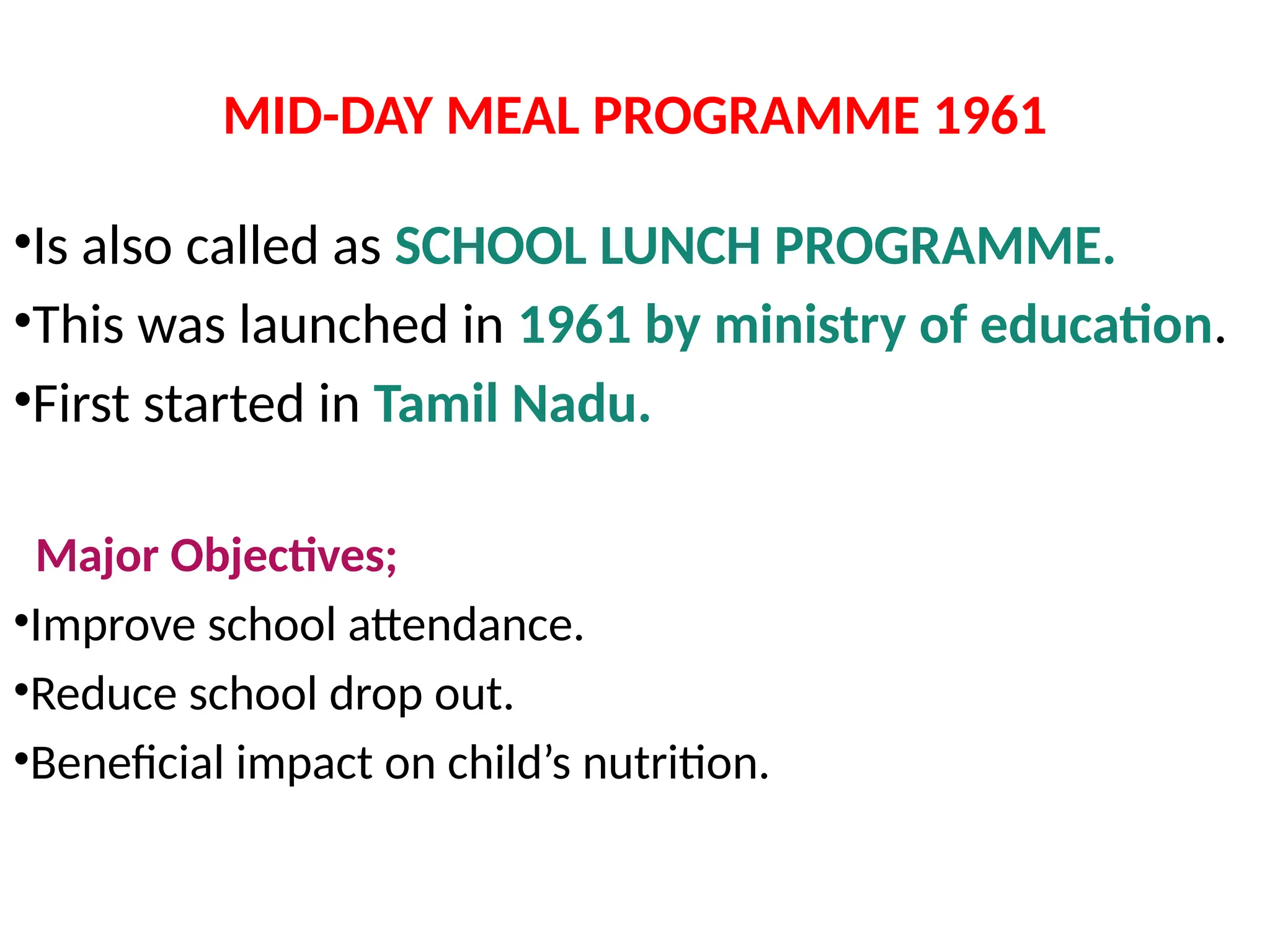
MID-DAY MEAL PROGRAMME 1961
•Is also called as SCHOOL LUNCH PROGRAMME.
•This was launched in 1961 by ministry of education.
•First started in Tamil Nadu.
Major Objectives;
•Improve school attendance.
•Reduce school drop out.
•Beneficial impact on child’s nutrition.
Principles;
• Supplement and not to substitute to the home diet.
• Supply at-least 1/3 of energy requirement and ½ of
protein needed.
• Cost of meal should be reasonably low.
• Meal prepared easily in school, no complicated cooking
procedures.
• Locally available foods should be used.
• The menu should be changed frequently.
• The meal should be hygienic.
The mid-day meal programme became part of the
minimum needs programme in FIFTH FIVE YEAR PLAN.
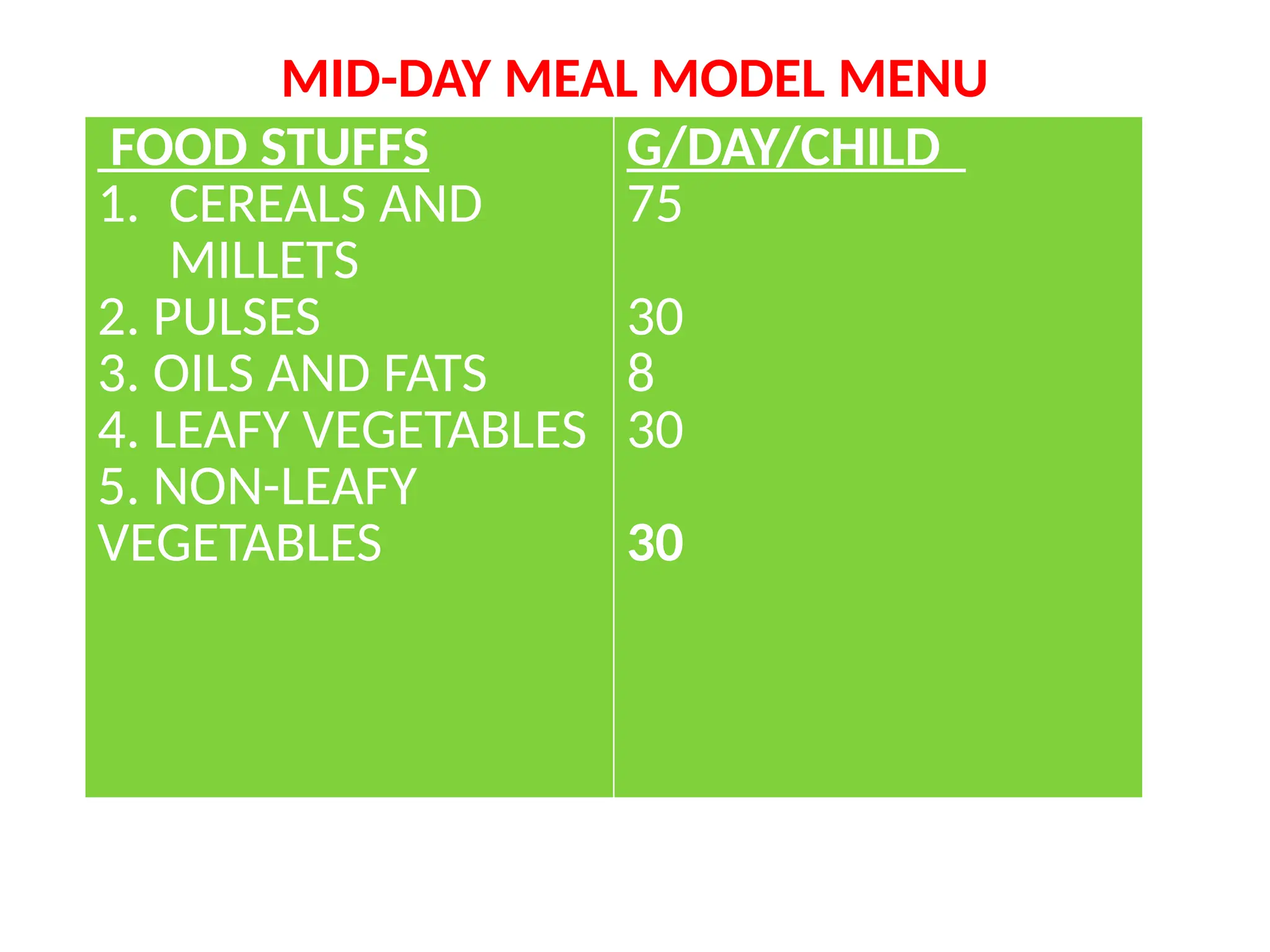
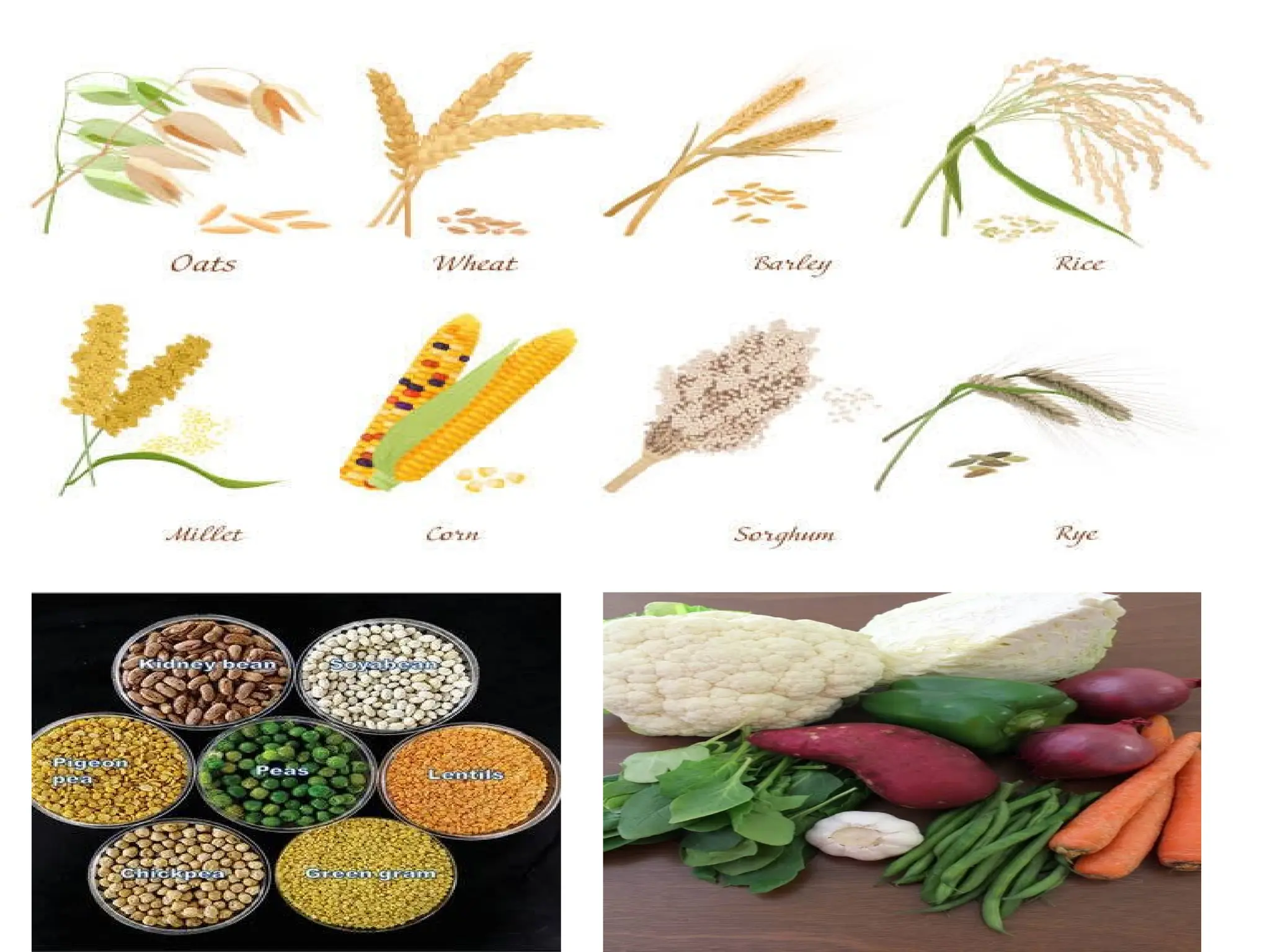
MID-DAY MEAL MODEL MENU
VVHUTRFYU
FOOD STUFFS
1. CEREALS AND
MILLETS
2. PULSES
3. OILS AND FATS
4. LEAFY VEGETABLES
5. NON-LEAFY
VEGETABLES
G/DAY/CHILD
75
30
8
30
30
MID-DAY MEAL SCHEME;
•Also called as National programme of nutritional support to primary
Education.
•Launched as a centrally sponsored scheme on 15 AUG 1995 and
revised in 2004.
Objective:
Universalization of primary education by
Increasing enrolment, retention and
Attendance and simultaneously impacting
On nutrition of students in primary classes.
It was implemented in 2408 blocks in the
First year covered the whole country in
Phased manner by 1997-98.
Cont.
• The programme originally covered children of primary stage
(1 to 5 classes) in govt. , local body and govt. aided schools
and was extended in OCT 2002 to cover children studying in
Education Guarantee Scheme and Alternative and
Innovative Education Centers also.
• The central assistance provided to states by way of free
supply of food grains from nearest Food Corporation of
India godown at the rate of 100g per student per day and
subsidy for transport of food grain.
• 300 calories and 8-12g of protein content will be provided
to all the children in class 1 to 5.
• In 2007 the scheme extended to cover 6th
to 7th
class in
upper primary of educationally backward block.
Benefits :
• Admissions in schools will be enhanced.
• Children attend school regularly.
• Enhance social interaction.
• Facilitate healthy growth of children.
• It is an opportunity to impart various good habits in
children (hand washing).
• Fosters social and gender equality.
• Facilitates cognitive, emotional and social development of
children.
SUGGESTIONS FOR PREPARATION 0F NUTRITIOUS MEAL
• Food be stored in tight containers.
• Use whole wheat or broken wheat.
• Rice par boiled or unpolished.
• Cereal pulse combination used.
• Sprouted pulses should be included.
• Wash the ingredients before cooking.
• Fermentation improves nutritive value.
• Cooking with lid to avoid wastage of nutrients.
• Avoid reheated oil.
• Overcooking should be avoided.
PM POSHAN
• The Union Cabinet Committee
on Economic Affairs (CCEA) chaired
by PM Narendra Modi approved the
pradadhan mantri poshan shakti nirman
(PM POSHAN) , a modified version
of existing MDMS on 29 SEP 2021.
• Meals will now be extended to students studying in pre-primary
levels or Bal Vatikas of govt. and govt. aided primary schools in
addition to those already covered under the scheme.
ROLE OF NURSE:
• Awareness to families in-order to improve health
status, reduce dropouts, increase enrolment.
• Education about menu planning.
• Identifying malnourished and maintaining growth
chart and in severe cases provision of referral
services.
• Education about best and easy way to achieve
nutritious diet.
• Educate about hygienic practices to prevent food
poisoning.
Cont…
• Periodic health checkup of cook cum helper is
done.
• Education regarding proper storage of food
items.
• Collaboration with government and non-
government agencies for betterment of
children.
Reference
• Textbook of community health nursing 2
prof. RP SAXENA
• Essentials of community health nursing (5th
edition)
K.PARK
• Textbook of community health nursing 2
SHYMALA D
MIDDAY MEAL applied Nutrition programme.pptx

MIDDAY MEAL applied Nutrition programme.pptx

  • 2.
    MID-DAY MEAL APPLIED NUTRITIONPROGRAMME PRESENTED BY: MEHVISH IQBAL
  • 3.
    CONTENT • Applied nutritionprogramme • Mid-day meal programme 1961 • Principles • Mid-day meal model menu • Mid-day meal scheme • benefits • Suggestions for preparation of nutritious meal • PM POSHAN • Role of nurse in mid-day meal programme.
  • 4.
    ‘There is aninteresting story about how K.KAMARAJ(3rd CM of Tamil Nadu) got an idea of noon meal scheme. He saw a few boys busy with their cows and goats. He asked one small boy, “What are you doing with these cows? Why didn’t you go to school?” The boy immediately answered,: If I go to school, will you give me food to eat? I can learn only if I eat. The boy’s retort sparked the entire process into establishing the MID-DAY MEAL PROGRAMME.’
  • 5.
    Applied nutrition programme(ANP): A nationwide village based ANP introduced in 1963. India signs a master plan of operation with UNICEF and other agencies , WHO and FAO for the improvement of health status of pregnant and lactating women and children. Objectives of ANP: •Increase production of protective foods •Encourage consumption of these foods by poor class, children and mother. •Promote nutritional education.
  • 6.
    MID-DAY MEAL PROGRAMME1961 •Is also called as SCHOOL LUNCH PROGRAMME. •This was launched in 1961 by ministry of education. •First started in Tamil Nadu. Major Objectives; •Improve school attendance. •Reduce school drop out. •Beneficial impact on child’s nutrition.
  • 7.
    Principles; • Supplement andnot to substitute to the home diet. • Supply at-least 1/3 of energy requirement and ½ of protein needed. • Cost of meal should be reasonably low. • Meal prepared easily in school, no complicated cooking procedures. • Locally available foods should be used. • The menu should be changed frequently. • The meal should be hygienic. The mid-day meal programme became part of the minimum needs programme in FIFTH FIVE YEAR PLAN.
  • 8.
    MID-DAY MEAL MODELMENU VVHUTRFYU FOOD STUFFS 1. CEREALS AND MILLETS 2. PULSES 3. OILS AND FATS 4. LEAFY VEGETABLES 5. NON-LEAFY VEGETABLES G/DAY/CHILD 75 30 8 30 30
  • 11.
    MID-DAY MEAL SCHEME; •Alsocalled as National programme of nutritional support to primary Education. •Launched as a centrally sponsored scheme on 15 AUG 1995 and revised in 2004. Objective: Universalization of primary education by Increasing enrolment, retention and Attendance and simultaneously impacting On nutrition of students in primary classes. It was implemented in 2408 blocks in the First year covered the whole country in Phased manner by 1997-98.
  • 12.
    Cont. • The programmeoriginally covered children of primary stage (1 to 5 classes) in govt. , local body and govt. aided schools and was extended in OCT 2002 to cover children studying in Education Guarantee Scheme and Alternative and Innovative Education Centers also. • The central assistance provided to states by way of free supply of food grains from nearest Food Corporation of India godown at the rate of 100g per student per day and subsidy for transport of food grain. • 300 calories and 8-12g of protein content will be provided to all the children in class 1 to 5.
  • 13.
    • In 2007the scheme extended to cover 6th to 7th class in upper primary of educationally backward block. Benefits : • Admissions in schools will be enhanced. • Children attend school regularly. • Enhance social interaction. • Facilitate healthy growth of children. • It is an opportunity to impart various good habits in children (hand washing). • Fosters social and gender equality. • Facilitates cognitive, emotional and social development of children.
  • 14.
    SUGGESTIONS FOR PREPARATION0F NUTRITIOUS MEAL • Food be stored in tight containers. • Use whole wheat or broken wheat. • Rice par boiled or unpolished. • Cereal pulse combination used. • Sprouted pulses should be included. • Wash the ingredients before cooking. • Fermentation improves nutritive value. • Cooking with lid to avoid wastage of nutrients. • Avoid reheated oil. • Overcooking should be avoided.
  • 15.
    PM POSHAN • TheUnion Cabinet Committee on Economic Affairs (CCEA) chaired by PM Narendra Modi approved the pradadhan mantri poshan shakti nirman (PM POSHAN) , a modified version of existing MDMS on 29 SEP 2021. • Meals will now be extended to students studying in pre-primary levels or Bal Vatikas of govt. and govt. aided primary schools in addition to those already covered under the scheme.
  • 16.
    ROLE OF NURSE: •Awareness to families in-order to improve health status, reduce dropouts, increase enrolment. • Education about menu planning. • Identifying malnourished and maintaining growth chart and in severe cases provision of referral services. • Education about best and easy way to achieve nutritious diet. • Educate about hygienic practices to prevent food poisoning.
  • 17.
    Cont… • Periodic healthcheckup of cook cum helper is done. • Education regarding proper storage of food items. • Collaboration with government and non- government agencies for betterment of children.
  • 18.
    Reference • Textbook ofcommunity health nursing 2 prof. RP SAXENA • Essentials of community health nursing (5th edition) K.PARK • Textbook of community health nursing 2 SHYMALA D