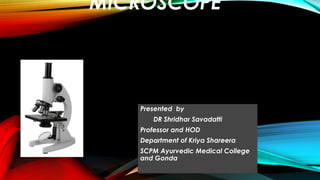
MICROSCOPE
Presented by
DR Shridhar Savadatti
Professor and HOD
Department of Kriya Shareera
SCPM Ayurvedic Medical College
and Gonda
AIM :
To study the parts of a compound
microscope and to view the slides under
microscope.
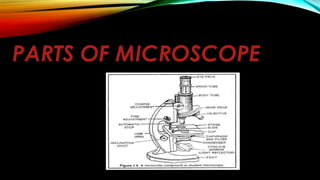
PARTS OF MICROSCOPE
•BASE :
It is u shape and supports the
microscope and provides maximum stability.
•PILLARS :
They are two in numbers and
projects upward direction from the Base and
extended upto the handle of microscope.
•HANDLE :
It is curved and it is used to tilt the
microscope it supports the magnifying and
attached to the handle adjusting system.
•BODY TUBE/BARREL :
is attached to the handle,it can
be raised and lowered while seeing the
slides.The length of the tube is 160mm.
•ADJUSTMENT SCREWS :
They include coarse
adjustment screws and the fine adjustment
screw.When viewing a slide the field is
initially focused using coarse adjusting
screw and then fine adjustment should be
done.
•STAGES :
They include fixed and mechanical
stage.Fixed stage is a square platform with
aperture in its centre and allows the light to
pass from the light source to the lens.The slide
to be placed is viewed on this
stage.Mechanical stage is fitted on the fixed
stage is a calibrated metal frame with a spring
mounted clip that holds the slide in position.
•NOSE PIECE :
It lies over the lower end of the
body tube.It includes fixed nose piece,that is
stationary and fitted to the lower end of body
tube.
•REVOLVING NOSE PIECE :
It is present below fixed nose
piece.The nose piece carry the objective lens.
• Objective lens :
They are three in numbers fitted to the revolving
nose piece.It includes low power objective lens(10
times).
HIGH POWER OBJECTIVE LENS (40-45 times)
OIL EMERSION OBJECTIVE (100 TIMES)
• EYE PIECE :
It is fitted on the top of the body tube commonly
used eye piece have magnifying power of 10 times.
• MIRROR AND ILLUMINATION :
It lies at the lower end of the microscope just below the
condenser. It can be adjusted to the reflect light rays into condenser.
It has two surfaces
1. Plane surface:Natural day light – distant one.
2. Concave surface:Electrical lamp-nearer to MICROSCOPE.
• CONDENSOR:
is fitted under the fixed stage and it can be raised or lower
using screw.It has two lens iris and diaphragm that can be
manipulated to control the amount of light entering the microscope.
•Magnifying system :
It plays an important role in the use
of microscope because it magnifies the
image of the object under view.The
compound microscope consist of two
magnifying lenses,the eye piece and
objective.
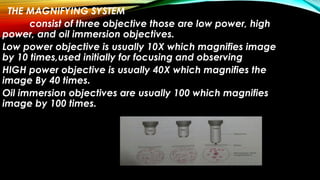
THE MAGNIFYING SYSTEM
consist of three objective those are low power, high
power, and oil immersion objectives.
Low power objective is usually 10X which magnifies image
by 10 times,used initially for focusing and observing
HIGH power objective is usually 40X which magnifies the
image By 40 times.
Oil immersion objectives are usually 100 which magnifies
image by 100 times.
• PRECAUTIONS :
1. Microscope should be placed on working table in stable
position.
2. The hight of the observer chair should be reviewed to a position
that allows for comfortable handling of microscope.
3. If natural light is used the microscope should be kept near the
window.
4. The mirror , the potion of handling and the aperture of the iris
should be checked in order to get proper illumination.
5. Keep the microscope covered when you are not using it.

micrscope.pptx NCSIM Kriya Shareera Practical

  • 1.
    MICROSCOPE Presented by DR ShridharSavadatti Professor and HOD Department of Kriya Shareera SCPM Ayurvedic Medical College and Gonda
  • 2.
    AIM : To studythe parts of a compound microscope and to view the slides under microscope.
  • 3.
  • 4.
    •BASE : It isu shape and supports the microscope and provides maximum stability. •PILLARS : They are two in numbers and projects upward direction from the Base and extended upto the handle of microscope.
  • 5.
    •HANDLE : It iscurved and it is used to tilt the microscope it supports the magnifying and attached to the handle adjusting system. •BODY TUBE/BARREL : is attached to the handle,it can be raised and lowered while seeing the slides.The length of the tube is 160mm.
  • 6.
    •ADJUSTMENT SCREWS : Theyinclude coarse adjustment screws and the fine adjustment screw.When viewing a slide the field is initially focused using coarse adjusting screw and then fine adjustment should be done.
  • 7.
    •STAGES : They includefixed and mechanical stage.Fixed stage is a square platform with aperture in its centre and allows the light to pass from the light source to the lens.The slide to be placed is viewed on this stage.Mechanical stage is fitted on the fixed stage is a calibrated metal frame with a spring mounted clip that holds the slide in position.
  • 8.
    •NOSE PIECE : Itlies over the lower end of the body tube.It includes fixed nose piece,that is stationary and fitted to the lower end of body tube. •REVOLVING NOSE PIECE : It is present below fixed nose piece.The nose piece carry the objective lens.
  • 9.
    • Objective lens: They are three in numbers fitted to the revolving nose piece.It includes low power objective lens(10 times). HIGH POWER OBJECTIVE LENS (40-45 times) OIL EMERSION OBJECTIVE (100 TIMES) • EYE PIECE : It is fitted on the top of the body tube commonly used eye piece have magnifying power of 10 times.
  • 10.
    • MIRROR ANDILLUMINATION : It lies at the lower end of the microscope just below the condenser. It can be adjusted to the reflect light rays into condenser. It has two surfaces 1. Plane surface:Natural day light – distant one. 2. Concave surface:Electrical lamp-nearer to MICROSCOPE. • CONDENSOR: is fitted under the fixed stage and it can be raised or lower using screw.It has two lens iris and diaphragm that can be manipulated to control the amount of light entering the microscope.
  • 11.
    •Magnifying system : Itplays an important role in the use of microscope because it magnifies the image of the object under view.The compound microscope consist of two magnifying lenses,the eye piece and objective.
  • 12.
    THE MAGNIFYING SYSTEM consistof three objective those are low power, high power, and oil immersion objectives. Low power objective is usually 10X which magnifies image by 10 times,used initially for focusing and observing HIGH power objective is usually 40X which magnifies the image By 40 times. Oil immersion objectives are usually 100 which magnifies image by 100 times.
  • 13.
    • PRECAUTIONS : 1.Microscope should be placed on working table in stable position. 2. The hight of the observer chair should be reviewed to a position that allows for comfortable handling of microscope. 3. If natural light is used the microscope should be kept near the window. 4. The mirror , the potion of handling and the aperture of the iris should be checked in order to get proper illumination. 5. Keep the microscope covered when you are not using it.