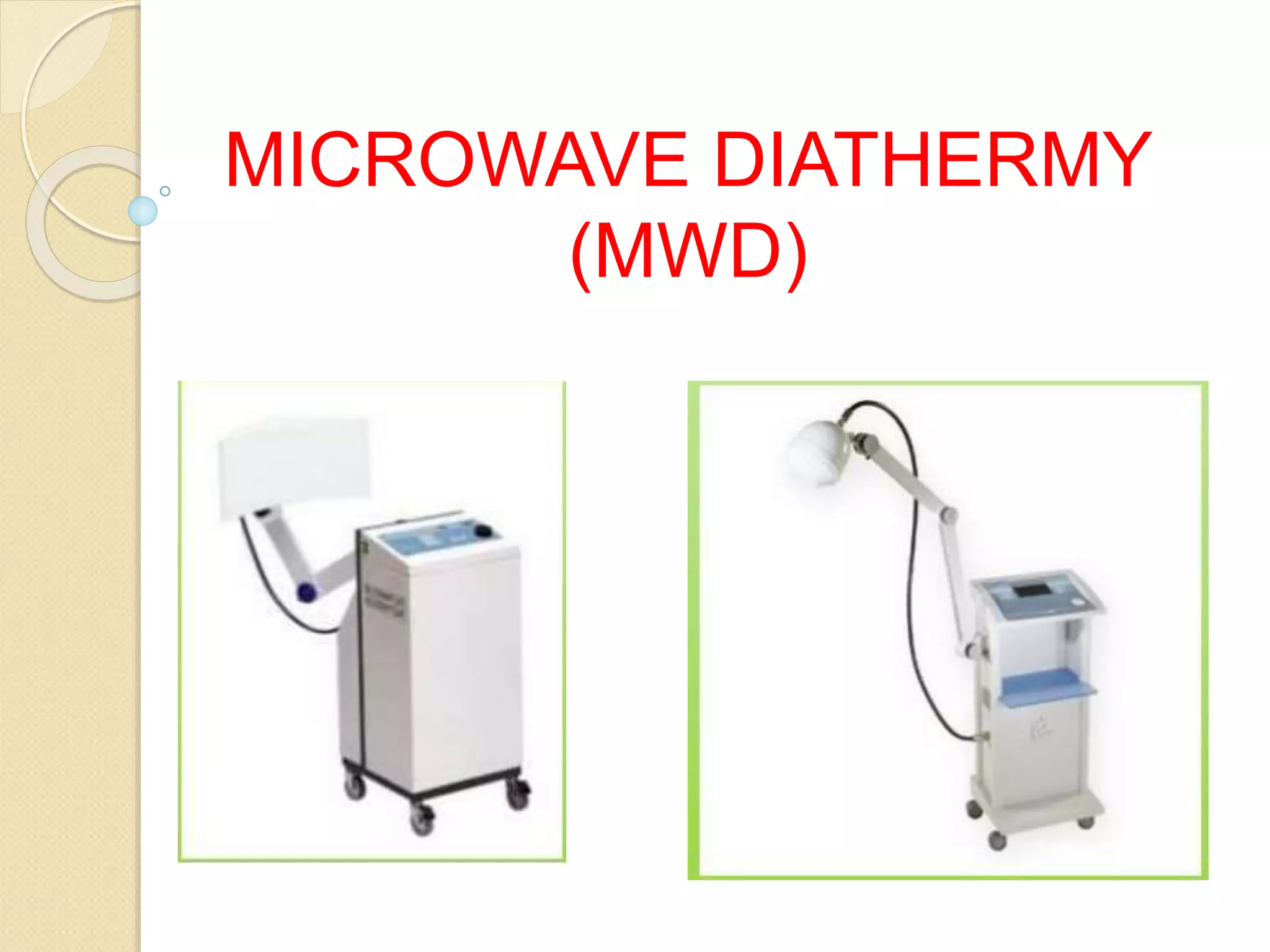
MICROWAVE DIATHERMY
(MWD)
Diathermy
Diathermy is a Greek word for “ through heating”, in which
a high frequency (>10.000Hz)
An electromagnetic current is applied to induce deep
heating within body tissue, to induce physiological effects
for therapeutic purposes.
1. Shortwave Diathermy (SWD)
2. Microwave Diathermy(MWD)
3. Pulsed Electromagnetic (PEM)
Microwave Diathermy
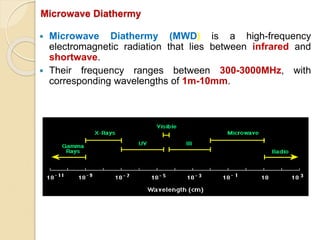
 Microwave Diathermy (MWD) is a high-frequency
electromagnetic radiation that lies between infrared and
shortwave.
 Their frequency ranges between 300-3000MHz, with
corresponding wavelengths of 1m-10mm.
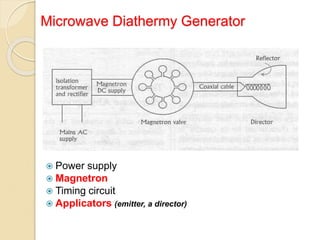
Microwave Diathermy Generator
 Power supply
 Magnetron
 Timing circuit
 Applicators (emitter, a director)
Principles Of MWD
 Deep heating modality
 Emits strong electrical field/ little magnetic field.
 Depth of penetration is frequency dependent.
 Produces much more localized & concentrated heating
effect than SWD.
 Providing a more shallow tissue heating effect, depends on
the type of tissue involved.
 Reflection, Refraction, and Absorption
Principle Of MWD
 MWD are strongly absorbed by tissues with high fluid
content and are heated most, while penetrated by tissues
with low fluid content (e.g. fat or bones).
 Tissues with low water content (fat) are penetrated to a
greater depth (half value thickness=3.5cm).
 Tissue with high water content (muscle, blood) is
penetrated to a superficial depth (=0.7cm).
The effective depth of MWD penetration (half-value depth)
is about 4.5 cm, so the depth of heating is intermediate
between that of infrared radiation (2cm) and short wave
diathermy (>5cm).
Principle of MWD
 The patients does not form apart of the circuit in MWD, so no
tuning is necessary as in SWD.
 Transmits as free space radiation, so needs only one emitter
(applicator).
 No Metal should be within 4 feet of MWD, since it will
interfere with the signal.
 Spacing is required between the skin and the applicators
with MWD, where the applicator on a short wave unit my be
placed in contact with treatment area.
Physiological and Therapeutic Effects of MWD
When the electromagnetic radiation of MWD enters the
body causes
◦ Ionic movement (vibration).
◦ Rotation of dipoles.
◦ Distortion of the non-polar molecule
Physiological effects Therapeutic effects
Effects on metabolism
Effects on blood supply
Effects on nervous tissue
Effects on muscular tissue
Effects on sweat glands
Relief of pain and muscle spasm
Promote healing
Infection
Increase the extensibility
 Soft tissue injury
 Mobilization
 Pain relief
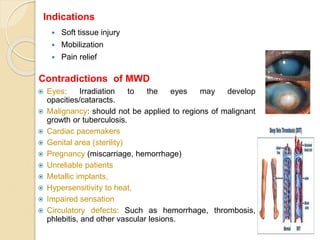
 Eyes: Irradiation to the eyes may develop
opacities/cataracts.
 Malignancy: should not be applied to regions of malignant
growth or tuberculosis.
 Cardiac pacemakers
 Genital area (sterility)
 Pregnancy (miscarriage, hemorrhage)
 Unreliable patients
 Metallic implants,
 Hypersensitivity to heat,
 Impaired sensation
 Circulatory defects: Such as hemorrhage, thrombosis,
phlebitis, and other vascular lesions.
Contradictions of MWD
Indications
Burn
1. Poor techniques
2. Inability of tissue to dissipate heat (circulatory defect)
3. Inability to detect heat (impaired sensation)
4. Implanted metal
5. Moist skin
6. Treatment near the eye
Pregnancy (miscarriage, hemorrhage)
Damage to the eye
Damage to the equipment
Dangerous of MWD
Microwave Diathermy
Advantages
 Operation of the machine is simple
 Comfortable for the patient
 Localized heat to small surfaces
 No overheating if precautions are followed
Disadvantages
 Not for deep structures
 Heats only one aspect of the joint
 Risk of burn
General Guideline &
Safety
 Question patients (contraindications and previous treatment).
 Position of the patient ( comfort, support, relaxed).
 Inspect the part to be treated (check for skin rashes, infection, or
open wounds).
 If indicated, drape the area with toweling.
 Place electrodes on the treated area then switch on the machine.
 Set pulse duration, pulse frequency, and treatment time, and adjust
intensity.
 Periodically ask the patient if the heating is too vigorous.
 When the timer shuts off, terminate the treatment and turn all dials
to zero.
 Assess treatment efficiency ( inspect area, feedback from patients ).
 Record treatment parameters
THANK YOU

Microwave Diathermy JP.ppt

  • 1.
  • 2.
    Diathermy Diathermy is aGreek word for “ through heating”, in which a high frequency (>10.000Hz) An electromagnetic current is applied to induce deep heating within body tissue, to induce physiological effects for therapeutic purposes. 1. Shortwave Diathermy (SWD) 2. Microwave Diathermy(MWD) 3. Pulsed Electromagnetic (PEM)
  • 3.
    Microwave Diathermy  MicrowaveDiathermy (MWD) is a high-frequency electromagnetic radiation that lies between infrared and shortwave.  Their frequency ranges between 300-3000MHz, with corresponding wavelengths of 1m-10mm.
  • 4.
    Microwave Diathermy Generator Power supply  Magnetron  Timing circuit  Applicators (emitter, a director)
  • 5.
    Principles Of MWD Deep heating modality  Emits strong electrical field/ little magnetic field.  Depth of penetration is frequency dependent.  Produces much more localized & concentrated heating effect than SWD.  Providing a more shallow tissue heating effect, depends on the type of tissue involved.  Reflection, Refraction, and Absorption
  • 6.
    Principle Of MWD MWD are strongly absorbed by tissues with high fluid content and are heated most, while penetrated by tissues with low fluid content (e.g. fat or bones).  Tissues with low water content (fat) are penetrated to a greater depth (half value thickness=3.5cm).  Tissue with high water content (muscle, blood) is penetrated to a superficial depth (=0.7cm). The effective depth of MWD penetration (half-value depth) is about 4.5 cm, so the depth of heating is intermediate between that of infrared radiation (2cm) and short wave diathermy (>5cm).
  • 7.
    Principle of MWD The patients does not form apart of the circuit in MWD, so no tuning is necessary as in SWD.  Transmits as free space radiation, so needs only one emitter (applicator).  No Metal should be within 4 feet of MWD, since it will interfere with the signal.  Spacing is required between the skin and the applicators with MWD, where the applicator on a short wave unit my be placed in contact with treatment area.
  • 8.
    Physiological and TherapeuticEffects of MWD When the electromagnetic radiation of MWD enters the body causes ◦ Ionic movement (vibration). ◦ Rotation of dipoles. ◦ Distortion of the non-polar molecule Physiological effects Therapeutic effects Effects on metabolism Effects on blood supply Effects on nervous tissue Effects on muscular tissue Effects on sweat glands Relief of pain and muscle spasm Promote healing Infection Increase the extensibility
  • 9.
     Soft tissueinjury  Mobilization  Pain relief  Eyes: Irradiation to the eyes may develop opacities/cataracts.  Malignancy: should not be applied to regions of malignant growth or tuberculosis.  Cardiac pacemakers  Genital area (sterility)  Pregnancy (miscarriage, hemorrhage)  Unreliable patients  Metallic implants,  Hypersensitivity to heat,  Impaired sensation  Circulatory defects: Such as hemorrhage, thrombosis, phlebitis, and other vascular lesions. Contradictions of MWD Indications
  • 10.
    Burn 1. Poor techniques 2.Inability of tissue to dissipate heat (circulatory defect) 3. Inability to detect heat (impaired sensation) 4. Implanted metal 5. Moist skin 6. Treatment near the eye Pregnancy (miscarriage, hemorrhage) Damage to the eye Damage to the equipment Dangerous of MWD
  • 11.
    Microwave Diathermy Advantages  Operationof the machine is simple  Comfortable for the patient  Localized heat to small surfaces  No overheating if precautions are followed Disadvantages  Not for deep structures  Heats only one aspect of the joint  Risk of burn
  • 12.
    General Guideline & Safety Question patients (contraindications and previous treatment).  Position of the patient ( comfort, support, relaxed).  Inspect the part to be treated (check for skin rashes, infection, or open wounds).  If indicated, drape the area with toweling.  Place electrodes on the treated area then switch on the machine.  Set pulse duration, pulse frequency, and treatment time, and adjust intensity.  Periodically ask the patient if the heating is too vigorous.  When the timer shuts off, terminate the treatment and turn all dials to zero.  Assess treatment efficiency ( inspect area, feedback from patients ).  Record treatment parameters
  • 13.