N.A.C.U.
Nursing Attitude Control
Unit
QSEN Change Project
Agent Hayley, Agent Kelly, Agent Rebekah, Agent Raychel,
Agent Fatima, and Agent Alexis
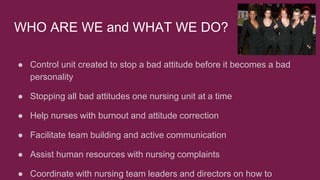
WHO ARE WE and WHAT WE DO?
● Control unit created to stop a bad attitude before it becomes a bad
personality
● Stopping all bad attitudes one nursing unit at a time
● Help nurses with burnout and attitude correction
● Facilitate team building and active communication
● Assist human resources with nursing complaints
● Coordinate with nursing team leaders and directors on how to
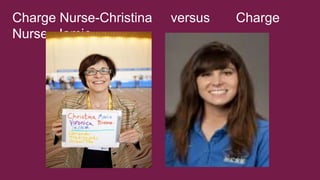
Charge Nurse-Christina versus Charge
Nurse- Jamie
Charge Nurse Christina
● Performed one task per patient (answered call light, gave a blanket,
inserted iv, change linen etc)
● Assisted with breaks and lunches
● made sure met each patient and checked in with doctors/nurses for
pending orders
● Documented all ambulance ring downs and bed assignments
● Facilitated celebrations of employee events (birthdays, anniversaries,
special awards and recognitions)
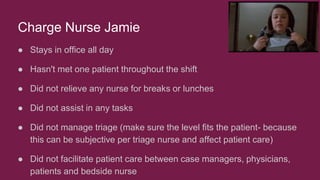
Charge Nurse Jamie
● Stays in office all day
● Hasn't met one patient throughout the shift
● Did not relieve any nurse for breaks or lunches
● Did not assist in any tasks
● Did not manage triage (make sure the level fits the patient- because
this can be subjective per triage nurse and affect patient care)
● Did not facilitate patient care between case managers, physicians,
patients and bedside nurse
Why were we called and What can we teach
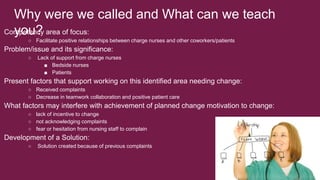
you?Competency area of focus:
○ Facilitate positive relationships between charge nurses and other coworkers/patients
Problem/issue and its significance:
○ Lack of support from charge nurses
■ Bedside nurses
■ Patients
Present factors that support working on this identified area needing change:
○ Received complaints
○ Decrease in teamwork collaboration and positive patient care
What factors may interfere with achievement of planned change motivation to change:
○ lack of incentive to change
○ not acknowledging complaints
○ fear or hesitation from nursing staff to complain
Development of a Solution:
○ Solution created because of previous complaints
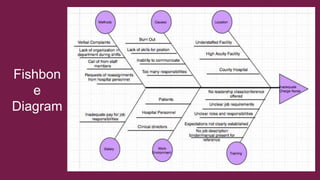
Fishbon
e
Diagram
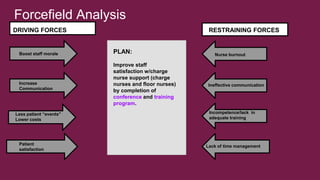
Forcefield Analysis
RESTRAINING FORCESDRIVING FORCES
Boost staff morale
Less patient “events”
Lower costs
Increase
Communication
Nurse burnout
Ineffective communication
Incompetence/lack in
adequate training
Lack of time managementPatient
satisfaction
PLAN:
Improve staff
satisfaction w/charge
nurse support (charge
nurses and floor nurses)
by completion of
conference and training
program.
Havelock’s Theory of Change
● Relationship
○ a relationship within the system that needs change needs to be identified
● Diagnosis
○ Examine the issue and its aspects, decide which part of issue are most urgent or more likely to
yield change
● Acquire
○ Resources to make change happen → finances, space, time, technology, knowledge, other
ideas
● Try
Other Concepts Used
QI
FADE model
Focus
Analyze
Develop
Execute
Evaluate
PDSA model (to make project)
Plan
Duke- Quality Improvement Modules
Culture of Safety
Assessing the culture
Shift blame of errors → opportunities to learn
Teamwork
Teamwork, Communication, Shared learning
Each team member knows their role and how it fits with other people’s roles
Cross-checking coworkers’ work
Patient Involvement
Helps providers stay attuned to reality of issue
Staff motivation because of patient feedback
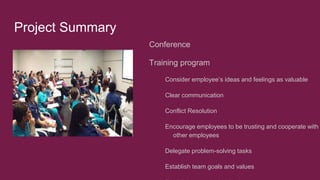
Project Summary
Conference
Training program
Consider employee’s ideas and feelings as valuable
Clear communication
Conflict Resolution
Encourage employees to be trusting and cooperate with
other employees
Delegate problem-solving tasks
Establish team goals and values
Project Summary cont.
Phone surveys:
Did your charge nurse introduce herself
to your patients today?
Did you need assistance from your
charge nurse today?
Did your charge nurse assist you
today?
Would you like to discuss this with your
ACD if there is a problem?
Responses are anonymous
Literature Review
Crowther (2004) stated that, “The scope of the [charge nurse] is wide-ranging. A
charge nurse manager enters the role with advanced clinical expertise and must
promptly become a:
● Strategic planner
● Human Resource Authority
● Quasi-Business Manager
● Financial Analyst
● Risk Manager
● Operations Manager
In addition, “Charge nurses manage:
● Budgets
● Rosters
● Beds
● Patients
● Families
● Colleagues
● Compliance
● Professional regulatory rules
● Organizational policies
● Procedures
● Quality assurance systems”
Literature Review
● “If nurses do not have the appropriate skill and competence, role
ineffectiveness is more likely” (McCallin & Frankson, 2010, p. 320).
● “Many nurses are promoted to these roles of substantial responsibility
commonly with no formal management preparation, an inherent under-
confidence and in some cases a tangible reluctance to manage” (Platt &
Foster, 2008, p. 853).
○ “Trend towards allowing recently qualified nurses to run wards was a cost-cutting strategy.
‘That is all management cares about’” (Snow, 2012, p. 11)
● “Aspiring charge nurses have in some cases been promoted rapidly with
inadequate experience which has resulted in staff feeling insecure,
unsupported and under-performing” (Platt & Foster, 2008, p. 855).
Literature Review
● Nurses looking to be promoted to charge nurses should:
○ “[Enroll] in a Post Graduate Diploma in Health Management [to prepare, including] the study of
human resources, accounting, operations management, health management, health
organization, quality in health care and health economics” (McCallin & Frankson, 2010, p.
324).
○ Participate in a training program that emphasizes:
■ “Emotional self-management, relationship management, graduate education,
management training and formal mentoring” (McCallin & Frankson, 2010, p. 324).
Literature Review
● Training Program
○ Other topics that have proven effective include:
■ Management, leadership, and Transformational Leadership (TL)
■ Process of influencing: Power
■ Motivation
■ Exemplary leadership practices
■ Becoming an effective leader
● (Duygulu & Kublay, 2010, p. 636).
○ The training program should focus on skills “such as involving the employees into the task,
formulating a vision, team cooperation and encouraging others to act as leaders in diverse
situations” (Duygulu & Kublay, 2010, 636).
Literature Review
● Incorporating reflection coping strategies
○ “Could help [nurses] to become more introspective and consequently respond more
constructively to their own needs, promoting wellbeing and reducing the risk of burnout”
(Fearon & Nicol, 2011, p. 39).
■ 34% of hospital staff nurses reported being burned out
■ 16% of nonclinical pharmaceutical staff reported being burned out (McHugh, Kutney-Lee, Cimiotti,
Sloane, & Aiken, 2011, para. 31).
○ Teaching and spreading positivity among staff
○ Charge nurses should focus on “[appreciating] the contributions of the employees [...] and
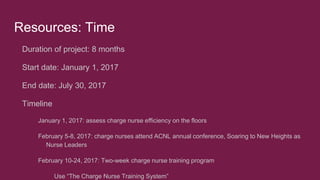
Resources: Time
Duration of project: 8 months
Start date: January 1, 2017
End date: July 30, 2017
Timeline
January 1, 2017: assess charge nurse efficiency on the floors
February 5-8, 2017: charge nurses attend ACNL annual conference, Soaring to New Heights as
Nurse Leaders
February 10-24, 2017: Two-week charge nurse training program
Use “The Charge Nurse Training System”
Resources: Financial
Conference Registration
$880 for full conference or $370 for one day only
Charge nurses cover hotel and food
Training Program
The Charge Nurse Training System: $190/bundle
IVR Telesurvey System
CallFire: $299/month
Online Survey
Resources: People affected by the project
Charge nurses
Floor nurses
Patients and family members
ACD
Nurse managers
Marketing Strategies
Hospital
“The goal of our program is to improving charge nurse leadership skills. Increasing leadership
with charge nurses will allow floor nurses to receive more support and decrease negative
outcomes such as medication errors and patient falls. Increased floor nurse support will also
increase HCAHPS scores by improving patient nurse satisfaction.
Nursing staff
Flyers
Emails
Pre-shift huddles
Include program ad with pay stub
Evaluation
PDSA - (Duke University, 2016)
Plan - evaluate program
Do - in person group interview, survey, and six sigma
Study - evaluate the results of the evaluation and hospital statistics
Act - create changes to improve the program
Debrief
Nurses, Charge nurses, Nurse managers
Experience with program
Sample Exit Evaluation
Group Interview
Charge nurses
Is there anything that you learned at the ACNL
conference/training course that you have
implemented into your daily practice?
All nurses (floor and charge)
What kinds of improvements have you seen in
the staff since this program was
implemented?
Would you consider this program helpful or
hurtful and why?
What about this program would you change or
Survey
Has your relationship with your charge nurse
improved since this program was
implemented?
Is your charge nurse more involved?
Has your charge nurse been their to help
during the shift?
Have you seen a change in the moral on the
floor?
Do you feel physically supported while on the
job?
How else can we solve the problem?
Alternative approach
Monthly meetings
Charge nurse with nurse manager
Floor nurse with nurse manager
Consequences
Lack of anonymity
Unshared floor time
Retaliation by charge nurses
What would we do differently?
Implement the alternative program in addition.
Return to the hospital 6 months, 12 months and 18 months after program
completion
Provide training for floor nurses
How to handle difficult charge nurse.
Provide an alternate conference for the charge nurse
Unable to attend due to work conflict
References:
❖ Duygulu, S., & Kublay, G. (2011). Transformational leadership training programme for charge nurses. Journal Of Advanced Nursing, 67(3), 633-642.
doi:10.1111/j.1365-2648.2010.05507.
❖ Duke University. (2016). Patient Safety: Quality Improvement. Retrieved from: http://patientsafetyed.duhs.duke.edu/index.html
❖ Fearon, C., & Nicol, M. (2011). Strategies to assist prevention of burnout in nursing staff. Nursing Standard, 26(14), 35-39.
❖ Havelock, R. (1995). The Change Agent’s Guide. [DX Reader Version]. Retrieved from https://books.google.com/books?hl=en&lr=&id=h-
uIrSJeVyUC&oi=fnd&pg=PR5&dq=Havelock++R+(1995)++The++Change++Agent%27s++Guide.&ots=n5ypBdF4x6&sig=NlMbaNIbpVmMpH5J2EPsHieJV
N4#v=onepage&q&f=false
❖ McCallin, A., & Frankson, C. (2010). The role of the charge nurse manager: a descriptive exploratory study. Journal Of Nursing Management, 18(3), 319-
325. doi:10.1111/j.1365-2834.2010.01067.
❖ McHugh, M. D., Kutney-Lee, A., Cimiotti, J. P., Sloane, D. M., & Aiken, L. H. (2011). Nurses’ widespread job dissatisfaction, burnout, and
frustration with health benefits signal problems for patient care. Health Affairs (Project Hope), 30(2), 202–210.
http://doi.org/10.1377/hlthaff.2010.0100
❖ Platt, J., & Foster, D. (2008). Revitalizing the charge nurse role through a bespoke development programme. Journal Of Nursing Management, 16(7), 853-
857. doi:10.1111/j.1365-2834.2008.00939
❖ Snow, T. (2012). Trusts take ‘cheap option’ and use inexperienced staff to run wards. Nursing Standard, 27(10), 11.

Qsen_Change

  • 1.
    N.A.C.U. Nursing Attitude Control Unit QSENChange Project Agent Hayley, Agent Kelly, Agent Rebekah, Agent Raychel, Agent Fatima, and Agent Alexis
  • 2.
    WHO ARE WEand WHAT WE DO? ● Control unit created to stop a bad attitude before it becomes a bad personality ● Stopping all bad attitudes one nursing unit at a time ● Help nurses with burnout and attitude correction ● Facilitate team building and active communication ● Assist human resources with nursing complaints ● Coordinate with nursing team leaders and directors on how to
  • 3.
    Charge Nurse-Christina versusCharge Nurse- Jamie
  • 4.
    Charge Nurse Christina ●Performed one task per patient (answered call light, gave a blanket, inserted iv, change linen etc) ● Assisted with breaks and lunches ● made sure met each patient and checked in with doctors/nurses for pending orders ● Documented all ambulance ring downs and bed assignments ● Facilitated celebrations of employee events (birthdays, anniversaries, special awards and recognitions)
  • 5.
    Charge Nurse Jamie ●Stays in office all day ● Hasn't met one patient throughout the shift ● Did not relieve any nurse for breaks or lunches ● Did not assist in any tasks ● Did not manage triage (make sure the level fits the patient- because this can be subjective per triage nurse and affect patient care) ● Did not facilitate patient care between case managers, physicians, patients and bedside nurse
  • 6.
    Why were wecalled and What can we teach you?Competency area of focus: ○ Facilitate positive relationships between charge nurses and other coworkers/patients Problem/issue and its significance: ○ Lack of support from charge nurses ■ Bedside nurses ■ Patients Present factors that support working on this identified area needing change: ○ Received complaints ○ Decrease in teamwork collaboration and positive patient care What factors may interfere with achievement of planned change motivation to change: ○ lack of incentive to change ○ not acknowledging complaints ○ fear or hesitation from nursing staff to complain Development of a Solution: ○ Solution created because of previous complaints
  • 7.
  • 8.
    Forcefield Analysis RESTRAINING FORCESDRIVINGFORCES Boost staff morale Less patient “events” Lower costs Increase Communication Nurse burnout Ineffective communication Incompetence/lack in adequate training Lack of time managementPatient satisfaction PLAN: Improve staff satisfaction w/charge nurse support (charge nurses and floor nurses) by completion of conference and training program.
  • 9.
    Havelock’s Theory ofChange ● Relationship ○ a relationship within the system that needs change needs to be identified ● Diagnosis ○ Examine the issue and its aspects, decide which part of issue are most urgent or more likely to yield change ● Acquire ○ Resources to make change happen → finances, space, time, technology, knowledge, other ideas ● Try
  • 10.
    Other Concepts Used QI FADEmodel Focus Analyze Develop Execute Evaluate PDSA model (to make project) Plan
  • 11.
    Duke- Quality ImprovementModules Culture of Safety Assessing the culture Shift blame of errors → opportunities to learn Teamwork Teamwork, Communication, Shared learning Each team member knows their role and how it fits with other people’s roles Cross-checking coworkers’ work Patient Involvement Helps providers stay attuned to reality of issue Staff motivation because of patient feedback
  • 12.
    Project Summary Conference Training program Consideremployee’s ideas and feelings as valuable Clear communication Conflict Resolution Encourage employees to be trusting and cooperate with other employees Delegate problem-solving tasks Establish team goals and values
  • 13.
    Project Summary cont. Phonesurveys: Did your charge nurse introduce herself to your patients today? Did you need assistance from your charge nurse today? Did your charge nurse assist you today? Would you like to discuss this with your ACD if there is a problem? Responses are anonymous
  • 14.
    Literature Review Crowther (2004)stated that, “The scope of the [charge nurse] is wide-ranging. A charge nurse manager enters the role with advanced clinical expertise and must promptly become a: ● Strategic planner ● Human Resource Authority ● Quasi-Business Manager ● Financial Analyst ● Risk Manager ● Operations Manager In addition, “Charge nurses manage: ● Budgets ● Rosters ● Beds ● Patients ● Families ● Colleagues ● Compliance ● Professional regulatory rules ● Organizational policies ● Procedures ● Quality assurance systems”
  • 15.
    Literature Review ● “Ifnurses do not have the appropriate skill and competence, role ineffectiveness is more likely” (McCallin & Frankson, 2010, p. 320). ● “Many nurses are promoted to these roles of substantial responsibility commonly with no formal management preparation, an inherent under- confidence and in some cases a tangible reluctance to manage” (Platt & Foster, 2008, p. 853). ○ “Trend towards allowing recently qualified nurses to run wards was a cost-cutting strategy. ‘That is all management cares about’” (Snow, 2012, p. 11) ● “Aspiring charge nurses have in some cases been promoted rapidly with inadequate experience which has resulted in staff feeling insecure, unsupported and under-performing” (Platt & Foster, 2008, p. 855).
  • 16.
    Literature Review ● Nurseslooking to be promoted to charge nurses should: ○ “[Enroll] in a Post Graduate Diploma in Health Management [to prepare, including] the study of human resources, accounting, operations management, health management, health organization, quality in health care and health economics” (McCallin & Frankson, 2010, p. 324). ○ Participate in a training program that emphasizes: ■ “Emotional self-management, relationship management, graduate education, management training and formal mentoring” (McCallin & Frankson, 2010, p. 324).
  • 17.
    Literature Review ● TrainingProgram ○ Other topics that have proven effective include: ■ Management, leadership, and Transformational Leadership (TL) ■ Process of influencing: Power ■ Motivation ■ Exemplary leadership practices ■ Becoming an effective leader ● (Duygulu & Kublay, 2010, p. 636). ○ The training program should focus on skills “such as involving the employees into the task, formulating a vision, team cooperation and encouraging others to act as leaders in diverse situations” (Duygulu & Kublay, 2010, 636).
  • 18.
    Literature Review ● Incorporatingreflection coping strategies ○ “Could help [nurses] to become more introspective and consequently respond more constructively to their own needs, promoting wellbeing and reducing the risk of burnout” (Fearon & Nicol, 2011, p. 39). ■ 34% of hospital staff nurses reported being burned out ■ 16% of nonclinical pharmaceutical staff reported being burned out (McHugh, Kutney-Lee, Cimiotti, Sloane, & Aiken, 2011, para. 31). ○ Teaching and spreading positivity among staff ○ Charge nurses should focus on “[appreciating] the contributions of the employees [...] and
  • 19.
    Resources: Time Duration ofproject: 8 months Start date: January 1, 2017 End date: July 30, 2017 Timeline January 1, 2017: assess charge nurse efficiency on the floors February 5-8, 2017: charge nurses attend ACNL annual conference, Soaring to New Heights as Nurse Leaders February 10-24, 2017: Two-week charge nurse training program Use “The Charge Nurse Training System”
  • 20.
    Resources: Financial Conference Registration $880for full conference or $370 for one day only Charge nurses cover hotel and food Training Program The Charge Nurse Training System: $190/bundle IVR Telesurvey System CallFire: $299/month Online Survey
  • 21.
    Resources: People affectedby the project Charge nurses Floor nurses Patients and family members ACD Nurse managers
  • 22.
    Marketing Strategies Hospital “The goalof our program is to improving charge nurse leadership skills. Increasing leadership with charge nurses will allow floor nurses to receive more support and decrease negative outcomes such as medication errors and patient falls. Increased floor nurse support will also increase HCAHPS scores by improving patient nurse satisfaction. Nursing staff Flyers Emails Pre-shift huddles Include program ad with pay stub
  • 23.
    Evaluation PDSA - (DukeUniversity, 2016) Plan - evaluate program Do - in person group interview, survey, and six sigma Study - evaluate the results of the evaluation and hospital statistics Act - create changes to improve the program Debrief Nurses, Charge nurses, Nurse managers Experience with program
  • 24.
    Sample Exit Evaluation GroupInterview Charge nurses Is there anything that you learned at the ACNL conference/training course that you have implemented into your daily practice? All nurses (floor and charge) What kinds of improvements have you seen in the staff since this program was implemented? Would you consider this program helpful or hurtful and why? What about this program would you change or Survey Has your relationship with your charge nurse improved since this program was implemented? Is your charge nurse more involved? Has your charge nurse been their to help during the shift? Have you seen a change in the moral on the floor? Do you feel physically supported while on the job?
  • 25.
    How else canwe solve the problem? Alternative approach Monthly meetings Charge nurse with nurse manager Floor nurse with nurse manager Consequences Lack of anonymity Unshared floor time Retaliation by charge nurses
  • 26.
    What would wedo differently? Implement the alternative program in addition. Return to the hospital 6 months, 12 months and 18 months after program completion Provide training for floor nurses How to handle difficult charge nurse. Provide an alternate conference for the charge nurse Unable to attend due to work conflict
  • 27.
    References: ❖ Duygulu, S.,& Kublay, G. (2011). Transformational leadership training programme for charge nurses. Journal Of Advanced Nursing, 67(3), 633-642. doi:10.1111/j.1365-2648.2010.05507. ❖ Duke University. (2016). Patient Safety: Quality Improvement. Retrieved from: http://patientsafetyed.duhs.duke.edu/index.html ❖ Fearon, C., & Nicol, M. (2011). Strategies to assist prevention of burnout in nursing staff. Nursing Standard, 26(14), 35-39. ❖ Havelock, R. (1995). The Change Agent’s Guide. [DX Reader Version]. Retrieved from https://books.google.com/books?hl=en&lr=&id=h- uIrSJeVyUC&oi=fnd&pg=PR5&dq=Havelock++R+(1995)++The++Change++Agent%27s++Guide.&ots=n5ypBdF4x6&sig=NlMbaNIbpVmMpH5J2EPsHieJV N4#v=onepage&q&f=false ❖ McCallin, A., & Frankson, C. (2010). The role of the charge nurse manager: a descriptive exploratory study. Journal Of Nursing Management, 18(3), 319- 325. doi:10.1111/j.1365-2834.2010.01067. ❖ McHugh, M. D., Kutney-Lee, A., Cimiotti, J. P., Sloane, D. M., & Aiken, L. H. (2011). Nurses’ widespread job dissatisfaction, burnout, and frustration with health benefits signal problems for patient care. Health Affairs (Project Hope), 30(2), 202–210. http://doi.org/10.1377/hlthaff.2010.0100 ❖ Platt, J., & Foster, D. (2008). Revitalizing the charge nurse role through a bespoke development programme. Journal Of Nursing Management, 16(7), 853- 857. doi:10.1111/j.1365-2834.2008.00939 ❖ Snow, T. (2012). Trusts take ‘cheap option’ and use inexperienced staff to run wards. Nursing Standard, 27(10), 11.

Editor's Notes

  • #2 To do: Fishbone diag
  • #7 Competency area of focus: Facilitate positive relationships between charge nurses and other coworkers/patients Problem/issue and its significance: Many nurses don't feel supported by charge nurses which affects patient care and productivity. Whether the staff nurses requests are ignored by their charge nurse, or the patients feel that they are not receiving optimal care by their current nurse and their concerns are not assessed by the charge nurse on shift. Present factors that support working on this identified area needing change: specific nurse in the emergency room department have complained about lack of support from their charge nurse about being informed about all patients in unit and assisting with tasks during break times and/or times of new admissions or challenging patient care. What factors may interfere with achievement of planned change motivation to change: lack of incentive to change, not acknowledging complaints, fear or hesitation from nursing staff to complain , lack of resources to attain survey results from employees and tools to effectively address complaints in general Development of a Solution: The solution is consistent with previous arguments presented and the existing state of health care. being a charge nurse is not only a raise in pay and status but the acceptance of a role as a leader and supporter. An effective charge nurse is aware of all that is going on in the unit and the staff.
  • #9 The driving forces to fix the issues that we have brought up would be to boost staff morale because then they will be more inclined to performing better. Also, staff will be more inclined to ask their charge nurse for help so that things will run smoother on the unit. Increasing communication is a driving force for this plan also because that creates more synchronization of the unit and create a better environment for teamwork in general. Having less patient “events” is a driving force because if nurses have higher morale, and work ethic (from satisfaction with their charge nurses), they are less likely to make medication errors or be on top of turning their patients in a timely manner; basically “events” are less likely to occur. Patient satisfaction is also a driving force because less patient events are likely to occur because nurses have higher morale.
  • #10 https://books.google.com/books?hl=en&lr=&id=h-uIrSJeVyUC&oi=fnd&pg=PR5&dq=Havelock++R+(1995)++The++Change++Agent%27s++Guide.&ots=n5ypBdF4x6&sig=NlMbaNIbpVmMpH5J2EPsHieJVN4#v=onepage&q&f=false
  • #11 FADE model Focus → define/verify the problem that needs to be improved Analyze → collect/analyze data to establish baselines, ID causes and point toward solutions Develop → develop plan for improvement (implementation, communication, measuring/monitoring) Execute → implement action plans Evaluate → create ongoing measuring/monitoring process to ensure success PDSA model Plan → plan a change or plan to test how something works Do → carry out the plan Study → look at the results (evaluate, figure out why you got those results) Act → decide wt actions to take to make improvements to your idea (http://patientsafetyed.duhs.duke.edu/module_a/methods/methods.html)
  • #12 Culture of Safety Focus should be on system effectiveness + teamwork to accomplish 1 goal (safe, high quality performance) CDC defines Cx of safety: “Shared commitment of mgmt + employees to ensure safety of work env. If something goes wrong, to focus should be WHAT, not WHO is the problem. Goal is to bring awareness to process failures/system issues in a non-threatening way A Cx of safety should acknowledge and plan for the possibility of errors occurring and try to prevent it from happening Examples of this kind of Cx are A place where people can report errors or “near misses” without fear of retribution Collabortaion across ranks to fix issues/find solutions (http://patientsafetyed.duhs.duke.edu/module_c/culture_saftey/assessing_culture.html)
  • #13 Conference: first part of the program, the charge nurses will be sent to a conference and Fatima will discuss it into further detail about it. Then the next step is to proceed to the training program. One of the obvious first rules to become an effective leader is to establish leadership with each team member. Rather to instill fear or power through their position, they should build relationships through trust and loyalty. This can be achieved by our training program that will educate your employees, such as a charge nurse on effective strategies that will provide an effective work environment as well as boost morale and decrease turnover. In our training program, we will cover these topics…. By considering employee’s feelings and ideas, you are letting your employees know that the matter and that it will not be discarded By keeping communication open and implementing it regularly allows things to run smoothly. Conflict resolution is an important skill to achieve because drama can happen in almost in any environment, especially in stressful work places like a hospital. So a charge nurse needs to resolve conflicts or else it could hurt the team environment. Encourage employees to be trusting and cooperate with other employees Delegate problem-solving task By establishing team goals and values, the team can understand what needs to be done and how it can be done. Same goes to establishing ground rules for the team Time management is another important skill to obtain because we know that nurses’ time is limited. By establishing time management, we can accomplish more with less effort and stress as well as improve decision making ability. Lastly, evaluation because charge nurses need to identify what is working and what is not successful so that they can idenity other solutions to resolve any problem.
  • #14 To evaluate if your charge nurses have implemented these skills and strategies in our training program, we are going provide an additional service. As your nurses clock out on the phone, there will be a short survey through an automated service using the IVR telesurvey system. And they can answer the questions by pushing the number to the appropriate response. If they are not able to answer while they are clocking out, they also have the option to complete the survey online as well using survey monkey. Our techs have designed this program to keep the nurses’ responses anonymous to ensure their will be no retaliation. To remain anonymity, the ACD, human resources as well as our representatives to keep the responses anonymous.
  • #15 The charge nurse has many roles, and it can be easy for a charge nurse to become overwhelmed, or feel inadequate in his/her position.
  • #16 What can we do to increase teamwork, staff satisfaction and charge nurse confidence and willingness to lead and manage the other nursing staff on their unit?
  • #17 We should be encouraging nurses to obtain Master’s and Doctorate degrees, in order to enhance their competence and feeling of preparedness when starting their new position as a charge nurse. A training program specifically tailored for charge nurses should focus on several elements. These include: (read above and go to next slide)
  • #19 Teaching charge nurses the importance of reflective coping strategies, and asking them to teach the nurses on their unit, could significantly decrease burnout among the staff. “Samaha et al(2007) found that negative emotion-focused coping strategies correlated positively with chronic fatigue” and burnout (as cited in Fearon & Nicol, 2011, p. 37). In a study of 95,499 registered nurses, “A much higher percentage of hospital staff nurses also reported being burned out (34 percent) compared to their colleagues working in nonclinical pharmaceutical jobs (16 percent)” (McHugh, Kutney-Lee, Cimiotti, Sloane, & Aiken, 2011, para. 31).
  • #21 SurveyMonkey features: unlimited questions and responss, 24/7 priority email support, data exporting and report generation (eliminates need for data collector), HIPAA compliant. (There are more features with this plan, but these seemed like the most pertinent to what we need)
  • #24 When evaluating the program created by NACU, we can use the PDSA model. The initial plan is to evaluate the effectiveness of the program that was implemented in the hospital. In order to do this, we will implement one final evaluation. We will perform in person interviews followed by a quick survey. The interview portion will vary depending on the position being interviewed. The charge nurses will be grouped together and asked about their experience. The same will be done with the floor nurses and nurse managers. By doing this we are seeing what they saw change and what they think needs to be improved. Once we complete this, we will also perform a six sigma in order to measure the process improvement and problem reduction completed. With these results and after speaking with the nurse managers about their improvements, we can then evaluate what changes we can make to the program. Between these results, we will be able to meet with the hospital leaders and suggest further improvements as needed. After we come up with the conclusion, we want to gather the charge nurses, nurse and nurse managers and come together to debrief everyone involved. At this point we can ask a few nurses to share their experience with the program as well as ask a few charge nurses to share what they learned at the ACNL conference/training program. Following the discussion by the nurses and charge nurse, we can let the nurse managers have the floor so they can share if there were any changes in the number of complaints, number of injuries and increase in patient satisfaction.
  • #26 Although the program we implemented work. There are other possible programs that could work. An alternative to what we created is to have monthly meetings with just the nurses and then just the charge nurses. The nurse leaders would run these meetings and speak with the nurses and charge nurses about the issue. The nurses could share what they felt was working and not working. By openly being able to voice their opinion, the nurses can help make a change. The information provided by the nurses can be brought up anonymously at the charge nurse meetings in order to help come up with a solution to the problems. At the meetings with the charge nurses, the nurse leaders can also provide training to help them become better leaders. A possible consequence of this approach is that there could be a time when there is a loss in anonymity. The nurse manager could accidentally let the names of the nurses complaining slip at the charge nurse meeting or vice versa resulting in a decrease in the morality on the floor. Another possible issue is that one nurse may take over and talk continuously not allowing anyone else to talk or share their opinion. This could result in unshared floor time and the inability for all the nurses to state their issues, concerns, or suggestions. To overcome this we need the nurse manager to act as a mediator and make sure everyone who wants to share their opinion gets the chance to. The last issue reverts back to the lack of anonymity. If the nurse manager accidently leaks the name of one of the nurse complaining, the charge nurse who the complaint was made against could retaliate against that nurse making his/her life a living hell. This program will easily be implemented into the hospital. Many hospitals have monthly or bimonthly meetings in order to share evidence-based practice and other things. During these meetings, the nurse leaders could easily open up the floor for suggestions. They could also easily split up the charge nurse and nurses into two different meetings to allow for this to happen. By simply implementing this simply program/process, the hospital leaders can improve the experience of the patients and improve their overall care provided at the hospital increasing their overall scores.
  • #27 There are many things that could be done differently in order to improve the program and outcome. First we could implement the alternative program as well as part of the original program. Maybe the phone evaluations may not work for all hospitals so by having the training/conference along with the meetings, the same outcome could be achieved. In addition to this plan, we could come back and interview the nurses, charge nurses, nurse managers and hospital leaders for the first 6, 12, and 18 months after the program ends in order to help with any adjustment issues that may arise. In addition to training the charge nurses, we can also provide training for the floor nurses on how to tackle situations that may result between them and charge nurses. Something that we could teach in this training is something like DESC which teaches the nurses how to talk with the charge nurse in a safe non confrontational manner. The last thing that we need to do is provide an alternate conference for charge nurses to attend because they may have to work or have a conflict with the one provided so by providing an alternate we can make sure that all the charge nurses get the chance to have the training and experience.