





Microservices
Pros & Cons
Things to Think About
What is a microservice?
 Small piece of software that does one thing really well
 Loosely coupled
 Separate data store
 Just enough to solve a problem
 Right technology for the job
 Autonomous
 Can update as often as is needed
 Intelligence in the service, not the routing/infrastructure/bus
 Immutable infrastructure
Should I use microservices?
 It depends!
 Likely no
 Think about fallacies of distributed computing:
 The network is reliable
 Latency is zero
 Bandwidth is infinite
 The network is secure
 Topology doesn’t change
 There is one administrator
 Transport cost is zero
 The network is homogeneous
When should I consider microservices?
 Many teams work on the same code base
 Merge hell, cross team dependencies, ...
 Huge monolithic application which is difficult to deploy
 Monolith cannot be scaled horizontally
 Different parts of the application have totally different requirements
 CPU bound
 I/O bound
 Memory bound
 etc.
 Some but not all areas of the application change frequently
 Development stack is outdated. New tools and patterns are hard if
not impossible to embrace
How big should a microservice be?
 Small enough to fit full context in your head
 Big enough to solve a problem
 Owned by one team
What does “big enough” look like...
Some examples:
 Lambda: https://github.com/meconlin/lambda-generic-microservice
 C#: https://github.com/AFASSoftware/CQRS-Microservices
 Spring: https://github.com/kbastani/spring-cloud-microservice-example
 akka: https://github.com/theiterators/akka-http-microservice
 https://github.com/dustinbarnes/microservice-example
How should a microservice communicate?
 Synchronous
 Asynchronous
 Messaging
 Fan out
 HTTP/REST
 TCP/IP
 Pub/sub
...but zero logic in the communication pipeline!
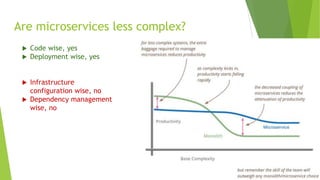
Are microservices less complex?
 Code wise, yes
 Deployment wise, yes
 Infrastructure
configuration wise, no
 Dependency management
wise, no
Microservice Management
Overview
How to manage microservices?
It’s a big world with lots of cutely named tools!
• Deploy: Jenkins / TeamCity / Ansible / Chef / Capistrano / StackStorm
• Discovery/config: Consul / Consul-Templates / etcd / Registrator / skydns
• Containers: Docker / Compose / Vagrant / Otto / Lambda
• Container Clustering: ECS / Kubernetes / Mesos / Docker Swarm
• Request Routing: Nginx / HAProxy / Kong / API Gateway
• Self Healing: Consul / ZooKeeper / Serf
• System Health: hystrix, SumoLogic, Nagios, NewRelic, statsd, LogEntries
AUTOMATE EVERYTHING
Deployment
 Continuous Deployment
 Continuous Delivery
 Versioned
 Blue / Green
 A-B Testing
 Net new, add to routing
 Zero downtime
Tools: Jenkins / TeamCity / Ansible / Chef / Capistrano / StackStorm
NEVER DESTRUCTIVE
Service Discovery & Configuration
 Minimize known dependencies
 No bottlenecks due to outage allowed
 Down stream health monitoring
 Configuration at deployment time when possible
 Configuration in runtime if you have to (adds fragility/degradation)
Tools: Consul / Consul-Templates / etcd / Registrator / skydns
NO DEPENDENCY KNOWLEDGE
Containers & Clustering
 Removes “works on my box” story
 Installed software dependencies become constrained to your need
 No more “servers as pets”
 Infrastructure as code becomes a reality
 Can deploy to fabric/cluster for better auto scaling story
 Serverless truly abstracts hardware from application
Tools: Docker / Compose / Vagrant / Otto / Lambda / AWS ECS /
Kubernetes / Mesos / Docker Swarm
NO HARDWARE DEPENDENCY PREFERRED
Request Routing
 Public abstraction from internal details
 Internal location can become dynamic
 Multiple versions of the same thing can be long lived
 Makes deployment story more flexible
 Live traffic can be drained over
 Warming up new instances is possible
Tools: Nginx / HAProxy / Kong / API Gateway
NEVER EXPOSE YOUR SERVICES DIRECTLY
Self Healing
It’s not IF it will fail but WHEN it will fail!
 Auto healing
 Automated Remediation
 Circuit breaker
 Fallbacks
 Graceful degradation
 Don’t cascade failures
Tools: Consul / ZooKeeper / Serf
PLAN FOR FAILURE FIRST
System Health
 Measure anything, measure everything
 https://codeascraft.com/2011/02/15/measure-anything-measure-everything/
 Performance monitoring, exception monitoring, logs, metrics
 NewRelic, nagios, SumoLogic
 statsd / graphite (hosted graphite) / kibana / grafana
 Centralized logging (logentries, logstash)
 Circuit Breaker (hystrix)
Tools: hystrix, SumoLogic, Nagios, NewRelic, statsd, LogEntries
VISUALIZE EVERYTHING
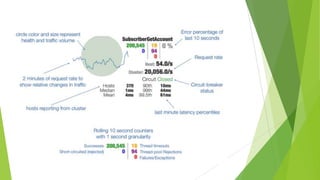
Circuit Breakers with Hystrix
Questions?
James Allen
http://www.linkedin.com/in/jamesallenatx
Miguel Gonzalez
https://www.linkedin.com/in/magonz
@doesnotcompile
Gabriel Schenker
https://www.linkedin.com/in/gabrielschenker
@gnschenker
Andrew Siemer
https://www.linkedin.com/in/andrewsiemer
@asiemer

Microservices pros and cons

  • 1.
  • 2.
    What is amicroservice?  Small piece of software that does one thing really well  Loosely coupled  Separate data store  Just enough to solve a problem  Right technology for the job  Autonomous  Can update as often as is needed  Intelligence in the service, not the routing/infrastructure/bus  Immutable infrastructure
  • 3.
    Should I usemicroservices?  It depends!  Likely no  Think about fallacies of distributed computing:  The network is reliable  Latency is zero  Bandwidth is infinite  The network is secure  Topology doesn’t change  There is one administrator  Transport cost is zero  The network is homogeneous
  • 4.
    When should Iconsider microservices?  Many teams work on the same code base  Merge hell, cross team dependencies, ...  Huge monolithic application which is difficult to deploy  Monolith cannot be scaled horizontally  Different parts of the application have totally different requirements  CPU bound  I/O bound  Memory bound  etc.  Some but not all areas of the application change frequently  Development stack is outdated. New tools and patterns are hard if not impossible to embrace
  • 5.
    How big shoulda microservice be?  Small enough to fit full context in your head  Big enough to solve a problem  Owned by one team
  • 6.
    What does “bigenough” look like... Some examples:  Lambda: https://github.com/meconlin/lambda-generic-microservice  C#: https://github.com/AFASSoftware/CQRS-Microservices  Spring: https://github.com/kbastani/spring-cloud-microservice-example  akka: https://github.com/theiterators/akka-http-microservice  https://github.com/dustinbarnes/microservice-example
  • 7.
    How should amicroservice communicate?  Synchronous  Asynchronous  Messaging  Fan out  HTTP/REST  TCP/IP  Pub/sub ...but zero logic in the communication pipeline!
  • 8.
    Are microservices lesscomplex?  Code wise, yes  Deployment wise, yes  Infrastructure configuration wise, no  Dependency management wise, no
  • 9.
  • 10.
    How to managemicroservices? It’s a big world with lots of cutely named tools! • Deploy: Jenkins / TeamCity / Ansible / Chef / Capistrano / StackStorm • Discovery/config: Consul / Consul-Templates / etcd / Registrator / skydns • Containers: Docker / Compose / Vagrant / Otto / Lambda • Container Clustering: ECS / Kubernetes / Mesos / Docker Swarm • Request Routing: Nginx / HAProxy / Kong / API Gateway • Self Healing: Consul / ZooKeeper / Serf • System Health: hystrix, SumoLogic, Nagios, NewRelic, statsd, LogEntries AUTOMATE EVERYTHING
  • 11.
    Deployment  Continuous Deployment Continuous Delivery  Versioned  Blue / Green  A-B Testing  Net new, add to routing  Zero downtime Tools: Jenkins / TeamCity / Ansible / Chef / Capistrano / StackStorm NEVER DESTRUCTIVE
  • 12.
    Service Discovery &Configuration  Minimize known dependencies  No bottlenecks due to outage allowed  Down stream health monitoring  Configuration at deployment time when possible  Configuration in runtime if you have to (adds fragility/degradation) Tools: Consul / Consul-Templates / etcd / Registrator / skydns NO DEPENDENCY KNOWLEDGE
  • 13.
    Containers & Clustering Removes “works on my box” story  Installed software dependencies become constrained to your need  No more “servers as pets”  Infrastructure as code becomes a reality  Can deploy to fabric/cluster for better auto scaling story  Serverless truly abstracts hardware from application Tools: Docker / Compose / Vagrant / Otto / Lambda / AWS ECS / Kubernetes / Mesos / Docker Swarm NO HARDWARE DEPENDENCY PREFERRED
  • 14.
    Request Routing  Publicabstraction from internal details  Internal location can become dynamic  Multiple versions of the same thing can be long lived  Makes deployment story more flexible  Live traffic can be drained over  Warming up new instances is possible Tools: Nginx / HAProxy / Kong / API Gateway NEVER EXPOSE YOUR SERVICES DIRECTLY
  • 15.
    Self Healing It’s notIF it will fail but WHEN it will fail!  Auto healing  Automated Remediation  Circuit breaker  Fallbacks  Graceful degradation  Don’t cascade failures Tools: Consul / ZooKeeper / Serf PLAN FOR FAILURE FIRST
  • 16.
    System Health  Measureanything, measure everything  https://codeascraft.com/2011/02/15/measure-anything-measure-everything/  Performance monitoring, exception monitoring, logs, metrics  NewRelic, nagios, SumoLogic  statsd / graphite (hosted graphite) / kibana / grafana  Centralized logging (logentries, logstash)  Circuit Breaker (hystrix) Tools: hystrix, SumoLogic, Nagios, NewRelic, statsd, LogEntries VISUALIZE EVERYTHING
  • 17.
  • 20.
    Questions? James Allen http://www.linkedin.com/in/jamesallenatx Miguel Gonzalez https://www.linkedin.com/in/magonz @doesnotcompile GabrielSchenker https://www.linkedin.com/in/gabrielschenker @gnschenker Andrew Siemer https://www.linkedin.com/in/andrewsiemer @asiemer