Susan J. Fowler
Production-
Ready
Microservices
BUILDING STANDARDIZED SYSTEMS ACROSS
AN ENGINEERING ORGANIZATION C
o
m
p
l
i
m
e
n
t
s
o
f
Susan J. Fowler
FREE CHAPTERS
FREE TRIAL LEARN MORE
flawless
application
delivery
Load
Balancer
Content
Cache
Web
Server
Security
Controls
Monitoring &
Management
This Excerpt contains Chapters 1, 3, 4, 7, and Appendix A of
the book Production-Ready Microservices. The complete book
is available at oreilly.com and through other retailers.
Susan J. Fowler
Production-Ready Microservices
Building Standardized Systems Across
an Engineering Organization
Boston Farnham Sebastopol Tokyo
Beijing Boston Farnham Sebastopol Tokyo
Beijing
978-1-491-96597-9
[LSI]
Production-Ready Microservices
by Susan J. Fowler
Copyright © 2017 Susan Fowler. All rights reserved.
Printed in the United States of America.
Published by O’Reilly Media, Inc., 1005 Gravenstein Highway North, Sebastopol, CA 95472.
O’Reilly books may be purchased for educational, business, or sales promotional use. Online editions are
also available for most titles (http://oreilly.com/safari). For more information, contact our corporate/insti‐
tutional sales department: 800-998-9938 or corporate@oreilly.com.
Editors: Nan Barber and Brian Foster
Production Editor: Kristen Brown
Copyeditor: Amanda Kersey
Proofreader: Jasmine Kwityn
Indexer: Wendy Catalano
Interior Designer: David Futato
Cover Designer: Karen Montgomery
Illustrator: Rebecca Demarest
December 2016: First Edition
Revision History for the First Edition
2016-11-23: First Release
See http://oreilly.com/catalog/errata.csp?isbn=9781491965979 for release details.
The O’Reilly logo is a registered trademark of O’Reilly Media, Inc. Production-Ready Microservices, the
cover image, and related trade dress are trademarks of O’Reilly Media, Inc.
While the publisher and the author have used good faith efforts to ensure that the information and
instructions contained in this work are accurate, the publisher and the author disclaim all responsibility
for errors or omissions, including without limitation responsibility for damages resulting from the use of
or reliance on this work. Use of the information and instructions contained in this work is at your own
risk. If any code samples or other technology this work contains or describes is subject to open source
licenses or the intellectual property rights of others, it is your responsibility to ensure that your use
thereof complies with such licenses and/or rights.
Table of Contents
1. Microservices. . . . . . . . . . . . . . . . . . . . . . . . . . . . . . . . . . . . . . . . . . . . . . . . . . . . . . . . . . . . . . . 1
From Monoliths to Microservices 2
Microservice Architecture 9
The Microservice Ecosystem 11
Layer 1: Hardware 12
Layer 2: Communication 13
Layer 3: The Application Platform 16
Layer 4: Microservices 19
Organizational Challenges 20
The Inverse Conway’s Law 21
Technical Sprawl 22
More Ways to Fail 23
Competition for Resources 23
3. Stability and Reliability. . . . . . . . . . . . . . . . . . . . . . . . . . . . . . . . . . . . . . . . . . . . . . . . . . . . . 25
Principles of Building Stable and Reliable Microservices 25
The Development Cycle 26
The Deployment Pipeline 28
Staging 29
Canary 34
Production 35
Enforcing Stable and Reliable Deployment 36
Dependencies 37
Routing and Discovery 39
Deprecation and Decommissioning 40
Evaluate Your Microservice 41
The Development Cycle 41
The Deployment Pipeline 41
iii
Dependencies 41
Routing and Discovery 42
Deprecation and Decommissioning 42
4. Scalability and Performance. . . . . . . . . . . . . . . . . . . . . . . . . . . . . . . . . . . . . . . . . . . . . . . . . 43
Principles of Microservice Scalability and Performance 43
Knowing the Growth Scale 44
The Qualitative Growth Scale 45
The Quantitative Growth Scale 46
Efficient Use of Resources 47
Resource Awareness 48
Resource Requirements 48
Resource Bottlenecks 49
Capacity Planning 49
Dependency Scaling 51
Traffic Management 52
Task Handling and Processing 53
Programming Language Limitations 53
Handling Requests and Processing Tasks Efficiently 54
Scalable Data Storage 55
Database Choice in Microservice Ecosystems 55
Database Challenges in Microservice Architecture 57
Evaluate Your Microservice 57
Knowing the Growth Scale 58
Efficient Use of Resources 58
Resource Awareness 58
Capacity Planning 58
Dependency Scaling 58
Traffic Management 59
Task Handling and Processing 59
Scalable Data Storage 59
7. Documentation and Understanding. . . . . . . . . . . . . . . . . . . . . . . . . . . . . . . . . . . . . . . . . . . 61
Principles of Microservice Documentation and Understanding 61
Microservice Documentation 63
Description 64
Architecture Diagram 65
Contact and On-Call Information 66
Links 66
Onboarding and Development Guide 66
Request Flows, Endpoints, and Dependencies 67
On-Call Runbooks 67
iv | Table of Contents
FAQ 68
Microservice Understanding 69
Architecture Reviews 70
Production-Readiness Audits 71
Production-Readiness Roadmaps 72
Production-Readiness Automation 72
Evaluate Your Microservice 73
Microservice Documentation 74
Microservice Understanding 74
A. Production-Readiness Checklist. . . . . . . . . . . . . . . . . . . . . . . . . . . . . . . . . . . . . . . . . . . . . . . 75
Table of Contents | v
CHAPTER 1
Microservices
In the past few years, the technology industry has witnessed a rapid change in
applied, practical distributed systems architecture that has led industry giants (such
as Netflix, Twitter, Amazon, eBay, and Uber) away from building monolithic applica‐
tions to adopting microservice architecture. While the fundamental concepts behind
microservices are not new, the contemporary application of microservice architecture
truly is, and its adoption has been driven in part by scalability challenges, lack of effi‐
ciency, slow developer velocity, and the difficulties with adopting new technologies
that arise when complex software systems are contained within and deployed as one
large monolithic application.
Adopting microservice architecture, whether from the ground up or by splitting an
existing monolithic application into independently developed and deployed micro‐
services, solves these problems. With microservice architecture, an application can
easily be scaled both horizontally and vertically, developer productivity and velocity
increase dramatically, and old technologies can easily be swapped out for the newest
ones.
As we will see in this chapter, the adoption of microservice architecture can be seen
as a natural step in the scaling of an application. The splitting of a monolithic applica‐
tion into microservices is driven by scalability and efficiency concerns, but microser‐
vices introduce challenges of their own. A successful, scalable microservice ecosystem
requires that a stable and sophisticated infrastructure be in place. In addition, the
organizational structure of a company adopting microservices must be radically
changed to support microservice architecture, and the team structures that spring
from this can lead to siloing and sprawl. The largest challenges that microservice
architecture brings, however, are the need for standardization of the architecture of
the services themselves, along with requirements for each microservice in order to
ensure trust and availability.
1
From Monoliths to Microservices
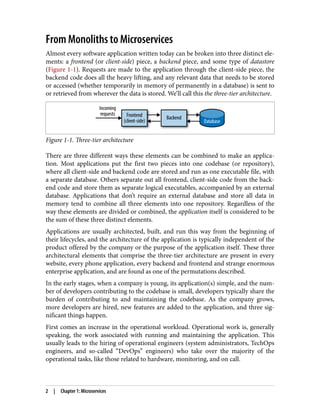
Almost every software application written today can be broken into three distinct ele‐
ments: a frontend (or client-side) piece, a backend piece, and some type of datastore
(Figure 1-1). Requests are made to the application through the client-side piece, the
backend code does all the heavy lifting, and any relevant data that needs to be stored
or accessed (whether temporarily in memory of permanently in a database) is sent to
or retrieved from wherever the data is stored. We’ll call this the three-tier architecture.
Figure 1-1. Three-tier architecture
There are three different ways these elements can be combined to make an applica‐
tion. Most applications put the first two pieces into one codebase (or repository),
where all client-side and backend code are stored and run as one executable file, with
a separate database. Others separate out all frontend, client-side code from the back‐
end code and store them as separate logical executables, accompanied by an external
database. Applications that don’t require an external database and store all data in
memory tend to combine all three elements into one repository. Regardless of the
way these elements are divided or combined, the application itself is considered to be
the sum of these three distinct elements.
Applications are usually architected, built, and run this way from the beginning of
their lifecycles, and the architecture of the application is typically independent of the
product offered by the company or the purpose of the application itself. These three
architectural elements that comprise the three-tier architecture are present in every
website, every phone application, every backend and frontend and strange enormous
enterprise application, and are found as one of the permutations described.
In the early stages, when a company is young, its application(s) simple, and the num‐
ber of developers contributing to the codebase is small, developers typically share the
burden of contributing to and maintaining the codebase. As the company grows,
more developers are hired, new features are added to the application, and three sig‐
nificant things happen.
First comes an increase in the operational workload. Operational work is, generally
speaking, the work associated with running and maintaining the application. This
usually leads to the hiring of operational engineers (system administrators, TechOps
engineers, and so-called “DevOps” engineers) who take over the majority of the
operational tasks, like those related to hardware, monitoring, and on call.
2 | Chapter 1: Microservices
The second thing that happens is a result of simple mathematics: adding new features
to your application increases both the number of lines of code in your application and
the complexity of the application itself.
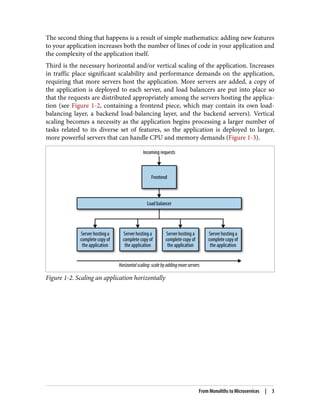
Third is the necessary horizontal and/or vertical scaling of the application. Increases
in traffic place significant scalability and performance demands on the application,
requiring that more servers host the application. More servers are added, a copy of
the application is deployed to each server, and load balancers are put into place so
that the requests are distributed appropriately among the servers hosting the applica‐
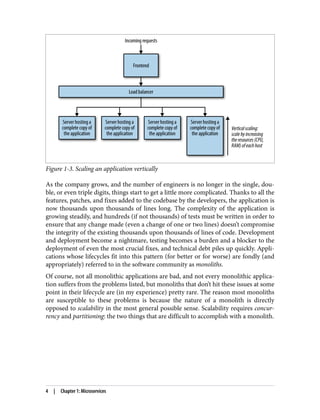
tion (see Figure 1-2, containing a frontend piece, which may contain its own load-
balancing layer, a backend load-balancing layer, and the backend servers). Vertical
scaling becomes a necessity as the application begins processing a larger number of
tasks related to its diverse set of features, so the application is deployed to larger,
more powerful servers that can handle CPU and memory demands (Figure 1-3).
Figure 1-2. Scaling an application horizontally
From Monoliths to Microservices | 3
Figure 1-3. Scaling an application vertically
As the company grows, and the number of engineers is no longer in the single, dou‐
ble, or even triple digits, things start to get a little more complicated. Thanks to all the
features, patches, and fixes added to the codebase by the developers, the application is
now thousands upon thousands of lines long. The complexity of the application is
growing steadily, and hundreds (if not thousands) of tests must be written in order to
ensure that any change made (even a change of one or two lines) doesn’t compromise
the integrity of the existing thousands upon thousands of lines of code. Development
and deployment become a nightmare, testing becomes a burden and a blocker to the
deployment of even the most crucial fixes, and technical debt piles up quickly. Appli‐
cations whose lifecycles fit into this pattern (for better or for worse) are fondly (and
appropriately) referred to in the software community as monoliths.
Of course, not all monolithic applications are bad, and not every monolithic applica‐
tion suffers from the problems listed, but monoliths that don’t hit these issues at some
point in their lifecycle are (in my experience) pretty rare. The reason most monoliths
are susceptible to these problems is because the nature of a monolith is directly
opposed to scalability in the most general possible sense. Scalability requires concur‐
rency and partitioning: the two things that are difficult to accomplish with a monolith.
4 | Chapter 1: Microservices
Scaling an Application
Let’s break this down a bit.
The goal of any software application is to process tasks of some sort. Regardless of
what those tasks are, we can make a general assumption about how we want our
application to handle them: it needs to process them efficiently.
To process tasks efficiently, our application needs to have some kind of concurrency.
This means that we can’t have just one process that does all the work, because then
that process will pick up one task at a time, complete all the necessary pieces of it (or
fail!), and then move onto the next—this isn’t efficient at all! To make our application
efficient, we can introduce concurrency so that each task can be broken up into
smaller pieces.
The second thing we can do to process tasks efficiently is to divide and conquer by
introducing partitioning, where each task is not only broken up into small pieces but
can be processed in parallel. If we have a bunch of tasks, we can process them all at
the same time by sending them to a set of workers that can process them in parallel. If
we need to process more tasks, we can easily scale with the demand by adding addi‐
tional workers to process the new tasks without affecting the efficiency of our system.
Concurrency and partitioning are difficult to support when you have one large appli‐
cation that needs to be deployed to every server, which needs to process any type of
task. If your application is even the slightest bit complicated, the only way you can
scale it with a growing list of features and increasing traffic is to scale up the hardware
that the application is deployed to.
To be truly efficient, the best way to scale an application is to break it into many small,
independent applications that each do one type of task. Need to add another step to
the overall process? Easy enough: just make a new application that only does that
step! Need to handle more traffic? Simple: add more workers to each application!
Concurrency and partitioning are difficult to support in a monolithic application,
which prevents monolithic application architecture from being as efficient as we need
it to be.
We’ve seen this pattern emerge at companies like Amazon, Twitter, Netflix, eBay, and
Uber: companies that run applications across not hundreds, but thousands, even
hundreds of thousands of servers and whose applications have evolved into mono‐
liths and hit scalability challenges. The challenges they faced were remedied by aban‐
doning monolithic application architecture in favor of microservices.
The basic concept of a microservice is simple: it’s a small application that does one
thing only, and does that one thing well. A microservice is a small component that is
From Monoliths to Microservices | 5
easily replaceable, independently developed, and independently deployable. A micro‐
service cannot live alone, however—no microservice is an island—and it is part of a
larger system, running and working alongside other microservices to accomplish
what would normally be handled by one large standalone application.
The goal of microservice architecture is to build a set of small applications that are
each responsible for performing one function (as opposed to the traditional way of
building one application that does everything), and to let each microservice be auton‐
omous, independent, and self-contained. The core difference between a monolithic
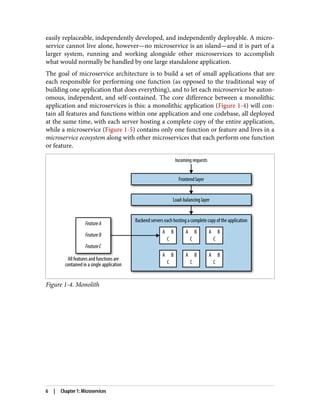
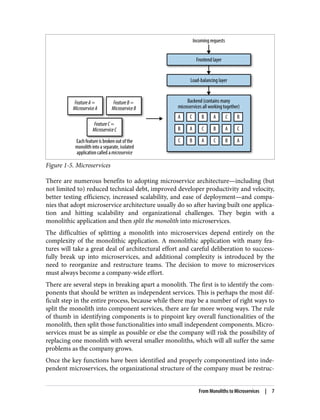
application and microservices is this: a monolithic application (Figure 1-4) will con‐
tain all features and functions within one application and one codebase, all deployed
at the same time, with each server hosting a complete copy of the entire application,
while a microservice (Figure 1-5) contains only one function or feature and lives in a
microservice ecosystem along with other microservices that each perform one function
or feature.
Figure 1-4. Monolith
6 | Chapter 1: Microservices
Figure 1-5. Microservices
There are numerous benefits to adopting microservice architecture—including (but
not limited to) reduced technical debt, improved developer productivity and velocity,
better testing efficiency, increased scalability, and ease of deployment—and compa‐
nies that adopt microservice architecture usually do so after having built one applica‐
tion and hitting scalability and organizational challenges. They begin with a
monolithic application and then split the monolith into microservices.
The difficulties of splitting a monolith into microservices depend entirely on the
complexity of the monolithic application. A monolithic application with many fea‐
tures will take a great deal of architectural effort and careful deliberation to success‐
fully break up into microservices, and additional complexity is introduced by the
need to reorganize and restructure teams. The decision to move to microservices
must always become a company-wide effort.
There are several steps in breaking apart a monolith. The first is to identify the com‐
ponents that should be written as independent services. This is perhaps the most dif‐
ficult step in the entire process, because while there may be a number of right ways to
split the monolith into component services, there are far more wrong ways. The rule
of thumb in identifying components is to pinpoint key overall functionalities of the
monolith, then split those functionalities into small independent components. Micro‐
services must be as simple as possible or else the company will risk the possibility of
replacing one monolith with several smaller monoliths, which will all suffer the same
problems as the company grows.
Once the key functions have been identified and properly componentized into inde‐
pendent microservices, the organizational structure of the company must be restruc‐
From Monoliths to Microservices | 7
tured so that each microservice is staffed by an engineering team. There are several
ways to do this. The first method of company reorganization around microservice
adoption is to dedicate one team to each microservice. The size of the team will be
determined completely by the complexity and workload of the microservice and
should be staffed by enough developers and site reliability engineers so that both fea‐
ture development and the on-call rotation of the service can be managed without
burdening the team. The second is to assign several services to one team and have
that team develop the services in parallel. This works best when the teams are organ‐
ized around specific products or business domains, and are responsible for develop‐
ing any services related to those products or domains. If a company chooses the
second method of reorganization, it needs to make sure that developers aren’t over‐
worked and don’t face task, outage, or operational fatigue.
Another important part of microservice adoption is the creation of a microservice eco‐
system. Typically (or, at least, hopefully), a company running a large monolithic appli‐
cation will have a dedicated infrastructure organization that is responsible for
designing, building, and maintaining the infrastructure that the application runs on.
When a monolith is split into microservices, the responsibilities of the infrastructure
organization for providing a stable platform for microservices to be developed and
run on grows drastically in importance. The infrastructure teams must provide
microservice teams with stable infrastructure that abstracts away the majority of the
complexity of the interactions between microservices.
Once these three steps have been completed—the componentization of the applica‐
tion, the restructuring of engineering teams to staff each microservice, and the devel‐
opment of the infrastructure organization within the company—the migration can
begin. Some teams choose to pull the relevant code for their microservice directly
from the monolith and into a separate service, and shadow the monolith’s traffic until
they are convinced that the microservice can perform the desired functionality on its
own. Other teams choose to build the service from scratch, starting with a clean slate,
and shadow traffic or redirect after the service has passed appropriate tests. The best
approach to migration depends on the functionality of the microservice, and I have
seen both approaches work equally well in most cases, but the real key to a successful
migration is thorough, careful, painstakingly documented planning and execution,
along with the realization that a complete migration of a large monolith can take sev‐
eral long years.
With all the work involved in splitting a monolith into microservices, it may seem
better to begin with microservice architecture, skip all of the painful scalability chal‐
lenges, and avoid the microservice migration drama. This approach may turn out all
right for some companies, but I want to offer several words of caution. Small compa‐
nies often do not have the necessary infrastructure in place to sustain microservices,
even at a very small scale: good microservice architecture requires stable, often very
complex, infrastructure. Such stable infrastructure requires a large, dedicated team
8 | Chapter 1: Microservices
whose cost can typically be sustained only by companies that have reached the scala‐
bility challenges that justify the move to microservice architecture. Small companies
simply will not have enough operational capacity to maintain a microservice ecosys‐
tem. Furthermore, it’s extraordinarily difficult to identify key areas and components
to build into microservices when a company is in the early stages: applications at new
companies will not have many features, nor many separate areas of functionality that
can be split appropriately into microservices.
Microservice Architecture
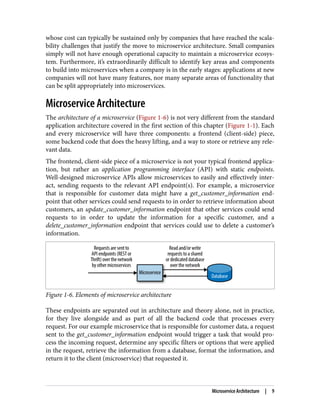
The architecture of a microservice (Figure 1-6) is not very different from the standard
application architecture covered in the first section of this chapter (Figure 1-1). Each
and every microservice will have three components: a frontend (client-side) piece,
some backend code that does the heavy lifting, and a way to store or retrieve any rele‐
vant data.
The frontend, client-side piece of a microservice is not your typical frontend applica‐
tion, but rather an application programming interface (API) with static endpoints.
Well-designed microservice APIs allow microservices to easily and effectively inter‐
act, sending requests to the relevant API endpoint(s). For example, a microservice
that is responsible for customer data might have a get_customer_information end‐
point that other services could send requests to in order to retrieve information about
customers, an update_customer_information endpoint that other services could send
requests to in order to update the information for a specific customer, and a
delete_customer_information endpoint that services could use to delete a customer’s
information.
Figure 1-6. Elements of microservice architecture
These endpoints are separated out in architecture and theory alone, not in practice,
for they live alongside and as part of all the backend code that processes every
request. For our example microservice that is responsible for customer data, a request
sent to the get_customer_information endpoint would trigger a task that would pro‐
cess the incoming request, determine any specific filters or options that were applied
in the request, retrieve the information from a database, format the information, and
return it to the client (microservice) that requested it.
Microservice Architecture | 9
Most microservices will store some type of data, whether in memory (perhaps using a
cache) or an external database. If the relevant data is stored in memory, there’s no
need to make an extra network call to an external database, and the microservice can
easily return any relevant data to a client. If the data is stored in an external database,
the microservice will need to make another request to the database, wait for a
response, and then continue to process the task.
This architecture is necessary if microservices are to work well together. The micro‐
service architecture paradigm requires that a set of microservices work together to
make up what would otherwise exist as one large application, and so there are certain
elements of this architecture that need to be standardized across an entire organiza‐
tion if a set of microservices is to interact successfully and efficiently.
The API endpoints of microservices should be standardized across an organization.
That is not to say that all microservices should have the same specific endpoints, but
that the type of endpoint should be the same. Two very common types of API end‐
points for microservices are REST or Apache Thrift, and I’ve seen some microservi‐
ces that have both types of endpoints (though this is rare, makes monitoring rather
complicated, and I don’t particularly recommend it). Choice of endpoint type is
reflective of the internal workings of the microservice itself, and will also dictate its
architecture: it’s difficult to build an asynchronous microservice that communicates
via HTTP over REST endpoints, for example, which would necessitate adding a
messaging-based endpoint to the services as well.
Microservices interact with each other via remote procedure calls (RPCs), which are
calls over the network designed to look and behave exactly like local procedure calls.
The protocols used will be dependent on architectural choices and organizational
support, as well as the endpoints used. A microservice with REST endpoints, for
example, will likely interact with other microservices via HTTP, while a microservice
with Thrift endpoints may communicate with other microservices over HTTP or a
more customized, in-house solution.
Avoid Versioning Microservices and Endpoints
A microservice is not a library (it is not loaded into memory at
compilation-time or during runtime) but an independent software
application. Due to the fast-paced nature of microservice develop‐
ment, versioning microservices can easily become an organiza‐
tional nightmare, with developers on client services pinning
specific (outdated, unmaintained) versions of a microservice in
their own code. Microservices should be treated as living, changing
things, not static releases or libraries. Versioning of API endpoints
is another anti-pattern that should be avoided for the same reasons.
10 | Chapter 1: Microservices
Any type of endpoint and any protocol used to communicate with other microservi‐
ces will have benefits and trade-offs. The architectural decisions here shouldn’t be
made by the individual developer who is building a microservice, but should be part
of the architectural design of the microservice ecosystem as a whole (we’ll get to this
in the next section).
Writing a microservice gives the developer a great deal of freedom: aside from any
organizational choices regarding API endpoints and communication protocols,
developers are free to write the internal workings of their microservice however they
wish. It can be written in any language whatsoever—it can be written in Go, in Java,
in Erlang, in Haskell—as long as the endpoints and communication protocols are
taken care of. Developing a microservice is not all that different from developing a
standalone application. There are some caveats to this, as we will see in the final sec‐
tion of this chapter (“Organizational Challenges” on page 20), because developer free‐
dom with regard to language choice comes at a hefty cost to the engineering
organization.
In this way, a microservice can be treated by others as a black box: you put some
information in by sending a request to one of its endpoints, and you get something
out. If you get what you want and need out of the microservice in a reasonable time
and without any crazy errors, it has done its job, and there’s no need to understand
anything further than the endpoints you need to hit and whether or not the service is
working properly.
Our discussion of the specifics of microservice architecture will end here—not
because this is all there is to microservice architecture, but because each of the follow‐
ing chapters within this book is devoted to bringing microservices to this ideal black-
box state.
The Microservice Ecosystem
Microservices do not live in isolation. The environment in which microservices are
built, are run, and interact is where they live. The complexities of the large-scale
microservice environment are on par with the ecological complexities of a rainforest,
a desert, or an ocean, and considering this environment as an ecosystem—a microser‐
vice ecosystem—is beneficial in adopting microservice architecture.
In well-designed, sustainable microservice ecosystems, the microservices are abstrac‐
ted away from all infrastructure. They are abstracted away from the hardware,
abstracted away from the networks, abstracted away from the build and deployment
pipeline, abstracted away from service discovery and load balancing. This is all part
of the infrastructure of the microservice ecosystem, and building, standardizing, and
maintaining this infrastructure in a stable, scalable, fault-tolerant, and reliable way is
essential for successful microservice operation.
The Microservice Ecosystem | 11
The infrastructure has to sustain the microservice ecosystem. The goal of all infra‐
structure engineers and architects must be to remove the low-level operational con‐
cerns from microservice development and build a stable infrastructure that can scale,
one that developers can easily build and run microservices on top of. Developing a
microservice within a stable microservice ecosystem should be just like developing a
small standalone application. This requires very sophisticated, top-notch infrastruc‐
ture.
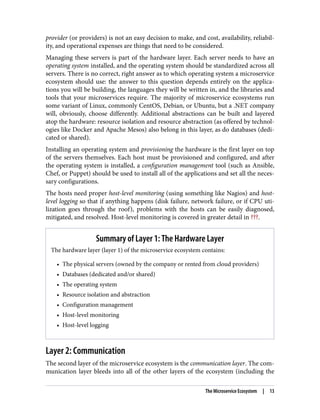
The microservice ecosystem can be split into four layers (Figure 1-7), though the
boundaries of each are not always clearly defined: some elements of the infrastructure
will touch every part of the stack. The lower three layers are the infrastructure layers:
at the bottom of the stack we find the hardware layer, and on top of that, the commu‐
nication layer (which bleeds up into the fourth layer), followed by the application
platform. The fourth (top) layer is where all individual microservices live.
Figure 1-7. Four-layer model of the microservice ecosystem
Layer 1: Hardware
At the very bottom of the microservice ecosystem, we find the hardware layer. These
are the actual machines, the real, physical computers that all internal tools and all
microservices run on. These servers are located on racks within datacenters, being
cooled by expensive HVAC systems and powered by electricity. Many different types
of servers can live here: some are optimized for databases; others for processing CPU-
intensive tasks. These servers can either be owned by the company itself, or “rented”
from so-called cloud providers like Amazon Web Services’ Elastic Compute Cloud
(AWS EC2), Google Cloud Platform (GCP), or Microsoft Azure.
The choice of specific hardware is determined by the owners of the servers. If your
company is running your own datacenters, the choice of hardware is your own, and
you can optimize the server choice for your specific needs. If you are running servers
in the cloud (which is the more common scenario), your choice is limited to whatever
hardware is offered by the cloud provider. Choosing between bare metal and a cloud
12 | Chapter 1: Microservices
provider (or providers) is not an easy decision to make, and cost, availability, reliabil‐
ity, and operational expenses are things that need to be considered.
Managing these servers is part of the hardware layer. Each server needs to have an
operating system installed, and the operating system should be standardized across all
servers. There is no correct, right answer as to which operating system a microservice
ecosystem should use: the answer to this question depends entirely on the applica‐
tions you will be building, the languages they will be written in, and the libraries and
tools that your microservices require. The majority of microservice ecosystems run
some variant of Linux, commonly CentOS, Debian, or Ubuntu, but a .NET company
will, obviously, choose differently. Additional abstractions can be built and layered
atop the hardware: resource isolation and resource abstraction (as offered by technol‐
ogies like Docker and Apache Mesos) also belong in this layer, as do databases (dedi‐
cated or shared).
Installing an operating system and provisioning the hardware is the first layer on top
of the servers themselves. Each host must be provisioned and configured, and after
the operating system is installed, a configuration management tool (such as Ansible,
Chef, or Puppet) should be used to install all of the applications and set all the neces‐
sary configurations.
The hosts need proper host-level monitoring (using something like Nagios) and host-
level logging so that if anything happens (disk failure, network failure, or if CPU uti‐
lization goes through the roof), problems with the hosts can be easily diagnosed,
mitigated, and resolved. Host-level monitoring is covered in greater detail in ???.
Summary of Layer 1: The Hardware Layer
The hardware layer (layer 1) of the microservice ecosystem contains:
• The physical servers (owned by the company or rented from cloud providers)
• Databases (dedicated and/or shared)
• The operating system
• Resource isolation and abstraction
• Configuration management
• Host-level monitoring
• Host-level logging
Layer 2: Communication
The second layer of the microservice ecosystem is the communication layer. The com‐
munication layer bleeds into all of the other layers of the ecosystem (including the
The Microservice Ecosystem | 13
application platform and microservices layers), because it is where all communication
between services is handled; the boundaries between the communication layer and
each other layer of the microservice ecosystem are poorly defined. While the bound‐
aries may not be clear, the elements are clear: the second layer of a microservice eco‐
system always contains the network, DNS, RPCs and API endpoints, service
discovery, service registry, and load balancing.
Discussing the network and DNS elements of the communication layer is beyond the
scope of this book, so we will be focusing on RPCs, API endpoints, service discovery,
service registry, and load balancing in this section.
RPCs, endpoints, and messaging
Microservices interact with one another over the network using remote procedure
calls (RPCs) or messaging to the API endpoints of other microservices (or, as we will
see in the case of messaging, to a message broker which will route the message appro‐
priately). The basic idea is this: using a specified protocol, a microservice will send
some data in a standardized format over the network to another service (perhaps to
another microservice’s API endpoint) or to a message broker which will make sure
that the data is send to another microservice’s API endpoint.
There are several microservice communication paradigms. The first is the most com‐
mon: HTTP+REST/THRIFT. In HTTP+REST/THRIFT, services communicate with
each other over the network using the Hypertext Transfer Protocol (HTTP), and send‐
ing requests and receiving responses to or from either specific representational state
transfer (REST) endpoints (using various methods, like GET, POST, etc.) or specific
Apache Thrift endpoints (or both). The data is usually formatted and sent as JSON (or
protocol buffers) over HTTP.
HTTP+REST is the most convenient form of microservice communication. There
aren’t any surprises, it’s easy to set up, and is the most stable and reliable—mostly
because it’s difficult to implement incorrectly. The downside of adopting this para‐
digm is that it is, by necessity, synchronous (blocking).
The second communication paradigm is messaging. Messaging is asynchronous (non‐
blocking), but it’s a bit more complicated. Messaging works the following way: a
microservice will send data (a message) over the network (HTTP or other) to a mes‐
sage broker, which will route the communication to other microservices.
Messaging comes in several flavors, the two most popular being publish–subscribe
(pubsub) messaging and request–response messaging. In pubsub models, clients will
subscribe to a topic and will receive a message whenever a publisher publishes a mes‐
sage to that topic. Request–response models are more straightforward, where a client
will send a request to a service (or message broker), which will respond with the infor‐
mation requested. There are some messaging technologies that are a unique blend of
both models, like Apache Kafka. Celery and Redis (or Celery with RabbitMQ) can be
14 | Chapter 1: Microservices
used for messaging (and task processing) for microservices written in Python: Celery
processes the tasks and/or messages using Redis or RabbitMQ as the broker.
Messaging comes with several significant downsides that must be mitigated. Messag‐
ing can be just as scalable (if not more scalable) than HTTP+REST solutions, if it is
architected for scalability from the get-go. Inherently, messaging is not as easy to
change and update, and its centralized nature (while it may seem like a benefit) can
lead to its queues and brokers becoming points of failure for the entire ecosystem.
The asynchronous nature of messaging can lead to race conditions and endless loops
if not prepared for. If a messaging system is implemented with protections against
these problems, it can become as stable and efficient as a synchronous solution.
Service discovery, service registry, and load balancing
In monolithic architecture, traffic only needs to be sent to one application and dis‐
tributed appropriately to the servers hosting the application. In microservice archi‐
tecture, traffic needs to be routed appropriately to a large number of different
applications, and then distributed appropriately to the servers hosting each specific
microservice. In order for this to be done efficiently and effectively, microservice
architecture requires three technologies be implemented in the communication layer:
service discovery, service registry, and load balancing.
In general, when a microservice A needs to make a request to another microservice B,
microservice A needs to know the IP address and port of a specific instance where
microservice B is hosted. More specifically, the communication layer between the
microservices needs to know the IP addresses and ports of these microservices so that
the requests between them can be routed appropriately. This is accomplished through
service discovery (such as etcd, Consul, Hyperbahn, or ZooKeeper), which ensures
that requests are routed to exactly where they are supposed to be sent and that (very
importantly) they are only routed to healthy instances. Service discovery requires a
service registry, which is a database that tracks all ports and IPs of all microservices
across the ecosystem.
Dynamic Scaling and Assigned Ports
In microservice architecture, ports and IPs can (and do) change all
of the time, especially as microservices are scaled and re-deployed
(especially with a hardware abstraction layer like Apache Mesos).
One way to approach the discovery and routing is to assign static
ports (both frontend and backend) to each microservice.
Unless you have each microservice hosted on only one instance (which is highly
unlikely), you’ll need load balancing in place in various parts of the communication
layer across the microservice ecosystem. Load balancing works, at a very high level,
like this: if you have 10 different instances hosting a microservice, load-balancing
The Microservice Ecosystem | 15
software (and/or hardware) will ensure that the traffic is distributed (balanced) across
all of the instances. Load balancing will be needed at every location in the ecosystem
in which a request is being sent to an application, which means that any large micro‐
service ecosystem will contain many, many layers of load balancing. Commonly used
load balancers for this purpose are Amazon Web Services Elastic Load Balancer, Net‐
flix Eureka, HAProxy, and Nginx.
Summary of Layer 2: The Communication Layer
The communication layer (layer 2) of the microservice ecosystem contains:
• Network
• DNS
• Remote procedure calls (RPCs)
• Endpoints
• Messaging
• Service discovery
• Service registry
• Load balancing
Layer 3: The Application Platform
The application platform is the third layer of the microservice ecosystem and contains
all of the internal tooling and services that are independent of the microservices. This
layer is filled with centralized, ecosystem-wide tools and services that must be built in
such a way that microservice development teams do not have to design, build, or
maintain anything except their own microservices.
A good application platform is one with self-service internal tools for developers, a
standardized development process, a centralized and automated build and release sys‐
tem, automated testing, a standardized and centralized deployment solution, and cen‐
tralized logging and microservice-level monitoring. Many of the details of these
elements are covered in later chapters, but we’ll cover several of them briefly here to
provide some introduction to the basic concepts.
Self-service internal development tools
Quite a few things can be categorized as self-service internal development tools, and
which particular things fall into this category depends not only on the needs of the
developers, but the level of abstraction and sophistication of both the infrastructure
and the ecosystem as a whole. The key to determining which tools need to be built is
16 | Chapter 1: Microservices
to first divide the realms of responsibility and then determine which tasks developers
need to be able to accomplish in order to design, build, and maintain their services.
Within a company that has adopted microservice architecture, responsibilities need
to be carefully delegated to different engineering teams. An easy way to do this is to
create an engineering suborganization for each layer of the microservice ecosystem,
along with other teams that bridge each layer. Each of these engineering organiza‐
tions, functioning semi-independently, will be responsible for everything within their
layer: TechOps teams will be responsible for layer 1, infrastructure teams will be
responsible for layer 2, application platform teams will be responsible for layer 3, and
microservice teams will be responsible for layer 4 (this is, of course, a very simplified
view, but you get the general idea).
Within this organizational scheme, any time that an engineer working on one of the
higher layers needs to set up, configure, or utilize something on one of the lower lay‐
ers, there should be a self-service tool in place that the engineer can use. For example,
the team working on messaging for the ecosystem should build a self-service tool so
that if a developer on a microservice team needs to configure messaging for her ser‐
vice, she can easily configure the messaging without having to understand all of the
intricacies of the messaging system.
There are many reasons to have these centralized, self-service tools in place for each
layer. In a diverse microservice ecosystem, the average engineer on any given team
will have no (or very little) knowledge of how the services and systems in other teams
work, and there is simply no way they could become experts in each service and sys‐
tem while working on their own—it simply can’t be done. Each individual developer
will know almost nothing except her own service, but together, all of the developers
working within the ecosystem will collectively know everything. Rather than trying to
educate each developer about the intricacies of each tool and service within the eco‐
system, build sustainable, easy-to-use user interfaces for every part of the ecosystem,
and then educate and train them on how to use those. Turn everything into a black
box, and document exactly how it works and how to use it.
The second reason to build these tools and build them well is that, in all honesty, you
do not want a developer from another team to be able to make significant changes to
your service or system, especially not one that could cause an outage. This is espe‐
cially true and compelling for services and systems belonging to the lower layers
(layer 1, layer 2, and layer 3). Allowing nonexperts to make changes to things within
these layers, or requiring (or worse, expecting) them to become experts in these areas
is a recipe for disaster. An example of where this can go terribly wrong is in configu‐
ration management: allowing developers on microservice teams to make changes to
system configurations without having the expertise to do so can and will lead to
large-scale production outages if a change is made that affects something other than
their service alone.
The Microservice Ecosystem | 17
The development cycle
When developers are making changes to existing microservices, or creating new ones,
development can be made more effective by streamlining and standardizing the
development process and automating away as much as possible. The details of stand‐
ardizing the process of stable and reliable development itself are covered in Chap‐
ter 4, Scalability and Performance, but there are several things that need to be in place
within the third layer of a microservice ecosystem in order for stable and reliable
development to be possible.
The first requirement is a centralized version control system where all code can be
stored, tracked, versioned, and searched. This is usually accomplished through some‐
thing like GitHub, or a self-hosted git or svn repository linked to some kind of collab‐
oration tool like Phabrictor, and these tools make it easy to maintain and review code.
The second requirement is a stable, efficient development environment. Development
environments are notoriously difficult to implement in microservice ecosystems, due
to the complicated dependencies each microservice will have on other services, but
they are absolutely essential. Some engineering organizations prefer when all devel‐
opment is done locally (on a developer’s laptop), but this can lead to bad deploys
because it doesn’t give the developer an accurate picture of how her code changes will
perform in the production world. The most stable and reliable way to design a devel‐
opment environment is to create a mirror of the production environment (one that is
not staging, nor canary, nor production) containing all of the intricate dependency
chains.
Test, build, package, and release
The test, build, package, and release steps in between development and deployment
should be standardized and centralized as much as possible. After the development
cycle, when any code change has been committed, all the necessary tests should be
run, and new releases should be automatically built and packaged. Continuous inte‐
gration tooling exists for precisely this purpose, and existing solutions (like Jenkins)
are very advanced and easy to configure. These tools make it easy to automate the
entire process, leaving very little room for human error.
Deployment pipeline
The deployment pipeline is the process by which new code makes its way to produc‐
tion servers after the development cycle and following the test, build, package, and
release steps. Deployment can quickly become very complicated in a microservice
ecosystem, where hundreds of deployments per day are not out of the ordinary.
Building tooling around deployment, and standardizing deployment practices for all
development teams is often necessary. The principles of building stable and reliable
18 | Chapter 1: Microservices
(production-ready) deployment pipelines are covered in detail in Chapter 3, Stability
and Reliability.
Logging and monitoring
All microservices should have microservice-level logging of all requests made to the
microservice (including all relevant and important information) and its responses.
Due to the fast-paced nature of microservice development, it’s often impossible to
reproduce bugs in the code because it’s impossible to reconstruct the state of the sys‐
tem at the time of failure. Good microservice-level logging gives developers the infor‐
mation they need to fully understand the state of their service at a certain time in the
past or present. Microservice-level monitoring of all key metrics of the microservices is
essential for similar reasons: accurate, real-time monitoring allows developers to
always know the health and status of their service. Microservice-level logging and
monitoring are covered in greater detail in ???.
Summary of Layer 3: The Application Platform Layer
The application platform layer (layer 3) of the microservice ecosystem contains:
• Self-service internal development tools
• Development environment
• Test, package, build, and release tools
• Deployment pipeline
• Microservice-level logging
• Microservice-level monitoring
Layer 4: Microservices
At the very top of the microservice ecosystem lies the microservice layer (layer 4). This
layer is where the microservices—and anything specific to them—live, completely
abstracted away from the lower infrastructure layers. Here they are abstracted from
the hardware, from deployment, from service discovery, from load balancing, and
from communication. The only things that are not abstracted away from the micro‐
service layer are the configurations specific to each service for using the tools.
It is common practice in software engineering to centralize all application configura‐
tions so that the configurations for a specific tool or set of tools (like configuration
management, resource isolation, or deployment tools) are all stored with the tool
itself. For example, custom deployment configurations for applications are often
stored not with the application code but with the code for the deployment tool. This
The Microservice Ecosystem | 19
practice works well for monolithic architecture, and even for small microservice eco‐
systems, but in very large microservice ecosystems containing hundreds of microser‐
vices and dozens of internal tools (each with their own custom configurations), this
practice becomes rather messy: developers on microservice teams are required to
make changes to codebases of tools in the layers below, and oftentimes will forget
where certain configurations live (or that they exist at all). To mitigate this problem,
all microservice-specific configurations can live in the repository of the microservice
and should be accessed there by the tools and systems of the layers below.
Summary of Layer 4: The Microservice Layer
The microservice layer (layer 4) of the microservice ecosystem contains:
• The microservices
• All microservice-specific configurations
Organizational Challenges
The adoption of microservice architecture resolves the most pressing challenges pre‐
sented by monolithic application architecture. Microservices aren’t plagued by the
same scalability challenges, the lack of efficiency, or the difficulties in adopting new
technologies: they are optimized for scalability, optimized for efficiency, optimized
for developer velocity. In an industry where new technologies rapidly gain market
traction, the pure organizational cost of maintaining and attempting to improve a
cumbersome monolithic application is simply not practical. With these things in
mind, it’s hard to imagine why anyone would be reluctant to split a monolith into
microservices, why anyone would be wary about building a microservice ecosystem
from the ground up.
Microservices seem like a magical (and somewhat obvious) solution, but we know
better than that. In The Mythical Man-Month, Frederick Brooks explained why there
are no silver bullets in software engineering, an idea he summarized as follows:
“There is no single development, in either technology or management technique,
which by itself promises even one order-of-magnitude improvement within a decade
in productivity, in reliability, in simplicity.”
When we find ourselves presented with technology that promises to offer us drastic
improvements, we need to look for the trade-offs. Microservices promise greater scal‐
ability and greater efficiency, but we know that those will come at a cost to some part
of the overall system.
There are four especially significant trade-offs that come with microservice architec‐
ture. The first is the change in organizational structure that tends toward isolation
20 | Chapter 1: Microservices
and poor cross-team communication—a consequence of the inverse of Conway’s Law.
The second is the dramatic increase in technical sprawl, sprawl that is extraordinarily
costly not only to the entire organization but which also presents significant costs to
each engineer. The third trade-off is the increased ability of the system to fail. The
fourth is the competition for engineering and infrastructure resources.
The Inverse Conway’s Law
The idea behind Conway’s Law (named after programmer Melvin Conway in 1968) is
this: that the architecture of a system will be determined by the communication and
organizational structures of the company. The inverse of Conway’s Law (which we’ll
call the Inverse Conway’s Law) is also valid and is especially relevant to the microser‐
vice ecosystem: the organizational structure of a company is determined by the archi‐
tecture of its product. Over 40 years after Conway’s Law was first introduced, both it
and its inverse still appear to hold true. Microsoft’s organizational structure, if
sketched out as if it were the architecture of a system, looks remarkably like the archi‐
tecture of its products—the same goes for Google, for Amazon, and for every other
large technology company. Companies that adopt microservice architecture will
never be an exception to this rule.
Microservice architecture is comprised of a large number of small, isolated, inde‐
pendent microservices. The Inverse Conway’s Law demands that the organizational
structure of any company using microservice architecture will be made up of a large
number of very small, isolated, and independent teams. The team structures that
spring from this inevitably lead to siloing and sprawl, problems that are made worse
every time the microservice ecosystem becomes more sophisticated, more complex,
more concurrent, and more efficient.
Inverse Conway’s Law also means that developers will be, in some ways, just like
microservices: they will be able to do one thing, and (hopefully) do that one thing
very well, but they will be isolated (in responsibility, in domain knowledge, and expe‐
rience) from the rest of the ecosystem. When considered together, all of the develop‐
ers collectively working within a microservice ecosystem will know everything there is
to know about it, but individually they will be extremely specialized, knowing only
the pieces of the ecosystem they are responsible for.
This poses an unavoidable organizational problem: even though microservices must
be developed in isolation (leading to isolated, siloed teams), they don’t live in isola‐
tion and must interact with one another seamlessly if the overall product is to func‐
tion at all. This requires that these isolated, independently functioning teams work
together closely and often—something that is difficult to accomplish, given that most
team’s goals and projects (codified in their team’s objectives and key results, or OKRs)
are specific to a particular microservice they are working on.
Organizational Challenges | 21
There is also a large communication gap between microservice teams and infrastruc‐
ture teams that needs to be closed. Application platform teams, for example, need to
build platform services and tools that all of the microservice teams will use, but gain‐
ing the requirements and needs from hundreds of microservice teams before building
one small project can take months (even years). Getting developers and infrastruc‐
ture teams to work together is not an easy task.
There’s a related problem that arises thanks to Inverse Conway’s Law, one that is only
rarely found in companies with monolithic architecture: the difficulty of running an
operations organization. With a monolith, an operations organization can easily be
staffed and on call for the application, but this is very difficult to achieve with micro‐
service architecture because it would require every single microservice to be staffed
by both a development team and an operational team. Consequently, microservice
development teams need to be responsible for the operational duties and tasks associ‐
ated with their microservice. There is no separate ops org to take over the on call, no
separate ops org responsible for monitoring: developers will need to be on call for
their services.
Technical Sprawl
The second trade-off, technical sprawl, is related to the first. While Conway’s Law and
its inverse predict organizational sprawl and siloing for microservices, a second type
of sprawl (related to technologies, tools, and the like) is also unavoidable in microser‐
vice architecture. There are many different ways in which technical sprawl can mani‐
fest. We’ll cover a few of the most common ways here.
It’s easy to see why microservice architecture leads to technical sprawl if we consider a
large microservice ecosystem, one containing 1,000 microservices. Suppose each of
these microservices is staffed by a development team of six developers, and each
developer uses their own set of favorite tools, favorite libraries, and works in their
own favorite languages. Each of these development teams has their own way of
deploying, their own specified metrics to monitor and alert on, their own external
libraries and internal dependencies they use, custom scripts to run on production
machines, and so on.
If you have a thousand of these teams, this means that within one system there are a
thousand ways to do one thing. There will be a thousand ways to deploy, a thousand
libraries to maintain, a thousand different ways of alerting and monitoring and test‐
ing and handling outages. The only way to cut down on technical sprawl is through
standardization at every level of the microservice ecosystem.
There’s another kind of technical sprawl associated with language choice. Microservi‐
ces infamously come with the promise of greater developer freedom, freedom to
choose whichever languages and libraries one wants. This is possible in principle, and
can be true in practice, but as a microservice ecosystem grows it often becomes
22 | Chapter 1: Microservices
impractical, costly, and dangerous. To see why this can become a problem, consider
the following scenario. Suppose we have a microservice ecosystem containing 200
services, and imagine that some of these microservices are written in Python, others
in JavaScript, some in Haskell, a few in Go, and a couple more in Ruby, Java, and
C++. For each internal tool, for each system and service within every layer of the eco‐
system, libraries will have to be written for each one of these languages.
Take a moment to contemplate the sheer amount of maintenance and development
that will have to be done in order for each language to receive the support it requires:
it’s extraordinary, and very few engineering organizations could afford to dedicate the
engineering resources necessary to make it happen. It’s more realistic to choose a
small number of supported languages and ensure that all libraries and tools are com‐
patible with and exist for these languages than to attempt to support a large number
of languages.
The last type of technical sprawl we will cover here is technical debt, which usually
refers to work that needs to be done because something was implemented in a way
that got the job done quickly, but not in the best or most optimal way. Given that
microservice development teams can churn out new features at a fast pace, technical
debt often builds up quietly in the background. When outages happen, when things
break, any work that comes out of an incident review will only rarely be the best over‐
all solution: as far as microservice development teams are concerned, whatever fixes
(or fixed) the problem quickly and in the moment was good enough, and any better
solutions are pawned off to the future.
More Ways to Fail
Microservices are large, complex, distributed systems with many small, independent
pieces that are constantly changing. The reality of working with complex systems of
this sort is that individual components will fail, they will fail often, and they will fail
in ways that nobody could have predicted. This is where the third trade-off comes
into play: microservice architecture introduces more ways your system can fail.
There are ways to prepare for failure, to mitigate failures when they occur, and to test
the limits and boundaries of both the individual components and the overall ecosys‐
tem, which I cover in ???. However, it is important to understand that no matter how
many resiliency tests you run, no matter how many failures and catastrophe scenarios
you’ve scoped out, you cannot escape the fact that the system will fail. You can only
do your best to prepare for when it does.
Competition for Resources
Just like any other ecosystem in the natural world, competition for resources in the
microservice ecosystem is fierce. Each engineering organization has finite resources:
it has finite engineering resources (teams, developers) and finite hardware and infra‐
Organizational Challenges | 23
structure resources (physical machines, cloud hardware, database storage, etc.), and
each resource costs the company a great deal of money.
When your microservice ecosystem has a large number of microservices and a large
and sophisticated application platform, competition between teams for hardware and
infrastructure resources is inevitable: every service, every tool will be presented as
equally important, its scaling needs presented as being of the highest priority.
Likewise, when application platform teams are asking for specifications and needs
from microservice teams so that they can design their systems and tools appropri‐
ately, every microservice development team will argue that their needs are the most
important and will be disappointed (and potentially very frustrated) if they are not
included. This kind of competition for engineering resources can lead to resentment
between teams.
The last kind of competition for resources is perhaps the most obvious one: the com‐
petition between managers, between teams, and between different engineering
departments/organization for engineering headcount. Even with the increase in com‐
puter science graduates and the rise of developer bootcamps, truly great developers
are difficult to find, and represent one of the most irreplaceable and scarce resources.
When there are hundreds or thousands of teams that could use an extra engineer or
two, every single team will insist that their team needs an extra engineer more than
any of the other teams.
There is no way to avoid competition for resources, though there are ways to mitigate
competition somewhat. The most effective seems to be organizing or categorizing
teams in terms of their importance and criticality to the overall business, and then
giving teams access to resources based on their priority or importance. There are
downsides to this, because it tends to result in poorly staffed development tools
teams, and in projects whose importance lies in shaping the future (such as adopting
new infrastructure technologies) being abandoned.
24 | Chapter 1: Microservices
CHAPTER 3
Stability and Reliability
A production-ready microservice is stable and reliable. Both individual microservices
and the overall microservice ecosystem are constantly changing and evolving, and
any efforts made to increase the stability and reliability of a microservice go a long
way toward ensuring the health and availability of the overall ecosystem. In this chap‐
ter, different ways to build and run a stable and reliable microservice are explored,
including standardizing the development process, building comprehensive deploy‐
ment pipelines, understanding dependencies and protecting against their failures,
building stable and reliable routing and discovery, and establishing appropriate dep‐
recation and decommissioning procedures for old or outdated microservices and/or
their endpoints.
Principles of Building Stable and Reliable Microservices
Microservice architecture lends itself to fast-paced development. The freedom offered
by microservices means that the ecosystem will be in a state of continuous change,
never static, always evolving. Features will be added every day, new builds will be
deployed multiple times per day, and old technologies will be swapped for newer and
better ones at an astounding pace. This freedom and flexibility gives rise to real, tan‐
gible innovation, but comes at a great cost.
Innovation, increased developer velocity and productivity, rapid technological
advancement, and the ever-changing microservice ecosystem can all very quickly be
brought to a screeching halt if any piece of the microservice ecosystem becomes
unstable or unreliable. In some cases, all it takes to bring the entire business down is
deploying a broken build or a build containing a bug to one business-critical micro‐
service.
25
A stable microservice is one for which development, deployment, the adoption of
new technologies, and the decommissioning or deprecation of other services do not
give rise to instability across the larger microservice ecosystem. This requires putting
measures into place to protect against the negative consequences that may be intro‐
duced by these types of changes. A reliable microservice is one that can be trusted by
other microservices and by the overall ecosystem. Stability goes hand in hand with
reliability because each stability requirement carries with it a reliability requirement
(and vice versa): for example, stable deployment processes are accompanied by a
requirement that each new deployment does not compromise the reliability of the
microservice from the point of view of one of their clients or dependencies.
There are several things that can be done to ensure that a microservice is stable and
reliable. A standardized development cycle can be implemented to protect against
poor development practices. The deployment process can be designed so that changes
to the code are forced to pass through multiple stages before being rolled out to all
production servers. Dependency failures can be protected against. Health checks,
proper routing, and circuit breaking can be built into the routing and discovery chan‐
nels to handle anomalous traffic patterns. Finally, microservices and their endpoints
can be deprecated and/or decommissioned without causing any failures for other
microservices.
A Production-Ready Service Is Stable and Reliable
• It has a standardized development cycle.
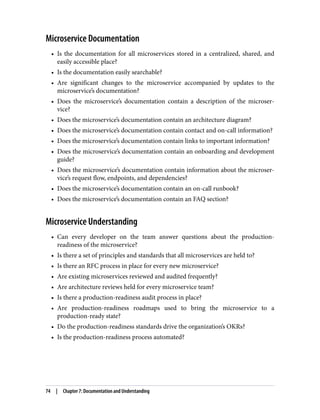
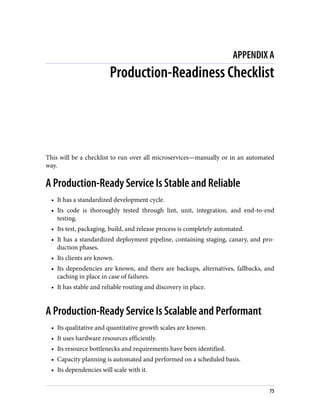
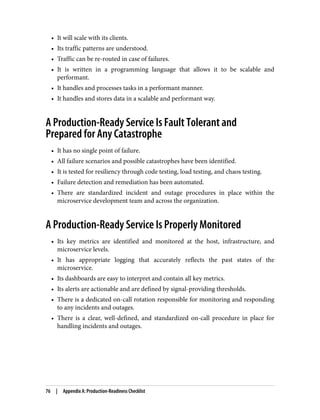
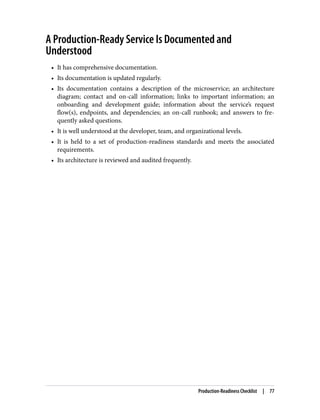
• Its code is thoroughly tested through lint, unit, integration, and end-to-end
testing.
• Its test, packaging, build, and release process is completely automated.
• It has a standardized deployment pipeline, containing staging, canary, and pro‐
duction phases.
• Its clients are known.
• Its dependencies are known, and there are backups, alternatives, fallbacks, and
caching in place in case of failures.
• It has stable and reliable routing and discovery in place.
The Development Cycle
The stability and reliability of a microservice begins with the individual developer
who is contributing code to the service. The majority of outages and microservice
failures are caused by bugs introduced into the code that were not caught in the
development phase, in any of the tests, or at any step in the deployment process. Miti‐
26 | Chapter 3: Stability and Reliability
gating and resolving these outages and failures usually entails nothing more than roll‐
ing back to the latest stable build, reverting whatever commit contained the bug, and
re-deploying a new (bug-less) version of the code.
The True Cost of Unstable and Unreliable Development
A microservice ecosystem is not the Wild West. Every outage,
every incident, and every bug can and will cost the company thou‐
sands (if not millions) of dollars in engineering hours and lost rev‐
enue. Safeguards need to be in place during the development cycle
(and, as we will see, in the deployment pipeline) to catch every bug
before it hits production.
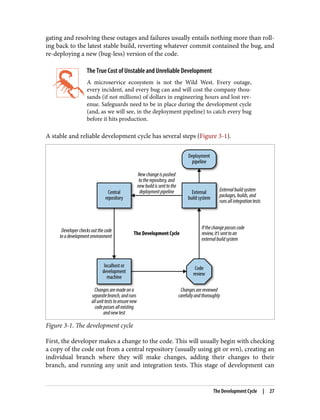
A stable and reliable development cycle has several steps (Figure 3-1).
Figure 3-1. The development cycle
First, the developer makes a change to the code. This will usually begin with checking
a copy of the code out from a central repository (usually using git or svn), creating an
individual branch where they will make changes, adding their changes to their
branch, and running any unit and integration tests. This stage of development can
The Development Cycle | 27
happen anywhere: locally on a developer’s laptop or on a server in a development
environment. A reliable development environment—one that accurately mirrors the
production world—is key, especially if testing the service in question requires making
requests to other microservices or reading or writing data to a database.
Once the code has been committed to the central repository, the second step consists
in having the change(s) reviewed carefully and thoroughly by other engineers on the
team. If all reviewers have approved the change(s), and all lint, unit, and integration
tests have passed on a new build, the change can be merged into the repository
(see ???, for more on lint, unit, and integration tests). Then, and only then, can the
new change be introduced into the deployment pipeline.
Test Before Code Review
One way to ensure that all bugs are caught before they hit produc‐
tion is to run all lint, unit, integration, and end-to-end tests before
the code review phase. This can be accomplished by having devel‐
opers work on a separate branch, kicking off all tests on that
branch as soon as the developer submits it for code review, and
then only allowing it to reach code review (or only allowing it to be
built) after it successfully passes all tests.
As mentioned in the section on layer 4 of the microservice ecosystem in Chapter 1,
Microservices, a lot happens in between the development cycle and the deployment
pipeline. The new release needs to be packaged, built, and thoroughly tested before
reaching the first stage of the deployment pipeline.
The Deployment Pipeline
There is a great deal of room for human error in microservice ecosystems, especially
where deployment practices are concerned, and (as I mentioned earlier) the majority
of outages in large-scale production systems are caused by bad deployments. Con‐
sider the organizational sprawl that accompanies the adoption of microservice archi‐
tecture and what it entails for the deployment process: you have, at the very least,
dozens (if not hundreds or thousands) of independent, isolated teams who are
deploying changes to their microservices on their own schedules, and often without
cross-team coordination between clients and dependencies. If something goes wrong,
if a bug is introduced into production, or if a service is temporarily unavailable dur‐
ing deployment, then the entire ecosystem can be negatively affected. To ensure that
things go wrong with less frequency, and that any failures can be caught before being
rolled out to all production servers, introducing a standardized deployment pipeline
across the engineering organization can help ensure stability and reliability across the
ecosystem.
28 | Chapter 3: Stability and Reliability
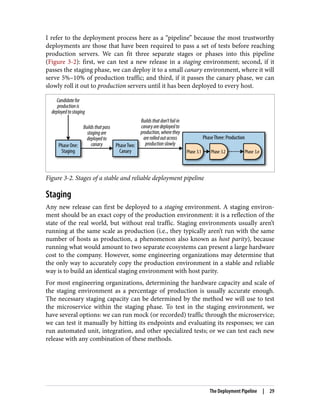
I refer to the deployment process here as a “pipeline” because the most trustworthy
deployments are those that have been required to pass a set of tests before reaching
production servers. We can fit three separate stages or phases into this pipeline
(Figure 3-2): first, we can test a new release in a staging environment; second, if it
passes the staging phase, we can deploy it to a small canary environment, where it will
serve 5%–10% of production traffic; and third, if it passes the canary phase, we can
slowly roll it out to production servers until it has been deployed to every host.
Figure 3-2. Stages of a stable and reliable deployment pipeline
Staging
Any new release can first be deployed to a staging environment. A staging environ‐
ment should be an exact copy of the production environment: it is a reflection of the
state of the real world, but without real traffic. Staging environments usually aren’t
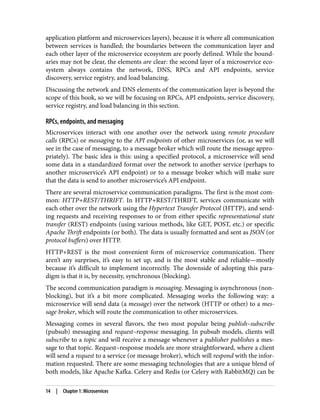
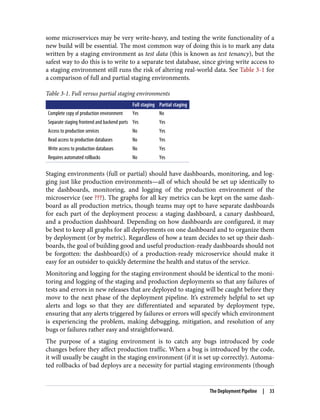
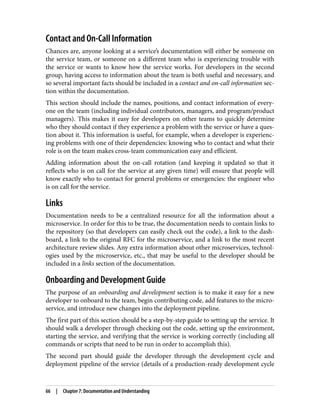
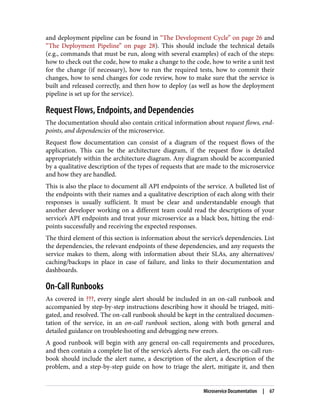
running at the same scale as production (i.e., they typically aren’t run with the same
number of hosts as production, a phenomenon also known as host parity), because
running what would amount to two separate ecosystems can present a large hardware
cost to the company. However, some engineering organizations may determine that
the only way to accurately copy the production environment in a stable and reliable
way is to build an identical staging environment with host parity.
For most engineering organizations, determining the hardware capacity and scale of
the staging environment as a percentage of production is usually accurate enough.
The necessary staging capacity can be determined by the method we will use to test
the microservice within the staging phase. To test in the staging environment, we
have several options: we can run mock (or recorded) traffic through the microservice;
we can test it manually by hitting its endpoints and evaluating its responses; we can
run automated unit, integration, and other specialized tests; or we can test each new
release with any combination of these methods.
The Deployment Pipeline | 29
Treat Staging and Production as Separate Deployments of the Same
Service
You may be tempted to run staging and production as separate
services and store them in separate repositories. This can be done
successfully, but it requires that changes be synchronized across
both services and repositories, including configuration changes
(which are often forgotten about). It’s much easier to treat staging
and production as separate “deployments” or “phases” of the same
microservice.
Even though staging environments are testing environments, they differ from both
the development phase and the development environment in that a release that has
been deployed to staging is a release that is a candidate for production. A candidate for
production must have already successfully passed lint tests, unit tests, integration
tests, and code review before being deployed to a staging environment.
Deploying to a staging environment should be treated by developers with the same
seriousness and caution as deploying to production. If a release is successfully
deployed to staging, it can be automatically deployed to canaries, which will be run‐
ning production traffic.
Setting up staging environments in a microservice ecosystem can be difficult, due to
the complexities introduced by dependencies. If your microservice depends on nine
other microservices, then it relies on those dependencies to give accurate responses
when requests are sent and reads or writes to the relevant database(s) are made. As a
consequence of these complexities, the success of a staging environment hinges on
the way staging is standardized across the company.
Full staging
There are several ways that the staging phase of the deployment pipeline can be con‐
figured. The first is full staging (Figure 3-3), where a separate staging ecosystem is
running as a complete mirror copy of the entire production ecosystem (though not
necessarily with host parity). Full staging still runs on the same core infrastructure as
production, but there are several key differences. Staging environments of the serv‐
ices are, at the very least, made accessible to other services by staging-specific front‐
end and backend ports. Importantly, staging environments in a full-staging ecosystem
communicate only with the staging environments of other services, and never send any
requests or receive any responses from any services running in production (which
means sending traffic to production ports from staging is off limits).
30 | Chapter 3: Stability and Reliability
Figure 3-3. Full staging
Full staging requires every microservice to have a fully functional staging environ‐
ment that other microservices can communicate with when new releases are
deployed. Communicating with other microservices within the staging ecosystem can
be accomplished either by writing specific tests that are kicked off when a new build
is deployed to the staging environment, or as mentioned, by running old recorded
production traffic or mock traffic through the service being deployed along with all
upstream and downstream dependencies.
Full staging also requires careful handling of test data: staging environments should
never have write access to any production databases, and granting read access to pro‐
duction databases is discouraged as well. Because full staging is designed to be a com‐
plete mirror copy of production, every microservice staging environment should
contain a separate test database that it can read from and write to.
Risks of Full Staging
Caution needs to be taken when implementing and deploying full
staging environments, because new releases of services will almost
always be communicating with other new releases of any upstream
and downstream dependencies—this may not be an accurate
reflection of the real world. Engineering organizations may need to
require teams to coordinate and/or schedule deployments to stag‐
ing to avoid the deployment of one service breaking the staging
environment for all other related services.
The Deployment Pipeline | 31
Partial staging
The second type of staging environment is known as partial staging. As the name sug‐
gests, it is not a complete mirror copy of the production environment. Rather, each
microservice has its own staging environment, which is a pool of servers with (at the
very least) staging-specific frontend and backend ports, and when new builds are
introduced into the staging phase, they communicate with the upstream clients and
downstream dependencies that are running in production (Figure 3-4).
Figure 3-4. Partial staging
Partial staging deployments should hit all production endpoints of a microservice’s
clients and dependencies to mimic the state of the actual world as accurately as possi‐
ble. Specific staging tests will need to be written and run to accomplish this, and
every new feature added should probably be accompanied by at least one additional
staging test to ensure that it is tested thoroughly.
Risks of Partial Staging
Because microservices with partial staging environments commu‐
nicate with production microservices, extreme care must be taken.
Even though partial staging is restricted to read-only requests, pro‐
duction services can easily be taken down by bad staging deploys
that send bad requests and/or overload production services with
too many requests.
These types of staging environments should also be restricted to read-only database
access: a staging environment should never write to a production database. However,
32 | Chapter 3: Stability and Reliability
some microservices may be very write-heavy, and testing the write functionality of a
new build will be essential. The most common way of doing this is to mark any data
written by a staging environment as test data (this is known as test tenancy), but the
safest way to do this is to write to a separate test database, since giving write access to
a staging environment still runs the risk of altering real-world data. See Table 3-1 for
a comparison of full and partial staging environments.
Table 3-1. Full versus partial staging environments
Full staging Partial staging
Complete copy of production environment Yes No
Separate staging frontend and backend ports Yes Yes
Access to production services No Yes
Read access to production databases No Yes
Write access to production databases No Yes
Requires automated rollbacks No Yes
Staging environments (full or partial) should have dashboards, monitoring, and log‐
ging just like production environments—all of which should be set up identically to
the dashboards, monitoring, and logging of the production environment of the
microservice (see ???). The graphs for all key metrics can be kept on the same dash‐
board as all production metrics, though teams may opt to have separate dashboards
for each part of the deployment process: a staging dashboard, a canary dashboard,
and a production dashboard. Depending on how dashboards are configured, it may
be best to keep all graphs for all deployments on one dashboard and to organize them
by deployment (or by metric). Regardless of how a team decides to set up their dash‐
boards, the goal of building good and useful production-ready dashboards should not
be forgotten: the dashboard(s) of a production-ready microservice should make it
easy for an outsider to quickly determine the health and status of the service.
Monitoring and logging for the staging environment should be identical to the moni‐
toring and logging of the staging and production deployments so that any failures of
tests and errors in new releases that are deployed to staging will be caught before they
move to the next phase of the deployment pipeline. It’s extremely helpful to set up
alerts and logs so that they are differentiated and separated by deployment type,
ensuring that any alerts triggered by failures or errors will specify which environment
is experiencing the problem, making debugging, mitigation, and resolution of any
bugs or failures rather easy and straightforward.
The purpose of a staging environment is to catch any bugs introduced by code
changes before they affect production traffic. When a bug is introduced by the code,
it will usually be caught in the staging environment (if it is set up correctly). Automa‐
ted rollbacks of bad deploys are a necessity for partial staging environments (though
The Deployment Pipeline | 33
are not required for full staging environments). Establishing when to revert to a pre‐
vious build should be determined by various thresholds on the microservice’s key
metrics.
Since partial staging requires interacting with microservices running in production,
bugs introduced by new releases deployed to a partial staging environment can bring
down other microservices that are running in production. If there aren’t any automa‐
ted rollbacks in place, mitigating and resolving these problems needs to be done
manually. Any steps of the deployment process that need manual intervention are
points of failure not only for the microservice itself, but for the entire microservice
ecosystem.
The last question a microservice team needs to answer when setting up a staging
environment is how long a new release should run on staging before it can be
deployed to canary (and, after that, to production). The answer to this question is
determined by the staging-specific tests that are run on staging: a new build is ready
to move to the next step of the deployment process as soon as all tests have passed
without failing.
Canary
Once a new release has successfully been deployed to staging and passed all required
tests, the build can be deployed to the next stage in the deployment pipeline: the can‐
ary environment. The unique name for this environment comes from a tactic used by
coal miners: they’d bring canaries with them into the coal mines to monitor the levels
of carbon monoxide in the air; if the canary died, they knew that the level of toxic gas
in the air was high, and they’d leave the mines. Sending a new build into a canary
environment serves the same purpose: deploy it to a small pool of servers running
production traffic (around 5%–10% of production capacity), and if it survives, deploy
to the rest of the production servers.
Canary Traffic Distribution
If the production service is deployed in multiple different
datacenters, regions, or cloud providers, then the canary pool
should contain servers in each of these in order to accurately sam‐
ple production.
Since a canary environment serves production traffic, it should be considered part of
production. It should have the same backend and frontend ports, and canary hosts
should be chosen at random from the pool of production servers to ensure accurate
sampling of production traffic. Canaries can (and should) have full access to produc‐
tion services: they should hit all production endpoints of upstream and downstream
34 | Chapter 3: Stability and Reliability
dependencies, and they should have both read and write access to any databases (if
applicable).
As with staging, the dashboards, monitoring, and logging should be the same for
canaries as for production. Alerts and logs should be differentiated and labeled as
coming from the canary deployment so that developers can easily mitigate, debug,
and resolve any problems.
Separate Ports for Canaries and Production
Allocating separate frontend and backend ports for canaries and
production so that traffic can be directed deliberately may seem
like a good idea, but unfortunately separating out the traffic in this
fashion defeats the purpose of canaries: to randomly sample pro‐
duction traffic on a small pool of servers to test a new release.
Automated rollbacks absolutely need to be in place for canaries: if any known errors
occur, the deployment system needs to automatically revert to the last known stable
version. Remember, canaries are serving production traffic, and any problems that
happen are affecting the real world.
How long should a new release sit in the canary pool until developers can be satisfied
that it is ready for production? This can be minutes, hours, or even days, and the
answer is determined by the microservice’s traffic patterns. The traffic of every micro‐
service is going to have some sort of pattern, no matter how strange your microser‐
vice or business may be. A new release should not leave the canary stage of
deployment until a full traffic cycle has been completed. How a “traffic cycle” is
defined needs to be standardized across the entire engineering organization, but the
duration and requirements of the traffic cycle may need to be created on a service-by-
service basis.
Production
Production is the real world. When a build has successfully made it through the devel‐
opment cycle, survived staging, and lived through the coal mines of the canary phase,
it is ready to be rolled out to the production deployment. At this point in the deploy‐
ment pipeline—the very last step—the development team should be completely con‐
fident in the new build. Any errors in the code should have been discovered,
mitigated, and resolved before making it this far.
Every build that makes it to production should be completely stable and reliable. A
build being deployed to production should have already been thoroughly tested, and
a build should never be deployed to production until it has made it through the stag‐
ing and canary phases without any issues. Deploying to production can be done in
one fell swoop after the build has lived through the canaries, or it can be gradually
The Deployment Pipeline | 35
rolled out in stages: developers can choose to roll out to production by percentage of
hardware (e.g., first to 25% of all servers, then to 50%, then 75%, and finally 100%),
or by datacenter, or by region, or by country, or any mixture of these.
Enforcing Stable and Reliable Deployment
By the time a new candidate for production has made it through the development
process, has survived the staging environment, and has been deployed to the canary
phase successfully, the chances of it causing a major outage are very slim, because
most bugs in the code will have been caught before the candidate for production is
rolled out to production. This is precisely why having a comprehensive deployment
pipeline is essential for building a stable and reliable microservice.
For some developers, the delay introduced by the deployment pipeline might seem
like an unnecessary burden because it delays their code changes and/or new features
from being deployed straight to production minutes after they have been written. In
reality, the delay introduced by the phases of the deployment pipeline is very short
and easily customizable, but sticking to the standardized deployment process needs
to be enforced to ensure reliability. Deploying to a microservice multiple times per
day can (and does) compromise the stability and reliability of the microservice and
any other services within its complex dependency chain: a microservice that is chang‐
ing every few hours is rarely a stable or reliable microservice.
Developers may be tempted to skip the staging and canary phases of the deployment
process and deploy a fix straight to production if, for example, a serious bug is dis‐
covered in production. While this solves the problem quickly, can possibly save the
company from losing revenue, and can prevent dependencies from experiencing out‐
ages, allowing developers to deploy straight to production should be reserved only for
the most severe outages. Without these restrictions in place, there is always the unfor‐
tunate possibility of abusing the process and deploying straight to production: for
most developers, every code change, every deploy is important and may seem impor‐
tant enough to bypass staging and canary, compromising the stability and reliability
of the entire microservice ecosystem. When failures occur, development teams should
instead be encouraged to always roll back to the latest stable build of the microser‐
vice, which will bring the microservice back to a known (and reliable) state, which
can run in production without any issues while the team works to discover the root
cause of the failure that occurred.
36 | Chapter 3: Stability and Reliability
Hotfixes Are an Anti-Pattern
When a deployment pipeline is in place, there should never be any
direct deployment to production unless there is an emergency, but
even this should be discouraged. Bypassing the initial phases of the
deployment pipeline often introduces new bugs into production, as
emergency code fixes run the risk of not being properly tested.
Rather than deploying a hotfix straight to production, developers
should roll back to the latest stable build if possible.
Stable and reliable deployment isn’t limited only to following the deployment pipe‐
line, and there are several cases in which blocking a particular microservice from
deploying can increase availability across the ecosystem.
If a service isn’t meeting their SLAs (see ???), all deployment can be postponed if the
downtime quota of the service has been used up. For example, if a service has an SLA
promising 99.99% availability (allowing 4.38 minutes of downtime each month), but
has been unavailable for 12 minutes in one month, then new deployments of that
microservice can be blocked for the next three months, ensuring that it meets its SLA.
If a service fails load testing (see ???), then deployment to production can be locked
until the service is able to appropriately pass any necessary load tests. For business-
critical services, whose outages would stop the company from functioning properly, it
can at times be necessary to block deployment if they do not meet the production-
readiness criteria established by the engineering organization.
Dependencies
The adoption of microservice architecture is sometimes driven by the idea that
microservices can be built and run in isolation, as fully independent and replaceable
components of a larger system. This is true in principle, but in the real world, every
microservice has dependencies, both upstream and downstream. Every microservice
will receive requests from clients (other microservices) that are counting on the ser‐
vice to perform as expected and to live up to its SLAs, as well as downstream depen‐
dencies (other services) that it will depend on to get the job done.
Building and running production-ready microservices requires developers to plan for
dependency failures, to mitigate them, and to protect against them. Understanding a
service’s dependencies and planning for their failures is one of the most important
aspects of building a stable and reliable microservice.
To understand how important this is, let’s consider an example microservice called
receipt-sender, whose SLA is four-nines (promising 99.99% availability to upstream
clients). Now, receipt-sender depends on several other microservices, including one
called customers (a microservice that handles all customer information), and one
called orders (a microservice that handles information about the orders each cus‐
Dependencies | 37
tomer places). Both customers and orders depend on other microservices: customers
depends on yet another microservice we’ll call customers-dependency, and orders on
one we’ll refer to as orders-dependency. The chances that customers-dependency and
orders-dependency have dependencies of their own are very high, so the dependency
graph for receipt-sender quickly becomes very, very complicated.
Since receipt-sender wants to protect its SLA and provide 99.99% uptime to all of its
clients, its team needs to make sure that the SLAs of all downstream dependencies are
strictly adhered to. If the SLA of receipt-sender depends on customers being available
99.99% of the time, but the actual uptime of customers is only 89.99% of the time, the
availability of receipt-sender is compromised and is now only 89.98%. Each one of the
dependencies of receipt-sender can suffer the same hit to their availability if any of the
dependencies in the dependency chain do not meet their SLAs.
A stable and reliable microservice needs to mitigate dependency failures of this sort
(and yes, not meeting an SLA is a failure!). This can be accomplished by having back‐
ups, fallbacks, caching, and/or alternatives for each dependency just in case they fail.
Before dependency failures can be planned for and mitigated, the dependencies of a
microservice must be known, documented, and tracked. Any dependency that could
harm a microservice’s SLA needs to be included in the architecture diagram and doc‐
umentation of the microservice (see Chapter 7, Documentation and Understanding)
and should be included on the service’s dashboard(s) (see ???). In addition, all depen‐
dencies should be tracked by automatically creating dependency graphs for each ser‐
vice, which can be accomplished by implementing a distributed tracking system
across all microservices in the organization.
Once all of the dependencies are known and tracked, the next step is to set up back‐
ups, alternatives, fallbacks, or caching for each dependency. The right way to do this
is completely dependent on the needs of the service. For example, if the functionality
of a dependency can be filled by calling the endpoint of another service, then failure
of the primary dependency should be handled by the microservice so that requests
are sent to the alternative instead. If requests that need to be sent to the dependency
can be held in a queue when the dependency is unavailable, then a queue should be
implemented. Another way to handle dependency failures is to put caching for the
dependency into place within the service: cache any relevant data so that any failures
will be handled gracefully.
The type of cache most often used in these cases is a Least Recently Used (LRU) cache,
in which relevant data is kept in a queue, and where any unused data is deleted when
the cache’s queue fills up. LRU caches are easy to implement (often a single line of
code for each instantiation), efficient (no expensive network calls need to be made),
performant (the data is immediately available), and do a decent job of mitigating any
dependency failures. This is known as defensive caching, and it is useful for protecting
a microservice against the failures of its dependencies: cache the information your
38 | Chapter 3: Stability and Reliability
microservice gets from its dependencies, and if the dependencies go down, the availa‐
bility of your microservice will be unaffected. Implementing defensive caching isn’t
necessary for every single dependency, but if a specific dependency or set of depen‐
dencies is or are unreliable, defensive caching will prevent your microservice from
being harmed.
Routing and Discovery
Another aspect of building stable and reliable microservices is to ensure that commu‐
nication and interaction between microservices is itself stable and reliable, which
means that layer 2 (the communication layer) of the microservice ecosystem (see
Chapter 1, Microservices) must be built to perform in a way that protects against
harmful traffic patterns and maintains trust across the ecosystem. The relevant parts
of the communication layer for stability and reliability (aside from the network itself)
are service discovery, service registry, and load balancing.
The health of a microservice at both the host level and the service level as a whole
should always be known. This means that health checks should be running constantly
so that a request is never sent to an unhealthy host or service. Running health checks
on a separate channel (not used for general microservice communication) is the easi‐
est way to ensure that health checks aren’t ever compromised by something like a
clogged network. Hardcoding “200 OK” responses on a /health endpoint for health
checks isn’t ideal for every microservice either, though it may be sufficient for most.
Hardcoded responses don’t tell you much except that the microservice was started on
the host semi-successfully: any /health endpoint of a microservice should give a use‐
ful, accurate response.
If an instance of a service on a host is unhealthy, the load balancers should no longer
route traffic to it. If a microservice as a whole is unhealthy (with all health checks fail‐
ing on either a certain percentage of hosts or all hosts in production), then traffic
should no longer be routed to that particular microservice until the problems causing
the health checks to fail are resolved.
However, health checks shouldn’t be the only determining factor in whether or not a
service is healthy. A large number of unhandled exceptions should also lead to a ser‐
vice being marked unhealthy, and circuit breakers should be put into place for these
failures so that if a service experiences an abnormal amount of errors, no more
requests will be sent to the service until the problem is resolved. The key in stable and
reliable routing and discovery is this: preserve the microservice ecosystem by pre‐
venting bad actors from serving production traffic and accepting requests from other
microservices.
Routing and Discovery | 39
Deprecation and Decommissioning
One often-forgotten, often-ignored cause of instability and unreliability in microser‐
vice ecosystems is the deprecation or decommissioning of a microservice or one of its
API endpoints. When a microservice is no longer in use or is no longer supported by
a development team, its decommissioning should be undertaken carefully to ensure
that no clients will be compromised. The deprecation of one or more of a microservi‐
ce’s API endpoints is even more common: when new features are added or old ones
removed, the endpoints often change, requiring that client teams are updated and any
requests made to the old endpoints are switched to new endpoints (or removed
entirely).
In most microservice ecosystems, deprecation and decommissioning is more of a
sociological problem within the engineering organization than a technical one, mak‐
ing it all the more difficult to address. When a microservice is about to be decommis‐
sioned, its development team needs to take care to alert all client services and advise
them on how to accommodate the loss of their dependency. If the microservice being
decommissioned is being replaced by another new microservice, or if the functional‐
ity of the microservice is being built into another existing microservice, then the team
should help all clients update their microservices to send requests to the new end‐
points. Deprecation of an endpoint follows a similar process: the clients must be aler‐
ted, and either given the new endpoint or advised on how to account for the loss of
the endpoint entirely. In both deprecation and decommissioning, monitoring plays a
critical role: endpoints will need to be monitored closely before the service or end‐
point is completely decommissioned and/or deprecated to check for any requests that
might still be sent to the outdated service or endpoint.
Conversely, failing to properly deprecate an endpoint or decommission a microser‐
vice can also have disastrous effects on the microservice ecosystem. This happens
more often than developers would care to admit. In an ecosystem containing hun‐
dreds or thousands of microservices, developers are often shifted between teams, pri‐
orities change, and both microservices and technologies are swapped out for newer,
better ones all of the time. When these old microservices or technologies are left to
run, without any (or much) involvement, oversight, or monitoring, any failures will
go unnoticed, and any failure that is noticed may not be resolved for a long period of
time. If a microservice is going to be left to fend for itself, it risks compromising its
clients in case of an outage—such microservices should be decommissioned rather
than abandoned.
Nothing is more disruptive to a microservice than the complete loss of one of its
dependencies. Nothing causes more instability and unreliability than the sudden,
unexpected failure of one of its dependencies, even if the failure was planned for by
another team. The importance of stable and reliable decommissioning and depreca‐
tion can honestly not be emphasized enough.
40 | Chapter 3: Stability and Reliability
Evaluate Your Microservice
Now that you have a better understanding of stability and reliability, use the following
list of questions to assess the production-readiness of your microservice(s) and
microservice ecosystem. The questions are organized by topic, and correspond to the
sections within this chapter.
The Development Cycle
• Does the microservice have a central repository where all code is stored?
• Do developers work in a development environment that accurately reflects the
state of production (e.g., that accurately reflects the real world)?
• Are there appropriate lint, unit, integration, and end-to-end tests in place for the
microservice?
• Are there code review procedures and policies in place?
• Is the test, packaging, build, and release process automated?
The Deployment Pipeline
• Does the microservice ecosystem have a standardized deployment pipeline?
• Is there a staging phase in the deployment pipeline that is either full or partial
staging?
• What access does the staging environment have to production services?
• Is there a canary phase in the deployment pipeline?
• Do deployments run in the canary phase for a period of time that is long enough
to catch any failures?
• Does the canary phase accurately host a random sample of production traffic?
• Are the microservice’s ports the same for canary and production?
• Are deployments to production done all at the same time, or incrementally rolled
out?
• Is there a procedure in place for skipping the staging and canary phases in case of
an emergency?
Dependencies
• What are this microservice’s dependencies?
• What are its clients?
Evaluate Your Microservice | 41
• How does this microservice mitigate dependency failures?
• Are there backups, alternatives, fallbacks, or defensive caching for each
dependency?
Routing and Discovery
• Are health checks to the microservice reliable?
• Do health checks accurately reflect the health of the microservice?
• Are health checks run on a separate channel within the communication layer?
• Are there circuit breakers in place to prevent unhealthy microservices from mak‐
ing requests?
• Are there circuit breakers in place to prevent production traffic from being sent
to unhealthy hosts and microservices?
Deprecation and Decommissioning
• Are there procedures in place for decommissioning a microservice?
• Are there procedures in place for deprecating a microservice’s API endpoints?
42 | Chapter 3: Stability and Reliability
CHAPTER 4
Scalability and Performance
A production-ready microservice is scalable and performant. A scalable, performant
microservice is one that is driven by efficiency, one that can not only handle a large
number of tasks or requests at the same time, but can handle them efficiently and is
prepared for tasks or requests to increase in the future. In this chapter, the essential
components of microservice scalability and performance are covered, including
understanding the qualitative and quantitative growth scales, hardware efficiency,
identification of resource requirements and bottlenecks, capacity awareness and plan‐
ning, scalable handling of traffic, the scaling of dependencies, task handling and pro‐
cessing, and scalable data storage.
Principles of Microservice Scalability and Performance
Efficiency is of the utmost importance in real-world, large-scale distributed systems
architecture, and microservice ecosystems are no exception to this rule. It’s easy to
quantify the efficiency of a single system (like a monolithic application), but evaluat‐
ing the efficiency and achieving greater efficiency in a large ecosystem of microservi‐
ces, where tasks are sharded out between hundreds (if not thousands) of small
services, is incredibly difficult. It’s also bounded by the laws of computer architecture
and distributed systems, which place limits on the efficiency of large-scale, complex
distributed systems: the more distributed your system, and the more microservices
you have in place within that system, the less of a difference the efficiency of one
microservice will have on the entire system. Standardization of principles that will
increase overall efficiency becomes a necessity. Two of our production-readiness
standards—scalability and performance—help to achieve this overall efficiency, and
increase the availability of the microservice ecosystem.
Scalability and performance are uniquely intertwined because of the effects they have
on the efficiency of each microservice and the ecosystem as a whole. As we saw in
43
Chapter 1, Microservices, in order to build a scalable application, we need to design
for concurrency and partitioning: concurrency allows each task to be broken up into
smaller pieces, while partitioning is essential for allowing these smaller pieces to be
processed in parallel. So, while scalability is related to how we divide and conquer the
processing of tasks, performance is the measure of how efficiently the application pro‐
cesses those tasks.
In a growing, thriving microservice ecosystem, where traffic is increasing steadily,
each microservice needs to be able to scale with the entire system without suffering
from performance problems. To ensure that our microservices are scalable and per‐
formant, we need to require several things of each microservice. We need to under‐
stand its growth scale, both quantitative and qualitative, so that we can prepare for
expected growth. We need to use our hardware resources efficiently, be aware of
resource bottlenecks and requirements, and do appropriate capacity planning. We need
to ensure that a microservice’s dependencies will scale with it. We need to manage traf‐
fic in a scalable and performant way. We need to handle and process tasks in a per‐
formant manner. Last but not least, we need to store data in a scalable way.
A Production-Ready Service Is Scalable and Performant
• Its qualitative and quantitative growth scales are known.
• It uses hardware resources efficiently.
• Its resource bottlenecks and requirements have been identified.
• Capacity planning is automated and performed on a scheduled basis.
• Its dependencies will scale with it.
• It will scale with its clients.
• Its traffic patterns are understood.
• Traffic can be re-routed in case of failures.
• It is written in a programming language that allows it to be scalable and perform‐
ant.
• It handles and processes tasks in a performant manner.
• It handles and stores data in a scalable and performant way.
Knowing the Growth Scale
Determining how a microservice scales (at a very high level) is the first step toward
understanding how to build and maintain a scalable microservice. There are two
aspects to knowing the growth scale of a microservice, and they both play important
roles in understanding and planning for the scalability of a service. The first is the
44 | Chapter 4: Scalability and Performance
qualitative growth scale, which comes from understanding where the service fits into
the overall microservice ecosystem and which key high-level business metrics it will
be affected by. The second is the quantitative growth scale, which is, as its name sug‐
gests, a well-defined, measurable, and quantitative understanding of how much traffic
a microservice can handle.
The Qualitative Growth Scale
The natural tendency when trying to determine the growth scale of a microservice is
to phrase the growth scale in terms of requests per second (RPS) or queries per second
(QPS) that the service can support, then predicting how many RPS/QPS will be made
to the service in the future. The term “requests per second” is generally used when
talking about microservices, and “queries per second” when talking about databases
or microservices that return data to clients, though in many cases they are inter‐
changeable. This is very important information, but it’s useless without additional
context—specifically, without the context of where the microservice fits into the over‐
all picture.
In most cases, information about the RPS/QPS a microservice can support is deter‐
mined by the state of the microservice at the time the growth scale is initially calcula‐
ted: if the growth scale is calculated by only looking at the current levels of traffic and
how the microservice handles the current traffic load, making any inferences about
how much traffic the microservice can handle in the future runs the risk of being
misguided. There are several approaches one could take to get around this problem,
including load testing (testing the microservice with higher loads of traffic), which
can present a more accurate picture of the scalability of the service, and analyzing his‐
torical traffic data to see how the traffic level grows over time. But there’s something
very key missing here, something that is an inherent property of microservice archi‐
tecture—namely, that microservices do not live alone but as part of a larger ecosys‐
tem.
This is where the qualitative growth scale comes in. Qualitative growth scales allow
the scalability of a service to tie in with higher-level business metrics: a microservice
may, for example, scale with the number of users, with the number of people who
open a phone application (“eyeballs”), or with the number of orders (for a food deliv‐
ery service). These metrics, these qualitative growth scales, aren’t tied to an individual
microservice but to the overall system or product(s). At the business level, the organi‐
zation will have, for the most part, some idea of how these metrics will change over
time. When these higher-level business metrics are communicated to engineering
teams, developers can interpret them as they relate to their respective microservices:
if one of their microservices is part of the order flow for a food delivery service, they
will know that any metrics related to the number of orders expected in the future will
tell them what kind of traffic their service should expect.
Knowing the Growth Scale | 45
When I ask microservice development teams if they know the growth scale of their
service, the usual response is, “It can handle x requests per second.” My follow-up
questions are always geared toward discovering where the service in question fits into
the overall product: When are requests made? Is it one request per trip? One request
each time someone opens the app? One request every time a new user signs up for
our product? When these context-filling questions are answered, the growth scale
becomes clear—and useful. If the number of requests made to the service is directly
linked to the number of people who open a phone application, then the service scales
with eyeballs, and we can plan for scaling the service by predicting how many people
will be opening the application. If the number of requests made to the service is
determined by the number of people who order delivery food, then the service scales
with deliveries, and we can plan and predict for scaling our service by using higher-
level business metrics about how many future deliveries are predicted.
There are exceptions to the rules of qualitative growth scales, and determining an
appropriate qualitative growth scale can become very complicated the further down
the stack the service is found. Internal tools tend to suffer from these complications,
and yet they tend to be so business-critical that if they aren’t scalable, the rest of the
organization quickly hits scalability challenges. It’s not easy to put the growth scale of
a service like a monitoring or alerting platform in terms of business metrics (users,
eyeballs, etc.), so platform and/or infrastructure organizations need to determine
accurate growth scales for their services in terms of their customers (developers, serv‐
ices, etc.) and their customers’ specifications. Internal tools can scale with, for exam‐
ple, number of deployments, number of services, number of logs aggregated, or
gigabytes of data. These are more complicated because of the inherent difficulty in
predicting these numbers, but they must be just as straightforward and predictable as
the growth scales of microservices higher in the stack.
The Quantitative Growth Scale
The second part of knowing the growth scale is determining its quantitative aspects,
which is where RPS/QPS and similar metrics come into play. To determine the quan‐
titative growth scale, we need to approach our microservices with the qualitative
growth scale in mind: the quantitative growth scale is defined by translating the quali‐
tative growth scale into a measurable quantity. For example, if the qualitative growth
scale of our microservice is measured in “eyeballs” (e.g., how many people open a
phone application), and each “eyeball” results in two requests to our microservice and
one database transaction, then our quantitative growth scale is measured in terms of
requests and transactions, resulting in requests per second and transactions per sec‐
ond as the two key quantities determining our scalability.
The importance of choosing accurate qualitative and quantitative growth scales can‐
not be overemphasized. As we will soon see, the growth scale will be used when mak‐
ing predictions about the service’s operational costs, hardware needs, and limitations.
46 | Chapter 4: Scalability and Performance
Efficient Use of Resources
When considering the scalability of large-scale distributed systems like microservice
ecosystems, one of the most useful abstractions we can make is to treat properties of
our hardware and infrastructure systems as resources. CPU, memory, data storage,
and the network are similar to resources in the natural world: they are finite, they are
physical objects in the real world, and they must be distributed and shared between
various key players in the ecosystem. As we discussed briefly in “Organizational Chal‐
lenges” on page 20, hardware resources are expensive, valuable, and sometimes rare,
which leads to fierce competition for resources within the microservice ecosystem.
The organizational challenge of resource allocation and distribution can be alleviated
by giving business-critical microservices a greater share of the resources. Resource
needs can be prioritized by categorizing various microservices within the ecosystem
according to their importance and value to the overall business: if resources are
scarce across the ecosystem, the most business-critical services can be given higher
priority with regard to resource allocation.
The technical challenge of resource allocation and distribution presents some diffi‐
culty, because many decisions need to be made about the first layer (the hardware
layer) of the microservice ecosystem. Microservices can be given dedicated hardware
so that only one service will run on each host, but this can be rather expensive and an
inefficient use of hardware resources. Many engineering organizations opt to share
hardware among multiple microservices, and each host will run several different
services—a practice that is, in most cases, a more efficient use of hardware resources.
The Dangers of Shared Hardware Resources
While running many different microservices on one machine (that
is, sharing machines between microservices) is usually a more effi‐
cient use of hardware resources, care must be taken to ensure that
the microservices are sufficiently isolated and don’t compromise
the performance, efficiency, or availability of their neighboring
microservices. Containerization (using Docker) along with
resource isolation can help prevent microservices from being
harmed by badly behaved neighbors.
One of the most effective ways to allocate and distribute hardware resources across a
microservice ecosystem is to fully abstract away the notion of a host and replace it
with hardware resources using resource abstraction technologies like Apache Mesos.
Using this level of resource abstraction allows resources to be allocated dynamically,
eliminating many of the pitfalls associated with resource allocation and distribution
in large-scale distributed systems like microservice ecosystems.
Efficient Use of Resources | 47
Resource Awareness
Before hardware resources can be efficiently allocated and distributed to microservi‐
ces within the microservice ecosystem, it is important to identify the resource require‐
ments and resource bottlenecks of each microservice. Resource requirements are the
specific resources (CPU, RAM, etc.) that each microservice needs; identifying these is
essential for running a scalable service. Resource bottlenecks are the scalability and
performance limitations of each individual microservice that are dependent on fea‐
tures of its resources.
Resource Requirements
The resource requirements of a microservice are the hardware resources the microser‐
vice needs in order to run properly, to process tasks efficiently, and to be scaled verti‐
cally and/or horizontally. The two most important and relevant hardware resources
tend to be, unsurprisingly, CPU and RAM (in multithreaded environments, threads
become the third important resource). Determining the resource requirements of a
microservice then entails quantifying the CPU and RAM that one instance of the ser‐
vice needs in order to run. This is essential for resource abstraction, for resource allo‐
cation and distribution, and for determining the overall scalability and performance
of the microservice.
Identifying Additional Resource Requirements
While CPU and RAM are the two most common resource require‐
ments, it’s important to keep an eye out for other resources that a
microservice may need within the ecosystem. These can be hard‐
ware resources like database connections or application platform
resources like logging quotas. Being aware of the needs of a specific
microservice can do a lot to improve scalability and performance.
Calculating the specific resource requirements of a microservice can be a tricky,
lengthy process, because there are many relevant factors. The key here, as I men‐
tioned earlier, is to determine what the requirements are for only one instance of the
service. The most effective and efficient way to scale our service is to scale it horizon‐
tally: if our traffic is about to increase, we want to add a few more hosts and deploy
our service to those new hosts. In order for us to know how many hosts we need to
add, we need to know what our service looks like running on only one host: how
much traffic can it handle? how much CPU does it utilize? how much memory?
Those numbers will tell us exactly what the resource requirements of our microser‐
vice are.
48 | Chapter 4: Scalability and Performance
Resource Bottlenecks
We can discover and quantify the performance and scalability limitations of our
microservices by identifying resource bottlenecks. A resource bottleneck is anything
inherent about the way the microservice utilizes its resources that limits the scalabil‐
ity of the application. This could be an infrastructure bottleneck or something within
the architecture of the service that prevents it from being scalable. For example, the
number of open database connections a microservice needs can be a bottleneck if it
nears the connection limit of the database. Another example of a common resource
bottleneck is when microservices need to be vertically scaled (rather than horizontally
scaled, where more instances/hardware is added) when they experience an increase in
traffic: if the only way to scale a microservice is to increase the resources of each
instance (more CPU, more memory), then the two principles of scalability (concur‐
rency and partitioning) are abandoned.
Some resource bottlenecks are easy to identify. If your microservice can only be
scaled to meet growing traffic by deploying it to machines with more CPU and mem‐
ory, then you have a scalability bottleneck and need to refactor the microservice so
that it can be scaled horizontally rather than vertically, using concurrency and parti‐
tioning as your guiding principles.
The Pitfalls of Vertical Scaling
Vertical scaling isn’t a sustainable or scalable way to architect
microservices. It may appear to work out all right in situations
where each microservice has dedicated hardware, but it will not
work well with the new hardware abstraction and isolation tech‐
nologies that are used in the tech world today, like Docker and
Apache Mesos. Always optimize for concurrency and partitioning
if you want to build a scalable application.
Other resource bottlenecks are not as obvious, and the best way to discover them is to
run extensive load testing on the service. We will cover load testing in much greater
detail in ???.
Capacity Planning
One of the most important requirements of building a scalable microservice is ensur‐
ing that it will have access to necessary and required hardware resources as it scales.
Efficiently using resources, planning for growth, and designing a microservice for
perfect efficiency and scalability from the ground up is all quickly made useless if no
hardware resources are available when the microservice needs to host more produc‐
tion traffic. This challenge is especially relevant for microservices that are optimized
for horizontal scalability.
Capacity Planning | 49
In addition to the technical challenges that accompany this potential problem, engi‐
neering organizations are often faced with larger organizational-level and business-
relevant issues that come along for the ride: hardware resources cost quite a bit of
money, businesses and individual development teams within them have budgets to
adhere to, and these budgets (which tend to include hardware) need to be planned for
in advance. To ensure that microservices can scale properly when traffic increases, we
can perform scheduled capacity planning. The principles of capacity planning are
pretty straightforward: determine the hardware needs of each microservice in
advance, build the needs into the budget, and make sure that the required hardware is
reserved.
To determine the hardware needs of each service, we can use the growth scales (both
quantitative and qualitative), key business metrics and traffic predictions, the known
resource bottlenecks and requirements, and historical data about the microservice’s
traffic. This is where qualitative and quantitative growth scales come in especially
handy, because they allow us to figure out precisely how the scalability behavior of
our microservices relate to high-level business predictions. For example, if we know
that (1) our microservice scales with unique visitors to the overall product, (2) each
unique visitor corresponds to a certain number of requests per second made to our
microservice, and (3) that the company predicts that the product will receive 20,000
new unique visitors in the next quarter, then we’ll know exactly what our capacity
needs will be for the next quarter.
This needs to be built into the budget of each development team, each engineering
organization, and each company. Running this exercise on a scheduled basis before
budgeting is determined can help engineering organizations make sure that hardware
resources are never unavailable simply because resource budgeting wasn’t completed
or prepared for. The important thing here (from both the engineering and business
perspectives) is to recognize the cost of inadequate capacity planning: microservices
that can’t scale properly because of hardware shortages lead to decreased availability
within the entire ecosystem, which leads to outages, which costs the company money.
Lead Time for New Hardware Requests
One potential problem that’s commonly overlooked by develop‐
ment teams during the capacity planning phase is that the hard‐
ware that is needed for the microservice might not exist at the time
of planning and may need to be acquired, installed, and configured
before any microservices can run on it. Before scheduling capacity
planning, take care to find out the exact lead time needed for
acquiring new hardware in order to avoid long shortages in critical
times, and allow some room for delays in the process.
50 | Chapter 4: Scalability and Performance
Once the hardware resources have been secured and dedicated to each microservice,
capacity planning is complete. Determining when and how to allocate the hardware
after the planning phase is, of course, up to each engineering organization and their
development, infrastructure, and operations teams.
Capacity planning can be a really difficult and manual task. Like most manual tasks
within engineering, it introduces new modes of failure: manual calculations can be
off, and even a small shortage can prove disastrous to business-critical services. Auto‐
mating the majority of the capacity planning process away from development and
operations teams cuts down on potential errors and failures, and a great way to
accomplish this is to build and run a capacity planning self-service tool within the
application platform layer of the microservice ecosystem.
Dependency Scaling
The scalability of a microservice’s dependencies can present a scalability problem of
its own. A microservice that is architected, built, and run to be perfectly scalable in
every way still faces scalability challenges if it’s dependencies cannot scale with it. If
even one critical dependency is unable to scale with its clients, then the entire
dependency chain suffers. Ensuring that all dependencies will scale with a microser‐
vice’s expected growth is essential for building production-ready services.
This challenge is relevant to every individual microservice and every part of the
microservice ecosystem stack, which means that microservice teams also need to
make sure that their service isn’t a scalability bottleneck for its clients. In other words,
additional complexity is introduced by the rest of the microservice ecosystem. The
inevitable additional traffic and growth from a microservice’s clients need to be pre‐
pared for.
Qualitative Growth Scales and Dependency Scalability
When dealing with incredibly complex dependency chains, making
sure that all microservice teams tie the scalability of their services
to high-level business metrics (using the qualitative growth scale)
can make sure that all services are properly prepared for expected
growth, even when cross-team communication becomes difficult.
The problem of dependency scaling is an especially strong argument for the imple‐
mentation of scalability and performance standards across every part of the microser‐
vice ecosystem. Most microservices do not live in isolation. Nearly every single
microservice is a small part of large, intertwined, intricate dependency chains. In
most cases, scaling the entire overall product, the organization, and the ecosystem
effectively requires that each piece of the system scales together with the rest. Having
a small number of super efficient, performant, and scalable microservices in a system
Dependency Scaling | 51
where the rest of the services aren’t held to (and don’t meet) the same standards ren‐
ders the efficiency of the standardized services completely moot.
Aside from standardization across the ecosystem, and holding each microservice
development team to high scalability standards, it’s important that development
teams work together across microservice boundaries to ensure that each dependency
chain will scale together. The development teams responsible for any dependencies of
a microservice need to be alerted when increases in traffic are expected. Cross-team
communication and collaboration are essential here: regularly communicating with
clients and dependencies about a service’s scalability requirements, status, and any
bottlenecks can help to guarantee that any services that rely on each other are pre‐
pared for growth and aware of any potential scalability bottlenecks. A strategy that
I’ve used to help teams accomplish this is by holding architecture and scalability
overview meetings with teams whose services rely on one another. In these meetings,
we cover the architecture of each service and its scalability limitations, then discuss
together what needs to be done to scale the entire set of services.
Traffic Management
As services scale, and the number of requests each service must handle grows, a scala‐
ble, performant service must also handle traffic intelligently. There are several aspects
to managing traffic in a scalable, performant way: first of all, the growth scale (quan‐
titative and qualitative) needs to be used to predict future increases (or decreases) in
traffic; second, the traffic patterns must be well understood and prepared for; and
third, microservices need to be able to intelligently handle increases in traffic, as well
as surges or bursts of traffic.
We’ve already covered the first aspect earlier in this chapter: understanding the
growth scales (both quantitative and qualitative) of a microservice allows us to under‐
stand current traffic loads on the service as well as prepare for future traffic growth.
Understanding current traffic patterns helps when interacting with the service on the
ground floor in a lot of really interesting ways. When traffic patterns are clearly iden‐
tified, both in terms of the requests per second sent to the service over time and all
key metrics (see ???, for more about key metrics), changes to the service, operational
downtimes, and deployments can be scheduled to avoid peak traffic times, cutting
down on possible future outages if a bug is deployed and on potential downtime if the
microservice is restarted while experiencing peak traffic load. Closely monitoring the
traffic in light of the traffic patterns and tuning the monitoring thresholds carefully
with the traffic patterns of the microservice in mind can help catch any issues and
incidents quickly before they cause an outage or lead to decreased availability (the
principles of production-ready monitoring are covered in greater detail in ???).
52 | Chapter 4: Scalability and Performance
When we can predict future traffic growth and understand the current and past traf‐
fic patterns well enough to know how the patterns will change with expected growth,
we can perform load testing on our services to make sure that they behave as we
expect under heavier traffic loads. The details of load testing are covered in ???.
The third aspect of traffic management is where things get especially tricky. The way
a microservice handles traffic should be scalable, which means it should be prepared
for drastic changes in traffic, especially bursts of traffic, handle them carefully, and
prevent them from taking down the service entirely. It’s easier said than done, because
even the most well-monitored, scalable, and performant microservices can experi‐
ence monitoring, logging, and other general issues if traffic suddenly spikes. These
sorts of spikes should be prepared for at the infrastructure level, within all monitor‐
ing and logging systems, and by the development team as part of the service’s resil‐
iency testing suite.
There’s one additional aspect I want to mention that’s related to management of traf‐
fic between and across various locations. Many microservice ecosystems won’t be
deployed only in one location, one datacenter, or one city, but rather across multiple
datacenters across the country (or even the world). It’s not uncommon for datacenters
themselves to experience large-scale outages, and when this happens, the entire
microservice ecosystem can (and usually will) go down with the datacenter. Distrib‐
uting and routing traffic appropriately between datacenters is the responsibility of the
infrastructure level (in particular, the communication layer) of the microservice eco‐
system, but each microservice needs to be prepared to re-route traffic from one data‐
center to another without the service experiencing any decreased availability.
Task Handling and Processing
Every microservice in the microservice ecosystem will need to process tasks of some
sort. That is, every microservice will be receiving requests from upstream client serv‐
ices who either need some sort of information from the microservice or need the
microservice to compute or process something and then return information about
that computation or process, and then the microservice will need to fulfill that
request (usually by communicating with downstream services in addition to doing
some work of its own) and return any requested information or response to the client
that sent the request.
Programming Language Limitations
Microservices can accomplish this and play their required role in a myriad of ways,
and the ways in which they will perform computations, interact with downstream
services, and process various tasks will depend on the language that the service is
written in, and consequently, on the architecture of the service (which is, in many
ways, determined by the language). For example, a microservice written in Python
Task Handling and Processing | 53
has a number of ways that it can process various tasks, some of which require the use
of asynchronous frameworks (like Tornado) and others which can utilize messaging
technologies like RabbitMQ and Celery to efficiently process tasks. For these reasons,
a microservice’s ability to handle and process tasks in a scalable and performant man‐
ner is dictated in part by choice of language.
Beware of Scalability and Performance Limitations of Programming
Languages
Many programming languages are not optimized for the perfor‐
mance and scalability requirements of microservice architecture, or
do not have scalable or performant frameworks that allow micro‐
services to process tasks efficiently.
Because of the limitations introduced by language choice when it comes to a micro‐
service’s ability to process tasks efficiently, language choice becomes extremely impor‐
tant in microservice architecture. To many developers, one of the selling points of the
adoption of microservice architecture is the ability to write a microservice in any lan‐
guage, and this is usually true, but with a caveat: programming language constraints
need to be taken into account, and language choice should be determined not by
whether a language is fashionable or fun (or even whether it is the most common lan‐
guage that the development team is familiar with), but with the performance and
scalability limitations of each potential language held as the deciding factors. There is
no one “best” language to write a microservice in, but there are languages that are
better suited than others to certain types of microservices.
Handling Requests and Processing Tasks Efficiently
Language choice aside, production-readiness standardization requires each microser‐
vice to be both scalable and performant, which means that microservices need to be
able to handle and process a large number of tasks at the same time, handle and pro‐
cess those tasks efficiently, and be prepared for tasks and requests to increase in the
future. With this in mind, development teams should be able to answer three basic
questions about their microservices: how their microservice processes tasks, how effi‐
ciently their microservice processes those tasks, and how their microservice will per‐
form as the number of requests scales.
To ensure scalability and performance, microservices need to process tasks efficiently.
In order to do this, they need to have both concurrency and partitioning. Concur‐
rency requires that the service can’t have one single process that does all of the work:
that process will pick up one task at a time, complete the steps in a specific order, and
then move on to the next, which is a relatively inefficient way to process tasks. Instead
of architecting our service to use a single process, we can introduce concurrency so
that each task is broken up into smaller pieces.
54 | Chapter 4: Scalability and Performance
Write Microservices in Programming Languages That Are Optimized for
Concurrency and Partitioning
Some languages are better suited for efficient (concurrent and par‐
titioned) task handling and processing than others. When writing a
new microservice, make sure that the language the service is being
written in won’t introduce scalability and performance constraints
on the microservices. Microservices that are already written in lan‐
guages with efficiency limitations can (and should) be rewritten in
more appropriate languages, a time consuming but incredibly
rewarding task that can drastically improve scalability and perfor‐
mance. For example, if you are optimizing for concurrency and
partitioning, and want to use an asynchronous framework to help
you accomplish that, writing your service in Python (rather than
C++, Java, or Go—three languages built for concurrency and parti‐
tioning) is going to introduce a lot of scalability and performance
bottlenecks that will be difficult to mitigate.
Taking the smaller pieces of these tasks, we can process them more efficiently using
partitioning, where each task is not only broken up into small pieces but can be pro‐
cessed in parallel. If we have a large number of small tasks, we can process then all at
the same time by sending them to a set of workers that can process them in parallel. If
we need to process more tasks, we can easily scale with the increased demand by
adding additional workers to process the new tasks without affecting the efficiency of
our system. Together, concurrency and partitioning help ensure that our microservice
is optimized for both scalability and partitioning.
Scalable Data Storage
Microservices need to handle data in a scalable and performant way. The way in
which a microservice stores and handles data can easily become the most significant
limitation or constraint that keeps it from becoming scalable and performant: choos‐
ing the wrong database, the wrong schema, or a database that doesn’t support test
tenancy can end up compromising the overall availability of a microservice. Choos‐
ing the right database for a microservice is a topic that, like all the other topics cov‐
ered in this book, is incredibly complex, and we will only scratch the surface in this
chapter. In the following sections, we’ll take a look at several things to consider when
choosing databases in microservice ecosystems, and then at some database challenges
that are specific to microservice architecture.
Database Choice in Microservice Ecosystems
Building, running, and maintaining databases in large microservice ecosystems is not
an easy task. Some companies adopting microservice architecture opt to allow devel‐
Scalable Data Storage | 55
opment teams to choose, build, and maintain their own databases, while others will
decide on at least one database option that works for the majority of the microservi‐
ces at the company, and build a separate team to run and maintain the database(s) so
that developers can focus solely on their own microservices.
If we think about microservice architecture as being composed of four separate layers
(see “Microservice Architecture” on page 9 for more details) and recognize that,
thanks to the Inverse Conway’s Law, the engineering organizations of companies that
adopt microservice architecture will mirror the architecture of its product, then we
can see where the responsibility for choosing the appropriate databases, building
them, running them, and maintaining them lies: either in the application platform
layer, which would allow databases to be provided as a service to microservice teams,
or the microservice layer, where the database used by a microservice is considered
part of the service. I’ve seen both of these setups in practice at various companies, and
some work better than others. I’ve also noticed that one approach to this works par‐
ticularly well: offering databases as a service within the application platform layer,
and then allowing individual microservice development teams to run their own data‐
base if the databases offered as part of the application platform do not fit their specific
needs.
The most common types of databases are relational databases (SQL, MySQL) and
NoSQL databases (Cassandra, Vertica, MongoDB, and key-value stores like Dynamo,
Redis, and Riak). Choosing between a relational database and a NoSQL database, and
then choosing the specific appropriate database for a microservice’s needs depends on
the answers to several questions:
• What are the needed transactions per second of each microservice?
• What type of data does each microservice need to store?
• What is the schema needed by each microservice? And how often will it need to
be changed?
• Do the microservices need strong consistency or eventual consistency?
• Are the microservices read-heavy, write-heavy, or both?
• Does the database need to be scaled horizontally or vertically?
Regardless of whether the database is maintained as part of the application platform
or by each individual microservice development team, database choice should be
driven by the answers to those questions. For example, if the database in question
needs to be scaled horizontally, or if reads and writes need to be made in parallel,
then a NoSQL database should be chosen, since relational databases struggle with
horizontal scaling and parallel reads and writes.
56 | Chapter 4: Scalability and Performance
Database Challenges in Microservice Architecture
There are several challenges with databases that are specific to microservice architec‐
ture. When databases are shared among microservices, competition for resources
kicks in, and some microservices may utilize more than their fair share of the avail‐
able storage. Engineers building and maintaining shared databases need to design
their data storage solutions so that the database can be easily scaled if any of the ten‐
ant microservices either require additional space or are running the risk of using up
all available space.
Watch Out for Database Connections
Some databases have strict limitations on the number of database
connections that can be open simultaneously. Make sure that all
connections are closed appropriately to avoid compromising both a
service’s availability and the availability of the database to all micro‐
services that use it.
Another challenge microservices often face, especially once they’ve built and standar‐
dized stable and reliable development cycles and deployment pipelines, is the han‐
dling of test data from end-to-end testing, load testing, and any test writes done in
staging. As mentioned in “The Deployment Pipeline” on page 28, the staging phase of
the deployment pipeline requires reading and/or writing to databases. If full staging
has been implemented, then the staging phase will have its own separate test and
staging database, but partial staging requires read and write access to production
servers, so great care needs to be taken to ensure that test data is handled appropri‐
ately: it needs to be clearly marked as test data (a process known as test tenancy), and
then all test data must be deleted at regular intervals.
Evaluate Your Microservice
Now that you have a better understanding of scalability and performance, use the fol‐
lowing list of questions to assess the production-readiness of your microservice(s)
and microservice ecosystem. The questions are organized by topic, and correspond to
the sections within this chapter.
Evaluate Your Microservice | 57
Knowing the Growth Scale
• What is this microservice’s qualitative growth scale?
• What is this microservice’s quantitative growth scale?
Efficient Use of Resources
• Is the microservice running on dedicated or shared hardware?
• Are any resource abstraction and allocation technologies being used?
Resource Awareness
• What are the microservice’s resource requirements (CPU, RAM, etc.)?
• How much traffic can one instance of the microservice handle?
• How much CPU does one instance of the microservice require?
• How much memory does one instance of the microservice require?
• Are there any other resource requirements that are specific to this microservice?
• What are the resource bottlenecks of this microservice?
• Does this microservice need to be scaled vertically, horizontally, or both?
Capacity Planning
• Is capacity planning performed on a scheduled basis?
• What is the lead time for new hardware?
• How often are hardware requests made?
• Are any microservices given priority when hardware requests are made?
• Is capacity planning automated, or is it manual?
Dependency Scaling
• What are this microservice’s dependencies?
• Are the dependencies scalable and performant?
• Will the dependencies scale with this microservice’s expected growth?
58 | Chapter 4: Scalability and Performance
• Are dependency owners prepared for this microservice’s expected growth?
Traffic Management
• Are the microservice’s traffic patterns well understood?
• Are changes to the service scheduled around traffic patterns?
• Are drastic changes in traffic patterns (especially bursts of traffic) handled care‐
fully and appropriately?
• Can traffic be automatically routed to other datacenters in case of failure?
Task Handling and Processing
• Is the microservice written in a programming language that will allow the service
to be scalable and performant?
• Are there any scalability or performance limitations in the way the microservice
handles requests?
• Are there any scalability or performance limitations in the way the microservice
processes tasks?
• Do developers on the microservice team understand how their service processes
tasks, how efficiently it processes those tasks, and how the service will perform as
the number of tasks and requests increases?
Scalable Data Storage
• Does this microservice handle data in a scalable and performant way?
• What type of data does this microservice need to store?
• What is the schema needed for its data?
• How many transactions are needed and/or made per second?
• Does this microservice need higher read or write performance?
• Is it read-heavy, write-heavy, or both?
• Is this service’s database scaled horizontally or vertically? Is it replicated or parti‐
tioned?
• Is this microservice using a dedicated or shared database?
• How does the service handle and/or store test data?
Evaluate Your Microservice | 59
CHAPTER 7
Documentation and Understanding
A production-ready microservice is documented and understood. Documentation
and organizational understanding increase developer velocity while mitigating two of
the most significant trade-offs that come with the adoption of microservice architec‐
ture: organizational sprawl and technical debt. This chapter explores the essential ele‐
ments of documenting and understanding a microservice, including how to build
comprehensive and useful documentation, how to increase microservice understand‐
ing at every level of the microservice ecosystem, and how to implement production-
readiness throughout an engineering organization.
Principles of Microservice Documentation and
Understanding
I’m going to open this final chapter on the last principle of microservice standardiza‐
tion with a famous story from Russian literature. While it may seem rather unortho‐
dox to quote Dostoyevsky in a book on software architecture, the character
Grushenka in The Brothers Karamazov captures so perfectly what I believe to be the
key of microservice documentation and understanding: “Just know one thing,
Rakitka, I may be wicked, but still I gave an onion.”
My favorite part of Dostoyevsky’s brilliant novel is a tale told by the character Grush‐
enka about an old woman and an onion. The tale goes something like this: there was
once an old, bitter woman who was very selfish and heartless. One day, she happened
upon a beggar, and for some reason, felt a great deal of pity. She wanted to give some‐
thing to the beggar, but all she had was an onion, so she gave her onion to the beggar.
The old woman eventually died, and thanks to her bitterness and coldness of heart,
ended up in hell. After she had suffered for quite some time, an angel came to save
her, for God had remembered her one selfless deed in life, and wanted to extend the
61
same kindness in return. The angel reached out to her with an onion in his hand. The
old woman grabbed the onion, but to her dismay, the other sinners around her
reached for the onion too. Her cold, bitter nature kicked in, and she tried to fight
them off, not wanting any of them to have any piece of the onion, and sadly, as she
tried to claw the onion away from them, the onion split into many layers and she and
the other sinners fell back into hell.
It’s not the most heartwarming tale, but there’s a moral to Grushenka’s story that I
have found remarkably applicable to the practice of microservice documentation:
always give an onion.
The importance of thorough, updated documentation for every microservice cannot
be emphasized enough. Ask developers working in a microservice ecosystem what
their main concerns are, and they’ll rattle off a list of features still to be implemented,
bugs to be fixed, dependencies that are causing trouble, and things that they don’t
understand about their own service and the dependencies they rely on. When asked
to go into greater detail about the latter two things, they tend to give similar answers:
they don’t understand how it works, it’s a black box, and the documentation is com‐
pletely useless.
Poor documentation of dependencies and internal tools slows developers down and
affects their ability to make their own services production-ready. It prevents them
from using dependencies and internal tools correctly and wastes countless engineer‐
ing hours, because sometimes the only way to figure out what a service or tool does
(without proper documentation) is to reverse-engineer it until you understand how it
works.
Poor documentation of a service also hurts the productivity of the developers who are
contributing to it. For example, the lack of runbooks for an on-call shift means who‐
ever is on call will need to figure out each problem from square one every single time.
Without an onboarding guide, each new developer working on the service will need
to start from scratch to understand how the service works. Single points of failure and
problems with the service will go unnoticed until they cause an outage. New features
added to the service will often miss the big picture of how the service actually works.
The goal of good, production-ready documentation is to create and maintain a cen‐
tralized repository of knowledge about the service. Sharing that knowledge has two
components: the bare facts about the service, and organizational understanding of
what the service does and where it fits into the organization as a whole. The problem
of poor documentation can then be divided into two subproblems: lack of documen‐
tation (the facts) and lack of understanding. Solving these two subproblems requires
standardizing documentation for every microservice and putting organizational
structures into place for sharing microservice understanding.
62 | Chapter 7: Documentation and Understanding
Grushenka’s tale is the golden rule of microservice documentation: always give an
onion. Give an onion for your sake, for the sake of fellow developers working on your
service, and for the sake of the developers whose services depend on yours.
A Production-Ready Service Is Documented and Understood
• It has comprehensive documentation.
• Its documentation is updated regularly.
• Its documentation contains a description of the microservice; an architecture
diagram; contact and on-call information; links to important information; an
onboarding and development guide; information about the service’s request
flow(s), endpoints, and dependencies; an on-call runbook; and answers to fre‐
quently asked questions.
• It is well understood at the developer, team, and organizational levels.
• It is held to a set of production-readiness standards and meets the associated
requirements.
• Its architecture is reviewed and audited frequently.
Microservice Documentation
The documentation for all microservices in an engineering organization should be
stored in a centralized, shared, and easily accessible place. Any developer on any team
should be able to find the documentation for every microservice without any diffi‐
culty. An internal website containing the documentation for all microservices and
internal tools tends to be the best medium for this.
READMEs and Code Comments Are Not Documentation
Many developers limit the documentation of their microservices to
a README file in their repository or to comments scattered
throughout the code. While having a README is essential, and all
microservice code should contain appropriate comments, this is
not production-ready documentation and requires that developers
check out and search through the code. Proper documentation is
stored in a centralized place (like a website) where the documenta‐
tion for all microservices in the engineering organization lives.
The documentation should be updated regularly. Any time a significant change is
made to the service, the documentation should be updated. For example, if a new API
endpoint is added, information about the endpoint must be added to the documenta‐
Microservice Documentation | 63
tion as well. If a new alert is added, then step-by-step instructions on how to triage,
mitigate, and resolve the alert should also be added to the service’s on-call runbook. If
a new dependency is added, then information about that dependency should be
added to the documentation. Always give an onion.
The best way to accomplish this is to make the process of updating documentation
part of the development workflow. If updating documentation is seen as a separate
task aside from (and secondary to) development, then it will never get done and will
become part of the technical debt of the service. To reduce technical debt, developers
should be encouraged (or, if need be, required) to accompany every significant code
change with an update to the documentation.
Make Updating Documentation Part of the Development Cycle
If updating and improving documentation is viewed as secondary
to writing code, it will often be pushed off and become part of the
technical debt of the service. To avoid this, make documentation
updates and improvements a required part of the development
cycle of the service.
Documentation should be both comprehensive and useful. It should contain all of the
relevant and important facts about the service. After reading through the documenta‐
tion, a developer should know how to develop and contribute to the service; the
architecture of the service; the contact and on-call information for the service; how
the service works (request flows, endpoints, dependencies, etc.); how to triage, miti‐
gate, and fix incidents and outages as well as resolve alerts generated by the service;
and answers to frequently asked questions about the service.
Most importantly, documentation should be written clearly and should be easy to
understand. Jargon-heavy documentation is useless, documentation that is overly
technical and doesn’t explain things that may be unique to the service is also useless,
as is documentation that doesn’t go into any significant detail at all. The goal in writ‐
ing good, clean, and clear documentation is to write it so that it can be understood by
any developer, manager, product manager, or executive within the company.
Let’s dive a little bit deeper into each of the elements of production-ready microser‐
vice documentation.
Description
Each microservice’s documentation should begin with a description of the service. It
should be short, sweet, and to the point. For example, if there is a microservice called
receipt-sender whose purpose is to send a receipt after a customer completes an order,
the description should read:
64 | Chapter 7: Documentation and Understanding
Description:
After a customer places an order, receipt-sender sends a receipt to the customer via
email.
This is essential because it ensures that anyone who finds the documentation will
know what role the microservice plays in the microservice ecosystem.
Architecture Diagram
The description of the service should be followed by an architecture diagram. This
diagram should detail the architecture of the service, including its components, its
endpoints, the request flow, its dependencies (both upstream and downstream), and
information about any databases or caches. See an example architecture diagram in
Figure 7-1.
Architecture diagrams are essential for several reasons. It’s nearly impossible to
understand how and why a microservice works just by reading through the code, and
so a well-designed architecture diagram is an easily understandable visual description
and summary of the microservice. These diagrams also aid developers in adding new
features by abstracting away the inner workings of the service so that developers can
see where and how new features will (or will not) fit. Most importantly, they illumi‐
nate issues and problems with the service that would go unnoticed without a com‐
plete visual representation of its architecture: it’s difficult to discover a service’s points
of failure by combing through lines of code, but they tend to stick out like sore
thumbs in an accurate architecture diagram.
Figure 7-1. Example microservice architecture diagram
Microservice Documentation | 65
Contact and On-Call Information
Chances are, anyone looking at a service’s documentation will either be someone on
the service team, or someone on a different team who is experiencing trouble with
the service or wants to know how the service works. For developers in the second
group, having access to information about the team is both useful and necessary, and
so several important facts should be included in a contact and on-call information sec‐
tion within the documentation.
This section should include the names, positions, and contact information of every‐
one on the team (including individual contributors, managers, and program/product
managers). This makes it easy for developers on other teams to quickly determine
who they should contact if they experience a problem with the service or have a ques‐
tion about it. This information is useful, for example, when a developer is experienc‐
ing problems with one of their dependencies: knowing who to contact and what their
role is on the team makes cross-team communication easy and efficient.
Adding information about the on-call rotation (and keeping it updated so that it
reflects who is on call for the service at any given time) will ensure that people will
know exactly who to contact for general problems or emergencies: the engineer who
is on call for the service.
Links
Documentation needs to be a centralized resource for all the information about a
microservice. In order for this to be true, the documentation needs to contain links to
the repository (so that developers can easily check out the code), a link to the dash‐
board, a link to the original RFC for the microservice, and a link to the most recent
architecture review slides. Any extra information about other microservices, technol‐
ogies used by the microservice, etc., that may be useful to the developer should be
included in a links section of the documentation.
Onboarding and Development Guide
The purpose of an onboarding and development section is to make it easy for a new
developer to onboard to the team, begin contributing code, add features to the micro‐
service, and introduce new changes into the deployment pipeline.
The first part of this section should be a step-by-step guide to setting up the service. It
should walk a developer through checking out the code, setting up the environment,
starting the service, and verifying that the service is working correctly (including all
commands or scripts that need to be run in order to accomplish this).
The second part should guide the developer through the development cycle and
deployment pipeline of the service (details of a production-ready development cycle
66 | Chapter 7: Documentation and Understanding
and deployment pipeline can be found in “The Development Cycle” on page 26 and
“The Deployment Pipeline” on page 28). This should include the technical details
(e.g., commands that must be run, along with several examples) of each of the steps:
how to check out the code, how to make a change to the code, how to write a unit test
for the change (if necessary), how to run the required tests, how to commit their
changes, how to send changes for code review, how to make sure that the service is
built and released correctly, and then how to deploy (as well as how the deployment
pipeline is set up for the service).
Request Flows, Endpoints, and Dependencies
The documentation should also contain critical information about request flows, end‐
points, and dependencies of the microservice.
Request flow documentation can consist of a diagram of the request flows of the
application. This can be the architecture diagram, if the request flow is detailed
appropriately within the architecture diagram. Any diagram should be accompanied
by a qualitative description of the types of requests that are made to the microservice
and how they are handled.
This is also the place to document all API endpoints of the service. A bulleted list of
the endpoints with their names and a qualitative description of each along with their
responses is usually sufficient. It must be clear and understandable enough that
another developer working on a different team could read the descriptions of your
service’s API endpoints and treat your microservice as a black box, hitting the end‐
points successfully and receiving the expected responses.
The third element of this section is information about the service’s dependencies. List
the dependencies, the relevant endpoints of these dependencies, and any requests the
service makes to them, along with information about their SLAs, any alternatives/
caching/backups in place in case of failure, and links to their documentation and
dashboards.
On-Call Runbooks
As covered in ???, every single alert should be included in an on-call runbook and
accompanied by step-by-step instructions describing how it should be triaged, miti‐
gated, and resolved. The on-call runbook should be kept in the centralized documen‐
tation of the service, in an on-call runbook section, along with both general and
detailed guidance on troubleshooting and debugging new errors.
A good runbook will begin with any general on-call requirements and procedures,
and then contain a complete list of the service’s alerts. For each alert, the on-call run‐
book should include the alert name, a description of the alert, a description of the
problem, and a step-by-step guide on how to triage the alert, mitigate it, and then
Microservice Documentation | 67
resolve it. It will also describe any organizational implications of the alert: the severity
of the problem, whether or not the alert signifies an outage, and information about
how to communicate any incidents and outages to the team, and if necessary, to the
rest of the engineering organization.
Write On-Call Runbooks That Sleepy Developers Can Understand at
2 A.M.
Developers on call for a service may (or, more realistically, will) be
paged at any hour of the day, including late at night or very early in
the morning. Write your on-call runbooks so that a half-asleep
developer will be able to follow along without any difficulty.
Writing good, clear, easily understandable on-call runbooks is extremely important.
They should be written so that any developer who is on call for the service or who is
experiencing trouble with the service will be able to act quickly, diagnose the prob‐
lem, mitigate the incident, and resolve, all in an extremely small amount of time in
order to keep the downtime of the service very, very low.
Not every alert will be easily mitigated or resolved, and most outages (aside from
those caused by code bugs introduced by a recent deployment) haven’t been seen
before. To equip developers to handle these problems wisely, add a general trouble‐
shooting and debugging section to the on-call runbook in the documentation that is
filled with tips on how to approach new problems in a strategic and methodical way.
FAQ
An often forgotten element of documentation is a section devoted to answering com‐
mon questions about the service. Having a “Frequently Asked Questions” section
takes the burden of answering common questions off of whomever is on call and,
consequently, the rest of the team.
There are two categories of questions that should be answered here. The first are
questions that developers on other teams ask about the service. The way to approach
answering these questions in an FAQ setting is simple: if someone asks you a ques‐
tion, and you think it might be asked again, add it to the FAQ. The second category of
questions are those that come from team members, and the same approach can be
taken here: if there’s a question about how or why or when to do something related to
the service, add it to the FAQ.
68 | Chapter 7: Documentation and Understanding
Summary: Elements of Production-Ready Microservice
Documentation
Production-ready microservice documentation includes:
• A description of the microservice and its place in the overall microservice eco‐
system and the business
• An architecture diagram detailing the architecture of the service and its clients
and dependencies at a high level of abstraction
• Contact and on-call information about the microservice’s development team
• Links to the repository, dashboard(s), the RFC for the service, architecture
reviews, and any other relevant or useful information
• An onboarding and development guide containing details about the develop‐
ment process, the deployment pipeline, and any other information that will be
useful to developers who contribute code to the service
• Detailed information about the microservice’s request flows, SLA, production-
readiness status, API endpoints, important clients, and dependencies
• An on-call runbook containing general incident and outage response procedures,
step-by-step instructions on how to triage, mitigate, and resolve each alert, and a
general troubleshooting and debugging section
• A “Frequently Asked Questions” (FAQ) section
Microservice Understanding
Centralized, updated, and thorough documentation is only one part of production-
ready microservice documentation and understanding. Aside from writing and
updating documentation, organizational processes should be put into place to ensure
that microservices are well understood not only by the individual development teams
but by the organization as a whole. In many ways, a well-understood microservice is
one that meets every production-readiness requirement.
Microservice understanding is truly indispensable to the developer, the team, and the
organization. While the notion of “understanding” a microservice may seem too
vague to be useful at first glance, the concept of a production-ready microservice can
be used to guide and define microservice understanding at every level. Armed with
production-readiness standards and requirements, along with a realistic understand‐
ing of organizational complexity and the challenges that microservice architecture
brings to the arena, developers can quantify their understanding of each microservice
Microservice Understanding | 69
and (as I’ve urged the reader earlier in this chapter) can give an onion to the rest of
the organization.
For the individual developer, this translates to being able to answer questions about
her microservice. For example, when asked if her microservice is scalable, she will be
able to look at a list of scalability requirements and confidently answer “Yes,” “No,” or
something in between (e.g., “It meets requirements x and z, but y has not yet been
implemented”). Likewise, when asked if her microservice is fault tolerant, she’ll be
able to rattle off all failure scenarios and possible catastrophes, then explain in detail
how she has prepared for these using various types of resiliency testing.
At the team level, understanding signifies that the team is aware of where their micro‐
service stands with regard to production-readiness and what needs to be accom‐
plished to bring their service to a production-ready state. This has to be a cultural
element of each team in order for it to be successful: production-readiness standards
and requirements need to drive the decisions made by the team and be seen not
merely as boxes to check off on a checklist, but rather as principles that guide the
team toward building the best possible microservice.
Understanding needs to be built into the fabric of the organization itself. This
requires that production-readiness standards and requirements become part of the
organizational process. Before a service is even built, and a request for comments
(RFC) is sent around for review, the service can be evaluated against the production-
readiness standards and requirements. Developers, architects, and operations engi‐
neers can make sure that the service is built for stability, reliability, scalability,
performance, fault tolerance, catastrophe-preparedness, proper monitoring, and
appropriately documented and understood before it even begins running—ensuring
that once the new service begins to host production traffic, it has been architected
and optimized for availability and can be trusted with production traffic.
It’s not enough to only review and architect for production-readiness at the beginning
of a microservice’s lifecycle. Existing services need to be reviewed and audited con‐
stantly so that the quality of each microservice is kept at a sufficiently high level,
ensuring high availability and trust across various microservice teams and the entire
microservice ecosystem. Automating these production-readiness audits of existing
services and internally publicizing the results can help to establish awareness across
the organization about the quality of the overall microservice ecosystem.
Architecture Reviews
One thing I’ve learned after driving these production-readiness standards and their
requirements across over a thousand different microservices and their development
teams is that the most immediately effective way to accomplish microservice under‐
standing is to hold scheduled architecture reviews for each microservice. A good
architecture review is a meeting where any and all developers and site reliability engi‐
70 | Chapter 7: Documentation and Understanding
neers (or other operations engineers) working on the service meet in a room, draw up
the architecture of the service on a whiteboard, and thoroughly evaluate its architec‐
ture.
Within several minutes into this exercise, it tends to become very clear precisely what
the scope of understanding is at the developer and team levels. Talking through the
architecture, developers will quickly discover scalability and performance bottle‐
necks, previously undiscovered points of failure, possible outages and future inci‐
dents and failures and catastrophe scenarios, and new features that should be added.
Poor architectural decisions that were made in the past will become obvious, and old
technologies that should be replaced by newer and/or better ones will stand out. To
ensure that evaluation and discussion is productive and objective, it’s helpful to bring
in developers from other teams (especially those in infrastructure, DevOps, or site
reliability engineering) who have experience in large-scale distributed systems archi‐
tecture (and the organization’s specific microservice ecosystem) and will be able to
point out problems that developers may not notice.
Each meeting should produce a new, updated architecture diagram for the service,
along with a list of projects to tackle in the coming weeks and months. The new dia‐
gram should definitely be added to the documentation, and projects can be included
in each service’s roadmap (see “Production-Readiness Roadmaps” on page 72) and
objectives and key results (OKRs).
Because microservice development moves rather quickly, microservices evolve at a
rapid pace and the lower layers of the microservice ecosystem will be constantly
changing. In order to keep the architecture and its understanding relevant and pro‐
ductive, these meetings should be held regularly. I’ve found that a good rule of thumb
is to schedule them so that they align with OKR and project planning. If projects and
OKRs are planned and scheduled quarterly, then quarterly architecture reviews
should be held each quarter before the planning cycle begins.
Production-Readiness Audits
To make sure that a microservice meets production-readiness standards and require‐
ments and is actually production-ready, the team can run a production-readiness audit
on the service. Running an audit is quite simple: the team sits down with a checklist
of the production-readiness requirements and checks off whether or not their service
meets each requirement. This enables understanding of a service: each developer and
team will know, by the end of the audit, exactly where their service stands and where
things can be improved.
The structure of an audit should mirror the production-readiness standards and
requirements that the engineering organization has adopted. The team should use the
audits to quantify the stability, reliability, scalability, fault tolerance, catastrophe-
preparedness, performance, monitoring, and documentation of the service. As I’ve
Microservice Understanding | 71
described in earlier chapters, each of these standards is accompanied by a set of
requirements that can be used to bring each service up to those standards—develop‐
ers can adjust these requirements of each production-readiness standard so that they
meet the needs and goals of the organization. The exact requirements will depend on
the details of the company’s microservice ecosystem, but the standards and their basic
components are relevant across every ecosystem (see Appendix A for a summary
checklist containing the production-readiness standards and their general require‐
ments).
Production-Readiness Roadmaps
Once a microservice development team has completed a thorough production-
readiness audit of their microservice and the team understands whether their service
is production-ready, the next step is to plan how to bring the service to a production-
ready state. Audits make this easy: at this point, the team has a checklist of which
production-readiness requirements their service doesn’t meet, and all that is left to do
is to satisfy each unfulfilled requirement.
This is where production-readiness roadmaps can be developed, and I’ve found them
to be an extremely useful piece of the production-readiness and microservice under‐
standing process. Each microservice is different, and the implementation details of
each unsatisfied requirement will vary between services, so producing a detailed
roadmap that documents all of the implementation details will guide the team toward
making their microservice production-ready. Requirements that need to be met can
be accompanied by the technical details, problems that have arisen (outages and inci‐
dents) that are related to the requirement, a link to some ticket in a task-management
system, and the name(s) of the developer(s) who will be working on the project.
The roadmap and the list of unsatisfied production-readiness requirements it con‐
tains can become part of whatever planning and (if used at the company) OKRs are in
store for the service. Satisfying production-readiness requirements works best when
the process goes hand in hand both with feature development and with the adoption
of new technologies. Making each service in the microservice ecosystem stable, relia‐
ble, scalable, performant, fault tolerant, catastrophe-prepared, monitored, docu‐
mented, and understood is a straightforward, quantifiable way to guarantee that each
service is truly production-ready, ensuring the availability of the entire microservice
ecosystem.
Production-Readiness Automation
Architecture reviews, audits, and roadmaps solve the challenges of microservice
understanding at the developer and team levels, but understanding at an organiza‐
tional level requires an additional component. As I’ve presented it so far, all of the
work that goes into building a production-ready microservice is mostly manual,
72 | Chapter 7: Documentation and Understanding
requiring developers to individually follow each audit step, make tasks and lists and
roadmaps and check off individual requirement boxes. Manual work like this often
gets put on the back burner to join the rest of the technical debt, even in the most
productive and production-readiness driven teams.
One of the key principles of software engineering in practice is this: if you have to do
something manually more than once, automate it so that you never have to do it
again. This applies to operational work, it applies to any one-off, ad hoc situations
and anything you need to type into a terminal, and not surprisingly, it applies to
enforcing production-readiness standards across an engineering organization. Auto‐
mation is the best onion you can give to your development teams.
It’s easy to make a list of the production-readiness requirements for every microser‐
vice. I’ve done it myself at Uber, I’ve seen other developers implement the very same
production-readiness standards in this book at their own companies, and I’ve created
a template checklist (Appendix A, Production-Readiness Checklist) that you, the
reader, can use. A list like this makes automating the checklist rather easy. For exam‐
ple, to check for fault tolerance and catastrophe-preparedness, you can run automa‐
ted checks to ensure that the proper resiliency tests are in place, are running, and that
each microservice passes the tests with flying colors.
The difficulty in automating each of these production-readiness checks will depend
entirely on the complexity of your internal services within each layer of the microser‐
vice ecosystem. If all microservices and self-service tools have decent APIs, automa‐
tion is a breeze. If your services have trouble communicating, or if any self-service
internal tools are finicky or poorly written, you’re going to have a bad time (and not
just with production-readiness, but with the integrity of your service and the entire
microservice ecosystem).
Automating production-readiness increases organizational understanding in several
extremely important and effective ways. If you automate these checks and run them
constantly, teams in the organization will always know where each microservice
stands. Publicize these results internally, give each microservice a production-
readiness score measuring how production-ready their service is, require business-
critical services to have a high minimum production-readiness score, and gate
deployments. Production-readiness can be made part of the engineering culture, and
this is one surefire way you can accomplish that.
Evaluate Your Microservice
Now that you have a better understanding of documentation, use the following list of
questions to assess the production-readiness of your microservice(s) and microser‐
vice ecosystem. The questions are organized by topic, and correspond to the sections
within this chapter.
Evaluate Your Microservice | 73
Microservice Documentation
• Is the documentation for all microservices stored in a centralized, shared, and
easily accessible place?
• Is the documentation easily searchable?
• Are significant changes to the microservice accompanied by updates to the
microservice’s documentation?
• Does the microservice’s documentation contain a description of the microser‐
vice?
• Does the microservice’s documentation contain an architecture diagram?
• Does the microservice’s documentation contain contact and on-call information?
• Does the microservice’s documentation contain links to important information?
• Does the microservice’s documentation contain an onboarding and development
guide?
• Does the microservice’s documentation contain information about the microser‐
vice’s request flow, endpoints, and dependencies?
• Does the microservice’s documentation contain an on-call runbook?
• Does the microservice’s documentation contain an FAQ section?
Microservice Understanding
• Can every developer on the team answer questions about the production-
readiness of the microservice?
• Is there a set of principles and standards that all microservices are held to?
• Is there an RFC process in place for every new microservice?
• Are existing microservices reviewed and audited frequently?
• Are architecture reviews held for every microservice team?
• Is there a production-readiness audit process in place?
• Are production-readiness roadmaps used to bring the microservice to a
production-ready state?
• Do the production-readiness standards drive the organization’s OKRs?
• Is the production-readiness process automated?
74 | Chapter 7: Documentation and Understanding
APPENDIX A
Production-Readiness Checklist
This will be a checklist to run over all microservices—manually or in an automated
way.
A Production-Ready Service Is Stable and Reliable
• It has a standardized development cycle.
• Its code is thoroughly tested through lint, unit, integration, and end-to-end
testing.
• Its test, packaging, build, and release process is completely automated.
• It has a standardized deployment pipeline, containing staging, canary, and pro‐
duction phases.
• Its clients are known.
• Its dependencies are known, and there are backups, alternatives, fallbacks, and
caching in place in case of failures.
• It has stable and reliable routing and discovery in place.
A Production-Ready Service Is Scalable and Performant
• Its qualitative and quantitative growth scales are known.
• It uses hardware resources efficiently.
• Its resource bottlenecks and requirements have been identified.
• Capacity planning is automated and performed on a scheduled basis.
• Its dependencies will scale with it.
75
• It will scale with its clients.
• Its traffic patterns are understood.
• Traffic can be re-routed in case of failures.
• It is written in a programming language that allows it to be scalable and
performant.
• It handles and processes tasks in a performant manner.
• It handles and stores data in a scalable and performant way.
A Production-Ready Service Is Fault Tolerant and
Prepared for Any Catastrophe
• It has no single point of failure.
• All failure scenarios and possible catastrophes have been identified.
• It is tested for resiliency through code testing, load testing, and chaos testing.
• Failure detection and remediation has been automated.
• There are standardized incident and outage procedures in place within the
microservice development team and across the organization.
A Production-Ready Service Is Properly Monitored
• Its key metrics are identified and monitored at the host, infrastructure, and
microservice levels.
• It has appropriate logging that accurately reflects the past states of the
microservice.
• Its dashboards are easy to interpret and contain all key metrics.
• Its alerts are actionable and are defined by signal-providing thresholds.
• There is a dedicated on-call rotation responsible for monitoring and responding
to any incidents and outages.
• There is a clear, well-defined, and standardized on-call procedure in place for
handling incidents and outages.
76 | Appendix A: Production-Readiness Checklist
A Production-Ready Service Is Documented and
Understood
• It has comprehensive documentation.
• Its documentation is updated regularly.
• Its documentation contains a description of the microservice; an architecture
diagram; contact and on-call information; links to important information; an
onboarding and development guide; information about the service’s request
flow(s), endpoints, and dependencies; an on-call runbook; and answers to fre‐
quently asked questions.
• It is well understood at the developer, team, and organizational levels.
• It is held to a set of production-readiness standards and meets the associated
requirements.
• Its architecture is reviewed and audited frequently.
Production-Readiness Checklist | 77
About the Author
Susan Fowler is a site reliability engineer at Uber Technologies, where she splits her
time between running a production-readiness initiative across all Uber microservices
and embedding within business-critical teams to bring their services to a production-
ready state. She worked on application platforms and infrastructure at several small
startups before joining Uber, and before that, studied particle physics at Penn, where
she searched for supersymmetry and designed hardware for the ATLAS and CMS
detectors.
Colophon
The animals on the cover of Production-Ready Microservices are leafcutter bees (of the
genus Megachile). There are over 1,500 species of this insect, which is widespread
throughout the world. One species from Indonesia, Megachile pluto, is thought to be
the largest bee in the world: individuals can be up to 0.9–1.5 inches long.
Leafcutter bees gain their name from the female’s common activity of cutting neat
semicircles from the edges of leaves. She then carries these disc-shaped leaf pieces to
her nest, which can be built in various places such as ready-made hollows, burrows in
the ground, or rotting wood that the bee can bore into. Nests are between 4–8 inches
long, cylindrical, and lined with leaf pieces in an overlapping pattern. These insects
do not live in colonies, though it’s possible for individuals to nest near each other.
The females arrange their nests in separate cells (building from the inside out) and lay
one egg within each, along with a regurgitated pollen-and-nectar ball for the larva to
eat. It is theorized that the leaves keep the larva’s food from drying out until it can be
eaten.
Adult bees also feed on nectar and pollen, and are very efficient pollinators due to
their vigorous swimming-like motion while inside flowers (which shakes a great deal
of pollen loose and coats the long hairs on the insect’s abdomen). Females often need
to take 10–15 trips to provision an individual nest cell, further increasing their effec‐
tiveness in cross-pollination. Thus, these bees are welcome inhabitants in many gar‐
dens and farms; artificial nesting boxes or tubes can be placed to attract them.
Many of the animals on O’Reilly covers are endangered; all of them are important to
the world. To learn more about how you can help, go to animals.oreilly.com.
The cover image is from Lydekker’s Royal Natural History. The cover fonts are URW
Typewriter and Guardian Sans. The text font is Adobe Minion Pro; the heading font
is Adobe Myriad Condensed; and the code font is Dalton Maag’s Ubuntu Mono.

Production-Ready_Microservices_excerpt.pdf

  • 1.
    Susan J. Fowler Production- Ready Microservices BUILDINGSTANDARDIZED SYSTEMS ACROSS AN ENGINEERING ORGANIZATION C o m p l i m e n t s o f Susan J. Fowler FREE CHAPTERS
  • 2.
    FREE TRIAL LEARNMORE flawless application delivery Load Balancer Content Cache Web Server Security Controls Monitoring & Management
  • 3.
    This Excerpt containsChapters 1, 3, 4, 7, and Appendix A of the book Production-Ready Microservices. The complete book is available at oreilly.com and through other retailers. Susan J. Fowler Production-Ready Microservices Building Standardized Systems Across an Engineering Organization Boston Farnham Sebastopol Tokyo Beijing Boston Farnham Sebastopol Tokyo Beijing
  • 4.
    978-1-491-96597-9 [LSI] Production-Ready Microservices by SusanJ. Fowler Copyright © 2017 Susan Fowler. All rights reserved. Printed in the United States of America. Published by O’Reilly Media, Inc., 1005 Gravenstein Highway North, Sebastopol, CA 95472. O’Reilly books may be purchased for educational, business, or sales promotional use. Online editions are also available for most titles (http://oreilly.com/safari). For more information, contact our corporate/insti‐ tutional sales department: 800-998-9938 or corporate@oreilly.com. Editors: Nan Barber and Brian Foster Production Editor: Kristen Brown Copyeditor: Amanda Kersey Proofreader: Jasmine Kwityn Indexer: Wendy Catalano Interior Designer: David Futato Cover Designer: Karen Montgomery Illustrator: Rebecca Demarest December 2016: First Edition Revision History for the First Edition 2016-11-23: First Release See http://oreilly.com/catalog/errata.csp?isbn=9781491965979 for release details. The O’Reilly logo is a registered trademark of O’Reilly Media, Inc. Production-Ready Microservices, the cover image, and related trade dress are trademarks of O’Reilly Media, Inc. While the publisher and the author have used good faith efforts to ensure that the information and instructions contained in this work are accurate, the publisher and the author disclaim all responsibility for errors or omissions, including without limitation responsibility for damages resulting from the use of or reliance on this work. Use of the information and instructions contained in this work is at your own risk. If any code samples or other technology this work contains or describes is subject to open source licenses or the intellectual property rights of others, it is your responsibility to ensure that your use thereof complies with such licenses and/or rights.
  • 5.
    Table of Contents 1.Microservices. . . . . . . . . . . . . . . . . . . . . . . . . . . . . . . . . . . . . . . . . . . . . . . . . . . . . . . . . . . . . . . 1 From Monoliths to Microservices 2 Microservice Architecture 9 The Microservice Ecosystem 11 Layer 1: Hardware 12 Layer 2: Communication 13 Layer 3: The Application Platform 16 Layer 4: Microservices 19 Organizational Challenges 20 The Inverse Conway’s Law 21 Technical Sprawl 22 More Ways to Fail 23 Competition for Resources 23 3. Stability and Reliability. . . . . . . . . . . . . . . . . . . . . . . . . . . . . . . . . . . . . . . . . . . . . . . . . . . . . 25 Principles of Building Stable and Reliable Microservices 25 The Development Cycle 26 The Deployment Pipeline 28 Staging 29 Canary 34 Production 35 Enforcing Stable and Reliable Deployment 36 Dependencies 37 Routing and Discovery 39 Deprecation and Decommissioning 40 Evaluate Your Microservice 41 The Development Cycle 41 The Deployment Pipeline 41 iii
  • 6.
    Dependencies 41 Routing andDiscovery 42 Deprecation and Decommissioning 42 4. Scalability and Performance. . . . . . . . . . . . . . . . . . . . . . . . . . . . . . . . . . . . . . . . . . . . . . . . . 43 Principles of Microservice Scalability and Performance 43 Knowing the Growth Scale 44 The Qualitative Growth Scale 45 The Quantitative Growth Scale 46 Efficient Use of Resources 47 Resource Awareness 48 Resource Requirements 48 Resource Bottlenecks 49 Capacity Planning 49 Dependency Scaling 51 Traffic Management 52 Task Handling and Processing 53 Programming Language Limitations 53 Handling Requests and Processing Tasks Efficiently 54 Scalable Data Storage 55 Database Choice in Microservice Ecosystems 55 Database Challenges in Microservice Architecture 57 Evaluate Your Microservice 57 Knowing the Growth Scale 58 Efficient Use of Resources 58 Resource Awareness 58 Capacity Planning 58 Dependency Scaling 58 Traffic Management 59 Task Handling and Processing 59 Scalable Data Storage 59 7. Documentation and Understanding. . . . . . . . . . . . . . . . . . . . . . . . . . . . . . . . . . . . . . . . . . . 61 Principles of Microservice Documentation and Understanding 61 Microservice Documentation 63 Description 64 Architecture Diagram 65 Contact and On-Call Information 66 Links 66 Onboarding and Development Guide 66 Request Flows, Endpoints, and Dependencies 67 On-Call Runbooks 67 iv | Table of Contents
  • 7.
    FAQ 68 Microservice Understanding69 Architecture Reviews 70 Production-Readiness Audits 71 Production-Readiness Roadmaps 72 Production-Readiness Automation 72 Evaluate Your Microservice 73 Microservice Documentation 74 Microservice Understanding 74 A. Production-Readiness Checklist. . . . . . . . . . . . . . . . . . . . . . . . . . . . . . . . . . . . . . . . . . . . . . . 75 Table of Contents | v
  • 9.
    CHAPTER 1 Microservices In thepast few years, the technology industry has witnessed a rapid change in applied, practical distributed systems architecture that has led industry giants (such as Netflix, Twitter, Amazon, eBay, and Uber) away from building monolithic applica‐ tions to adopting microservice architecture. While the fundamental concepts behind microservices are not new, the contemporary application of microservice architecture truly is, and its adoption has been driven in part by scalability challenges, lack of effi‐ ciency, slow developer velocity, and the difficulties with adopting new technologies that arise when complex software systems are contained within and deployed as one large monolithic application. Adopting microservice architecture, whether from the ground up or by splitting an existing monolithic application into independently developed and deployed micro‐ services, solves these problems. With microservice architecture, an application can easily be scaled both horizontally and vertically, developer productivity and velocity increase dramatically, and old technologies can easily be swapped out for the newest ones. As we will see in this chapter, the adoption of microservice architecture can be seen as a natural step in the scaling of an application. The splitting of a monolithic applica‐ tion into microservices is driven by scalability and efficiency concerns, but microser‐ vices introduce challenges of their own. A successful, scalable microservice ecosystem requires that a stable and sophisticated infrastructure be in place. In addition, the organizational structure of a company adopting microservices must be radically changed to support microservice architecture, and the team structures that spring from this can lead to siloing and sprawl. The largest challenges that microservice architecture brings, however, are the need for standardization of the architecture of the services themselves, along with requirements for each microservice in order to ensure trust and availability. 1
  • 10.
    From Monoliths toMicroservices Almost every software application written today can be broken into three distinct ele‐ ments: a frontend (or client-side) piece, a backend piece, and some type of datastore (Figure 1-1). Requests are made to the application through the client-side piece, the backend code does all the heavy lifting, and any relevant data that needs to be stored or accessed (whether temporarily in memory of permanently in a database) is sent to or retrieved from wherever the data is stored. We’ll call this the three-tier architecture. Figure 1-1. Three-tier architecture There are three different ways these elements can be combined to make an applica‐ tion. Most applications put the first two pieces into one codebase (or repository), where all client-side and backend code are stored and run as one executable file, with a separate database. Others separate out all frontend, client-side code from the back‐ end code and store them as separate logical executables, accompanied by an external database. Applications that don’t require an external database and store all data in memory tend to combine all three elements into one repository. Regardless of the way these elements are divided or combined, the application itself is considered to be the sum of these three distinct elements. Applications are usually architected, built, and run this way from the beginning of their lifecycles, and the architecture of the application is typically independent of the product offered by the company or the purpose of the application itself. These three architectural elements that comprise the three-tier architecture are present in every website, every phone application, every backend and frontend and strange enormous enterprise application, and are found as one of the permutations described. In the early stages, when a company is young, its application(s) simple, and the num‐ ber of developers contributing to the codebase is small, developers typically share the burden of contributing to and maintaining the codebase. As the company grows, more developers are hired, new features are added to the application, and three sig‐ nificant things happen. First comes an increase in the operational workload. Operational work is, generally speaking, the work associated with running and maintaining the application. This usually leads to the hiring of operational engineers (system administrators, TechOps engineers, and so-called “DevOps” engineers) who take over the majority of the operational tasks, like those related to hardware, monitoring, and on call. 2 | Chapter 1: Microservices
  • 11.
    The second thingthat happens is a result of simple mathematics: adding new features to your application increases both the number of lines of code in your application and the complexity of the application itself. Third is the necessary horizontal and/or vertical scaling of the application. Increases in traffic place significant scalability and performance demands on the application, requiring that more servers host the application. More servers are added, a copy of the application is deployed to each server, and load balancers are put into place so that the requests are distributed appropriately among the servers hosting the applica‐ tion (see Figure 1-2, containing a frontend piece, which may contain its own load- balancing layer, a backend load-balancing layer, and the backend servers). Vertical scaling becomes a necessity as the application begins processing a larger number of tasks related to its diverse set of features, so the application is deployed to larger, more powerful servers that can handle CPU and memory demands (Figure 1-3). Figure 1-2. Scaling an application horizontally From Monoliths to Microservices | 3
  • 12.
    Figure 1-3. Scalingan application vertically As the company grows, and the number of engineers is no longer in the single, dou‐ ble, or even triple digits, things start to get a little more complicated. Thanks to all the features, patches, and fixes added to the codebase by the developers, the application is now thousands upon thousands of lines long. The complexity of the application is growing steadily, and hundreds (if not thousands) of tests must be written in order to ensure that any change made (even a change of one or two lines) doesn’t compromise the integrity of the existing thousands upon thousands of lines of code. Development and deployment become a nightmare, testing becomes a burden and a blocker to the deployment of even the most crucial fixes, and technical debt piles up quickly. Appli‐ cations whose lifecycles fit into this pattern (for better or for worse) are fondly (and appropriately) referred to in the software community as monoliths. Of course, not all monolithic applications are bad, and not every monolithic applica‐ tion suffers from the problems listed, but monoliths that don’t hit these issues at some point in their lifecycle are (in my experience) pretty rare. The reason most monoliths are susceptible to these problems is because the nature of a monolith is directly opposed to scalability in the most general possible sense. Scalability requires concur‐ rency and partitioning: the two things that are difficult to accomplish with a monolith. 4 | Chapter 1: Microservices
  • 13.
    Scaling an Application Let’sbreak this down a bit. The goal of any software application is to process tasks of some sort. Regardless of what those tasks are, we can make a general assumption about how we want our application to handle them: it needs to process them efficiently. To process tasks efficiently, our application needs to have some kind of concurrency. This means that we can’t have just one process that does all the work, because then that process will pick up one task at a time, complete all the necessary pieces of it (or fail!), and then move onto the next—this isn’t efficient at all! To make our application efficient, we can introduce concurrency so that each task can be broken up into smaller pieces. The second thing we can do to process tasks efficiently is to divide and conquer by introducing partitioning, where each task is not only broken up into small pieces but can be processed in parallel. If we have a bunch of tasks, we can process them all at the same time by sending them to a set of workers that can process them in parallel. If we need to process more tasks, we can easily scale with the demand by adding addi‐ tional workers to process the new tasks without affecting the efficiency of our system. Concurrency and partitioning are difficult to support when you have one large appli‐ cation that needs to be deployed to every server, which needs to process any type of task. If your application is even the slightest bit complicated, the only way you can scale it with a growing list of features and increasing traffic is to scale up the hardware that the application is deployed to. To be truly efficient, the best way to scale an application is to break it into many small, independent applications that each do one type of task. Need to add another step to the overall process? Easy enough: just make a new application that only does that step! Need to handle more traffic? Simple: add more workers to each application! Concurrency and partitioning are difficult to support in a monolithic application, which prevents monolithic application architecture from being as efficient as we need it to be. We’ve seen this pattern emerge at companies like Amazon, Twitter, Netflix, eBay, and Uber: companies that run applications across not hundreds, but thousands, even hundreds of thousands of servers and whose applications have evolved into mono‐ liths and hit scalability challenges. The challenges they faced were remedied by aban‐ doning monolithic application architecture in favor of microservices. The basic concept of a microservice is simple: it’s a small application that does one thing only, and does that one thing well. A microservice is a small component that is From Monoliths to Microservices | 5
  • 14.
    easily replaceable, independentlydeveloped, and independently deployable. A micro‐ service cannot live alone, however—no microservice is an island—and it is part of a larger system, running and working alongside other microservices to accomplish what would normally be handled by one large standalone application. The goal of microservice architecture is to build a set of small applications that are each responsible for performing one function (as opposed to the traditional way of building one application that does everything), and to let each microservice be auton‐ omous, independent, and self-contained. The core difference between a monolithic application and microservices is this: a monolithic application (Figure 1-4) will con‐ tain all features and functions within one application and one codebase, all deployed at the same time, with each server hosting a complete copy of the entire application, while a microservice (Figure 1-5) contains only one function or feature and lives in a microservice ecosystem along with other microservices that each perform one function or feature. Figure 1-4. Monolith 6 | Chapter 1: Microservices
  • 15.
    Figure 1-5. Microservices Thereare numerous benefits to adopting microservice architecture—including (but not limited to) reduced technical debt, improved developer productivity and velocity, better testing efficiency, increased scalability, and ease of deployment—and compa‐ nies that adopt microservice architecture usually do so after having built one applica‐ tion and hitting scalability and organizational challenges. They begin with a monolithic application and then split the monolith into microservices. The difficulties of splitting a monolith into microservices depend entirely on the complexity of the monolithic application. A monolithic application with many fea‐ tures will take a great deal of architectural effort and careful deliberation to success‐ fully break up into microservices, and additional complexity is introduced by the need to reorganize and restructure teams. The decision to move to microservices must always become a company-wide effort. There are several steps in breaking apart a monolith. The first is to identify the com‐ ponents that should be written as independent services. This is perhaps the most dif‐ ficult step in the entire process, because while there may be a number of right ways to split the monolith into component services, there are far more wrong ways. The rule of thumb in identifying components is to pinpoint key overall functionalities of the monolith, then split those functionalities into small independent components. Micro‐ services must be as simple as possible or else the company will risk the possibility of replacing one monolith with several smaller monoliths, which will all suffer the same problems as the company grows. Once the key functions have been identified and properly componentized into inde‐ pendent microservices, the organizational structure of the company must be restruc‐ From Monoliths to Microservices | 7
  • 16.
    tured so thateach microservice is staffed by an engineering team. There are several ways to do this. The first method of company reorganization around microservice adoption is to dedicate one team to each microservice. The size of the team will be determined completely by the complexity and workload of the microservice and should be staffed by enough developers and site reliability engineers so that both fea‐ ture development and the on-call rotation of the service can be managed without burdening the team. The second is to assign several services to one team and have that team develop the services in parallel. This works best when the teams are organ‐ ized around specific products or business domains, and are responsible for develop‐ ing any services related to those products or domains. If a company chooses the second method of reorganization, it needs to make sure that developers aren’t over‐ worked and don’t face task, outage, or operational fatigue. Another important part of microservice adoption is the creation of a microservice eco‐ system. Typically (or, at least, hopefully), a company running a large monolithic appli‐ cation will have a dedicated infrastructure organization that is responsible for designing, building, and maintaining the infrastructure that the application runs on. When a monolith is split into microservices, the responsibilities of the infrastructure organization for providing a stable platform for microservices to be developed and run on grows drastically in importance. The infrastructure teams must provide microservice teams with stable infrastructure that abstracts away the majority of the complexity of the interactions between microservices. Once these three steps have been completed—the componentization of the applica‐ tion, the restructuring of engineering teams to staff each microservice, and the devel‐ opment of the infrastructure organization within the company—the migration can begin. Some teams choose to pull the relevant code for their microservice directly from the monolith and into a separate service, and shadow the monolith’s traffic until they are convinced that the microservice can perform the desired functionality on its own. Other teams choose to build the service from scratch, starting with a clean slate, and shadow traffic or redirect after the service has passed appropriate tests. The best approach to migration depends on the functionality of the microservice, and I have seen both approaches work equally well in most cases, but the real key to a successful migration is thorough, careful, painstakingly documented planning and execution, along with the realization that a complete migration of a large monolith can take sev‐ eral long years. With all the work involved in splitting a monolith into microservices, it may seem better to begin with microservice architecture, skip all of the painful scalability chal‐ lenges, and avoid the microservice migration drama. This approach may turn out all right for some companies, but I want to offer several words of caution. Small compa‐ nies often do not have the necessary infrastructure in place to sustain microservices, even at a very small scale: good microservice architecture requires stable, often very complex, infrastructure. Such stable infrastructure requires a large, dedicated team 8 | Chapter 1: Microservices
  • 17.
    whose cost cantypically be sustained only by companies that have reached the scala‐ bility challenges that justify the move to microservice architecture. Small companies simply will not have enough operational capacity to maintain a microservice ecosys‐ tem. Furthermore, it’s extraordinarily difficult to identify key areas and components to build into microservices when a company is in the early stages: applications at new companies will not have many features, nor many separate areas of functionality that can be split appropriately into microservices. Microservice Architecture The architecture of a microservice (Figure 1-6) is not very different from the standard application architecture covered in the first section of this chapter (Figure 1-1). Each and every microservice will have three components: a frontend (client-side) piece, some backend code that does the heavy lifting, and a way to store or retrieve any rele‐ vant data. The frontend, client-side piece of a microservice is not your typical frontend applica‐ tion, but rather an application programming interface (API) with static endpoints. Well-designed microservice APIs allow microservices to easily and effectively inter‐ act, sending requests to the relevant API endpoint(s). For example, a microservice that is responsible for customer data might have a get_customer_information end‐ point that other services could send requests to in order to retrieve information about customers, an update_customer_information endpoint that other services could send requests to in order to update the information for a specific customer, and a delete_customer_information endpoint that services could use to delete a customer’s information. Figure 1-6. Elements of microservice architecture These endpoints are separated out in architecture and theory alone, not in practice, for they live alongside and as part of all the backend code that processes every request. For our example microservice that is responsible for customer data, a request sent to the get_customer_information endpoint would trigger a task that would pro‐ cess the incoming request, determine any specific filters or options that were applied in the request, retrieve the information from a database, format the information, and return it to the client (microservice) that requested it. Microservice Architecture | 9
  • 18.
    Most microservices willstore some type of data, whether in memory (perhaps using a cache) or an external database. If the relevant data is stored in memory, there’s no need to make an extra network call to an external database, and the microservice can easily return any relevant data to a client. If the data is stored in an external database, the microservice will need to make another request to the database, wait for a response, and then continue to process the task. This architecture is necessary if microservices are to work well together. The micro‐ service architecture paradigm requires that a set of microservices work together to make up what would otherwise exist as one large application, and so there are certain elements of this architecture that need to be standardized across an entire organiza‐ tion if a set of microservices is to interact successfully and efficiently. The API endpoints of microservices should be standardized across an organization. That is not to say that all microservices should have the same specific endpoints, but that the type of endpoint should be the same. Two very common types of API end‐ points for microservices are REST or Apache Thrift, and I’ve seen some microservi‐ ces that have both types of endpoints (though this is rare, makes monitoring rather complicated, and I don’t particularly recommend it). Choice of endpoint type is reflective of the internal workings of the microservice itself, and will also dictate its architecture: it’s difficult to build an asynchronous microservice that communicates via HTTP over REST endpoints, for example, which would necessitate adding a messaging-based endpoint to the services as well. Microservices interact with each other via remote procedure calls (RPCs), which are calls over the network designed to look and behave exactly like local procedure calls. The protocols used will be dependent on architectural choices and organizational support, as well as the endpoints used. A microservice with REST endpoints, for example, will likely interact with other microservices via HTTP, while a microservice with Thrift endpoints may communicate with other microservices over HTTP or a more customized, in-house solution. Avoid Versioning Microservices and Endpoints A microservice is not a library (it is not loaded into memory at compilation-time or during runtime) but an independent software application. Due to the fast-paced nature of microservice develop‐ ment, versioning microservices can easily become an organiza‐ tional nightmare, with developers on client services pinning specific (outdated, unmaintained) versions of a microservice in their own code. Microservices should be treated as living, changing things, not static releases or libraries. Versioning of API endpoints is another anti-pattern that should be avoided for the same reasons. 10 | Chapter 1: Microservices
  • 19.
    Any type ofendpoint and any protocol used to communicate with other microservi‐ ces will have benefits and trade-offs. The architectural decisions here shouldn’t be made by the individual developer who is building a microservice, but should be part of the architectural design of the microservice ecosystem as a whole (we’ll get to this in the next section). Writing a microservice gives the developer a great deal of freedom: aside from any organizational choices regarding API endpoints and communication protocols, developers are free to write the internal workings of their microservice however they wish. It can be written in any language whatsoever—it can be written in Go, in Java, in Erlang, in Haskell—as long as the endpoints and communication protocols are taken care of. Developing a microservice is not all that different from developing a standalone application. There are some caveats to this, as we will see in the final sec‐ tion of this chapter (“Organizational Challenges” on page 20), because developer free‐ dom with regard to language choice comes at a hefty cost to the engineering organization. In this way, a microservice can be treated by others as a black box: you put some information in by sending a request to one of its endpoints, and you get something out. If you get what you want and need out of the microservice in a reasonable time and without any crazy errors, it has done its job, and there’s no need to understand anything further than the endpoints you need to hit and whether or not the service is working properly. Our discussion of the specifics of microservice architecture will end here—not because this is all there is to microservice architecture, but because each of the follow‐ ing chapters within this book is devoted to bringing microservices to this ideal black- box state. The Microservice Ecosystem Microservices do not live in isolation. The environment in which microservices are built, are run, and interact is where they live. The complexities of the large-scale microservice environment are on par with the ecological complexities of a rainforest, a desert, or an ocean, and considering this environment as an ecosystem—a microser‐ vice ecosystem—is beneficial in adopting microservice architecture. In well-designed, sustainable microservice ecosystems, the microservices are abstrac‐ ted away from all infrastructure. They are abstracted away from the hardware, abstracted away from the networks, abstracted away from the build and deployment pipeline, abstracted away from service discovery and load balancing. This is all part of the infrastructure of the microservice ecosystem, and building, standardizing, and maintaining this infrastructure in a stable, scalable, fault-tolerant, and reliable way is essential for successful microservice operation. The Microservice Ecosystem | 11
  • 20.
    The infrastructure hasto sustain the microservice ecosystem. The goal of all infra‐ structure engineers and architects must be to remove the low-level operational con‐ cerns from microservice development and build a stable infrastructure that can scale, one that developers can easily build and run microservices on top of. Developing a microservice within a stable microservice ecosystem should be just like developing a small standalone application. This requires very sophisticated, top-notch infrastruc‐ ture. The microservice ecosystem can be split into four layers (Figure 1-7), though the boundaries of each are not always clearly defined: some elements of the infrastructure will touch every part of the stack. The lower three layers are the infrastructure layers: at the bottom of the stack we find the hardware layer, and on top of that, the commu‐ nication layer (which bleeds up into the fourth layer), followed by the application platform. The fourth (top) layer is where all individual microservices live. Figure 1-7. Four-layer model of the microservice ecosystem Layer 1: Hardware At the very bottom of the microservice ecosystem, we find the hardware layer. These are the actual machines, the real, physical computers that all internal tools and all microservices run on. These servers are located on racks within datacenters, being cooled by expensive HVAC systems and powered by electricity. Many different types of servers can live here: some are optimized for databases; others for processing CPU- intensive tasks. These servers can either be owned by the company itself, or “rented” from so-called cloud providers like Amazon Web Services’ Elastic Compute Cloud (AWS EC2), Google Cloud Platform (GCP), or Microsoft Azure. The choice of specific hardware is determined by the owners of the servers. If your company is running your own datacenters, the choice of hardware is your own, and you can optimize the server choice for your specific needs. If you are running servers in the cloud (which is the more common scenario), your choice is limited to whatever hardware is offered by the cloud provider. Choosing between bare metal and a cloud 12 | Chapter 1: Microservices
  • 21.
    provider (or providers)is not an easy decision to make, and cost, availability, reliabil‐ ity, and operational expenses are things that need to be considered. Managing these servers is part of the hardware layer. Each server needs to have an operating system installed, and the operating system should be standardized across all servers. There is no correct, right answer as to which operating system a microservice ecosystem should use: the answer to this question depends entirely on the applica‐ tions you will be building, the languages they will be written in, and the libraries and tools that your microservices require. The majority of microservice ecosystems run some variant of Linux, commonly CentOS, Debian, or Ubuntu, but a .NET company will, obviously, choose differently. Additional abstractions can be built and layered atop the hardware: resource isolation and resource abstraction (as offered by technol‐ ogies like Docker and Apache Mesos) also belong in this layer, as do databases (dedi‐ cated or shared). Installing an operating system and provisioning the hardware is the first layer on top of the servers themselves. Each host must be provisioned and configured, and after the operating system is installed, a configuration management tool (such as Ansible, Chef, or Puppet) should be used to install all of the applications and set all the neces‐ sary configurations. The hosts need proper host-level monitoring (using something like Nagios) and host- level logging so that if anything happens (disk failure, network failure, or if CPU uti‐ lization goes through the roof), problems with the hosts can be easily diagnosed, mitigated, and resolved. Host-level monitoring is covered in greater detail in ???. Summary of Layer 1: The Hardware Layer The hardware layer (layer 1) of the microservice ecosystem contains: • The physical servers (owned by the company or rented from cloud providers) • Databases (dedicated and/or shared) • The operating system • Resource isolation and abstraction • Configuration management • Host-level monitoring • Host-level logging Layer 2: Communication The second layer of the microservice ecosystem is the communication layer. The com‐ munication layer bleeds into all of the other layers of the ecosystem (including the The Microservice Ecosystem | 13
  • 22.
    application platform andmicroservices layers), because it is where all communication between services is handled; the boundaries between the communication layer and each other layer of the microservice ecosystem are poorly defined. While the bound‐ aries may not be clear, the elements are clear: the second layer of a microservice eco‐ system always contains the network, DNS, RPCs and API endpoints, service discovery, service registry, and load balancing. Discussing the network and DNS elements of the communication layer is beyond the scope of this book, so we will be focusing on RPCs, API endpoints, service discovery, service registry, and load balancing in this section. RPCs, endpoints, and messaging Microservices interact with one another over the network using remote procedure calls (RPCs) or messaging to the API endpoints of other microservices (or, as we will see in the case of messaging, to a message broker which will route the message appro‐ priately). The basic idea is this: using a specified protocol, a microservice will send some data in a standardized format over the network to another service (perhaps to another microservice’s API endpoint) or to a message broker which will make sure that the data is send to another microservice’s API endpoint. There are several microservice communication paradigms. The first is the most com‐ mon: HTTP+REST/THRIFT. In HTTP+REST/THRIFT, services communicate with each other over the network using the Hypertext Transfer Protocol (HTTP), and send‐ ing requests and receiving responses to or from either specific representational state transfer (REST) endpoints (using various methods, like GET, POST, etc.) or specific Apache Thrift endpoints (or both). The data is usually formatted and sent as JSON (or protocol buffers) over HTTP. HTTP+REST is the most convenient form of microservice communication. There aren’t any surprises, it’s easy to set up, and is the most stable and reliable—mostly because it’s difficult to implement incorrectly. The downside of adopting this para‐ digm is that it is, by necessity, synchronous (blocking). The second communication paradigm is messaging. Messaging is asynchronous (non‐ blocking), but it’s a bit more complicated. Messaging works the following way: a microservice will send data (a message) over the network (HTTP or other) to a mes‐ sage broker, which will route the communication to other microservices. Messaging comes in several flavors, the two most popular being publish–subscribe (pubsub) messaging and request–response messaging. In pubsub models, clients will subscribe to a topic and will receive a message whenever a publisher publishes a mes‐ sage to that topic. Request–response models are more straightforward, where a client will send a request to a service (or message broker), which will respond with the infor‐ mation requested. There are some messaging technologies that are a unique blend of both models, like Apache Kafka. Celery and Redis (or Celery with RabbitMQ) can be 14 | Chapter 1: Microservices
  • 23.
    used for messaging(and task processing) for microservices written in Python: Celery processes the tasks and/or messages using Redis or RabbitMQ as the broker. Messaging comes with several significant downsides that must be mitigated. Messag‐ ing can be just as scalable (if not more scalable) than HTTP+REST solutions, if it is architected for scalability from the get-go. Inherently, messaging is not as easy to change and update, and its centralized nature (while it may seem like a benefit) can lead to its queues and brokers becoming points of failure for the entire ecosystem. The asynchronous nature of messaging can lead to race conditions and endless loops if not prepared for. If a messaging system is implemented with protections against these problems, it can become as stable and efficient as a synchronous solution. Service discovery, service registry, and load balancing In monolithic architecture, traffic only needs to be sent to one application and dis‐ tributed appropriately to the servers hosting the application. In microservice archi‐ tecture, traffic needs to be routed appropriately to a large number of different applications, and then distributed appropriately to the servers hosting each specific microservice. In order for this to be done efficiently and effectively, microservice architecture requires three technologies be implemented in the communication layer: service discovery, service registry, and load balancing. In general, when a microservice A needs to make a request to another microservice B, microservice A needs to know the IP address and port of a specific instance where microservice B is hosted. More specifically, the communication layer between the microservices needs to know the IP addresses and ports of these microservices so that the requests between them can be routed appropriately. This is accomplished through service discovery (such as etcd, Consul, Hyperbahn, or ZooKeeper), which ensures that requests are routed to exactly where they are supposed to be sent and that (very importantly) they are only routed to healthy instances. Service discovery requires a service registry, which is a database that tracks all ports and IPs of all microservices across the ecosystem. Dynamic Scaling and Assigned Ports In microservice architecture, ports and IPs can (and do) change all of the time, especially as microservices are scaled and re-deployed (especially with a hardware abstraction layer like Apache Mesos). One way to approach the discovery and routing is to assign static ports (both frontend and backend) to each microservice. Unless you have each microservice hosted on only one instance (which is highly unlikely), you’ll need load balancing in place in various parts of the communication layer across the microservice ecosystem. Load balancing works, at a very high level, like this: if you have 10 different instances hosting a microservice, load-balancing The Microservice Ecosystem | 15
  • 24.
    software (and/or hardware)will ensure that the traffic is distributed (balanced) across all of the instances. Load balancing will be needed at every location in the ecosystem in which a request is being sent to an application, which means that any large micro‐ service ecosystem will contain many, many layers of load balancing. Commonly used load balancers for this purpose are Amazon Web Services Elastic Load Balancer, Net‐ flix Eureka, HAProxy, and Nginx. Summary of Layer 2: The Communication Layer The communication layer (layer 2) of the microservice ecosystem contains: • Network • DNS • Remote procedure calls (RPCs) • Endpoints • Messaging • Service discovery • Service registry • Load balancing Layer 3: The Application Platform The application platform is the third layer of the microservice ecosystem and contains all of the internal tooling and services that are independent of the microservices. This layer is filled with centralized, ecosystem-wide tools and services that must be built in such a way that microservice development teams do not have to design, build, or maintain anything except their own microservices. A good application platform is one with self-service internal tools for developers, a standardized development process, a centralized and automated build and release sys‐ tem, automated testing, a standardized and centralized deployment solution, and cen‐ tralized logging and microservice-level monitoring. Many of the details of these elements are covered in later chapters, but we’ll cover several of them briefly here to provide some introduction to the basic concepts. Self-service internal development tools Quite a few things can be categorized as self-service internal development tools, and which particular things fall into this category depends not only on the needs of the developers, but the level of abstraction and sophistication of both the infrastructure and the ecosystem as a whole. The key to determining which tools need to be built is 16 | Chapter 1: Microservices
  • 25.
    to first dividethe realms of responsibility and then determine which tasks developers need to be able to accomplish in order to design, build, and maintain their services. Within a company that has adopted microservice architecture, responsibilities need to be carefully delegated to different engineering teams. An easy way to do this is to create an engineering suborganization for each layer of the microservice ecosystem, along with other teams that bridge each layer. Each of these engineering organiza‐ tions, functioning semi-independently, will be responsible for everything within their layer: TechOps teams will be responsible for layer 1, infrastructure teams will be responsible for layer 2, application platform teams will be responsible for layer 3, and microservice teams will be responsible for layer 4 (this is, of course, a very simplified view, but you get the general idea). Within this organizational scheme, any time that an engineer working on one of the higher layers needs to set up, configure, or utilize something on one of the lower lay‐ ers, there should be a self-service tool in place that the engineer can use. For example, the team working on messaging for the ecosystem should build a self-service tool so that if a developer on a microservice team needs to configure messaging for her ser‐ vice, she can easily configure the messaging without having to understand all of the intricacies of the messaging system. There are many reasons to have these centralized, self-service tools in place for each layer. In a diverse microservice ecosystem, the average engineer on any given team will have no (or very little) knowledge of how the services and systems in other teams work, and there is simply no way they could become experts in each service and sys‐ tem while working on their own—it simply can’t be done. Each individual developer will know almost nothing except her own service, but together, all of the developers working within the ecosystem will collectively know everything. Rather than trying to educate each developer about the intricacies of each tool and service within the eco‐ system, build sustainable, easy-to-use user interfaces for every part of the ecosystem, and then educate and train them on how to use those. Turn everything into a black box, and document exactly how it works and how to use it. The second reason to build these tools and build them well is that, in all honesty, you do not want a developer from another team to be able to make significant changes to your service or system, especially not one that could cause an outage. This is espe‐ cially true and compelling for services and systems belonging to the lower layers (layer 1, layer 2, and layer 3). Allowing nonexperts to make changes to things within these layers, or requiring (or worse, expecting) them to become experts in these areas is a recipe for disaster. An example of where this can go terribly wrong is in configu‐ ration management: allowing developers on microservice teams to make changes to system configurations without having the expertise to do so can and will lead to large-scale production outages if a change is made that affects something other than their service alone. The Microservice Ecosystem | 17
  • 26.
    The development cycle Whendevelopers are making changes to existing microservices, or creating new ones, development can be made more effective by streamlining and standardizing the development process and automating away as much as possible. The details of stand‐ ardizing the process of stable and reliable development itself are covered in Chap‐ ter 4, Scalability and Performance, but there are several things that need to be in place within the third layer of a microservice ecosystem in order for stable and reliable development to be possible. The first requirement is a centralized version control system where all code can be stored, tracked, versioned, and searched. This is usually accomplished through some‐ thing like GitHub, or a self-hosted git or svn repository linked to some kind of collab‐ oration tool like Phabrictor, and these tools make it easy to maintain and review code. The second requirement is a stable, efficient development environment. Development environments are notoriously difficult to implement in microservice ecosystems, due to the complicated dependencies each microservice will have on other services, but they are absolutely essential. Some engineering organizations prefer when all devel‐ opment is done locally (on a developer’s laptop), but this can lead to bad deploys because it doesn’t give the developer an accurate picture of how her code changes will perform in the production world. The most stable and reliable way to design a devel‐ opment environment is to create a mirror of the production environment (one that is not staging, nor canary, nor production) containing all of the intricate dependency chains. Test, build, package, and release The test, build, package, and release steps in between development and deployment should be standardized and centralized as much as possible. After the development cycle, when any code change has been committed, all the necessary tests should be run, and new releases should be automatically built and packaged. Continuous inte‐ gration tooling exists for precisely this purpose, and existing solutions (like Jenkins) are very advanced and easy to configure. These tools make it easy to automate the entire process, leaving very little room for human error. Deployment pipeline The deployment pipeline is the process by which new code makes its way to produc‐ tion servers after the development cycle and following the test, build, package, and release steps. Deployment can quickly become very complicated in a microservice ecosystem, where hundreds of deployments per day are not out of the ordinary. Building tooling around deployment, and standardizing deployment practices for all development teams is often necessary. The principles of building stable and reliable 18 | Chapter 1: Microservices
  • 27.
    (production-ready) deployment pipelinesare covered in detail in Chapter 3, Stability and Reliability. Logging and monitoring All microservices should have microservice-level logging of all requests made to the microservice (including all relevant and important information) and its responses. Due to the fast-paced nature of microservice development, it’s often impossible to reproduce bugs in the code because it’s impossible to reconstruct the state of the sys‐ tem at the time of failure. Good microservice-level logging gives developers the infor‐ mation they need to fully understand the state of their service at a certain time in the past or present. Microservice-level monitoring of all key metrics of the microservices is essential for similar reasons: accurate, real-time monitoring allows developers to always know the health and status of their service. Microservice-level logging and monitoring are covered in greater detail in ???. Summary of Layer 3: The Application Platform Layer The application platform layer (layer 3) of the microservice ecosystem contains: • Self-service internal development tools • Development environment • Test, package, build, and release tools • Deployment pipeline • Microservice-level logging • Microservice-level monitoring Layer 4: Microservices At the very top of the microservice ecosystem lies the microservice layer (layer 4). This layer is where the microservices—and anything specific to them—live, completely abstracted away from the lower infrastructure layers. Here they are abstracted from the hardware, from deployment, from service discovery, from load balancing, and from communication. The only things that are not abstracted away from the micro‐ service layer are the configurations specific to each service for using the tools. It is common practice in software engineering to centralize all application configura‐ tions so that the configurations for a specific tool or set of tools (like configuration management, resource isolation, or deployment tools) are all stored with the tool itself. For example, custom deployment configurations for applications are often stored not with the application code but with the code for the deployment tool. This The Microservice Ecosystem | 19
  • 28.
    practice works wellfor monolithic architecture, and even for small microservice eco‐ systems, but in very large microservice ecosystems containing hundreds of microser‐ vices and dozens of internal tools (each with their own custom configurations), this practice becomes rather messy: developers on microservice teams are required to make changes to codebases of tools in the layers below, and oftentimes will forget where certain configurations live (or that they exist at all). To mitigate this problem, all microservice-specific configurations can live in the repository of the microservice and should be accessed there by the tools and systems of the layers below. Summary of Layer 4: The Microservice Layer The microservice layer (layer 4) of the microservice ecosystem contains: • The microservices • All microservice-specific configurations Organizational Challenges The adoption of microservice architecture resolves the most pressing challenges pre‐ sented by monolithic application architecture. Microservices aren’t plagued by the same scalability challenges, the lack of efficiency, or the difficulties in adopting new technologies: they are optimized for scalability, optimized for efficiency, optimized for developer velocity. In an industry where new technologies rapidly gain market traction, the pure organizational cost of maintaining and attempting to improve a cumbersome monolithic application is simply not practical. With these things in mind, it’s hard to imagine why anyone would be reluctant to split a monolith into microservices, why anyone would be wary about building a microservice ecosystem from the ground up. Microservices seem like a magical (and somewhat obvious) solution, but we know better than that. In The Mythical Man-Month, Frederick Brooks explained why there are no silver bullets in software engineering, an idea he summarized as follows: “There is no single development, in either technology or management technique, which by itself promises even one order-of-magnitude improvement within a decade in productivity, in reliability, in simplicity.” When we find ourselves presented with technology that promises to offer us drastic improvements, we need to look for the trade-offs. Microservices promise greater scal‐ ability and greater efficiency, but we know that those will come at a cost to some part of the overall system. There are four especially significant trade-offs that come with microservice architec‐ ture. The first is the change in organizational structure that tends toward isolation 20 | Chapter 1: Microservices
  • 29.
    and poor cross-teamcommunication—a consequence of the inverse of Conway’s Law. The second is the dramatic increase in technical sprawl, sprawl that is extraordinarily costly not only to the entire organization but which also presents significant costs to each engineer. The third trade-off is the increased ability of the system to fail. The fourth is the competition for engineering and infrastructure resources. The Inverse Conway’s Law The idea behind Conway’s Law (named after programmer Melvin Conway in 1968) is this: that the architecture of a system will be determined by the communication and organizational structures of the company. The inverse of Conway’s Law (which we’ll call the Inverse Conway’s Law) is also valid and is especially relevant to the microser‐ vice ecosystem: the organizational structure of a company is determined by the archi‐ tecture of its product. Over 40 years after Conway’s Law was first introduced, both it and its inverse still appear to hold true. Microsoft’s organizational structure, if sketched out as if it were the architecture of a system, looks remarkably like the archi‐ tecture of its products—the same goes for Google, for Amazon, and for every other large technology company. Companies that adopt microservice architecture will never be an exception to this rule. Microservice architecture is comprised of a large number of small, isolated, inde‐ pendent microservices. The Inverse Conway’s Law demands that the organizational structure of any company using microservice architecture will be made up of a large number of very small, isolated, and independent teams. The team structures that spring from this inevitably lead to siloing and sprawl, problems that are made worse every time the microservice ecosystem becomes more sophisticated, more complex, more concurrent, and more efficient. Inverse Conway’s Law also means that developers will be, in some ways, just like microservices: they will be able to do one thing, and (hopefully) do that one thing very well, but they will be isolated (in responsibility, in domain knowledge, and expe‐ rience) from the rest of the ecosystem. When considered together, all of the develop‐ ers collectively working within a microservice ecosystem will know everything there is to know about it, but individually they will be extremely specialized, knowing only the pieces of the ecosystem they are responsible for. This poses an unavoidable organizational problem: even though microservices must be developed in isolation (leading to isolated, siloed teams), they don’t live in isola‐ tion and must interact with one another seamlessly if the overall product is to func‐ tion at all. This requires that these isolated, independently functioning teams work together closely and often—something that is difficult to accomplish, given that most team’s goals and projects (codified in their team’s objectives and key results, or OKRs) are specific to a particular microservice they are working on. Organizational Challenges | 21
  • 30.
    There is alsoa large communication gap between microservice teams and infrastruc‐ ture teams that needs to be closed. Application platform teams, for example, need to build platform services and tools that all of the microservice teams will use, but gain‐ ing the requirements and needs from hundreds of microservice teams before building one small project can take months (even years). Getting developers and infrastruc‐ ture teams to work together is not an easy task. There’s a related problem that arises thanks to Inverse Conway’s Law, one that is only rarely found in companies with monolithic architecture: the difficulty of running an operations organization. With a monolith, an operations organization can easily be staffed and on call for the application, but this is very difficult to achieve with micro‐ service architecture because it would require every single microservice to be staffed by both a development team and an operational team. Consequently, microservice development teams need to be responsible for the operational duties and tasks associ‐ ated with their microservice. There is no separate ops org to take over the on call, no separate ops org responsible for monitoring: developers will need to be on call for their services. Technical Sprawl The second trade-off, technical sprawl, is related to the first. While Conway’s Law and its inverse predict organizational sprawl and siloing for microservices, a second type of sprawl (related to technologies, tools, and the like) is also unavoidable in microser‐ vice architecture. There are many different ways in which technical sprawl can mani‐ fest. We’ll cover a few of the most common ways here. It’s easy to see why microservice architecture leads to technical sprawl if we consider a large microservice ecosystem, one containing 1,000 microservices. Suppose each of these microservices is staffed by a development team of six developers, and each developer uses their own set of favorite tools, favorite libraries, and works in their own favorite languages. Each of these development teams has their own way of deploying, their own specified metrics to monitor and alert on, their own external libraries and internal dependencies they use, custom scripts to run on production machines, and so on. If you have a thousand of these teams, this means that within one system there are a thousand ways to do one thing. There will be a thousand ways to deploy, a thousand libraries to maintain, a thousand different ways of alerting and monitoring and test‐ ing and handling outages. The only way to cut down on technical sprawl is through standardization at every level of the microservice ecosystem. There’s another kind of technical sprawl associated with language choice. Microservi‐ ces infamously come with the promise of greater developer freedom, freedom to choose whichever languages and libraries one wants. This is possible in principle, and can be true in practice, but as a microservice ecosystem grows it often becomes 22 | Chapter 1: Microservices
  • 31.
    impractical, costly, anddangerous. To see why this can become a problem, consider the following scenario. Suppose we have a microservice ecosystem containing 200 services, and imagine that some of these microservices are written in Python, others in JavaScript, some in Haskell, a few in Go, and a couple more in Ruby, Java, and C++. For each internal tool, for each system and service within every layer of the eco‐ system, libraries will have to be written for each one of these languages. Take a moment to contemplate the sheer amount of maintenance and development that will have to be done in order for each language to receive the support it requires: it’s extraordinary, and very few engineering organizations could afford to dedicate the engineering resources necessary to make it happen. It’s more realistic to choose a small number of supported languages and ensure that all libraries and tools are com‐ patible with and exist for these languages than to attempt to support a large number of languages. The last type of technical sprawl we will cover here is technical debt, which usually refers to work that needs to be done because something was implemented in a way that got the job done quickly, but not in the best or most optimal way. Given that microservice development teams can churn out new features at a fast pace, technical debt often builds up quietly in the background. When outages happen, when things break, any work that comes out of an incident review will only rarely be the best over‐ all solution: as far as microservice development teams are concerned, whatever fixes (or fixed) the problem quickly and in the moment was good enough, and any better solutions are pawned off to the future. More Ways to Fail Microservices are large, complex, distributed systems with many small, independent pieces that are constantly changing. The reality of working with complex systems of this sort is that individual components will fail, they will fail often, and they will fail in ways that nobody could have predicted. This is where the third trade-off comes into play: microservice architecture introduces more ways your system can fail. There are ways to prepare for failure, to mitigate failures when they occur, and to test the limits and boundaries of both the individual components and the overall ecosys‐ tem, which I cover in ???. However, it is important to understand that no matter how many resiliency tests you run, no matter how many failures and catastrophe scenarios you’ve scoped out, you cannot escape the fact that the system will fail. You can only do your best to prepare for when it does. Competition for Resources Just like any other ecosystem in the natural world, competition for resources in the microservice ecosystem is fierce. Each engineering organization has finite resources: it has finite engineering resources (teams, developers) and finite hardware and infra‐ Organizational Challenges | 23
  • 32.
    structure resources (physicalmachines, cloud hardware, database storage, etc.), and each resource costs the company a great deal of money. When your microservice ecosystem has a large number of microservices and a large and sophisticated application platform, competition between teams for hardware and infrastructure resources is inevitable: every service, every tool will be presented as equally important, its scaling needs presented as being of the highest priority. Likewise, when application platform teams are asking for specifications and needs from microservice teams so that they can design their systems and tools appropri‐ ately, every microservice development team will argue that their needs are the most important and will be disappointed (and potentially very frustrated) if they are not included. This kind of competition for engineering resources can lead to resentment between teams. The last kind of competition for resources is perhaps the most obvious one: the com‐ petition between managers, between teams, and between different engineering departments/organization for engineering headcount. Even with the increase in com‐ puter science graduates and the rise of developer bootcamps, truly great developers are difficult to find, and represent one of the most irreplaceable and scarce resources. When there are hundreds or thousands of teams that could use an extra engineer or two, every single team will insist that their team needs an extra engineer more than any of the other teams. There is no way to avoid competition for resources, though there are ways to mitigate competition somewhat. The most effective seems to be organizing or categorizing teams in terms of their importance and criticality to the overall business, and then giving teams access to resources based on their priority or importance. There are downsides to this, because it tends to result in poorly staffed development tools teams, and in projects whose importance lies in shaping the future (such as adopting new infrastructure technologies) being abandoned. 24 | Chapter 1: Microservices
  • 33.
    CHAPTER 3 Stability andReliability A production-ready microservice is stable and reliable. Both individual microservices and the overall microservice ecosystem are constantly changing and evolving, and any efforts made to increase the stability and reliability of a microservice go a long way toward ensuring the health and availability of the overall ecosystem. In this chap‐ ter, different ways to build and run a stable and reliable microservice are explored, including standardizing the development process, building comprehensive deploy‐ ment pipelines, understanding dependencies and protecting against their failures, building stable and reliable routing and discovery, and establishing appropriate dep‐ recation and decommissioning procedures for old or outdated microservices and/or their endpoints. Principles of Building Stable and Reliable Microservices Microservice architecture lends itself to fast-paced development. The freedom offered by microservices means that the ecosystem will be in a state of continuous change, never static, always evolving. Features will be added every day, new builds will be deployed multiple times per day, and old technologies will be swapped for newer and better ones at an astounding pace. This freedom and flexibility gives rise to real, tan‐ gible innovation, but comes at a great cost. Innovation, increased developer velocity and productivity, rapid technological advancement, and the ever-changing microservice ecosystem can all very quickly be brought to a screeching halt if any piece of the microservice ecosystem becomes unstable or unreliable. In some cases, all it takes to bring the entire business down is deploying a broken build or a build containing a bug to one business-critical micro‐ service. 25
  • 34.
    A stable microserviceis one for which development, deployment, the adoption of new technologies, and the decommissioning or deprecation of other services do not give rise to instability across the larger microservice ecosystem. This requires putting measures into place to protect against the negative consequences that may be intro‐ duced by these types of changes. A reliable microservice is one that can be trusted by other microservices and by the overall ecosystem. Stability goes hand in hand with reliability because each stability requirement carries with it a reliability requirement (and vice versa): for example, stable deployment processes are accompanied by a requirement that each new deployment does not compromise the reliability of the microservice from the point of view of one of their clients or dependencies. There are several things that can be done to ensure that a microservice is stable and reliable. A standardized development cycle can be implemented to protect against poor development practices. The deployment process can be designed so that changes to the code are forced to pass through multiple stages before being rolled out to all production servers. Dependency failures can be protected against. Health checks, proper routing, and circuit breaking can be built into the routing and discovery chan‐ nels to handle anomalous traffic patterns. Finally, microservices and their endpoints can be deprecated and/or decommissioned without causing any failures for other microservices. A Production-Ready Service Is Stable and Reliable • It has a standardized development cycle. • Its code is thoroughly tested through lint, unit, integration, and end-to-end testing. • Its test, packaging, build, and release process is completely automated. • It has a standardized deployment pipeline, containing staging, canary, and pro‐ duction phases. • Its clients are known. • Its dependencies are known, and there are backups, alternatives, fallbacks, and caching in place in case of failures. • It has stable and reliable routing and discovery in place. The Development Cycle The stability and reliability of a microservice begins with the individual developer who is contributing code to the service. The majority of outages and microservice failures are caused by bugs introduced into the code that were not caught in the development phase, in any of the tests, or at any step in the deployment process. Miti‐ 26 | Chapter 3: Stability and Reliability
  • 35.
    gating and resolvingthese outages and failures usually entails nothing more than roll‐ ing back to the latest stable build, reverting whatever commit contained the bug, and re-deploying a new (bug-less) version of the code. The True Cost of Unstable and Unreliable Development A microservice ecosystem is not the Wild West. Every outage, every incident, and every bug can and will cost the company thou‐ sands (if not millions) of dollars in engineering hours and lost rev‐ enue. Safeguards need to be in place during the development cycle (and, as we will see, in the deployment pipeline) to catch every bug before it hits production. A stable and reliable development cycle has several steps (Figure 3-1). Figure 3-1. The development cycle First, the developer makes a change to the code. This will usually begin with checking a copy of the code out from a central repository (usually using git or svn), creating an individual branch where they will make changes, adding their changes to their branch, and running any unit and integration tests. This stage of development can The Development Cycle | 27
  • 36.
    happen anywhere: locallyon a developer’s laptop or on a server in a development environment. A reliable development environment—one that accurately mirrors the production world—is key, especially if testing the service in question requires making requests to other microservices or reading or writing data to a database. Once the code has been committed to the central repository, the second step consists in having the change(s) reviewed carefully and thoroughly by other engineers on the team. If all reviewers have approved the change(s), and all lint, unit, and integration tests have passed on a new build, the change can be merged into the repository (see ???, for more on lint, unit, and integration tests). Then, and only then, can the new change be introduced into the deployment pipeline. Test Before Code Review One way to ensure that all bugs are caught before they hit produc‐ tion is to run all lint, unit, integration, and end-to-end tests before the code review phase. This can be accomplished by having devel‐ opers work on a separate branch, kicking off all tests on that branch as soon as the developer submits it for code review, and then only allowing it to reach code review (or only allowing it to be built) after it successfully passes all tests. As mentioned in the section on layer 4 of the microservice ecosystem in Chapter 1, Microservices, a lot happens in between the development cycle and the deployment pipeline. The new release needs to be packaged, built, and thoroughly tested before reaching the first stage of the deployment pipeline. The Deployment Pipeline There is a great deal of room for human error in microservice ecosystems, especially where deployment practices are concerned, and (as I mentioned earlier) the majority of outages in large-scale production systems are caused by bad deployments. Con‐ sider the organizational sprawl that accompanies the adoption of microservice archi‐ tecture and what it entails for the deployment process: you have, at the very least, dozens (if not hundreds or thousands) of independent, isolated teams who are deploying changes to their microservices on their own schedules, and often without cross-team coordination between clients and dependencies. If something goes wrong, if a bug is introduced into production, or if a service is temporarily unavailable dur‐ ing deployment, then the entire ecosystem can be negatively affected. To ensure that things go wrong with less frequency, and that any failures can be caught before being rolled out to all production servers, introducing a standardized deployment pipeline across the engineering organization can help ensure stability and reliability across the ecosystem. 28 | Chapter 3: Stability and Reliability
  • 37.
    I refer tothe deployment process here as a “pipeline” because the most trustworthy deployments are those that have been required to pass a set of tests before reaching production servers. We can fit three separate stages or phases into this pipeline (Figure 3-2): first, we can test a new release in a staging environment; second, if it passes the staging phase, we can deploy it to a small canary environment, where it will serve 5%–10% of production traffic; and third, if it passes the canary phase, we can slowly roll it out to production servers until it has been deployed to every host. Figure 3-2. Stages of a stable and reliable deployment pipeline Staging Any new release can first be deployed to a staging environment. A staging environ‐ ment should be an exact copy of the production environment: it is a reflection of the state of the real world, but without real traffic. Staging environments usually aren’t running at the same scale as production (i.e., they typically aren’t run with the same number of hosts as production, a phenomenon also known as host parity), because running what would amount to two separate ecosystems can present a large hardware cost to the company. However, some engineering organizations may determine that the only way to accurately copy the production environment in a stable and reliable way is to build an identical staging environment with host parity. For most engineering organizations, determining the hardware capacity and scale of the staging environment as a percentage of production is usually accurate enough. The necessary staging capacity can be determined by the method we will use to test the microservice within the staging phase. To test in the staging environment, we have several options: we can run mock (or recorded) traffic through the microservice; we can test it manually by hitting its endpoints and evaluating its responses; we can run automated unit, integration, and other specialized tests; or we can test each new release with any combination of these methods. The Deployment Pipeline | 29
  • 38.
    Treat Staging andProduction as Separate Deployments of the Same Service You may be tempted to run staging and production as separate services and store them in separate repositories. This can be done successfully, but it requires that changes be synchronized across both services and repositories, including configuration changes (which are often forgotten about). It’s much easier to treat staging and production as separate “deployments” or “phases” of the same microservice. Even though staging environments are testing environments, they differ from both the development phase and the development environment in that a release that has been deployed to staging is a release that is a candidate for production. A candidate for production must have already successfully passed lint tests, unit tests, integration tests, and code review before being deployed to a staging environment. Deploying to a staging environment should be treated by developers with the same seriousness and caution as deploying to production. If a release is successfully deployed to staging, it can be automatically deployed to canaries, which will be run‐ ning production traffic. Setting up staging environments in a microservice ecosystem can be difficult, due to the complexities introduced by dependencies. If your microservice depends on nine other microservices, then it relies on those dependencies to give accurate responses when requests are sent and reads or writes to the relevant database(s) are made. As a consequence of these complexities, the success of a staging environment hinges on the way staging is standardized across the company. Full staging There are several ways that the staging phase of the deployment pipeline can be con‐ figured. The first is full staging (Figure 3-3), where a separate staging ecosystem is running as a complete mirror copy of the entire production ecosystem (though not necessarily with host parity). Full staging still runs on the same core infrastructure as production, but there are several key differences. Staging environments of the serv‐ ices are, at the very least, made accessible to other services by staging-specific front‐ end and backend ports. Importantly, staging environments in a full-staging ecosystem communicate only with the staging environments of other services, and never send any requests or receive any responses from any services running in production (which means sending traffic to production ports from staging is off limits). 30 | Chapter 3: Stability and Reliability
  • 39.
    Figure 3-3. Fullstaging Full staging requires every microservice to have a fully functional staging environ‐ ment that other microservices can communicate with when new releases are deployed. Communicating with other microservices within the staging ecosystem can be accomplished either by writing specific tests that are kicked off when a new build is deployed to the staging environment, or as mentioned, by running old recorded production traffic or mock traffic through the service being deployed along with all upstream and downstream dependencies. Full staging also requires careful handling of test data: staging environments should never have write access to any production databases, and granting read access to pro‐ duction databases is discouraged as well. Because full staging is designed to be a com‐ plete mirror copy of production, every microservice staging environment should contain a separate test database that it can read from and write to. Risks of Full Staging Caution needs to be taken when implementing and deploying full staging environments, because new releases of services will almost always be communicating with other new releases of any upstream and downstream dependencies—this may not be an accurate reflection of the real world. Engineering organizations may need to require teams to coordinate and/or schedule deployments to stag‐ ing to avoid the deployment of one service breaking the staging environment for all other related services. The Deployment Pipeline | 31
  • 40.
    Partial staging The secondtype of staging environment is known as partial staging. As the name sug‐ gests, it is not a complete mirror copy of the production environment. Rather, each microservice has its own staging environment, which is a pool of servers with (at the very least) staging-specific frontend and backend ports, and when new builds are introduced into the staging phase, they communicate with the upstream clients and downstream dependencies that are running in production (Figure 3-4). Figure 3-4. Partial staging Partial staging deployments should hit all production endpoints of a microservice’s clients and dependencies to mimic the state of the actual world as accurately as possi‐ ble. Specific staging tests will need to be written and run to accomplish this, and every new feature added should probably be accompanied by at least one additional staging test to ensure that it is tested thoroughly. Risks of Partial Staging Because microservices with partial staging environments commu‐ nicate with production microservices, extreme care must be taken. Even though partial staging is restricted to read-only requests, pro‐ duction services can easily be taken down by bad staging deploys that send bad requests and/or overload production services with too many requests. These types of staging environments should also be restricted to read-only database access: a staging environment should never write to a production database. However, 32 | Chapter 3: Stability and Reliability
  • 41.
    some microservices maybe very write-heavy, and testing the write functionality of a new build will be essential. The most common way of doing this is to mark any data written by a staging environment as test data (this is known as test tenancy), but the safest way to do this is to write to a separate test database, since giving write access to a staging environment still runs the risk of altering real-world data. See Table 3-1 for a comparison of full and partial staging environments. Table 3-1. Full versus partial staging environments Full staging Partial staging Complete copy of production environment Yes No Separate staging frontend and backend ports Yes Yes Access to production services No Yes Read access to production databases No Yes Write access to production databases No Yes Requires automated rollbacks No Yes Staging environments (full or partial) should have dashboards, monitoring, and log‐ ging just like production environments—all of which should be set up identically to the dashboards, monitoring, and logging of the production environment of the microservice (see ???). The graphs for all key metrics can be kept on the same dash‐ board as all production metrics, though teams may opt to have separate dashboards for each part of the deployment process: a staging dashboard, a canary dashboard, and a production dashboard. Depending on how dashboards are configured, it may be best to keep all graphs for all deployments on one dashboard and to organize them by deployment (or by metric). Regardless of how a team decides to set up their dash‐ boards, the goal of building good and useful production-ready dashboards should not be forgotten: the dashboard(s) of a production-ready microservice should make it easy for an outsider to quickly determine the health and status of the service. Monitoring and logging for the staging environment should be identical to the moni‐ toring and logging of the staging and production deployments so that any failures of tests and errors in new releases that are deployed to staging will be caught before they move to the next phase of the deployment pipeline. It’s extremely helpful to set up alerts and logs so that they are differentiated and separated by deployment type, ensuring that any alerts triggered by failures or errors will specify which environment is experiencing the problem, making debugging, mitigation, and resolution of any bugs or failures rather easy and straightforward. The purpose of a staging environment is to catch any bugs introduced by code changes before they affect production traffic. When a bug is introduced by the code, it will usually be caught in the staging environment (if it is set up correctly). Automa‐ ted rollbacks of bad deploys are a necessity for partial staging environments (though The Deployment Pipeline | 33
  • 42.
    are not requiredfor full staging environments). Establishing when to revert to a pre‐ vious build should be determined by various thresholds on the microservice’s key metrics. Since partial staging requires interacting with microservices running in production, bugs introduced by new releases deployed to a partial staging environment can bring down other microservices that are running in production. If there aren’t any automa‐ ted rollbacks in place, mitigating and resolving these problems needs to be done manually. Any steps of the deployment process that need manual intervention are points of failure not only for the microservice itself, but for the entire microservice ecosystem. The last question a microservice team needs to answer when setting up a staging environment is how long a new release should run on staging before it can be deployed to canary (and, after that, to production). The answer to this question is determined by the staging-specific tests that are run on staging: a new build is ready to move to the next step of the deployment process as soon as all tests have passed without failing. Canary Once a new release has successfully been deployed to staging and passed all required tests, the build can be deployed to the next stage in the deployment pipeline: the can‐ ary environment. The unique name for this environment comes from a tactic used by coal miners: they’d bring canaries with them into the coal mines to monitor the levels of carbon monoxide in the air; if the canary died, they knew that the level of toxic gas in the air was high, and they’d leave the mines. Sending a new build into a canary environment serves the same purpose: deploy it to a small pool of servers running production traffic (around 5%–10% of production capacity), and if it survives, deploy to the rest of the production servers. Canary Traffic Distribution If the production service is deployed in multiple different datacenters, regions, or cloud providers, then the canary pool should contain servers in each of these in order to accurately sam‐ ple production. Since a canary environment serves production traffic, it should be considered part of production. It should have the same backend and frontend ports, and canary hosts should be chosen at random from the pool of production servers to ensure accurate sampling of production traffic. Canaries can (and should) have full access to produc‐ tion services: they should hit all production endpoints of upstream and downstream 34 | Chapter 3: Stability and Reliability
  • 43.
    dependencies, and theyshould have both read and write access to any databases (if applicable). As with staging, the dashboards, monitoring, and logging should be the same for canaries as for production. Alerts and logs should be differentiated and labeled as coming from the canary deployment so that developers can easily mitigate, debug, and resolve any problems. Separate Ports for Canaries and Production Allocating separate frontend and backend ports for canaries and production so that traffic can be directed deliberately may seem like a good idea, but unfortunately separating out the traffic in this fashion defeats the purpose of canaries: to randomly sample pro‐ duction traffic on a small pool of servers to test a new release. Automated rollbacks absolutely need to be in place for canaries: if any known errors occur, the deployment system needs to automatically revert to the last known stable version. Remember, canaries are serving production traffic, and any problems that happen are affecting the real world. How long should a new release sit in the canary pool until developers can be satisfied that it is ready for production? This can be minutes, hours, or even days, and the answer is determined by the microservice’s traffic patterns. The traffic of every micro‐ service is going to have some sort of pattern, no matter how strange your microser‐ vice or business may be. A new release should not leave the canary stage of deployment until a full traffic cycle has been completed. How a “traffic cycle” is defined needs to be standardized across the entire engineering organization, but the duration and requirements of the traffic cycle may need to be created on a service-by- service basis. Production Production is the real world. When a build has successfully made it through the devel‐ opment cycle, survived staging, and lived through the coal mines of the canary phase, it is ready to be rolled out to the production deployment. At this point in the deploy‐ ment pipeline—the very last step—the development team should be completely con‐ fident in the new build. Any errors in the code should have been discovered, mitigated, and resolved before making it this far. Every build that makes it to production should be completely stable and reliable. A build being deployed to production should have already been thoroughly tested, and a build should never be deployed to production until it has made it through the stag‐ ing and canary phases without any issues. Deploying to production can be done in one fell swoop after the build has lived through the canaries, or it can be gradually The Deployment Pipeline | 35
  • 44.
    rolled out instages: developers can choose to roll out to production by percentage of hardware (e.g., first to 25% of all servers, then to 50%, then 75%, and finally 100%), or by datacenter, or by region, or by country, or any mixture of these. Enforcing Stable and Reliable Deployment By the time a new candidate for production has made it through the development process, has survived the staging environment, and has been deployed to the canary phase successfully, the chances of it causing a major outage are very slim, because most bugs in the code will have been caught before the candidate for production is rolled out to production. This is precisely why having a comprehensive deployment pipeline is essential for building a stable and reliable microservice. For some developers, the delay introduced by the deployment pipeline might seem like an unnecessary burden because it delays their code changes and/or new features from being deployed straight to production minutes after they have been written. In reality, the delay introduced by the phases of the deployment pipeline is very short and easily customizable, but sticking to the standardized deployment process needs to be enforced to ensure reliability. Deploying to a microservice multiple times per day can (and does) compromise the stability and reliability of the microservice and any other services within its complex dependency chain: a microservice that is chang‐ ing every few hours is rarely a stable or reliable microservice. Developers may be tempted to skip the staging and canary phases of the deployment process and deploy a fix straight to production if, for example, a serious bug is dis‐ covered in production. While this solves the problem quickly, can possibly save the company from losing revenue, and can prevent dependencies from experiencing out‐ ages, allowing developers to deploy straight to production should be reserved only for the most severe outages. Without these restrictions in place, there is always the unfor‐ tunate possibility of abusing the process and deploying straight to production: for most developers, every code change, every deploy is important and may seem impor‐ tant enough to bypass staging and canary, compromising the stability and reliability of the entire microservice ecosystem. When failures occur, development teams should instead be encouraged to always roll back to the latest stable build of the microser‐ vice, which will bring the microservice back to a known (and reliable) state, which can run in production without any issues while the team works to discover the root cause of the failure that occurred. 36 | Chapter 3: Stability and Reliability
  • 45.
    Hotfixes Are anAnti-Pattern When a deployment pipeline is in place, there should never be any direct deployment to production unless there is an emergency, but even this should be discouraged. Bypassing the initial phases of the deployment pipeline often introduces new bugs into production, as emergency code fixes run the risk of not being properly tested. Rather than deploying a hotfix straight to production, developers should roll back to the latest stable build if possible. Stable and reliable deployment isn’t limited only to following the deployment pipe‐ line, and there are several cases in which blocking a particular microservice from deploying can increase availability across the ecosystem. If a service isn’t meeting their SLAs (see ???), all deployment can be postponed if the downtime quota of the service has been used up. For example, if a service has an SLA promising 99.99% availability (allowing 4.38 minutes of downtime each month), but has been unavailable for 12 minutes in one month, then new deployments of that microservice can be blocked for the next three months, ensuring that it meets its SLA. If a service fails load testing (see ???), then deployment to production can be locked until the service is able to appropriately pass any necessary load tests. For business- critical services, whose outages would stop the company from functioning properly, it can at times be necessary to block deployment if they do not meet the production- readiness criteria established by the engineering organization. Dependencies The adoption of microservice architecture is sometimes driven by the idea that microservices can be built and run in isolation, as fully independent and replaceable components of a larger system. This is true in principle, but in the real world, every microservice has dependencies, both upstream and downstream. Every microservice will receive requests from clients (other microservices) that are counting on the ser‐ vice to perform as expected and to live up to its SLAs, as well as downstream depen‐ dencies (other services) that it will depend on to get the job done. Building and running production-ready microservices requires developers to plan for dependency failures, to mitigate them, and to protect against them. Understanding a service’s dependencies and planning for their failures is one of the most important aspects of building a stable and reliable microservice. To understand how important this is, let’s consider an example microservice called receipt-sender, whose SLA is four-nines (promising 99.99% availability to upstream clients). Now, receipt-sender depends on several other microservices, including one called customers (a microservice that handles all customer information), and one called orders (a microservice that handles information about the orders each cus‐ Dependencies | 37
  • 46.
    tomer places). Bothcustomers and orders depend on other microservices: customers depends on yet another microservice we’ll call customers-dependency, and orders on one we’ll refer to as orders-dependency. The chances that customers-dependency and orders-dependency have dependencies of their own are very high, so the dependency graph for receipt-sender quickly becomes very, very complicated. Since receipt-sender wants to protect its SLA and provide 99.99% uptime to all of its clients, its team needs to make sure that the SLAs of all downstream dependencies are strictly adhered to. If the SLA of receipt-sender depends on customers being available 99.99% of the time, but the actual uptime of customers is only 89.99% of the time, the availability of receipt-sender is compromised and is now only 89.98%. Each one of the dependencies of receipt-sender can suffer the same hit to their availability if any of the dependencies in the dependency chain do not meet their SLAs. A stable and reliable microservice needs to mitigate dependency failures of this sort (and yes, not meeting an SLA is a failure!). This can be accomplished by having back‐ ups, fallbacks, caching, and/or alternatives for each dependency just in case they fail. Before dependency failures can be planned for and mitigated, the dependencies of a microservice must be known, documented, and tracked. Any dependency that could harm a microservice’s SLA needs to be included in the architecture diagram and doc‐ umentation of the microservice (see Chapter 7, Documentation and Understanding) and should be included on the service’s dashboard(s) (see ???). In addition, all depen‐ dencies should be tracked by automatically creating dependency graphs for each ser‐ vice, which can be accomplished by implementing a distributed tracking system across all microservices in the organization. Once all of the dependencies are known and tracked, the next step is to set up back‐ ups, alternatives, fallbacks, or caching for each dependency. The right way to do this is completely dependent on the needs of the service. For example, if the functionality of a dependency can be filled by calling the endpoint of another service, then failure of the primary dependency should be handled by the microservice so that requests are sent to the alternative instead. If requests that need to be sent to the dependency can be held in a queue when the dependency is unavailable, then a queue should be implemented. Another way to handle dependency failures is to put caching for the dependency into place within the service: cache any relevant data so that any failures will be handled gracefully. The type of cache most often used in these cases is a Least Recently Used (LRU) cache, in which relevant data is kept in a queue, and where any unused data is deleted when the cache’s queue fills up. LRU caches are easy to implement (often a single line of code for each instantiation), efficient (no expensive network calls need to be made), performant (the data is immediately available), and do a decent job of mitigating any dependency failures. This is known as defensive caching, and it is useful for protecting a microservice against the failures of its dependencies: cache the information your 38 | Chapter 3: Stability and Reliability
  • 47.
    microservice gets fromits dependencies, and if the dependencies go down, the availa‐ bility of your microservice will be unaffected. Implementing defensive caching isn’t necessary for every single dependency, but if a specific dependency or set of depen‐ dencies is or are unreliable, defensive caching will prevent your microservice from being harmed. Routing and Discovery Another aspect of building stable and reliable microservices is to ensure that commu‐ nication and interaction between microservices is itself stable and reliable, which means that layer 2 (the communication layer) of the microservice ecosystem (see Chapter 1, Microservices) must be built to perform in a way that protects against harmful traffic patterns and maintains trust across the ecosystem. The relevant parts of the communication layer for stability and reliability (aside from the network itself) are service discovery, service registry, and load balancing. The health of a microservice at both the host level and the service level as a whole should always be known. This means that health checks should be running constantly so that a request is never sent to an unhealthy host or service. Running health checks on a separate channel (not used for general microservice communication) is the easi‐ est way to ensure that health checks aren’t ever compromised by something like a clogged network. Hardcoding “200 OK” responses on a /health endpoint for health checks isn’t ideal for every microservice either, though it may be sufficient for most. Hardcoded responses don’t tell you much except that the microservice was started on the host semi-successfully: any /health endpoint of a microservice should give a use‐ ful, accurate response. If an instance of a service on a host is unhealthy, the load balancers should no longer route traffic to it. If a microservice as a whole is unhealthy (with all health checks fail‐ ing on either a certain percentage of hosts or all hosts in production), then traffic should no longer be routed to that particular microservice until the problems causing the health checks to fail are resolved. However, health checks shouldn’t be the only determining factor in whether or not a service is healthy. A large number of unhandled exceptions should also lead to a ser‐ vice being marked unhealthy, and circuit breakers should be put into place for these failures so that if a service experiences an abnormal amount of errors, no more requests will be sent to the service until the problem is resolved. The key in stable and reliable routing and discovery is this: preserve the microservice ecosystem by pre‐ venting bad actors from serving production traffic and accepting requests from other microservices. Routing and Discovery | 39
  • 48.
    Deprecation and Decommissioning Oneoften-forgotten, often-ignored cause of instability and unreliability in microser‐ vice ecosystems is the deprecation or decommissioning of a microservice or one of its API endpoints. When a microservice is no longer in use or is no longer supported by a development team, its decommissioning should be undertaken carefully to ensure that no clients will be compromised. The deprecation of one or more of a microservi‐ ce’s API endpoints is even more common: when new features are added or old ones removed, the endpoints often change, requiring that client teams are updated and any requests made to the old endpoints are switched to new endpoints (or removed entirely). In most microservice ecosystems, deprecation and decommissioning is more of a sociological problem within the engineering organization than a technical one, mak‐ ing it all the more difficult to address. When a microservice is about to be decommis‐ sioned, its development team needs to take care to alert all client services and advise them on how to accommodate the loss of their dependency. If the microservice being decommissioned is being replaced by another new microservice, or if the functional‐ ity of the microservice is being built into another existing microservice, then the team should help all clients update their microservices to send requests to the new end‐ points. Deprecation of an endpoint follows a similar process: the clients must be aler‐ ted, and either given the new endpoint or advised on how to account for the loss of the endpoint entirely. In both deprecation and decommissioning, monitoring plays a critical role: endpoints will need to be monitored closely before the service or end‐ point is completely decommissioned and/or deprecated to check for any requests that might still be sent to the outdated service or endpoint. Conversely, failing to properly deprecate an endpoint or decommission a microser‐ vice can also have disastrous effects on the microservice ecosystem. This happens more often than developers would care to admit. In an ecosystem containing hun‐ dreds or thousands of microservices, developers are often shifted between teams, pri‐ orities change, and both microservices and technologies are swapped out for newer, better ones all of the time. When these old microservices or technologies are left to run, without any (or much) involvement, oversight, or monitoring, any failures will go unnoticed, and any failure that is noticed may not be resolved for a long period of time. If a microservice is going to be left to fend for itself, it risks compromising its clients in case of an outage—such microservices should be decommissioned rather than abandoned. Nothing is more disruptive to a microservice than the complete loss of one of its dependencies. Nothing causes more instability and unreliability than the sudden, unexpected failure of one of its dependencies, even if the failure was planned for by another team. The importance of stable and reliable decommissioning and depreca‐ tion can honestly not be emphasized enough. 40 | Chapter 3: Stability and Reliability
  • 49.
    Evaluate Your Microservice Nowthat you have a better understanding of stability and reliability, use the following list of questions to assess the production-readiness of your microservice(s) and microservice ecosystem. The questions are organized by topic, and correspond to the sections within this chapter. The Development Cycle • Does the microservice have a central repository where all code is stored? • Do developers work in a development environment that accurately reflects the state of production (e.g., that accurately reflects the real world)? • Are there appropriate lint, unit, integration, and end-to-end tests in place for the microservice? • Are there code review procedures and policies in place? • Is the test, packaging, build, and release process automated? The Deployment Pipeline • Does the microservice ecosystem have a standardized deployment pipeline? • Is there a staging phase in the deployment pipeline that is either full or partial staging? • What access does the staging environment have to production services? • Is there a canary phase in the deployment pipeline? • Do deployments run in the canary phase for a period of time that is long enough to catch any failures? • Does the canary phase accurately host a random sample of production traffic? • Are the microservice’s ports the same for canary and production? • Are deployments to production done all at the same time, or incrementally rolled out? • Is there a procedure in place for skipping the staging and canary phases in case of an emergency? Dependencies • What are this microservice’s dependencies? • What are its clients? Evaluate Your Microservice | 41
  • 50.
    • How doesthis microservice mitigate dependency failures? • Are there backups, alternatives, fallbacks, or defensive caching for each dependency? Routing and Discovery • Are health checks to the microservice reliable? • Do health checks accurately reflect the health of the microservice? • Are health checks run on a separate channel within the communication layer? • Are there circuit breakers in place to prevent unhealthy microservices from mak‐ ing requests? • Are there circuit breakers in place to prevent production traffic from being sent to unhealthy hosts and microservices? Deprecation and Decommissioning • Are there procedures in place for decommissioning a microservice? • Are there procedures in place for deprecating a microservice’s API endpoints? 42 | Chapter 3: Stability and Reliability
  • 51.
    CHAPTER 4 Scalability andPerformance A production-ready microservice is scalable and performant. A scalable, performant microservice is one that is driven by efficiency, one that can not only handle a large number of tasks or requests at the same time, but can handle them efficiently and is prepared for tasks or requests to increase in the future. In this chapter, the essential components of microservice scalability and performance are covered, including understanding the qualitative and quantitative growth scales, hardware efficiency, identification of resource requirements and bottlenecks, capacity awareness and plan‐ ning, scalable handling of traffic, the scaling of dependencies, task handling and pro‐ cessing, and scalable data storage. Principles of Microservice Scalability and Performance Efficiency is of the utmost importance in real-world, large-scale distributed systems architecture, and microservice ecosystems are no exception to this rule. It’s easy to quantify the efficiency of a single system (like a monolithic application), but evaluat‐ ing the efficiency and achieving greater efficiency in a large ecosystem of microservi‐ ces, where tasks are sharded out between hundreds (if not thousands) of small services, is incredibly difficult. It’s also bounded by the laws of computer architecture and distributed systems, which place limits on the efficiency of large-scale, complex distributed systems: the more distributed your system, and the more microservices you have in place within that system, the less of a difference the efficiency of one microservice will have on the entire system. Standardization of principles that will increase overall efficiency becomes a necessity. Two of our production-readiness standards—scalability and performance—help to achieve this overall efficiency, and increase the availability of the microservice ecosystem. Scalability and performance are uniquely intertwined because of the effects they have on the efficiency of each microservice and the ecosystem as a whole. As we saw in 43
  • 52.
    Chapter 1, Microservices,in order to build a scalable application, we need to design for concurrency and partitioning: concurrency allows each task to be broken up into smaller pieces, while partitioning is essential for allowing these smaller pieces to be processed in parallel. So, while scalability is related to how we divide and conquer the processing of tasks, performance is the measure of how efficiently the application pro‐ cesses those tasks. In a growing, thriving microservice ecosystem, where traffic is increasing steadily, each microservice needs to be able to scale with the entire system without suffering from performance problems. To ensure that our microservices are scalable and per‐ formant, we need to require several things of each microservice. We need to under‐ stand its growth scale, both quantitative and qualitative, so that we can prepare for expected growth. We need to use our hardware resources efficiently, be aware of resource bottlenecks and requirements, and do appropriate capacity planning. We need to ensure that a microservice’s dependencies will scale with it. We need to manage traf‐ fic in a scalable and performant way. We need to handle and process tasks in a per‐ formant manner. Last but not least, we need to store data in a scalable way. A Production-Ready Service Is Scalable and Performant • Its qualitative and quantitative growth scales are known. • It uses hardware resources efficiently. • Its resource bottlenecks and requirements have been identified. • Capacity planning is automated and performed on a scheduled basis. • Its dependencies will scale with it. • It will scale with its clients. • Its traffic patterns are understood. • Traffic can be re-routed in case of failures. • It is written in a programming language that allows it to be scalable and perform‐ ant. • It handles and processes tasks in a performant manner. • It handles and stores data in a scalable and performant way. Knowing the Growth Scale Determining how a microservice scales (at a very high level) is the first step toward understanding how to build and maintain a scalable microservice. There are two aspects to knowing the growth scale of a microservice, and they both play important roles in understanding and planning for the scalability of a service. The first is the 44 | Chapter 4: Scalability and Performance
  • 53.
    qualitative growth scale,which comes from understanding where the service fits into the overall microservice ecosystem and which key high-level business metrics it will be affected by. The second is the quantitative growth scale, which is, as its name sug‐ gests, a well-defined, measurable, and quantitative understanding of how much traffic a microservice can handle. The Qualitative Growth Scale The natural tendency when trying to determine the growth scale of a microservice is to phrase the growth scale in terms of requests per second (RPS) or queries per second (QPS) that the service can support, then predicting how many RPS/QPS will be made to the service in the future. The term “requests per second” is generally used when talking about microservices, and “queries per second” when talking about databases or microservices that return data to clients, though in many cases they are inter‐ changeable. This is very important information, but it’s useless without additional context—specifically, without the context of where the microservice fits into the over‐ all picture. In most cases, information about the RPS/QPS a microservice can support is deter‐ mined by the state of the microservice at the time the growth scale is initially calcula‐ ted: if the growth scale is calculated by only looking at the current levels of traffic and how the microservice handles the current traffic load, making any inferences about how much traffic the microservice can handle in the future runs the risk of being misguided. There are several approaches one could take to get around this problem, including load testing (testing the microservice with higher loads of traffic), which can present a more accurate picture of the scalability of the service, and analyzing his‐ torical traffic data to see how the traffic level grows over time. But there’s something very key missing here, something that is an inherent property of microservice archi‐ tecture—namely, that microservices do not live alone but as part of a larger ecosys‐ tem. This is where the qualitative growth scale comes in. Qualitative growth scales allow the scalability of a service to tie in with higher-level business metrics: a microservice may, for example, scale with the number of users, with the number of people who open a phone application (“eyeballs”), or with the number of orders (for a food deliv‐ ery service). These metrics, these qualitative growth scales, aren’t tied to an individual microservice but to the overall system or product(s). At the business level, the organi‐ zation will have, for the most part, some idea of how these metrics will change over time. When these higher-level business metrics are communicated to engineering teams, developers can interpret them as they relate to their respective microservices: if one of their microservices is part of the order flow for a food delivery service, they will know that any metrics related to the number of orders expected in the future will tell them what kind of traffic their service should expect. Knowing the Growth Scale | 45
  • 54.
    When I askmicroservice development teams if they know the growth scale of their service, the usual response is, “It can handle x requests per second.” My follow-up questions are always geared toward discovering where the service in question fits into the overall product: When are requests made? Is it one request per trip? One request each time someone opens the app? One request every time a new user signs up for our product? When these context-filling questions are answered, the growth scale becomes clear—and useful. If the number of requests made to the service is directly linked to the number of people who open a phone application, then the service scales with eyeballs, and we can plan for scaling the service by predicting how many people will be opening the application. If the number of requests made to the service is determined by the number of people who order delivery food, then the service scales with deliveries, and we can plan and predict for scaling our service by using higher- level business metrics about how many future deliveries are predicted. There are exceptions to the rules of qualitative growth scales, and determining an appropriate qualitative growth scale can become very complicated the further down the stack the service is found. Internal tools tend to suffer from these complications, and yet they tend to be so business-critical that if they aren’t scalable, the rest of the organization quickly hits scalability challenges. It’s not easy to put the growth scale of a service like a monitoring or alerting platform in terms of business metrics (users, eyeballs, etc.), so platform and/or infrastructure organizations need to determine accurate growth scales for their services in terms of their customers (developers, serv‐ ices, etc.) and their customers’ specifications. Internal tools can scale with, for exam‐ ple, number of deployments, number of services, number of logs aggregated, or gigabytes of data. These are more complicated because of the inherent difficulty in predicting these numbers, but they must be just as straightforward and predictable as the growth scales of microservices higher in the stack. The Quantitative Growth Scale The second part of knowing the growth scale is determining its quantitative aspects, which is where RPS/QPS and similar metrics come into play. To determine the quan‐ titative growth scale, we need to approach our microservices with the qualitative growth scale in mind: the quantitative growth scale is defined by translating the quali‐ tative growth scale into a measurable quantity. For example, if the qualitative growth scale of our microservice is measured in “eyeballs” (e.g., how many people open a phone application), and each “eyeball” results in two requests to our microservice and one database transaction, then our quantitative growth scale is measured in terms of requests and transactions, resulting in requests per second and transactions per sec‐ ond as the two key quantities determining our scalability. The importance of choosing accurate qualitative and quantitative growth scales can‐ not be overemphasized. As we will soon see, the growth scale will be used when mak‐ ing predictions about the service’s operational costs, hardware needs, and limitations. 46 | Chapter 4: Scalability and Performance
  • 55.
    Efficient Use ofResources When considering the scalability of large-scale distributed systems like microservice ecosystems, one of the most useful abstractions we can make is to treat properties of our hardware and infrastructure systems as resources. CPU, memory, data storage, and the network are similar to resources in the natural world: they are finite, they are physical objects in the real world, and they must be distributed and shared between various key players in the ecosystem. As we discussed briefly in “Organizational Chal‐ lenges” on page 20, hardware resources are expensive, valuable, and sometimes rare, which leads to fierce competition for resources within the microservice ecosystem. The organizational challenge of resource allocation and distribution can be alleviated by giving business-critical microservices a greater share of the resources. Resource needs can be prioritized by categorizing various microservices within the ecosystem according to their importance and value to the overall business: if resources are scarce across the ecosystem, the most business-critical services can be given higher priority with regard to resource allocation. The technical challenge of resource allocation and distribution presents some diffi‐ culty, because many decisions need to be made about the first layer (the hardware layer) of the microservice ecosystem. Microservices can be given dedicated hardware so that only one service will run on each host, but this can be rather expensive and an inefficient use of hardware resources. Many engineering organizations opt to share hardware among multiple microservices, and each host will run several different services—a practice that is, in most cases, a more efficient use of hardware resources. The Dangers of Shared Hardware Resources While running many different microservices on one machine (that is, sharing machines between microservices) is usually a more effi‐ cient use of hardware resources, care must be taken to ensure that the microservices are sufficiently isolated and don’t compromise the performance, efficiency, or availability of their neighboring microservices. Containerization (using Docker) along with resource isolation can help prevent microservices from being harmed by badly behaved neighbors. One of the most effective ways to allocate and distribute hardware resources across a microservice ecosystem is to fully abstract away the notion of a host and replace it with hardware resources using resource abstraction technologies like Apache Mesos. Using this level of resource abstraction allows resources to be allocated dynamically, eliminating many of the pitfalls associated with resource allocation and distribution in large-scale distributed systems like microservice ecosystems. Efficient Use of Resources | 47
  • 56.
    Resource Awareness Before hardwareresources can be efficiently allocated and distributed to microservi‐ ces within the microservice ecosystem, it is important to identify the resource require‐ ments and resource bottlenecks of each microservice. Resource requirements are the specific resources (CPU, RAM, etc.) that each microservice needs; identifying these is essential for running a scalable service. Resource bottlenecks are the scalability and performance limitations of each individual microservice that are dependent on fea‐ tures of its resources. Resource Requirements The resource requirements of a microservice are the hardware resources the microser‐ vice needs in order to run properly, to process tasks efficiently, and to be scaled verti‐ cally and/or horizontally. The two most important and relevant hardware resources tend to be, unsurprisingly, CPU and RAM (in multithreaded environments, threads become the third important resource). Determining the resource requirements of a microservice then entails quantifying the CPU and RAM that one instance of the ser‐ vice needs in order to run. This is essential for resource abstraction, for resource allo‐ cation and distribution, and for determining the overall scalability and performance of the microservice. Identifying Additional Resource Requirements While CPU and RAM are the two most common resource require‐ ments, it’s important to keep an eye out for other resources that a microservice may need within the ecosystem. These can be hard‐ ware resources like database connections or application platform resources like logging quotas. Being aware of the needs of a specific microservice can do a lot to improve scalability and performance. Calculating the specific resource requirements of a microservice can be a tricky, lengthy process, because there are many relevant factors. The key here, as I men‐ tioned earlier, is to determine what the requirements are for only one instance of the service. The most effective and efficient way to scale our service is to scale it horizon‐ tally: if our traffic is about to increase, we want to add a few more hosts and deploy our service to those new hosts. In order for us to know how many hosts we need to add, we need to know what our service looks like running on only one host: how much traffic can it handle? how much CPU does it utilize? how much memory? Those numbers will tell us exactly what the resource requirements of our microser‐ vice are. 48 | Chapter 4: Scalability and Performance
  • 57.
    Resource Bottlenecks We candiscover and quantify the performance and scalability limitations of our microservices by identifying resource bottlenecks. A resource bottleneck is anything inherent about the way the microservice utilizes its resources that limits the scalabil‐ ity of the application. This could be an infrastructure bottleneck or something within the architecture of the service that prevents it from being scalable. For example, the number of open database connections a microservice needs can be a bottleneck if it nears the connection limit of the database. Another example of a common resource bottleneck is when microservices need to be vertically scaled (rather than horizontally scaled, where more instances/hardware is added) when they experience an increase in traffic: if the only way to scale a microservice is to increase the resources of each instance (more CPU, more memory), then the two principles of scalability (concur‐ rency and partitioning) are abandoned. Some resource bottlenecks are easy to identify. If your microservice can only be scaled to meet growing traffic by deploying it to machines with more CPU and mem‐ ory, then you have a scalability bottleneck and need to refactor the microservice so that it can be scaled horizontally rather than vertically, using concurrency and parti‐ tioning as your guiding principles. The Pitfalls of Vertical Scaling Vertical scaling isn’t a sustainable or scalable way to architect microservices. It may appear to work out all right in situations where each microservice has dedicated hardware, but it will not work well with the new hardware abstraction and isolation tech‐ nologies that are used in the tech world today, like Docker and Apache Mesos. Always optimize for concurrency and partitioning if you want to build a scalable application. Other resource bottlenecks are not as obvious, and the best way to discover them is to run extensive load testing on the service. We will cover load testing in much greater detail in ???. Capacity Planning One of the most important requirements of building a scalable microservice is ensur‐ ing that it will have access to necessary and required hardware resources as it scales. Efficiently using resources, planning for growth, and designing a microservice for perfect efficiency and scalability from the ground up is all quickly made useless if no hardware resources are available when the microservice needs to host more produc‐ tion traffic. This challenge is especially relevant for microservices that are optimized for horizontal scalability. Capacity Planning | 49
  • 58.
    In addition tothe technical challenges that accompany this potential problem, engi‐ neering organizations are often faced with larger organizational-level and business- relevant issues that come along for the ride: hardware resources cost quite a bit of money, businesses and individual development teams within them have budgets to adhere to, and these budgets (which tend to include hardware) need to be planned for in advance. To ensure that microservices can scale properly when traffic increases, we can perform scheduled capacity planning. The principles of capacity planning are pretty straightforward: determine the hardware needs of each microservice in advance, build the needs into the budget, and make sure that the required hardware is reserved. To determine the hardware needs of each service, we can use the growth scales (both quantitative and qualitative), key business metrics and traffic predictions, the known resource bottlenecks and requirements, and historical data about the microservice’s traffic. This is where qualitative and quantitative growth scales come in especially handy, because they allow us to figure out precisely how the scalability behavior of our microservices relate to high-level business predictions. For example, if we know that (1) our microservice scales with unique visitors to the overall product, (2) each unique visitor corresponds to a certain number of requests per second made to our microservice, and (3) that the company predicts that the product will receive 20,000 new unique visitors in the next quarter, then we’ll know exactly what our capacity needs will be for the next quarter. This needs to be built into the budget of each development team, each engineering organization, and each company. Running this exercise on a scheduled basis before budgeting is determined can help engineering organizations make sure that hardware resources are never unavailable simply because resource budgeting wasn’t completed or prepared for. The important thing here (from both the engineering and business perspectives) is to recognize the cost of inadequate capacity planning: microservices that can’t scale properly because of hardware shortages lead to decreased availability within the entire ecosystem, which leads to outages, which costs the company money. Lead Time for New Hardware Requests One potential problem that’s commonly overlooked by develop‐ ment teams during the capacity planning phase is that the hard‐ ware that is needed for the microservice might not exist at the time of planning and may need to be acquired, installed, and configured before any microservices can run on it. Before scheduling capacity planning, take care to find out the exact lead time needed for acquiring new hardware in order to avoid long shortages in critical times, and allow some room for delays in the process. 50 | Chapter 4: Scalability and Performance
  • 59.
    Once the hardwareresources have been secured and dedicated to each microservice, capacity planning is complete. Determining when and how to allocate the hardware after the planning phase is, of course, up to each engineering organization and their development, infrastructure, and operations teams. Capacity planning can be a really difficult and manual task. Like most manual tasks within engineering, it introduces new modes of failure: manual calculations can be off, and even a small shortage can prove disastrous to business-critical services. Auto‐ mating the majority of the capacity planning process away from development and operations teams cuts down on potential errors and failures, and a great way to accomplish this is to build and run a capacity planning self-service tool within the application platform layer of the microservice ecosystem. Dependency Scaling The scalability of a microservice’s dependencies can present a scalability problem of its own. A microservice that is architected, built, and run to be perfectly scalable in every way still faces scalability challenges if it’s dependencies cannot scale with it. If even one critical dependency is unable to scale with its clients, then the entire dependency chain suffers. Ensuring that all dependencies will scale with a microser‐ vice’s expected growth is essential for building production-ready services. This challenge is relevant to every individual microservice and every part of the microservice ecosystem stack, which means that microservice teams also need to make sure that their service isn’t a scalability bottleneck for its clients. In other words, additional complexity is introduced by the rest of the microservice ecosystem. The inevitable additional traffic and growth from a microservice’s clients need to be pre‐ pared for. Qualitative Growth Scales and Dependency Scalability When dealing with incredibly complex dependency chains, making sure that all microservice teams tie the scalability of their services to high-level business metrics (using the qualitative growth scale) can make sure that all services are properly prepared for expected growth, even when cross-team communication becomes difficult. The problem of dependency scaling is an especially strong argument for the imple‐ mentation of scalability and performance standards across every part of the microser‐ vice ecosystem. Most microservices do not live in isolation. Nearly every single microservice is a small part of large, intertwined, intricate dependency chains. In most cases, scaling the entire overall product, the organization, and the ecosystem effectively requires that each piece of the system scales together with the rest. Having a small number of super efficient, performant, and scalable microservices in a system Dependency Scaling | 51
  • 60.
    where the restof the services aren’t held to (and don’t meet) the same standards ren‐ ders the efficiency of the standardized services completely moot. Aside from standardization across the ecosystem, and holding each microservice development team to high scalability standards, it’s important that development teams work together across microservice boundaries to ensure that each dependency chain will scale together. The development teams responsible for any dependencies of a microservice need to be alerted when increases in traffic are expected. Cross-team communication and collaboration are essential here: regularly communicating with clients and dependencies about a service’s scalability requirements, status, and any bottlenecks can help to guarantee that any services that rely on each other are pre‐ pared for growth and aware of any potential scalability bottlenecks. A strategy that I’ve used to help teams accomplish this is by holding architecture and scalability overview meetings with teams whose services rely on one another. In these meetings, we cover the architecture of each service and its scalability limitations, then discuss together what needs to be done to scale the entire set of services. Traffic Management As services scale, and the number of requests each service must handle grows, a scala‐ ble, performant service must also handle traffic intelligently. There are several aspects to managing traffic in a scalable, performant way: first of all, the growth scale (quan‐ titative and qualitative) needs to be used to predict future increases (or decreases) in traffic; second, the traffic patterns must be well understood and prepared for; and third, microservices need to be able to intelligently handle increases in traffic, as well as surges or bursts of traffic. We’ve already covered the first aspect earlier in this chapter: understanding the growth scales (both quantitative and qualitative) of a microservice allows us to under‐ stand current traffic loads on the service as well as prepare for future traffic growth. Understanding current traffic patterns helps when interacting with the service on the ground floor in a lot of really interesting ways. When traffic patterns are clearly iden‐ tified, both in terms of the requests per second sent to the service over time and all key metrics (see ???, for more about key metrics), changes to the service, operational downtimes, and deployments can be scheduled to avoid peak traffic times, cutting down on possible future outages if a bug is deployed and on potential downtime if the microservice is restarted while experiencing peak traffic load. Closely monitoring the traffic in light of the traffic patterns and tuning the monitoring thresholds carefully with the traffic patterns of the microservice in mind can help catch any issues and incidents quickly before they cause an outage or lead to decreased availability (the principles of production-ready monitoring are covered in greater detail in ???). 52 | Chapter 4: Scalability and Performance
  • 61.
    When we canpredict future traffic growth and understand the current and past traf‐ fic patterns well enough to know how the patterns will change with expected growth, we can perform load testing on our services to make sure that they behave as we expect under heavier traffic loads. The details of load testing are covered in ???. The third aspect of traffic management is where things get especially tricky. The way a microservice handles traffic should be scalable, which means it should be prepared for drastic changes in traffic, especially bursts of traffic, handle them carefully, and prevent them from taking down the service entirely. It’s easier said than done, because even the most well-monitored, scalable, and performant microservices can experi‐ ence monitoring, logging, and other general issues if traffic suddenly spikes. These sorts of spikes should be prepared for at the infrastructure level, within all monitor‐ ing and logging systems, and by the development team as part of the service’s resil‐ iency testing suite. There’s one additional aspect I want to mention that’s related to management of traf‐ fic between and across various locations. Many microservice ecosystems won’t be deployed only in one location, one datacenter, or one city, but rather across multiple datacenters across the country (or even the world). It’s not uncommon for datacenters themselves to experience large-scale outages, and when this happens, the entire microservice ecosystem can (and usually will) go down with the datacenter. Distrib‐ uting and routing traffic appropriately between datacenters is the responsibility of the infrastructure level (in particular, the communication layer) of the microservice eco‐ system, but each microservice needs to be prepared to re-route traffic from one data‐ center to another without the service experiencing any decreased availability. Task Handling and Processing Every microservice in the microservice ecosystem will need to process tasks of some sort. That is, every microservice will be receiving requests from upstream client serv‐ ices who either need some sort of information from the microservice or need the microservice to compute or process something and then return information about that computation or process, and then the microservice will need to fulfill that request (usually by communicating with downstream services in addition to doing some work of its own) and return any requested information or response to the client that sent the request. Programming Language Limitations Microservices can accomplish this and play their required role in a myriad of ways, and the ways in which they will perform computations, interact with downstream services, and process various tasks will depend on the language that the service is written in, and consequently, on the architecture of the service (which is, in many ways, determined by the language). For example, a microservice written in Python Task Handling and Processing | 53
  • 62.
    has a numberof ways that it can process various tasks, some of which require the use of asynchronous frameworks (like Tornado) and others which can utilize messaging technologies like RabbitMQ and Celery to efficiently process tasks. For these reasons, a microservice’s ability to handle and process tasks in a scalable and performant man‐ ner is dictated in part by choice of language. Beware of Scalability and Performance Limitations of Programming Languages Many programming languages are not optimized for the perfor‐ mance and scalability requirements of microservice architecture, or do not have scalable or performant frameworks that allow micro‐ services to process tasks efficiently. Because of the limitations introduced by language choice when it comes to a micro‐ service’s ability to process tasks efficiently, language choice becomes extremely impor‐ tant in microservice architecture. To many developers, one of the selling points of the adoption of microservice architecture is the ability to write a microservice in any lan‐ guage, and this is usually true, but with a caveat: programming language constraints need to be taken into account, and language choice should be determined not by whether a language is fashionable or fun (or even whether it is the most common lan‐ guage that the development team is familiar with), but with the performance and scalability limitations of each potential language held as the deciding factors. There is no one “best” language to write a microservice in, but there are languages that are better suited than others to certain types of microservices. Handling Requests and Processing Tasks Efficiently Language choice aside, production-readiness standardization requires each microser‐ vice to be both scalable and performant, which means that microservices need to be able to handle and process a large number of tasks at the same time, handle and pro‐ cess those tasks efficiently, and be prepared for tasks and requests to increase in the future. With this in mind, development teams should be able to answer three basic questions about their microservices: how their microservice processes tasks, how effi‐ ciently their microservice processes those tasks, and how their microservice will per‐ form as the number of requests scales. To ensure scalability and performance, microservices need to process tasks efficiently. In order to do this, they need to have both concurrency and partitioning. Concur‐ rency requires that the service can’t have one single process that does all of the work: that process will pick up one task at a time, complete the steps in a specific order, and then move on to the next, which is a relatively inefficient way to process tasks. Instead of architecting our service to use a single process, we can introduce concurrency so that each task is broken up into smaller pieces. 54 | Chapter 4: Scalability and Performance
  • 63.
    Write Microservices inProgramming Languages That Are Optimized for Concurrency and Partitioning Some languages are better suited for efficient (concurrent and par‐ titioned) task handling and processing than others. When writing a new microservice, make sure that the language the service is being written in won’t introduce scalability and performance constraints on the microservices. Microservices that are already written in lan‐ guages with efficiency limitations can (and should) be rewritten in more appropriate languages, a time consuming but incredibly rewarding task that can drastically improve scalability and perfor‐ mance. For example, if you are optimizing for concurrency and partitioning, and want to use an asynchronous framework to help you accomplish that, writing your service in Python (rather than C++, Java, or Go—three languages built for concurrency and parti‐ tioning) is going to introduce a lot of scalability and performance bottlenecks that will be difficult to mitigate. Taking the smaller pieces of these tasks, we can process them more efficiently using partitioning, where each task is not only broken up into small pieces but can be pro‐ cessed in parallel. If we have a large number of small tasks, we can process then all at the same time by sending them to a set of workers that can process them in parallel. If we need to process more tasks, we can easily scale with the increased demand by adding additional workers to process the new tasks without affecting the efficiency of our system. Together, concurrency and partitioning help ensure that our microservice is optimized for both scalability and partitioning. Scalable Data Storage Microservices need to handle data in a scalable and performant way. The way in which a microservice stores and handles data can easily become the most significant limitation or constraint that keeps it from becoming scalable and performant: choos‐ ing the wrong database, the wrong schema, or a database that doesn’t support test tenancy can end up compromising the overall availability of a microservice. Choos‐ ing the right database for a microservice is a topic that, like all the other topics cov‐ ered in this book, is incredibly complex, and we will only scratch the surface in this chapter. In the following sections, we’ll take a look at several things to consider when choosing databases in microservice ecosystems, and then at some database challenges that are specific to microservice architecture. Database Choice in Microservice Ecosystems Building, running, and maintaining databases in large microservice ecosystems is not an easy task. Some companies adopting microservice architecture opt to allow devel‐ Scalable Data Storage | 55
  • 64.
    opment teams tochoose, build, and maintain their own databases, while others will decide on at least one database option that works for the majority of the microservi‐ ces at the company, and build a separate team to run and maintain the database(s) so that developers can focus solely on their own microservices. If we think about microservice architecture as being composed of four separate layers (see “Microservice Architecture” on page 9 for more details) and recognize that, thanks to the Inverse Conway’s Law, the engineering organizations of companies that adopt microservice architecture will mirror the architecture of its product, then we can see where the responsibility for choosing the appropriate databases, building them, running them, and maintaining them lies: either in the application platform layer, which would allow databases to be provided as a service to microservice teams, or the microservice layer, where the database used by a microservice is considered part of the service. I’ve seen both of these setups in practice at various companies, and some work better than others. I’ve also noticed that one approach to this works par‐ ticularly well: offering databases as a service within the application platform layer, and then allowing individual microservice development teams to run their own data‐ base if the databases offered as part of the application platform do not fit their specific needs. The most common types of databases are relational databases (SQL, MySQL) and NoSQL databases (Cassandra, Vertica, MongoDB, and key-value stores like Dynamo, Redis, and Riak). Choosing between a relational database and a NoSQL database, and then choosing the specific appropriate database for a microservice’s needs depends on the answers to several questions: • What are the needed transactions per second of each microservice? • What type of data does each microservice need to store? • What is the schema needed by each microservice? And how often will it need to be changed? • Do the microservices need strong consistency or eventual consistency? • Are the microservices read-heavy, write-heavy, or both? • Does the database need to be scaled horizontally or vertically? Regardless of whether the database is maintained as part of the application platform or by each individual microservice development team, database choice should be driven by the answers to those questions. For example, if the database in question needs to be scaled horizontally, or if reads and writes need to be made in parallel, then a NoSQL database should be chosen, since relational databases struggle with horizontal scaling and parallel reads and writes. 56 | Chapter 4: Scalability and Performance
  • 65.
    Database Challenges inMicroservice Architecture There are several challenges with databases that are specific to microservice architec‐ ture. When databases are shared among microservices, competition for resources kicks in, and some microservices may utilize more than their fair share of the avail‐ able storage. Engineers building and maintaining shared databases need to design their data storage solutions so that the database can be easily scaled if any of the ten‐ ant microservices either require additional space or are running the risk of using up all available space. Watch Out for Database Connections Some databases have strict limitations on the number of database connections that can be open simultaneously. Make sure that all connections are closed appropriately to avoid compromising both a service’s availability and the availability of the database to all micro‐ services that use it. Another challenge microservices often face, especially once they’ve built and standar‐ dized stable and reliable development cycles and deployment pipelines, is the han‐ dling of test data from end-to-end testing, load testing, and any test writes done in staging. As mentioned in “The Deployment Pipeline” on page 28, the staging phase of the deployment pipeline requires reading and/or writing to databases. If full staging has been implemented, then the staging phase will have its own separate test and staging database, but partial staging requires read and write access to production servers, so great care needs to be taken to ensure that test data is handled appropri‐ ately: it needs to be clearly marked as test data (a process known as test tenancy), and then all test data must be deleted at regular intervals. Evaluate Your Microservice Now that you have a better understanding of scalability and performance, use the fol‐ lowing list of questions to assess the production-readiness of your microservice(s) and microservice ecosystem. The questions are organized by topic, and correspond to the sections within this chapter. Evaluate Your Microservice | 57
  • 66.
    Knowing the GrowthScale • What is this microservice’s qualitative growth scale? • What is this microservice’s quantitative growth scale? Efficient Use of Resources • Is the microservice running on dedicated or shared hardware? • Are any resource abstraction and allocation technologies being used? Resource Awareness • What are the microservice’s resource requirements (CPU, RAM, etc.)? • How much traffic can one instance of the microservice handle? • How much CPU does one instance of the microservice require? • How much memory does one instance of the microservice require? • Are there any other resource requirements that are specific to this microservice? • What are the resource bottlenecks of this microservice? • Does this microservice need to be scaled vertically, horizontally, or both? Capacity Planning • Is capacity planning performed on a scheduled basis? • What is the lead time for new hardware? • How often are hardware requests made? • Are any microservices given priority when hardware requests are made? • Is capacity planning automated, or is it manual? Dependency Scaling • What are this microservice’s dependencies? • Are the dependencies scalable and performant? • Will the dependencies scale with this microservice’s expected growth? 58 | Chapter 4: Scalability and Performance
  • 67.
    • Are dependencyowners prepared for this microservice’s expected growth? Traffic Management • Are the microservice’s traffic patterns well understood? • Are changes to the service scheduled around traffic patterns? • Are drastic changes in traffic patterns (especially bursts of traffic) handled care‐ fully and appropriately? • Can traffic be automatically routed to other datacenters in case of failure? Task Handling and Processing • Is the microservice written in a programming language that will allow the service to be scalable and performant? • Are there any scalability or performance limitations in the way the microservice handles requests? • Are there any scalability or performance limitations in the way the microservice processes tasks? • Do developers on the microservice team understand how their service processes tasks, how efficiently it processes those tasks, and how the service will perform as the number of tasks and requests increases? Scalable Data Storage • Does this microservice handle data in a scalable and performant way? • What type of data does this microservice need to store? • What is the schema needed for its data? • How many transactions are needed and/or made per second? • Does this microservice need higher read or write performance? • Is it read-heavy, write-heavy, or both? • Is this service’s database scaled horizontally or vertically? Is it replicated or parti‐ tioned? • Is this microservice using a dedicated or shared database? • How does the service handle and/or store test data? Evaluate Your Microservice | 59
  • 69.
    CHAPTER 7 Documentation andUnderstanding A production-ready microservice is documented and understood. Documentation and organizational understanding increase developer velocity while mitigating two of the most significant trade-offs that come with the adoption of microservice architec‐ ture: organizational sprawl and technical debt. This chapter explores the essential ele‐ ments of documenting and understanding a microservice, including how to build comprehensive and useful documentation, how to increase microservice understand‐ ing at every level of the microservice ecosystem, and how to implement production- readiness throughout an engineering organization. Principles of Microservice Documentation and Understanding I’m going to open this final chapter on the last principle of microservice standardiza‐ tion with a famous story from Russian literature. While it may seem rather unortho‐ dox to quote Dostoyevsky in a book on software architecture, the character Grushenka in The Brothers Karamazov captures so perfectly what I believe to be the key of microservice documentation and understanding: “Just know one thing, Rakitka, I may be wicked, but still I gave an onion.” My favorite part of Dostoyevsky’s brilliant novel is a tale told by the character Grush‐ enka about an old woman and an onion. The tale goes something like this: there was once an old, bitter woman who was very selfish and heartless. One day, she happened upon a beggar, and for some reason, felt a great deal of pity. She wanted to give some‐ thing to the beggar, but all she had was an onion, so she gave her onion to the beggar. The old woman eventually died, and thanks to her bitterness and coldness of heart, ended up in hell. After she had suffered for quite some time, an angel came to save her, for God had remembered her one selfless deed in life, and wanted to extend the 61
  • 70.
    same kindness inreturn. The angel reached out to her with an onion in his hand. The old woman grabbed the onion, but to her dismay, the other sinners around her reached for the onion too. Her cold, bitter nature kicked in, and she tried to fight them off, not wanting any of them to have any piece of the onion, and sadly, as she tried to claw the onion away from them, the onion split into many layers and she and the other sinners fell back into hell. It’s not the most heartwarming tale, but there’s a moral to Grushenka’s story that I have found remarkably applicable to the practice of microservice documentation: always give an onion. The importance of thorough, updated documentation for every microservice cannot be emphasized enough. Ask developers working in a microservice ecosystem what their main concerns are, and they’ll rattle off a list of features still to be implemented, bugs to be fixed, dependencies that are causing trouble, and things that they don’t understand about their own service and the dependencies they rely on. When asked to go into greater detail about the latter two things, they tend to give similar answers: they don’t understand how it works, it’s a black box, and the documentation is com‐ pletely useless. Poor documentation of dependencies and internal tools slows developers down and affects their ability to make their own services production-ready. It prevents them from using dependencies and internal tools correctly and wastes countless engineer‐ ing hours, because sometimes the only way to figure out what a service or tool does (without proper documentation) is to reverse-engineer it until you understand how it works. Poor documentation of a service also hurts the productivity of the developers who are contributing to it. For example, the lack of runbooks for an on-call shift means who‐ ever is on call will need to figure out each problem from square one every single time. Without an onboarding guide, each new developer working on the service will need to start from scratch to understand how the service works. Single points of failure and problems with the service will go unnoticed until they cause an outage. New features added to the service will often miss the big picture of how the service actually works. The goal of good, production-ready documentation is to create and maintain a cen‐ tralized repository of knowledge about the service. Sharing that knowledge has two components: the bare facts about the service, and organizational understanding of what the service does and where it fits into the organization as a whole. The problem of poor documentation can then be divided into two subproblems: lack of documen‐ tation (the facts) and lack of understanding. Solving these two subproblems requires standardizing documentation for every microservice and putting organizational structures into place for sharing microservice understanding. 62 | Chapter 7: Documentation and Understanding
  • 71.
    Grushenka’s tale isthe golden rule of microservice documentation: always give an onion. Give an onion for your sake, for the sake of fellow developers working on your service, and for the sake of the developers whose services depend on yours. A Production-Ready Service Is Documented and Understood • It has comprehensive documentation. • Its documentation is updated regularly. • Its documentation contains a description of the microservice; an architecture diagram; contact and on-call information; links to important information; an onboarding and development guide; information about the service’s request flow(s), endpoints, and dependencies; an on-call runbook; and answers to fre‐ quently asked questions. • It is well understood at the developer, team, and organizational levels. • It is held to a set of production-readiness standards and meets the associated requirements. • Its architecture is reviewed and audited frequently. Microservice Documentation The documentation for all microservices in an engineering organization should be stored in a centralized, shared, and easily accessible place. Any developer on any team should be able to find the documentation for every microservice without any diffi‐ culty. An internal website containing the documentation for all microservices and internal tools tends to be the best medium for this. READMEs and Code Comments Are Not Documentation Many developers limit the documentation of their microservices to a README file in their repository or to comments scattered throughout the code. While having a README is essential, and all microservice code should contain appropriate comments, this is not production-ready documentation and requires that developers check out and search through the code. Proper documentation is stored in a centralized place (like a website) where the documenta‐ tion for all microservices in the engineering organization lives. The documentation should be updated regularly. Any time a significant change is made to the service, the documentation should be updated. For example, if a new API endpoint is added, information about the endpoint must be added to the documenta‐ Microservice Documentation | 63
  • 72.
    tion as well.If a new alert is added, then step-by-step instructions on how to triage, mitigate, and resolve the alert should also be added to the service’s on-call runbook. If a new dependency is added, then information about that dependency should be added to the documentation. Always give an onion. The best way to accomplish this is to make the process of updating documentation part of the development workflow. If updating documentation is seen as a separate task aside from (and secondary to) development, then it will never get done and will become part of the technical debt of the service. To reduce technical debt, developers should be encouraged (or, if need be, required) to accompany every significant code change with an update to the documentation. Make Updating Documentation Part of the Development Cycle If updating and improving documentation is viewed as secondary to writing code, it will often be pushed off and become part of the technical debt of the service. To avoid this, make documentation updates and improvements a required part of the development cycle of the service. Documentation should be both comprehensive and useful. It should contain all of the relevant and important facts about the service. After reading through the documenta‐ tion, a developer should know how to develop and contribute to the service; the architecture of the service; the contact and on-call information for the service; how the service works (request flows, endpoints, dependencies, etc.); how to triage, miti‐ gate, and fix incidents and outages as well as resolve alerts generated by the service; and answers to frequently asked questions about the service. Most importantly, documentation should be written clearly and should be easy to understand. Jargon-heavy documentation is useless, documentation that is overly technical and doesn’t explain things that may be unique to the service is also useless, as is documentation that doesn’t go into any significant detail at all. The goal in writ‐ ing good, clean, and clear documentation is to write it so that it can be understood by any developer, manager, product manager, or executive within the company. Let’s dive a little bit deeper into each of the elements of production-ready microser‐ vice documentation. Description Each microservice’s documentation should begin with a description of the service. It should be short, sweet, and to the point. For example, if there is a microservice called receipt-sender whose purpose is to send a receipt after a customer completes an order, the description should read: 64 | Chapter 7: Documentation and Understanding
  • 73.
    Description: After a customerplaces an order, receipt-sender sends a receipt to the customer via email. This is essential because it ensures that anyone who finds the documentation will know what role the microservice plays in the microservice ecosystem. Architecture Diagram The description of the service should be followed by an architecture diagram. This diagram should detail the architecture of the service, including its components, its endpoints, the request flow, its dependencies (both upstream and downstream), and information about any databases or caches. See an example architecture diagram in Figure 7-1. Architecture diagrams are essential for several reasons. It’s nearly impossible to understand how and why a microservice works just by reading through the code, and so a well-designed architecture diagram is an easily understandable visual description and summary of the microservice. These diagrams also aid developers in adding new features by abstracting away the inner workings of the service so that developers can see where and how new features will (or will not) fit. Most importantly, they illumi‐ nate issues and problems with the service that would go unnoticed without a com‐ plete visual representation of its architecture: it’s difficult to discover a service’s points of failure by combing through lines of code, but they tend to stick out like sore thumbs in an accurate architecture diagram. Figure 7-1. Example microservice architecture diagram Microservice Documentation | 65
  • 74.
    Contact and On-CallInformation Chances are, anyone looking at a service’s documentation will either be someone on the service team, or someone on a different team who is experiencing trouble with the service or wants to know how the service works. For developers in the second group, having access to information about the team is both useful and necessary, and so several important facts should be included in a contact and on-call information sec‐ tion within the documentation. This section should include the names, positions, and contact information of every‐ one on the team (including individual contributors, managers, and program/product managers). This makes it easy for developers on other teams to quickly determine who they should contact if they experience a problem with the service or have a ques‐ tion about it. This information is useful, for example, when a developer is experienc‐ ing problems with one of their dependencies: knowing who to contact and what their role is on the team makes cross-team communication easy and efficient. Adding information about the on-call rotation (and keeping it updated so that it reflects who is on call for the service at any given time) will ensure that people will know exactly who to contact for general problems or emergencies: the engineer who is on call for the service. Links Documentation needs to be a centralized resource for all the information about a microservice. In order for this to be true, the documentation needs to contain links to the repository (so that developers can easily check out the code), a link to the dash‐ board, a link to the original RFC for the microservice, and a link to the most recent architecture review slides. Any extra information about other microservices, technol‐ ogies used by the microservice, etc., that may be useful to the developer should be included in a links section of the documentation. Onboarding and Development Guide The purpose of an onboarding and development section is to make it easy for a new developer to onboard to the team, begin contributing code, add features to the micro‐ service, and introduce new changes into the deployment pipeline. The first part of this section should be a step-by-step guide to setting up the service. It should walk a developer through checking out the code, setting up the environment, starting the service, and verifying that the service is working correctly (including all commands or scripts that need to be run in order to accomplish this). The second part should guide the developer through the development cycle and deployment pipeline of the service (details of a production-ready development cycle 66 | Chapter 7: Documentation and Understanding
  • 75.
    and deployment pipelinecan be found in “The Development Cycle” on page 26 and “The Deployment Pipeline” on page 28). This should include the technical details (e.g., commands that must be run, along with several examples) of each of the steps: how to check out the code, how to make a change to the code, how to write a unit test for the change (if necessary), how to run the required tests, how to commit their changes, how to send changes for code review, how to make sure that the service is built and released correctly, and then how to deploy (as well as how the deployment pipeline is set up for the service). Request Flows, Endpoints, and Dependencies The documentation should also contain critical information about request flows, end‐ points, and dependencies of the microservice. Request flow documentation can consist of a diagram of the request flows of the application. This can be the architecture diagram, if the request flow is detailed appropriately within the architecture diagram. Any diagram should be accompanied by a qualitative description of the types of requests that are made to the microservice and how they are handled. This is also the place to document all API endpoints of the service. A bulleted list of the endpoints with their names and a qualitative description of each along with their responses is usually sufficient. It must be clear and understandable enough that another developer working on a different team could read the descriptions of your service’s API endpoints and treat your microservice as a black box, hitting the end‐ points successfully and receiving the expected responses. The third element of this section is information about the service’s dependencies. List the dependencies, the relevant endpoints of these dependencies, and any requests the service makes to them, along with information about their SLAs, any alternatives/ caching/backups in place in case of failure, and links to their documentation and dashboards. On-Call Runbooks As covered in ???, every single alert should be included in an on-call runbook and accompanied by step-by-step instructions describing how it should be triaged, miti‐ gated, and resolved. The on-call runbook should be kept in the centralized documen‐ tation of the service, in an on-call runbook section, along with both general and detailed guidance on troubleshooting and debugging new errors. A good runbook will begin with any general on-call requirements and procedures, and then contain a complete list of the service’s alerts. For each alert, the on-call run‐ book should include the alert name, a description of the alert, a description of the problem, and a step-by-step guide on how to triage the alert, mitigate it, and then Microservice Documentation | 67
  • 76.
    resolve it. Itwill also describe any organizational implications of the alert: the severity of the problem, whether or not the alert signifies an outage, and information about how to communicate any incidents and outages to the team, and if necessary, to the rest of the engineering organization. Write On-Call Runbooks That Sleepy Developers Can Understand at 2 A.M. Developers on call for a service may (or, more realistically, will) be paged at any hour of the day, including late at night or very early in the morning. Write your on-call runbooks so that a half-asleep developer will be able to follow along without any difficulty. Writing good, clear, easily understandable on-call runbooks is extremely important. They should be written so that any developer who is on call for the service or who is experiencing trouble with the service will be able to act quickly, diagnose the prob‐ lem, mitigate the incident, and resolve, all in an extremely small amount of time in order to keep the downtime of the service very, very low. Not every alert will be easily mitigated or resolved, and most outages (aside from those caused by code bugs introduced by a recent deployment) haven’t been seen before. To equip developers to handle these problems wisely, add a general trouble‐ shooting and debugging section to the on-call runbook in the documentation that is filled with tips on how to approach new problems in a strategic and methodical way. FAQ An often forgotten element of documentation is a section devoted to answering com‐ mon questions about the service. Having a “Frequently Asked Questions” section takes the burden of answering common questions off of whomever is on call and, consequently, the rest of the team. There are two categories of questions that should be answered here. The first are questions that developers on other teams ask about the service. The way to approach answering these questions in an FAQ setting is simple: if someone asks you a ques‐ tion, and you think it might be asked again, add it to the FAQ. The second category of questions are those that come from team members, and the same approach can be taken here: if there’s a question about how or why or when to do something related to the service, add it to the FAQ. 68 | Chapter 7: Documentation and Understanding
  • 77.
    Summary: Elements ofProduction-Ready Microservice Documentation Production-ready microservice documentation includes: • A description of the microservice and its place in the overall microservice eco‐ system and the business • An architecture diagram detailing the architecture of the service and its clients and dependencies at a high level of abstraction • Contact and on-call information about the microservice’s development team • Links to the repository, dashboard(s), the RFC for the service, architecture reviews, and any other relevant or useful information • An onboarding and development guide containing details about the develop‐ ment process, the deployment pipeline, and any other information that will be useful to developers who contribute code to the service • Detailed information about the microservice’s request flows, SLA, production- readiness status, API endpoints, important clients, and dependencies • An on-call runbook containing general incident and outage response procedures, step-by-step instructions on how to triage, mitigate, and resolve each alert, and a general troubleshooting and debugging section • A “Frequently Asked Questions” (FAQ) section Microservice Understanding Centralized, updated, and thorough documentation is only one part of production- ready microservice documentation and understanding. Aside from writing and updating documentation, organizational processes should be put into place to ensure that microservices are well understood not only by the individual development teams but by the organization as a whole. In many ways, a well-understood microservice is one that meets every production-readiness requirement. Microservice understanding is truly indispensable to the developer, the team, and the organization. While the notion of “understanding” a microservice may seem too vague to be useful at first glance, the concept of a production-ready microservice can be used to guide and define microservice understanding at every level. Armed with production-readiness standards and requirements, along with a realistic understand‐ ing of organizational complexity and the challenges that microservice architecture brings to the arena, developers can quantify their understanding of each microservice Microservice Understanding | 69
  • 78.
    and (as I’veurged the reader earlier in this chapter) can give an onion to the rest of the organization. For the individual developer, this translates to being able to answer questions about her microservice. For example, when asked if her microservice is scalable, she will be able to look at a list of scalability requirements and confidently answer “Yes,” “No,” or something in between (e.g., “It meets requirements x and z, but y has not yet been implemented”). Likewise, when asked if her microservice is fault tolerant, she’ll be able to rattle off all failure scenarios and possible catastrophes, then explain in detail how she has prepared for these using various types of resiliency testing. At the team level, understanding signifies that the team is aware of where their micro‐ service stands with regard to production-readiness and what needs to be accom‐ plished to bring their service to a production-ready state. This has to be a cultural element of each team in order for it to be successful: production-readiness standards and requirements need to drive the decisions made by the team and be seen not merely as boxes to check off on a checklist, but rather as principles that guide the team toward building the best possible microservice. Understanding needs to be built into the fabric of the organization itself. This requires that production-readiness standards and requirements become part of the organizational process. Before a service is even built, and a request for comments (RFC) is sent around for review, the service can be evaluated against the production- readiness standards and requirements. Developers, architects, and operations engi‐ neers can make sure that the service is built for stability, reliability, scalability, performance, fault tolerance, catastrophe-preparedness, proper monitoring, and appropriately documented and understood before it even begins running—ensuring that once the new service begins to host production traffic, it has been architected and optimized for availability and can be trusted with production traffic. It’s not enough to only review and architect for production-readiness at the beginning of a microservice’s lifecycle. Existing services need to be reviewed and audited con‐ stantly so that the quality of each microservice is kept at a sufficiently high level, ensuring high availability and trust across various microservice teams and the entire microservice ecosystem. Automating these production-readiness audits of existing services and internally publicizing the results can help to establish awareness across the organization about the quality of the overall microservice ecosystem. Architecture Reviews One thing I’ve learned after driving these production-readiness standards and their requirements across over a thousand different microservices and their development teams is that the most immediately effective way to accomplish microservice under‐ standing is to hold scheduled architecture reviews for each microservice. A good architecture review is a meeting where any and all developers and site reliability engi‐ 70 | Chapter 7: Documentation and Understanding
  • 79.
    neers (or otheroperations engineers) working on the service meet in a room, draw up the architecture of the service on a whiteboard, and thoroughly evaluate its architec‐ ture. Within several minutes into this exercise, it tends to become very clear precisely what the scope of understanding is at the developer and team levels. Talking through the architecture, developers will quickly discover scalability and performance bottle‐ necks, previously undiscovered points of failure, possible outages and future inci‐ dents and failures and catastrophe scenarios, and new features that should be added. Poor architectural decisions that were made in the past will become obvious, and old technologies that should be replaced by newer and/or better ones will stand out. To ensure that evaluation and discussion is productive and objective, it’s helpful to bring in developers from other teams (especially those in infrastructure, DevOps, or site reliability engineering) who have experience in large-scale distributed systems archi‐ tecture (and the organization’s specific microservice ecosystem) and will be able to point out problems that developers may not notice. Each meeting should produce a new, updated architecture diagram for the service, along with a list of projects to tackle in the coming weeks and months. The new dia‐ gram should definitely be added to the documentation, and projects can be included in each service’s roadmap (see “Production-Readiness Roadmaps” on page 72) and objectives and key results (OKRs). Because microservice development moves rather quickly, microservices evolve at a rapid pace and the lower layers of the microservice ecosystem will be constantly changing. In order to keep the architecture and its understanding relevant and pro‐ ductive, these meetings should be held regularly. I’ve found that a good rule of thumb is to schedule them so that they align with OKR and project planning. If projects and OKRs are planned and scheduled quarterly, then quarterly architecture reviews should be held each quarter before the planning cycle begins. Production-Readiness Audits To make sure that a microservice meets production-readiness standards and require‐ ments and is actually production-ready, the team can run a production-readiness audit on the service. Running an audit is quite simple: the team sits down with a checklist of the production-readiness requirements and checks off whether or not their service meets each requirement. This enables understanding of a service: each developer and team will know, by the end of the audit, exactly where their service stands and where things can be improved. The structure of an audit should mirror the production-readiness standards and requirements that the engineering organization has adopted. The team should use the audits to quantify the stability, reliability, scalability, fault tolerance, catastrophe- preparedness, performance, monitoring, and documentation of the service. As I’ve Microservice Understanding | 71
  • 80.
    described in earlierchapters, each of these standards is accompanied by a set of requirements that can be used to bring each service up to those standards—develop‐ ers can adjust these requirements of each production-readiness standard so that they meet the needs and goals of the organization. The exact requirements will depend on the details of the company’s microservice ecosystem, but the standards and their basic components are relevant across every ecosystem (see Appendix A for a summary checklist containing the production-readiness standards and their general require‐ ments). Production-Readiness Roadmaps Once a microservice development team has completed a thorough production- readiness audit of their microservice and the team understands whether their service is production-ready, the next step is to plan how to bring the service to a production- ready state. Audits make this easy: at this point, the team has a checklist of which production-readiness requirements their service doesn’t meet, and all that is left to do is to satisfy each unfulfilled requirement. This is where production-readiness roadmaps can be developed, and I’ve found them to be an extremely useful piece of the production-readiness and microservice under‐ standing process. Each microservice is different, and the implementation details of each unsatisfied requirement will vary between services, so producing a detailed roadmap that documents all of the implementation details will guide the team toward making their microservice production-ready. Requirements that need to be met can be accompanied by the technical details, problems that have arisen (outages and inci‐ dents) that are related to the requirement, a link to some ticket in a task-management system, and the name(s) of the developer(s) who will be working on the project. The roadmap and the list of unsatisfied production-readiness requirements it con‐ tains can become part of whatever planning and (if used at the company) OKRs are in store for the service. Satisfying production-readiness requirements works best when the process goes hand in hand both with feature development and with the adoption of new technologies. Making each service in the microservice ecosystem stable, relia‐ ble, scalable, performant, fault tolerant, catastrophe-prepared, monitored, docu‐ mented, and understood is a straightforward, quantifiable way to guarantee that each service is truly production-ready, ensuring the availability of the entire microservice ecosystem. Production-Readiness Automation Architecture reviews, audits, and roadmaps solve the challenges of microservice understanding at the developer and team levels, but understanding at an organiza‐ tional level requires an additional component. As I’ve presented it so far, all of the work that goes into building a production-ready microservice is mostly manual, 72 | Chapter 7: Documentation and Understanding
  • 81.
    requiring developers toindividually follow each audit step, make tasks and lists and roadmaps and check off individual requirement boxes. Manual work like this often gets put on the back burner to join the rest of the technical debt, even in the most productive and production-readiness driven teams. One of the key principles of software engineering in practice is this: if you have to do something manually more than once, automate it so that you never have to do it again. This applies to operational work, it applies to any one-off, ad hoc situations and anything you need to type into a terminal, and not surprisingly, it applies to enforcing production-readiness standards across an engineering organization. Auto‐ mation is the best onion you can give to your development teams. It’s easy to make a list of the production-readiness requirements for every microser‐ vice. I’ve done it myself at Uber, I’ve seen other developers implement the very same production-readiness standards in this book at their own companies, and I’ve created a template checklist (Appendix A, Production-Readiness Checklist) that you, the reader, can use. A list like this makes automating the checklist rather easy. For exam‐ ple, to check for fault tolerance and catastrophe-preparedness, you can run automa‐ ted checks to ensure that the proper resiliency tests are in place, are running, and that each microservice passes the tests with flying colors. The difficulty in automating each of these production-readiness checks will depend entirely on the complexity of your internal services within each layer of the microser‐ vice ecosystem. If all microservices and self-service tools have decent APIs, automa‐ tion is a breeze. If your services have trouble communicating, or if any self-service internal tools are finicky or poorly written, you’re going to have a bad time (and not just with production-readiness, but with the integrity of your service and the entire microservice ecosystem). Automating production-readiness increases organizational understanding in several extremely important and effective ways. If you automate these checks and run them constantly, teams in the organization will always know where each microservice stands. Publicize these results internally, give each microservice a production- readiness score measuring how production-ready their service is, require business- critical services to have a high minimum production-readiness score, and gate deployments. Production-readiness can be made part of the engineering culture, and this is one surefire way you can accomplish that. Evaluate Your Microservice Now that you have a better understanding of documentation, use the following list of questions to assess the production-readiness of your microservice(s) and microser‐ vice ecosystem. The questions are organized by topic, and correspond to the sections within this chapter. Evaluate Your Microservice | 73
  • 82.
    Microservice Documentation • Isthe documentation for all microservices stored in a centralized, shared, and easily accessible place? • Is the documentation easily searchable? • Are significant changes to the microservice accompanied by updates to the microservice’s documentation? • Does the microservice’s documentation contain a description of the microser‐ vice? • Does the microservice’s documentation contain an architecture diagram? • Does the microservice’s documentation contain contact and on-call information? • Does the microservice’s documentation contain links to important information? • Does the microservice’s documentation contain an onboarding and development guide? • Does the microservice’s documentation contain information about the microser‐ vice’s request flow, endpoints, and dependencies? • Does the microservice’s documentation contain an on-call runbook? • Does the microservice’s documentation contain an FAQ section? Microservice Understanding • Can every developer on the team answer questions about the production- readiness of the microservice? • Is there a set of principles and standards that all microservices are held to? • Is there an RFC process in place for every new microservice? • Are existing microservices reviewed and audited frequently? • Are architecture reviews held for every microservice team? • Is there a production-readiness audit process in place? • Are production-readiness roadmaps used to bring the microservice to a production-ready state? • Do the production-readiness standards drive the organization’s OKRs? • Is the production-readiness process automated? 74 | Chapter 7: Documentation and Understanding
  • 83.
    APPENDIX A Production-Readiness Checklist Thiswill be a checklist to run over all microservices—manually or in an automated way. A Production-Ready Service Is Stable and Reliable • It has a standardized development cycle. • Its code is thoroughly tested through lint, unit, integration, and end-to-end testing. • Its test, packaging, build, and release process is completely automated. • It has a standardized deployment pipeline, containing staging, canary, and pro‐ duction phases. • Its clients are known. • Its dependencies are known, and there are backups, alternatives, fallbacks, and caching in place in case of failures. • It has stable and reliable routing and discovery in place. A Production-Ready Service Is Scalable and Performant • Its qualitative and quantitative growth scales are known. • It uses hardware resources efficiently. • Its resource bottlenecks and requirements have been identified. • Capacity planning is automated and performed on a scheduled basis. • Its dependencies will scale with it. 75
  • 84.
    • It willscale with its clients. • Its traffic patterns are understood. • Traffic can be re-routed in case of failures. • It is written in a programming language that allows it to be scalable and performant. • It handles and processes tasks in a performant manner. • It handles and stores data in a scalable and performant way. A Production-Ready Service Is Fault Tolerant and Prepared for Any Catastrophe • It has no single point of failure. • All failure scenarios and possible catastrophes have been identified. • It is tested for resiliency through code testing, load testing, and chaos testing. • Failure detection and remediation has been automated. • There are standardized incident and outage procedures in place within the microservice development team and across the organization. A Production-Ready Service Is Properly Monitored • Its key metrics are identified and monitored at the host, infrastructure, and microservice levels. • It has appropriate logging that accurately reflects the past states of the microservice. • Its dashboards are easy to interpret and contain all key metrics. • Its alerts are actionable and are defined by signal-providing thresholds. • There is a dedicated on-call rotation responsible for monitoring and responding to any incidents and outages. • There is a clear, well-defined, and standardized on-call procedure in place for handling incidents and outages. 76 | Appendix A: Production-Readiness Checklist
  • 85.
    A Production-Ready ServiceIs Documented and Understood • It has comprehensive documentation. • Its documentation is updated regularly. • Its documentation contains a description of the microservice; an architecture diagram; contact and on-call information; links to important information; an onboarding and development guide; information about the service’s request flow(s), endpoints, and dependencies; an on-call runbook; and answers to fre‐ quently asked questions. • It is well understood at the developer, team, and organizational levels. • It is held to a set of production-readiness standards and meets the associated requirements. • Its architecture is reviewed and audited frequently. Production-Readiness Checklist | 77
  • 86.
    About the Author SusanFowler is a site reliability engineer at Uber Technologies, where she splits her time between running a production-readiness initiative across all Uber microservices and embedding within business-critical teams to bring their services to a production- ready state. She worked on application platforms and infrastructure at several small startups before joining Uber, and before that, studied particle physics at Penn, where she searched for supersymmetry and designed hardware for the ATLAS and CMS detectors. Colophon The animals on the cover of Production-Ready Microservices are leafcutter bees (of the genus Megachile). There are over 1,500 species of this insect, which is widespread throughout the world. One species from Indonesia, Megachile pluto, is thought to be the largest bee in the world: individuals can be up to 0.9–1.5 inches long. Leafcutter bees gain their name from the female’s common activity of cutting neat semicircles from the edges of leaves. She then carries these disc-shaped leaf pieces to her nest, which can be built in various places such as ready-made hollows, burrows in the ground, or rotting wood that the bee can bore into. Nests are between 4–8 inches long, cylindrical, and lined with leaf pieces in an overlapping pattern. These insects do not live in colonies, though it’s possible for individuals to nest near each other. The females arrange their nests in separate cells (building from the inside out) and lay one egg within each, along with a regurgitated pollen-and-nectar ball for the larva to eat. It is theorized that the leaves keep the larva’s food from drying out until it can be eaten. Adult bees also feed on nectar and pollen, and are very efficient pollinators due to their vigorous swimming-like motion while inside flowers (which shakes a great deal of pollen loose and coats the long hairs on the insect’s abdomen). Females often need to take 10–15 trips to provision an individual nest cell, further increasing their effec‐ tiveness in cross-pollination. Thus, these bees are welcome inhabitants in many gar‐ dens and farms; artificial nesting boxes or tubes can be placed to attract them. Many of the animals on O’Reilly covers are endangered; all of them are important to the world. To learn more about how you can help, go to animals.oreilly.com. The cover image is from Lydekker’s Royal Natural History. The cover fonts are URW Typewriter and Guardian Sans. The text font is Adobe Minion Pro; the heading font is Adobe Myriad Condensed; and the code font is Dalton Maag’s Ubuntu Mono.