1
Microservices &
Continuous Data Integration
Dormain Drewitz - Pivotal
Matt Aslett - 451 Research
Jürgen Leschner - Pivotal
2
Today’s speakers
Panelist
Matt Aslett
Research Director
451 Group
Panelist
Jürgen Leschner
Product Team
Pivotal
Moderator
Dormain Drewitz
Platform Ecosystem
Pivotal
3
Agenda
1.  Backdrop: Digital Transformation
2.  Data Integration: What’s changed?
3.  The Case for Microservices for Continuous
Data Integration
4.  Day 2: People and Platforms
5.  Looking toward the Future
Copyright (C) 2017 451 Research LLC
451 Research is a leading IT research & advisory company
Founded in 2000
300+ employees, including over 120 analysts
2,000+ clients: Technology & Service providers, corporate
advisory, finance, professional services, and IT decision makers
50,000+ IT professionals, business users and consumers in our research
community
Over 52 million data points published each quarter and 4,500+ reports
published each year
3,000+ technology & service providers under coverage
451 Research and its sister company, Uptime Institute, are the two divisions
of The 451 Group
Headquartered in New York City, with offices in London, Boston, San
Francisco, Washington DC, Mexico, Costa Rica, Brazil, Spain, UAE, Russia,
Taiwan, Singapore and Malaysia
Research & Data
Advisory
Events
Go 2 Market
5
Pivotal Labs
Agile Practice Pivotal Data Suite
Greenplum GemFire
HDB
Pivotal Tracker
Organize and Plan
Spring
Build reliably
on Spring Boot
Concourse
Continuous Integration and
Deployment
Pivotal Cloud Foundry
Multi-Cloud Platform
for Cloud-Native Apps
Digital Transformation
6
Copyright (C) 2017 451 Research LLC
Digital Transformation: What do we mean?
7
Copyright (C) 2017 451 Research LLC
When IT innovation is aligned with and driven by a well-planned business
strategy to:
!  transform how organizations serve customers, employees, and partners
!  support continuous improvement in business operations
!  disrupt existing businesses and markets
!  invent new businesses and business models
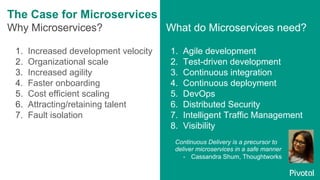
The Case for Microservices
Why Microservices?
1.  Increased development velocity
2.  Organizational scale
3.  Increased agility
4.  Faster onboarding
5.  Cost efficient scaling
6.  Attracting/retaining talent
7.  Fault isolation
Continuous Delivery is a precursor to
deliver microservices in a safe manner
-  Cassandra Shum, Thoughtworks
What do Microservices need?
1.  Agile development
2.  Test-driven development
3.  Continuous integration
4.  Continuous deployment
5.  DevOps
6.  Distributed Security
7.  Intelligent Traffic Management
8.  Visibility
Data Integration: What’s
changed?
9
Copyright (C) 2017 451 Research LLC
Engagement and Intelligence: Retail example
Customer service is driven by systems of
engagement. Traditionally that engagement was
physical, and person-to-person
Help, advice, suggestions and recommendations
were provided and questions were answered (or
not) by the employee
Even the transaction was performed physically,
before being entered into the system of record
(financial/ERP, CRM applications)
That data was then made available for analysis
Copyright (C) 2017 451 Research LLC
SYSTEMS OF ENGAGEMENT
Traditional systems of engagement and analysis
SYSTEMS OF ANALYSIS
DATA
ANALYSTS
DECISION
MAKERS
IT PROS
SYSTEMS OF RECORD
Copyright (C) 2017 451 Research LLC
SYSTEMS OF ENGAGEMENT
New systems of engagement and analysis
SYSTEMS OF ANALYSISSYSTEMS OF RECORD
DATA
SCIENTISTS
DECISION
MAKERS
BUSINESS
USERS
DATA
ANALYSTS
Copyright (C) 2017 451 Research LLC
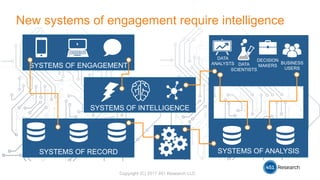
New systems of engagement require intelligence
SYSTEMS OF ANALYSISSYSTEMS OF RECORD
SYSTEMS OF ENGAGEMENT
DATA
ANALYSTS DATA
SCIENTISTS
DECISION
MAKERS
BUSINESS
USERS
SYSTEMS OF INTELLIGENCE
Copyright (C) 2017 451 Research LLC
Batch processing as a barrier to intelligence
SYSTEMS OF ANALYSISSYSTEMS OF RECORD
SYSTEMS OF ENGAGEMENT
DATA
ANALYSTS DATA
SCIENTISTS
DECISION
MAKERS
BUSINESS
USERS
SYSTEMS OF INTELLIGENCE
15
Problems with what’s going on here
What’s slowing the conversion of data to insight?
1. Monolithic ETL systems
2. “Waterfall” changes
3. No shared responsibility
4. Singular unit of scale
5. Testing....???
The case for Microservices
for Continuous Data
Integration
1
Copyright (C) 2017 451 Research LLC
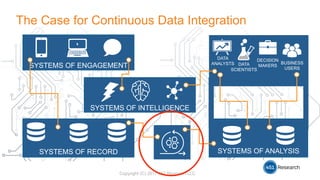
The Case for Continuous Data Integration
SYSTEMS OF ANALYSISSYSTEMS OF RECORD
SYSTEMS OF ENGAGEMENT
DATA
ANALYSTS DATA
SCIENTISTS
DECISION
MAKERS
BUSINESS
USERS
SYSTEMS OF INTELLIGENCE
Copyright (C) 2017 451 Research LLC
Continuous Data Integration
The key concepts of a
continuous integration and
delivery process can be
applied to the process of
developing, deploying and
managing data integration
pipelines, resulting in
pipelines that are responsive
to changing business and
data processing
requirements.
for Data Integration
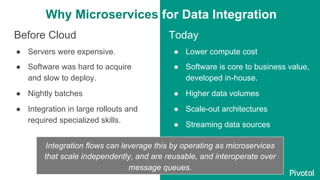
Before Cloud
●  Servers were expensive.
●  Software was hard to acquire
and slow to deploy.
●  Nightly batches
●  Integration in large rollouts and
required specialized skills.
Today
●  Lower compute cost
●  Software is core to business value,
developed in-house.
●  Higher data volumes
●  Scale-out architectures
●  Streaming data sources
Why Microservices
Integration flows can leverage this by operating as microservices
that scale independently, and are reusable, and interoperate over
message queues.
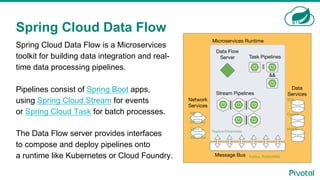
Spring Cloud Data Flow
Spring Cloud Data Flow is a Microservices
toolkit for building data integration and real-
time data processing pipelines.
Pipelines consist of Spring Boot apps,
using Spring Cloud Stream for events
or Spring Cloud Task for batch processes.
The Data Flow server provides interfaces
to compose and deploy pipelines onto
a runtime like Kubernetes or Cloud Foundry.
Day 2: People and
Platforms
2
Copyright (C) 2017 451 Research LLC
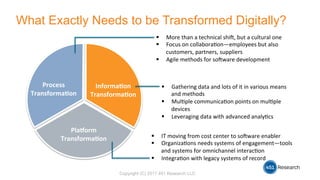
What Exactly Needs to be Transformed Digitally?
Process	
Transforma-on	
Informa-on	
Transforma-on	
Pla0orm	
Transforma-on	
!  More	than	a	technical	shi.,	but	a	cultural	one	
!  Focus	on	collabora3on—employees	but	also	
customers,	partners,	suppliers	
!  Agile	methods	for	so.ware	development	
!  Gathering	data	and	lots	of	it	in	various	means	
and	methods	
!  Mul3ple	communica3on	points	on	mul3ple	
devices	
!  Leveraging	data	with	advanced	analy3cs	
!  IT	moving	from	cost	center	to	so.ware	enabler	
!  Organiza3ons	needs	systems	of	engagement—tools	
and	systems	for	omnichannel	interac3on	
!  Integra3on	with	legacy	systems	of	record
23
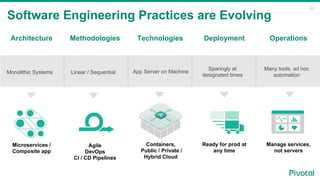
Methodologies Deployment
Sparingly at
designated times
Ready for prod at
any time
Architecture Technologies Operations
App Server on Machine
Containers,
Public / Private /
Hybrid Cloud
Monolithic Systems
Microservices /
Composite app
Linear / Sequential
Agile
DevOps
CI / CD Pipelines
Many tools, ad hoc
automation
Manage services,
not servers
Software Engineering Practices are Evolving
So, Now What?
2
Align your
Data engineering
and development
teams
Identify
data sources,
processes, and
destinations
Focus on
system of
engagement in
need of
intelligence
26
Thank You!

Microservices Approaches for Continuous Data Integration

  • 1.
    1 Microservices & Continuous DataIntegration Dormain Drewitz - Pivotal Matt Aslett - 451 Research Jürgen Leschner - Pivotal
  • 2.
    2 Today’s speakers Panelist Matt Aslett ResearchDirector 451 Group Panelist Jürgen Leschner Product Team Pivotal Moderator Dormain Drewitz Platform Ecosystem Pivotal
  • 3.
    3 Agenda 1.  Backdrop: DigitalTransformation 2.  Data Integration: What’s changed? 3.  The Case for Microservices for Continuous Data Integration 4.  Day 2: People and Platforms 5.  Looking toward the Future
  • 4.
    Copyright (C) 2017451 Research LLC 451 Research is a leading IT research & advisory company Founded in 2000 300+ employees, including over 120 analysts 2,000+ clients: Technology & Service providers, corporate advisory, finance, professional services, and IT decision makers 50,000+ IT professionals, business users and consumers in our research community Over 52 million data points published each quarter and 4,500+ reports published each year 3,000+ technology & service providers under coverage 451 Research and its sister company, Uptime Institute, are the two divisions of The 451 Group Headquartered in New York City, with offices in London, Boston, San Francisco, Washington DC, Mexico, Costa Rica, Brazil, Spain, UAE, Russia, Taiwan, Singapore and Malaysia Research & Data Advisory Events Go 2 Market
  • 5.
    5 Pivotal Labs Agile PracticePivotal Data Suite Greenplum GemFire HDB Pivotal Tracker Organize and Plan Spring Build reliably on Spring Boot Concourse Continuous Integration and Deployment Pivotal Cloud Foundry Multi-Cloud Platform for Cloud-Native Apps
  • 6.
  • 7.
    Copyright (C) 2017451 Research LLC Digital Transformation: What do we mean? 7 Copyright (C) 2017 451 Research LLC When IT innovation is aligned with and driven by a well-planned business strategy to: !  transform how organizations serve customers, employees, and partners !  support continuous improvement in business operations !  disrupt existing businesses and markets !  invent new businesses and business models
  • 8.
    The Case forMicroservices Why Microservices? 1.  Increased development velocity 2.  Organizational scale 3.  Increased agility 4.  Faster onboarding 5.  Cost efficient scaling 6.  Attracting/retaining talent 7.  Fault isolation Continuous Delivery is a precursor to deliver microservices in a safe manner -  Cassandra Shum, Thoughtworks What do Microservices need? 1.  Agile development 2.  Test-driven development 3.  Continuous integration 4.  Continuous deployment 5.  DevOps 6.  Distributed Security 7.  Intelligent Traffic Management 8.  Visibility
  • 9.
  • 10.
    Copyright (C) 2017451 Research LLC Engagement and Intelligence: Retail example Customer service is driven by systems of engagement. Traditionally that engagement was physical, and person-to-person Help, advice, suggestions and recommendations were provided and questions were answered (or not) by the employee Even the transaction was performed physically, before being entered into the system of record (financial/ERP, CRM applications) That data was then made available for analysis
  • 11.
    Copyright (C) 2017451 Research LLC SYSTEMS OF ENGAGEMENT Traditional systems of engagement and analysis SYSTEMS OF ANALYSIS DATA ANALYSTS DECISION MAKERS IT PROS SYSTEMS OF RECORD
  • 12.
    Copyright (C) 2017451 Research LLC SYSTEMS OF ENGAGEMENT New systems of engagement and analysis SYSTEMS OF ANALYSISSYSTEMS OF RECORD DATA SCIENTISTS DECISION MAKERS BUSINESS USERS DATA ANALYSTS
  • 13.
    Copyright (C) 2017451 Research LLC New systems of engagement require intelligence SYSTEMS OF ANALYSISSYSTEMS OF RECORD SYSTEMS OF ENGAGEMENT DATA ANALYSTS DATA SCIENTISTS DECISION MAKERS BUSINESS USERS SYSTEMS OF INTELLIGENCE
  • 14.
    Copyright (C) 2017451 Research LLC Batch processing as a barrier to intelligence SYSTEMS OF ANALYSISSYSTEMS OF RECORD SYSTEMS OF ENGAGEMENT DATA ANALYSTS DATA SCIENTISTS DECISION MAKERS BUSINESS USERS SYSTEMS OF INTELLIGENCE
  • 15.
    15 Problems with what’sgoing on here What’s slowing the conversion of data to insight? 1. Monolithic ETL systems 2. “Waterfall” changes 3. No shared responsibility 4. Singular unit of scale 5. Testing....???
  • 16.
    The case forMicroservices for Continuous Data Integration 1
  • 17.
    Copyright (C) 2017451 Research LLC The Case for Continuous Data Integration SYSTEMS OF ANALYSISSYSTEMS OF RECORD SYSTEMS OF ENGAGEMENT DATA ANALYSTS DATA SCIENTISTS DECISION MAKERS BUSINESS USERS SYSTEMS OF INTELLIGENCE
  • 18.
    Copyright (C) 2017451 Research LLC Continuous Data Integration The key concepts of a continuous integration and delivery process can be applied to the process of developing, deploying and managing data integration pipelines, resulting in pipelines that are responsive to changing business and data processing requirements.
  • 19.
    for Data Integration BeforeCloud ●  Servers were expensive. ●  Software was hard to acquire and slow to deploy. ●  Nightly batches ●  Integration in large rollouts and required specialized skills. Today ●  Lower compute cost ●  Software is core to business value, developed in-house. ●  Higher data volumes ●  Scale-out architectures ●  Streaming data sources Why Microservices Integration flows can leverage this by operating as microservices that scale independently, and are reusable, and interoperate over message queues.
  • 20.
    Spring Cloud DataFlow Spring Cloud Data Flow is a Microservices toolkit for building data integration and real- time data processing pipelines. Pipelines consist of Spring Boot apps, using Spring Cloud Stream for events or Spring Cloud Task for batch processes. The Data Flow server provides interfaces to compose and deploy pipelines onto a runtime like Kubernetes or Cloud Foundry.
  • 21.
    Day 2: Peopleand Platforms 2
  • 22.
    Copyright (C) 2017451 Research LLC What Exactly Needs to be Transformed Digitally? Process Transforma-on Informa-on Transforma-on Pla0orm Transforma-on !  More than a technical shi., but a cultural one !  Focus on collabora3on—employees but also customers, partners, suppliers !  Agile methods for so.ware development !  Gathering data and lots of it in various means and methods !  Mul3ple communica3on points on mul3ple devices !  Leveraging data with advanced analy3cs !  IT moving from cost center to so.ware enabler !  Organiza3ons needs systems of engagement—tools and systems for omnichannel interac3on !  Integra3on with legacy systems of record
  • 23.
    23 Methodologies Deployment Sparingly at designatedtimes Ready for prod at any time Architecture Technologies Operations App Server on Machine Containers, Public / Private / Hybrid Cloud Monolithic Systems Microservices / Composite app Linear / Sequential Agile DevOps CI / CD Pipelines Many tools, ad hoc automation Manage services, not servers Software Engineering Practices are Evolving
  • 24.
  • 25.
    Align your Data engineering anddevelopment teams Identify data sources, processes, and destinations Focus on system of engagement in need of intelligence
  • 26.