DevOps Platform for the
Evolving Enterprise
DBmaestro and Clarive
Joint-Webinar
May 4th, 2016
Before We Begin
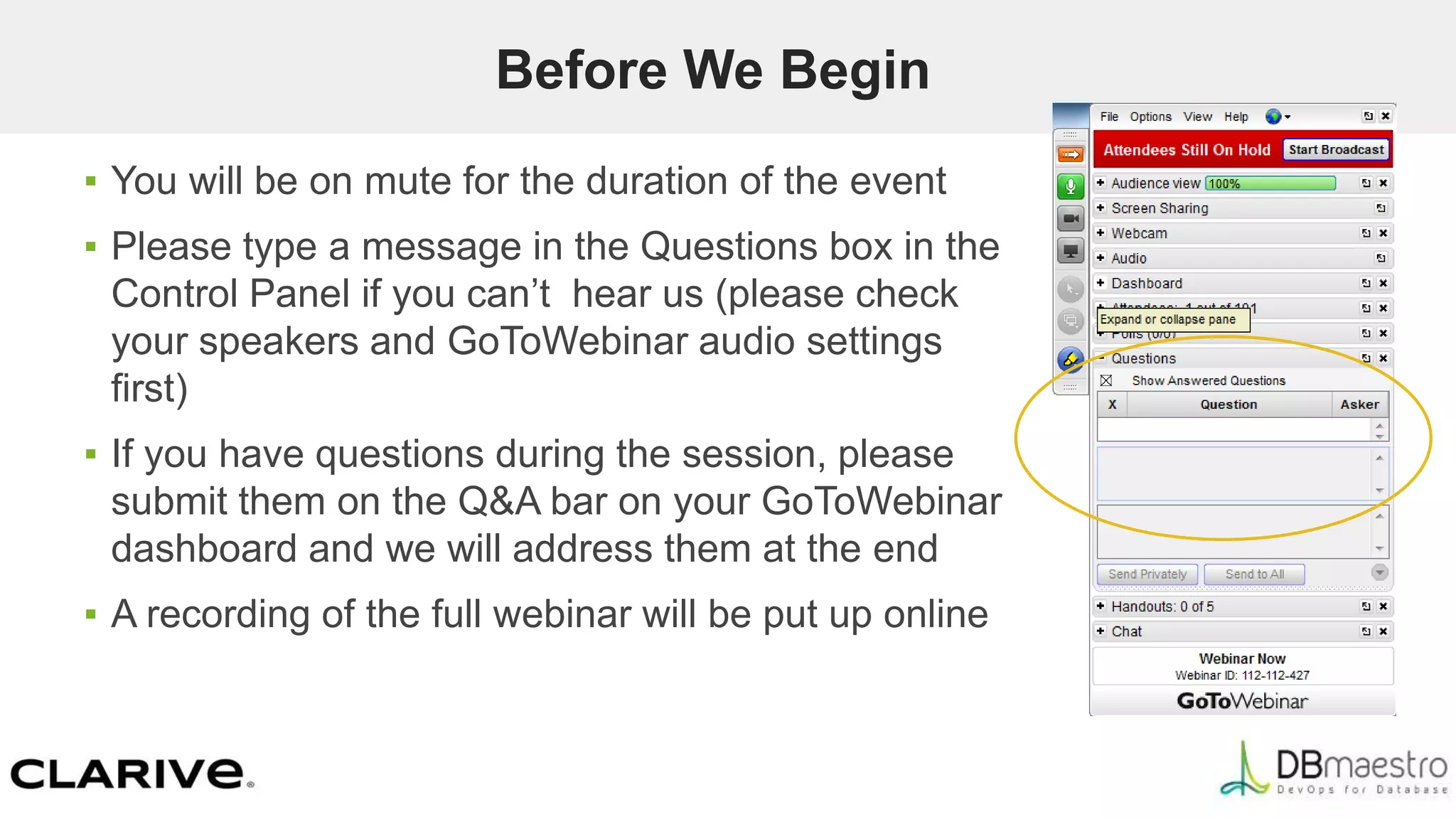
▪ You will be on mute for the duration of the event
▪ Please type a message in the Questions box in the
Control Panel if you can’t hear us (please check
your speakers and GoToWebinar audio settings
first)
▪ If you have questions during the session, please
submit them on the Q&A bar on your GoToWebinar
dashboard and we will address them at the end
▪ A recording of the full webinar will be put up online
Outline
▪ Best Practices of Continuous Delivery for Modern
Applications
▪ DevOps Platform for the Evolving Enterprise
▪ The Reasons why the Database is Often Left Behind
▪ Database Continuous Delivery, from Development to Build
to Deploy
▪ Q&A
Presenters
Cindy Bean
Sr. Software Consultant at DBmaestro
Spent over 20 years working with various database management
products for Oracle, SQL Server and other relational database systems as
a DBA, product manager, and consultant.
Presenters
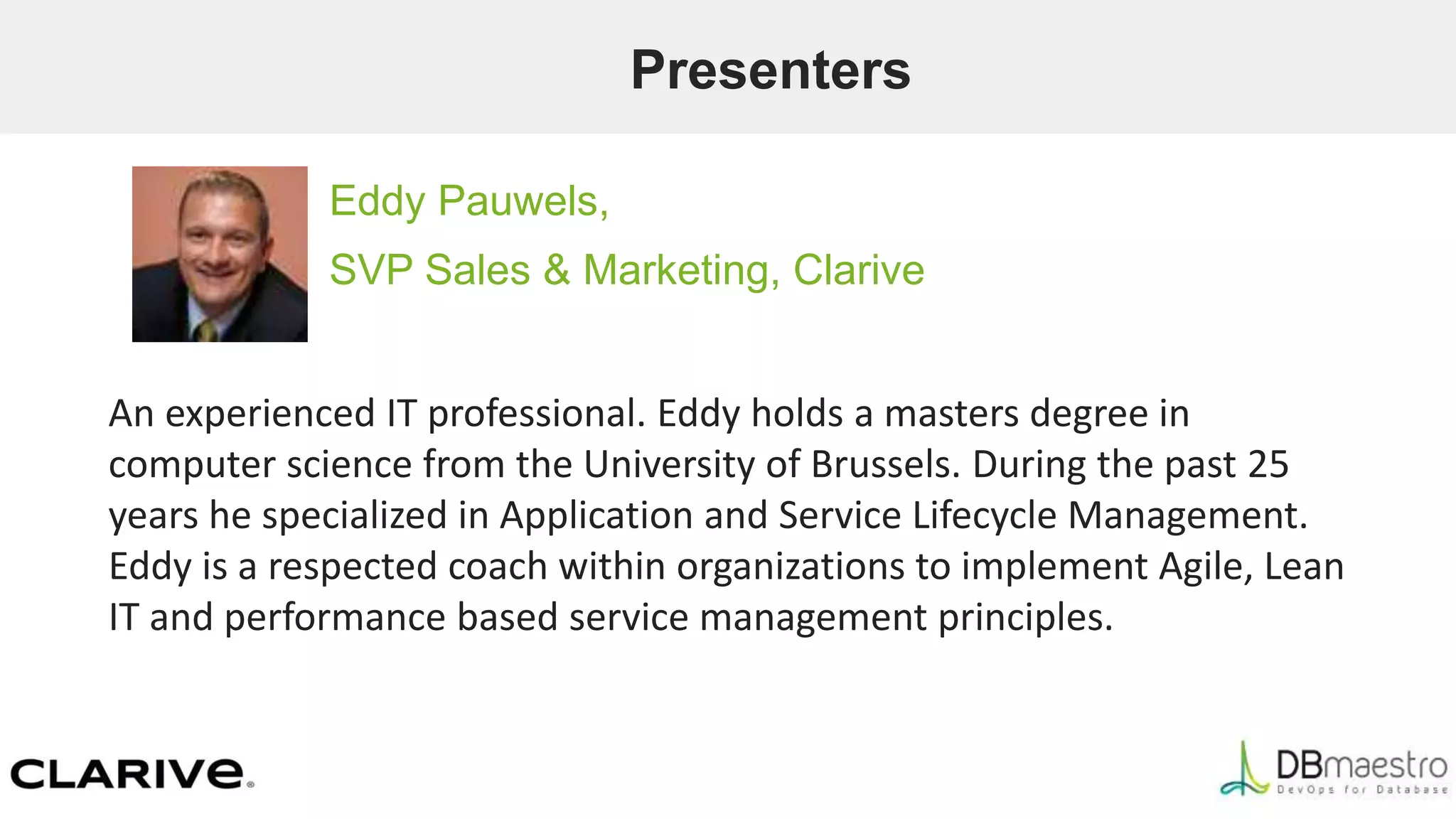
Eddy Pauwels,
SVP Sales & Marketing, Clarive
An experienced IT professional. Eddy holds a masters degree in
computer science from the University of Brussels. During the past 25
years he specialized in Application and Service Lifecycle Management.
Eddy is a respected coach within organizations to implement Agile, Lean
IT and performance based service management principles.
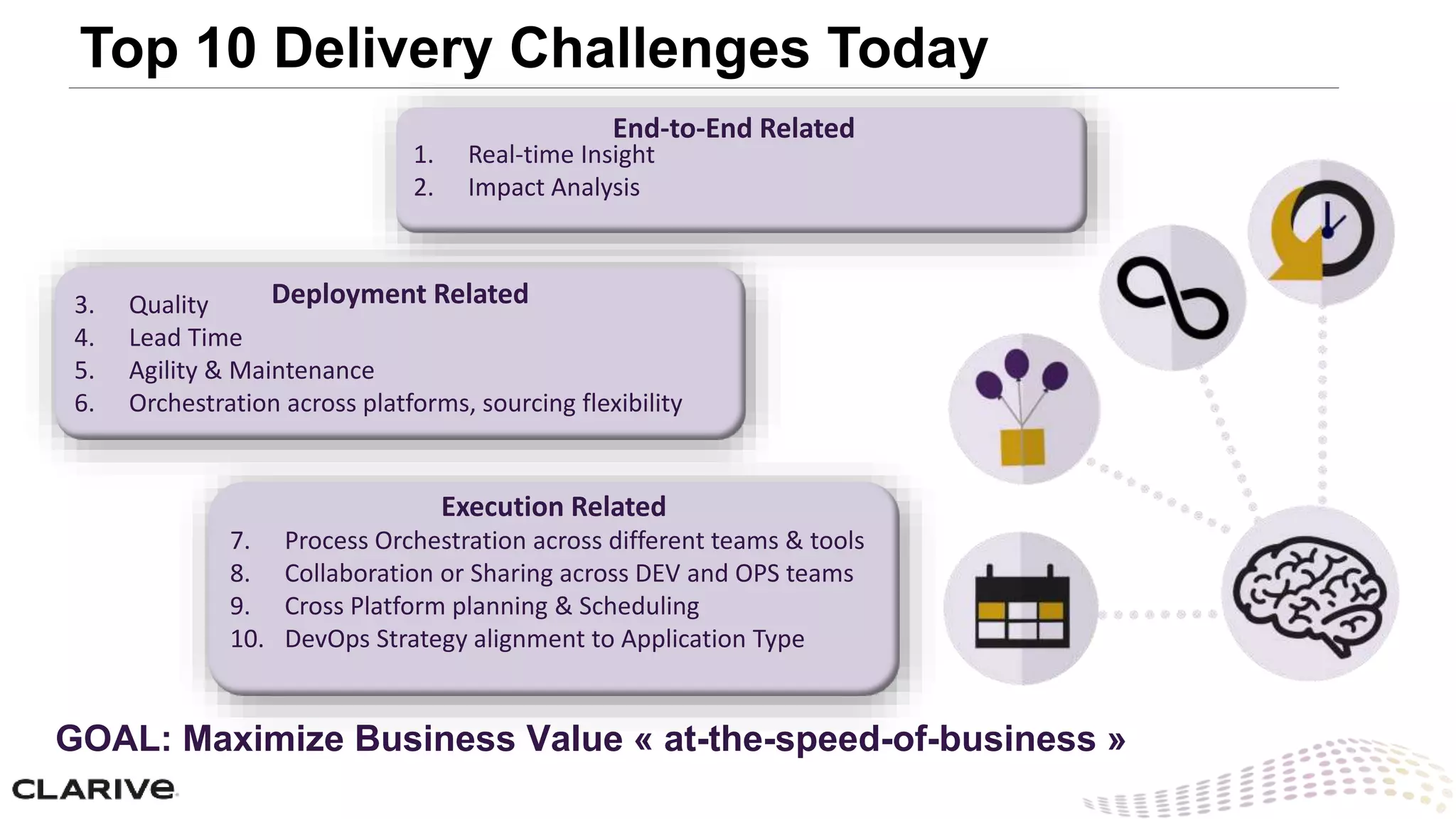
Top 10 Delivery Challenges Today
GOAL: Maximize Business Value « at-the-speed-of-business »
1. Real-time Insight
2. Impact Analysis
End-to-End Related
3. Quality
4. Lead Time
5. Agility & Maintenance
6. Orchestration across platforms, sourcing flexibility
Deployment Related
7. Process Orchestration across different teams & tools
8. Collaboration or Sharing across DEV and OPS teams
9. Cross Platform planning & Scheduling
10. DevOps Strategy alignment to Application Type
Execution Related
Automation
Coordination,
Collaboration,
Sharing,
Integration
Standardization
between DEV-QA-Build-Release
Build – Test – Deployment to development and
QA environments
Application Delivery pipeline
Increase Delivery
Speed & Business
Agility
Delivery Driven Initiatives
Focus on Application Delivery process
between service providers and with business
Release Delivery, Environment Provisioning,
Monitoring, & Recovery
services and delivery models
Increase Efficiency &
Reduce TCO
Operations Driven Initiatives
Focus on Service Delivery process
Audit, Governance
Insight
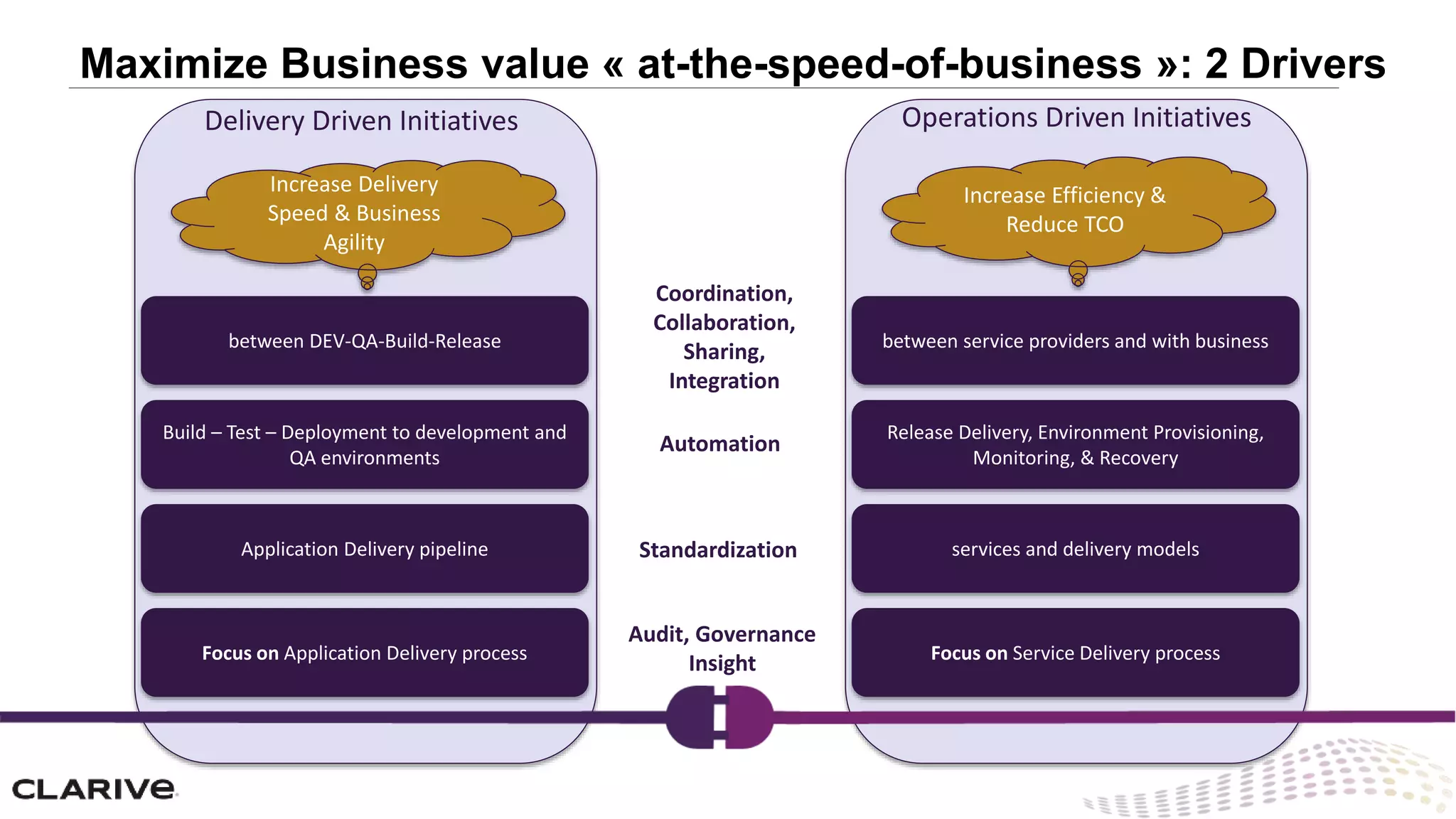
Maximize Business value « at-the-speed-of-business »: 2 Drivers
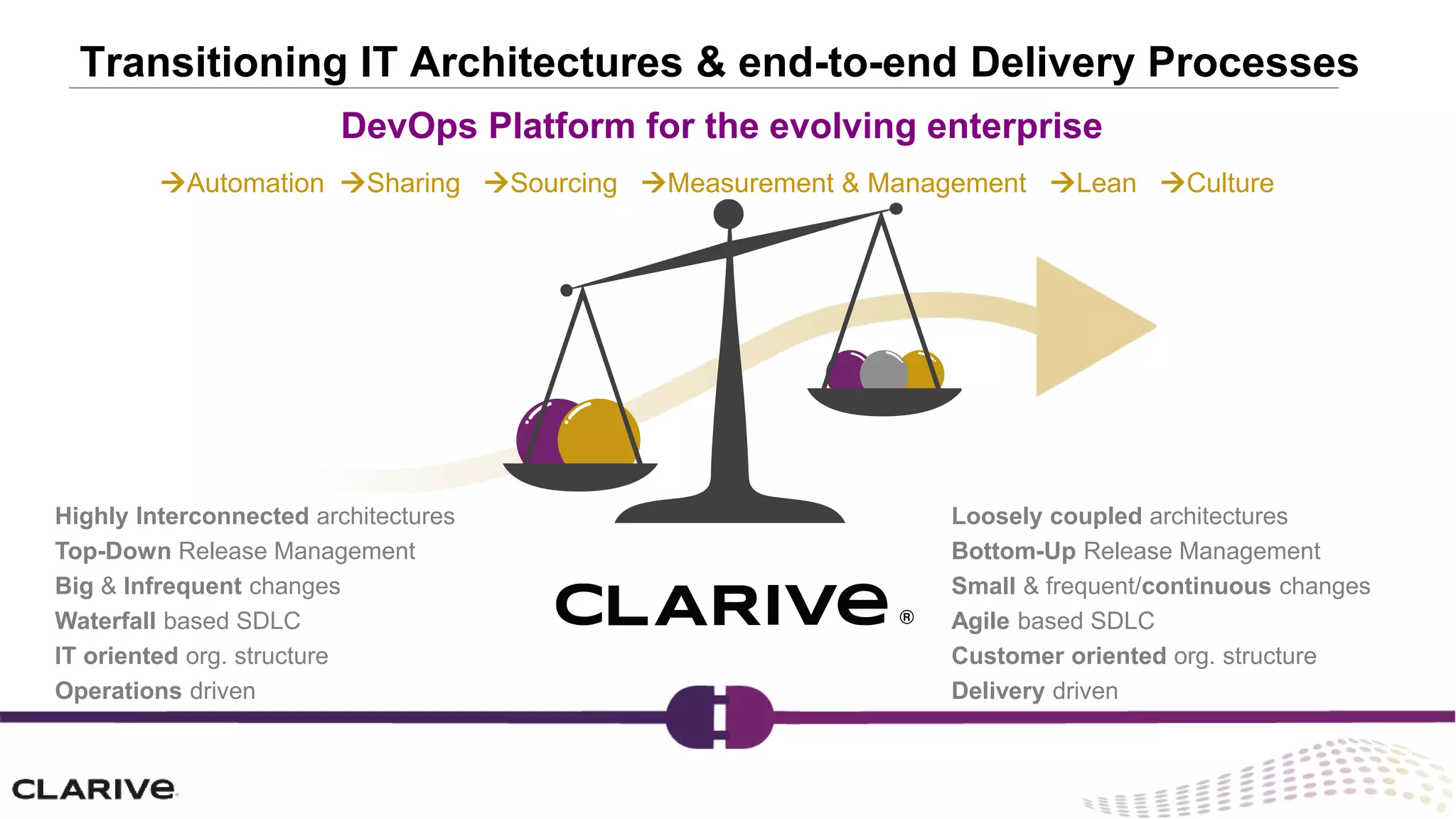
Transitioning IT Architectures & end-to-end Delivery Processes
DevOps Platform for the evolving enterprise
Highly Interconnected architectures
Top-Down Release Management
Big & Infrequent changes
Waterfall based SDLC
IT oriented org. structure
Operations driven
Loosely coupled architectures
Bottom-Up Release Management
Small & frequent/continuous changes
Agile based SDLC
Customer oriented org. structure
Delivery driven
Automation Sharing Sourcing Measurement & Management Lean Culture
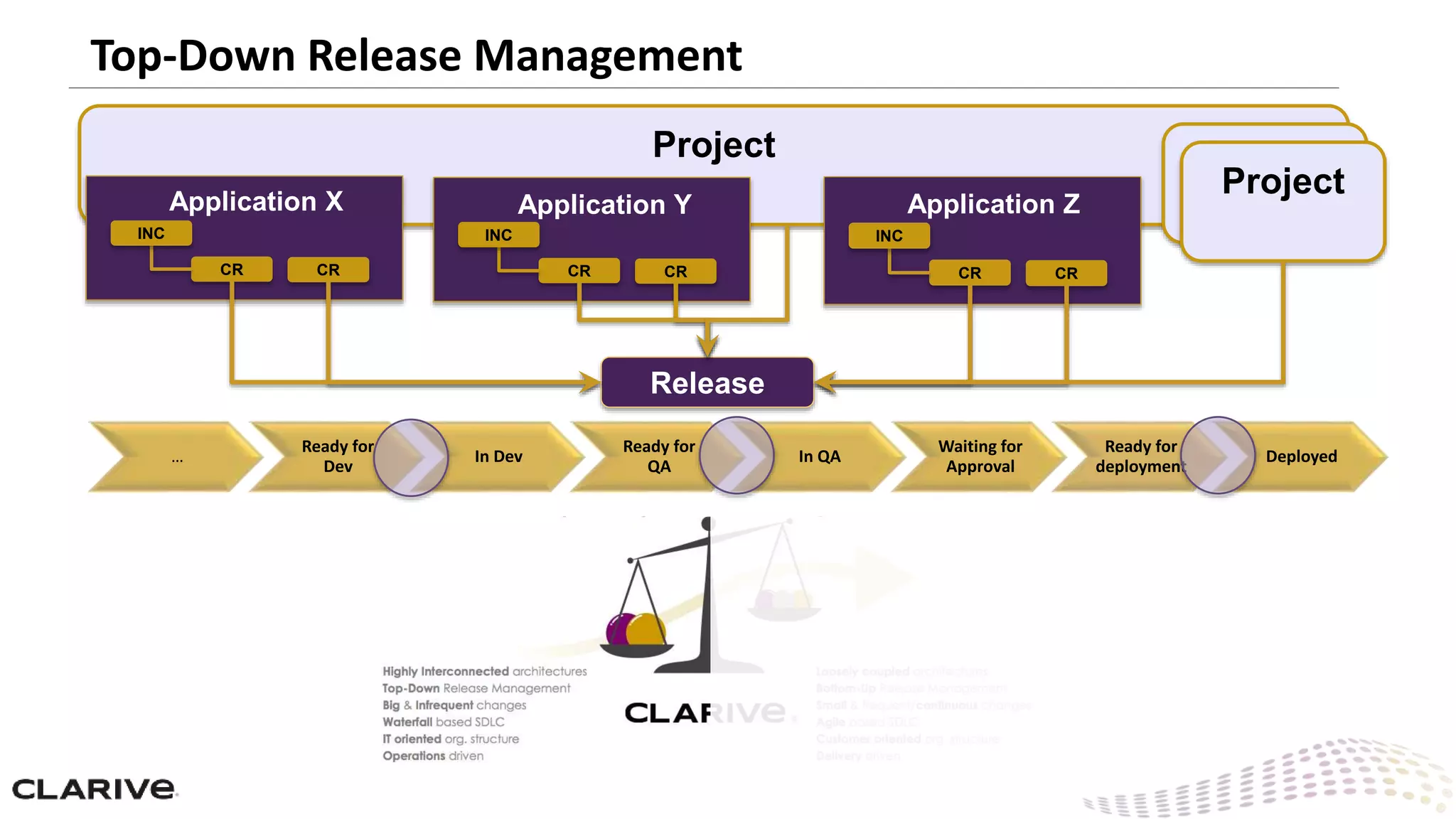
Project
Top-Down Release Management
CR
Application X
CR
INC
CR CR
Application Y
INC
CR CR
Application Z
INC
Project
Project
Release
…
Ready for
Dev
In Dev
Ready for
QA
In QA
Waiting for
Approval
Ready for
deployment
Deployed
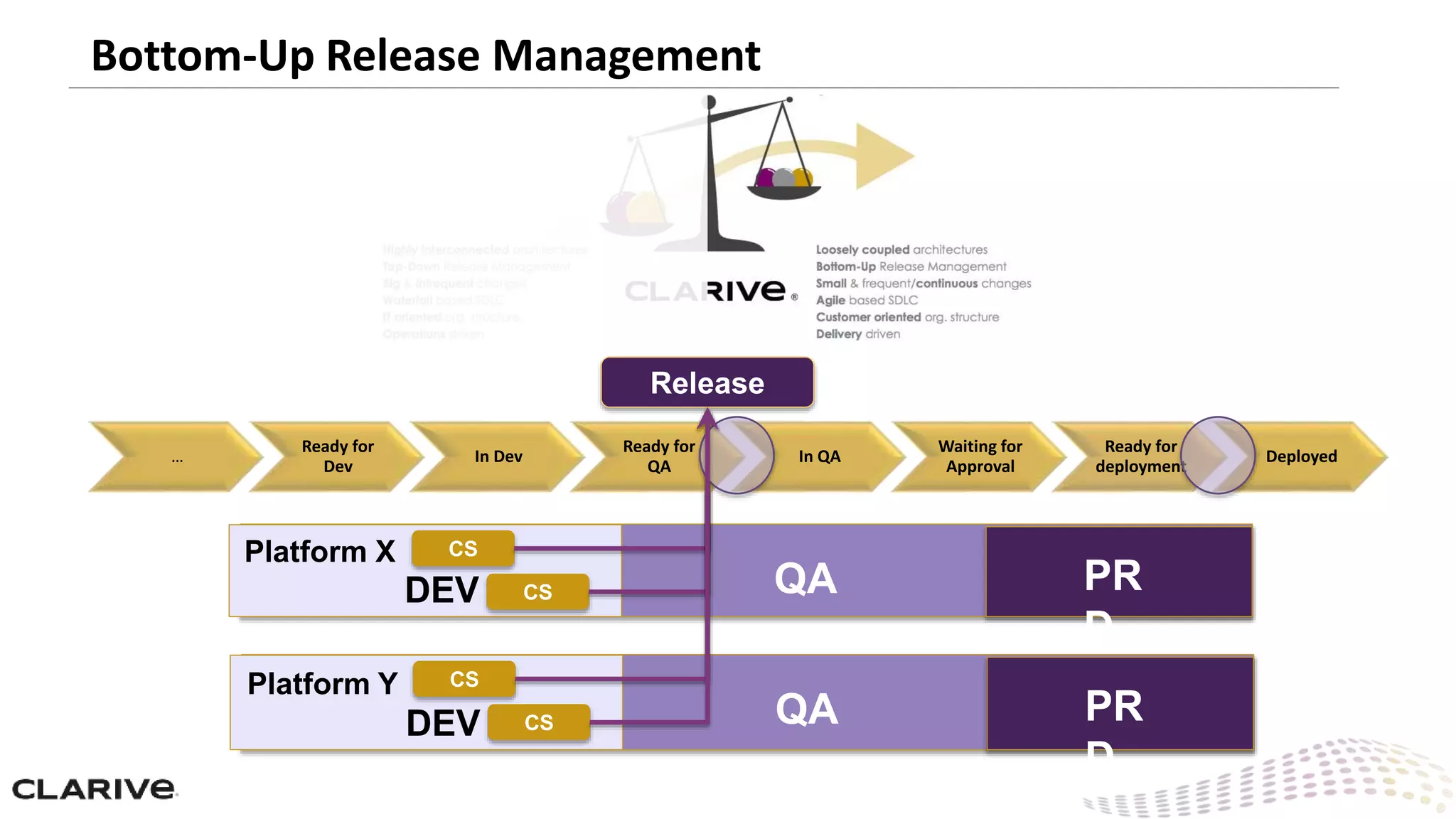
Bottom-Up Release Management
Release
Platform Y CS
CSDEV QA PR
D
Platform X CS
CSDEV QA PR
D
…
Ready for
Dev
In Dev
Ready for
QA
In QA
Waiting for
Approval
Ready for
deployment
Deployed
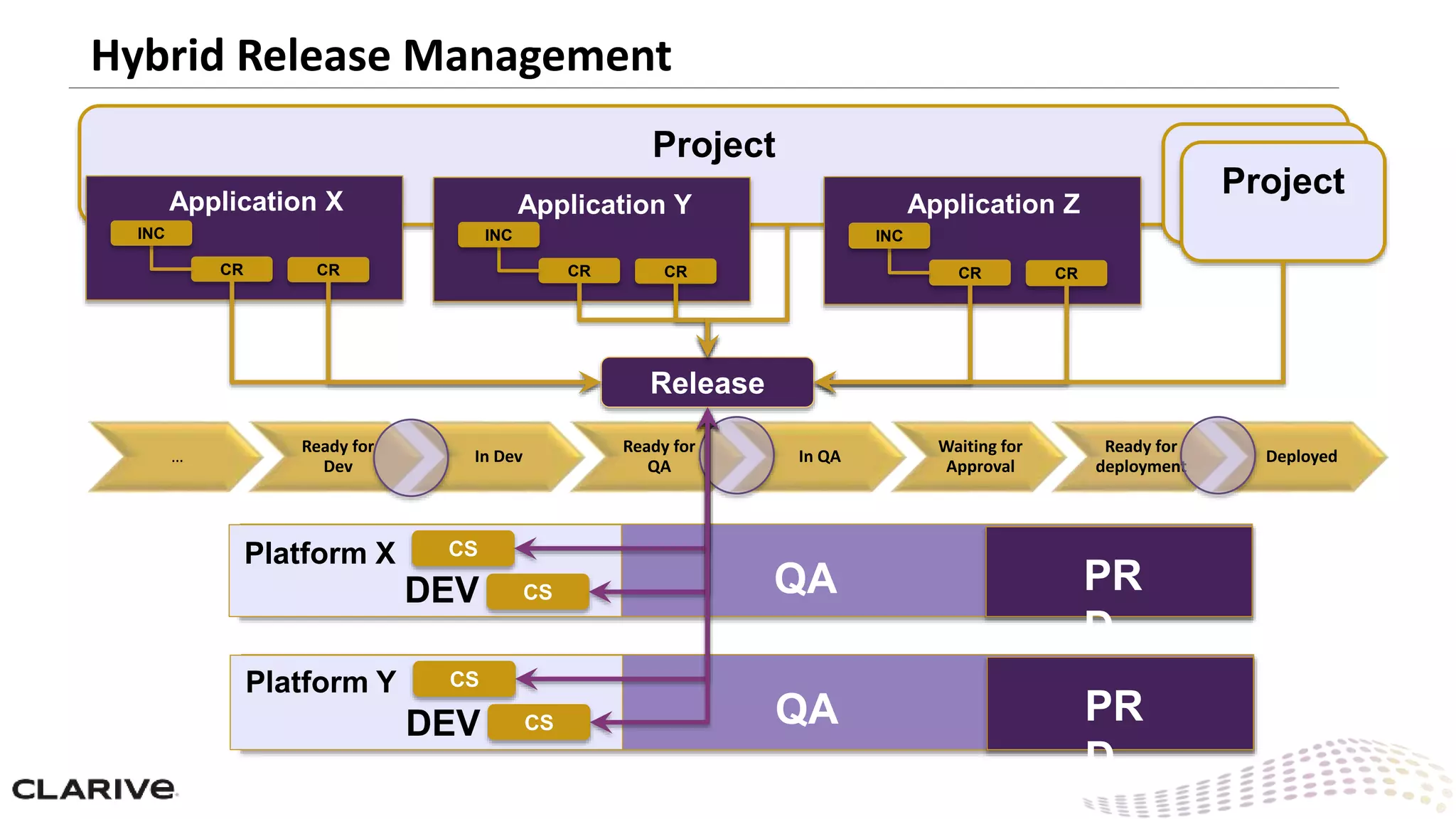
Project
Hybrid Release Management
CR
Application X
CR
INC
CR CR
Application Y
INC
CR CR
Application Z
INC
Project
Project
Release
…
Ready for
Dev
In Dev
Ready for
QA
In QA
Waiting for
Approval
Ready for
deployment
Deployed
Platform Y CS
CSDEV QA PR
D
Platform X CS
CSDEV QA PR
D
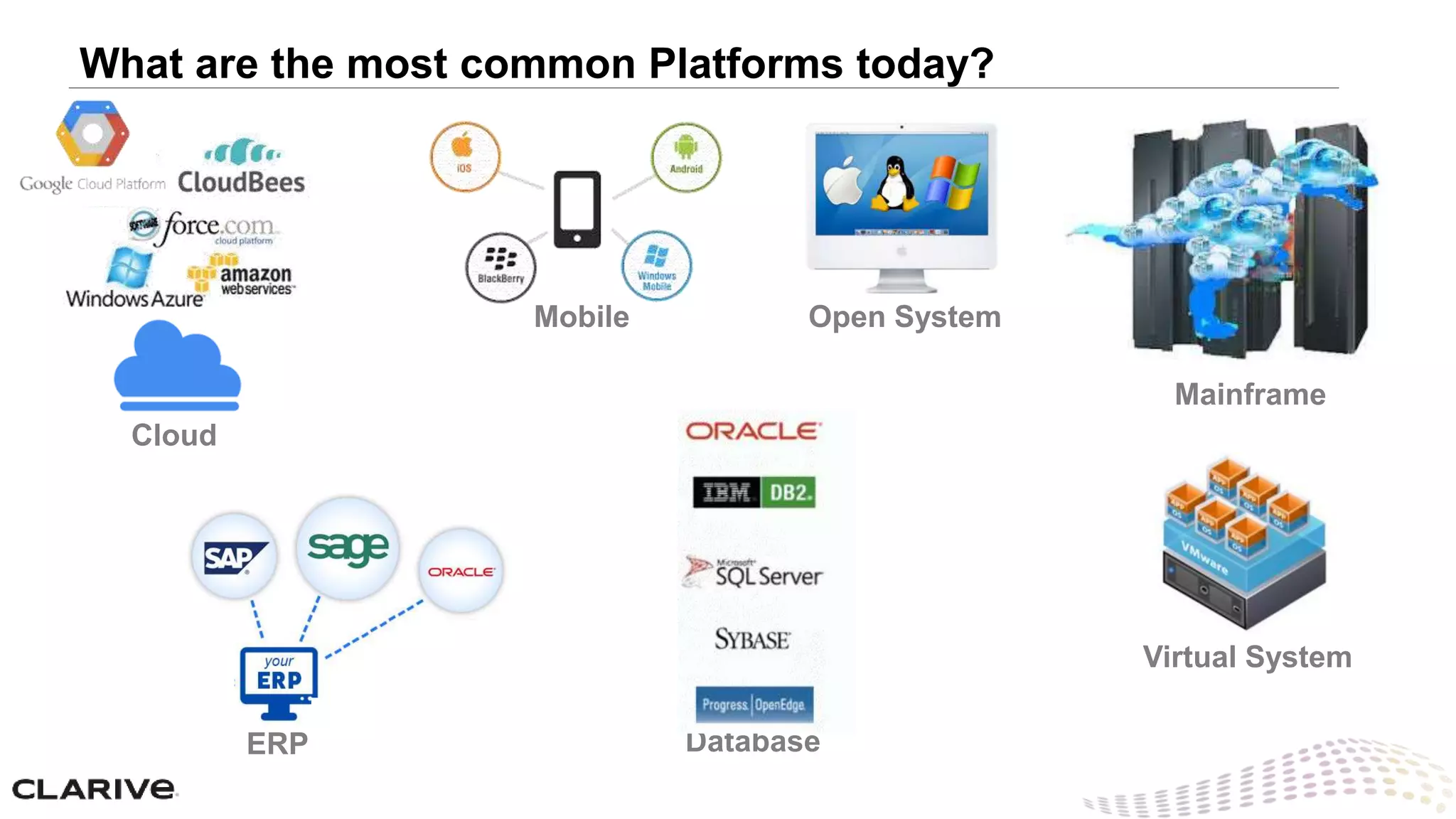
What are the most common Platforms today?
Cloud
ERP
Mobile
Mainframe
Database
Open System
Virtual System
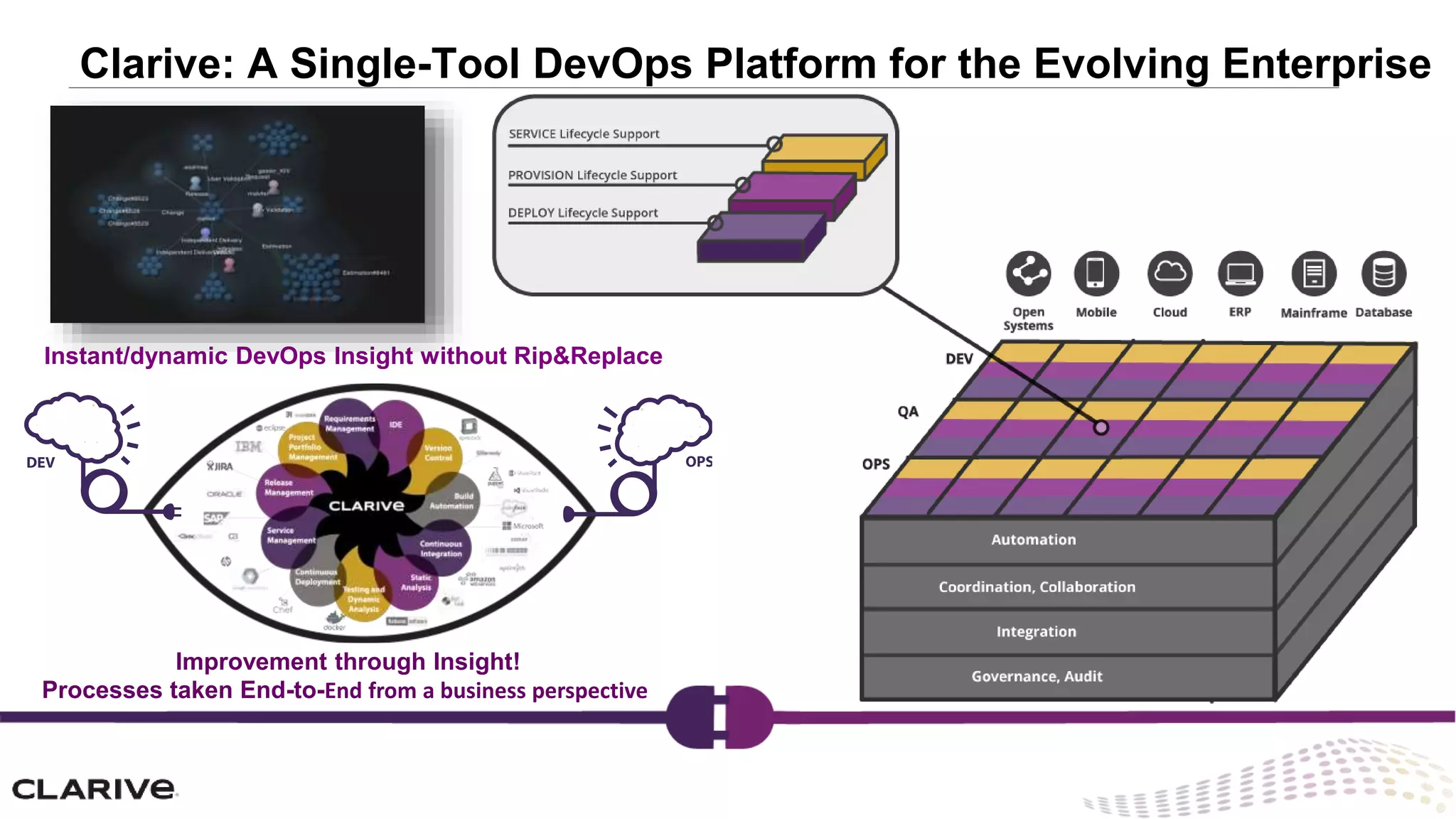
Clarive: A Single-Tool DevOps Platform for the Evolving Enterprise
Instant/dynamic DevOps Insight without Rip&Replace
Improvement through Insight!
Processes taken End-to-End from a business perspective
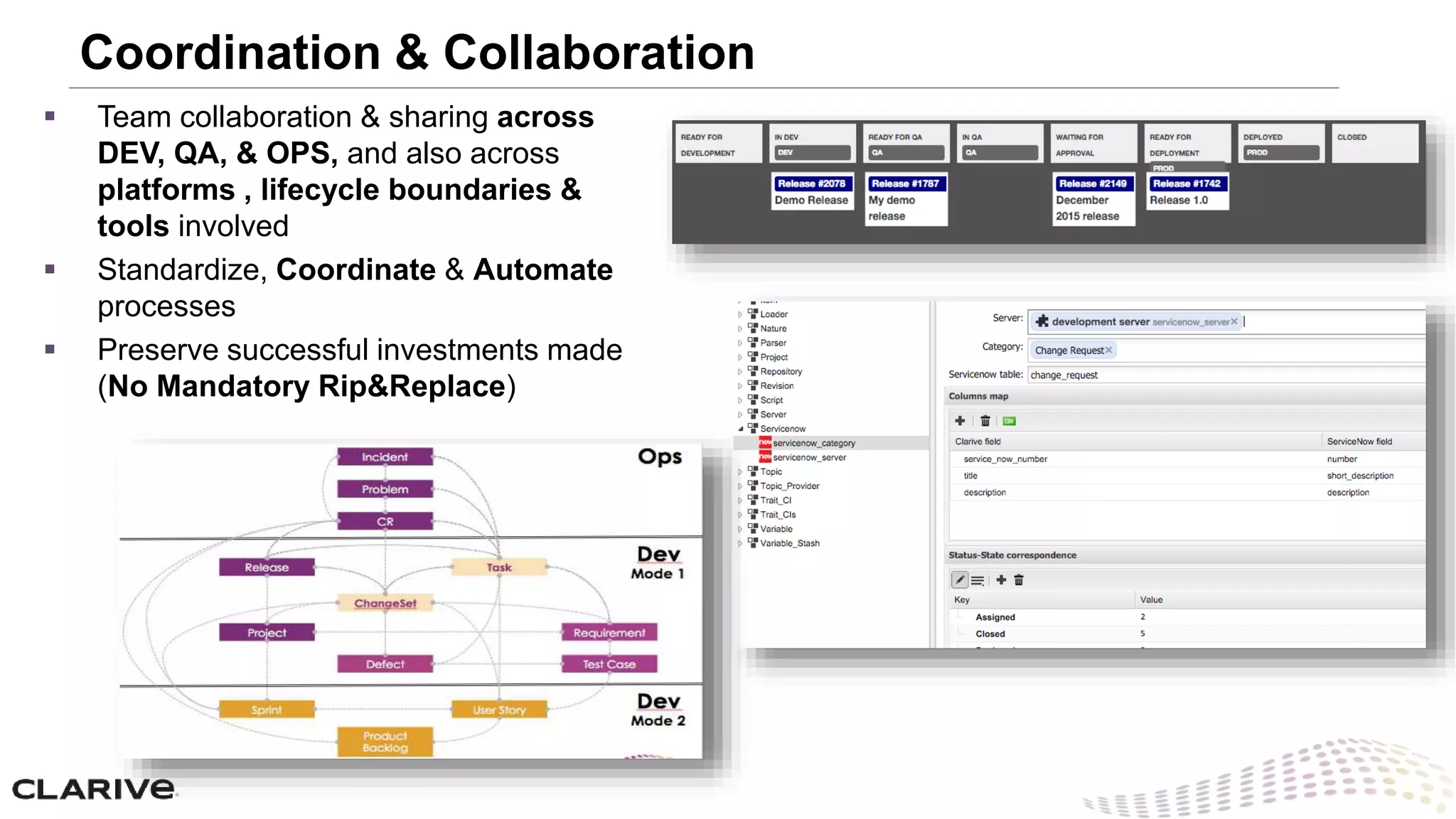
Coordination & Collaboration
 Team collaboration & sharing across
DEV, QA, & OPS, and also across
platforms , lifecycle boundaries &
tools involved
 Standardize, Coordinate & Automate
processes
 Preserve successful investments made
(No Mandatory Rip&Replace)
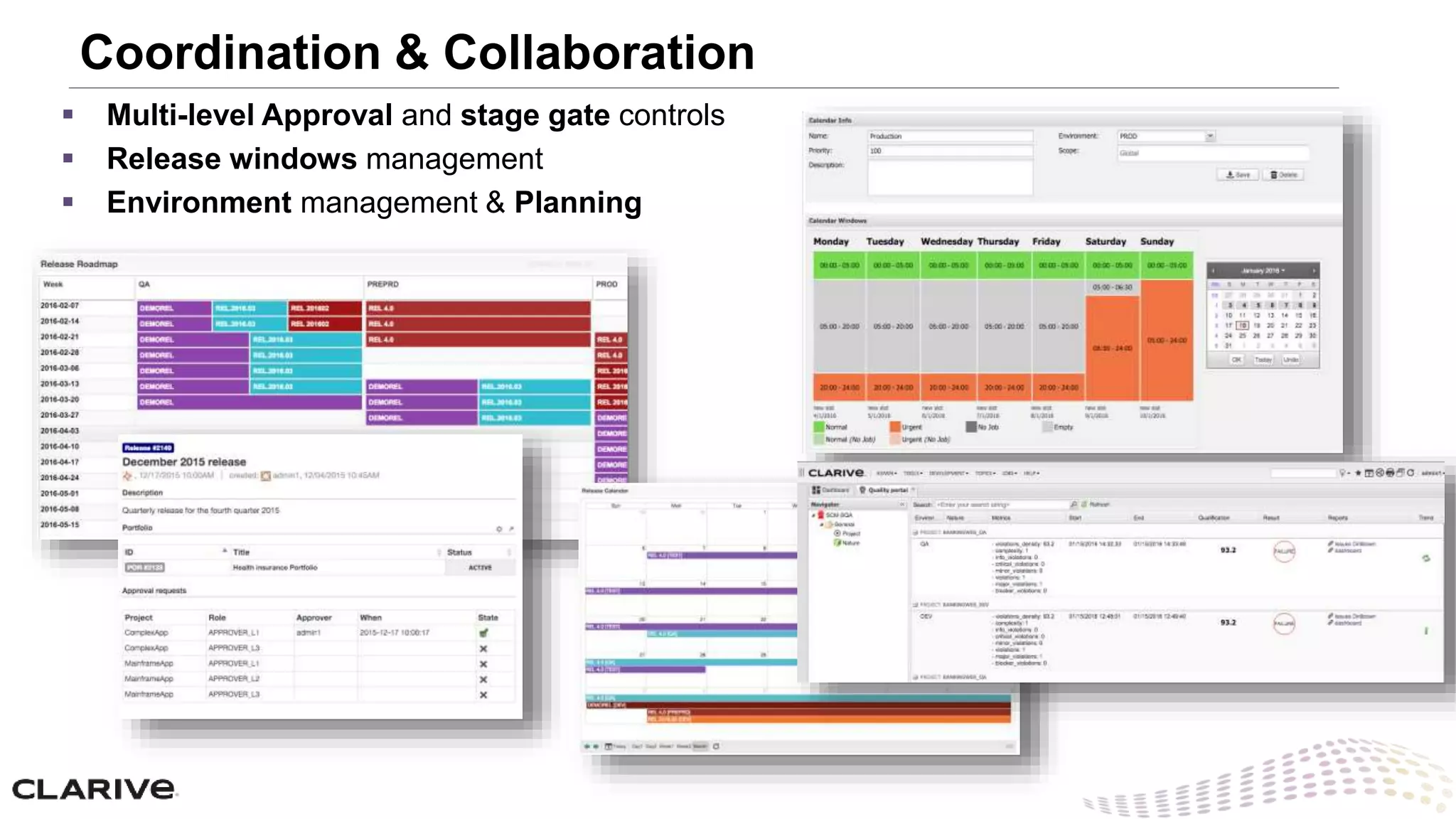
 Multi-level Approval and stage gate controls
 Release windows management
 Environment management & Planning
Coordination & Collaboration
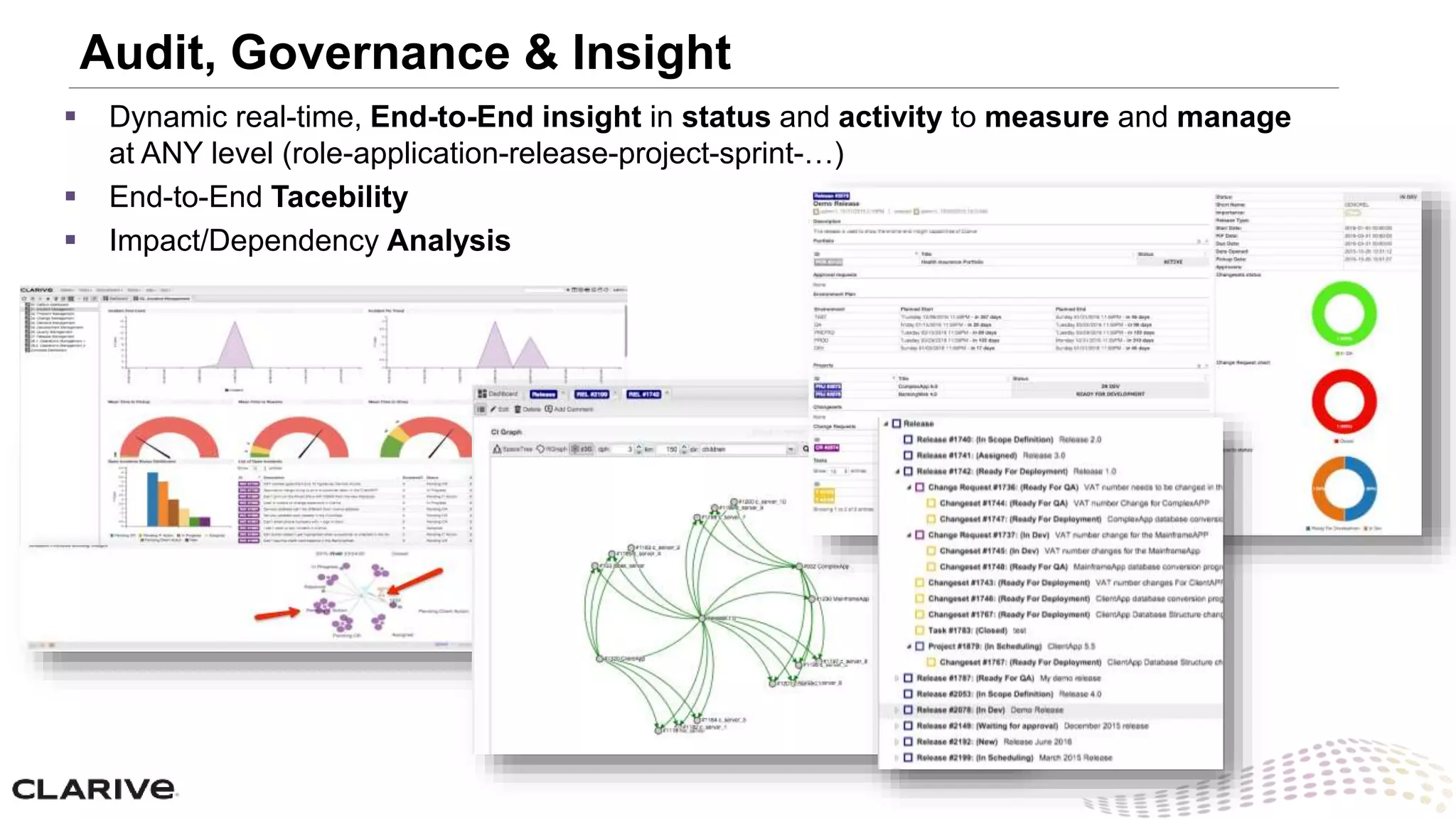
Audit, Governance & Insight
 Dynamic real-time, End-to-End insight in status and activity to measure and manage
at ANY level (role-application-release-project-sprint-…)
 End-to-End Tacebility
 Impact/Dependency Analysis
Integration
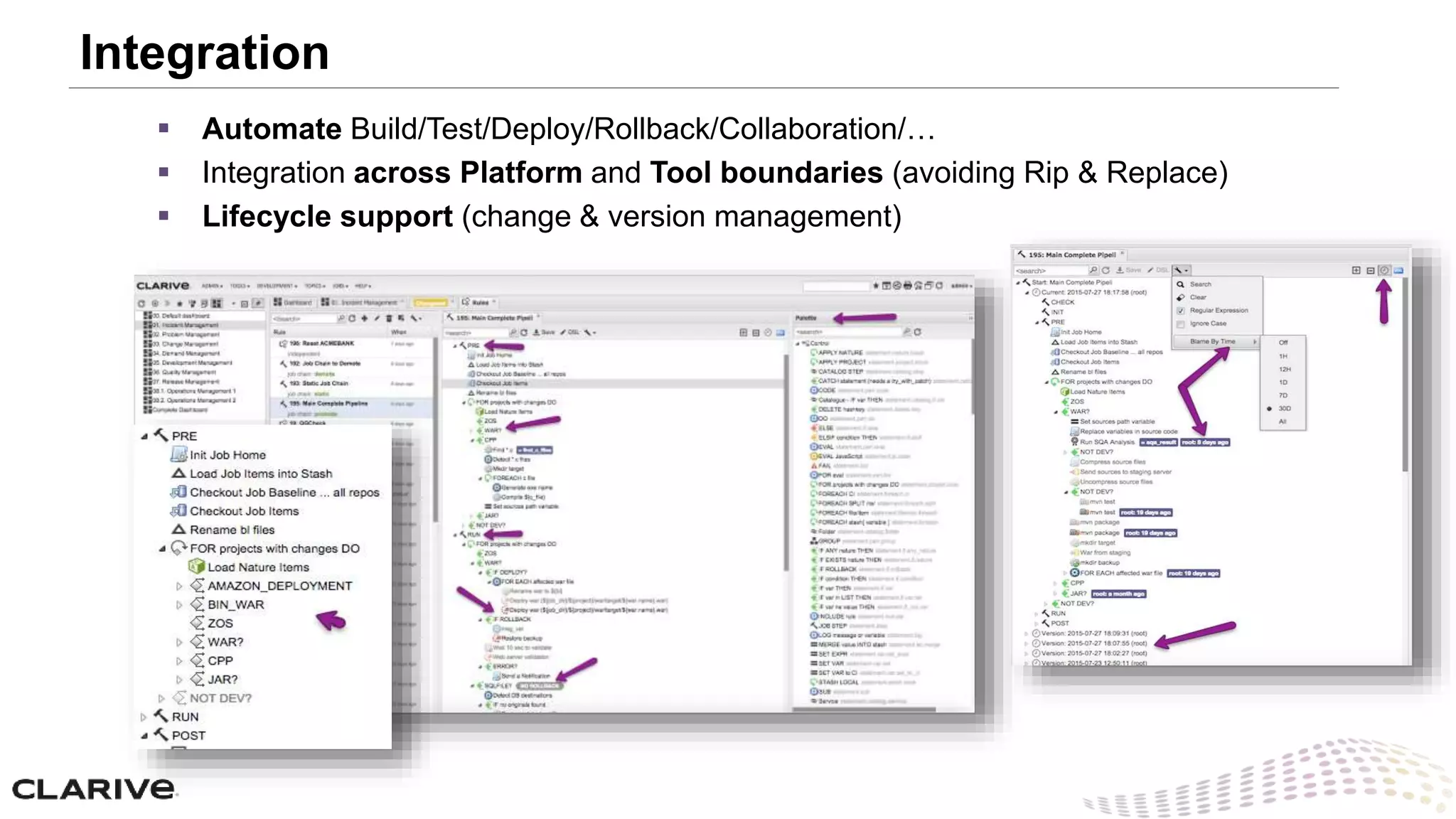
 Automate Build/Test/Deploy/Rollback/Collaboration/…
 Integration across Platform and Tool boundaries (avoiding Rip & Replace)
 Lifecycle support (change & version management)
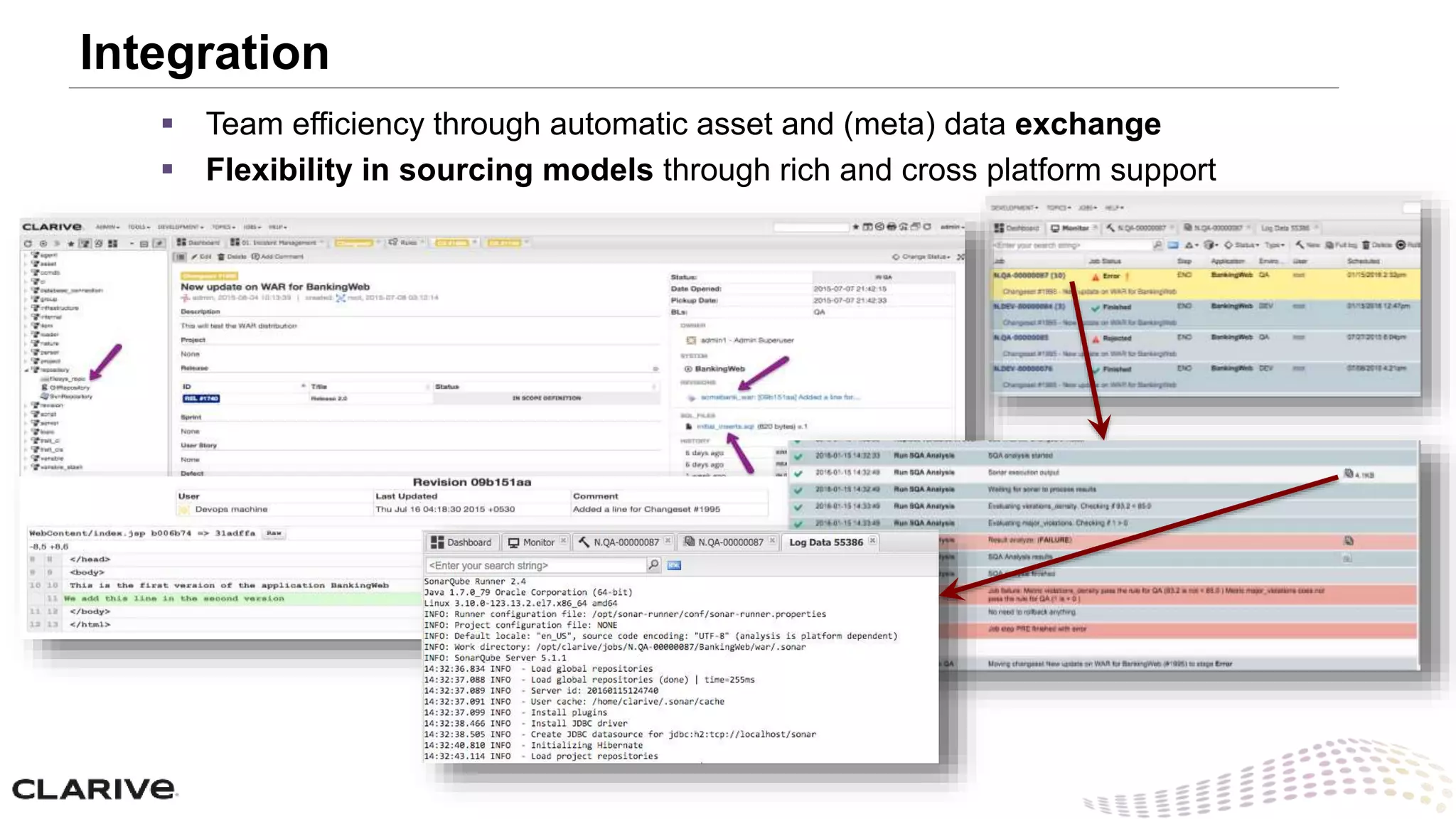
 Team efficiency through automatic asset and (meta) data exchange
 Flexibility in sourcing models through rich and cross platform support
Integration
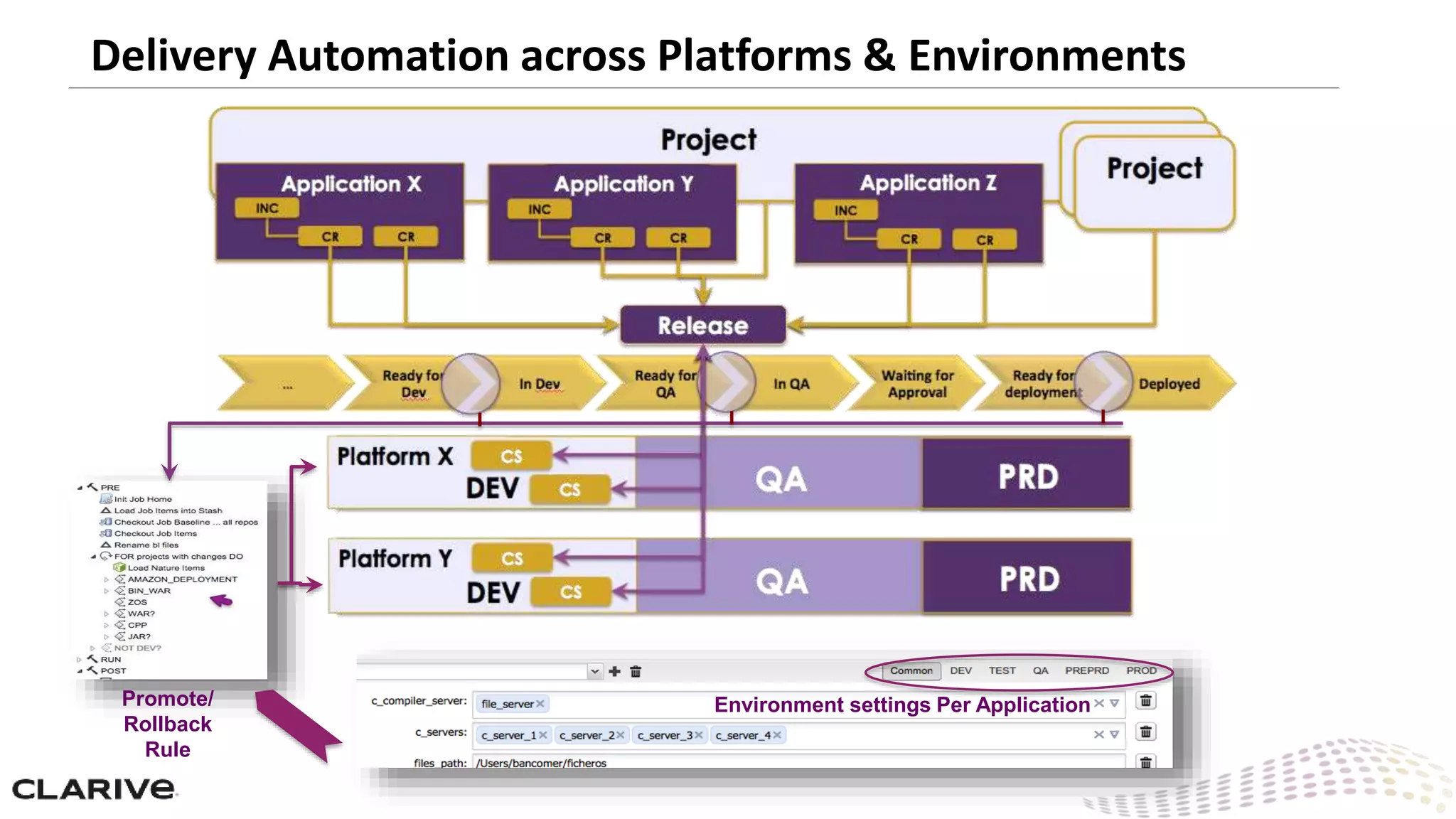
Delivery Automation across Platforms & Environments
Promote/
Rollback
Rule
Environment settings Per Application
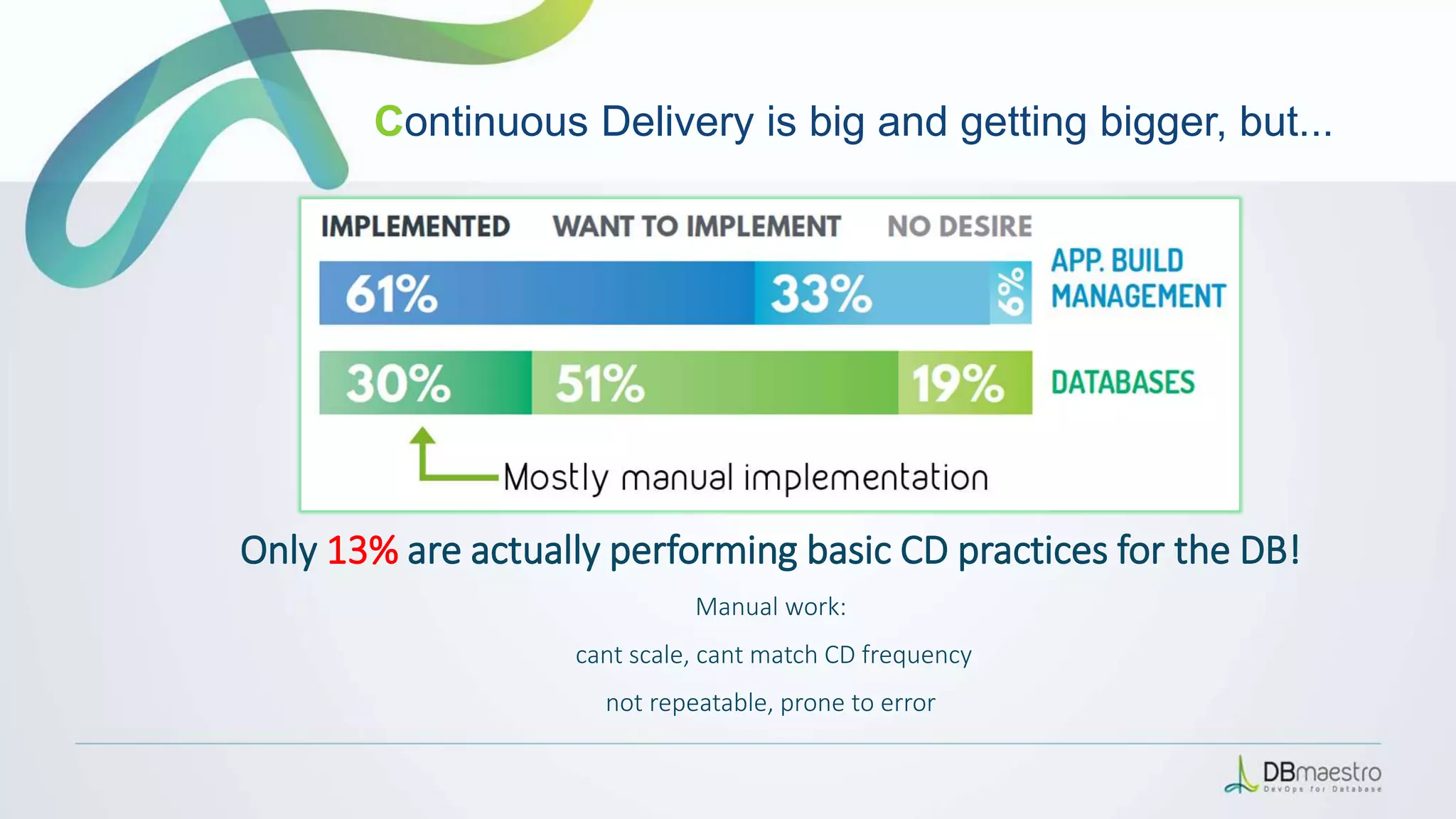
Only 13% are actually performing basic CD practices for the DB!
Manual work:
cant scale, cant match CD frequency
not repeatable, prone to error
Continuous Delivery is big and getting bigger, but...
What is the problem?
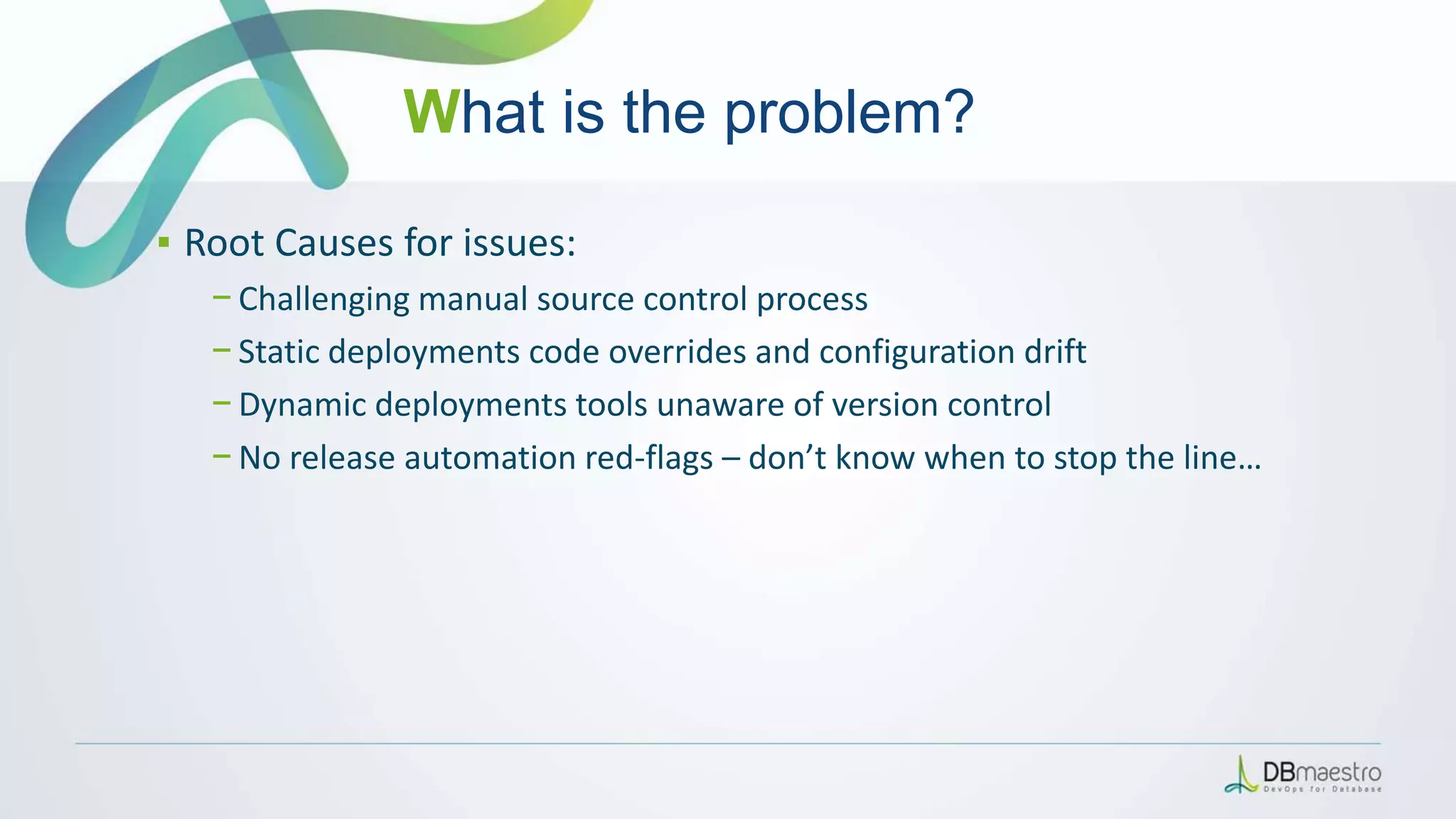
▪ Root Causes for issues:
− Challenging manual source control process
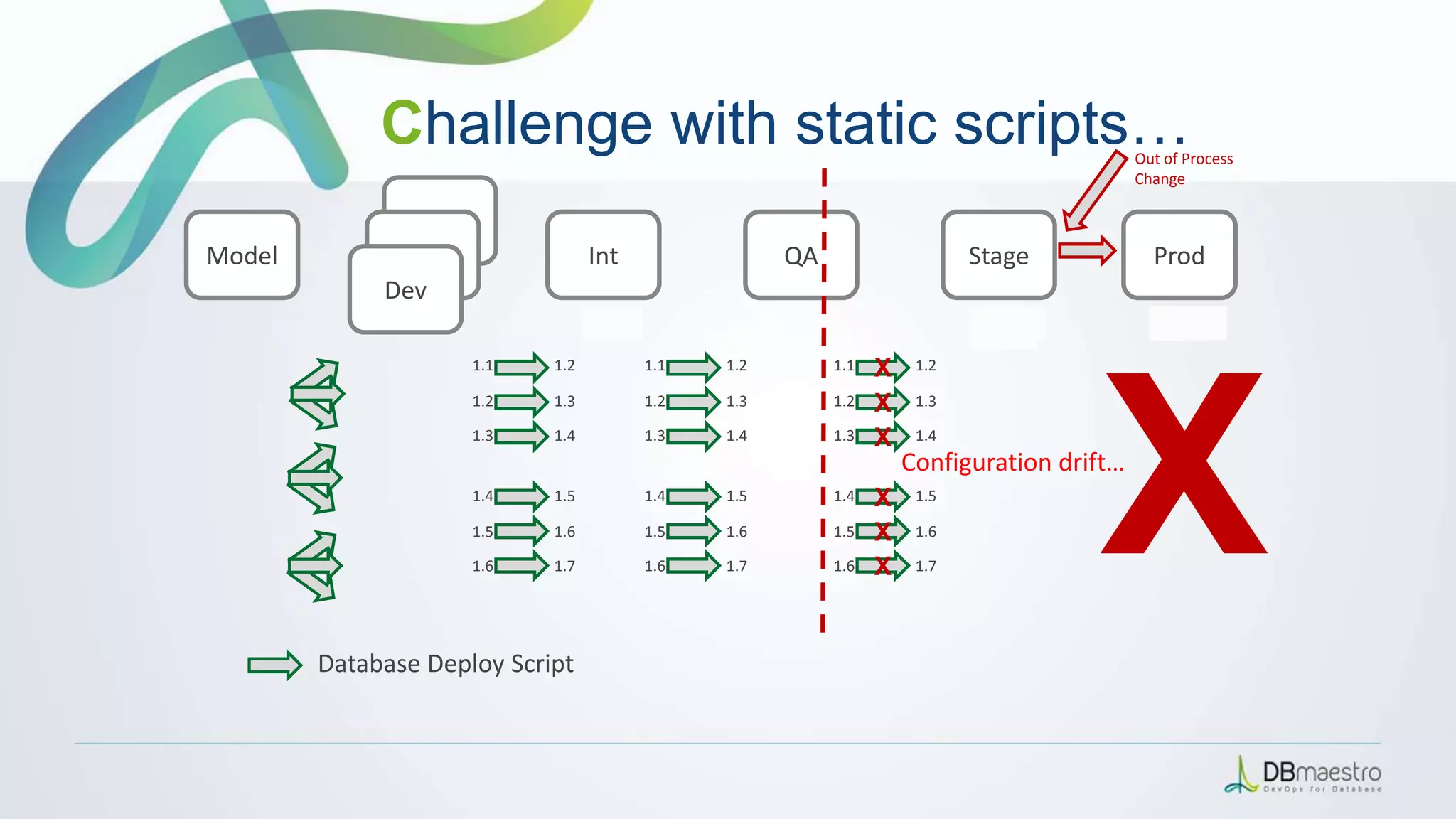
− Static deployments code overrides and configuration drift
− Dynamic deployments tools unaware of version control
− No release automation red-flags – don’t know when to stop the line…
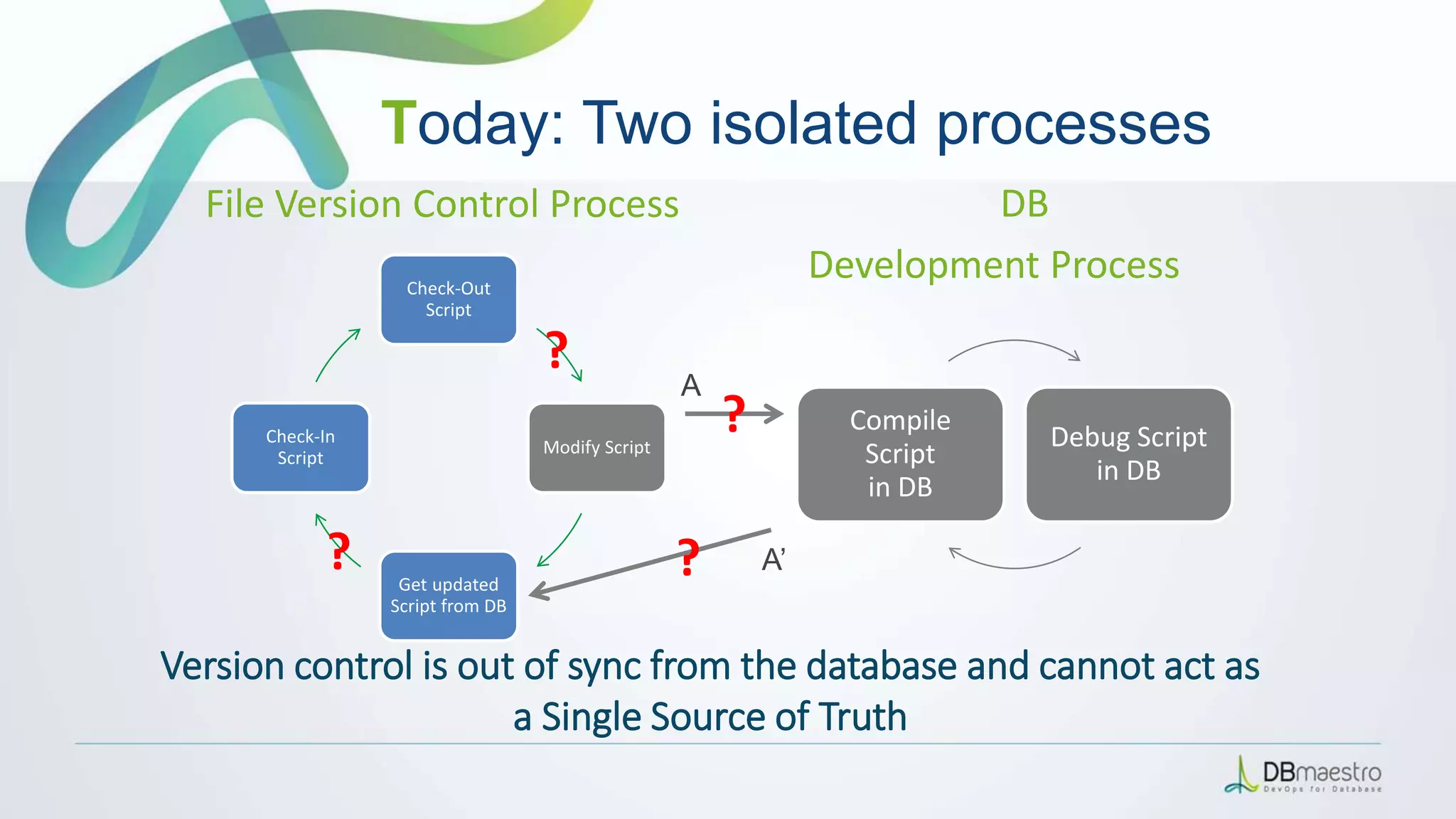
File Version Control Process
Today: Two isolated processes
DB
Development ProcessCheck-Out
Script
Modify Script
Get updated
Script from DB
Check-In
Script
Compile
Script
in DB
Debug Script
in DB
?
?
?
?
A
A’
Version control is out of sync from the database and cannot act as
a Single Source of Truth
X
1.11.1.11.11.21.31.41.51.61.7
Int QA Stage Prod
Database Deploy Script
Dev
Dev
Dev
Model
1.1 1.2
1.2 1.3
1.3 1.4
1.4 1.5
1.5 1.6
1.6 1.7
1.11.11.41.7
1.1 1.2
1.2 1.3
1.3 1.4
1.4 1.5
1.5 1.6
1.6 1.7
1.1 1.2
1.2 1.3
1.3 1.4
1.4 1.5
1.5 1.6
1.6 1.7
Out of Process
Change
X
X
X
X
X
? 1.1.1
X
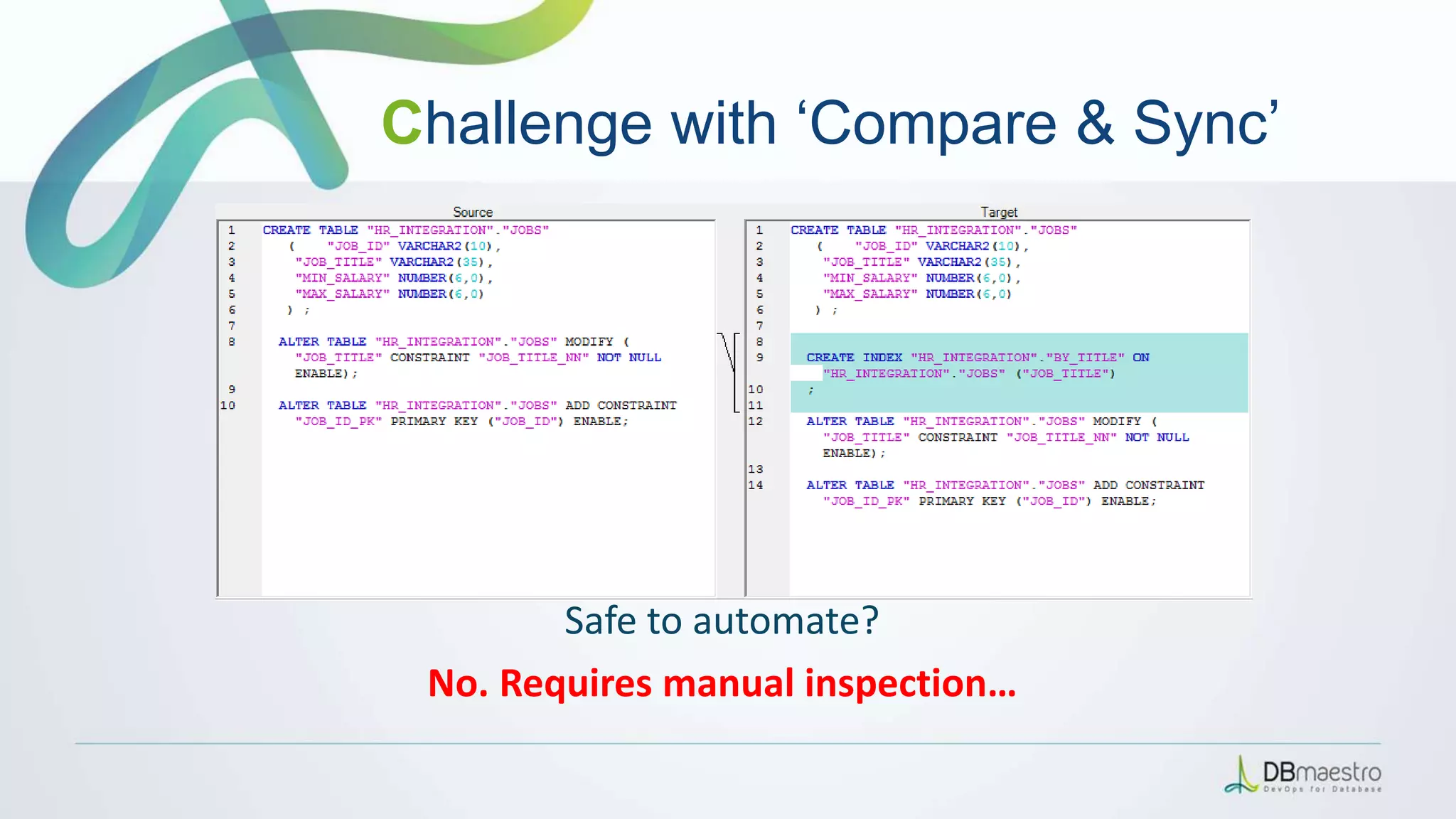
Challenge with static scripts…
Configuration drift…
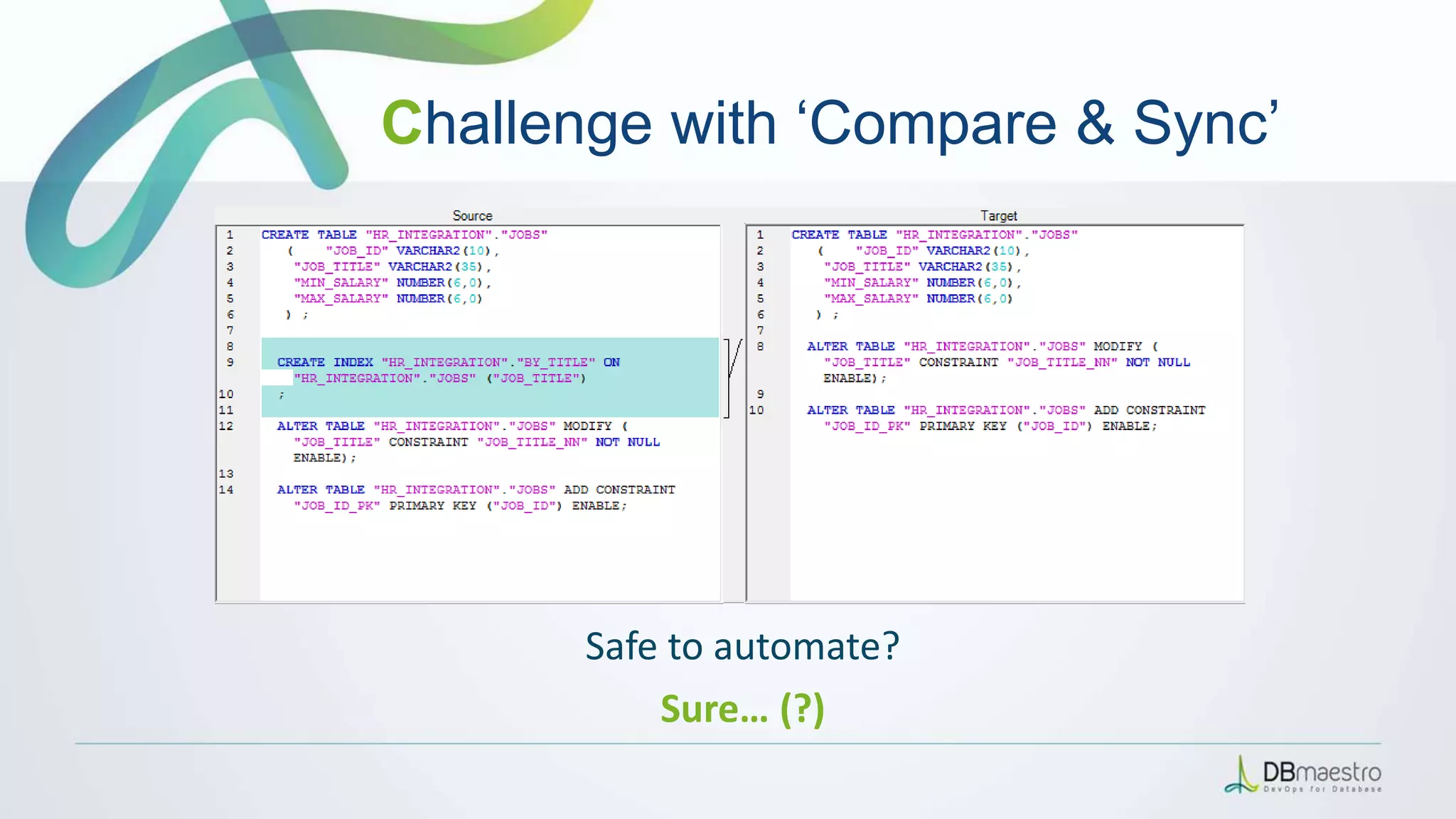
Safe to automate?
Sure… (?)
Challenge with ‘Compare & Sync’
Safe to automate?
No. Requires manual inspection…
Challenge with ‘Compare & Sync’
Leverage
Version control knowledge
into
Deployment decisions
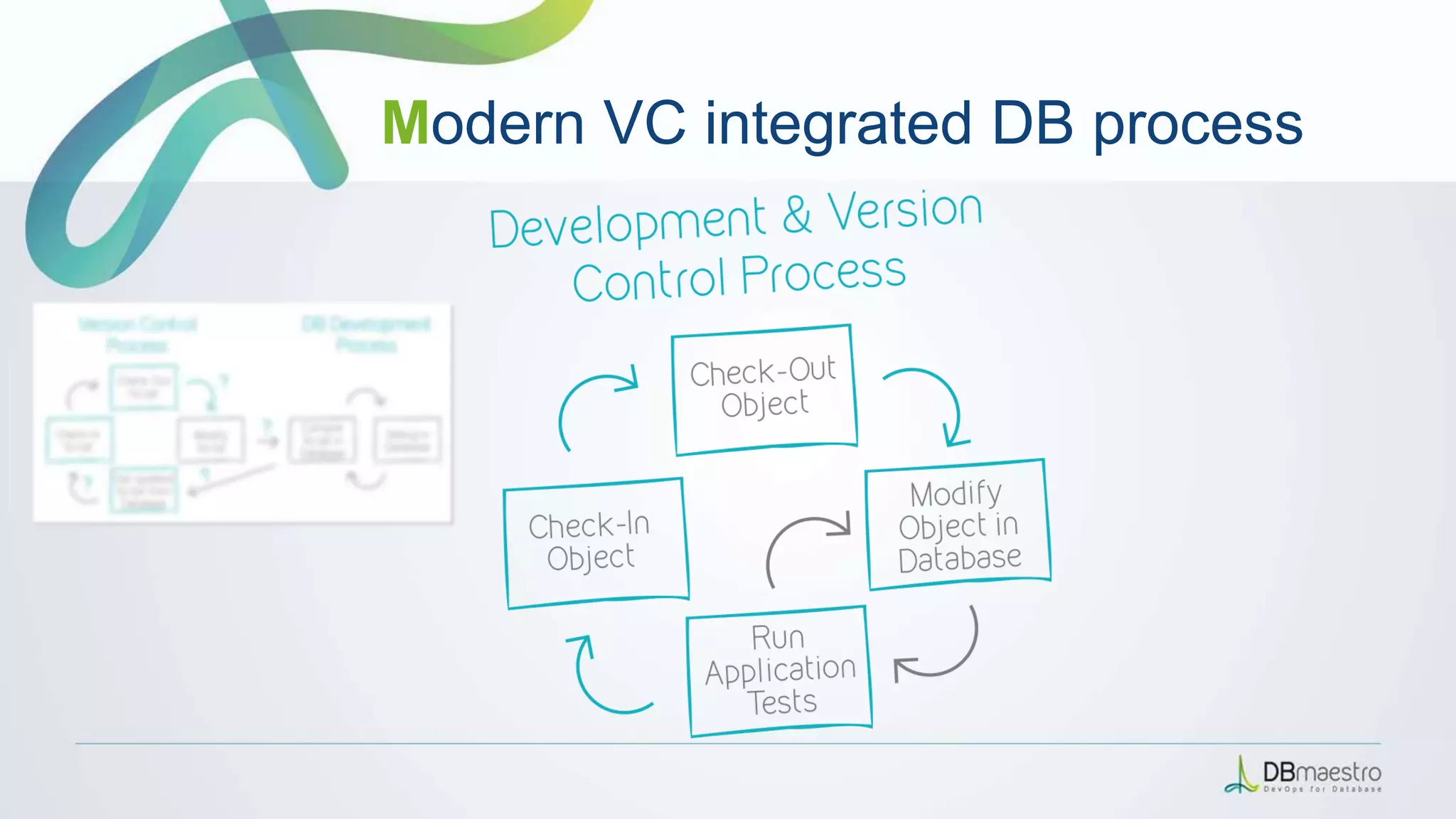
Modern VC integrated DB process
Revision history
Actions
Standard IDE
Change Management
Enforced and integrated to existing process
1.11.21.31.41.51.61.7
*
Int QA Stage Prod
Dev
Dev
Dev
Model
1.1 1.2
1.2 1.3
1.3 1.4
1.1 1.7
1.1.1 1.7
1.1 1.1 1.11.41.7
Out of Process
Change
1.1.11.7 1.1.11.7
Validate
1.4 1.5
1.5 1.6
1.6 1.7
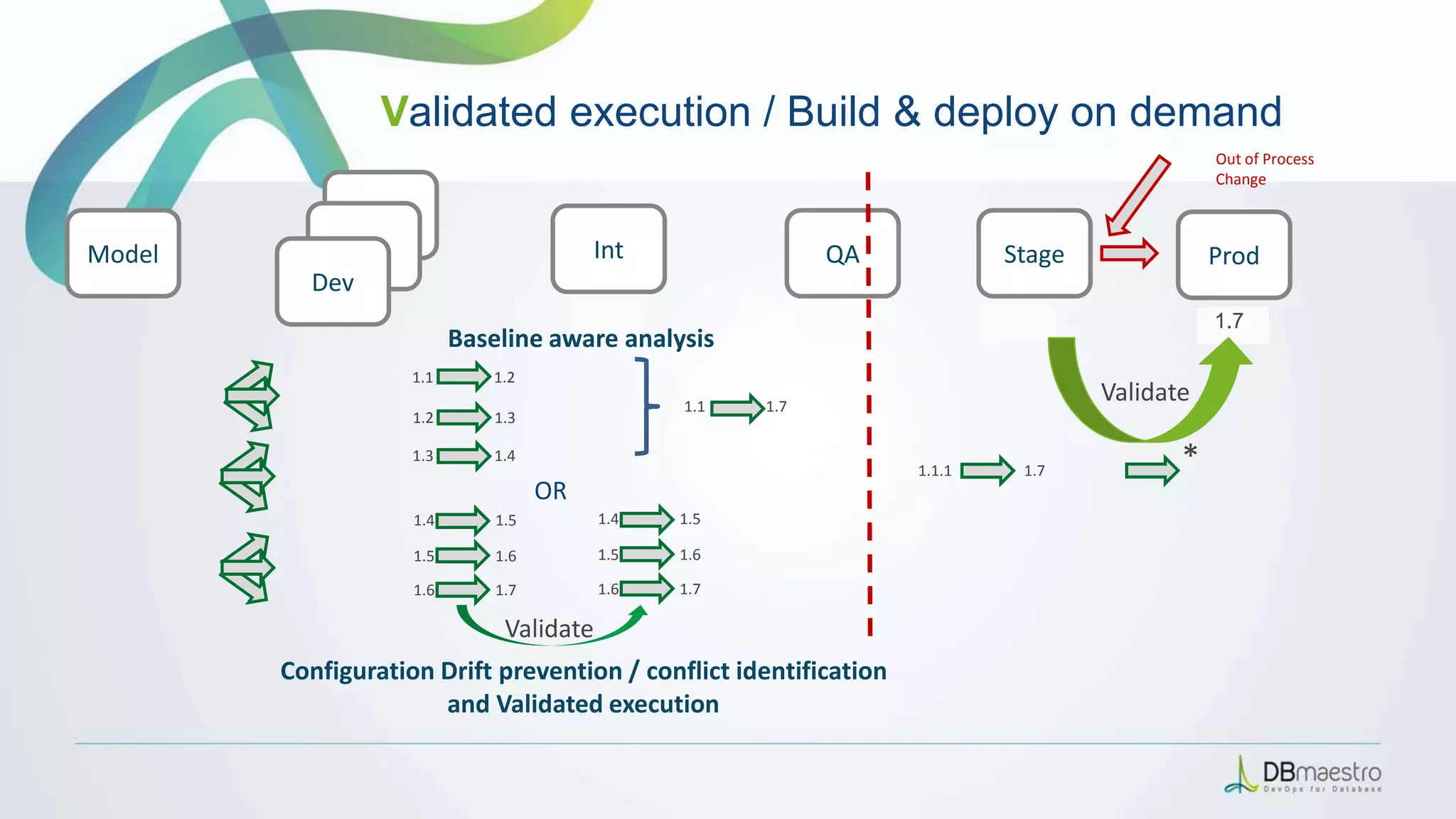
Configuration Drift prevention / conflict identification
and Validated execution
1.4 1.5
1.5 1.6
1.6 1.7
OR
Baseline aware analysis
Validated execution / Build & deploy on demand
Validate
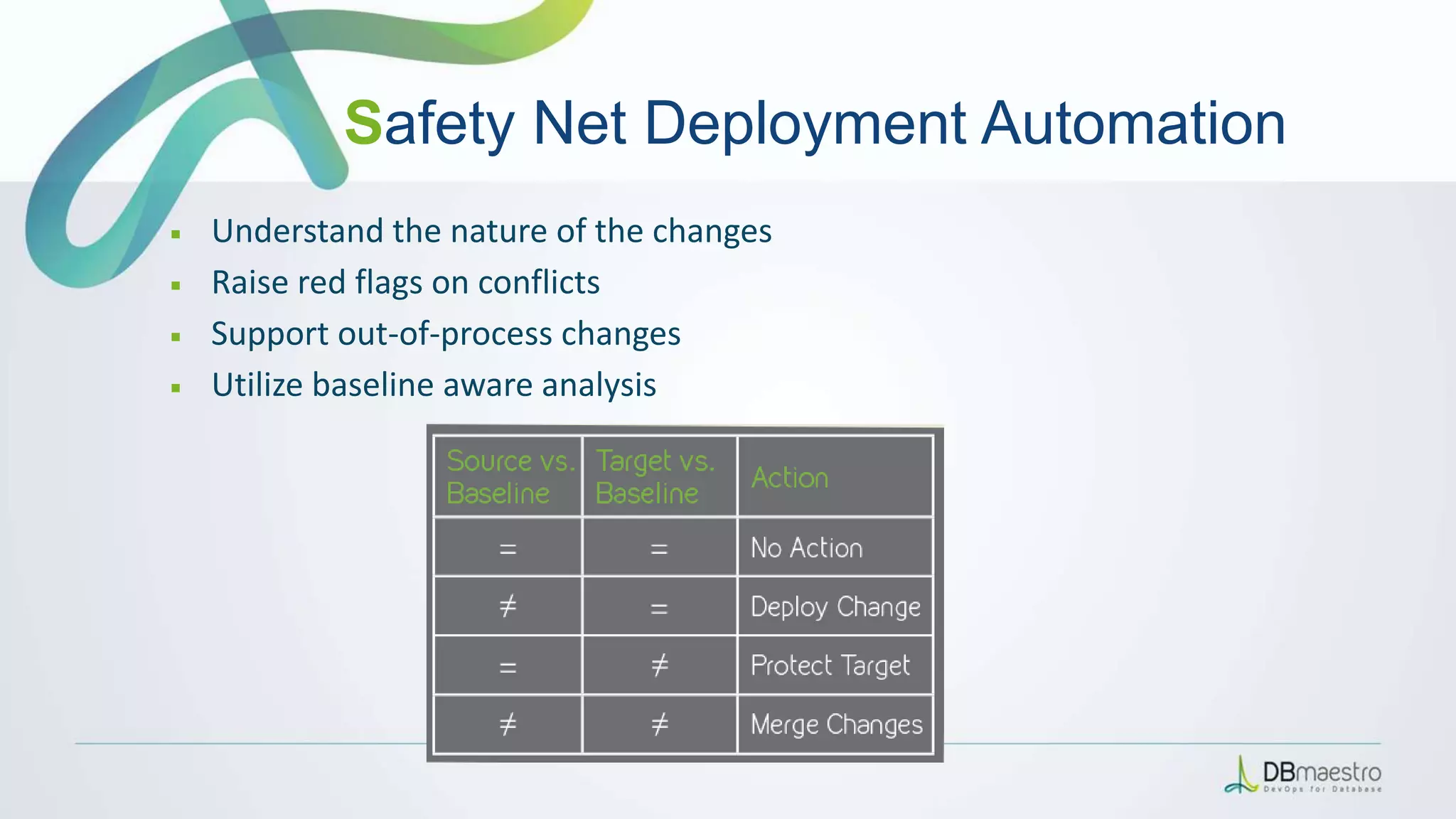
■ Understand the nature of the changes
■ Raise red flags on conflicts
■ Support out-of-process changes
■ Utilize baseline aware analysis
Safety Net Deployment Automation
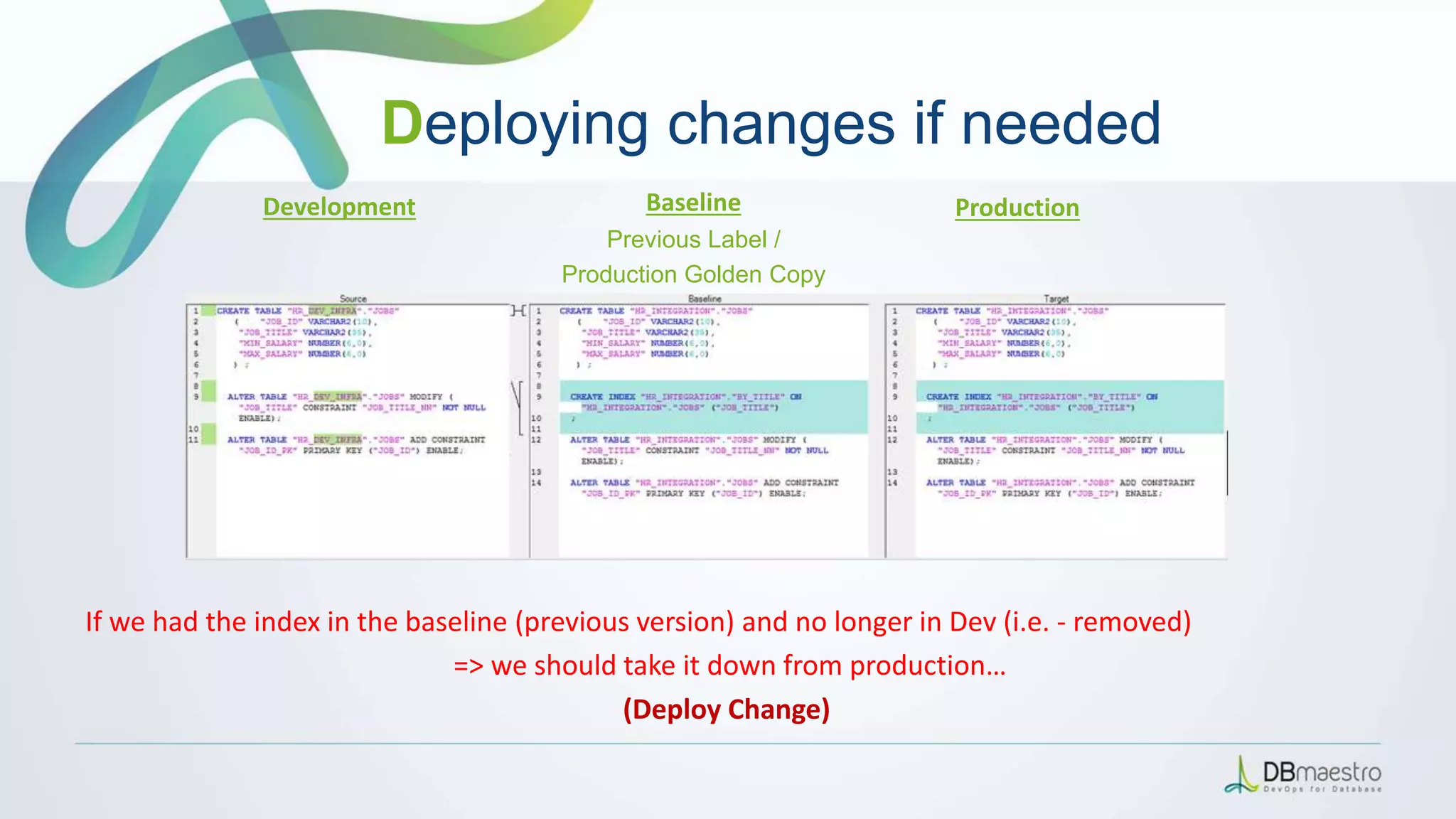
If we had the index in the baseline (previous version) and no longer in Dev (i.e. - removed)
=> we should take it down from production…
(Deploy Change)
Deploying changes if needed
Development Baseline
Previous Label /
Production Golden Copy
Production
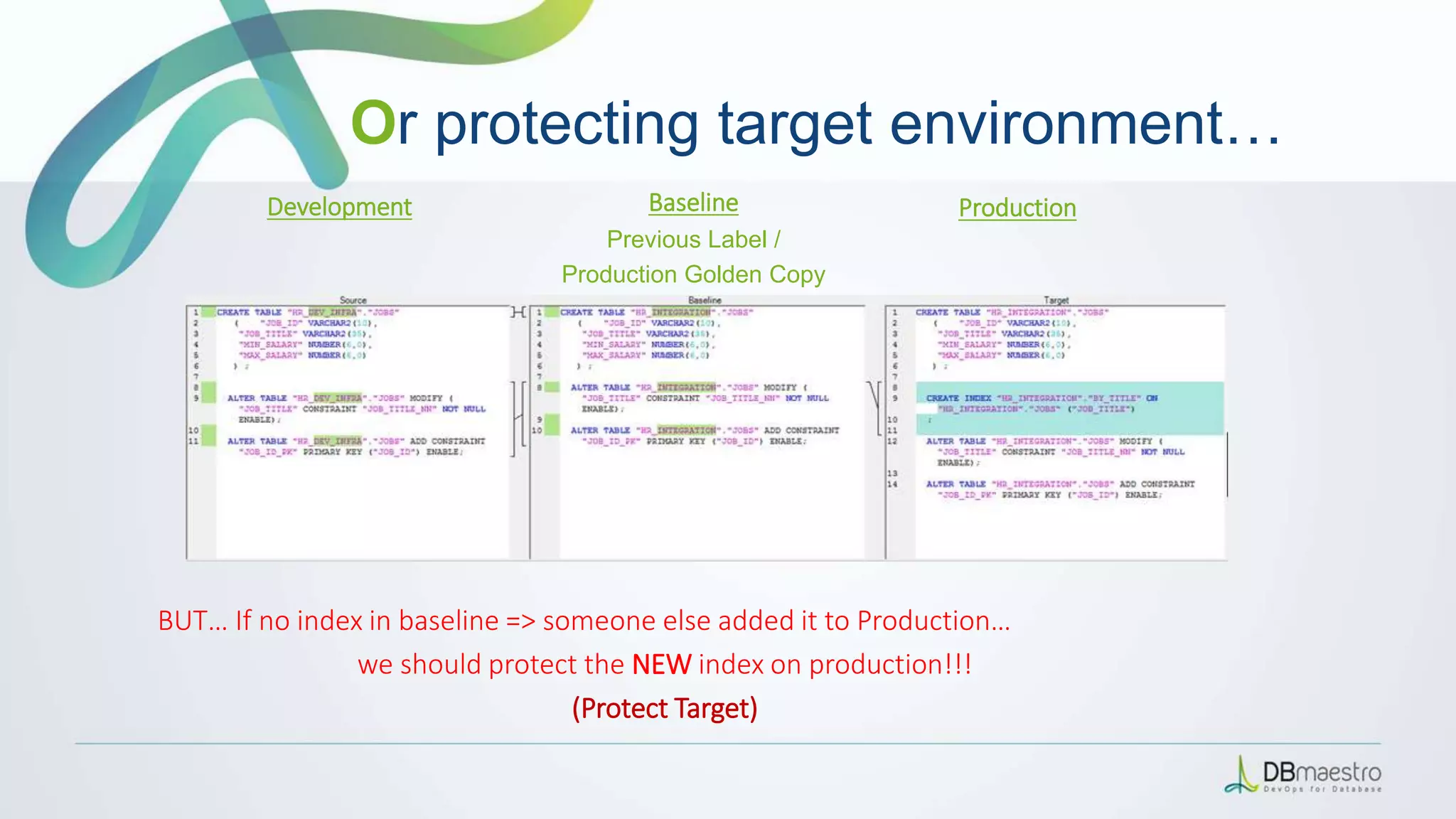
Development Baseline
Previous Label /
Production Golden Copy
Production
BUT… If no index in baseline => someone else added it to Production…
we should protect the NEW index on production!!!
(Protect Target)
Or protecting target environment…
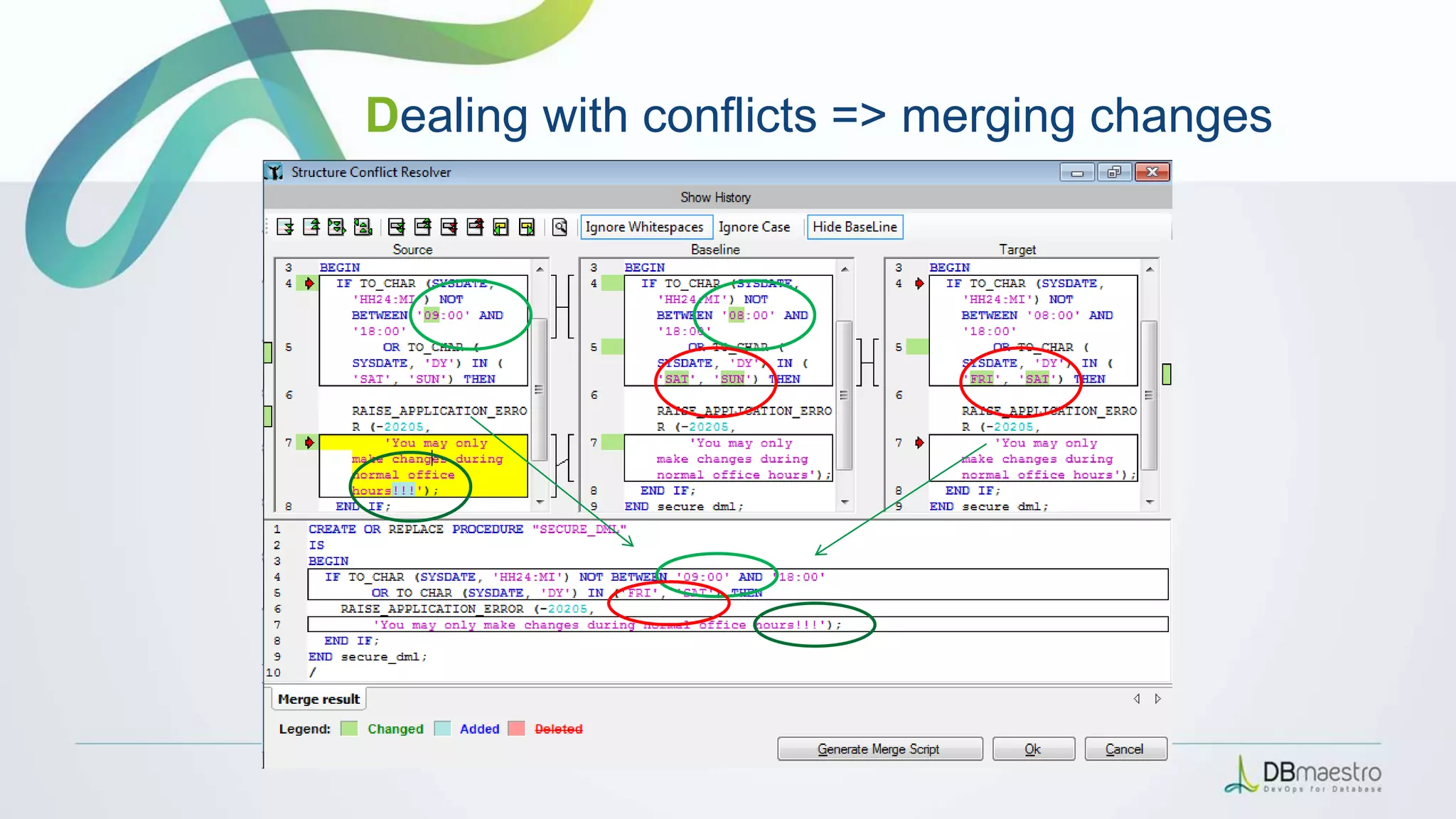
Dealing with conflicts => merging changes
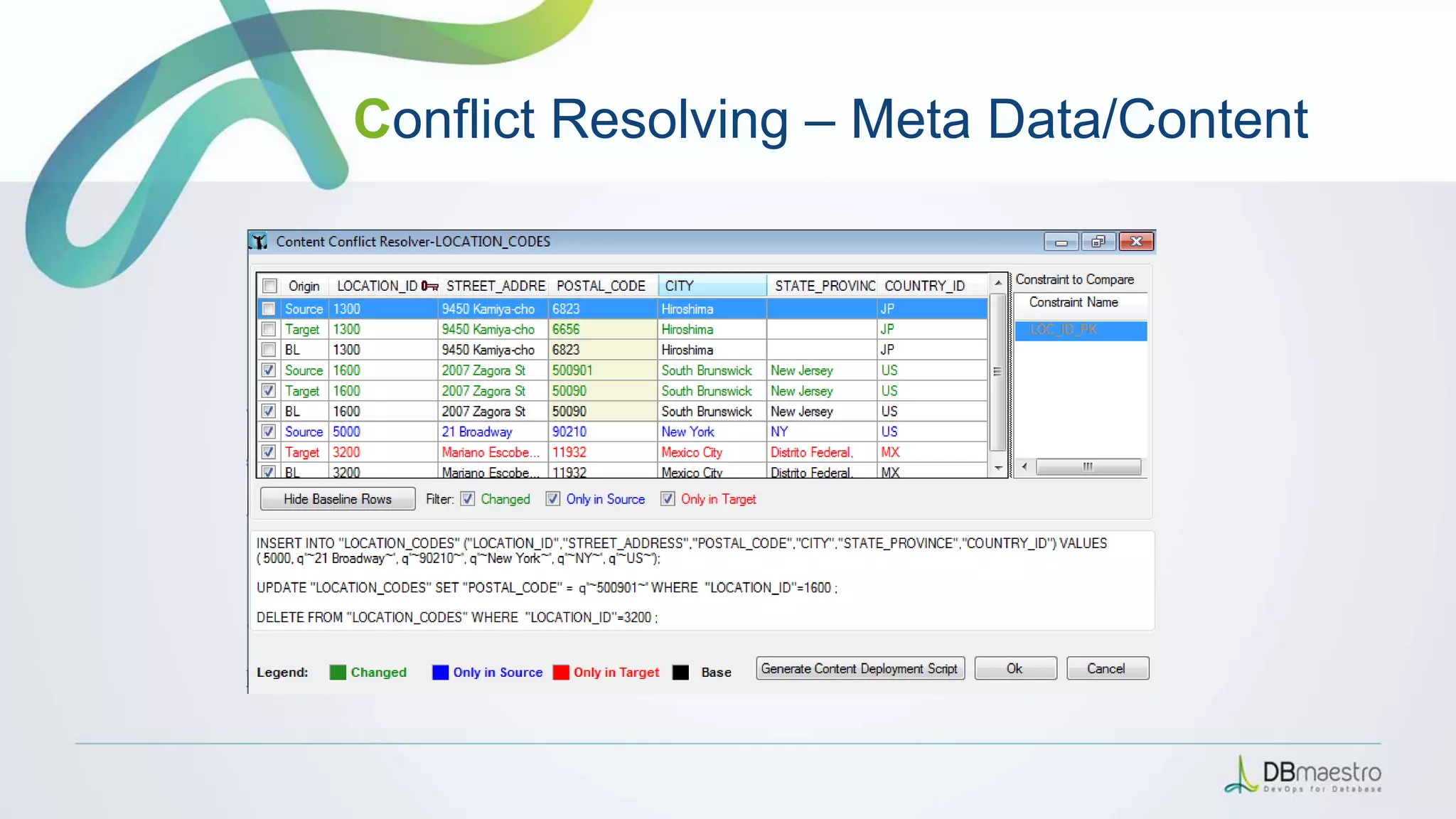
Conflict Resolving – Meta Data/Content
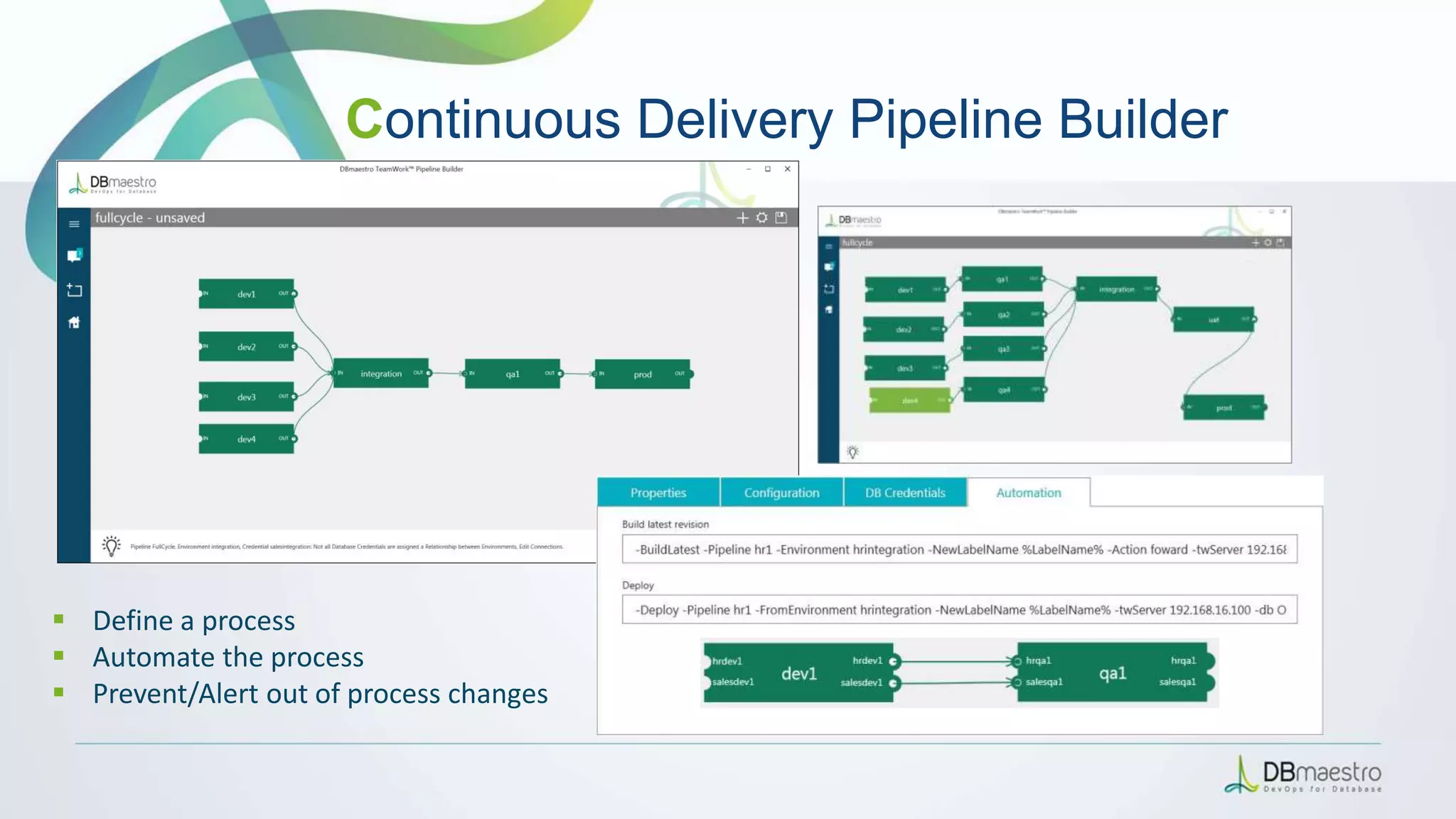
Continuous Delivery Pipeline Builder
 Define a process
 Automate the process
 Prevent/Alert out of process changes
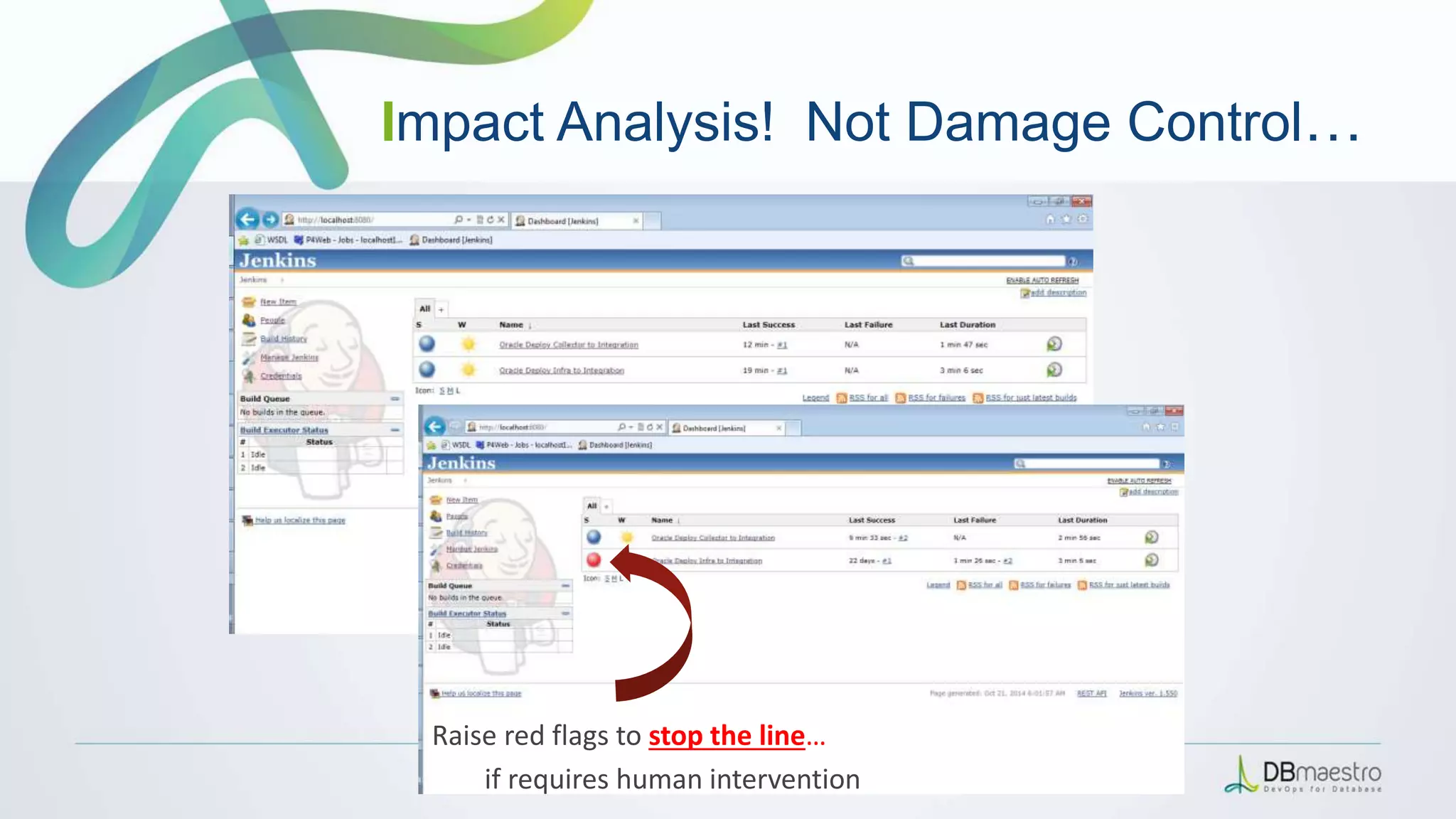
Raise red flags to stop the line…
if requires human intervention
Impact Analysis! Not Damage Control…
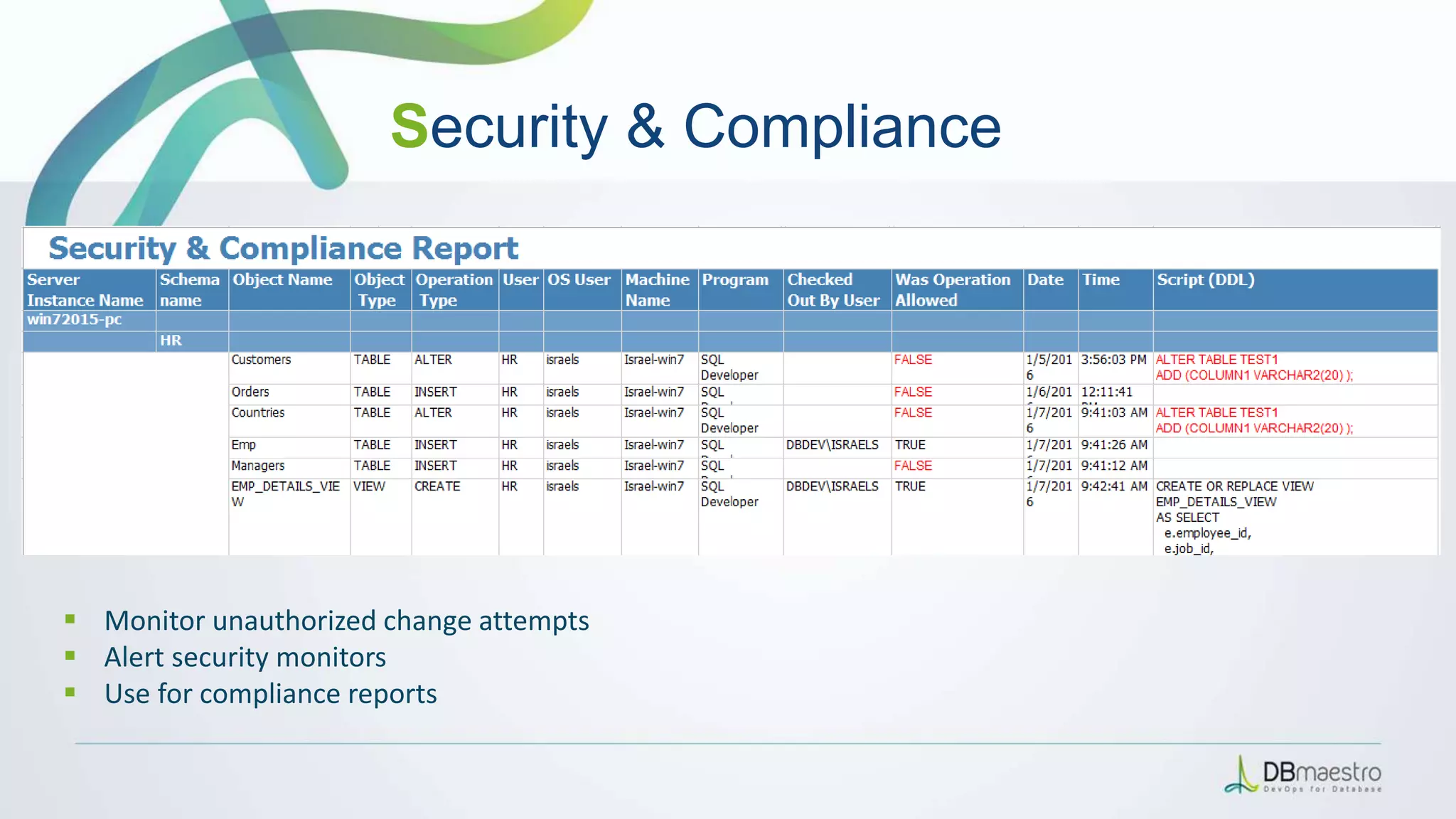
Security & Compliance
 Monitor unauthorized change attempts
 Alert security monitors
 Use for compliance reports
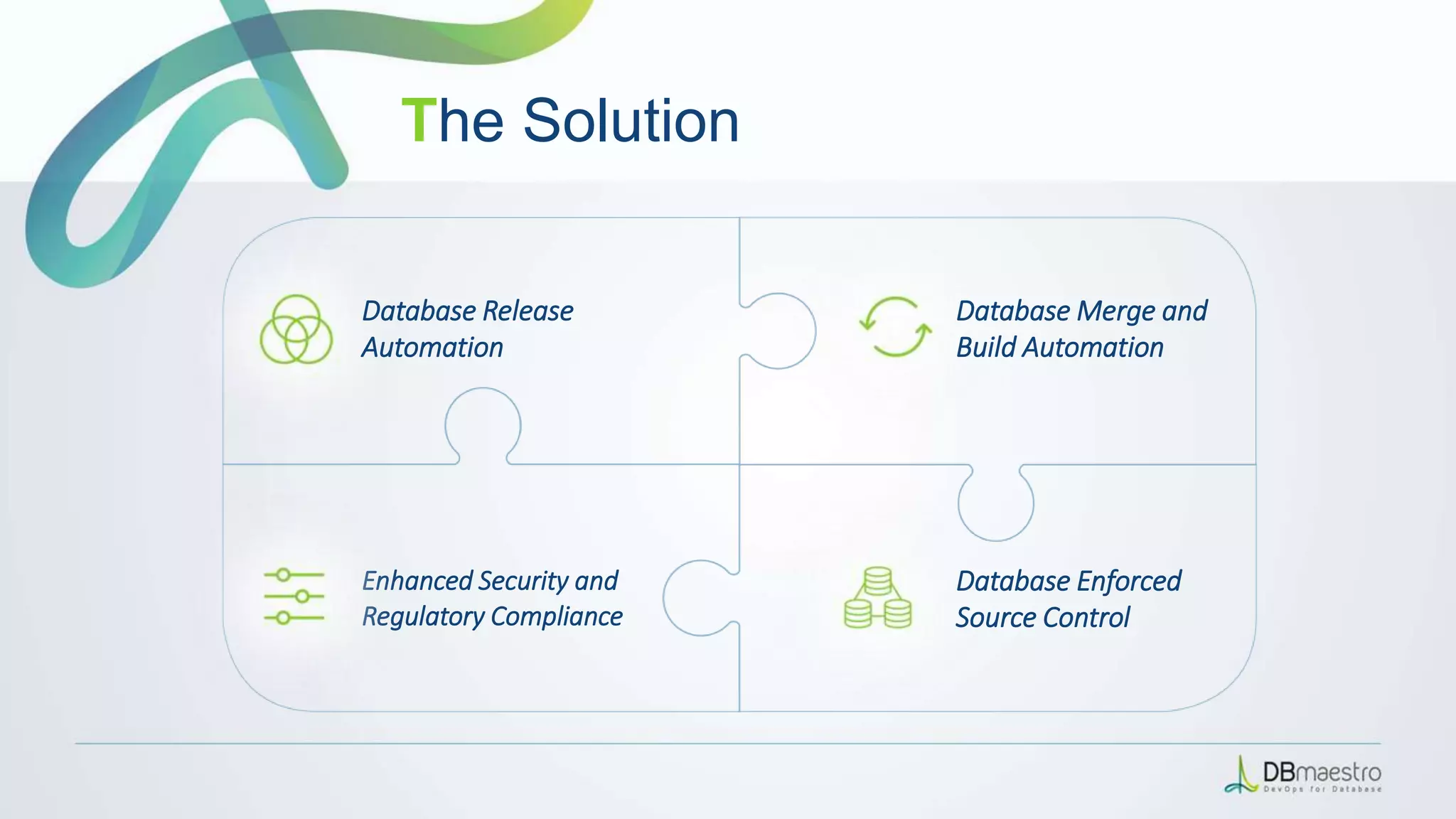
Database Enforced
Source Control
Enhanced Security and
Regulatory Compliance
Database Merge and
Build Automation
Database Release
Automation
The Solution
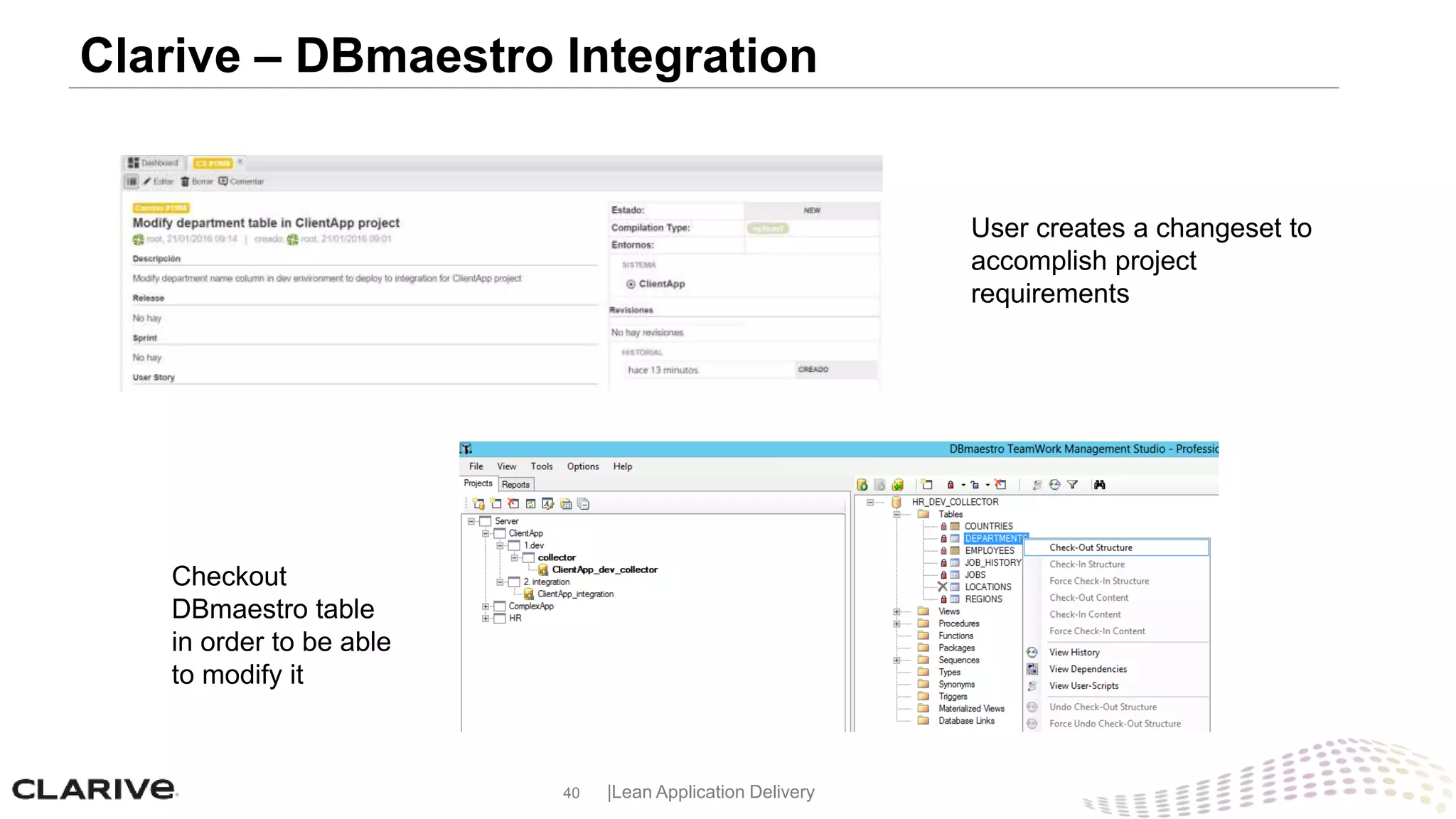
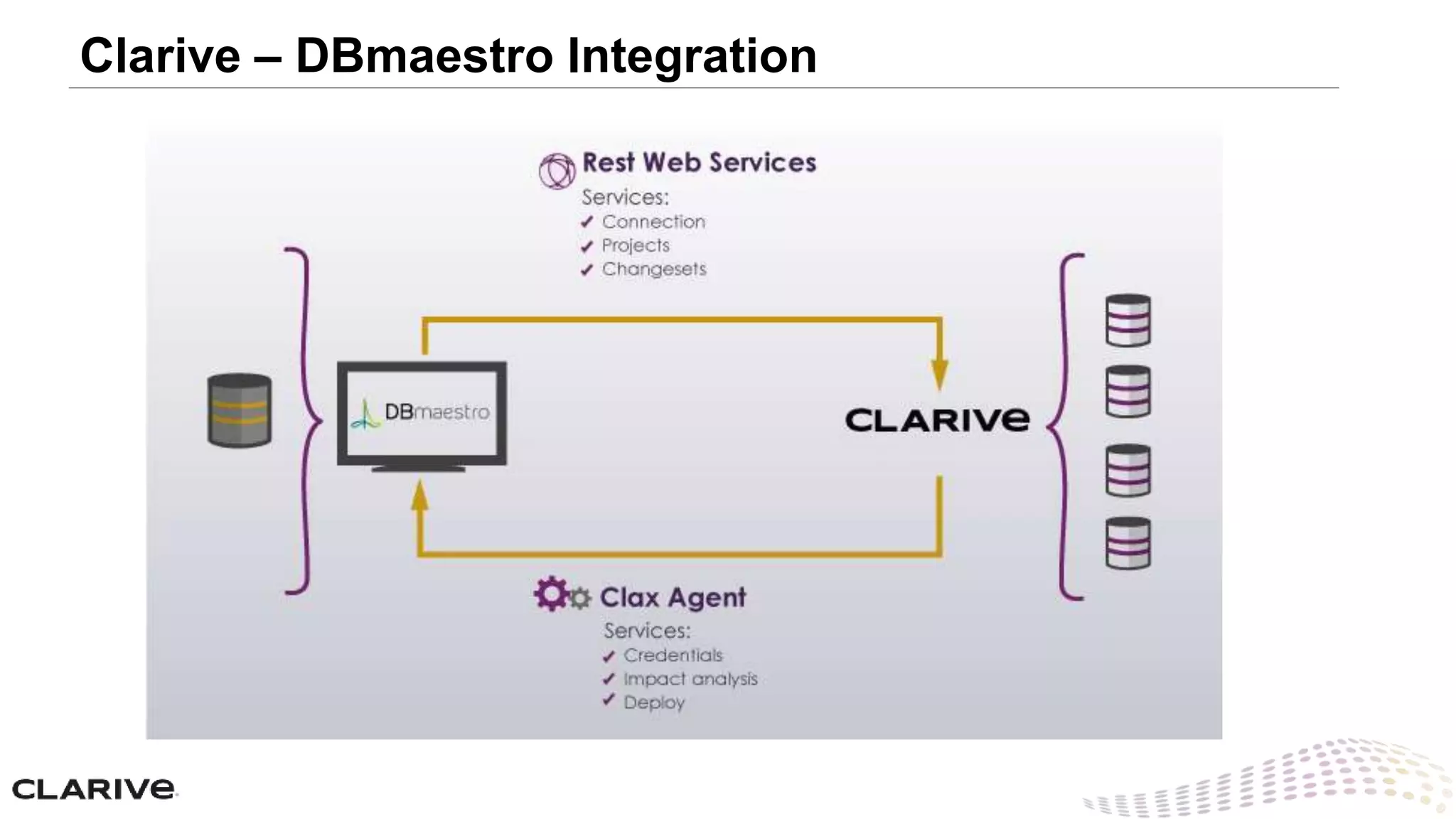
Clarive – DBmaestro Integration
40 |Lean Application Delivery
User creates a changeset to
accomplish project
requirements
Checkout
DBmaestro table
in order to be able
to modify it
Clarive – DBmaestro Integration
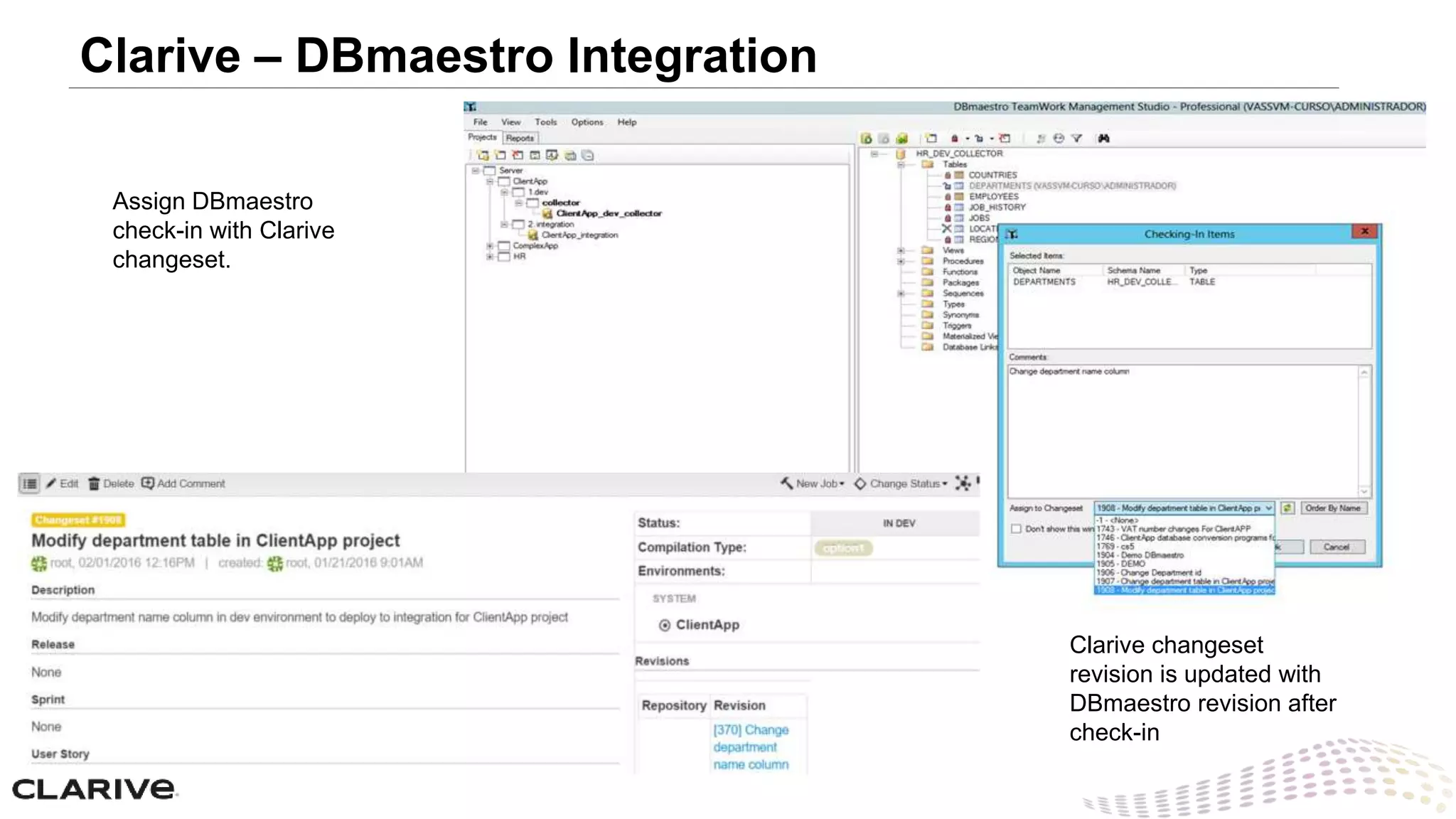
Assign DBmaestro
check-in with Clarive
changeset.
Clarive changeset
revision is updated with
DBmaestro revision after
check-in
Clarive – DBmaestro Integration
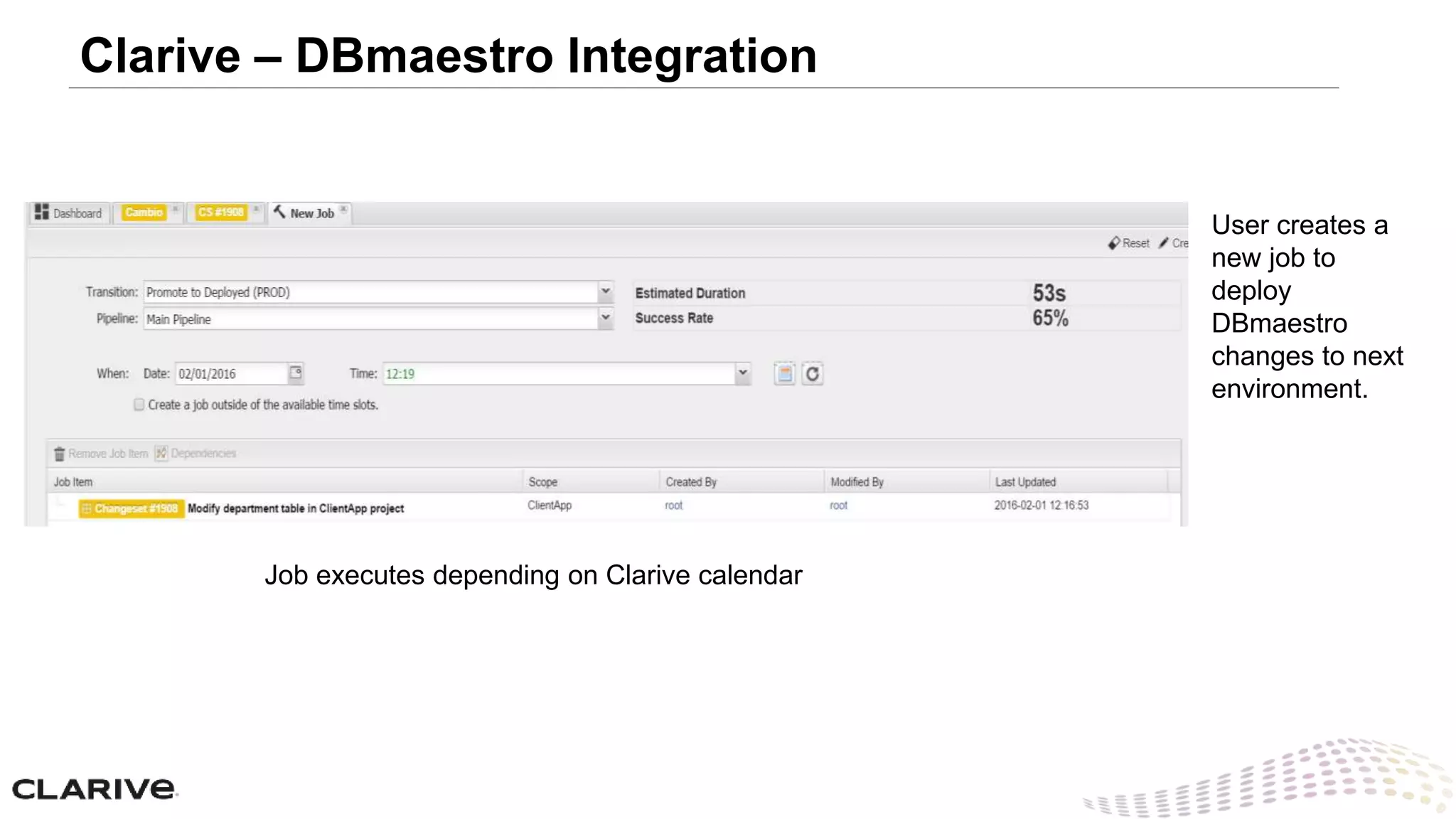
Job executes depending on Clarive calendar
User creates a
new job to
deploy
DBmaestro
changes to next
environment.
Clarive – DBmaestro Integration
DBmaestro impact
analysis accessed from
Clarive log report
Execute
DBmaestro
impact
analysis in
step PRE
Clarive – DBmaestro Integration
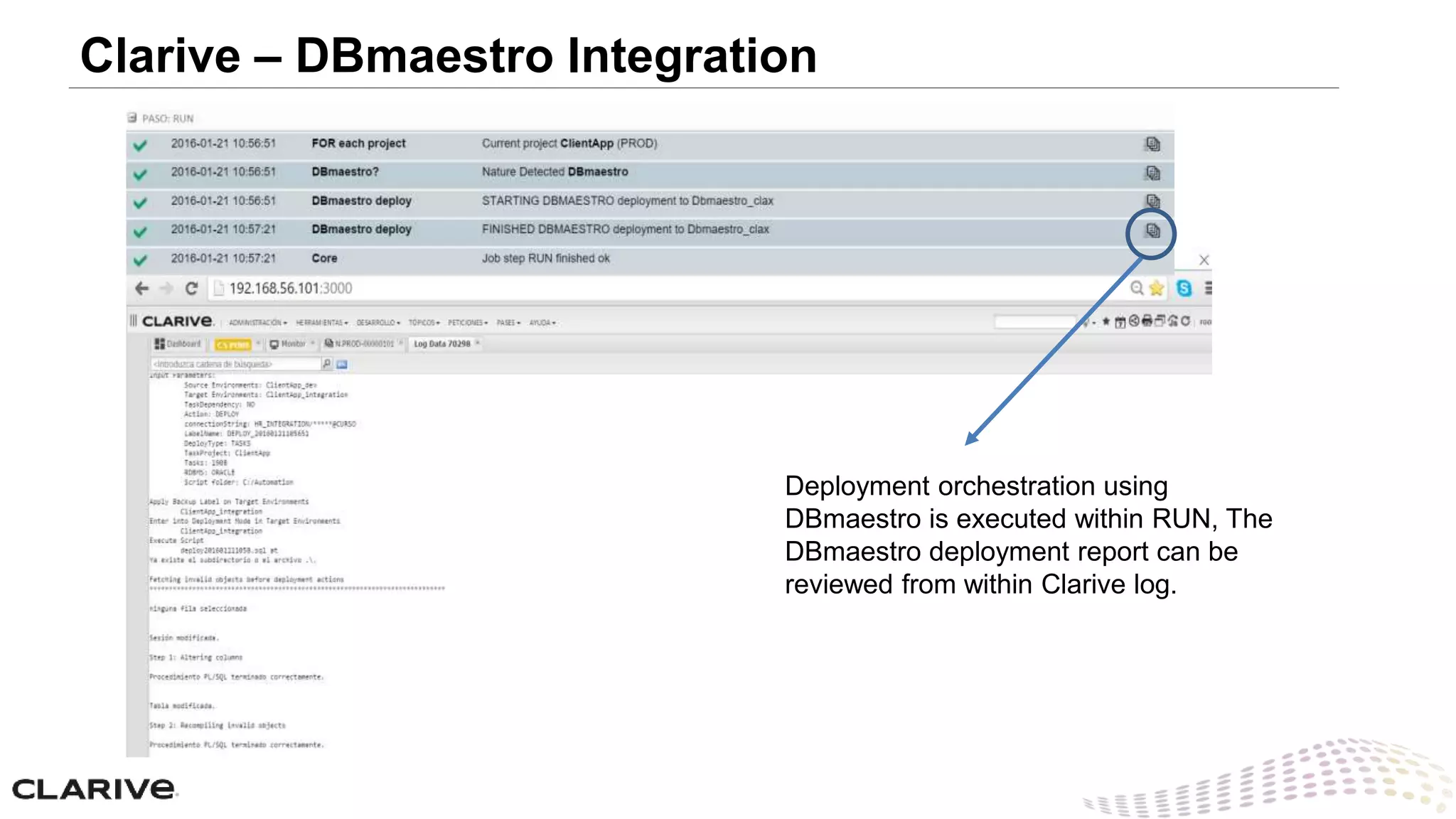
Deployment orchestration using
DBmaestro is executed within RUN, The
DBmaestro deployment report can be
reviewed from within Clarive log.
Clarive – DBmaestro Integration
45 |Lean Application Delivery
1999 2010 2015
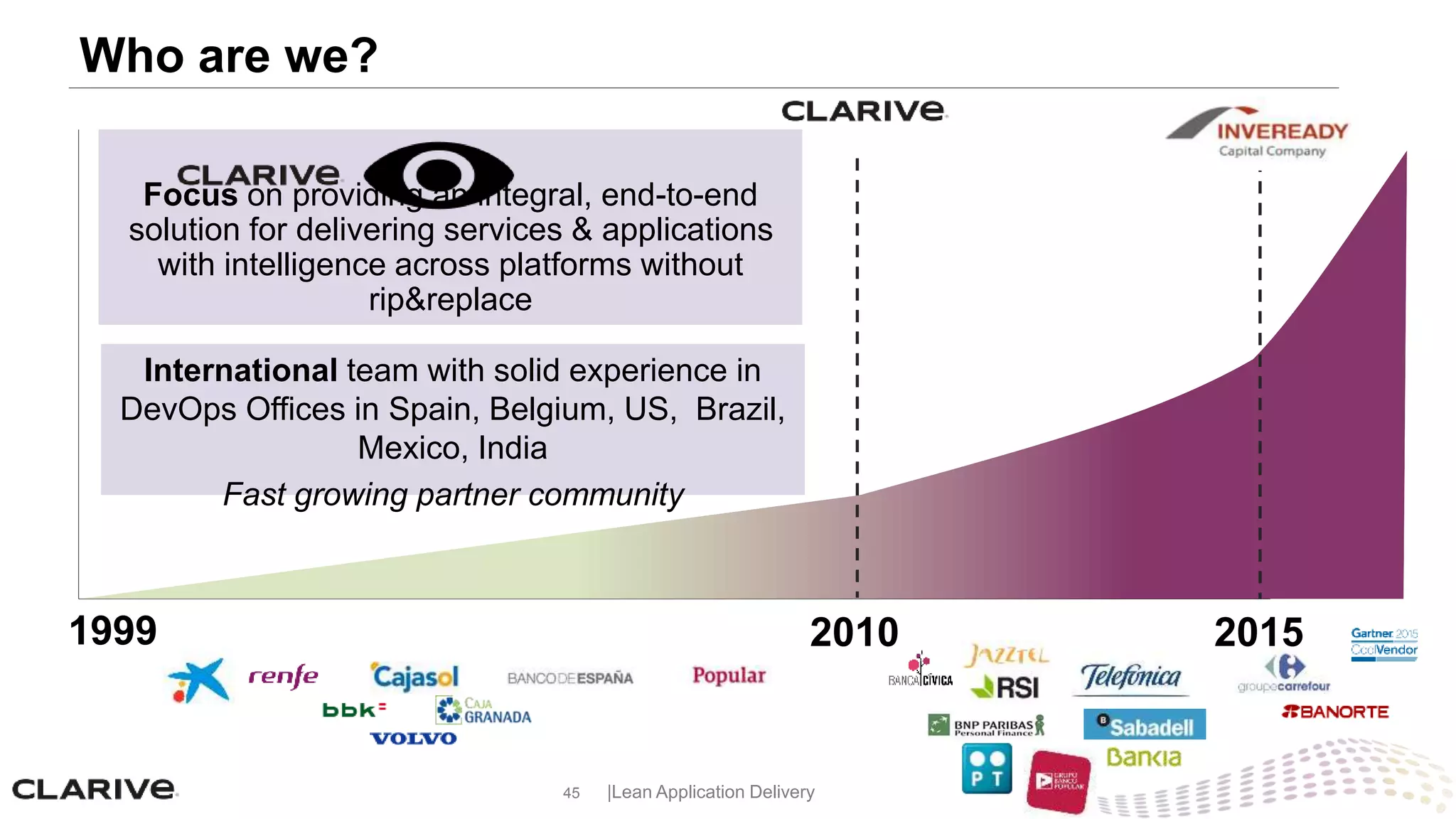
Focus on providing an integral, end-to-end
solution for delivering services & applications
with intelligence across platforms without
rip&replace
International team with solid experience in
DevOps Offices in Spain, Belgium, US, Brazil,
Mexico, India
Fast growing partner community
Who are we?
46 |Lean Application Delivery
THE PROBLEM WE SOLVE
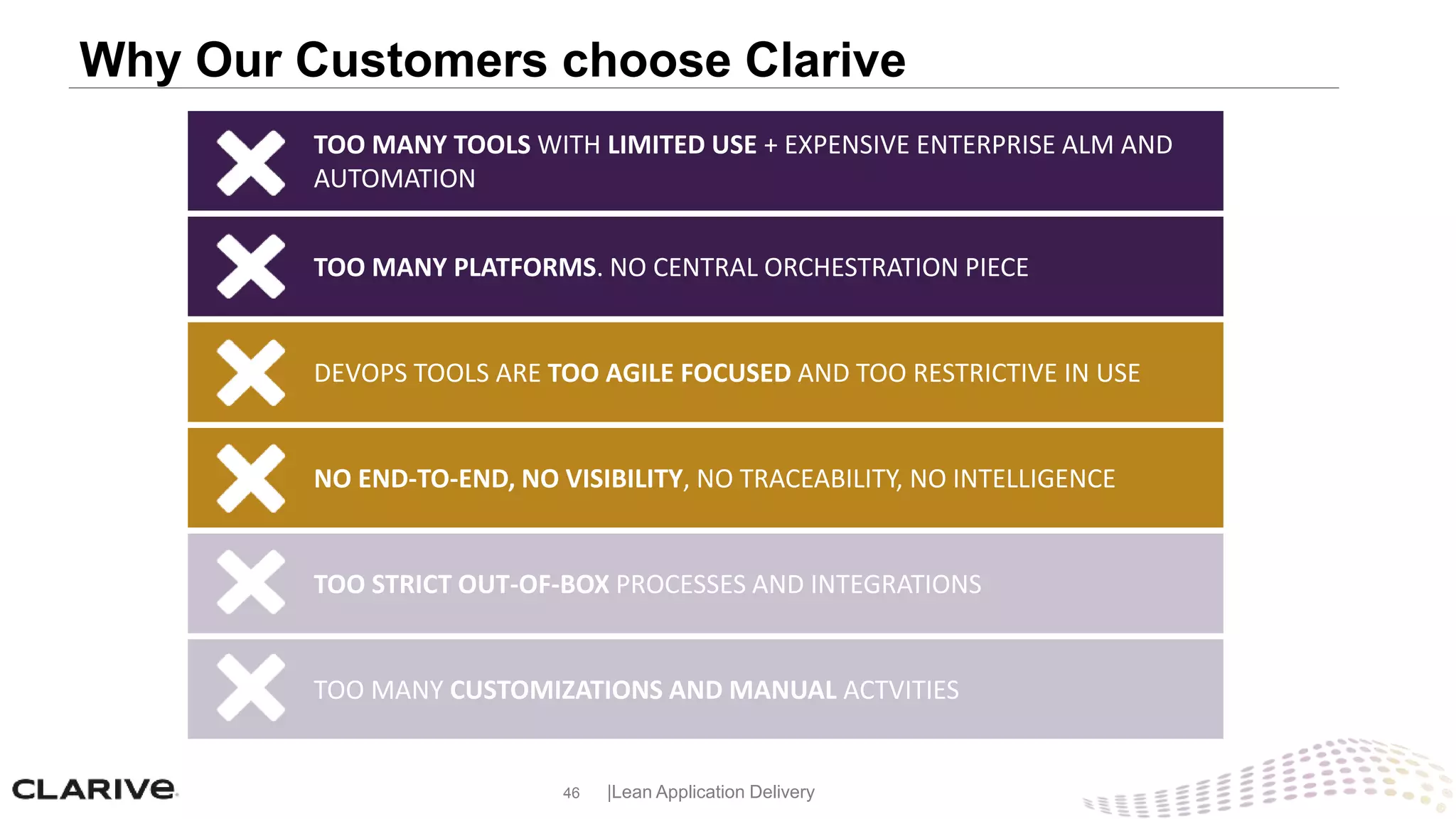
TOO MANY TOOLS WITH LIMITED USE + EXPENSIVE ENTERPRISE ALM AND
AUTOMATION
TOO MANY PLATFORMS. NO CENTRAL ORCHESTRATION PIECE
DEVOPS TOOLS ARE TOO AGILE FOCUSED AND TOO RESTRICTIVE IN USE
NO END-TO-END, NO VISIBILITY, NO TRACEABILITY, NO INTELLIGENCE
TOO STRICT OUT-OF-BOX PROCESSES AND INTEGRATIONS
TOO MANY CUSTOMIZATIONS AND MANUAL ACTVITIES
Why Our Customers choose Clarive
47 |Lean Application Delivery
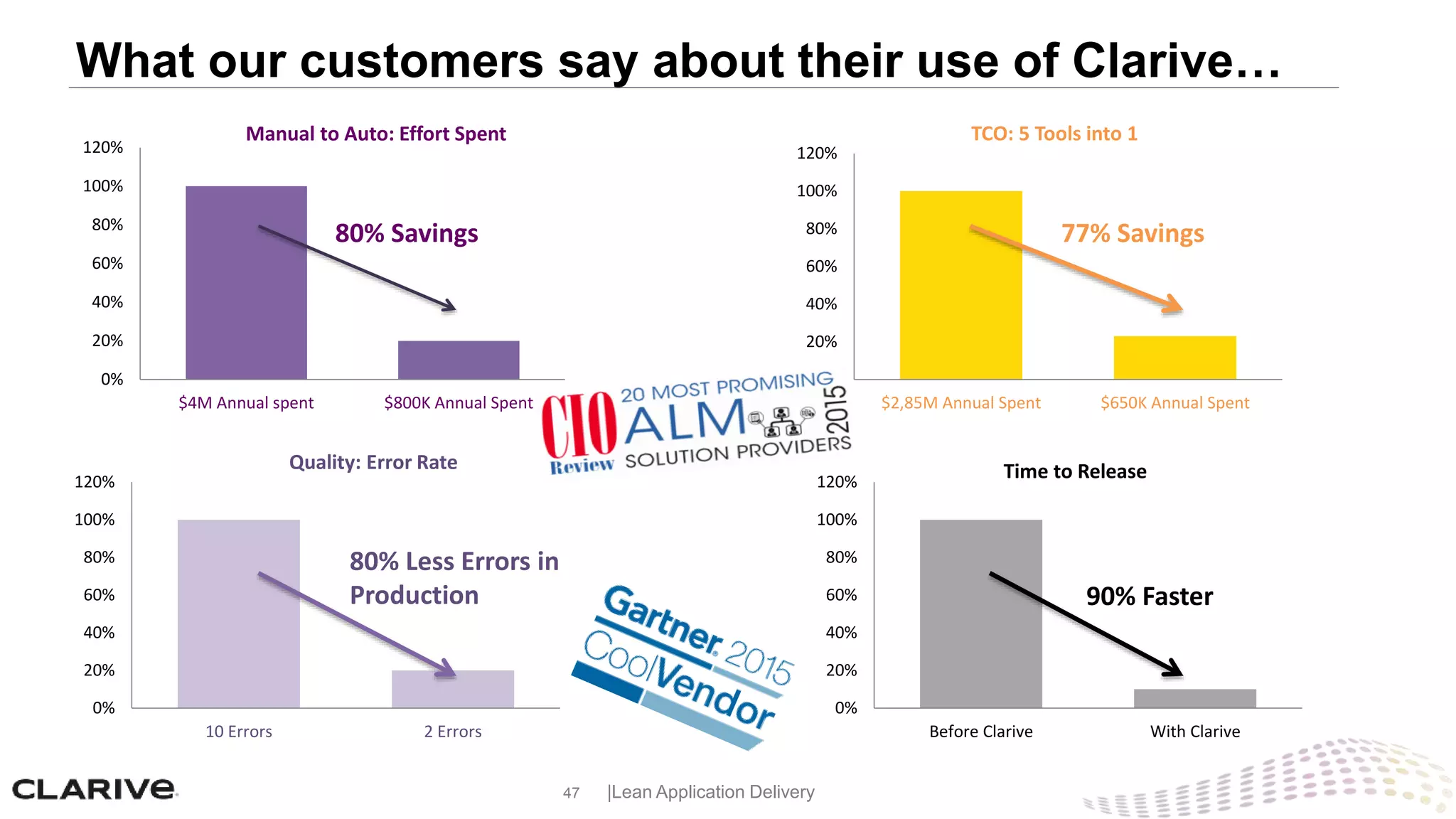
What our customers say about their use of Clarive…
0%
20%
40%
60%
80%
100%
120%
$4M Annual spent $800K Annual Spent
Manual to Auto: Effort Spent
80% Savings
0%
20%
40%
60%
80%
100%
120%
$2,85M Annual Spent $650K Annual Spent
TCO: 5 Tools into 1
77% Savings
0%
20%
40%
60%
80%
100%
120%
10 Errors 2 Errors
Quality: Error Rate
80% Less Errors in
Production
0%
20%
40%
60%
80%
100%
120%
Before Clarive With Clarive
Time to Release
90% Faster
48 |Lean Application Delivery
EMEA Headquarters
Av. Industria, 4 E0-2A
Alcobendas – Madrid
28108 Spain
+34 91 123 8473
US Headquarters
234 5th Ave.
New York
10001USA
+1 415 800 1842
info@clarive.com
INTL Headquarters
Uitbreidingsstraat 84/3
Berchem– Antwerp
B2600 Belgium
+32 3 808 12 50
DBmaestro Selected Customers
Thank you!
Q & A
Eddy Pauwels Cindy Bean
eddy@clarive.com cyndyb@dbmaestro.com
www.clarive.com www.dbmaestro.com

Webinar - Devops platform for the evolving enterprise

  • 1.
    DevOps Platform forthe Evolving Enterprise DBmaestro and Clarive Joint-Webinar May 4th, 2016
  • 2.
    Before We Begin ▪You will be on mute for the duration of the event ▪ Please type a message in the Questions box in the Control Panel if you can’t hear us (please check your speakers and GoToWebinar audio settings first) ▪ If you have questions during the session, please submit them on the Q&A bar on your GoToWebinar dashboard and we will address them at the end ▪ A recording of the full webinar will be put up online
  • 3.
    Outline ▪ Best Practicesof Continuous Delivery for Modern Applications ▪ DevOps Platform for the Evolving Enterprise ▪ The Reasons why the Database is Often Left Behind ▪ Database Continuous Delivery, from Development to Build to Deploy ▪ Q&A
  • 4.
    Presenters Cindy Bean Sr. SoftwareConsultant at DBmaestro Spent over 20 years working with various database management products for Oracle, SQL Server and other relational database systems as a DBA, product manager, and consultant.
  • 5.
    Presenters Eddy Pauwels, SVP Sales& Marketing, Clarive An experienced IT professional. Eddy holds a masters degree in computer science from the University of Brussels. During the past 25 years he specialized in Application and Service Lifecycle Management. Eddy is a respected coach within organizations to implement Agile, Lean IT and performance based service management principles.
  • 6.
    Top 10 DeliveryChallenges Today GOAL: Maximize Business Value « at-the-speed-of-business » 1. Real-time Insight 2. Impact Analysis End-to-End Related 3. Quality 4. Lead Time 5. Agility & Maintenance 6. Orchestration across platforms, sourcing flexibility Deployment Related 7. Process Orchestration across different teams & tools 8. Collaboration or Sharing across DEV and OPS teams 9. Cross Platform planning & Scheduling 10. DevOps Strategy alignment to Application Type Execution Related
  • 7.
    Automation Coordination, Collaboration, Sharing, Integration Standardization between DEV-QA-Build-Release Build –Test – Deployment to development and QA environments Application Delivery pipeline Increase Delivery Speed & Business Agility Delivery Driven Initiatives Focus on Application Delivery process between service providers and with business Release Delivery, Environment Provisioning, Monitoring, & Recovery services and delivery models Increase Efficiency & Reduce TCO Operations Driven Initiatives Focus on Service Delivery process Audit, Governance Insight Maximize Business value « at-the-speed-of-business »: 2 Drivers
  • 8.
    Transitioning IT Architectures& end-to-end Delivery Processes DevOps Platform for the evolving enterprise Highly Interconnected architectures Top-Down Release Management Big & Infrequent changes Waterfall based SDLC IT oriented org. structure Operations driven Loosely coupled architectures Bottom-Up Release Management Small & frequent/continuous changes Agile based SDLC Customer oriented org. structure Delivery driven Automation Sharing Sourcing Measurement & Management Lean Culture
  • 9.
    Project Top-Down Release Management CR ApplicationX CR INC CR CR Application Y INC CR CR Application Z INC Project Project Release … Ready for Dev In Dev Ready for QA In QA Waiting for Approval Ready for deployment Deployed
  • 10.
    Bottom-Up Release Management Release PlatformY CS CSDEV QA PR D Platform X CS CSDEV QA PR D … Ready for Dev In Dev Ready for QA In QA Waiting for Approval Ready for deployment Deployed
  • 11.
    Project Hybrid Release Management CR ApplicationX CR INC CR CR Application Y INC CR CR Application Z INC Project Project Release … Ready for Dev In Dev Ready for QA In QA Waiting for Approval Ready for deployment Deployed Platform Y CS CSDEV QA PR D Platform X CS CSDEV QA PR D
  • 12.
    What are themost common Platforms today? Cloud ERP Mobile Mainframe Database Open System Virtual System
  • 13.
    Clarive: A Single-ToolDevOps Platform for the Evolving Enterprise Instant/dynamic DevOps Insight without Rip&Replace Improvement through Insight! Processes taken End-to-End from a business perspective
  • 14.
    Coordination & Collaboration Team collaboration & sharing across DEV, QA, & OPS, and also across platforms , lifecycle boundaries & tools involved  Standardize, Coordinate & Automate processes  Preserve successful investments made (No Mandatory Rip&Replace)
  • 15.
     Multi-level Approvaland stage gate controls  Release windows management  Environment management & Planning Coordination & Collaboration
  • 16.
    Audit, Governance &Insight  Dynamic real-time, End-to-End insight in status and activity to measure and manage at ANY level (role-application-release-project-sprint-…)  End-to-End Tacebility  Impact/Dependency Analysis
  • 17.
    Integration  Automate Build/Test/Deploy/Rollback/Collaboration/… Integration across Platform and Tool boundaries (avoiding Rip & Replace)  Lifecycle support (change & version management)
  • 18.
     Team efficiencythrough automatic asset and (meta) data exchange  Flexibility in sourcing models through rich and cross platform support Integration
  • 19.
    Delivery Automation acrossPlatforms & Environments Promote/ Rollback Rule Environment settings Per Application
  • 20.
    Only 13% areactually performing basic CD practices for the DB! Manual work: cant scale, cant match CD frequency not repeatable, prone to error Continuous Delivery is big and getting bigger, but...
  • 21.
    What is theproblem? ▪ Root Causes for issues: − Challenging manual source control process − Static deployments code overrides and configuration drift − Dynamic deployments tools unaware of version control − No release automation red-flags – don’t know when to stop the line…
  • 22.
    File Version ControlProcess Today: Two isolated processes DB Development ProcessCheck-Out Script Modify Script Get updated Script from DB Check-In Script Compile Script in DB Debug Script in DB ? ? ? ? A A’ Version control is out of sync from the database and cannot act as a Single Source of Truth
  • 23.
    X 1.11.1.11.11.21.31.41.51.61.7 Int QA StageProd Database Deploy Script Dev Dev Dev Model 1.1 1.2 1.2 1.3 1.3 1.4 1.4 1.5 1.5 1.6 1.6 1.7 1.11.11.41.7 1.1 1.2 1.2 1.3 1.3 1.4 1.4 1.5 1.5 1.6 1.6 1.7 1.1 1.2 1.2 1.3 1.3 1.4 1.4 1.5 1.5 1.6 1.6 1.7 Out of Process Change X X X X X ? 1.1.1 X Challenge with static scripts… Configuration drift…
  • 24.
    Safe to automate? Sure…(?) Challenge with ‘Compare & Sync’
  • 25.
    Safe to automate? No.Requires manual inspection… Challenge with ‘Compare & Sync’
  • 26.
  • 27.
  • 28.
    Revision history Actions Standard IDE ChangeManagement Enforced and integrated to existing process
  • 29.
    1.11.21.31.41.51.61.7 * Int QA StageProd Dev Dev Dev Model 1.1 1.2 1.2 1.3 1.3 1.4 1.1 1.7 1.1.1 1.7 1.1 1.1 1.11.41.7 Out of Process Change 1.1.11.7 1.1.11.7 Validate 1.4 1.5 1.5 1.6 1.6 1.7 Configuration Drift prevention / conflict identification and Validated execution 1.4 1.5 1.5 1.6 1.6 1.7 OR Baseline aware analysis Validated execution / Build & deploy on demand Validate
  • 30.
    ■ Understand thenature of the changes ■ Raise red flags on conflicts ■ Support out-of-process changes ■ Utilize baseline aware analysis Safety Net Deployment Automation
  • 31.
    If we hadthe index in the baseline (previous version) and no longer in Dev (i.e. - removed) => we should take it down from production… (Deploy Change) Deploying changes if needed Development Baseline Previous Label / Production Golden Copy Production
  • 32.
    Development Baseline Previous Label/ Production Golden Copy Production BUT… If no index in baseline => someone else added it to Production… we should protect the NEW index on production!!! (Protect Target) Or protecting target environment…
  • 33.
    Dealing with conflicts=> merging changes
  • 34.
    Conflict Resolving –Meta Data/Content
  • 35.
    Continuous Delivery PipelineBuilder  Define a process  Automate the process  Prevent/Alert out of process changes
  • 36.
    Raise red flagsto stop the line… if requires human intervention Impact Analysis! Not Damage Control…
  • 37.
    Security & Compliance Monitor unauthorized change attempts  Alert security monitors  Use for compliance reports
  • 38.
    Database Enforced Source Control EnhancedSecurity and Regulatory Compliance Database Merge and Build Automation Database Release Automation The Solution
  • 39.
  • 40.
    40 |Lean ApplicationDelivery User creates a changeset to accomplish project requirements Checkout DBmaestro table in order to be able to modify it Clarive – DBmaestro Integration
  • 41.
    Assign DBmaestro check-in withClarive changeset. Clarive changeset revision is updated with DBmaestro revision after check-in Clarive – DBmaestro Integration
  • 42.
    Job executes dependingon Clarive calendar User creates a new job to deploy DBmaestro changes to next environment. Clarive – DBmaestro Integration
  • 43.
    DBmaestro impact analysis accessedfrom Clarive log report Execute DBmaestro impact analysis in step PRE Clarive – DBmaestro Integration
  • 44.
    Deployment orchestration using DBmaestrois executed within RUN, The DBmaestro deployment report can be reviewed from within Clarive log. Clarive – DBmaestro Integration
  • 45.
    45 |Lean ApplicationDelivery 1999 2010 2015 Focus on providing an integral, end-to-end solution for delivering services & applications with intelligence across platforms without rip&replace International team with solid experience in DevOps Offices in Spain, Belgium, US, Brazil, Mexico, India Fast growing partner community Who are we?
  • 46.
    46 |Lean ApplicationDelivery THE PROBLEM WE SOLVE TOO MANY TOOLS WITH LIMITED USE + EXPENSIVE ENTERPRISE ALM AND AUTOMATION TOO MANY PLATFORMS. NO CENTRAL ORCHESTRATION PIECE DEVOPS TOOLS ARE TOO AGILE FOCUSED AND TOO RESTRICTIVE IN USE NO END-TO-END, NO VISIBILITY, NO TRACEABILITY, NO INTELLIGENCE TOO STRICT OUT-OF-BOX PROCESSES AND INTEGRATIONS TOO MANY CUSTOMIZATIONS AND MANUAL ACTVITIES Why Our Customers choose Clarive
  • 47.
    47 |Lean ApplicationDelivery What our customers say about their use of Clarive… 0% 20% 40% 60% 80% 100% 120% $4M Annual spent $800K Annual Spent Manual to Auto: Effort Spent 80% Savings 0% 20% 40% 60% 80% 100% 120% $2,85M Annual Spent $650K Annual Spent TCO: 5 Tools into 1 77% Savings 0% 20% 40% 60% 80% 100% 120% 10 Errors 2 Errors Quality: Error Rate 80% Less Errors in Production 0% 20% 40% 60% 80% 100% 120% Before Clarive With Clarive Time to Release 90% Faster
  • 48.
    48 |Lean ApplicationDelivery EMEA Headquarters Av. Industria, 4 E0-2A Alcobendas – Madrid 28108 Spain +34 91 123 8473 US Headquarters 234 5th Ave. New York 10001USA +1 415 800 1842 info@clarive.com INTL Headquarters Uitbreidingsstraat 84/3 Berchem– Antwerp B2600 Belgium +32 3 808 12 50
  • 49.
  • 50.
    Thank you! Q &A Eddy Pauwels Cindy Bean eddy@clarive.com cyndyb@dbmaestro.com www.clarive.com www.dbmaestro.com

Editor's Notes

  • #3 ? -> YY
  • #7 When we talk to our customers today we find the following 10 delivery challenges to be the most important today. They can be grouped into 3 areas.
  • #8 To achieve the goal of maximizing business value at-the-speed-of-business, there are initiatives being driven from 2 parts within the IT organization: those from the development or delivery teams and those driven from operations. They each have their own focus and specifics, but in essence they both are centered around: - collaboration, coordination, sharing, and integration - automation where possible - standardization - governance, auditability and insight.
  • #9 As articulated by the analyst firms and seen at our customer base, organizations are transitioning their IT architectures as well as their delivery processes to better maximize business value and deliver faster. Most organizations are in transitioning from a situation described by the items on the left of the slide towards the items described on the right of the slide. They are looking how to rebalance their approach to better support the delivery of their applications, depending on application characteristics and architectural constraints. Unfortunately many DevOps solutions today assume that organizations are already far progressed toward the right side, which is in most cases untrue. This is why we offer a DevOps Platform for the evolving enterprise. We want organizations to start NOW and increase automation and sharing for the delivery of ALL their applications, regardless whether they are based left or right of the spectrum. We want to be able to provide ultimate sourcing flexibility by support EVERY PLATFORM, from mainframe, cloud, mobile, open systems , IoT, to ERP. By doing so, and providing end-to-end visibility, better measurement and management becomes possible, lean principles can be applied and the organizational cultural can change
  • #10 Let take a closer look at the left and right side of the spectrum. Traditionally application delivery can be described as top-down release management. In this approach, a release takes a number of projects (more complex changes, managed as a project) and smaller change request from different applications The release, coordinated by release management and authorized by change management, then follows a specific flow to get realized and deployed.
  • #11 Application delivery on the right side of the spectrum is typically more developer lead, and most suitable for fast/continuous delivery. Development team build new features and fix issues. Once ready they bundle the revisions into a changes set or a release and this set becomes deployed onto various environments, following a defined release path until it is deployed to production.
  • #12 Organizations in evolution or DevOps Transition will often have a hybrid release management approach, where some components are developed using a bottom up approach, while other components still are managed top down. At some point the “ready changesets” are bundled into a release that follows the process.
  • #14 So how does such a DevOps platform for an evolving enterprise look like? What are the required components. First, such a platform should allow all stakeholders to share, collaborate and exchange assets, they key ones being DEV, QA, And OPS Second, such a platform should support every available platform so that sourcing strategies can be changed when needed without having to change the DevOps Solution A DevOps Platform should support automation, coordination, collaboration, integration, governance and insight, often needed in audits as well, across ALL platforms and ALL stakeholders, this by managing the lifecycle of the application or service code, the provisioning “code” as well as the deployment “code. Clarive is the DevOps Platform supporting the above for the evolving enterprise, and it does this without forcing a rip&replace It provides insight to all stakeholders looking at processes from and end-to-end perspective.
  • #15 In the following slides we will explain and show what we mean by some of the platform characteristics mentioned. First coordination & collaboration
  • #17 Second audit, governance & Insight
  • #18 Third Integration
  • #20 Finally automation. I believe automation is one of the key strengths of the Clarive SINGLE-TOOL platform. It allows you to manage the deployment across platforms and across environments to be managed FROM A SINGLE RULE. In such a rule we manage not only the deployment logic, but also the PRE and POST deployment logic. This means you can start from the code itself, BUILD it, test it, deploy it, perform cleanup and update CMDB entries all in a single rule!! We manage different environment through the use of environment variables accessed within a rule. Clarive not only allows you to define the deployment strategy within a rule, it also allows you to define the rollback strategy associated with this rule AT THE SAME TIME. Finally, note that every Clarive rule is under lifecycle management, so versions and changes are tracked!!
  • #22 הצלחה עסקית - מוכרים בהצלחה ליותר מלקוחות 500 - 2000 הגדולים בעולם
  • #39 IT organizations that have tried to custom adjust current tools to meet DevOps practices have a failure rate of 80%, thus making tool replacement and/or addition a critical requirement The average cost percentage (per year) of a single application's development, testing, deployment, and operations life cycle considered wasteful and unnecessary is 25% Development teams are the leading sponsors of DevOps teams, with operations and architecture teams close behind There are significant acceleration advantages for IT leaders that decide to create a DevOps team or center of excellence versus a less-organized DevOps organizational approach
  • #47 THESE are the reasons our customer may be shy on implementing a process revamp GAS NATURAL expensive Too many tools for each role in the process Continuous delivery, time-to-market oriented, agile focused. Have new process, need new ALM tools that are DevOps oriented. Looking for bimodal support. Audit and traceability oriented, looking for compliance. Chaotic releases and deploys, looking for an end-to-end process and operational control. Reduce release expenditure, lessen manual tasks.
  • #50 הצלחה עסקית - מוכרים בהצלחה ליותר מלקוחות 500 - 2000 הגדולים בעולם