The Zen of High Performance
Messaging with NATS
Waldemar Quevedo / @wallyqs
Strange Loop 2016
ABOUT
Waldemar Quevedo /
Software Developer at in SF
Development of the Apcera Platform
Past: PaaS DevOps at Rakuten in Tokyo
NATS client maintainer (Ruby, Python)
@wallyqs
Apcera
ABOUT THIS TALK
What is NATS
Design from NATS
Building systems with NATS
What is NATS?
NATS
High Performance Messaging System
Created by
First written in in 2010
Originally built for Cloud Foundry
Rewritten in in 2012
Better performance
Open Source, MIT License
Derek Collison
Ruby
Go
https://github.com/nats-io
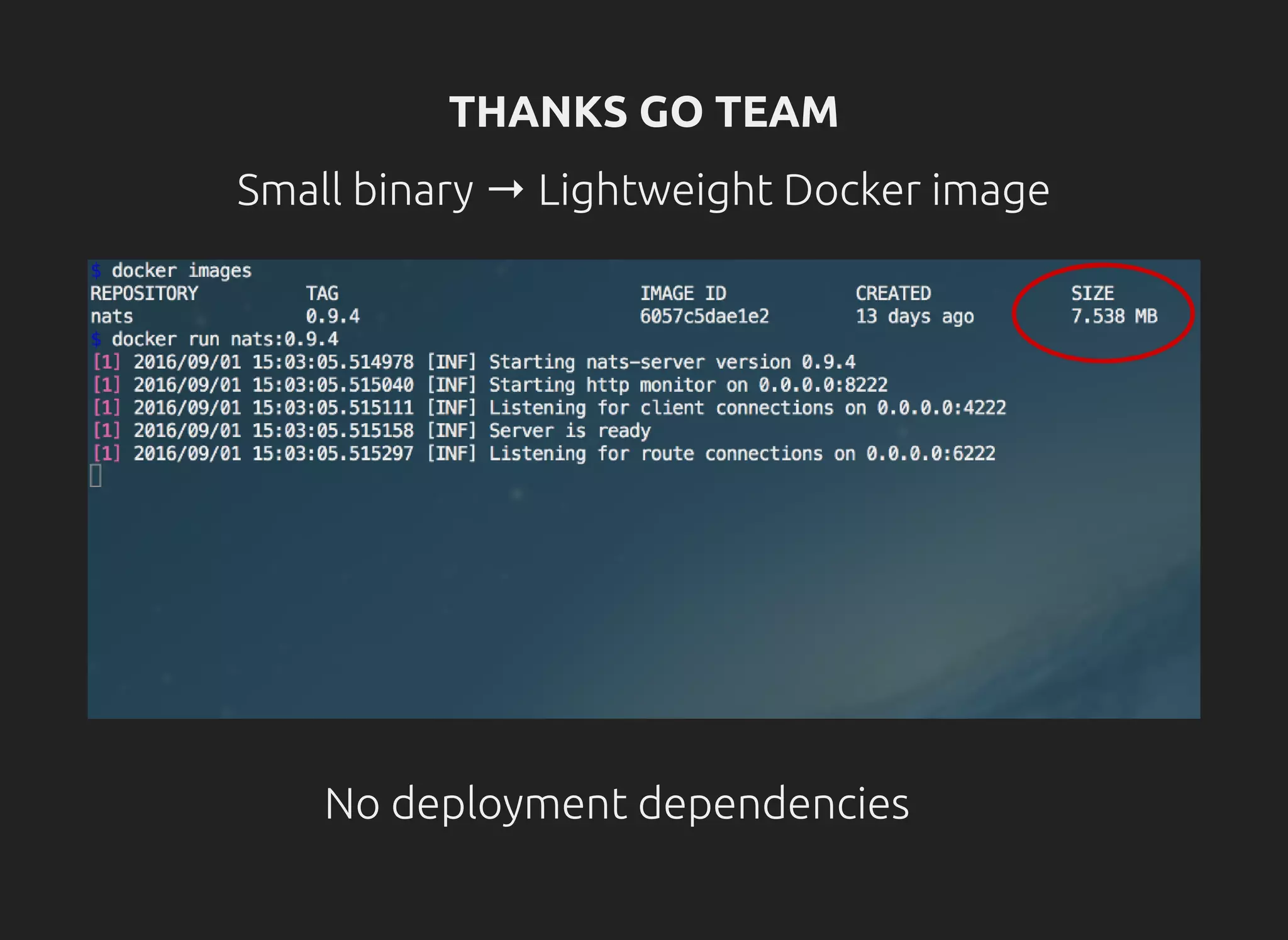
THANKS GO TEAM
Small binary → Lightweight Docker image
No deployment dependencies ✌
Acts as an always available dial-tone
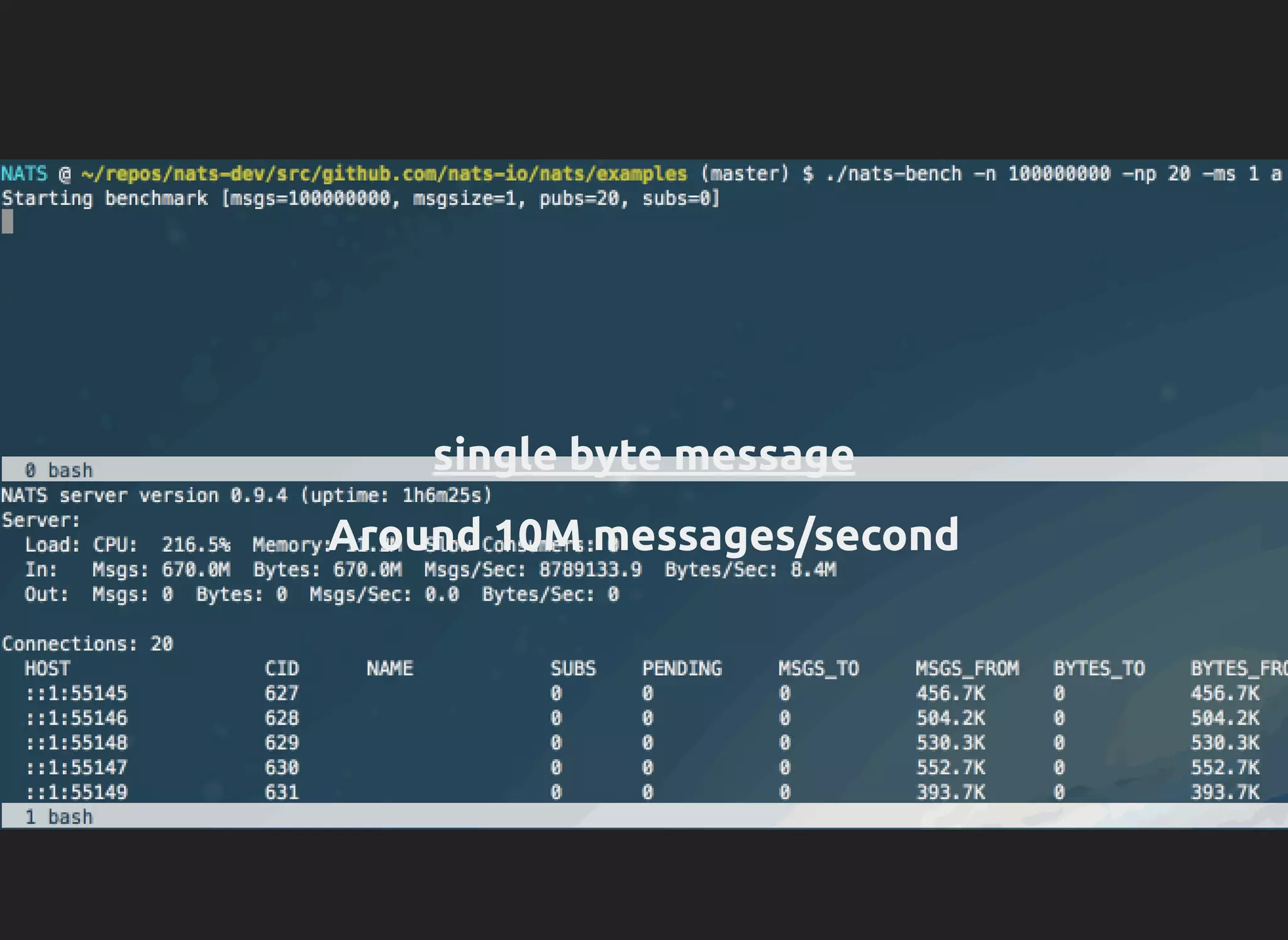
Performance
single byte message
Around 10M messages/second
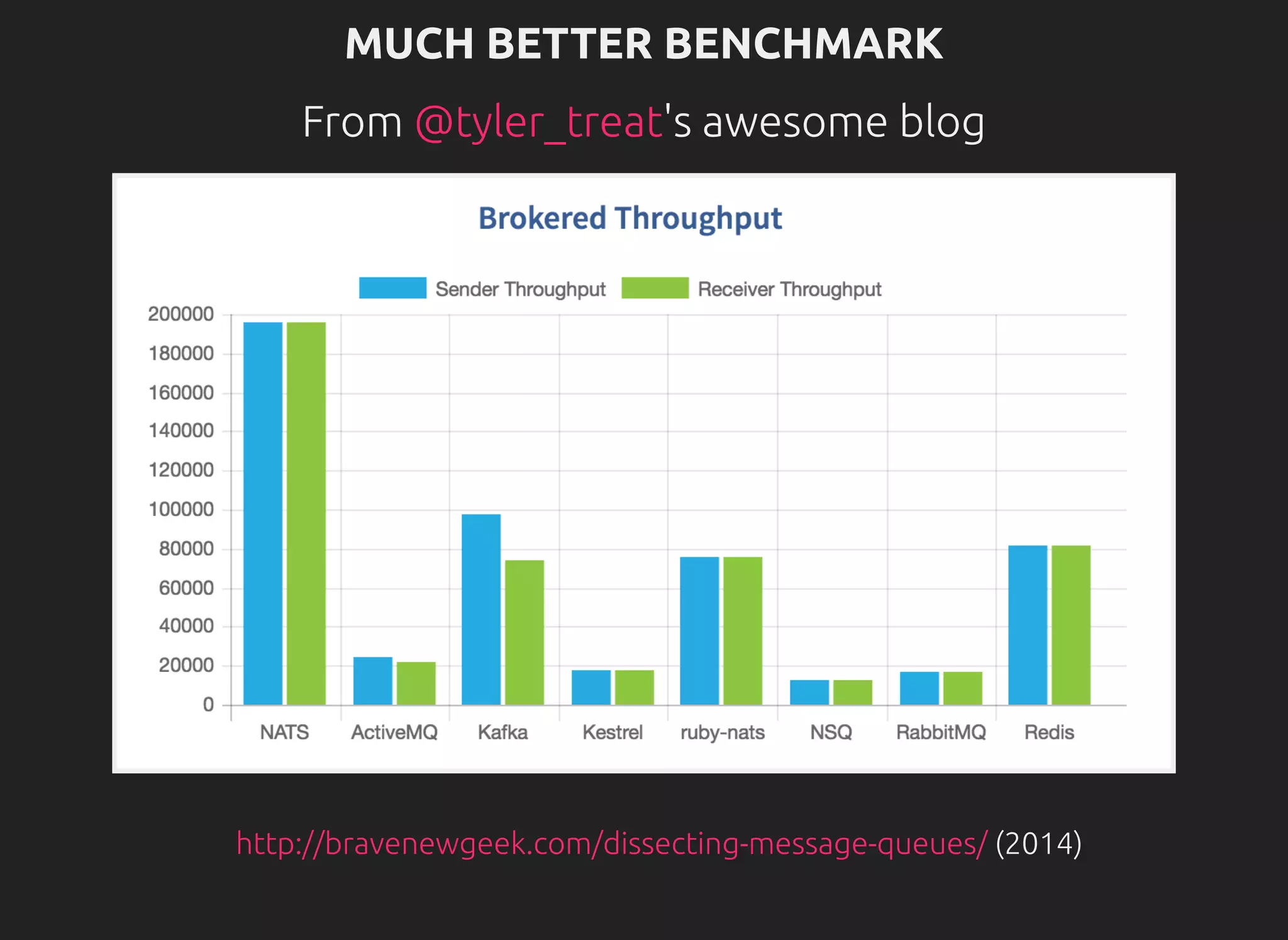
MUCH BETTER BENCHMARK
From 's awesome blog@tyler_treat
(2014)http://bravenewgeek.com/dissecting-message-queues/
NATS = Performance + Simplicity
Design from NATS
NATS
Design constrained to keep it as operationally simple and
reliable as possible while still being both performant and
scalable.
Simplicity Matters!
Simplicity buys you opportunity.
ー Rich Hickey, Cognitect
Link: https://www.youtube.com/watch?v=rI8tNMsozo0
LESS IS BETTER
Concise feature set (pure pub/sub)
No built-in persistence of messages
No exactly-once-delivery promises either
Those concerns are simpli ed away from NATS
THOUGHT EXERCISE
What could be the fastest,
simplest and most reliable
way of writing and reading
to a socket to communicate
with N nodes?
DESIGN
TCP/IP based
Plain text protocol
Pure pub/sub
re and forget
at most once
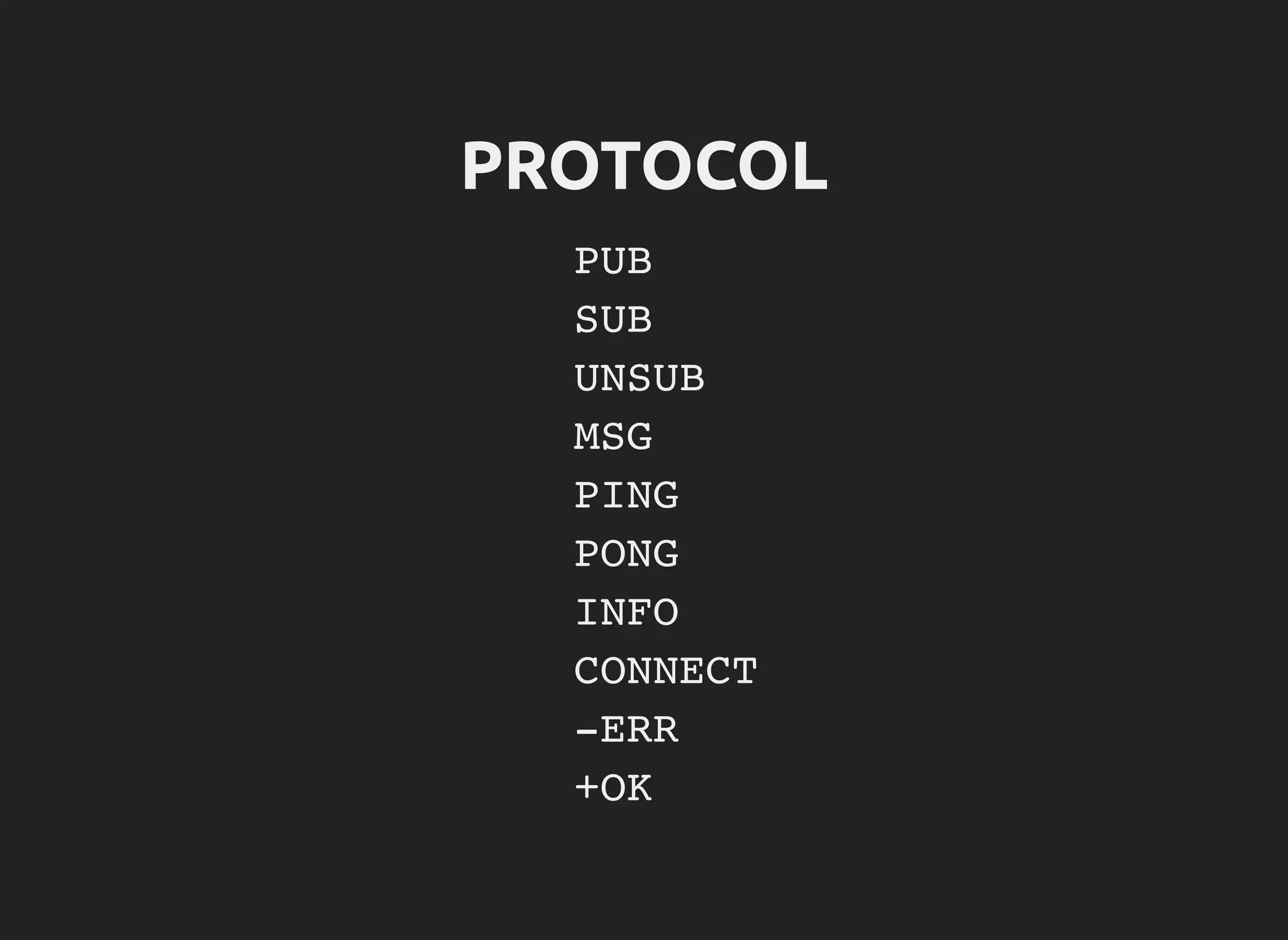
PROTOCOL
PUB
SUB
UNSUB
MSG
PING
PONG
INFO
CONNECT
-ERR
+OK
EXAMPLE
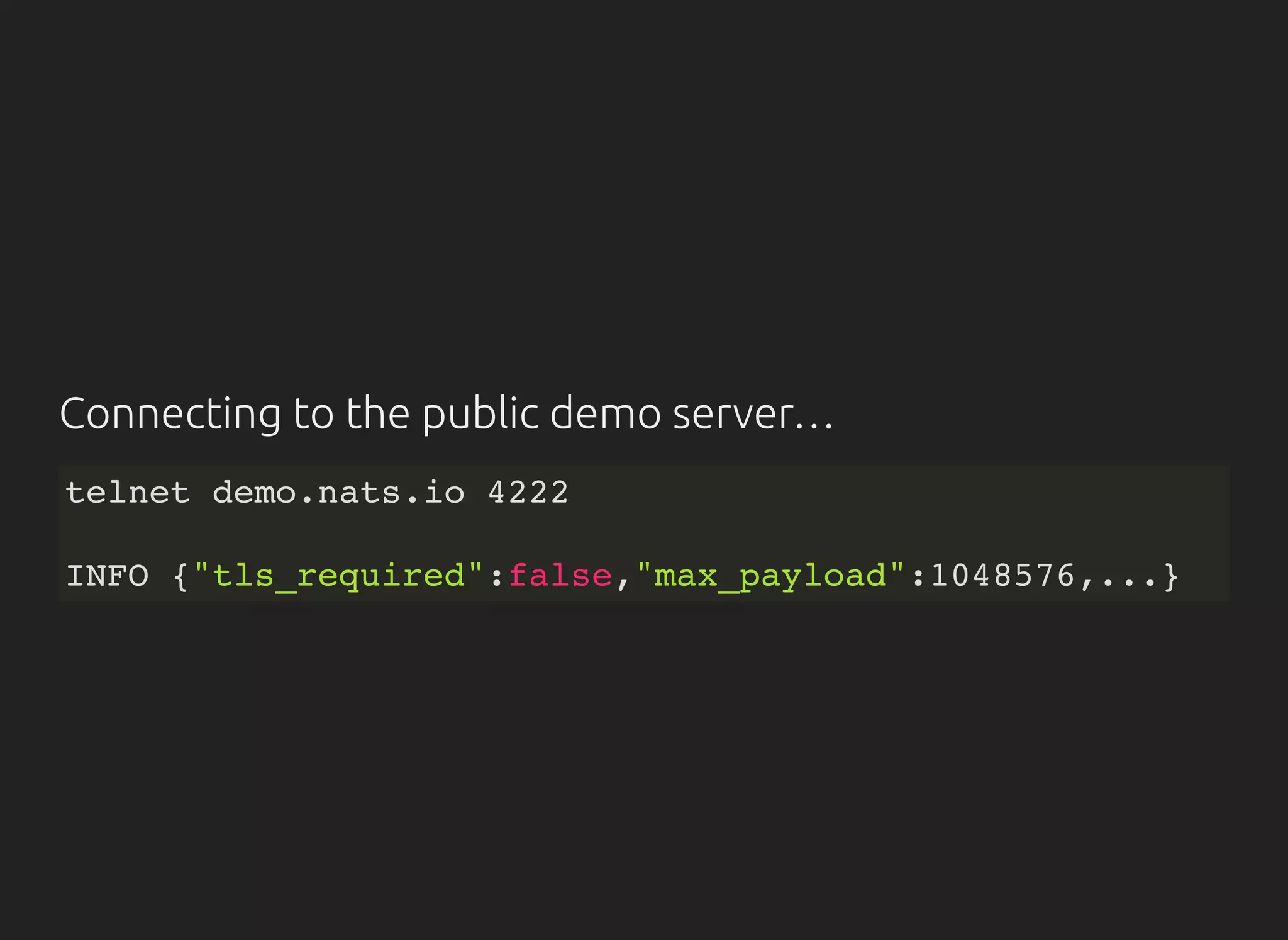
Connecting to the public demo server…
telnet demo.nats.io 4222
INFO {"tls_required":false,"max_payload":1048576,...}
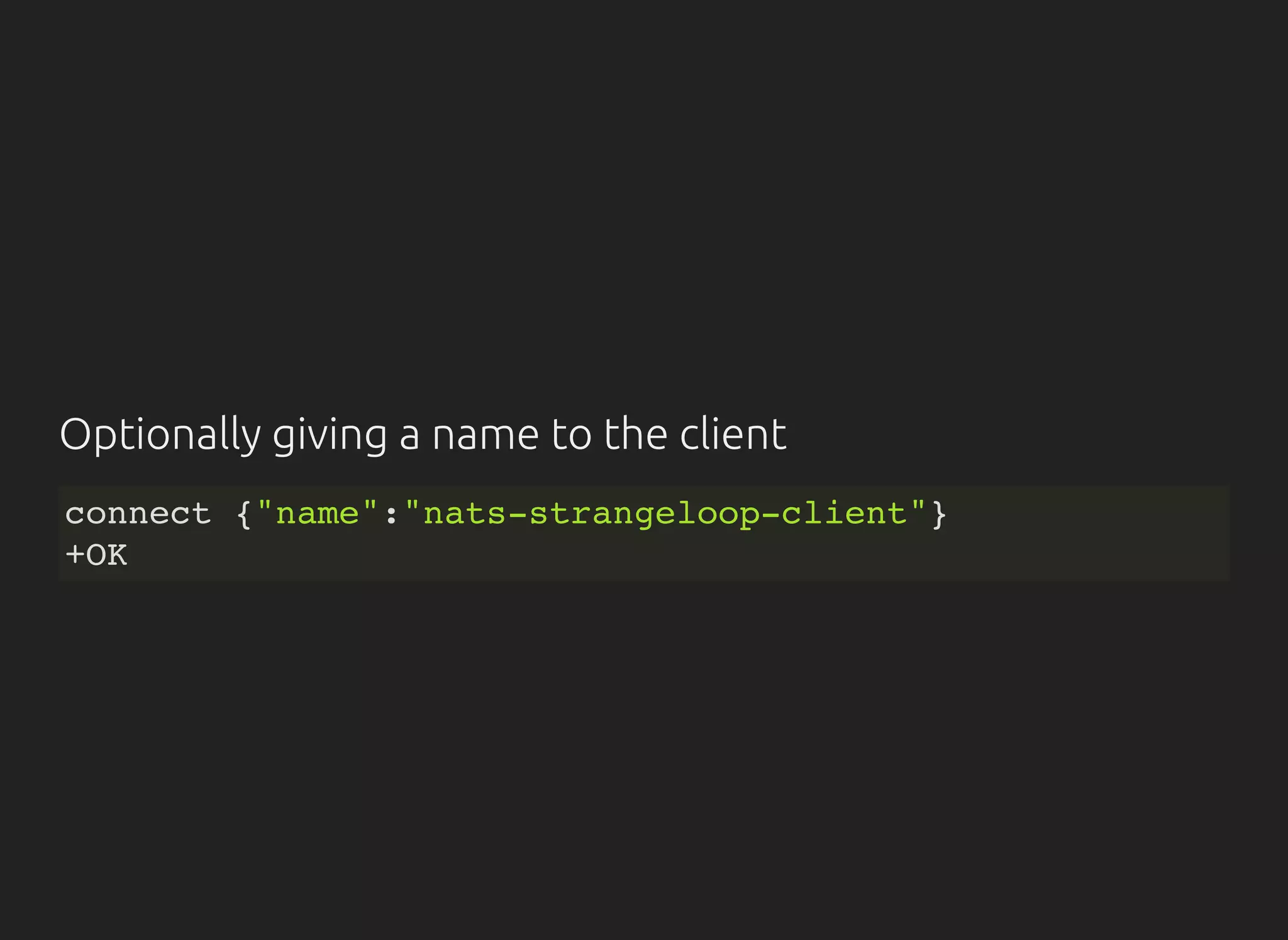
Optionally giving a name to the client
connect {"name":"nats-strangeloop-client"}
+OK
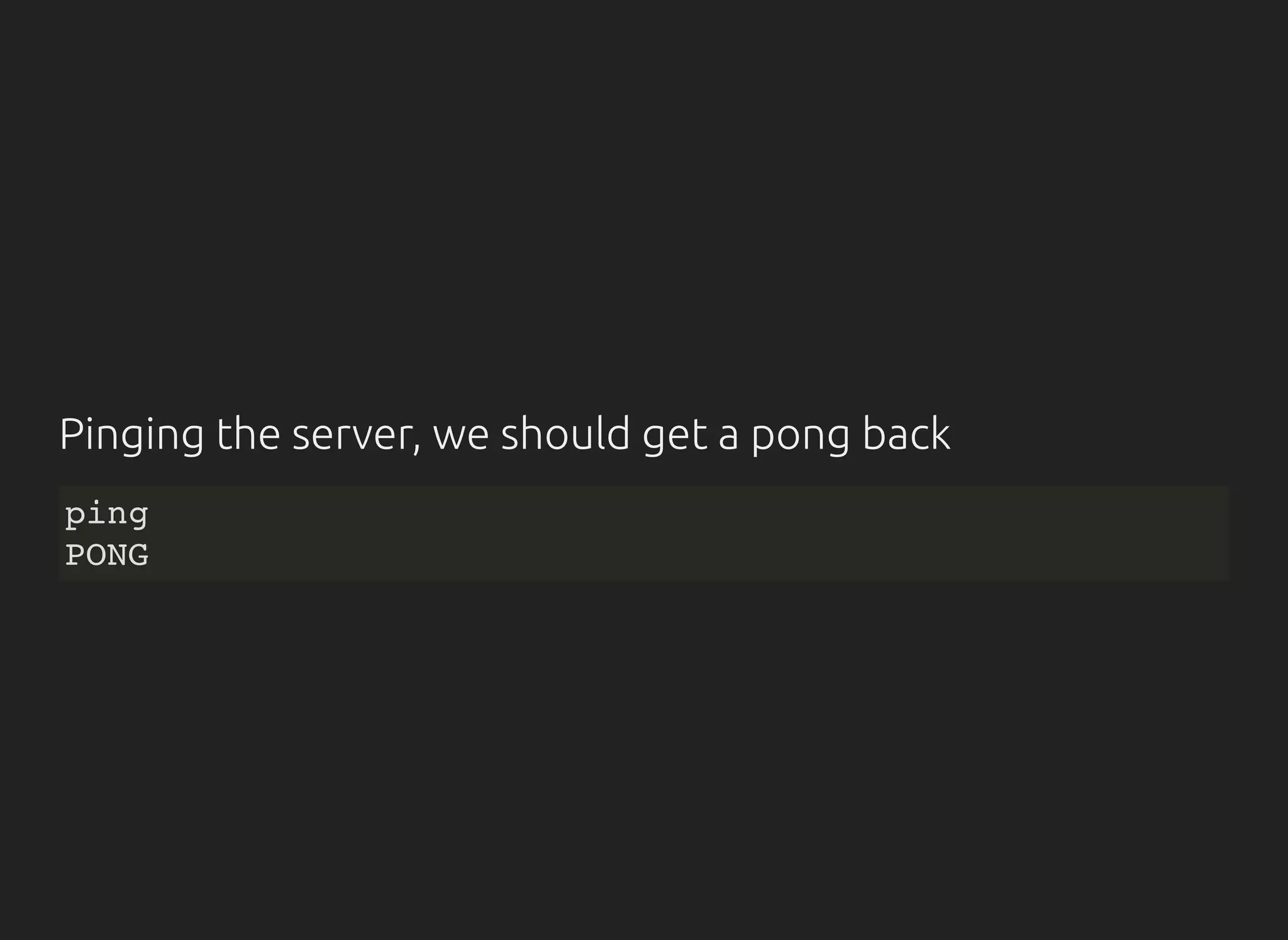
Pinging the server, we should get a pong back
ping
PONG
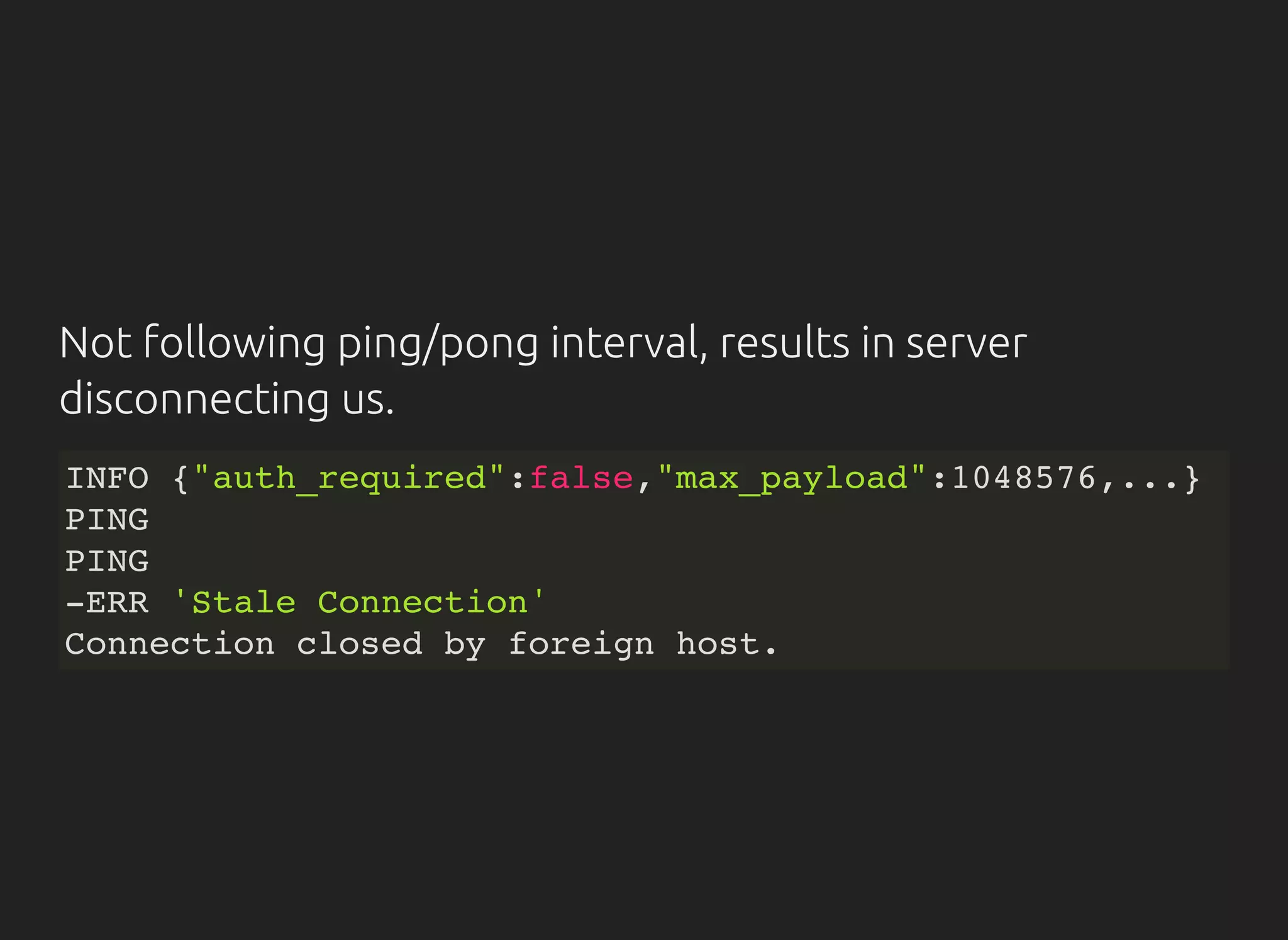
Not following ping/pong interval, results in server
disconnecting us.
INFO {"auth_required":false,"max_payload":1048576,...}
PING
PING
-ERR 'Stale Connection'
Connection closed by foreign host.
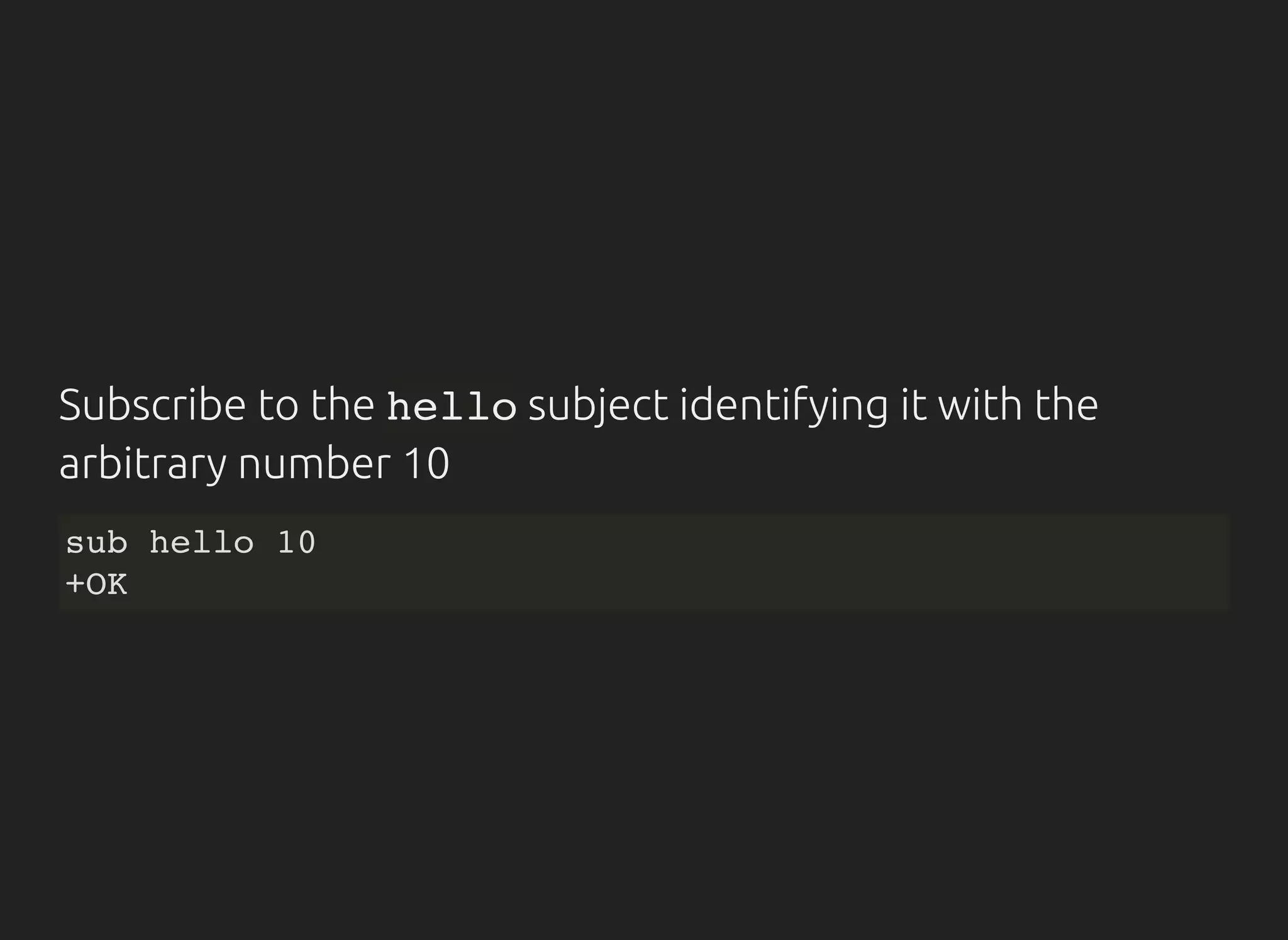
Subscribe to the hellosubject identifying it with the
arbitrary number 10
sub hello 10
+OK
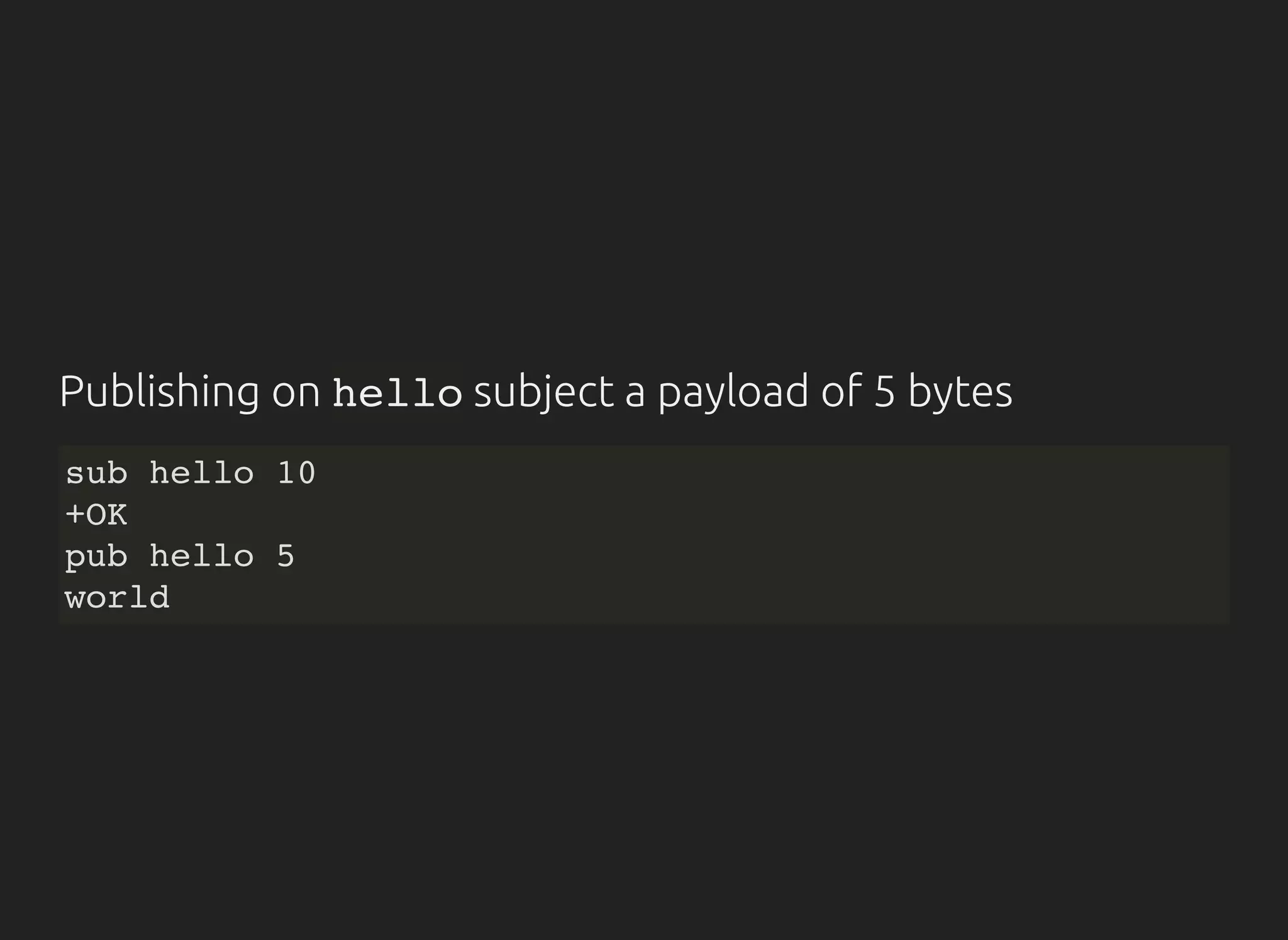
Publishing on hellosubject a payload of 5 bytes
sub hello 10
+OK
pub hello 5
world
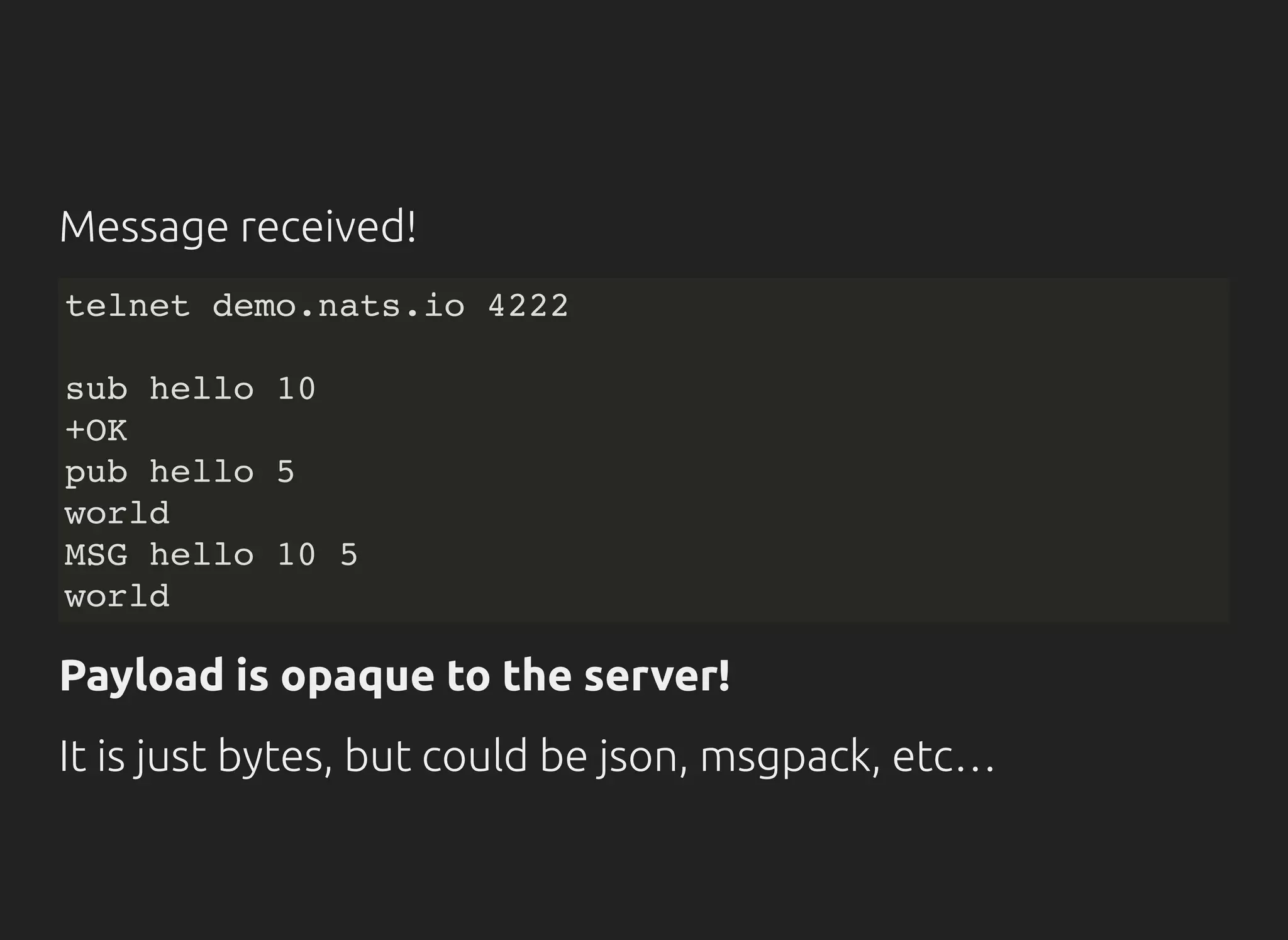
Message received!
telnet demo.nats.io 4222
sub hello 10
+OK
pub hello 5
world
MSG hello 10 5
world
Payload is opaque to the server!
It is just bytes, but could be json, msgpack, etc…
REQUEST/RESPONSE
is also pure pub/sub
PROBLEM
How can we send a request and expect a response back
with pure pub/sub?
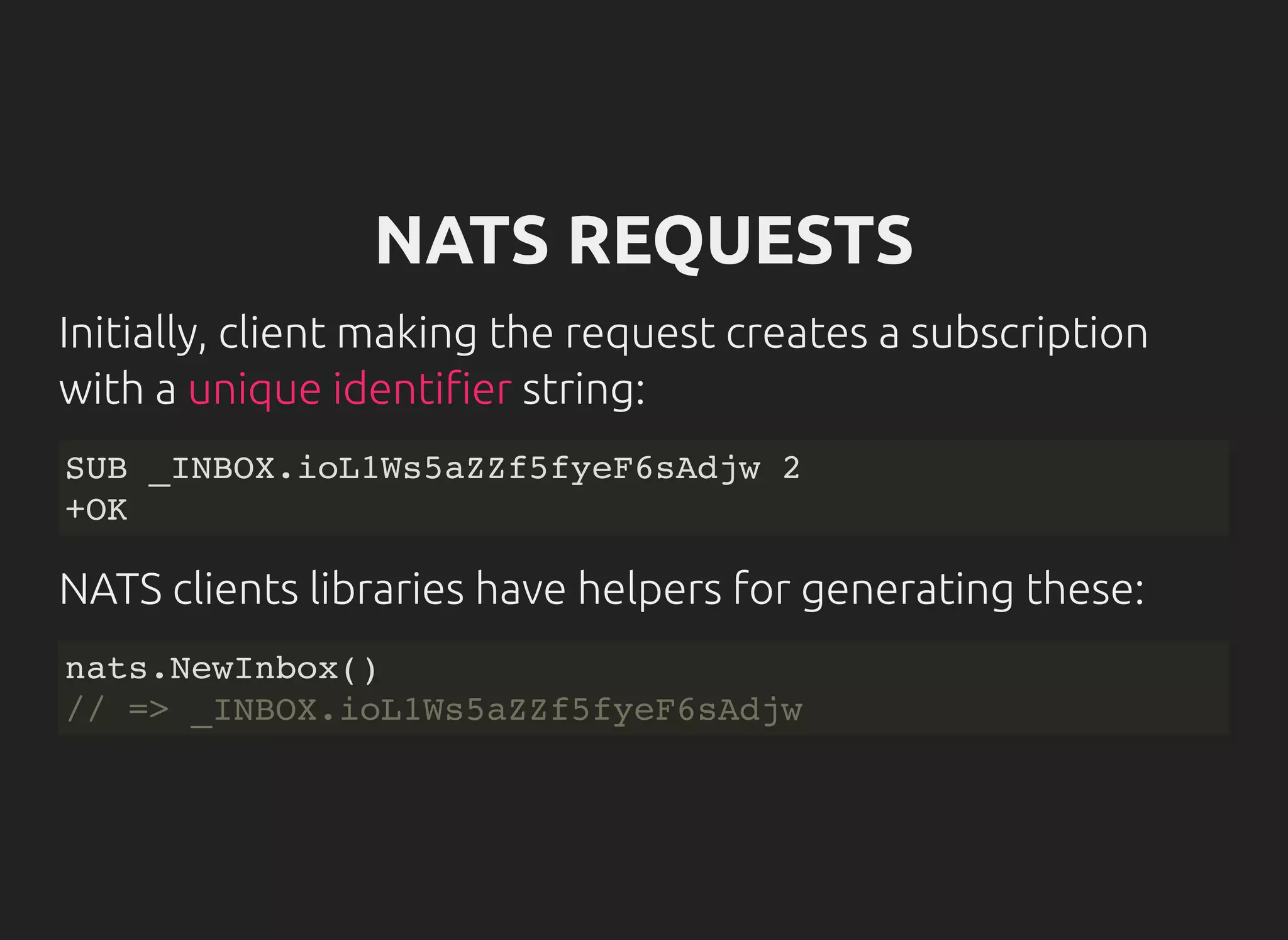
NATS REQUESTS
Initially, client making the request creates a subscription
with a string:unique identi er
SUB _INBOX.ioL1Ws5aZZf5fyeF6sAdjw 2
+OK
NATS clients libraries have helpers for generating these:
nats.NewInbox()
// => _INBOX.ioL1Ws5aZZf5fyeF6sAdjw
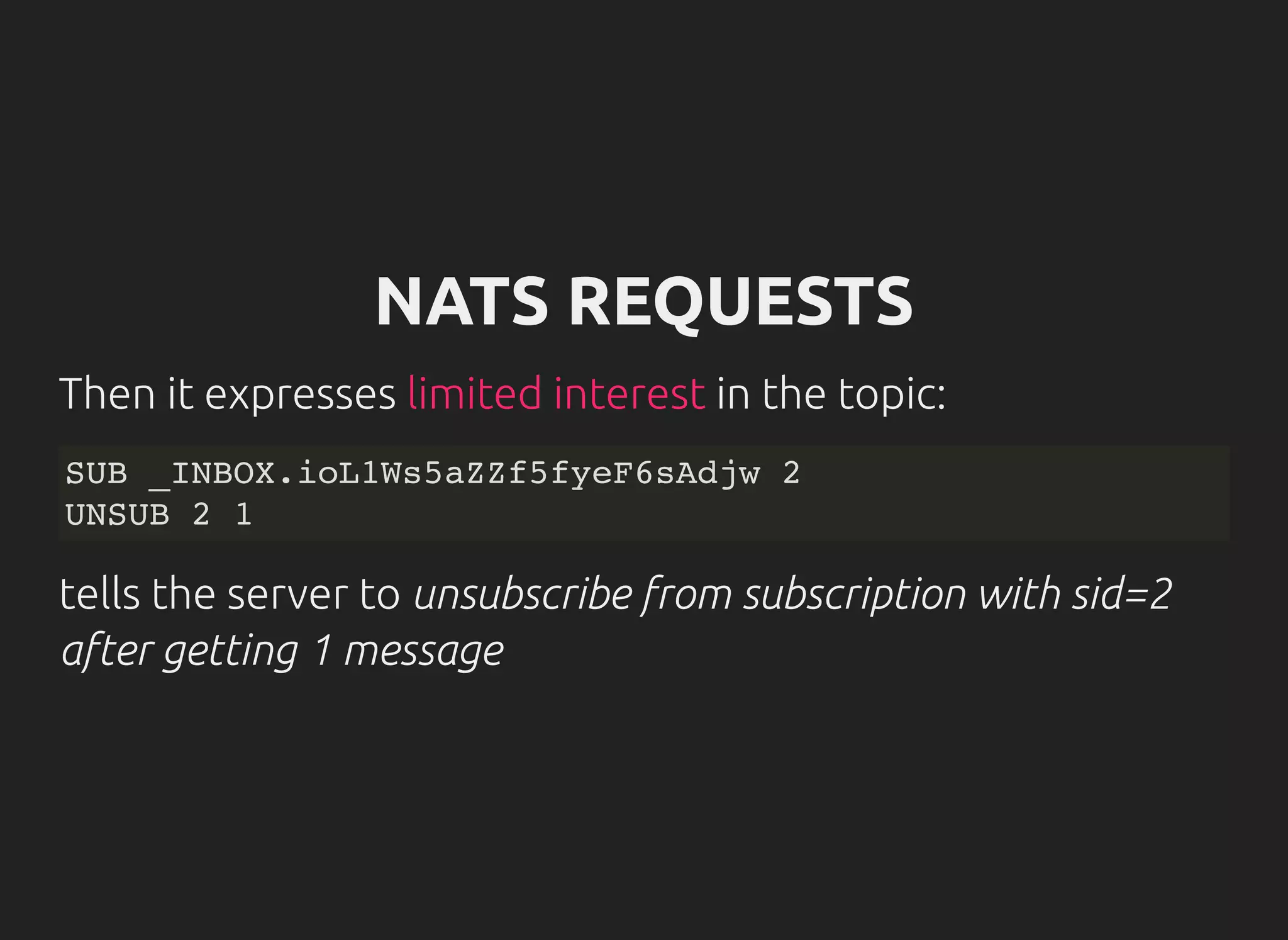
NATS REQUESTS
Then it expresses in the topic:limited interest
SUB _INBOX.ioL1Ws5aZZf5fyeF6sAdjw 2
UNSUB 2 1
tells the server to unsubscribe from subscription with sid=2
after getting 1 message
NATS REQUESTS
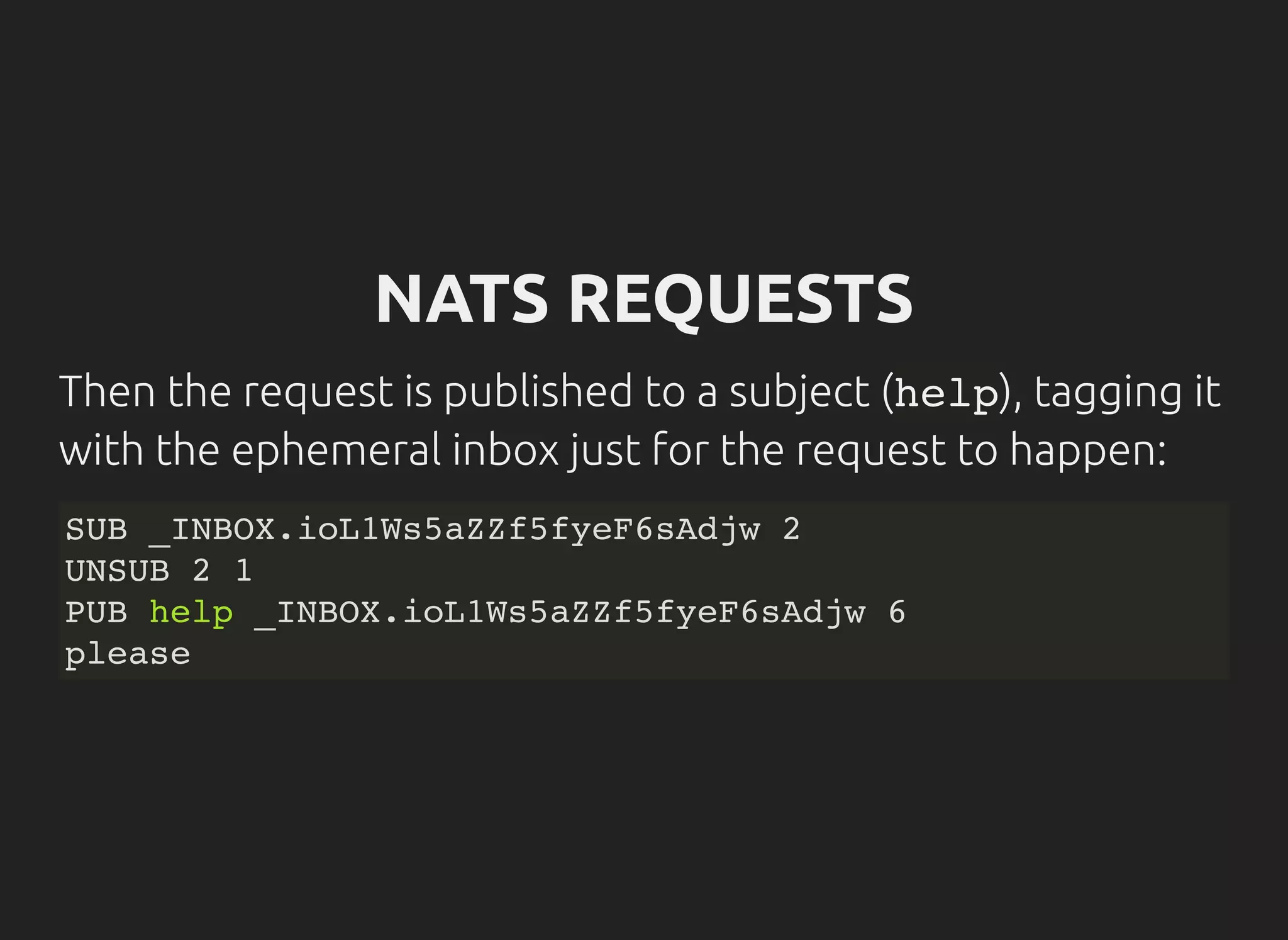
Then the request is published to a subject (help), tagging it
with the ephemeral inbox just for the request to happen:
SUB _INBOX.ioL1Ws5aZZf5fyeF6sAdjw 2
UNSUB 2 1
PUB help _INBOX.ioL1Ws5aZZf5fyeF6sAdjw 6
please
NATS REQUESTS
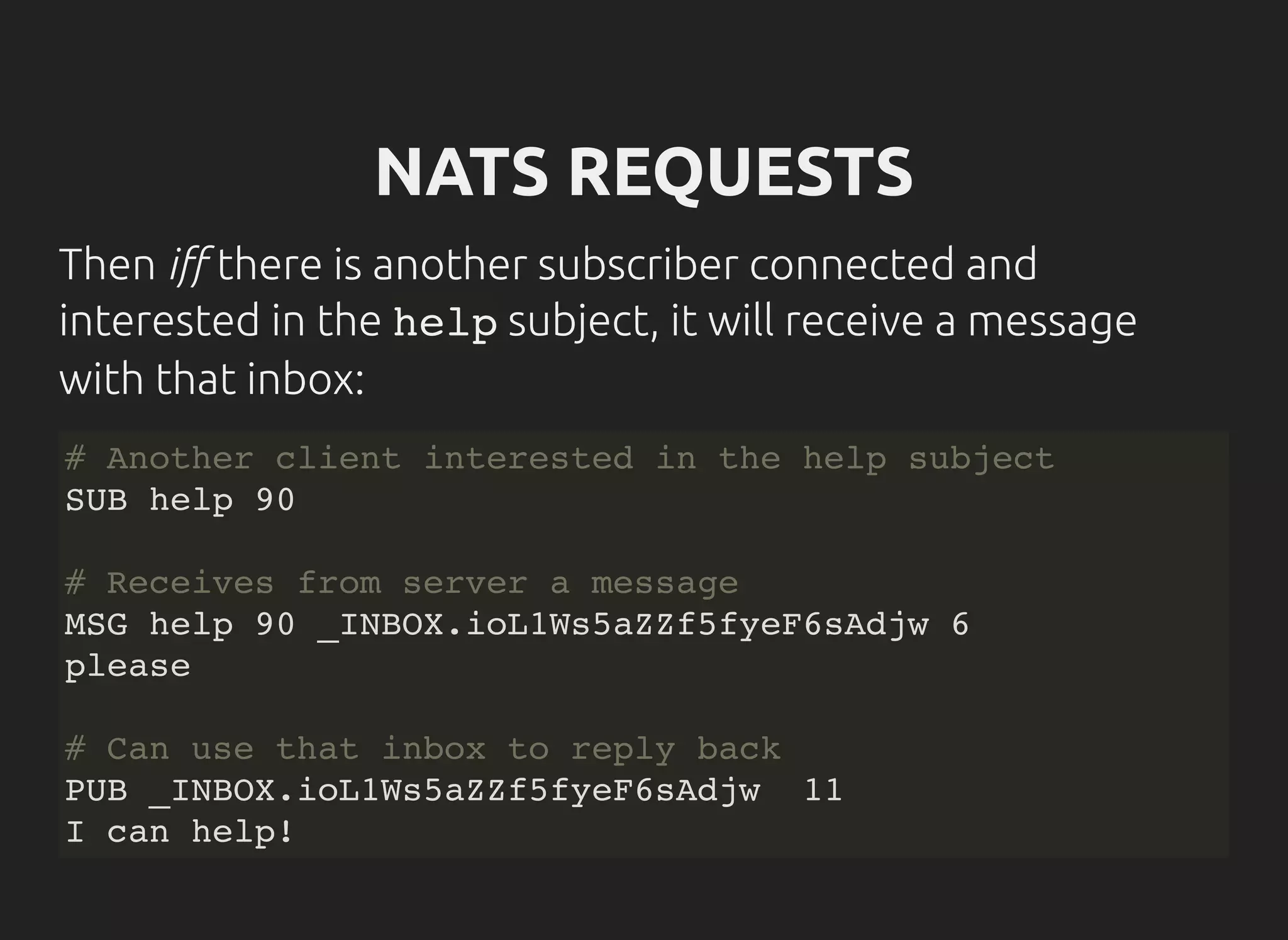
Then i there is another subscriber connected and
interested in the helpsubject, it will receive a message
with that inbox:
# Another client interested in the help subject
SUB help 90
# Receives from server a message
MSG help 90 _INBOX.ioL1Ws5aZZf5fyeF6sAdjw 6
please
# Can use that inbox to reply back
PUB _INBOX.ioL1Ws5aZZf5fyeF6sAdjw 11
I can help!
NATS REQUESTS
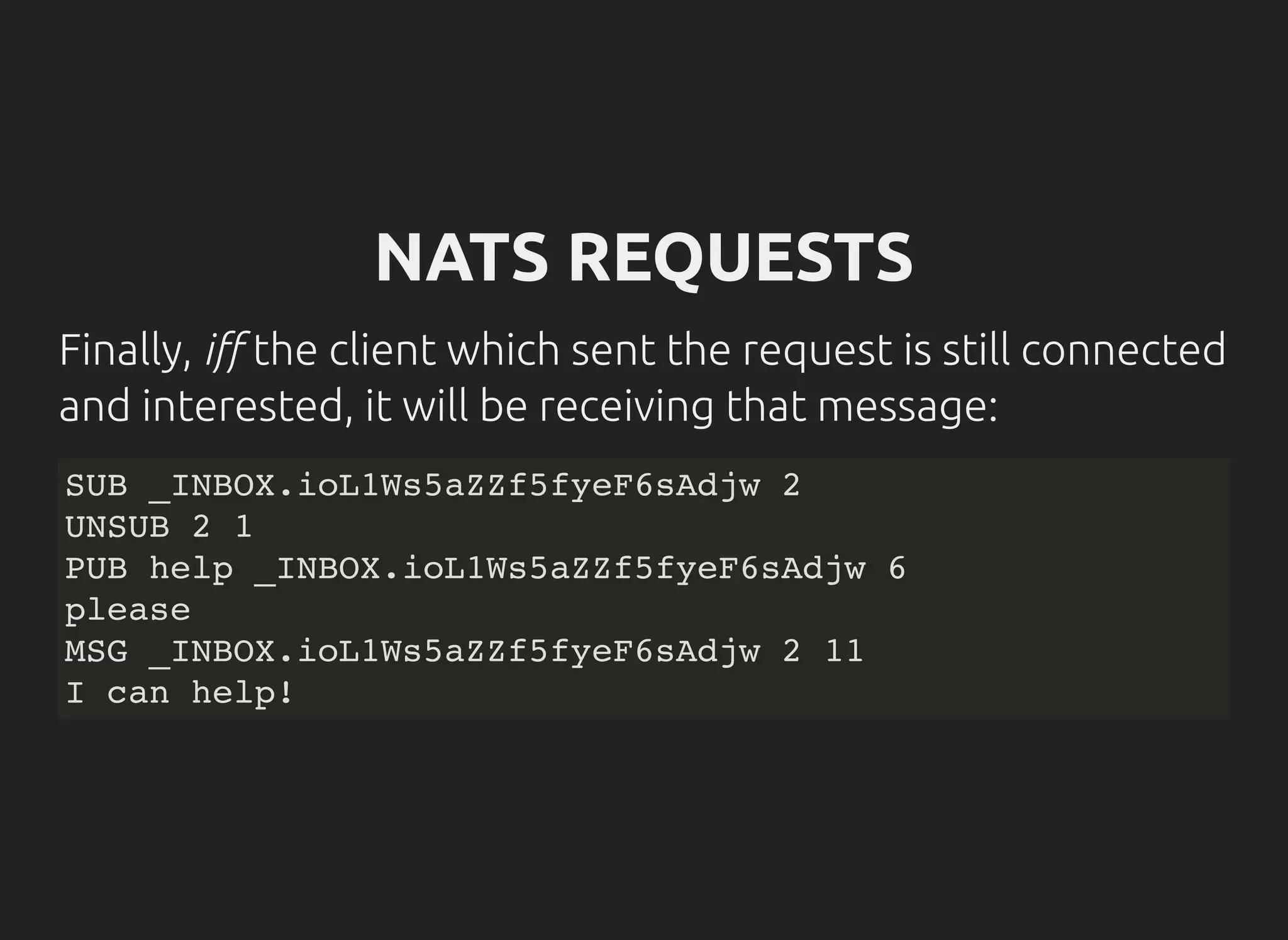
Finally, i the client which sent the request is still connected
and interested, it will be receiving that message:
SUB _INBOX.ioL1Ws5aZZf5fyeF6sAdjw 2
UNSUB 2 1
PUB help _INBOX.ioL1Ws5aZZf5fyeF6sAdjw 6
please
MSG _INBOX.ioL1Ws5aZZf5fyeF6sAdjw 2 11
I can help!
Simple Protocol == Simple Clients
Given the protocol is simple, NATS clients libraries
tend to have a very small footprint as well.
CLIENTS
RUBY
require 'nats/client'
NATS.start do |nc|
nc.subscribe("hello") do |msg|
puts "[Received] #{msg}"
end
nc.publish("hello", "world")
end
GO
nc, err := nats.Connect()
// ...
nc.Subscribe("hello", func(m *nats.Msg){
fmt.Printf("[Received] %s", m.Data)
})
nc.Publish("hello", []byte("world"))
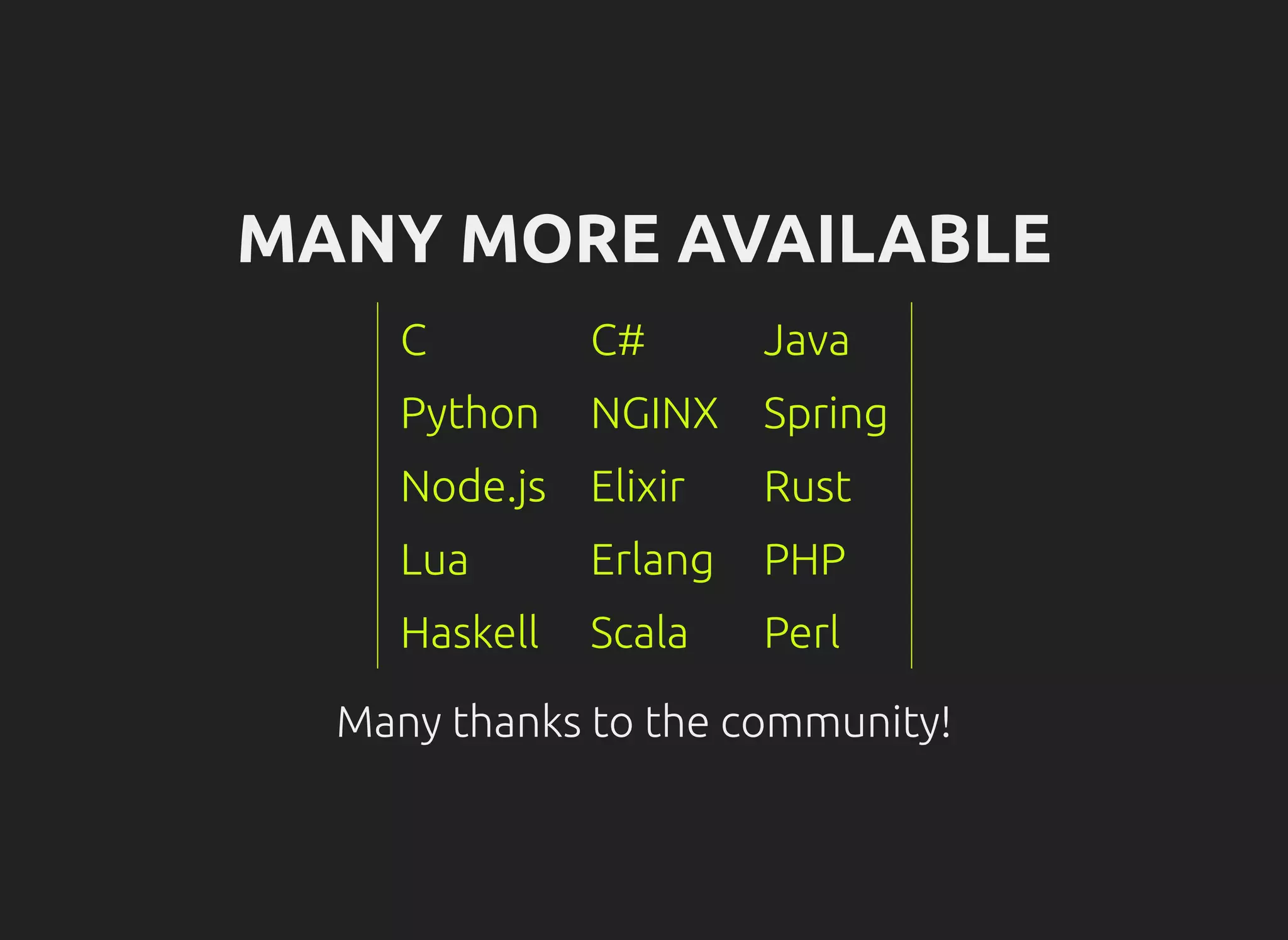
MANY MORE AVAILABLE
C C# Java
Python NGINX Spring
Node.js Elixir Rust
Lua Erlang PHP
Haskell Scala Perl
Many thanks to the community!
ASYNCHRONOUS IO
Note: Most clients have asynchronous behavior
nc, err := nats.Connect()
// ...
nc.Subscribe("hello", func(m *nats.Msg){
fmt.Printf("[Received] %s", m.Data)
})
for i := 0; i < 1000; i ++ {
nc.Publish("hello", []byte("world"))
}
// No guarantees of having sent the bytes yet!
// They may still just be in the flushing queue.
ASYNCHRONOUS IO
In order to guarantee that the published messages have
been processed by the server, we can do an extra
ping/pong to con rm they were consumed:
nc.Subscribe("hello", func(m *nats.Msg){
fmt.Printf("[Received] %s", m.Data)
})
for i := 0; i < 1000; i ++ {
nc.Publish("hello", []byte("world"))
}
// Do a PING/PONG roundtrip with the server.
nc.Flush()
SUB hello 1rnPUB hello 5rnworldrn..PINGrn
Then ush the bu er and wait for PONGfrom server
ASYNCHRONOUS IO
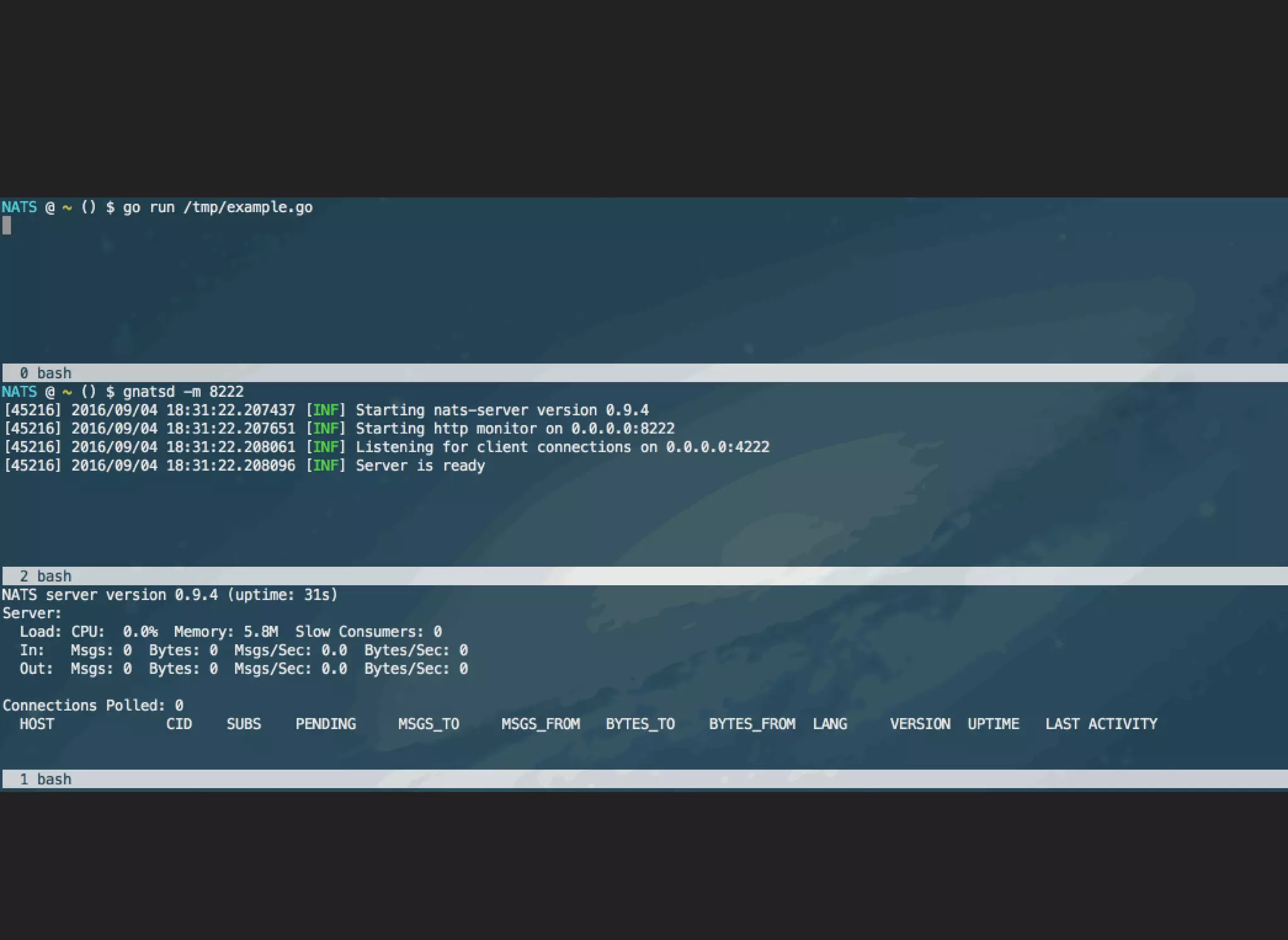
Worst way of measuring NATS performance
nc, _ := nats.Connect(nats.DefaultURL)
msg := []byte("hi")
nc.Subscribe("hello", func(_ *nats.Msg) {})
for i := 0; i < 100000000; i++ {
nc.Publish("hello", msg)
}
 
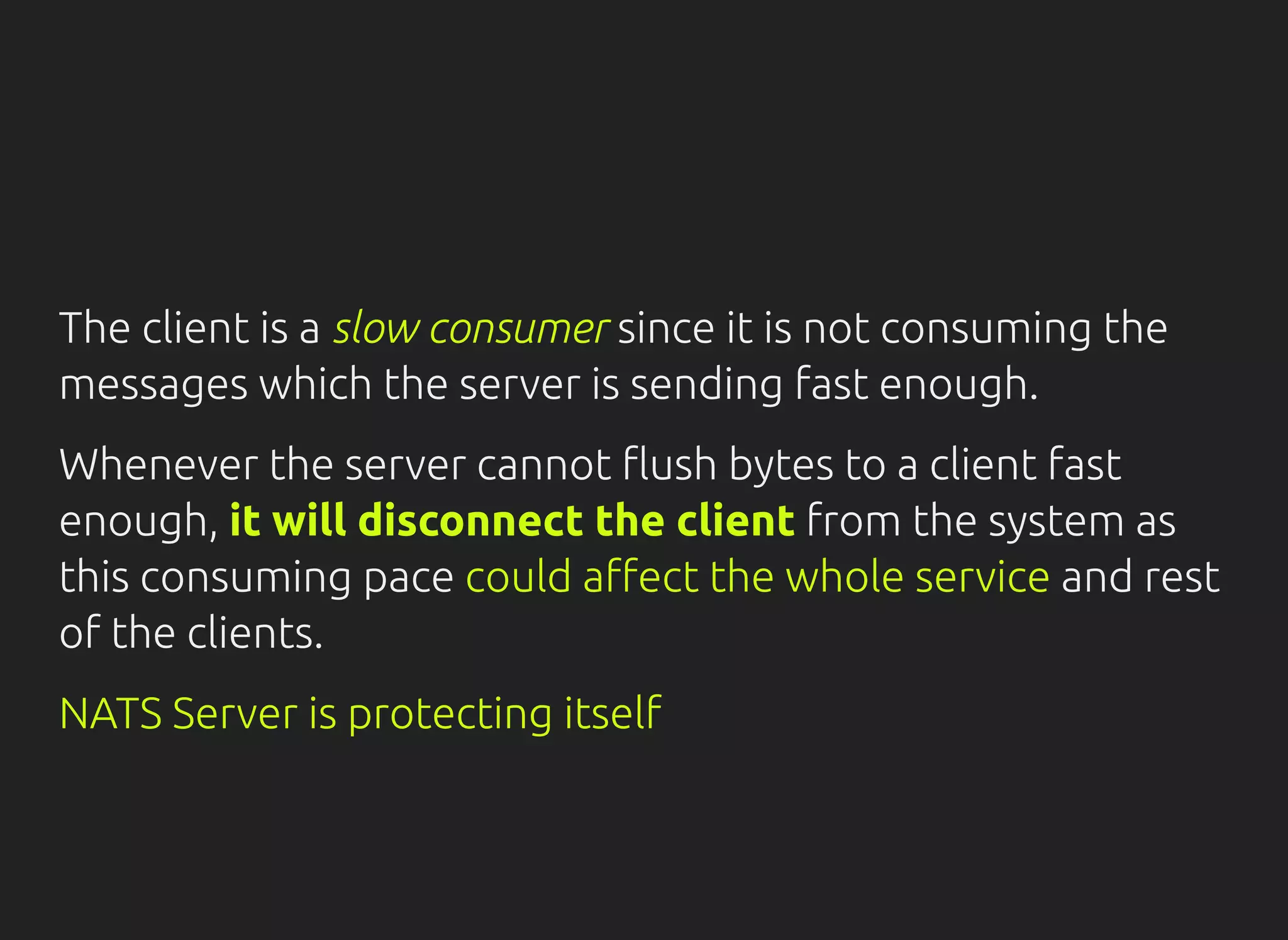
The client is a slow consumer since it is not consuming the
messages which the server is sending fast enough.
Whenever the server cannot ush bytes to a client fast
enough, it will disconnect the client from the system as
this consuming pace could a ect the whole service and rest
of the clients.
NATS Server is protecting itself
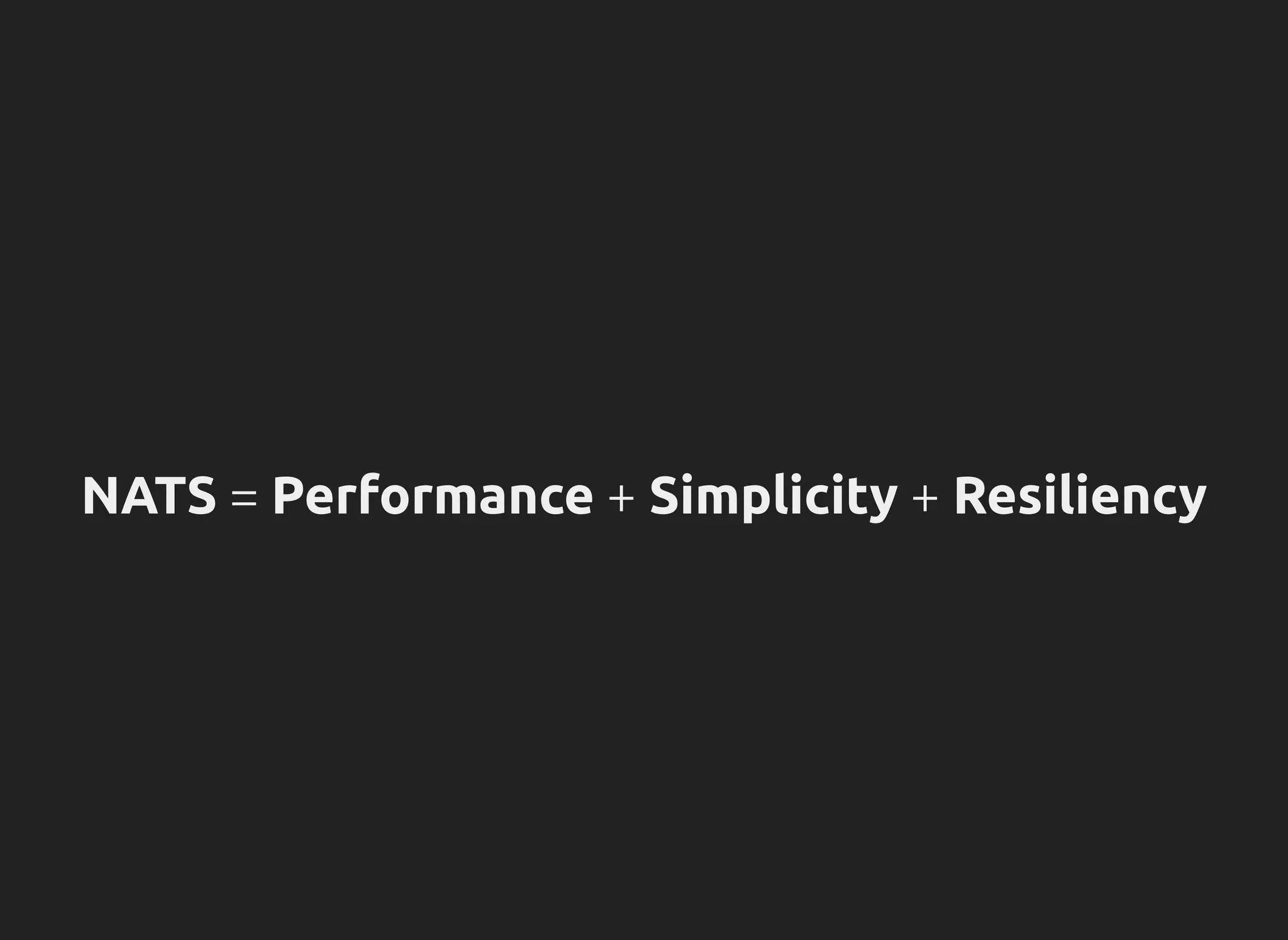
NATS = Performance + Simplicity + Resiliency
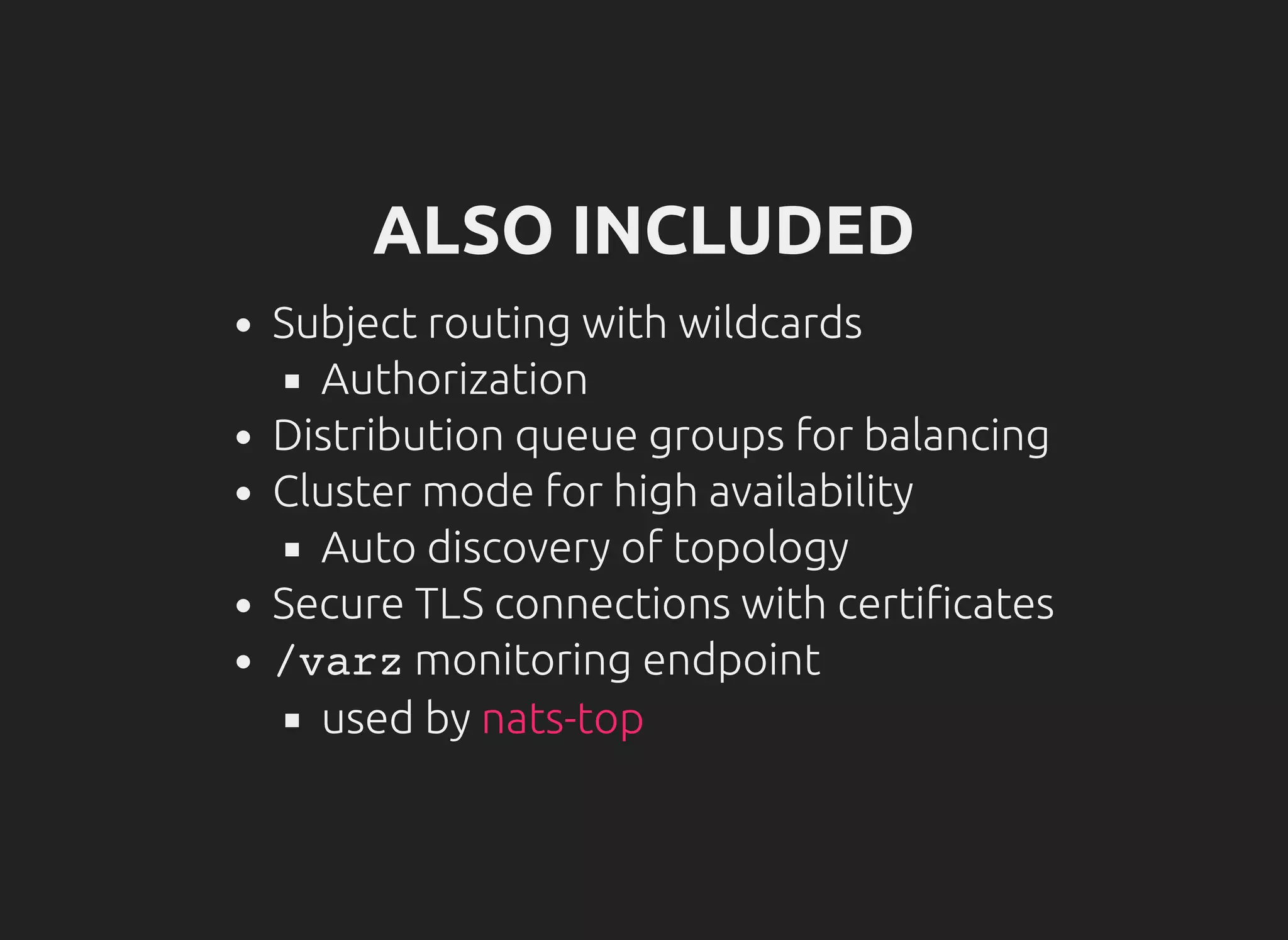
ALSO INCLUDED
Subject routing with wildcards
Authorization
Distribution queue groups for balancing
Cluster mode for high availability
Auto discovery of topology
Secure TLS connections with certi cates
/varzmonitoring endpoint
used by nats-top
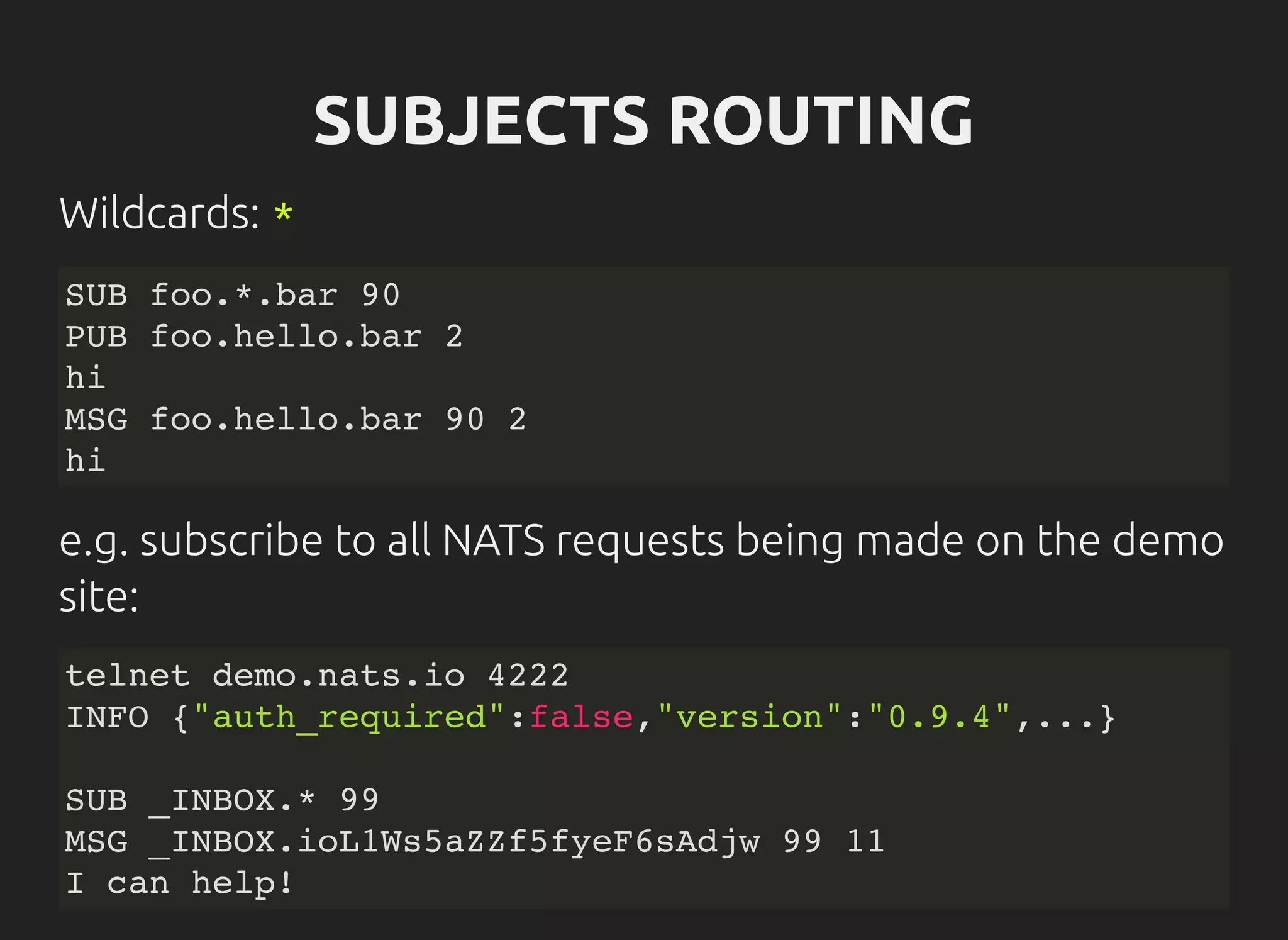
SUBJECTS ROUTING
Wildcards: *
SUB foo.*.bar 90
PUB foo.hello.bar 2
hi
MSG foo.hello.bar 90 2
hi
e.g. subscribe to all NATS requests being made on the demo
site:
telnet demo.nats.io 4222
INFO {"auth_required":false,"version":"0.9.4",...}
SUB _INBOX.* 99
MSG _INBOX.ioL1Ws5aZZf5fyeF6sAdjw 99 11
I can help!
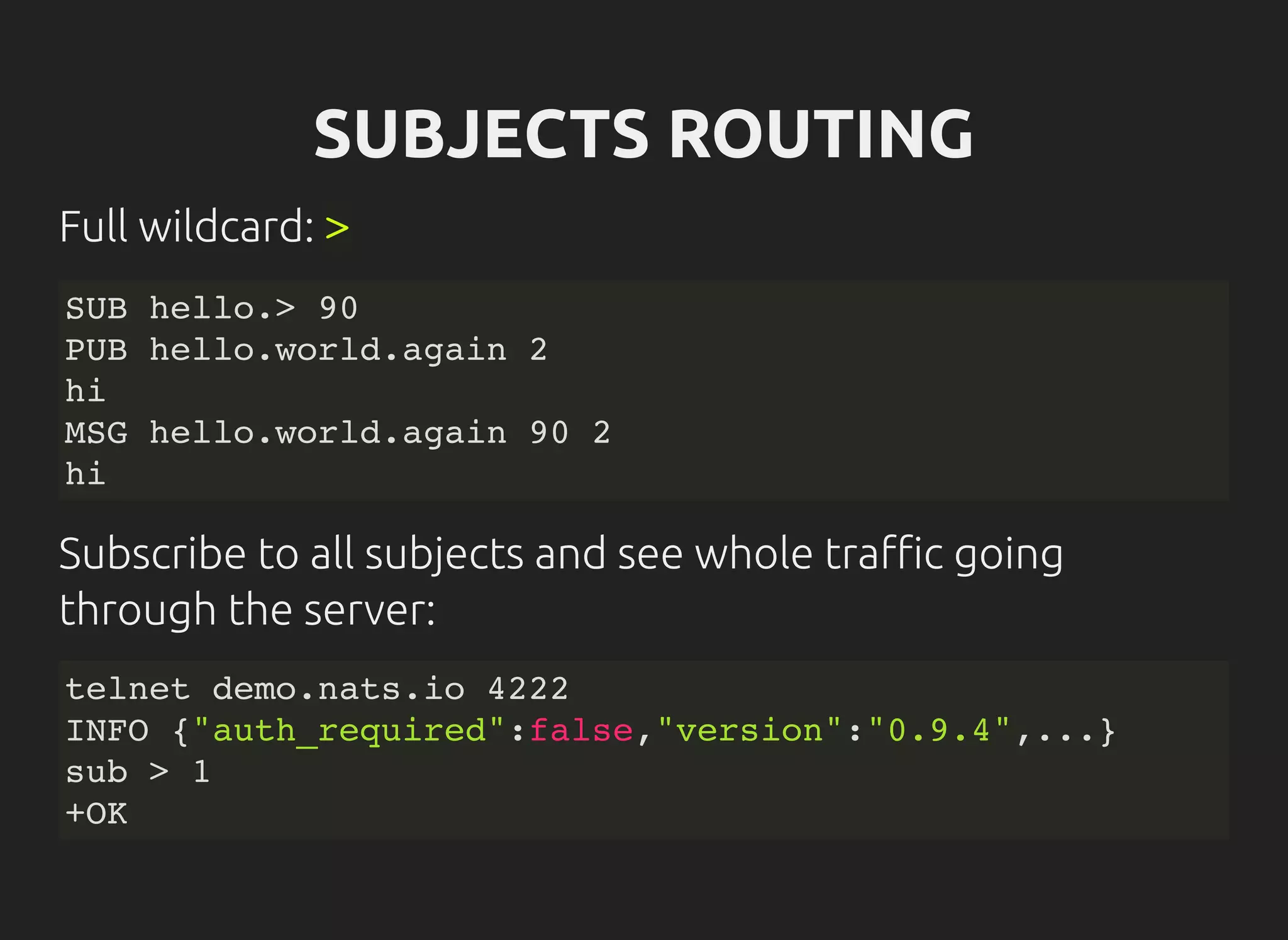
SUBJECTS ROUTING
Full wildcard: >
SUB hello.> 90
PUB hello.world.again 2
hi
MSG hello.world.again 90 2
hi
Subscribe to all subjects and see whole tra c going
through the server:
telnet demo.nats.io 4222
INFO {"auth_required":false,"version":"0.9.4",...}
sub > 1
+OK
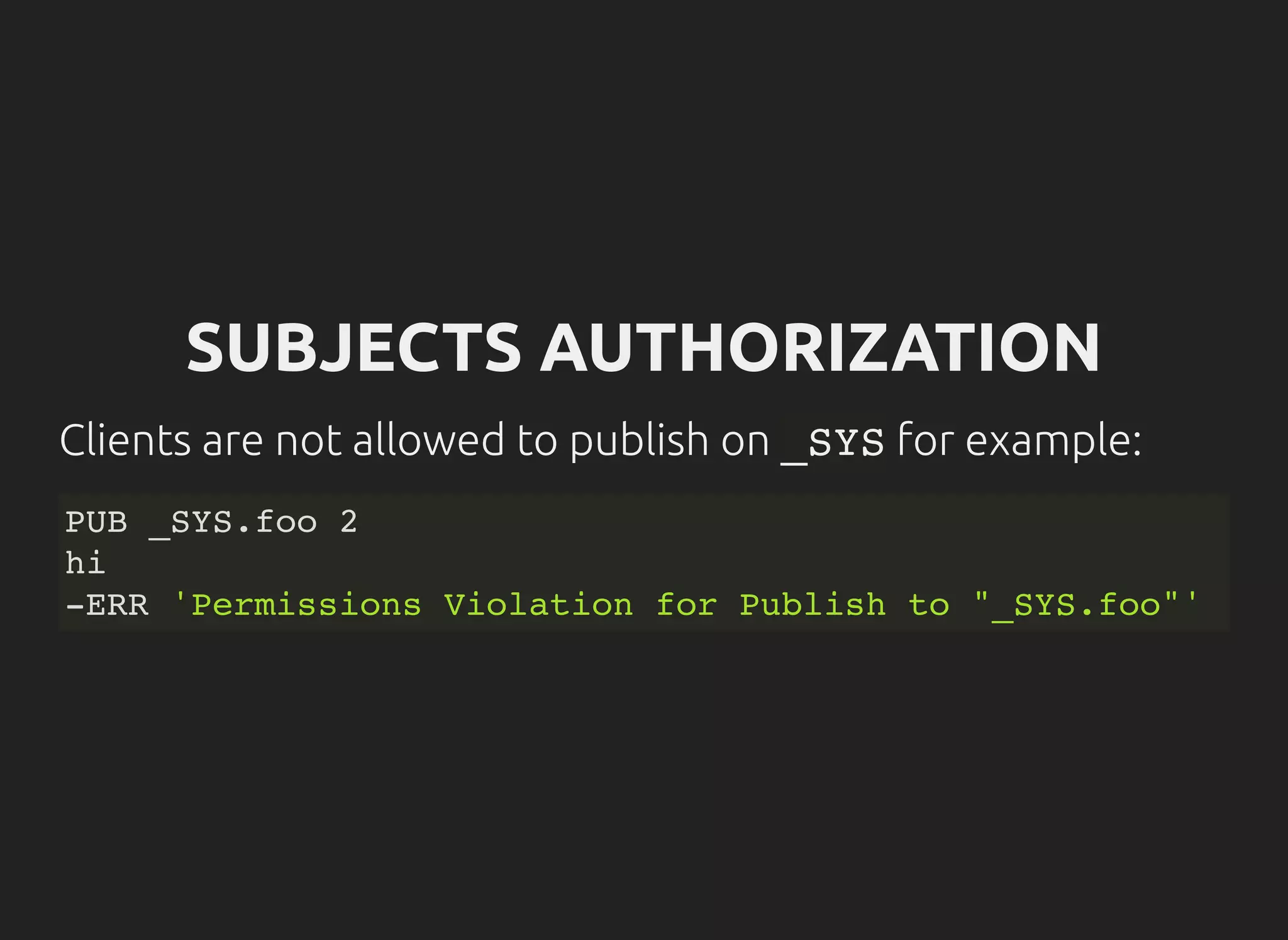
SUBJECTS AUTHORIZATION
Clients are not allowed to publish on _SYSfor example:
PUB _SYS.foo 2
hi
-ERR 'Permissions Violation for Publish to "_SYS.foo"'
SUBJECTS AUTHORIZATION
Can customize disallowing pub/sub on certain subjects via
server con g too:
authorization {
admin = { publish = ">", subscribe = ">" }
requestor = {
publish = ["req.foo", "req.bar"]
subscribe = "_INBOX.*"
}
users = [
{user: alice, password: foo, permissions: $admin}
{user: bob, password: bar, permissions: $requestor}
]
}
Building systems with NATS
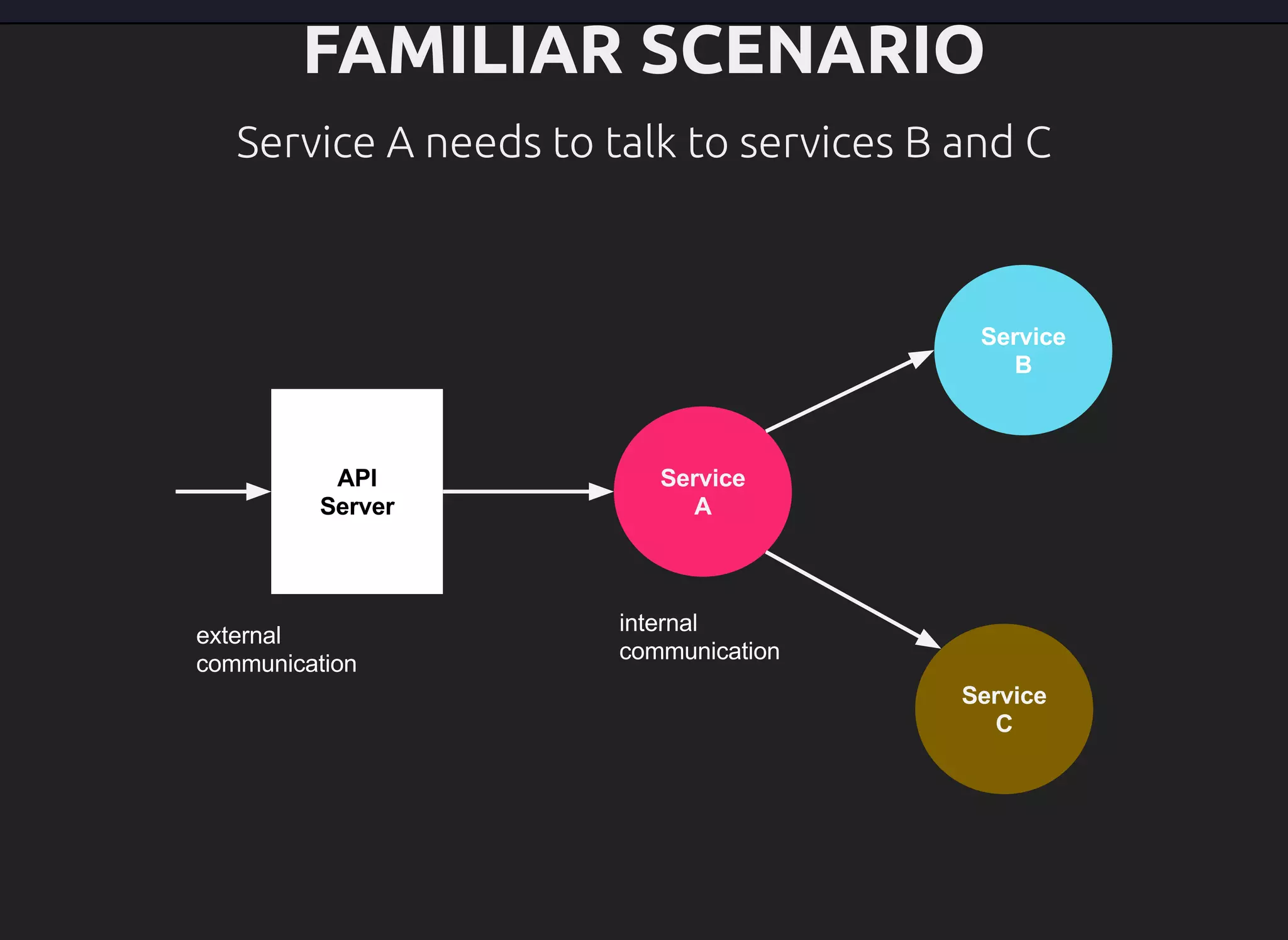
FAMILIAR SCENARIO
Service A needs to talk to services B and C
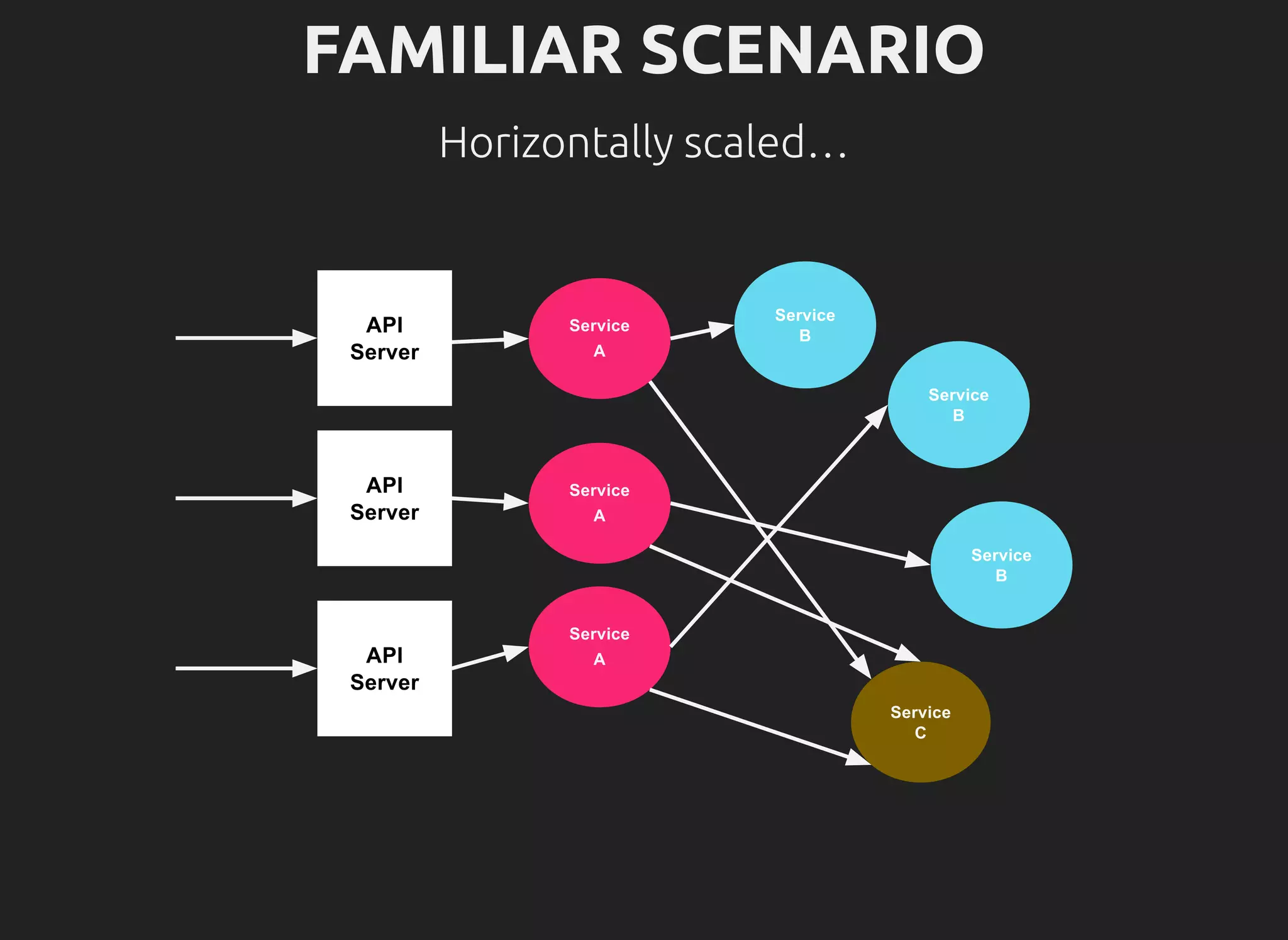
FAMILIAR SCENARIO
Horizontally scaled…
COMMUNICATING WITHIN A
DISTRIBUTED SYSTEM
Just use HTTP everywhere?
Use some form of point to point RPC?
What about service discovery and load balancing?
What if sub ms latency performance is required?
 
WHAT NATS GIVES US
publish/subscribe based low latency mechanism for
communicating with 1 to 1, 1 to N nodes
An established TCP connection to a server
A dial tone
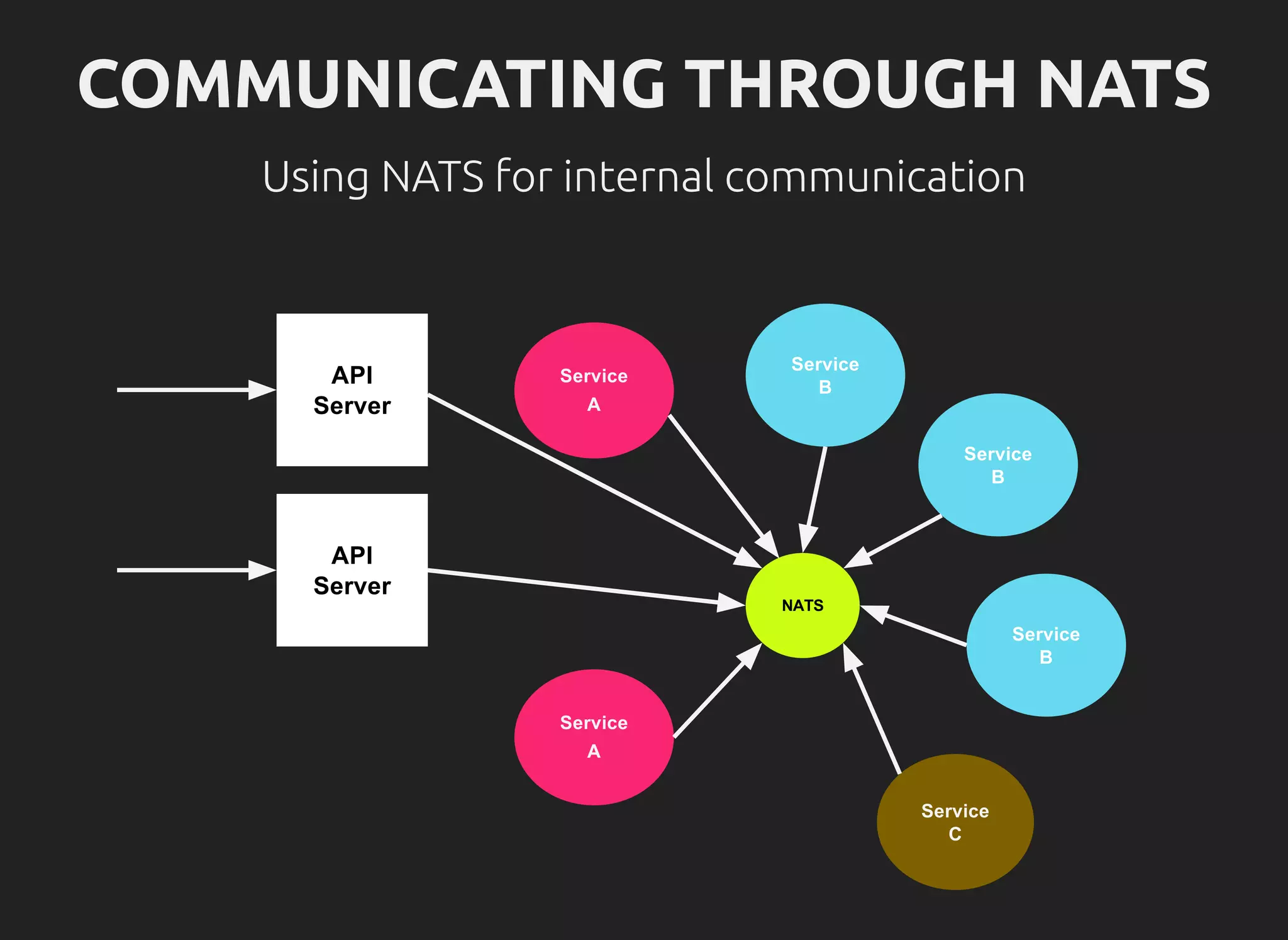
COMMUNICATING THROUGH NATS
Using NATS for internal communication
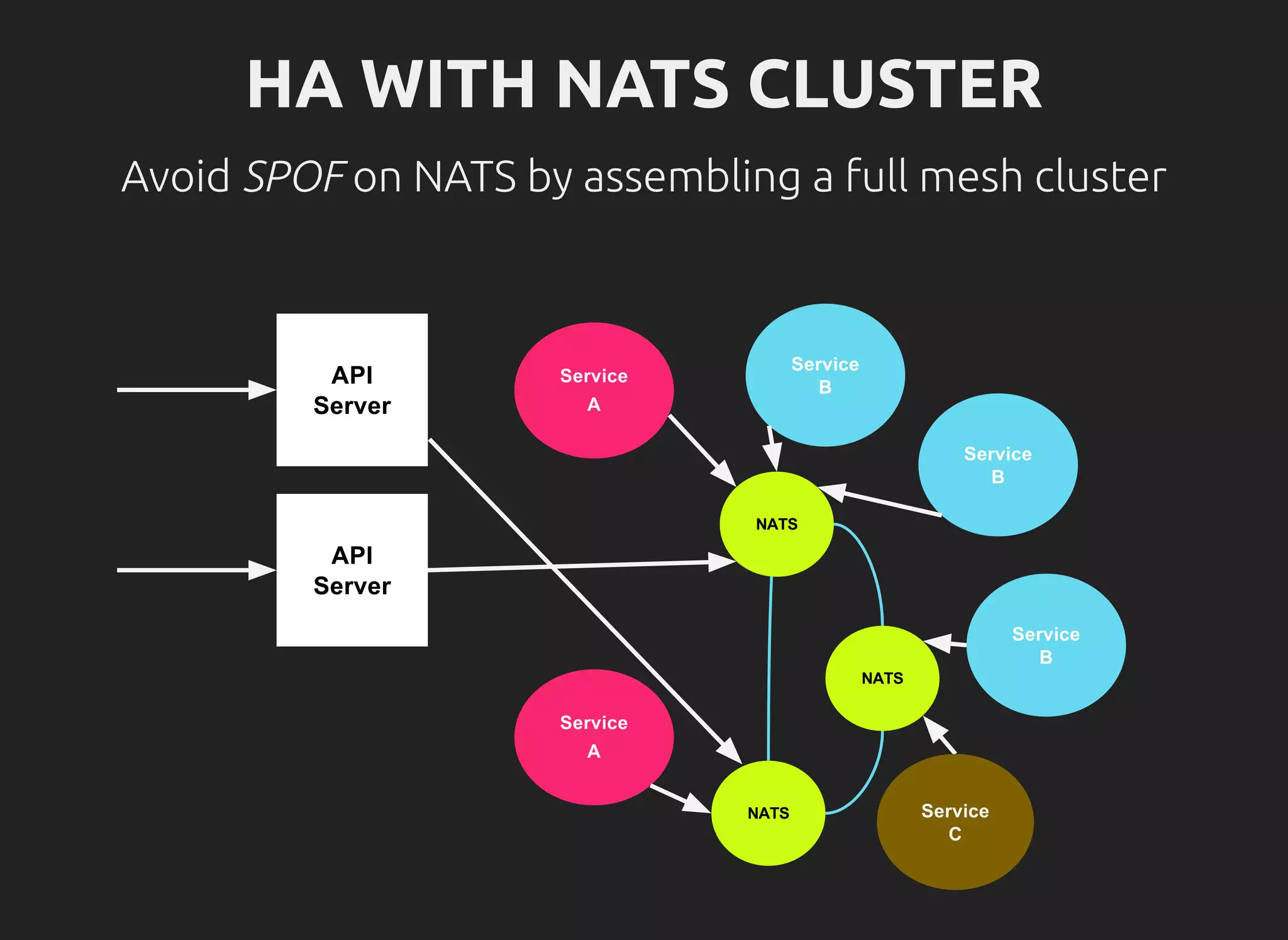
HA WITH NATS CLUSTER
Avoid SPOF on NATS by assembling a full mesh cluster
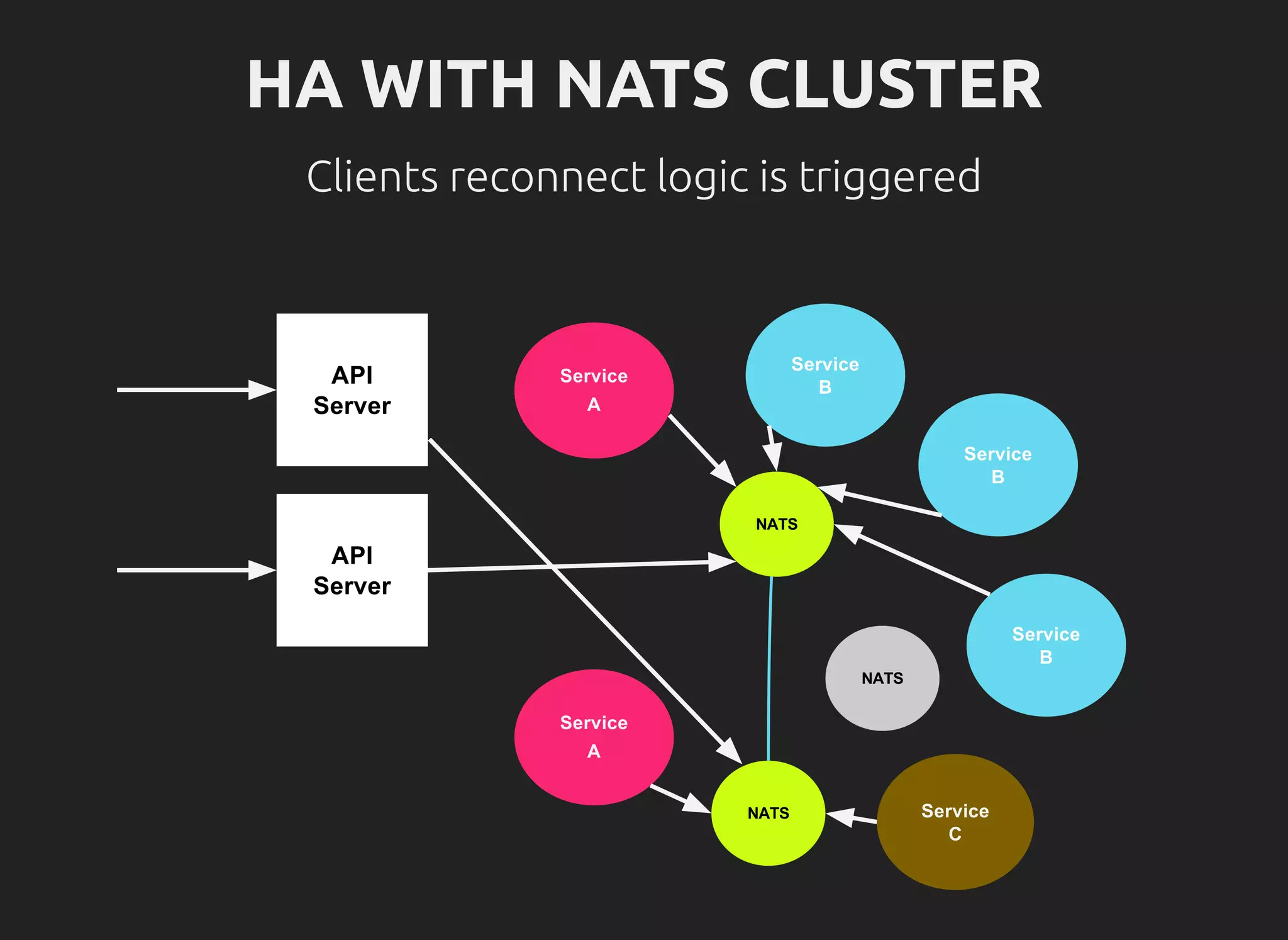
HA WITH NATS CLUSTER
Clients reconnect logic is triggered
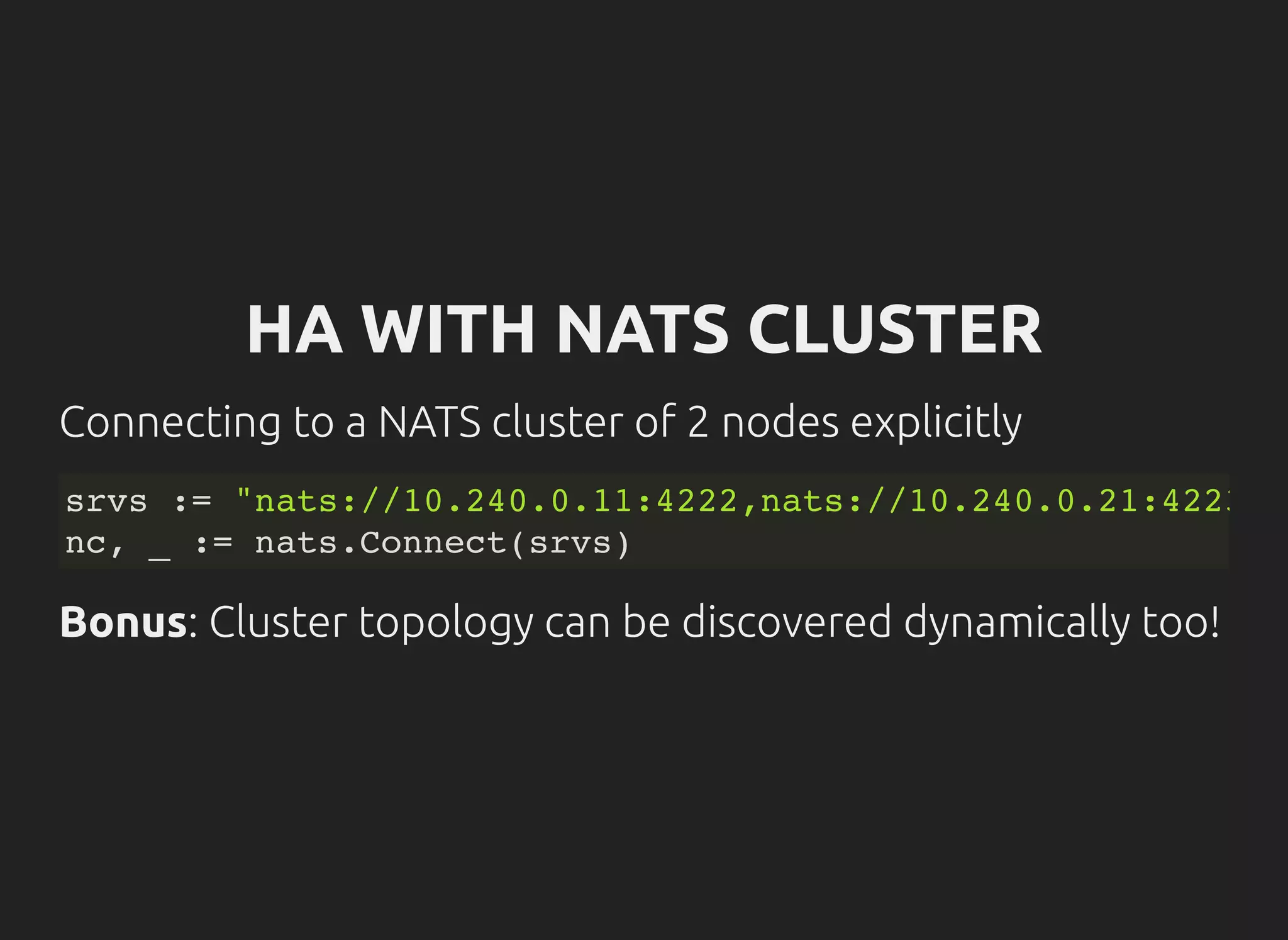
HA WITH NATS CLUSTER
Connecting to a NATS cluster of 2 nodes explicitly
srvs := "nats://10.240.0.11:4222,nats://10.240.0.21:4223"
nc, _ := nats.Connect(srvs)
Bonus: Cluster topology can be discovered dynamically too!
CLUSTER AUTO DISCOVERY
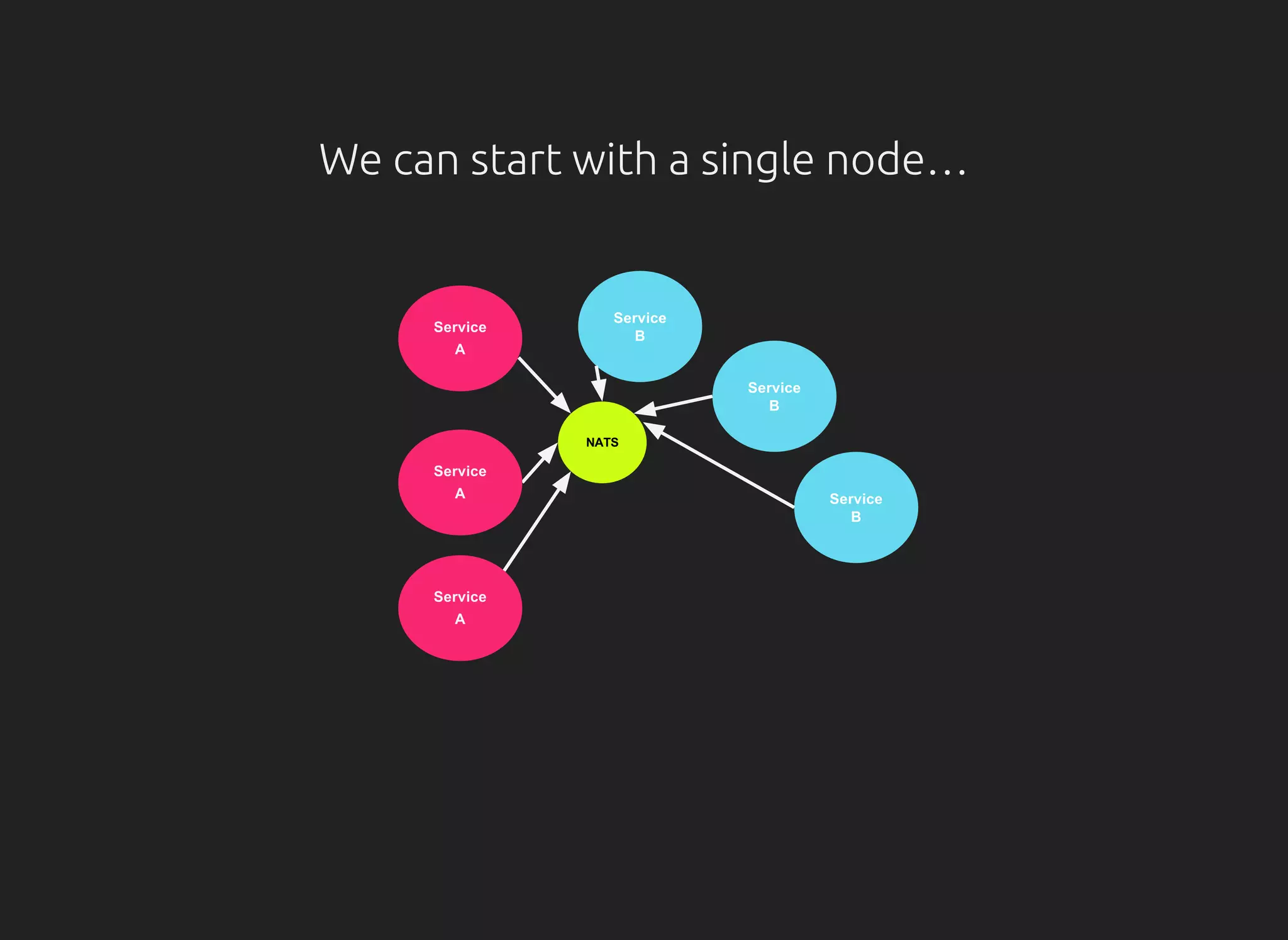
We can start with a single node…
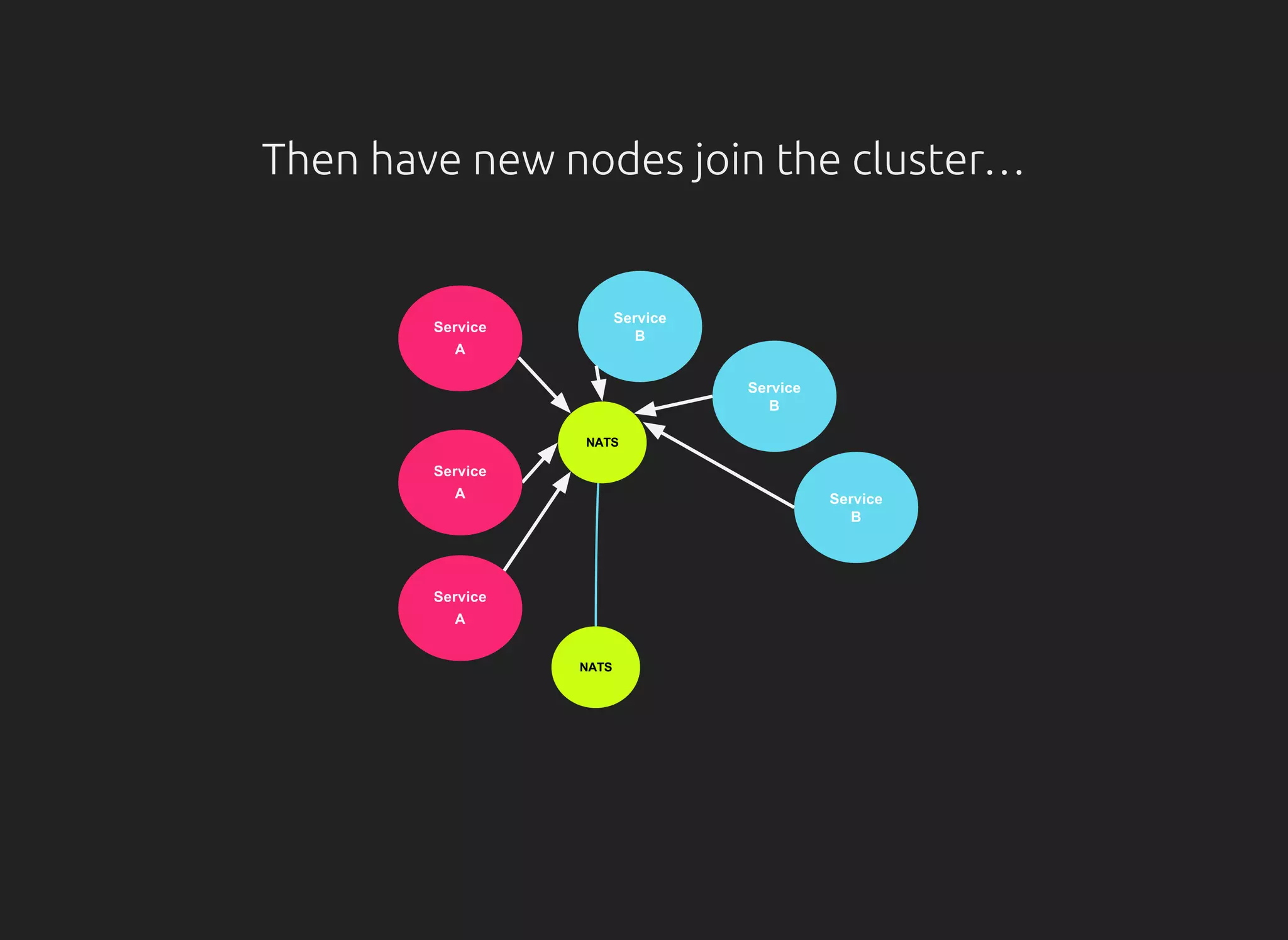
Then have new nodes join the cluster…
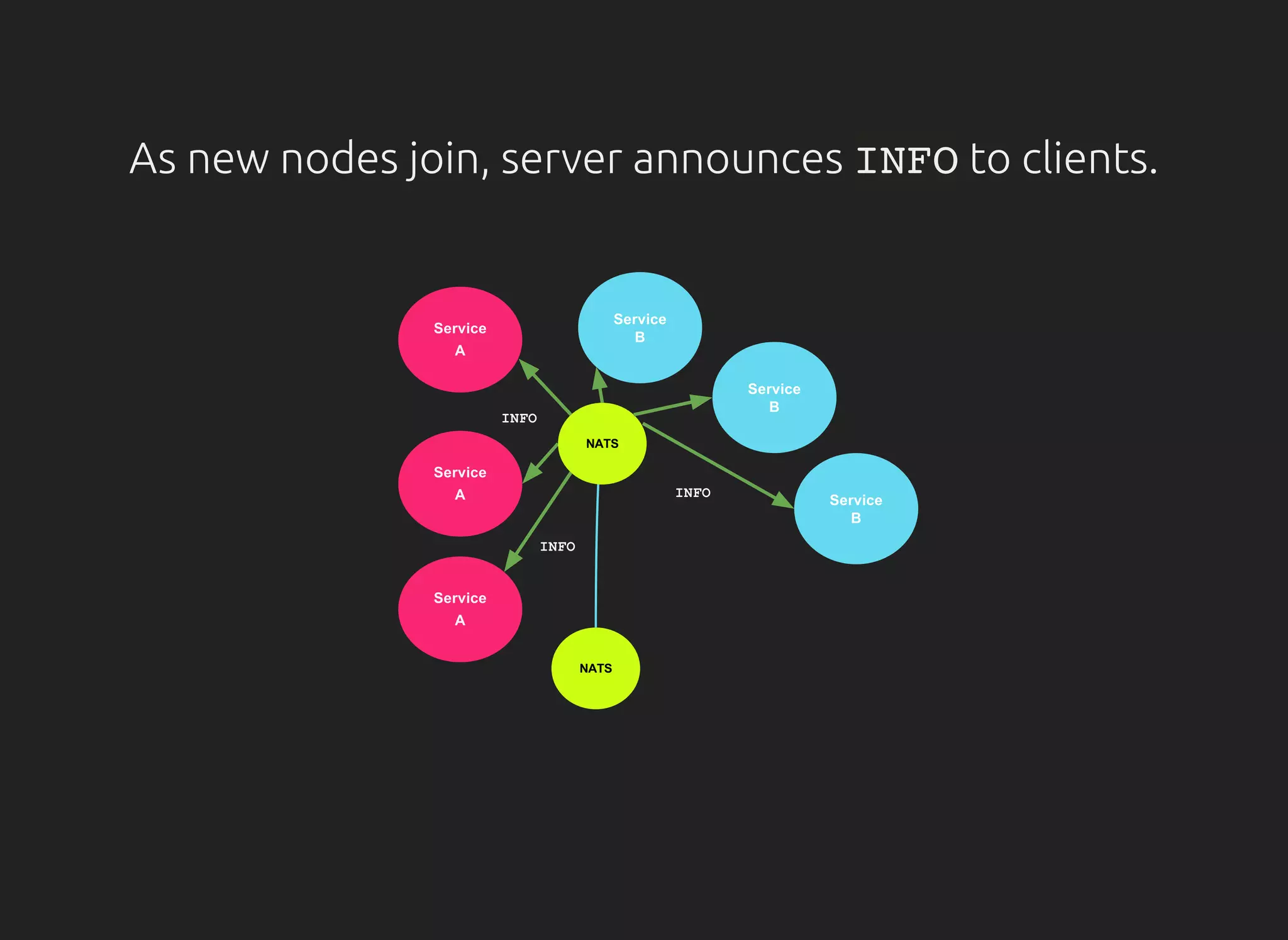
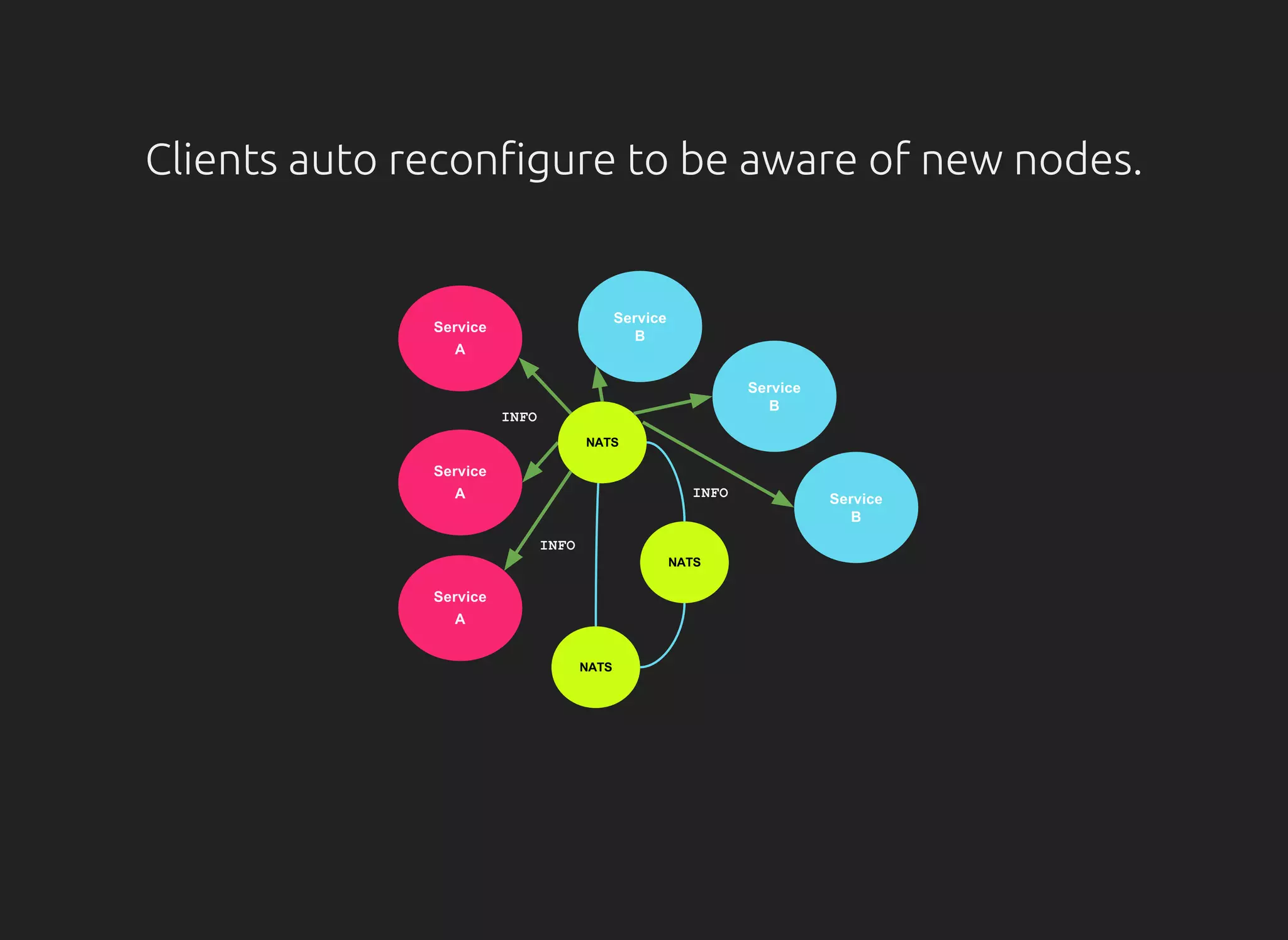
As new nodes join, server announces INFOto clients.
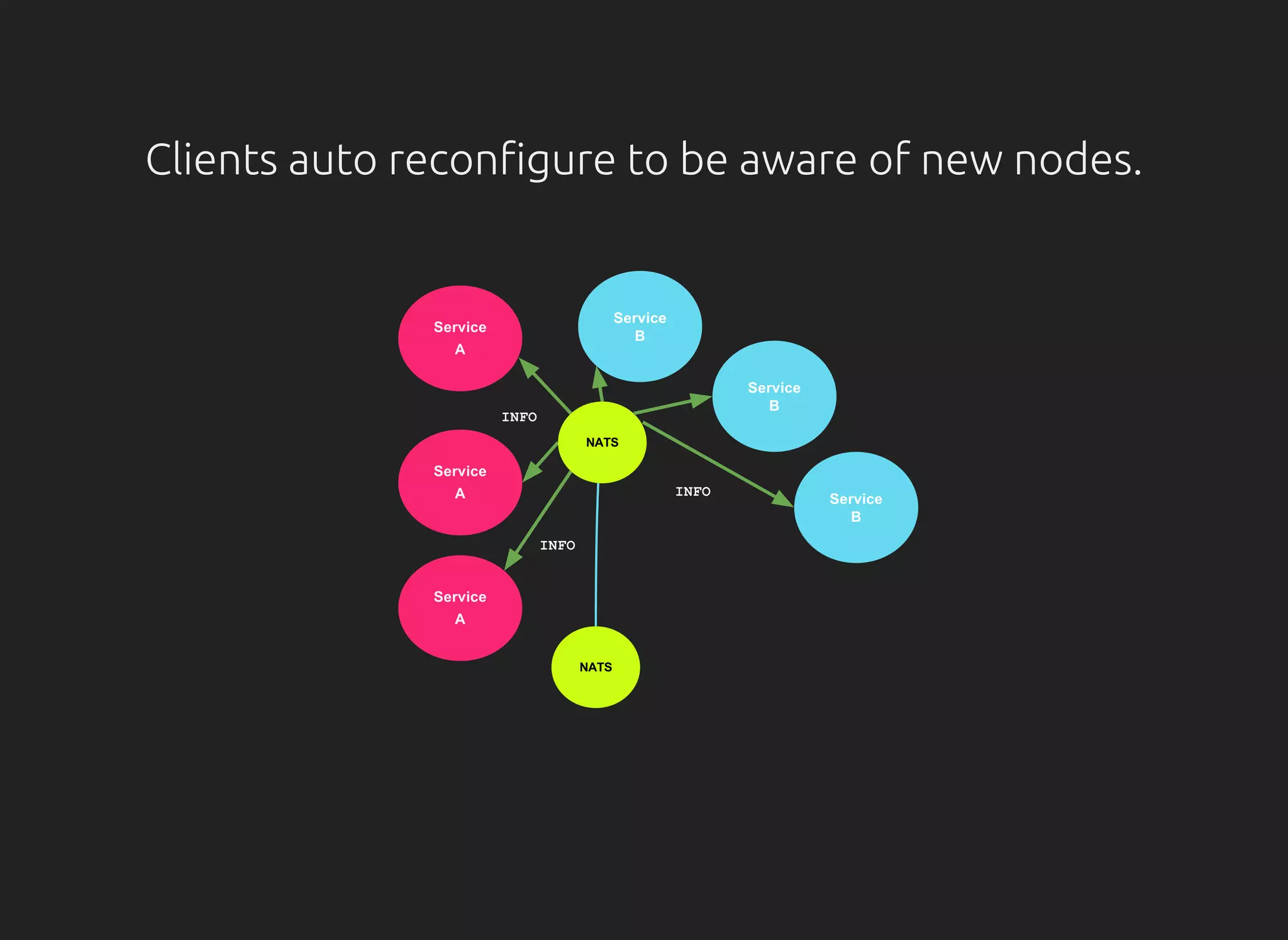
Clients auto recon gure to be aware of new nodes.
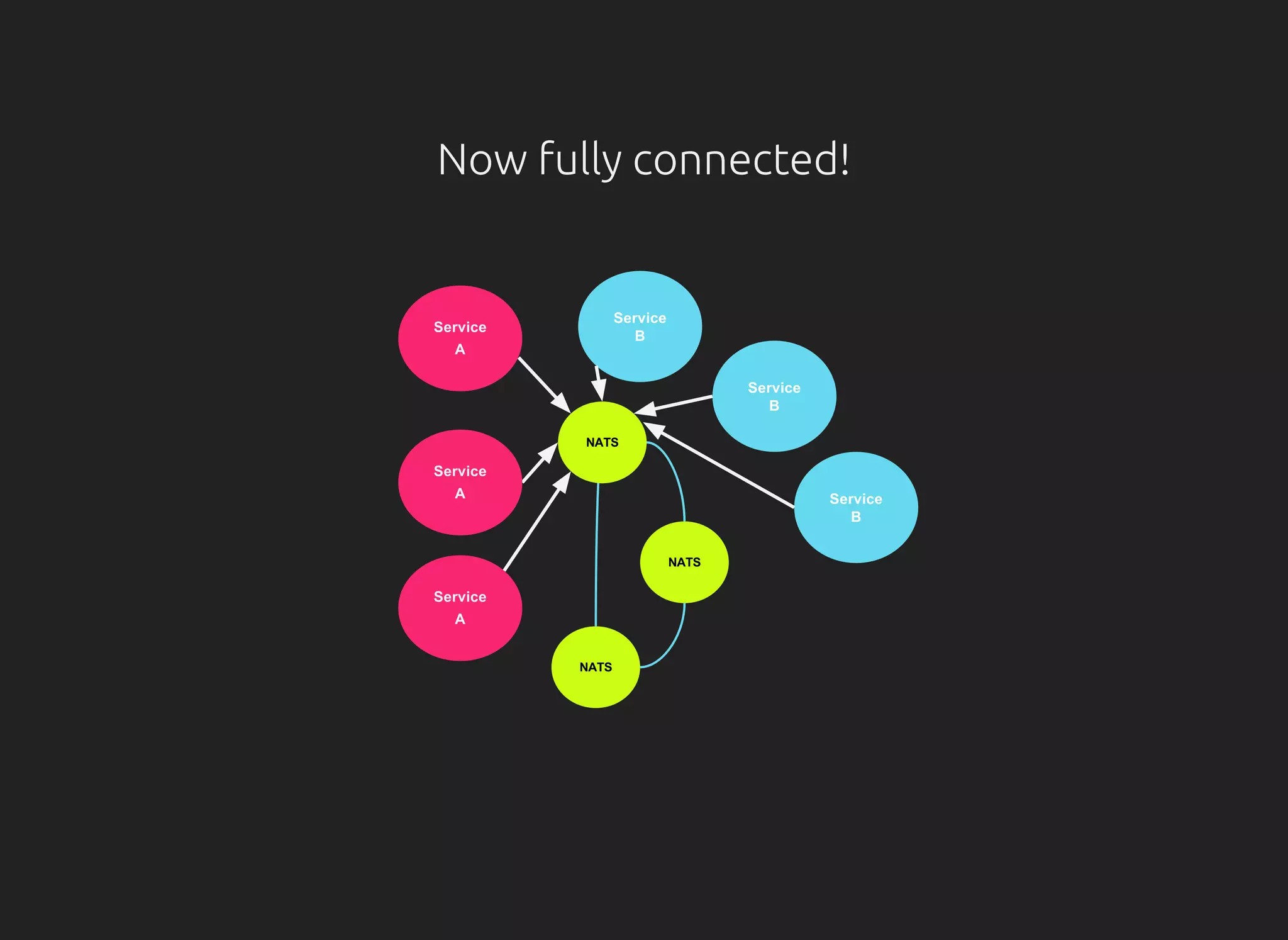
Now fully connected!
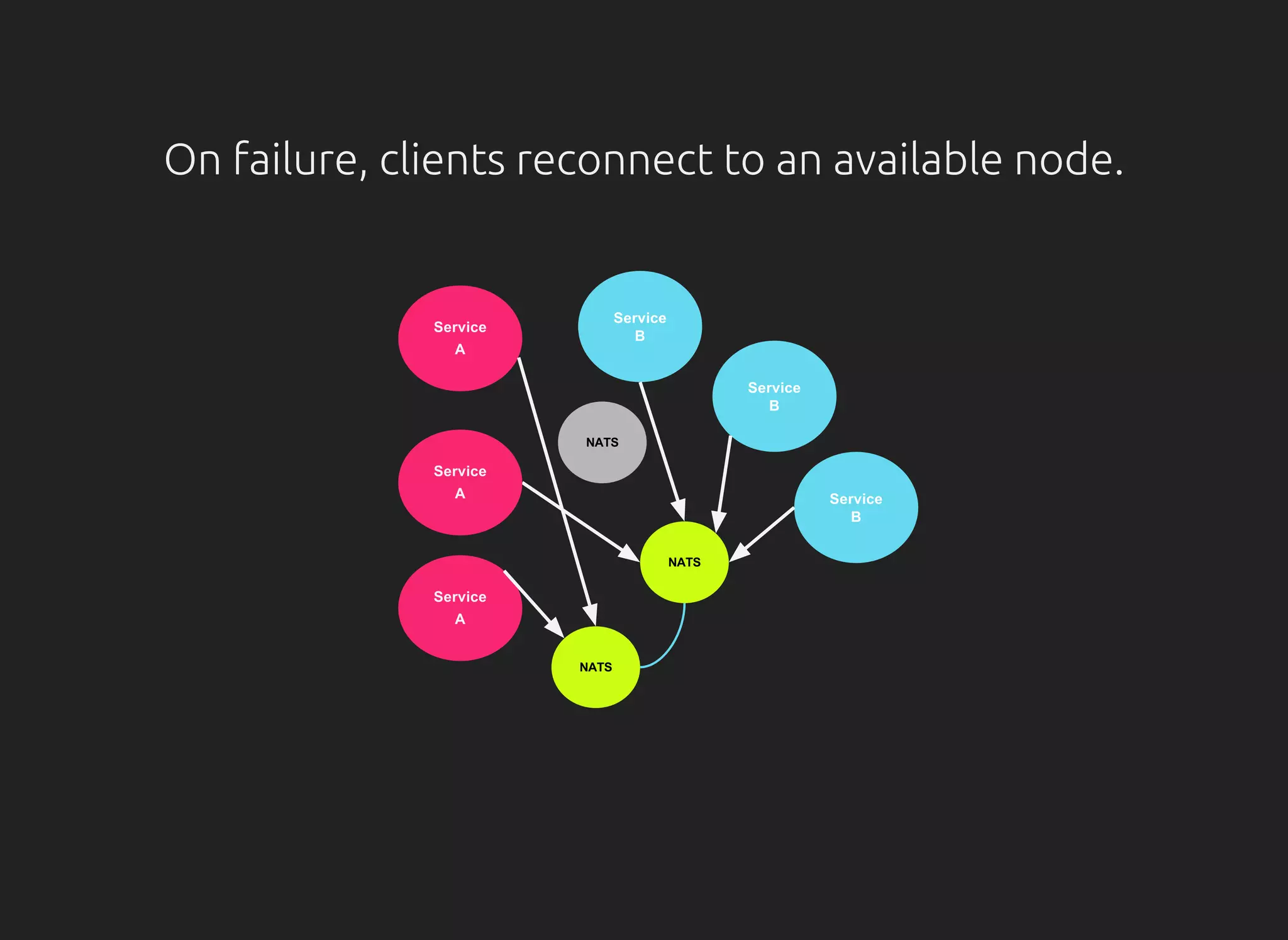
On failure, clients reconnect to an available node.
COMMUNICATING USING NATS
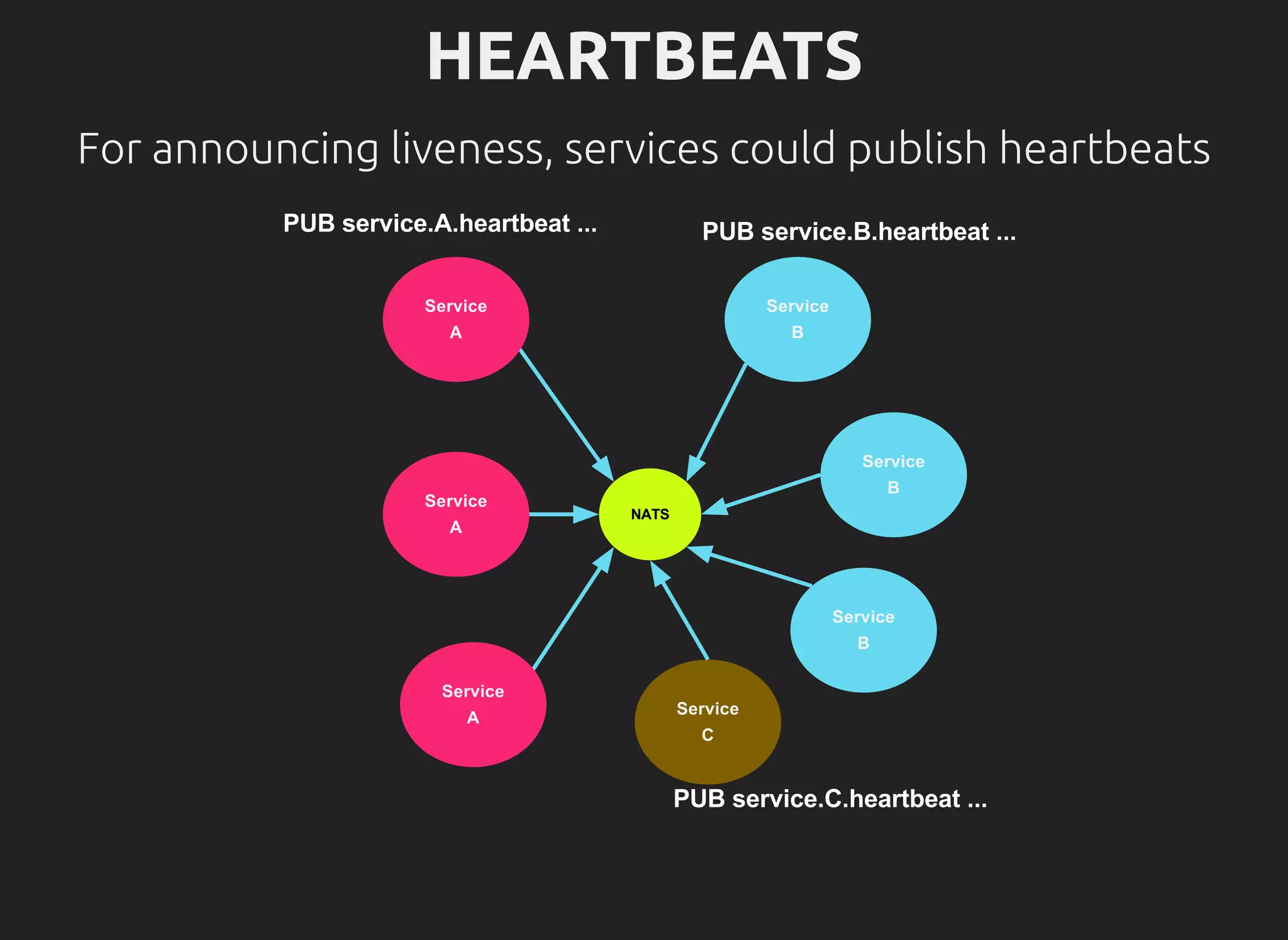
HEARTBEATS
For announcing liveness, services could publish heartbeats
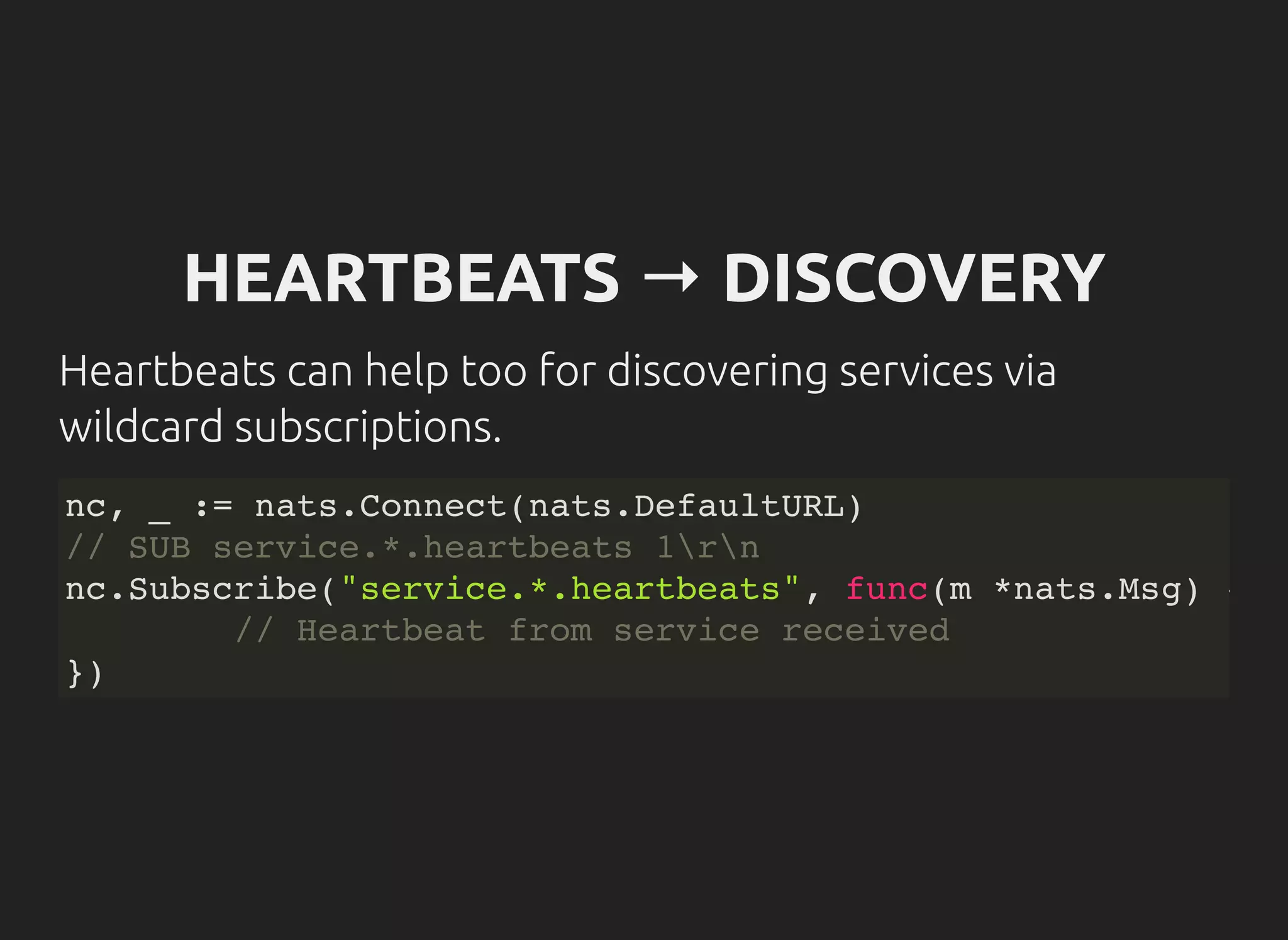
HEARTBEATS → DISCOVERY
Heartbeats can help too for discovering services via
wildcard subscriptions.
nc, _ := nats.Connect(nats.DefaultURL)
// SUB service.*.heartbeats 1rn
nc.Subscribe("service.*.heartbeats", func(m *nats.Msg) {
// Heartbeat from service received
})
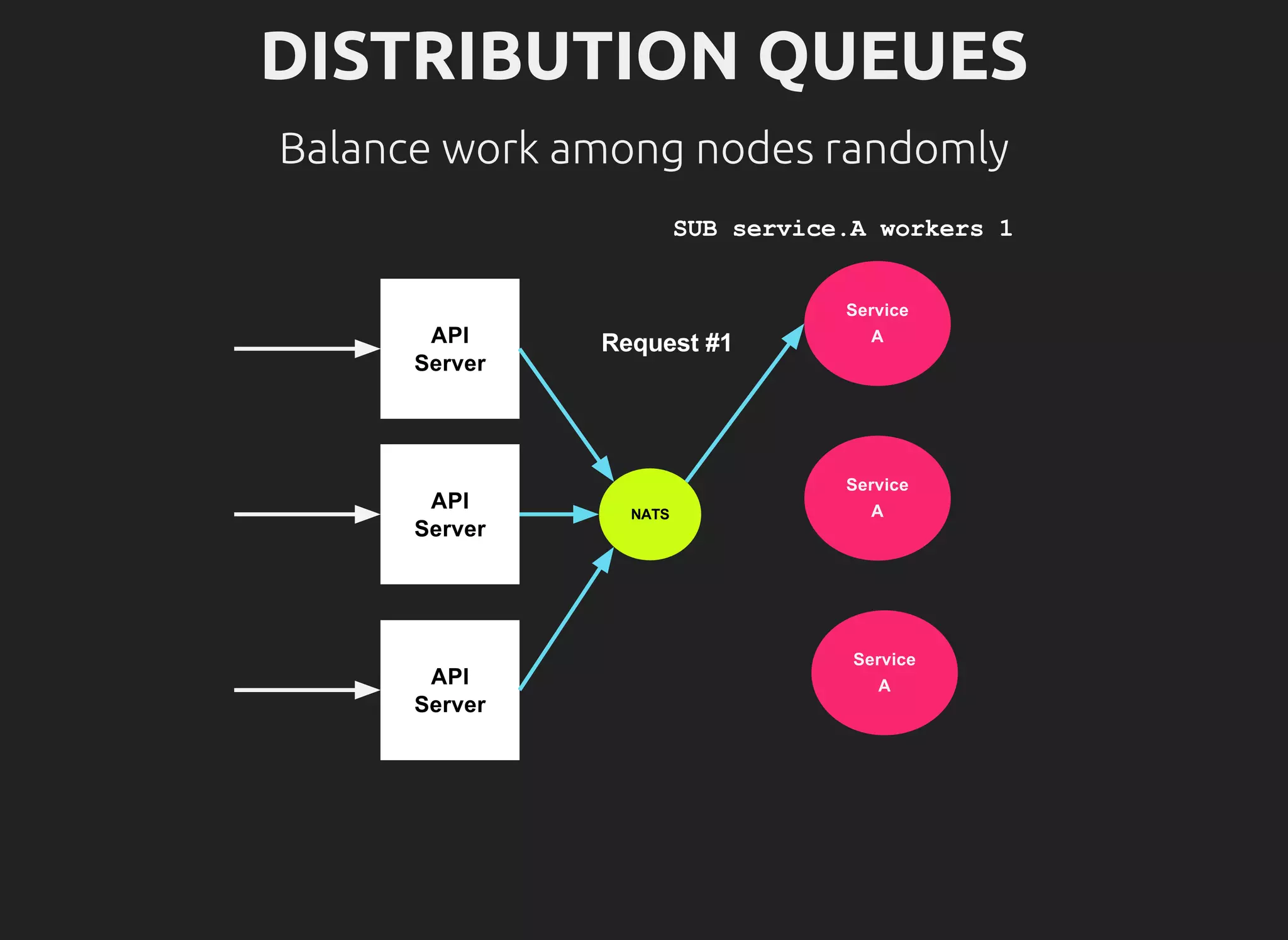
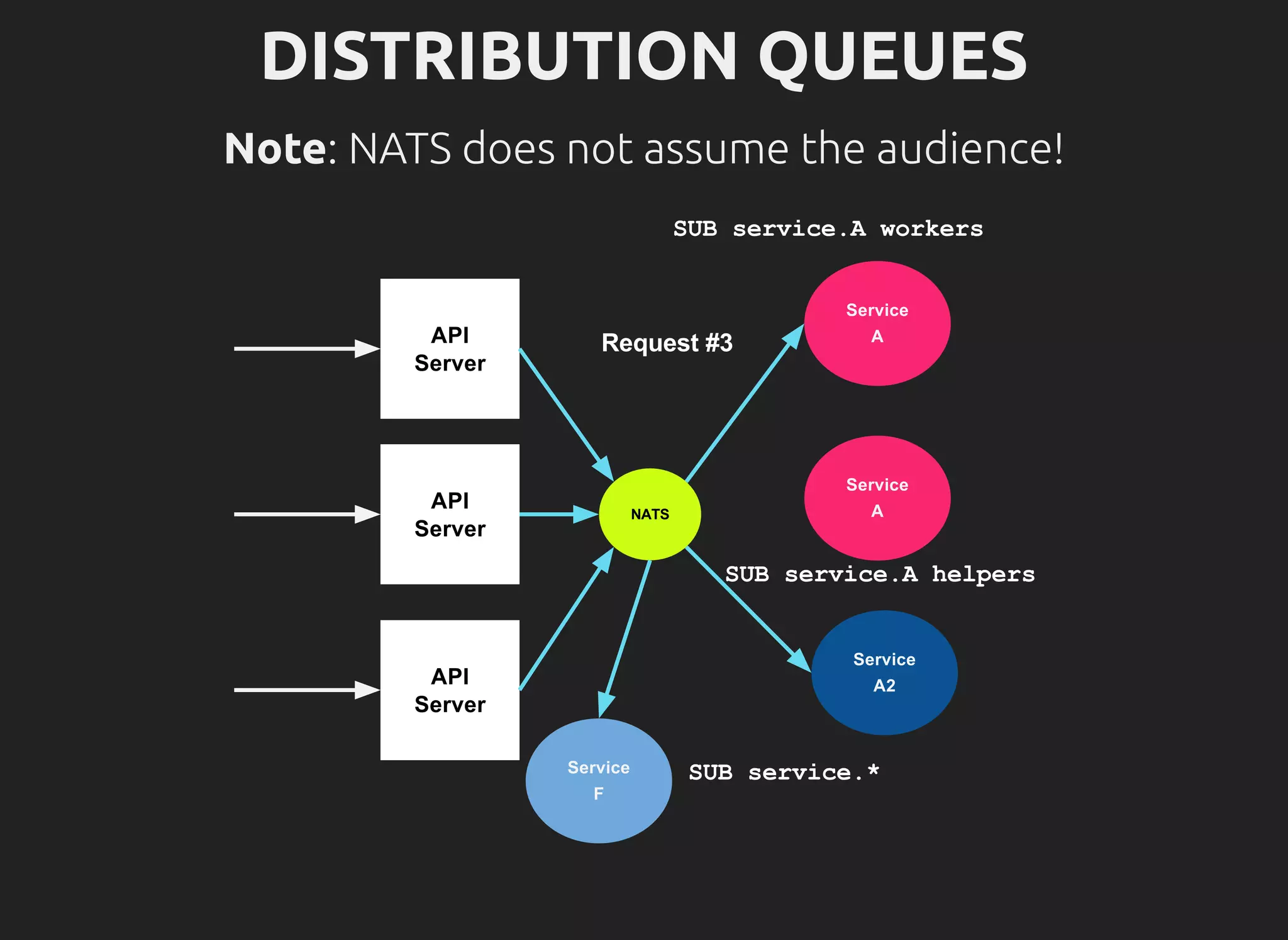
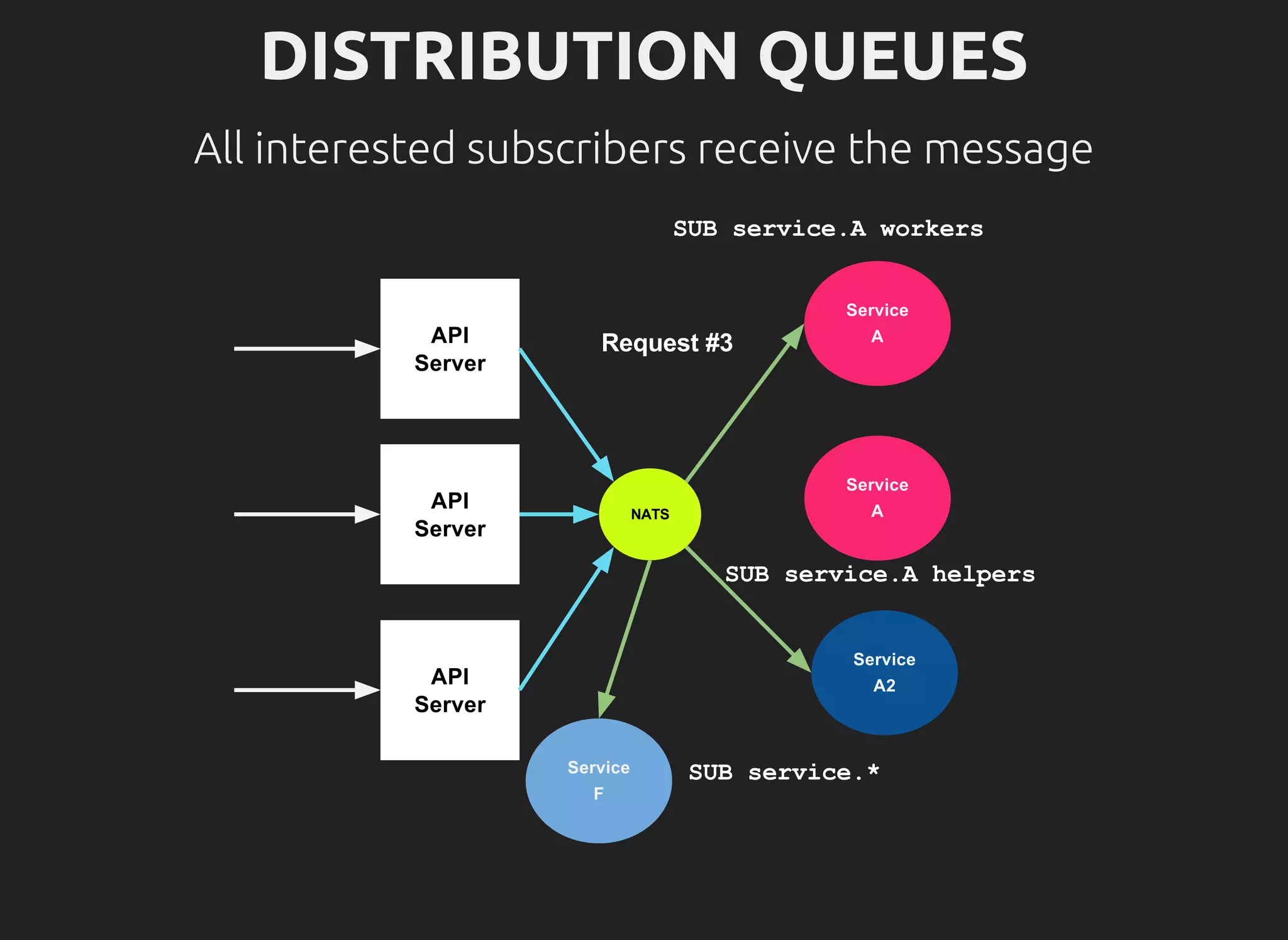
DISTRIBUTION QUEUES
Balance work among nodes randomly
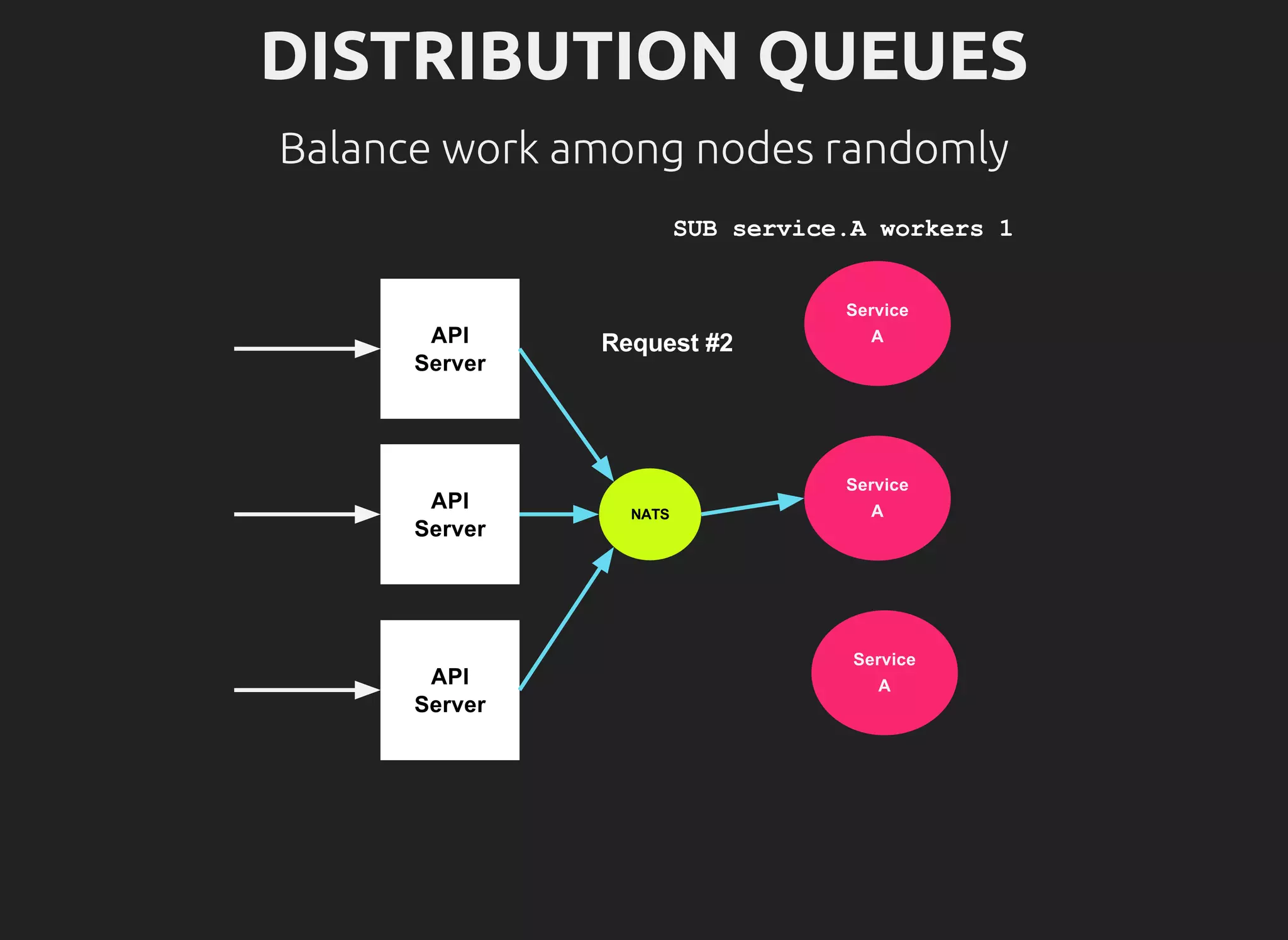
DISTRIBUTION QUEUES
Balance work among nodes randomly
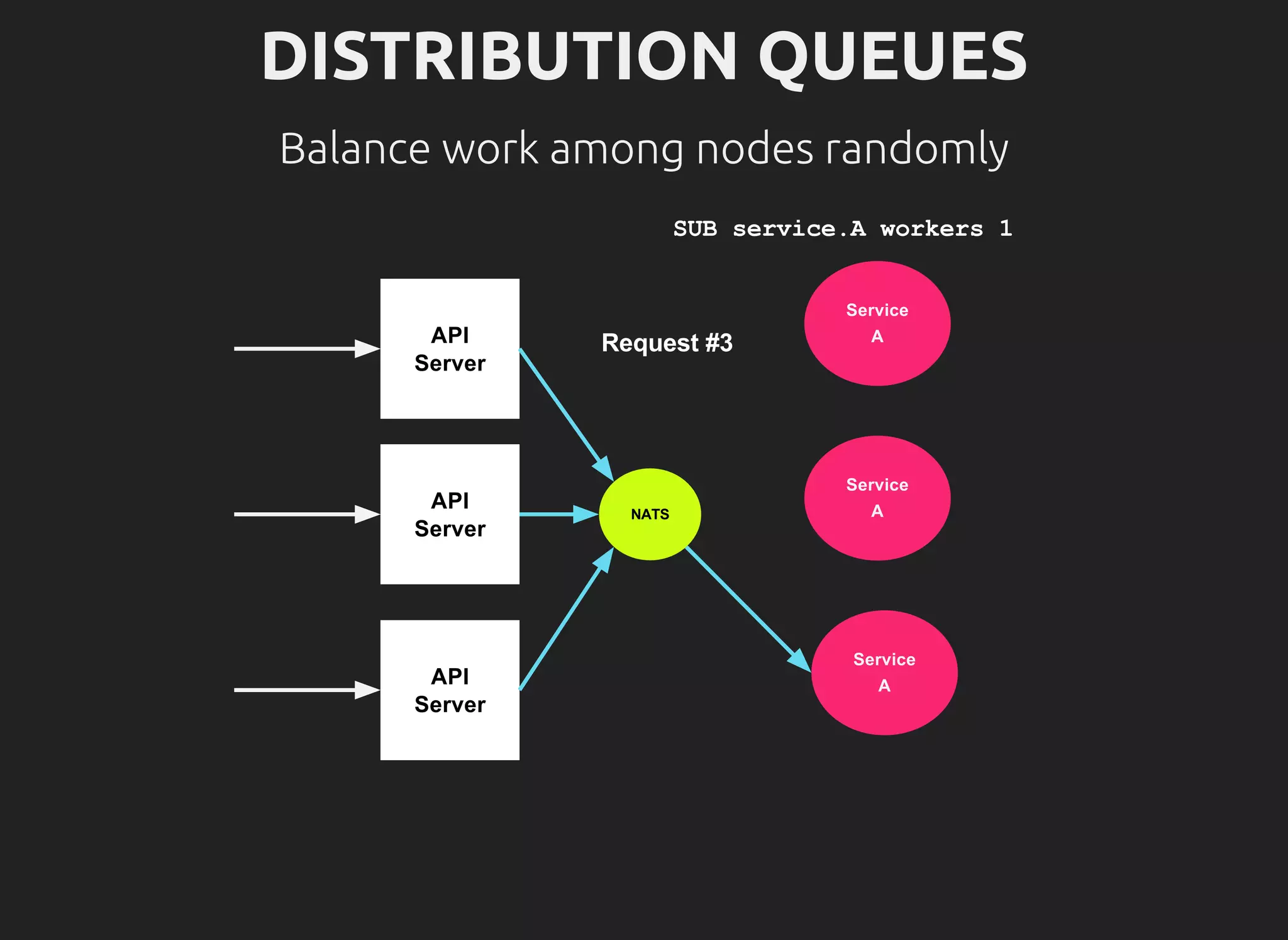
DISTRIBUTION QUEUES
Balance work among nodes randomly
DISTRIBUTION QUEUES
Service A workers subscribe to service.Aand create
workersdistribution queue group for balancing the work.
nc, _ := nats.Connect(nats.DefaultURL)
// SUB service.A workers 1rn
nc.QueueSubscribe("service.A", "workers",
func(m *nats.Msg) {
nc.Publish(m.Reply, []byte("hi!"))
})
DISTRIBUTION QUEUES
Note: NATS does not assume the audience!
DISTRIBUTION QUEUES
All interested subscribers receive the message
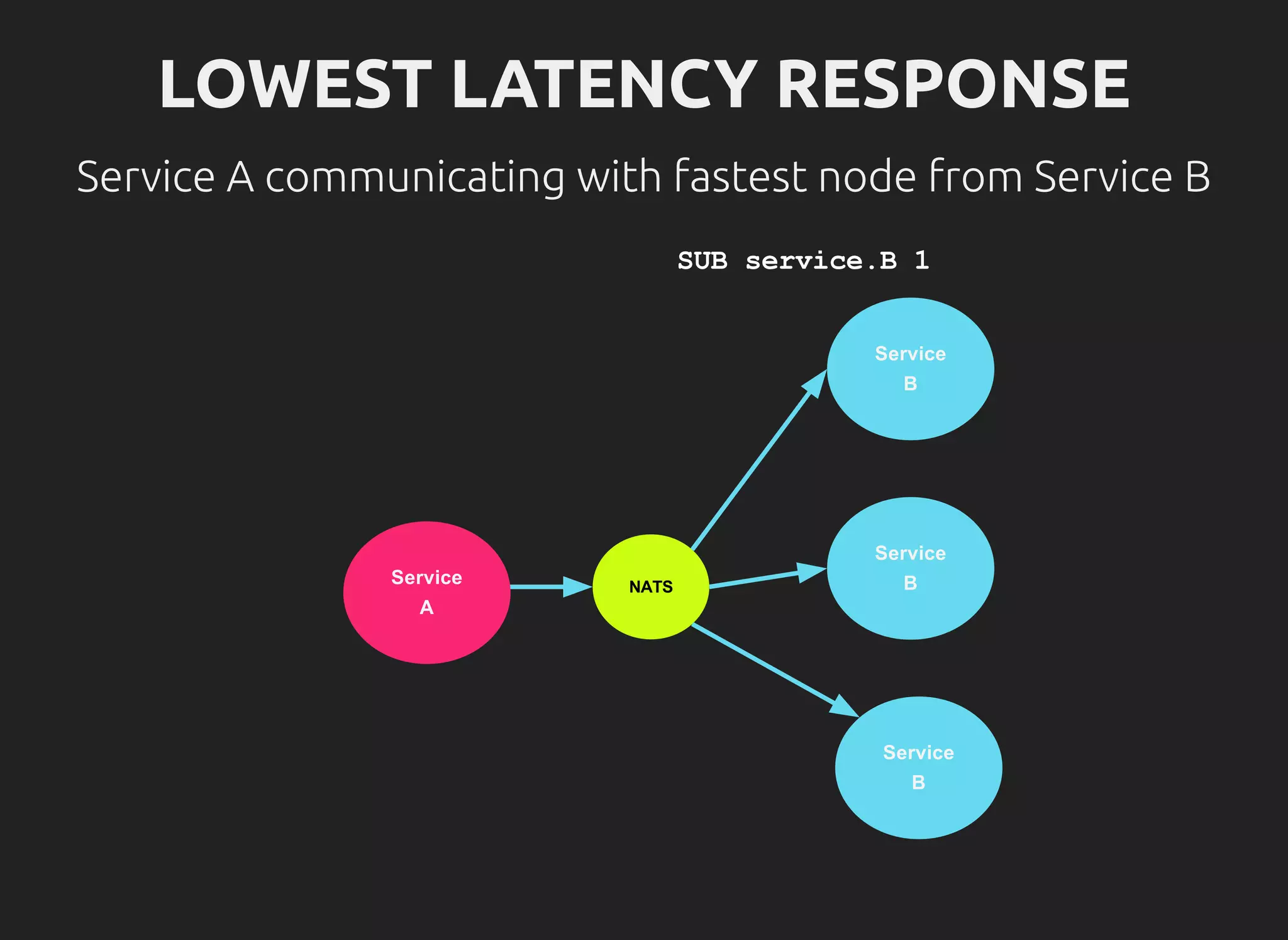
LOWEST LATENCY RESPONSE
Service A communicating with fastest node from Service B
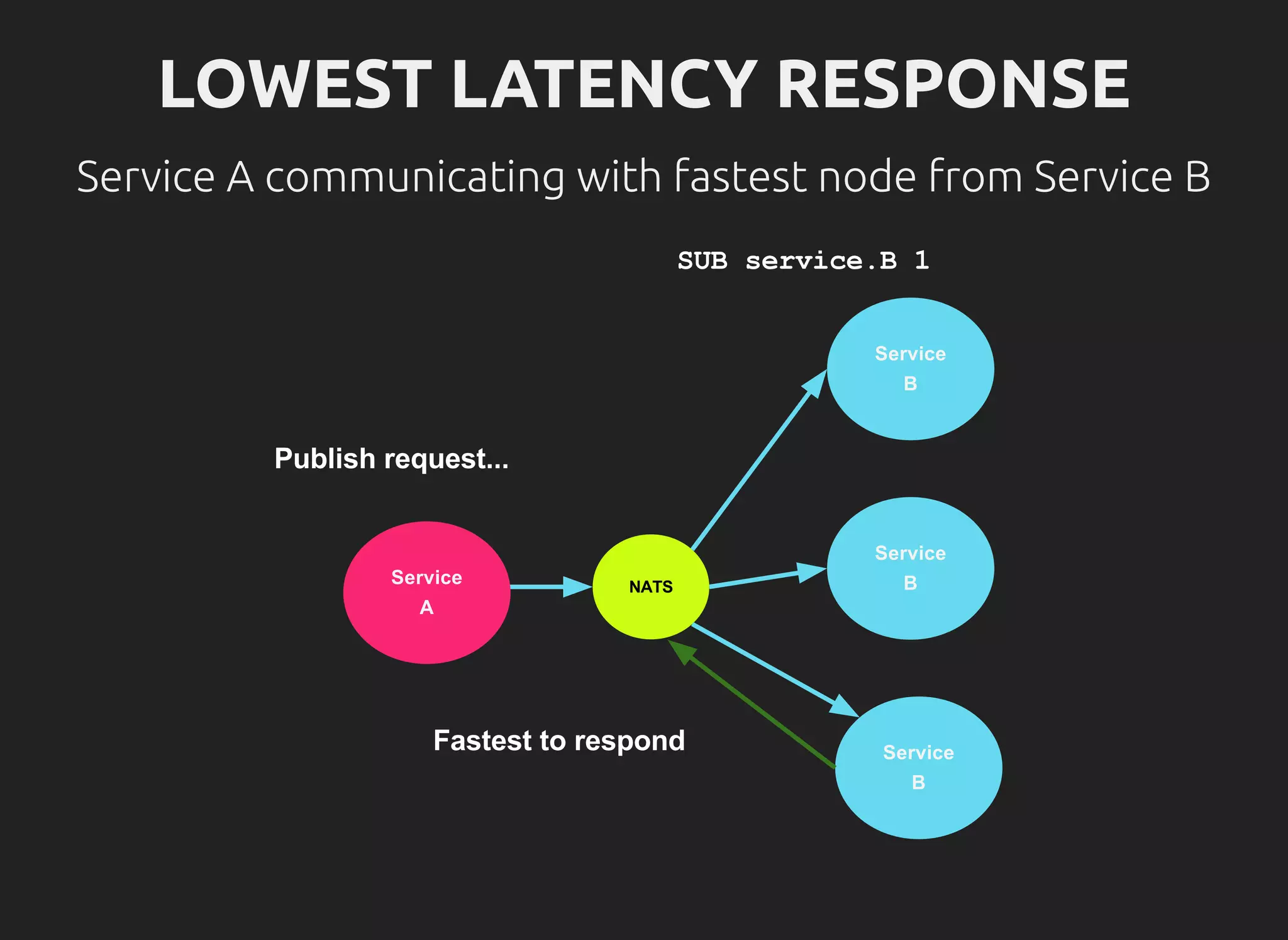
LOWEST LATENCY RESPONSE
Service A communicating with fastest node from Service B
LOWEST LATENCY RESPONSE
NATS requests were designed exactly for this
nc, _ := nats.Connect(nats.DefaultURL)
t := 250*time.Millisecond
// Request sets to AutoUnsubscribe after 1 response
msg, err := nc.Request("service.B", []byte("help"), t)
if err == nil {
fmt.Println(string(msg.Data))
// => sure!
}
nc, _ := nats.Connect(nats.DefaultURL)
nc.Subscribe("service.B", func(m *nats.Msg) {
nc.Publish(m.Reply, []byte("sure!"))
})
UNDERSTANDING NATS TIMEOUT
Note: Making a request involves establishing a client
timeout.
t := 250*time.Millisecond
_, err := nc.Request("service.A", []byte("help"), t)
fmt.Println(err)
// => nats: timeout
This needs special handling!
UNDERSTANDING NATS TIMEOUT
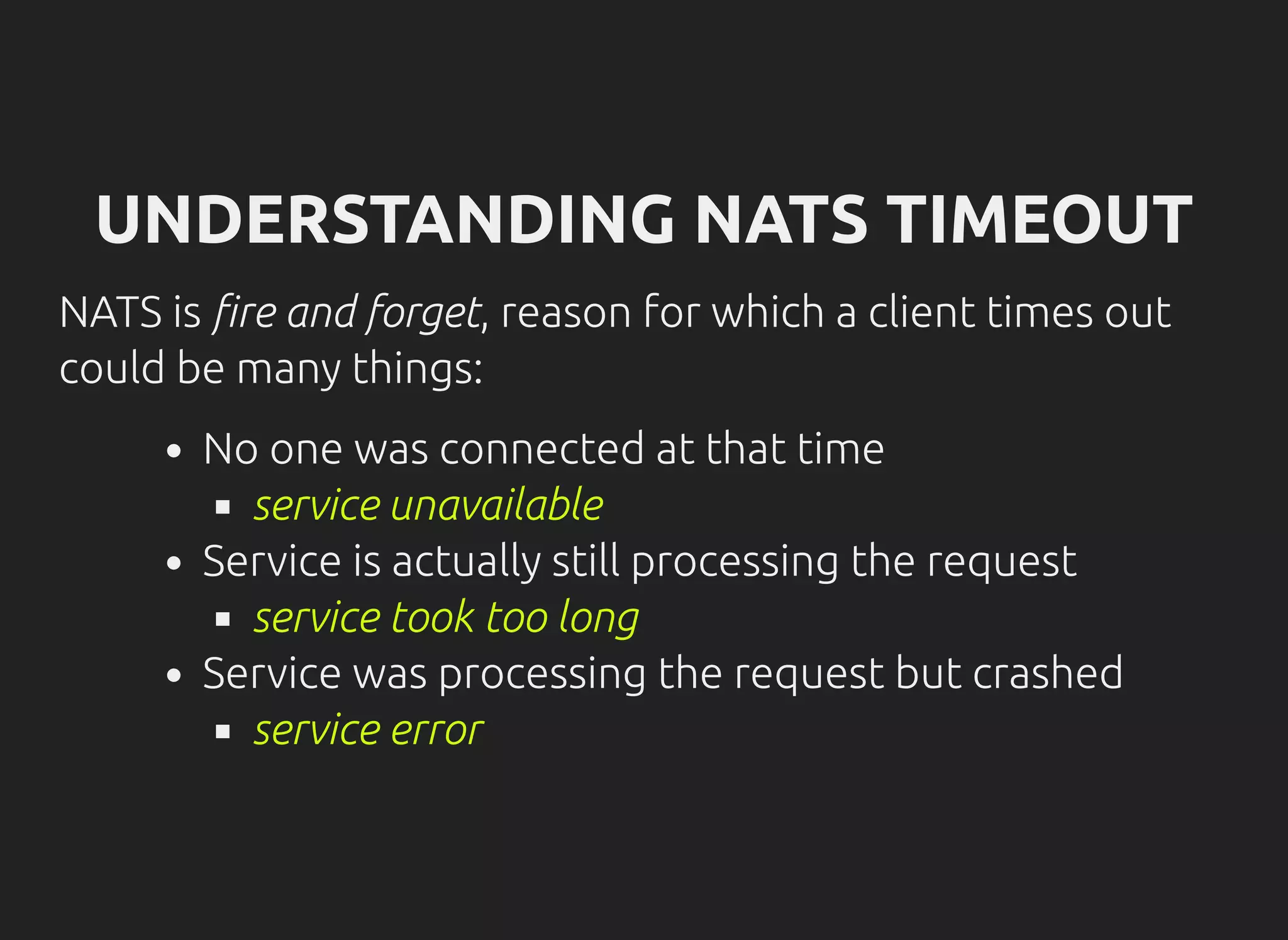
NATS is re and forget, reason for which a client times out
could be many things:
No one was connected at that time
service unavailable
Service is actually still processing the request
service took too long
Service was processing the request but crashed
service error
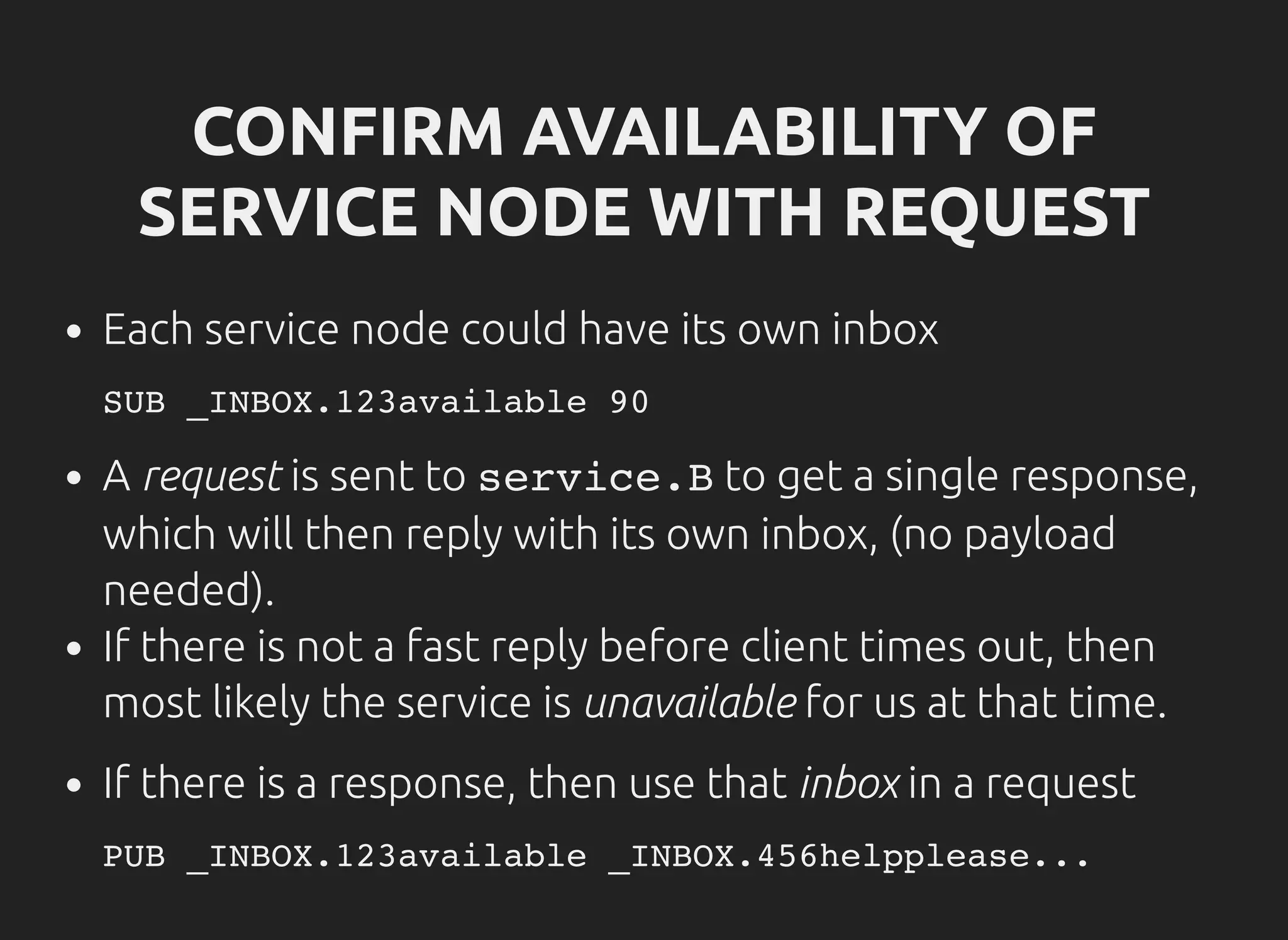
CONFIRM AVAILABILITY OF
SERVICE NODE WITH REQUEST
Each service node could have its own inbox
A request is sent to service.Bto get a single response,
which will then reply with its own inbox, (no payload
needed).
If there is not a fast reply before client times out, then
most likely the service is unavailable for us at that time.
If there is a response, then use that inbox in a request
SUB _INBOX.123available 90
PUB _INBOX.123available _INBOX.456helpplease...
Summary
NATS is a simple, fast and reliable solution for the internal
communication of a distributed system.
It chooses simplicity and reliability over guaranteed
delivery.
Though this does not necessarily mean that guarantees of a
system are constrained due to NATS!
→ https://en.wikipedia.org/wiki/End-to-end_principle
We can always build strong guarantees on top, but
we can't always remove them from below.
Tyler Treat, Simple Solutions to Complex Problems
Replayability can be better than guaranteed delivery
Idempotency can be better than exactly once delivery
Commutativity can be better than ordered delivery
Related NATS project: NATS Streaming
REFERENCES
High Performance Systems in Go (Gophercon 2014)
Derek Collison ( )
Dissecting Message Queues (2014)
Tyler Treat ( )
Simplicity Matters (RailsConf 2012)
Rich Hickey ( )
Simple Solutions for Complex Problems (2016)
Tyler Treat ( )
End To End Argument (1984)
J.H. Saltzer, D.P. Reed and D.D. Clark ( )
link
link
link
link
link
THANKS!
/github.com/nats-io @nats_io
Play with the demo site!
telnet demo.nats.io 4222

The Zen of High Performance Messaging with NATS

  • 1.
      The Zen ofHigh Performance Messaging with NATS Waldemar Quevedo / @wallyqs Strange Loop 2016
  • 2.
    ABOUT Waldemar Quevedo / SoftwareDeveloper at in SF Development of the Apcera Platform Past: PaaS DevOps at Rakuten in Tokyo NATS client maintainer (Ruby, Python) @wallyqs Apcera
  • 3.
    ABOUT THIS TALK Whatis NATS Design from NATS Building systems with NATS
  • 4.
  • 5.
    NATS High Performance MessagingSystem Created by First written in in 2010 Originally built for Cloud Foundry Rewritten in in 2012 Better performance Open Source, MIT License Derek Collison Ruby Go https://github.com/nats-io
  • 6.
    THANKS GO TEAM Smallbinary → Lightweight Docker image No deployment dependencies ✌
  • 7.
    Acts as analways available dial-tone
  • 8.
  • 9.
    single byte message Around10M messages/second
  • 10.
    MUCH BETTER BENCHMARK From's awesome blog@tyler_treat (2014)http://bravenewgeek.com/dissecting-message-queues/
  • 11.
    NATS = Performance+ Simplicity
  • 12.
  • 13.
    NATS Design constrained tokeep it as operationally simple and reliable as possible while still being both performant and scalable.
  • 14.
  • 15.
    Simplicity buys youopportunity. ー Rich Hickey, Cognitect Link: https://www.youtube.com/watch?v=rI8tNMsozo0
  • 16.
    LESS IS BETTER Concisefeature set (pure pub/sub) No built-in persistence of messages No exactly-once-delivery promises either Those concerns are simpli ed away from NATS
  • 17.
  • 18.
    What could bethe fastest, simplest and most reliable way of writing and reading to a socket to communicate with N nodes?
  • 19.
    DESIGN TCP/IP based Plain textprotocol Pure pub/sub re and forget at most once
  • 20.
  • 21.
  • 22.
    Connecting to thepublic demo server… telnet demo.nats.io 4222 INFO {"tls_required":false,"max_payload":1048576,...}
  • 23.
    Optionally giving aname to the client connect {"name":"nats-strangeloop-client"} +OK
  • 24.
    Pinging the server,we should get a pong back ping PONG
  • 25.
    Not following ping/ponginterval, results in server disconnecting us. INFO {"auth_required":false,"max_payload":1048576,...} PING PING -ERR 'Stale Connection' Connection closed by foreign host.
  • 26.
    Subscribe to thehellosubject identifying it with the arbitrary number 10 sub hello 10 +OK
  • 27.
    Publishing on hellosubjecta payload of 5 bytes sub hello 10 +OK pub hello 5 world
  • 28.
    Message received! telnet demo.nats.io4222 sub hello 10 +OK pub hello 5 world MSG hello 10 5 world Payload is opaque to the server! It is just bytes, but could be json, msgpack, etc…
  • 29.
  • 30.
    PROBLEM How can wesend a request and expect a response back with pure pub/sub?
  • 31.
    NATS REQUESTS Initially, clientmaking the request creates a subscription with a string:unique identi er SUB _INBOX.ioL1Ws5aZZf5fyeF6sAdjw 2 +OK NATS clients libraries have helpers for generating these: nats.NewInbox() // => _INBOX.ioL1Ws5aZZf5fyeF6sAdjw
  • 32.
    NATS REQUESTS Then itexpresses in the topic:limited interest SUB _INBOX.ioL1Ws5aZZf5fyeF6sAdjw 2 UNSUB 2 1 tells the server to unsubscribe from subscription with sid=2 after getting 1 message
  • 33.
    NATS REQUESTS Then therequest is published to a subject (help), tagging it with the ephemeral inbox just for the request to happen: SUB _INBOX.ioL1Ws5aZZf5fyeF6sAdjw 2 UNSUB 2 1 PUB help _INBOX.ioL1Ws5aZZf5fyeF6sAdjw 6 please
  • 34.
    NATS REQUESTS Then ithere is another subscriber connected and interested in the helpsubject, it will receive a message with that inbox: # Another client interested in the help subject SUB help 90 # Receives from server a message MSG help 90 _INBOX.ioL1Ws5aZZf5fyeF6sAdjw 6 please # Can use that inbox to reply back PUB _INBOX.ioL1Ws5aZZf5fyeF6sAdjw 11 I can help!
  • 35.
    NATS REQUESTS Finally, ithe client which sent the request is still connected and interested, it will be receiving that message: SUB _INBOX.ioL1Ws5aZZf5fyeF6sAdjw 2 UNSUB 2 1 PUB help _INBOX.ioL1Ws5aZZf5fyeF6sAdjw 6 please MSG _INBOX.ioL1Ws5aZZf5fyeF6sAdjw 2 11 I can help!
  • 36.
    Simple Protocol ==Simple Clients
  • 37.
    Given the protocolis simple, NATS clients libraries tend to have a very small footprint as well.
  • 38.
  • 39.
    RUBY require 'nats/client' NATS.start do|nc| nc.subscribe("hello") do |msg| puts "[Received] #{msg}" end nc.publish("hello", "world") end
  • 40.
    GO nc, err :=nats.Connect() // ... nc.Subscribe("hello", func(m *nats.Msg){ fmt.Printf("[Received] %s", m.Data) }) nc.Publish("hello", []byte("world"))
  • 41.
    MANY MORE AVAILABLE CC# Java Python NGINX Spring Node.js Elixir Rust Lua Erlang PHP Haskell Scala Perl Many thanks to the community!
  • 42.
    ASYNCHRONOUS IO Note: Mostclients have asynchronous behavior nc, err := nats.Connect() // ... nc.Subscribe("hello", func(m *nats.Msg){ fmt.Printf("[Received] %s", m.Data) }) for i := 0; i < 1000; i ++ { nc.Publish("hello", []byte("world")) } // No guarantees of having sent the bytes yet! // They may still just be in the flushing queue.
  • 43.
    ASYNCHRONOUS IO In orderto guarantee that the published messages have been processed by the server, we can do an extra ping/pong to con rm they were consumed: nc.Subscribe("hello", func(m *nats.Msg){ fmt.Printf("[Received] %s", m.Data) }) for i := 0; i < 1000; i ++ { nc.Publish("hello", []byte("world")) } // Do a PING/PONG roundtrip with the server. nc.Flush() SUB hello 1rnPUB hello 5rnworldrn..PINGrn Then ush the bu er and wait for PONGfrom server
  • 44.
    ASYNCHRONOUS IO Worst wayof measuring NATS performance nc, _ := nats.Connect(nats.DefaultURL) msg := []byte("hi") nc.Subscribe("hello", func(_ *nats.Msg) {}) for i := 0; i < 100000000; i++ { nc.Publish("hello", msg) }
  • 45.
  • 46.
    The client isa slow consumer since it is not consuming the messages which the server is sending fast enough. Whenever the server cannot ush bytes to a client fast enough, it will disconnect the client from the system as this consuming pace could a ect the whole service and rest of the clients. NATS Server is protecting itself
  • 47.
    NATS = Performance+ Simplicity + Resiliency
  • 48.
    ALSO INCLUDED Subject routingwith wildcards Authorization Distribution queue groups for balancing Cluster mode for high availability Auto discovery of topology Secure TLS connections with certi cates /varzmonitoring endpoint used by nats-top
  • 49.
    SUBJECTS ROUTING Wildcards: * SUBfoo.*.bar 90 PUB foo.hello.bar 2 hi MSG foo.hello.bar 90 2 hi e.g. subscribe to all NATS requests being made on the demo site: telnet demo.nats.io 4222 INFO {"auth_required":false,"version":"0.9.4",...} SUB _INBOX.* 99 MSG _INBOX.ioL1Ws5aZZf5fyeF6sAdjw 99 11 I can help!
  • 50.
    SUBJECTS ROUTING Full wildcard:> SUB hello.> 90 PUB hello.world.again 2 hi MSG hello.world.again 90 2 hi Subscribe to all subjects and see whole tra c going through the server: telnet demo.nats.io 4222 INFO {"auth_required":false,"version":"0.9.4",...} sub > 1 +OK
  • 51.
    SUBJECTS AUTHORIZATION Clients arenot allowed to publish on _SYSfor example: PUB _SYS.foo 2 hi -ERR 'Permissions Violation for Publish to "_SYS.foo"'
  • 52.
    SUBJECTS AUTHORIZATION Can customizedisallowing pub/sub on certain subjects via server con g too: authorization { admin = { publish = ">", subscribe = ">" } requestor = { publish = ["req.foo", "req.bar"] subscribe = "_INBOX.*" } users = [ {user: alice, password: foo, permissions: $admin} {user: bob, password: bar, permissions: $requestor} ] }
  • 53.
  • 54.
    FAMILIAR SCENARIO Service Aneeds to talk to services B and C
  • 55.
  • 56.
    COMMUNICATING WITHIN A DISTRIBUTEDSYSTEM Just use HTTP everywhere? Use some form of point to point RPC? What about service discovery and load balancing? What if sub ms latency performance is required?
  • 57.
  • 58.
    WHAT NATS GIVESUS publish/subscribe based low latency mechanism for communicating with 1 to 1, 1 to N nodes An established TCP connection to a server A dial tone
  • 59.
    COMMUNICATING THROUGH NATS UsingNATS for internal communication
  • 60.
    HA WITH NATSCLUSTER Avoid SPOF on NATS by assembling a full mesh cluster
  • 61.
    HA WITH NATSCLUSTER Clients reconnect logic is triggered
  • 62.
    HA WITH NATSCLUSTER Connecting to a NATS cluster of 2 nodes explicitly srvs := "nats://10.240.0.11:4222,nats://10.240.0.21:4223" nc, _ := nats.Connect(srvs) Bonus: Cluster topology can be discovered dynamically too!
  • 63.
  • 64.
    We can startwith a single node…
  • 65.
    Then have newnodes join the cluster…
  • 66.
    As new nodesjoin, server announces INFOto clients.
  • 67.
    Clients auto recongure to be aware of new nodes.
  • 68.
    Clients auto recongure to be aware of new nodes.
  • 69.
  • 70.
    On failure, clientsreconnect to an available node.
  • 71.
  • 72.
    HEARTBEATS For announcing liveness,services could publish heartbeats
  • 73.
    HEARTBEATS → DISCOVERY Heartbeatscan help too for discovering services via wildcard subscriptions. nc, _ := nats.Connect(nats.DefaultURL) // SUB service.*.heartbeats 1rn nc.Subscribe("service.*.heartbeats", func(m *nats.Msg) { // Heartbeat from service received })
  • 74.
  • 75.
  • 76.
  • 77.
    DISTRIBUTION QUEUES Service Aworkers subscribe to service.Aand create workersdistribution queue group for balancing the work. nc, _ := nats.Connect(nats.DefaultURL) // SUB service.A workers 1rn nc.QueueSubscribe("service.A", "workers", func(m *nats.Msg) { nc.Publish(m.Reply, []byte("hi!")) })
  • 78.
    DISTRIBUTION QUEUES Note: NATSdoes not assume the audience!
  • 79.
    DISTRIBUTION QUEUES All interestedsubscribers receive the message
  • 80.
    LOWEST LATENCY RESPONSE ServiceA communicating with fastest node from Service B
  • 81.
    LOWEST LATENCY RESPONSE ServiceA communicating with fastest node from Service B
  • 82.
    LOWEST LATENCY RESPONSE NATSrequests were designed exactly for this nc, _ := nats.Connect(nats.DefaultURL) t := 250*time.Millisecond // Request sets to AutoUnsubscribe after 1 response msg, err := nc.Request("service.B", []byte("help"), t) if err == nil { fmt.Println(string(msg.Data)) // => sure! } nc, _ := nats.Connect(nats.DefaultURL) nc.Subscribe("service.B", func(m *nats.Msg) { nc.Publish(m.Reply, []byte("sure!")) })
  • 83.
    UNDERSTANDING NATS TIMEOUT Note:Making a request involves establishing a client timeout. t := 250*time.Millisecond _, err := nc.Request("service.A", []byte("help"), t) fmt.Println(err) // => nats: timeout This needs special handling!
  • 84.
    UNDERSTANDING NATS TIMEOUT NATSis re and forget, reason for which a client times out could be many things: No one was connected at that time service unavailable Service is actually still processing the request service took too long Service was processing the request but crashed service error
  • 85.
    CONFIRM AVAILABILITY OF SERVICENODE WITH REQUEST Each service node could have its own inbox A request is sent to service.Bto get a single response, which will then reply with its own inbox, (no payload needed). If there is not a fast reply before client times out, then most likely the service is unavailable for us at that time. If there is a response, then use that inbox in a request SUB _INBOX.123available 90 PUB _INBOX.123available _INBOX.456helpplease...
  • 86.
  • 87.
    NATS is asimple, fast and reliable solution for the internal communication of a distributed system. It chooses simplicity and reliability over guaranteed delivery. Though this does not necessarily mean that guarantees of a system are constrained due to NATS! → https://en.wikipedia.org/wiki/End-to-end_principle
  • 88.
    We can alwaysbuild strong guarantees on top, but we can't always remove them from below. Tyler Treat, Simple Solutions to Complex Problems Replayability can be better than guaranteed delivery Idempotency can be better than exactly once delivery Commutativity can be better than ordered delivery Related NATS project: NATS Streaming
  • 89.
    REFERENCES High Performance Systemsin Go (Gophercon 2014) Derek Collison ( ) Dissecting Message Queues (2014) Tyler Treat ( ) Simplicity Matters (RailsConf 2012) Rich Hickey ( ) Simple Solutions for Complex Problems (2016) Tyler Treat ( ) End To End Argument (1984) J.H. Saltzer, D.P. Reed and D.D. Clark ( ) link link link link link
  • 90.
    THANKS! /github.com/nats-io @nats_io Play withthe demo site! telnet demo.nats.io 4222