Microservices for Architects
Given by Derek C. Ashmore
LwTechSummit - Splash
July 16, 2016
©2016 Derek C. Ashmore, All Rights Reserved 1
Who am I?
• Professional Geek
since 1987
• Java/J2EE/Java EE
since 1999
• Cloud since 2012
• Roles include:
• Cloud Architect
• Project Manager
• Developer
• DBA
• System Admin
©2016 Derek C. Ashmore, All Rights Reserved 2
Discussion Resources
• This slide deck
– http://www.slideshare.net/derekashmore
• Sample code on my Github
– https://github.com/Derek-Ashmore/
• Sample Java Microservice (Moneta)
– https://github.com/Derek-Ashmore/moneta
• Slide deck has hyper-links!
– Don’t bother writing down URLs
©2016 Derek C. Ashmore, All Rights Reserved 3
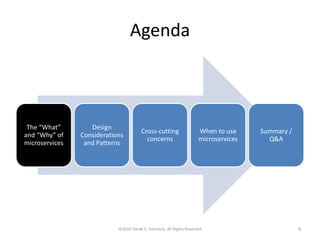
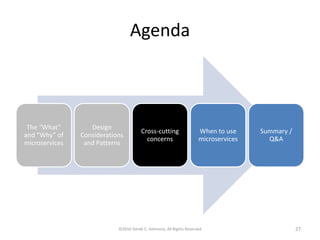
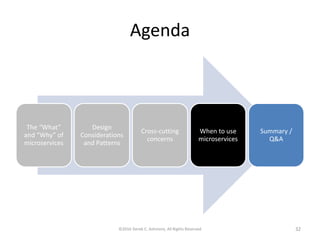
Agenda
The “What”
and “Why” of
microservices
Design
Considerations
and Patterns
Cross-cutting
concerns
When to use
microservices
Summary /
Q&A
©2016 Derek C. Ashmore, All Rights Reserved 4
What are Microservices?
• No concrete definition
• Common microservice traits
– Single functional purpose
• Most/all changes only impact one service
• Not dependent on execution context
– “loosely coupled”
– Independent process/jvm
– Stateless
– Standard Interface (typically Web Service/REST)
– Analogy: Stereo system, Linux utilities
©2016 Derek C. Ashmore, All Rights Reserved 5
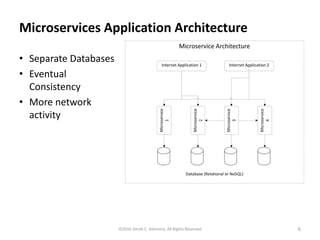
Microservices Application Architecture
• Separate Databases
• Eventual
Consistency
• More network
activity
©2016 Derek C. Ashmore, All Rights Reserved 6
Microservices are not about size
©2016 Derek C. Ashmore, All Rights Reserved 7
….. Microservices are about having a single business purpose!
Faster Delivery to Market
• High Deployment Rates
– Amazon = 23,000/day
– Netflix = 5,500 / day
• Business Benefits
– New features delivered
more quickly
– Quicker reaction to
competitors actions
• Combined with
– Continuous Delivery
– DevOps
©2016 Derek C. Ashmore, All Rights Reserved 8
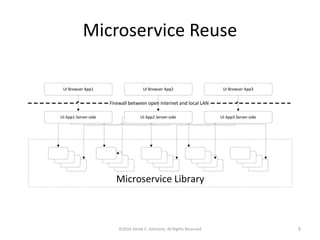
Microservice Reuse
©2016 Derek C. Ashmore, All Rights Reserved 9
No Lock-in
• Platform agnostic
• Fewer dependency
conflicts
• Still have cross-cutting
concerns
• “Toll” for first app
• Still have support
concerns
• Others need to be
able to support your
work
10©2016 Derek C. Ashmore, All Rights Reserved
Better Availability and Resiliency
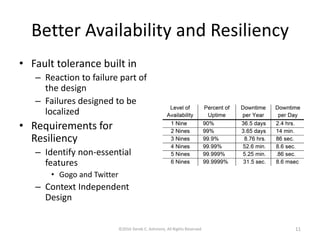
• Fault tolerance built in
– Reaction to failure part of
the design
– Failures designed to be
localized
• Requirements for
Resiliency
– Identify non-essential
features
• Gogo and Twitter
– Context Independent
Design
©2016 Derek C. Ashmore, All Rights Reserved 11
Easier Management /
Higher Throughput
• Easier to manage large
numbers of developers
– Concentrate on
intelligently drawing
service boundaries
– Manage/enforce service
contracts
• Each service team works
independently
• Team independence leads
to higher development
throughput
©2016 Derek C. Ashmore, All Rights Reserved 12
What is a Monolith?
• Hard to change
– QA test cycles are long
– Change causes unintended
consequences
• Hard to onboard new
developers
• Married to your technical
stack
• Harder to diagnose
bottlenecks and memory
issues
©2016 Derek C. Ashmore, All Rights Reserved 13
Challenges for Microservices
• More to manage
– More deployables
– More dependencies
– More complex
deployments
• Contract design critical
– Quality Matters
– Minimize breaking
changes
• Paradigm shift for
managers too
©2016 Derek C. Ashmore, All Rights Reserved 14
Agenda
The “What”
and “Why” of
microservices
Design
Considerations
and Patterns
Cross-cutting
concerns
When to use
microservices
Summary /
Q&A
©2016 Derek C. Ashmore, All Rights Reserved 15
Design considerations
• Service Boundaries (gerrymandering)
• Service call Failure / Unavailability
• Data Integrity
• Performance
©2016 Derek C. Ashmore, All Rights Reserved 16
Service Boundaries
• Core Services
– Services responsible for maintaining a specific business area data
– Usually named after Nouns
• Service is a system of record for a <blank>
– Student, Course, Classroom, etc.
• Process Services
– Services responsible for performing single complex tasks
– Usually represents an Action or Process
• Service is responsible for processing <blank>
– Student applications, Debt collection, etc.
– These services rely on core services
• Partitioning is an art
– Too few  same drawbacks as traditional architecture
– Too many  excessive network hops
©2016 Derek C. Ashmore, All Rights Reserved 17
Context Independence Check
• Does your service have multiple consumers?
– Could it?
• Could your service execute as easily in batch as
online?
– If ‘No’, then you’re making context assumptions
• Warning Signs
– Spending time analyzing service call flow
• Your services likely make context assumptions
– Agonizing over which service should do a given
activity
• Maybe you need a new service
©2016 Derek C. Ashmore, All Rights Reserved 18
Designing for Failure
• Dependent services could be down
– Minimize human intervention
– Fail sooner rather than later
– Horizontal scaling / clustering is your first line of defense
– Coding patterns can help as a backup
• Common Patterns:
– Retry
– Circuit Breaker
– Dispatch via Messaging
– Service Call Mediator
©2016 Derek C. Ashmore, All Rights Reserved 19
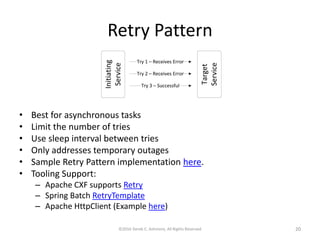
Retry Pattern
©2016 Derek C. Ashmore, All Rights Reserved 20
• Best for asynchronous tasks
• Limit the number of tries
• Use sleep interval between tries
• Only addresses temporary outages
• Sample Retry Pattern implementation here.
• Tooling Support:
– Apache CXF supports Retry
– Spring Batch RetryTemplate
– Apache HttpClient (Example here)
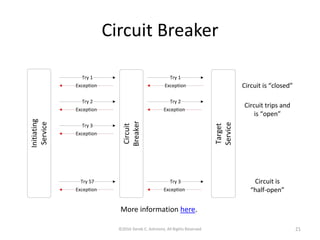
Circuit Breaker
©2016 Derek C. Ashmore, All Rights Reserved 21
More information here.
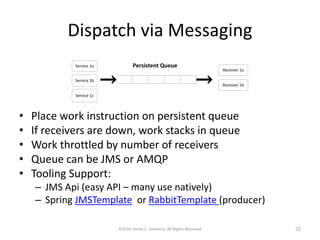
Dispatch via Messaging
©2016 Derek C. Ashmore, All Rights Reserved 22
• Place work instruction on persistent queue
• If receivers are down, work stacks in queue
• Work throttled by number of receivers
• Queue can be JMS or AMQP
• Tooling Support:
– JMS Api (easy API – many use natively)
– Spring JMSTemplate or RabbitTemplate (producer)
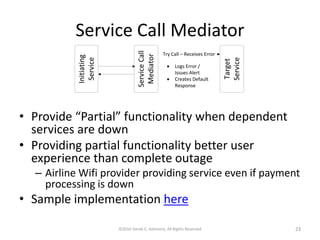
Service Call Mediator
©2016 Derek C. Ashmore, All Rights Reserved 23
• Provide “Partial” functionality when dependent
services are down
• Providing partial functionality better user
experience than complete outage
– Airline Wifi provider providing service even if payment
processing is down
• Sample implementation here
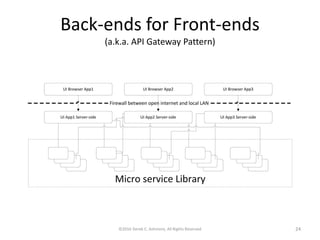
Back-ends for Front-ends
(a.k.a. API Gateway Pattern)
©2016 Derek C. Ashmore, All Rights Reserved 24
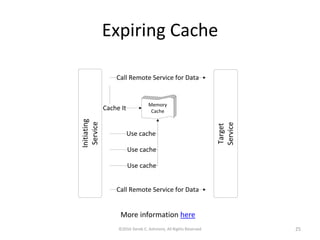
Expiring Cache
©2016 Derek C. Ashmore, All Rights Reserved 25
More information here
Common code between services?
• Yes, but….
– Version it; services make decision as to when to
upgrade
– Changes to common code can’t require the
deployment of multiple services
• That ‘common code’ needs to be its own separate
service
• Tends *not* to have business logic as that can change
and impact multiple services
©2016 Derek C. Ashmore, All Rights Reserved 26
Agenda
The “What”
and “Why” of
microservices
Design
Considerations
and Patterns
Cross-cutting
concerns
When to use
microservices
Summary /
Q&A
©2016 Derek C. Ashmore, All Rights Reserved 27
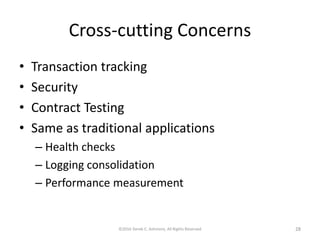
Cross-cutting Concerns
• Transaction tracking
• Security
• Contract Testing
• Same as traditional applications
– Health checks
– Logging consolidation
– Performance measurement
©2016 Derek C. Ashmore, All Rights Reserved 28
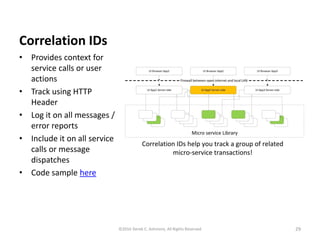
Correlation IDs
• Provides context for
service calls or user
actions
• Track using HTTP
Header
• Log it on all messages /
error reports
• Include it on all service
calls or message
dispatches
• Code sample here
29©2016 Derek C. Ashmore, All Rights Reserved
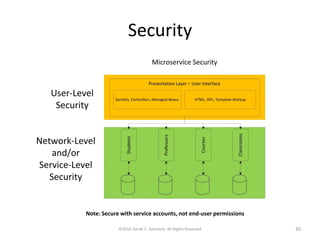
Security
©2016 Derek C. Ashmore, All Rights Reserved 30
Note: Secure with service accounts, not end-user permissions
Contract Testing
• Critical for MS architectures
– Contract changes can break other services
– Bulkhead for rogue developers
– Makes individual services more disposable
• Consumer-based testing
• Tooling support
– Apache HttpClient
– SoapUI
– ActiveMQ for JMS (embedded broker)
©2016 Derek C. Ashmore, All Rights Reserved 31
Agenda
The “What”
and “Why” of
microservices
Design
Considerations
and Patterns
Cross-cutting
concerns
When to use
microservices
Summary /
Q&A
©2016 Derek C. Ashmore, All Rights Reserved 32
When to consider MS
• Starting out with MS isn’t recommended unless
– Parts of the application will have extremely high volume
• Need to scale a portion of the application differently
• Note: MS isn’t all or nothing!
• Warning signs for app that’s too large
– Unintended consequences after release
– High technical debt / design rot
– Release testing cycles abnormally large
– Need to coordinate large numbers of developers for a
single code base
• Large number == takes more than two pizzas to feed
©2016 Derek C. Ashmore, All Rights Reserved 33
Common Mistakes
• Inappropriate Service Boundries
– Services that are not truly loosely coupled
• One change  Multiple services deployed
– Services that make ‘assumptions’ about execution
context
• Deployments cause unintended consequences
• Not recording all requests/responses
– Support developers need to localize problems
– Include request/response data in exceptions
• Contexted Exceptions in Commons Lang
©2016 Derek C. Ashmore, All Rights Reserved 34
Common Mistakes (continued)
• Not checking arguments up front
– Derivative exceptions take longer to debug/fix
– Error out faster
– NullPointerException == Argument not checked!
• No Change in Governance
– Easier / quicker path to production
– Automated Deployments/Backouts
• Less manual intervention
• Less manual testing (quick reaction vs prevention)
– Continuous Delivery / DevOps / Microservices go
hand-in-hand
©2016 Derek C. Ashmore, All Rights Reserved 35
Microservices Hype Cycle
©2016 Derek C. Ashmore, All Rights Reserved 36
Further Reading
• Microservices reading list
– http://www.mattstine.com/microservices
• Microsoft’s Cloud Design Patterns
– https://msdn.microsoft.com/en-us/library/dn600223.aspx
• Moneta Java microservice example
– https://github.com/Derek-Ashmore/moneta
• This slide deck
– http://www.slideshare.net/derekashmore
©2016 Derek C. Ashmore, All Rights Reserved 37
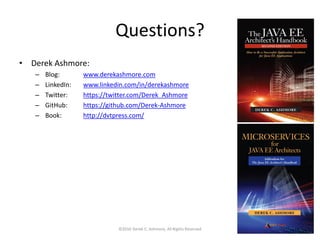
Questions?
• Derek Ashmore:
– Blog: www.derekashmore.com
– LinkedIn: www.linkedin.com/in/derekashmore
– Twitter: https://twitter.com/Derek_Ashmore
– GitHub: https://github.com/Derek-Ashmore
– Book: http://dvtpress.com/
©2016 Derek C. Ashmore, All Rights Reserved 38

Microservices for architects los angeles-2016-07-16

  • 1.
    Microservices for Architects Givenby Derek C. Ashmore LwTechSummit - Splash July 16, 2016 ©2016 Derek C. Ashmore, All Rights Reserved 1
  • 2.
    Who am I? •Professional Geek since 1987 • Java/J2EE/Java EE since 1999 • Cloud since 2012 • Roles include: • Cloud Architect • Project Manager • Developer • DBA • System Admin ©2016 Derek C. Ashmore, All Rights Reserved 2
  • 3.
    Discussion Resources • Thisslide deck – http://www.slideshare.net/derekashmore • Sample code on my Github – https://github.com/Derek-Ashmore/ • Sample Java Microservice (Moneta) – https://github.com/Derek-Ashmore/moneta • Slide deck has hyper-links! – Don’t bother writing down URLs ©2016 Derek C. Ashmore, All Rights Reserved 3
  • 4.
    Agenda The “What” and “Why”of microservices Design Considerations and Patterns Cross-cutting concerns When to use microservices Summary / Q&A ©2016 Derek C. Ashmore, All Rights Reserved 4
  • 5.
    What are Microservices? •No concrete definition • Common microservice traits – Single functional purpose • Most/all changes only impact one service • Not dependent on execution context – “loosely coupled” – Independent process/jvm – Stateless – Standard Interface (typically Web Service/REST) – Analogy: Stereo system, Linux utilities ©2016 Derek C. Ashmore, All Rights Reserved 5
  • 6.
    Microservices Application Architecture •Separate Databases • Eventual Consistency • More network activity ©2016 Derek C. Ashmore, All Rights Reserved 6
  • 7.
    Microservices are notabout size ©2016 Derek C. Ashmore, All Rights Reserved 7 ….. Microservices are about having a single business purpose!
  • 8.
    Faster Delivery toMarket • High Deployment Rates – Amazon = 23,000/day – Netflix = 5,500 / day • Business Benefits – New features delivered more quickly – Quicker reaction to competitors actions • Combined with – Continuous Delivery – DevOps ©2016 Derek C. Ashmore, All Rights Reserved 8
  • 9.
    Microservice Reuse ©2016 DerekC. Ashmore, All Rights Reserved 9
  • 10.
    No Lock-in • Platformagnostic • Fewer dependency conflicts • Still have cross-cutting concerns • “Toll” for first app • Still have support concerns • Others need to be able to support your work 10©2016 Derek C. Ashmore, All Rights Reserved
  • 11.
    Better Availability andResiliency • Fault tolerance built in – Reaction to failure part of the design – Failures designed to be localized • Requirements for Resiliency – Identify non-essential features • Gogo and Twitter – Context Independent Design ©2016 Derek C. Ashmore, All Rights Reserved 11
  • 12.
    Easier Management / HigherThroughput • Easier to manage large numbers of developers – Concentrate on intelligently drawing service boundaries – Manage/enforce service contracts • Each service team works independently • Team independence leads to higher development throughput ©2016 Derek C. Ashmore, All Rights Reserved 12
  • 13.
    What is aMonolith? • Hard to change – QA test cycles are long – Change causes unintended consequences • Hard to onboard new developers • Married to your technical stack • Harder to diagnose bottlenecks and memory issues ©2016 Derek C. Ashmore, All Rights Reserved 13
  • 14.
    Challenges for Microservices •More to manage – More deployables – More dependencies – More complex deployments • Contract design critical – Quality Matters – Minimize breaking changes • Paradigm shift for managers too ©2016 Derek C. Ashmore, All Rights Reserved 14
  • 15.
    Agenda The “What” and “Why”of microservices Design Considerations and Patterns Cross-cutting concerns When to use microservices Summary / Q&A ©2016 Derek C. Ashmore, All Rights Reserved 15
  • 16.
    Design considerations • ServiceBoundaries (gerrymandering) • Service call Failure / Unavailability • Data Integrity • Performance ©2016 Derek C. Ashmore, All Rights Reserved 16
  • 17.
    Service Boundaries • CoreServices – Services responsible for maintaining a specific business area data – Usually named after Nouns • Service is a system of record for a <blank> – Student, Course, Classroom, etc. • Process Services – Services responsible for performing single complex tasks – Usually represents an Action or Process • Service is responsible for processing <blank> – Student applications, Debt collection, etc. – These services rely on core services • Partitioning is an art – Too few  same drawbacks as traditional architecture – Too many  excessive network hops ©2016 Derek C. Ashmore, All Rights Reserved 17
  • 18.
    Context Independence Check •Does your service have multiple consumers? – Could it? • Could your service execute as easily in batch as online? – If ‘No’, then you’re making context assumptions • Warning Signs – Spending time analyzing service call flow • Your services likely make context assumptions – Agonizing over which service should do a given activity • Maybe you need a new service ©2016 Derek C. Ashmore, All Rights Reserved 18
  • 19.
    Designing for Failure •Dependent services could be down – Minimize human intervention – Fail sooner rather than later – Horizontal scaling / clustering is your first line of defense – Coding patterns can help as a backup • Common Patterns: – Retry – Circuit Breaker – Dispatch via Messaging – Service Call Mediator ©2016 Derek C. Ashmore, All Rights Reserved 19
  • 20.
    Retry Pattern ©2016 DerekC. Ashmore, All Rights Reserved 20 • Best for asynchronous tasks • Limit the number of tries • Use sleep interval between tries • Only addresses temporary outages • Sample Retry Pattern implementation here. • Tooling Support: – Apache CXF supports Retry – Spring Batch RetryTemplate – Apache HttpClient (Example here)
  • 21.
    Circuit Breaker ©2016 DerekC. Ashmore, All Rights Reserved 21 More information here.
  • 22.
    Dispatch via Messaging ©2016Derek C. Ashmore, All Rights Reserved 22 • Place work instruction on persistent queue • If receivers are down, work stacks in queue • Work throttled by number of receivers • Queue can be JMS or AMQP • Tooling Support: – JMS Api (easy API – many use natively) – Spring JMSTemplate or RabbitTemplate (producer)
  • 23.
    Service Call Mediator ©2016Derek C. Ashmore, All Rights Reserved 23 • Provide “Partial” functionality when dependent services are down • Providing partial functionality better user experience than complete outage – Airline Wifi provider providing service even if payment processing is down • Sample implementation here
  • 24.
    Back-ends for Front-ends (a.k.a.API Gateway Pattern) ©2016 Derek C. Ashmore, All Rights Reserved 24
  • 25.
    Expiring Cache ©2016 DerekC. Ashmore, All Rights Reserved 25 More information here
  • 26.
    Common code betweenservices? • Yes, but…. – Version it; services make decision as to when to upgrade – Changes to common code can’t require the deployment of multiple services • That ‘common code’ needs to be its own separate service • Tends *not* to have business logic as that can change and impact multiple services ©2016 Derek C. Ashmore, All Rights Reserved 26
  • 27.
    Agenda The “What” and “Why”of microservices Design Considerations and Patterns Cross-cutting concerns When to use microservices Summary / Q&A ©2016 Derek C. Ashmore, All Rights Reserved 27
  • 28.
    Cross-cutting Concerns • Transactiontracking • Security • Contract Testing • Same as traditional applications – Health checks – Logging consolidation – Performance measurement ©2016 Derek C. Ashmore, All Rights Reserved 28
  • 29.
    Correlation IDs • Providescontext for service calls or user actions • Track using HTTP Header • Log it on all messages / error reports • Include it on all service calls or message dispatches • Code sample here 29©2016 Derek C. Ashmore, All Rights Reserved
  • 30.
    Security ©2016 Derek C.Ashmore, All Rights Reserved 30 Note: Secure with service accounts, not end-user permissions
  • 31.
    Contract Testing • Criticalfor MS architectures – Contract changes can break other services – Bulkhead for rogue developers – Makes individual services more disposable • Consumer-based testing • Tooling support – Apache HttpClient – SoapUI – ActiveMQ for JMS (embedded broker) ©2016 Derek C. Ashmore, All Rights Reserved 31
  • 32.
    Agenda The “What” and “Why”of microservices Design Considerations and Patterns Cross-cutting concerns When to use microservices Summary / Q&A ©2016 Derek C. Ashmore, All Rights Reserved 32
  • 33.
    When to considerMS • Starting out with MS isn’t recommended unless – Parts of the application will have extremely high volume • Need to scale a portion of the application differently • Note: MS isn’t all or nothing! • Warning signs for app that’s too large – Unintended consequences after release – High technical debt / design rot – Release testing cycles abnormally large – Need to coordinate large numbers of developers for a single code base • Large number == takes more than two pizzas to feed ©2016 Derek C. Ashmore, All Rights Reserved 33
  • 34.
    Common Mistakes • InappropriateService Boundries – Services that are not truly loosely coupled • One change  Multiple services deployed – Services that make ‘assumptions’ about execution context • Deployments cause unintended consequences • Not recording all requests/responses – Support developers need to localize problems – Include request/response data in exceptions • Contexted Exceptions in Commons Lang ©2016 Derek C. Ashmore, All Rights Reserved 34
  • 35.
    Common Mistakes (continued) •Not checking arguments up front – Derivative exceptions take longer to debug/fix – Error out faster – NullPointerException == Argument not checked! • No Change in Governance – Easier / quicker path to production – Automated Deployments/Backouts • Less manual intervention • Less manual testing (quick reaction vs prevention) – Continuous Delivery / DevOps / Microservices go hand-in-hand ©2016 Derek C. Ashmore, All Rights Reserved 35
  • 36.
    Microservices Hype Cycle ©2016Derek C. Ashmore, All Rights Reserved 36
  • 37.
    Further Reading • Microservicesreading list – http://www.mattstine.com/microservices • Microsoft’s Cloud Design Patterns – https://msdn.microsoft.com/en-us/library/dn600223.aspx • Moneta Java microservice example – https://github.com/Derek-Ashmore/moneta • This slide deck – http://www.slideshare.net/derekashmore ©2016 Derek C. Ashmore, All Rights Reserved 37
  • 38.
    Questions? • Derek Ashmore: –Blog: www.derekashmore.com – LinkedIn: www.linkedin.com/in/derekashmore – Twitter: https://twitter.com/Derek_Ashmore – GitHub: https://github.com/Derek-Ashmore – Book: http://dvtpress.com/ ©2016 Derek C. Ashmore, All Rights Reserved 38