Microsc. Microanal. Microstruct. 8

(1997)

355-368

DECEMBER

1997,

PAGE

355

Fabrication of Nano-Tips by Carbon Contamination in a Scanning
Electron Microscope for Use in Scanning Probe Microscopy and
Field Emission
Massimo

Antognozzi,

Andrea Sentimenti and

INFM and Centre of Electron
46, 40126 Bologna,

via Irnerio

Ugo Valdrè

Microscopy, Department of Physics of the University,
Italy

(Received August 29, 1997; accepted

December 1,

1997)

PACS.61.16.-d - Electron, ion, and scanning probe microscopy

PACS.79.70.+q -

Field

emission, ionization, evaporation, and desorption

Abstract. 2014 Results are reported on a systematic study addressed to an effective fabrication
of nano-tips by means of carbon contamination in a scanning electron microscope. Nano-tips
with angular aperture of 10°, apical radius of about 5 nm,1 03BCm long can be efficiently produced
by our method in less than 60 s of electron beam exposure; it involves, in particular, successive
focusing during tip growth and the use of a carbon block as a source of contaminant. These tips
have been used as high aspect ratio and low capillary force probes in atomic force microscopy,
and as nano-sized field emitters for electron guns.

1. Introduction
a wide interest in the fabrication of nano-sized tips. At least three major
concerned with their applications: (i) Scanning Probe Microscopy (SPM) [1], (ii)
field emission [2,3] and (iii) field emitter displays [4]. Here we deal specifically with the first
two cases only; however case (iii) will benefit from progress in field (ii).
Case (i) requires probes with the highest possible aspect ratio (i. e., the smallest tip angular
aperture), mechanical strength and the smallest apical radius in order to profile irregular
surfaces with steep slants and to attain high resolution. An additional requirement may be the
electrical conductivity when the probes are to be used in scanning tunneling microscopy and
electric force microscopy.
Case (ii) demands sharp and electrically conducting emitters, in order to get the highest
possible current densities and coherence, with the lowest extraction voltage, for use in electron
guns applied in various types of microscopy and devices.
Usually, probes are made out of metals (e.g., W, Pt, Pt/Ir), semiconductors (Si) or insulators (Si3N4); the latters are sometimes coated with a conducting layer (e.g., Au, Pd, Al)
or a magnetic layer (Ni, Co) depending on the application. Emitters are made of metals or
semiconductors. Here we deal with both probe and emitter tips, fabricated by carbon contamination in a Scanning Electron Microscope (SEM). Whereas this method has been pursued
in several places as far as probes are concerned, nothing has been reported to our knowledge

There is

nowadays

areas are

Oc

EDP Sciences 1998

Article available at http://mmm.edpsciences.org or http://dx.doi.org/10.1051/mmm:1997127

,
356

in the case of field emitters. However, the properties of field emitters made of carbon in the
form of nanotubes and diamond chips have been investigated, and the results obtained are
very interesting [4-6]. This paper reports first on the deliberate enhancement of carbon contamination in an SEM, then on an optimized method for the fabrication of carbon nano-tips;
examples of their applications as probes and field emitters are finally presented.

2. Carbon Contamination
Carbon contamination has been studied extensively in electron and ion microscopy with the aim
ideally eliminate it. Very little work has been done so far on the opposite problem
of increasing the contamination selectively, efficiently and in a simple way; such previous work
concerns the production of high aspect ratio probes at the top of cantilevers for application
in scanning probe microscopy by using the electron beam of a SEM. The inconsistent results
we obtained by following empirical recipes suggested by various authors (i.e., use of several
contaminants, such as paraffin oils or blocks), prompted us to tackle the problem afresh.
The following parameters affecting the growth of carbon contamination tips were taken into
account and their effects systematically investigated.
to reduce and

1. SEM

accelerating voltage,

2. beam current, measured with

3. beam

diameter,

4. beam

stability, focus

5.

1

specimen
and

Faraday

eucentric

cup,

level, and corresponding

density,

astigmatism,

material,

coating before carbon-growth for non-conductive specimens.

The pressure in the specimen chamber during the
10-4 Torr and the hydrocarbon partial pressure

x

mass

current

specimen material, shape and clamping,

6. stub

7.

at

a

spectrometer

investigations ranged from 5 x 10⁻⁵ to
about 10-6 Torr, measured with a

was

[7].

The assessment of the tips geometry after their growth was usually made by SEM observations with the tip placed at 90° with respect to the beam; in some cases the observations were
performed in a Transmission Electron Microscope (TEM).
The results are reported below.
(i) The best accelerating voltage is 30 kV (highest value provided by our instrument, a Philips
SEM 515); the beam current at the specimen level ranged from about 10-12 to 10-13 A and
the corresponding nominal spot sizes were 20 nm and 5 nm (the emission current, read from
the microscope meter, was between 100 and 200 03BCA).
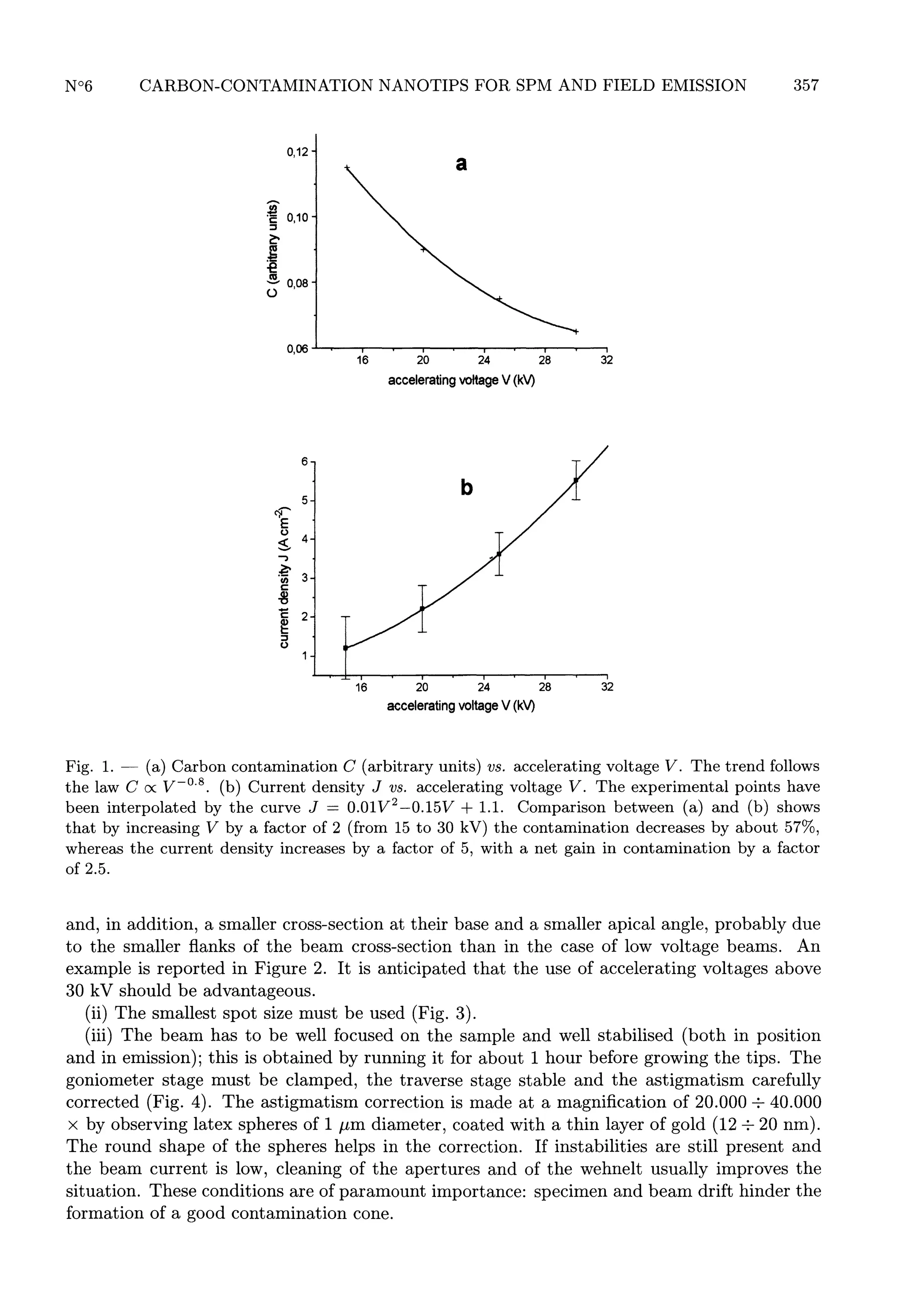
Since it is well known that the contamination rate C increases on decreasing the accelerating
voltage V (C is proportional to V-0-8, Fig. la) [8,9] and is proportional to the current density
J at specimen level, one would expect the best results are obtained at low voltages. However,
the gain in contamination at low voltage does not balance the contamination reduction due to
the decrease of current density connected with the voltage change (Fig. lb) [8,9]. In fact, the
contamination decreases by a factor of about 2.5 by lowering the voltage from 30 to 15 kV.
Tips grown at the highest voltage show better features than those produced at low voltages,
for the same values of the remaining free parameters: they have, of course, a greater height
357

Fig. 1.
(a) Carbon contamination C (arbitrary units) vs. accelerating voltage V. The trend follows
the law (7 oc y-D.8. (b) Current density J vs. accelerating voltage V. The experimental points have
been interpolated by the curve J = 0.01V2-0.15V + 1.1. Comparison between (a) and (b) shows
that by increasing V by a factor of 2 (from 15 to 30 kV) the contamination decreases by about 57%,
whereas the current density increases by a factor of 5, with a net gain in contamination by a factor
of 2.5.
-

angle, probably due
voltage beams. An
of accelerating voltages above

and, in addition, a smaller cross-section at their base and a smaller apical
to the smaller flanks of the beam cross-section than in the case of low

is reported in Figure 2. It is anticipated that the use
30 kV should be advantageous.
(ii) The smallest spot size must be used (Fig. 3).
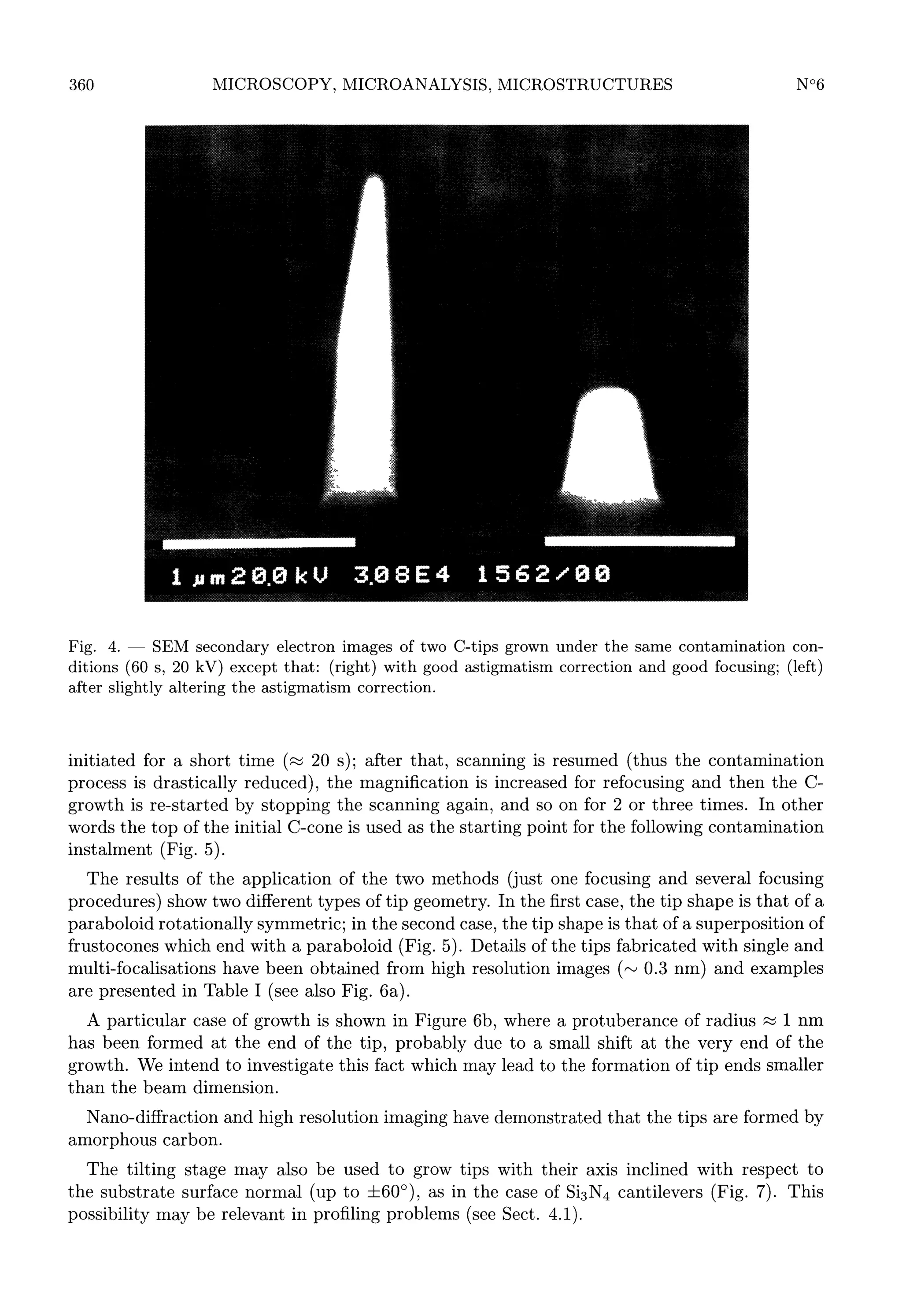
(iii) The beam has to be well focused on the sample and well stabilised (both in position
and in émission) ; this is obtained by running it for about 1 hour before growing the tips. The
goniometer stage must be clamped, the traverse stage stable and the astigmatism carefully
corrected (Fig. 4). The astigmatism correction is made at a magnification of 20.000 z 40.000
x by observing latex spheres of 1 Mm diameter, coated with a thin layer of gold (12 20 nm).
The round shape of the spheres helps in the correction. If instabilities are still present and
the beam current is low, cleaning of the apertures and of the wehnelt usually improves the
situation. These conditions are of paramount importance: specimen and beam drift hinder the
formation of a good contamination cone.

example
358

SEM secondary electron image taken at 30 kV of two carbon tips grown on a tungsten
surface showing a large difference of geometry and size. (Right side tip) Growth conditions: 15 kV,
60 s, spot size 5 nm, current density 1.1 A cm-2.(Left side tip) Growth conditions: 30 kV, 60 s, spot
size 5 nm, current density 5.6 A cm-2.

Fig.

2.

-

not seem to influence the contamination growth,
tested (Tungsten in the form of wires, plates and microscope
filaments, Tantalum edges, Gold and Palladium films) as long as the specimen is an electrical
conductor and clean. In the case of Si and Si3N4 cantilevers, effective C-contamination growth
is obtained by first coating the substrate with a metal layer (about 20 nm thick of Au or
Pd) to avoid charging up. The carbon growth is more regular on a Pd than on a Au coating
film, owing to the finest size of the Pd clusters. If the above specified conditions are not well
set, contamination rate is low, even with the microscope in standard order; after 10 min of
irradiation only thin (20 2013 80 nm) slightly bulging contamination spots of 50 2013 80 nm diameter
were obtained.

(iv)

The

specimen material and shape do

at least for the

types which

were

(v) Whether the specimen is mechanically clamped or glued with silver dag is irrelevant. On
the contrary, the use of a carbon stub (with the specimen mechanically held), improves the
contamination growth and the reproducibility of the results. Alternatively, simply and cheaply,
use can be made of standard Al stubs to support the specimen and by placing in its vicinity a
small carbon block (N 50 mm3). The effectiveness of the C-block depends on both its surface
and its distance from the specimen region where the C-growth has to take place. The growth
rate is 120132 03BCm per minute. The adsorption properties of carbon have been known and exploited
for long time. In the present situation it is believed that under vacuum the carbon block
releases the contaminants previously adsorbed, thus creating a high concentration of carbon
compounds in the proximity of the specimen, which favours the contamination growth [10].
The contamination effect is also well noticeable when a large C-block (surface 50 cm2) is placed
inside the specimen chamber ( e.g., in a corner).
359

SEM secondary electron image of a tip grown with a 5 nm beam diameter (left), and of the
Fig. 3.
contamination spot (right) which was produced during an attempt to grow a carbon tip with a large
electron beam diameter (100 nm).
-

(vi) Charging up effects constitute a serious problem when using high accelerating voltages,
since they affect the stability of the electron beam and give rise to drift. The coating of
the substrate with a metal (e.g., gold) overcomes this problem. We also found that coating
obtained by evaporation provides more reproducible results than sputtering.
3.

Carbon-Tip

Growth

practical procedure developed to fabricate conically shaped C-tip with small full aperture
angle « 10° ) and a small apical radius « 5 nm) is as follows.
First of all the electron beam, set at the smallest spot, is checked to be spatially and intensity stable (time required usually 1 h) and the astigmatism corrected with the help of latex
spheres. The specimen on which the C-tips have to be grown is then inserted in the SEM. The
The

electron beam is focused over an area where small details are present (observation made at
80.000 2013 160.000 x ) near to the region where the tip has to be grown. Then the beam is
stopped on the latter region. As soon as contamination is formed, astigmatism correction
is again performed by observing the contamination spot. Good focusing, high stability and
careful astigmatism correction are essential operations in order to achieve high quality tips;
otherwise the regular shape, the sharpness and even the growth rate are jeopardised (Fig. 4).
During the growth of contamination, the Secondary Electron (SE) signal (observed in the
y-monitor) increases because of topographic (edge) effects [11] ; it increases until the tip has
reached its maximum aspect ratio. The beam is then scanned and the geometrical quality of
the tip assessed visually by tilting the specimen stage by 90° with respect to the electron beam.
The finest results are, however, obtained by a focusing sequence: the beam is first scanned
for selecting the region of growth and for focusing, then scanning is stopped and C-growth
360

SEM secondary electron images of two C-tips grown under the same contamination conFig. 4.
ditions (60 s, 20 kV) except that: (right) with good astigmatism correction and good focusing; (left)
after slightly altering the astigmatism correction.
-

a short time (~ 20 s); after that, scanning is resumed (thus the contamination
drastically reduced), the magnificat ion is increased for refocusing and then the Cgrowth is re-started by stopping the scanning again, and so on for 2 or three times. In other
words the top of the initial C-cone is used as the starting point for the following contamination

initiated for

process is

instalment

(Fig. 5).

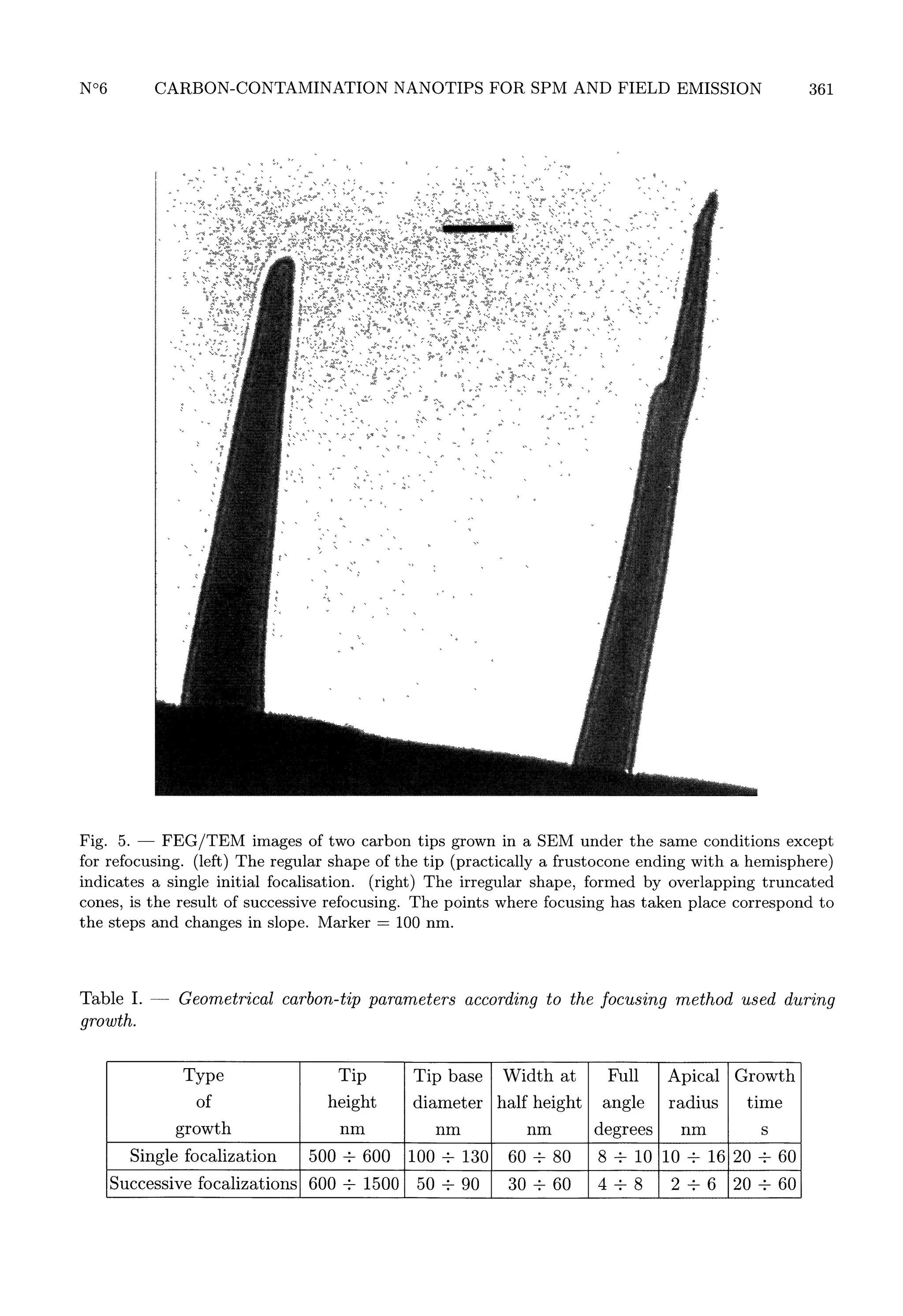
(just one focusing and several focusing
In the first case, the tip shape is that of a
paraboloid rotationally symmetric; in the second case, the tip shape is that of a superposition of
frustocones which end with a paraboloid (Fig. 5). Details of the tips fabricated with single and
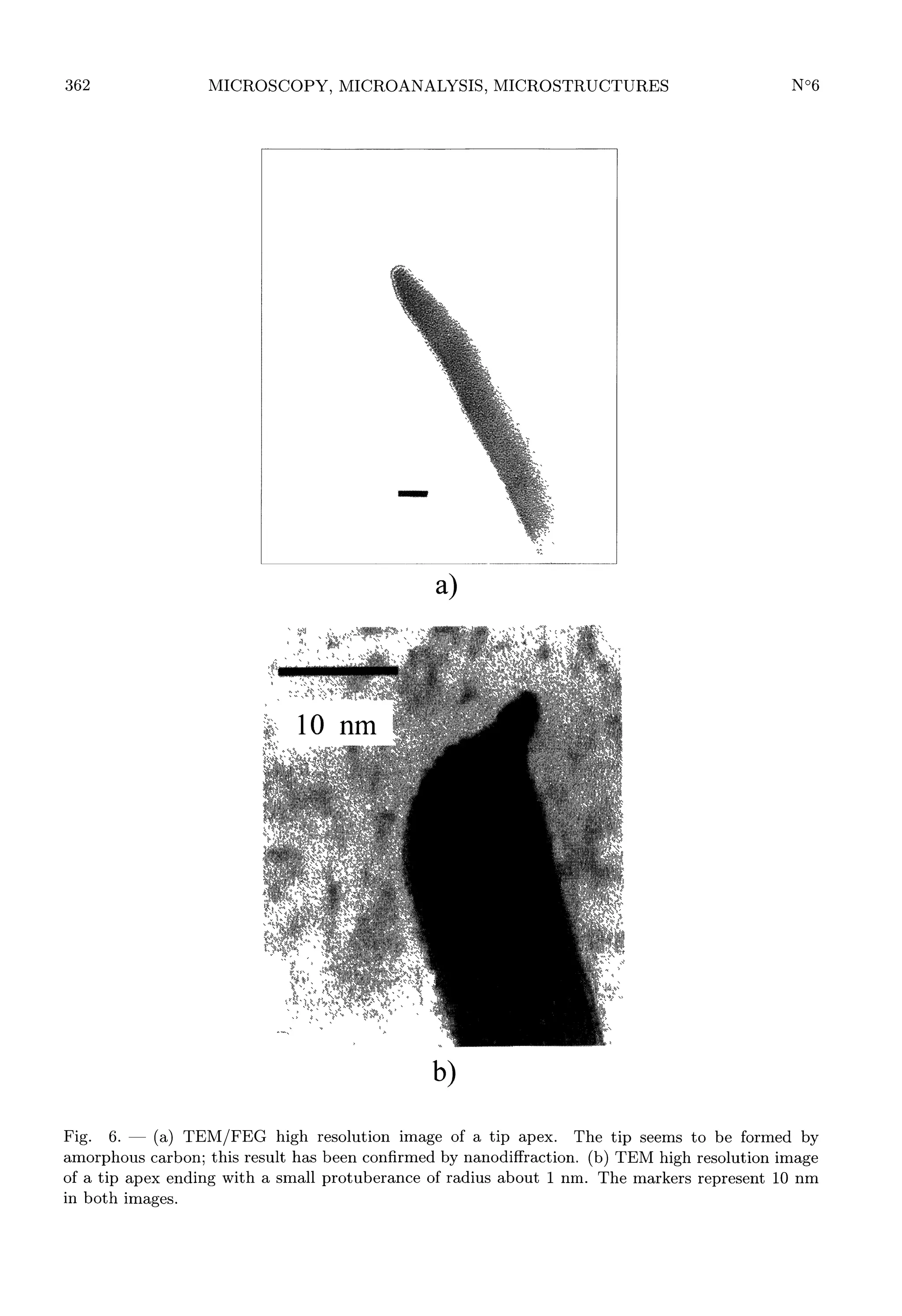
multi-focalisations have been obtained from high resolution images (N 0.3 nm) and examples
are presented in Table I (see also Fig. 6a).
The results of the

application of

the two methods

procedures) show two different types of tip geometry.

A particular case of growth is shown in Figure 6b, where a protuberance of radius 1 nm
has been formed at the end of the tip, probably due to a small shift at the very end of the
growth. We intend to investigate this fact which may lead to the formation of tip ends smaller
than the beam dimension.
Nano-diffraction and

amorphous carbon.
The tilting stage

high resolution imaging have demonstrated that

the

tips

are

formed

by

may also be used to grow tips with their axis inclined with respect to
the substrate surface normal (up to =b60°), as in the case of Si3N4 cantilevers (Fig. 7). This
possibility may be relevant in profiling problems (see Sect. 4.1).
361

Fig. 5.
FEG/TEM images of two carbon tips grown in a SEM under the same conditions except
for refocusing. (left) The regular shape of the tip (practically a frustocone ending with a hemisphere)
indicates a single initial focalisation. (right) The irregular shape, formed by overlapping truncated
cones, is the result of successive refocusing. The points where focusing has taken place correspond to
the steps and changes in slope. Marker = 100 nm.
-

Table I.

growth.

-

Geometrical

carbon-tip parameters according

to the

focusing

method used

during
362

Fig. 6.
(a) TEM/FEG high resolution image of a tip apex. The tip seems to be formed by
carbon; this result has been confirmed by nanodiffraction. (b) TEM high resolution image
amorphous
of a tip apex ending with a small protuberance of radius about 1 nm. The markers represent 10 nm
in both images.
-
363

7.
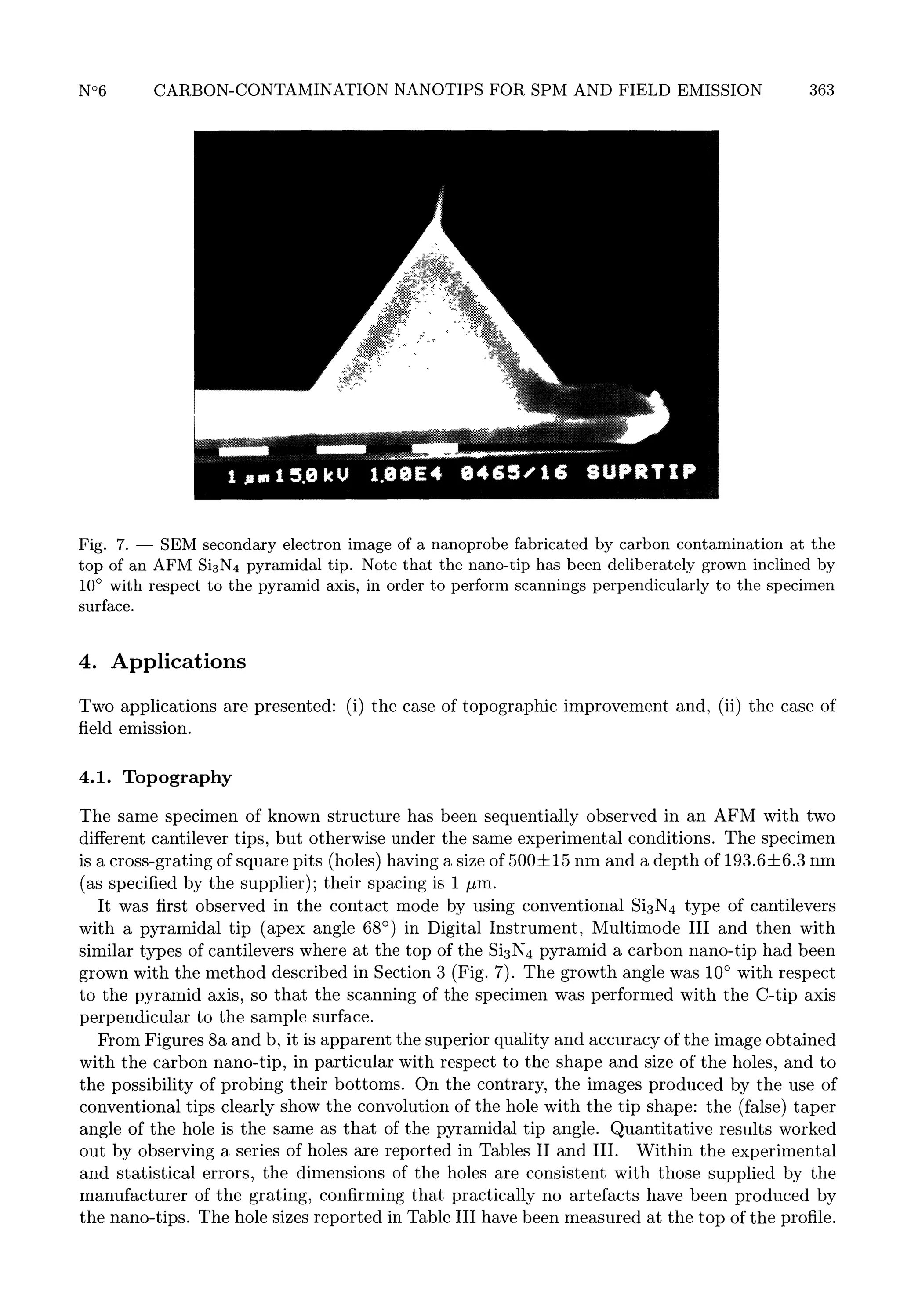
SEM secondary electron image of a nanoprobe fabricated by carbon contamination at the
of an AFM Si3N4 pyramidal tip. Note that the nano-tip has been deliberately grown inclined by
top
10° with respect to the pyramid axis, in order to perform scannings perpendicularly to the specimen
surface.

Fig.

4.

-

Applications

Two applications
field emission.
4.1.

are

presented: (i)

the

case

of

topographic improvement and, (ii)

the

case

of

Topography

The same specimen of known structure has been sequentially observed in an AFM with two
different cantilever tips, but otherwise under the same experimental conditions. The specimen
is a cross-grating of square pits (holes) having a size off 15 nm and a depth of 193.6=b6.3 nm
(as specified by the supplier); their spacing is 1 03BCm.
It was first observed in the contact mode by using conventional Si3N4 type of cantilevers
with a pyramidal tip (apex angle 68° ) in Digital Instrument, Multimode III and then with
similar types of cantilevers where at the top of the Si3N4 pyramid a carbon nano-tip had been
grown with the method described in Section 3 (Fig. 7). The growth angle was 10° with respect
to the pyramid axis, so that the scanning of the specimen was performed with the C-tip axis
perpendicular to the sample surface.
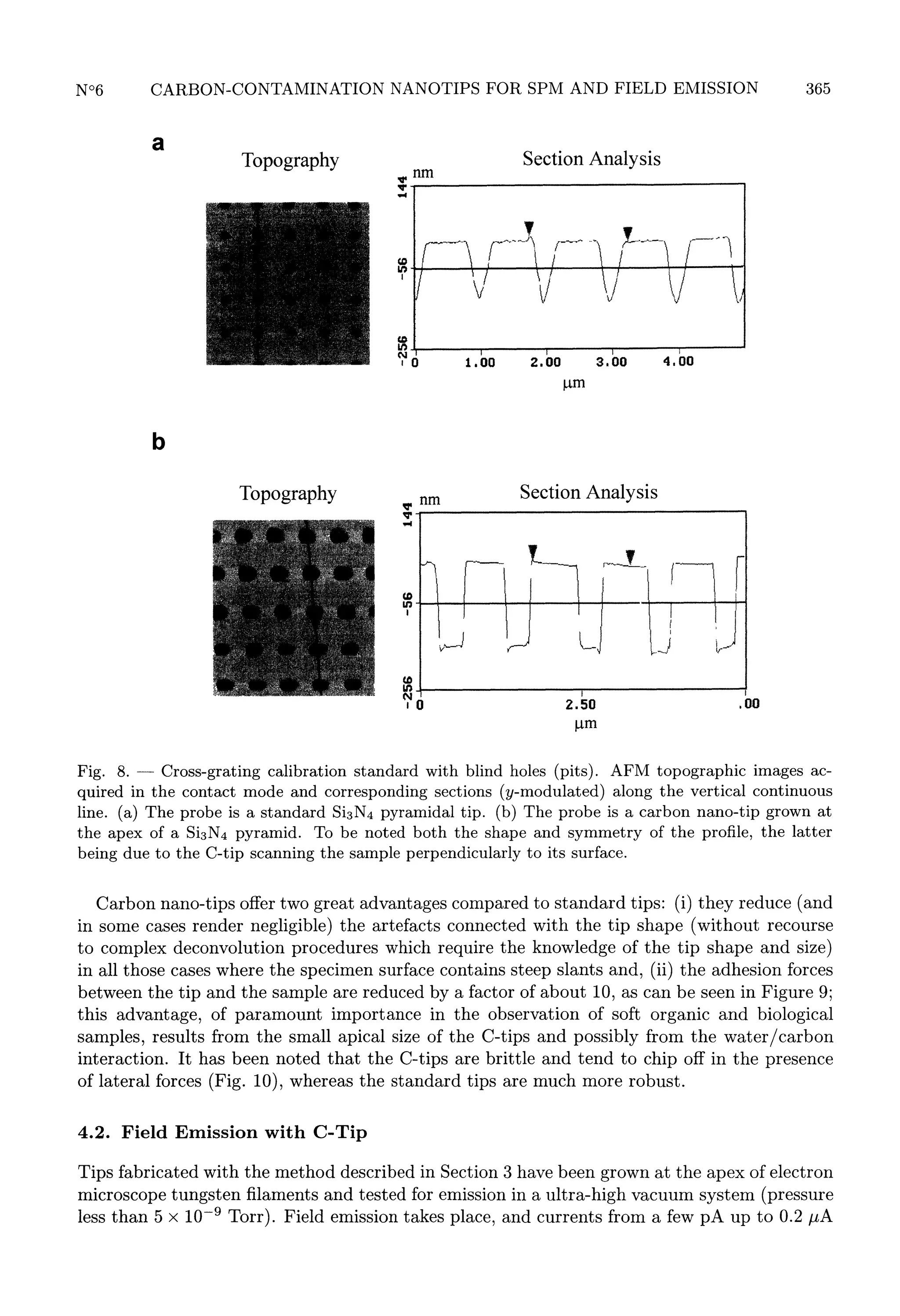
From Figures 8a and b, it is apparent the superior quality and accuracy of the image obtained
with the carbon nano-tip, in particular with respect to the shape and size of the holes, and to
the possibility of probing their bottoms. On the contrary, the images produced by the use of
conventional tips clearly show the convolution of the hole with the tip shape: the (false) taper
angle of the hole is the same as that of the pyramidal tip angle. Quantitative results worked
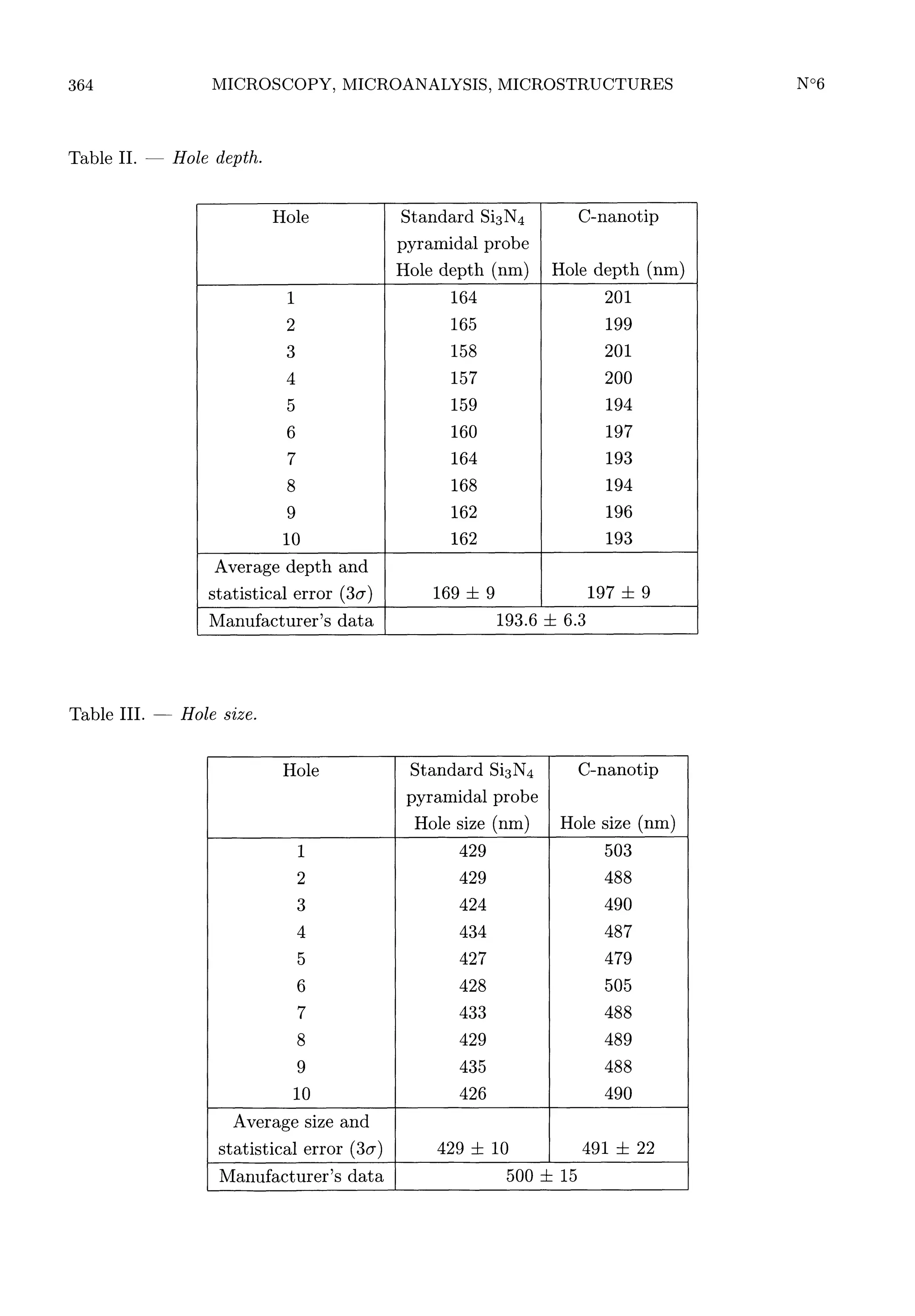
out by observing a series of holes are reported in Tables II and III. Within the experimental
and statistical errors, the dimensions of the holes are consistent with those supplied by the
manufacturer of the grating, confirming that practically no artefacts have been produced by
the nano-tips. The hole sizes reported in Table III have been measured at the top of the profile.
364

Table II.

Table III.

-

-

Hole

depth.

Hole size.
365

Cross-grating calibration standard with blind holes (pits). AFM topographic images acFig. 8.
quired in the contact mode and corresponding sections (y-modulated) along the vertical continuous
line. (a) The probe is a standard Si3N4 pyramidal tip. (b) The probe is a carbon nano-tip grown at
the apex of a Si3N4 pyramid. To be noted both the shape and symmetry of the profile, the latter
being due to the C-tip scanning the sample perpendicularly to its surface.
-

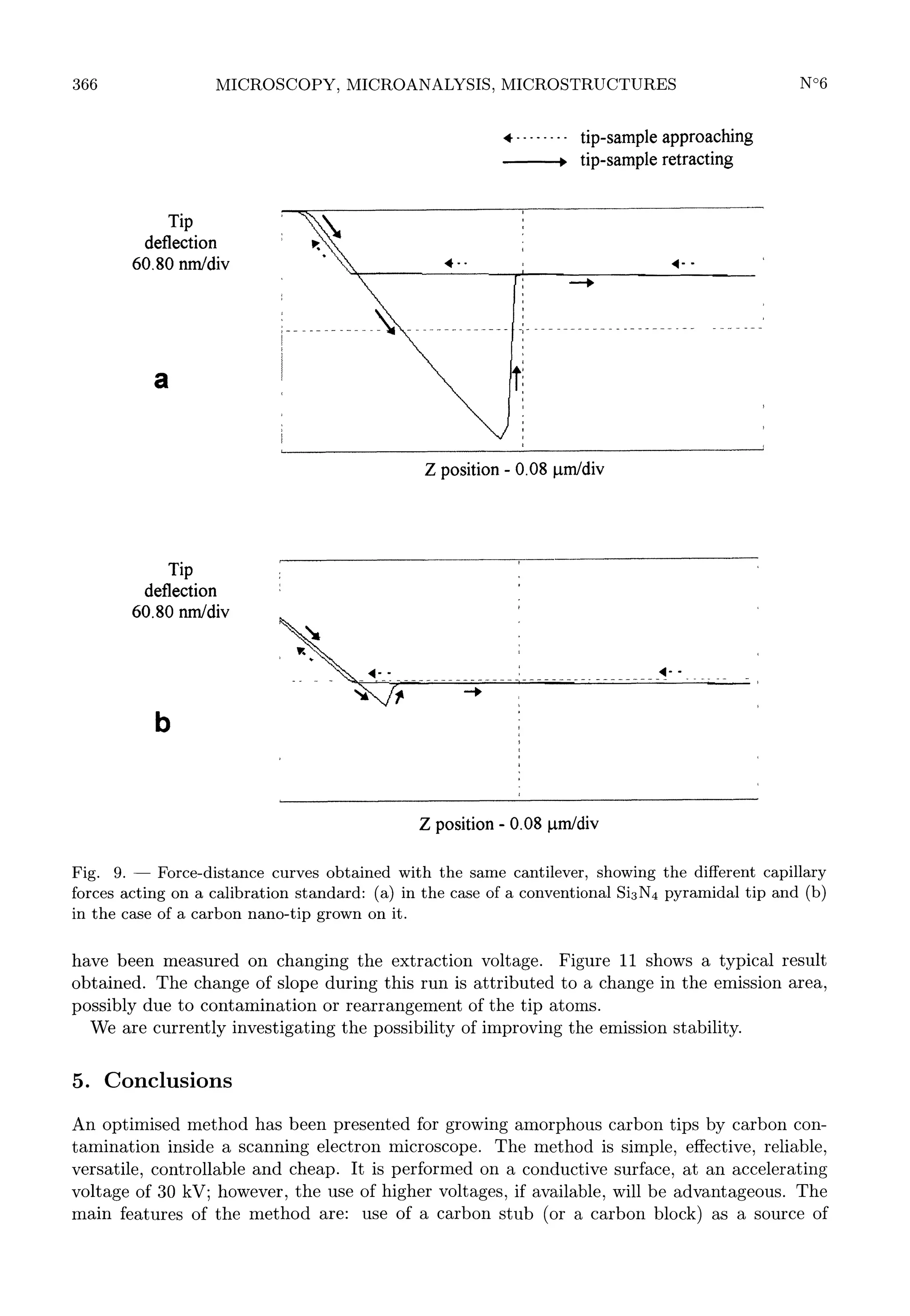
Carbon nano-tips offer two great advantages compared to standard tips: (i) they reduce (and
some cases render negligible) the artefacts connected with the tip shape (without recourse
to complex deconvolution procedures which require the knowledge of the tip shape and size)
in all those cases where the specimen surface contains steep slants and, (ii) the adhesion forces
between the tip and the sample are reduced by a factor of about 10, as can be seen in Figure 9;
this advantage, of paramount importance in the observation of soft organic and biological
samples, results from the small apical size of the C-tips and possibly from the water/carbon
interaction. It has been noted that the C-tips are brittle and tend to chip off in the presence
of lateral forces (Fig. 10), whereas the standard tips are much more robust.
in

4.2. Field Emission with

C-Tip

Tips fabricated with the method described in Section 3 have been grown at the apex of electron
microscope tungsten filaments and tested for emission in a ultra-high vacuum system (pressure
less than 5 x 10⁻⁹ Torr). Field emission takes place, and currents from a few pA up to 0.2 MA
366

Fig.

9.

forces
in the

-

Force-distance curves obtained with the same cantilever, showing the different capillary
on a calibration standard: (a) in the case of a conventional Si3N4 pyramidal tip and (b)
of a carbon nano-tip grown on it.

acting
case

have been measured on changing the extraction voltage. Figure 11 shows a typical result
obtained. The change of slope during this run is attributed to a change in the emission area,
possibly due to contamination or rearrangement of the tip atoms.
We are currently investigating the possibility of improving the emission stability.

5. Conclusions
An optimised method has been presented for growing amorphous carbon tips by carbon contamination inside a scanning electron microscope. The method is simple, effective, reliable,
versatile, controllable and cheap. It is performed on a conductive surface, at an accelerating
voltage of 30 kV; however, the use of higher voltages, if available, will be advantageous. The
main features of the method are: use of a carbon stub (or a carbon block) as a source of
367

10.
SEM secondary electron image of latex spheres deposited
after several observations in an AFM. To be noted the two broken
The marker represents 1 03BCm.

Fig.

-

gold-coated graphite surface
tips lying near the large sphere.

on a

contaminant, and controlled focusing and astigmatism correction during the tip growth. The
results can be immediately assessed.
Probes can be prepared with this technique in about 60 s; they have a conical shape with
the full angle as small as 10° and the length of 1 /mi. However, the height can be varied within
a large range (from less than 1 ,um to several tens of 03BCm) by varying the contamination time.
An example of application in the imaging and measurement of depth and size of blind holes
has been given and comparison has been made to the case of using standard tips. It has also
been shown that the capilary forces acting on a carbon nano-tip are smaller by one order of
magnitude with respect to those acting on standard tips under the same conditions.
Nano-tips made by carbon contamination (radius less than 5 nm) have been grown at the
apex of ordinary electron microscope tungsten filaments, and field emission has been demonstrated to take place; its features are similar to those obtained with pointed tungsten filaments
under the same geometrical conditions. However, current instabilities are a problem, which
are believed to be related to the pressure in the field emission chamber, around 5 x 10⁻⁹ Torr.
Modifications to the chamber to improve the vacuum are in progress.
We envisage the exploitation of such arrangements in electron microscopes equipped with
field emission guns. The use of standard pointed-filament (with their own sockets) at the
top of which carbon nano-tips are grown under controlled conditions in a scanning electron
microscope will allow their re-utilization in TEM/FEGs or in STEMs without the need to
change neither the configuration of the gun electrodes, nor the related electronics, as might be
required for re-sharpening blunt tungsten tips for field emission guns [12]. Carbon tips grown
on an electrically conducting substrate may also be used in scanning tunneling microscopy.
368

Experimental Fowler-Nordheim plot obtained from a carbon-contamination grown nanofield emitter at a pressure of less than 5 x 10-g Torr. At 2600 V the emission current is
2.6 nA. The two trends are attributed to emission changes due to contaminants or geometrical changes.

Fig. Il.
tip used

-

as

Acknowledgments
We thank Dr A. Alessandrini for useful discussions and MURST for financial support.

References

[1] Keller D.J. and Chou C.-C., Surf. Sci. 268 (1992) 333.
[2] Fink H.W., Phys. Scr. 38 (1988) 260.
[3] Binh V.T. and Garcia N., Ultramicroscopy 42-44 (1992) 80.
[4] Baptist R., Proc. 7th Int. Vacuum Microelectronics Conf., Grenoble (Société Française du
Vide, Paris, 1994).
[5] Rinzler A.S., Hafner J.H., Nikolaev P., Lou L., Kim S.G., Tomanek D., Nordlander P.,
Colbert D.T. and Smalley R.E., Science 269 (1995) 1150.
[6] De Heer W.A., Châtelain A. and Ugarte D., Science 270 (1995) 1179.
[7] Randi M.R., Monteverde F.T. and Valdrè U., J. Supercond. Sci. Technol. 7 (1994) 507.
[8] Hart K.R., Kassner T.F. and Maurin J.K., Phil. Mag. 21 (1970) 453.
[9] Hirsch P., Kässens M., Püttmann M. and Reimer L., Scanning 16 (1994) 101.
[10] Sentimenti A., Thesis, no. 2091, Università degli Studi, Bologna, 1995.
[11] Antognozzi M. and Valdrè U., Microsc. Microanal. Microstruct. 6 (1995) 513.
[12] Binh V.T., Garcia N. and Purcell S.T., Adv. Imag. Elec. Phys. 95 (1996) 63.

Microscopy microanalysis microstructures_the european physical journal_applied physics_nanotechnology_sentimenti

  • 1.
    Microsc. Microanal. Microstruct.8 (1997) 355-368 DECEMBER 1997, PAGE 355 Fabrication of Nano-Tips by Carbon Contamination in a Scanning Electron Microscope for Use in Scanning Probe Microscopy and Field Emission Massimo Antognozzi, Andrea Sentimenti and INFM and Centre of Electron 46, 40126 Bologna, via Irnerio Ugo Valdrè Microscopy, Department of Physics of the University, Italy (Received August 29, 1997; accepted December 1, 1997) PACS.61.16.-d - Electron, ion, and scanning probe microscopy PACS.79.70.+q - Field emission, ionization, evaporation, and desorption Abstract. 2014 Results are reported on a systematic study addressed to an effective fabrication of nano-tips by means of carbon contamination in a scanning electron microscope. Nano-tips with angular aperture of 10°, apical radius of about 5 nm,1 03BCm long can be efficiently produced by our method in less than 60 s of electron beam exposure; it involves, in particular, successive focusing during tip growth and the use of a carbon block as a source of contaminant. These tips have been used as high aspect ratio and low capillary force probes in atomic force microscopy, and as nano-sized field emitters for electron guns. 1. Introduction a wide interest in the fabrication of nano-sized tips. At least three major concerned with their applications: (i) Scanning Probe Microscopy (SPM) [1], (ii) field emission [2,3] and (iii) field emitter displays [4]. Here we deal specifically with the first two cases only; however case (iii) will benefit from progress in field (ii). Case (i) requires probes with the highest possible aspect ratio (i. e., the smallest tip angular aperture), mechanical strength and the smallest apical radius in order to profile irregular surfaces with steep slants and to attain high resolution. An additional requirement may be the electrical conductivity when the probes are to be used in scanning tunneling microscopy and electric force microscopy. Case (ii) demands sharp and electrically conducting emitters, in order to get the highest possible current densities and coherence, with the lowest extraction voltage, for use in electron guns applied in various types of microscopy and devices. Usually, probes are made out of metals (e.g., W, Pt, Pt/Ir), semiconductors (Si) or insulators (Si3N4); the latters are sometimes coated with a conducting layer (e.g., Au, Pd, Al) or a magnetic layer (Ni, Co) depending on the application. Emitters are made of metals or semiconductors. Here we deal with both probe and emitter tips, fabricated by carbon contamination in a Scanning Electron Microscope (SEM). Whereas this method has been pursued in several places as far as probes are concerned, nothing has been reported to our knowledge There is nowadays areas are Oc EDP Sciences 1998 Article available at http://mmm.edpsciences.org or http://dx.doi.org/10.1051/mmm:1997127 ,
  • 2.
    356 in the caseof field emitters. However, the properties of field emitters made of carbon in the form of nanotubes and diamond chips have been investigated, and the results obtained are very interesting [4-6]. This paper reports first on the deliberate enhancement of carbon contamination in an SEM, then on an optimized method for the fabrication of carbon nano-tips; examples of their applications as probes and field emitters are finally presented. 2. Carbon Contamination Carbon contamination has been studied extensively in electron and ion microscopy with the aim ideally eliminate it. Very little work has been done so far on the opposite problem of increasing the contamination selectively, efficiently and in a simple way; such previous work concerns the production of high aspect ratio probes at the top of cantilevers for application in scanning probe microscopy by using the electron beam of a SEM. The inconsistent results we obtained by following empirical recipes suggested by various authors (i.e., use of several contaminants, such as paraffin oils or blocks), prompted us to tackle the problem afresh. The following parameters affecting the growth of carbon contamination tips were taken into account and their effects systematically investigated. to reduce and 1. SEM accelerating voltage, 2. beam current, measured with 3. beam diameter, 4. beam stability, focus 5. 1 specimen and Faraday eucentric cup, level, and corresponding density, astigmatism, material, coating before carbon-growth for non-conductive specimens. The pressure in the specimen chamber during the 10-4 Torr and the hydrocarbon partial pressure x mass current specimen material, shape and clamping, 6. stub 7. at a spectrometer investigations ranged from 5 x 10⁻⁵ to about 10-6 Torr, measured with a was [7]. The assessment of the tips geometry after their growth was usually made by SEM observations with the tip placed at 90° with respect to the beam; in some cases the observations were performed in a Transmission Electron Microscope (TEM). The results are reported below. (i) The best accelerating voltage is 30 kV (highest value provided by our instrument, a Philips SEM 515); the beam current at the specimen level ranged from about 10-12 to 10-13 A and the corresponding nominal spot sizes were 20 nm and 5 nm (the emission current, read from the microscope meter, was between 100 and 200 03BCA). Since it is well known that the contamination rate C increases on decreasing the accelerating voltage V (C is proportional to V-0-8, Fig. la) [8,9] and is proportional to the current density J at specimen level, one would expect the best results are obtained at low voltages. However, the gain in contamination at low voltage does not balance the contamination reduction due to the decrease of current density connected with the voltage change (Fig. lb) [8,9]. In fact, the contamination decreases by a factor of about 2.5 by lowering the voltage from 30 to 15 kV. Tips grown at the highest voltage show better features than those produced at low voltages, for the same values of the remaining free parameters: they have, of course, a greater height
  • 3.
    357 Fig. 1. (a) Carboncontamination C (arbitrary units) vs. accelerating voltage V. The trend follows the law (7 oc y-D.8. (b) Current density J vs. accelerating voltage V. The experimental points have been interpolated by the curve J = 0.01V2-0.15V + 1.1. Comparison between (a) and (b) shows that by increasing V by a factor of 2 (from 15 to 30 kV) the contamination decreases by about 57%, whereas the current density increases by a factor of 5, with a net gain in contamination by a factor of 2.5. - angle, probably due voltage beams. An of accelerating voltages above and, in addition, a smaller cross-section at their base and a smaller apical to the smaller flanks of the beam cross-section than in the case of low is reported in Figure 2. It is anticipated that the use 30 kV should be advantageous. (ii) The smallest spot size must be used (Fig. 3). (iii) The beam has to be well focused on the sample and well stabilised (both in position and in émission) ; this is obtained by running it for about 1 hour before growing the tips. The goniometer stage must be clamped, the traverse stage stable and the astigmatism carefully corrected (Fig. 4). The astigmatism correction is made at a magnification of 20.000 z 40.000 x by observing latex spheres of 1 Mm diameter, coated with a thin layer of gold (12 20 nm). The round shape of the spheres helps in the correction. If instabilities are still present and the beam current is low, cleaning of the apertures and of the wehnelt usually improves the situation. These conditions are of paramount importance: specimen and beam drift hinder the formation of a good contamination cone. example
  • 4.
    358 SEM secondary electronimage taken at 30 kV of two carbon tips grown on a tungsten surface showing a large difference of geometry and size. (Right side tip) Growth conditions: 15 kV, 60 s, spot size 5 nm, current density 1.1 A cm-2.(Left side tip) Growth conditions: 30 kV, 60 s, spot size 5 nm, current density 5.6 A cm-2. Fig. 2. - not seem to influence the contamination growth, tested (Tungsten in the form of wires, plates and microscope filaments, Tantalum edges, Gold and Palladium films) as long as the specimen is an electrical conductor and clean. In the case of Si and Si3N4 cantilevers, effective C-contamination growth is obtained by first coating the substrate with a metal layer (about 20 nm thick of Au or Pd) to avoid charging up. The carbon growth is more regular on a Pd than on a Au coating film, owing to the finest size of the Pd clusters. If the above specified conditions are not well set, contamination rate is low, even with the microscope in standard order; after 10 min of irradiation only thin (20 2013 80 nm) slightly bulging contamination spots of 50 2013 80 nm diameter were obtained. (iv) The specimen material and shape do at least for the types which were (v) Whether the specimen is mechanically clamped or glued with silver dag is irrelevant. On the contrary, the use of a carbon stub (with the specimen mechanically held), improves the contamination growth and the reproducibility of the results. Alternatively, simply and cheaply, use can be made of standard Al stubs to support the specimen and by placing in its vicinity a small carbon block (N 50 mm3). The effectiveness of the C-block depends on both its surface and its distance from the specimen region where the C-growth has to take place. The growth rate is 120132 03BCm per minute. The adsorption properties of carbon have been known and exploited for long time. In the present situation it is believed that under vacuum the carbon block releases the contaminants previously adsorbed, thus creating a high concentration of carbon compounds in the proximity of the specimen, which favours the contamination growth [10]. The contamination effect is also well noticeable when a large C-block (surface 50 cm2) is placed inside the specimen chamber ( e.g., in a corner).
  • 5.
    359 SEM secondary electronimage of a tip grown with a 5 nm beam diameter (left), and of the Fig. 3. contamination spot (right) which was produced during an attempt to grow a carbon tip with a large electron beam diameter (100 nm). - (vi) Charging up effects constitute a serious problem when using high accelerating voltages, since they affect the stability of the electron beam and give rise to drift. The coating of the substrate with a metal (e.g., gold) overcomes this problem. We also found that coating obtained by evaporation provides more reproducible results than sputtering. 3. Carbon-Tip Growth practical procedure developed to fabricate conically shaped C-tip with small full aperture angle « 10° ) and a small apical radius « 5 nm) is as follows. First of all the electron beam, set at the smallest spot, is checked to be spatially and intensity stable (time required usually 1 h) and the astigmatism corrected with the help of latex spheres. The specimen on which the C-tips have to be grown is then inserted in the SEM. The The electron beam is focused over an area where small details are present (observation made at 80.000 2013 160.000 x ) near to the region where the tip has to be grown. Then the beam is stopped on the latter region. As soon as contamination is formed, astigmatism correction is again performed by observing the contamination spot. Good focusing, high stability and careful astigmatism correction are essential operations in order to achieve high quality tips; otherwise the regular shape, the sharpness and even the growth rate are jeopardised (Fig. 4). During the growth of contamination, the Secondary Electron (SE) signal (observed in the y-monitor) increases because of topographic (edge) effects [11] ; it increases until the tip has reached its maximum aspect ratio. The beam is then scanned and the geometrical quality of the tip assessed visually by tilting the specimen stage by 90° with respect to the electron beam. The finest results are, however, obtained by a focusing sequence: the beam is first scanned for selecting the region of growth and for focusing, then scanning is stopped and C-growth
  • 6.
    360 SEM secondary electronimages of two C-tips grown under the same contamination conFig. 4. ditions (60 s, 20 kV) except that: (right) with good astigmatism correction and good focusing; (left) after slightly altering the astigmatism correction. - a short time (~ 20 s); after that, scanning is resumed (thus the contamination drastically reduced), the magnificat ion is increased for refocusing and then the Cgrowth is re-started by stopping the scanning again, and so on for 2 or three times. In other words the top of the initial C-cone is used as the starting point for the following contamination initiated for process is instalment (Fig. 5). (just one focusing and several focusing In the first case, the tip shape is that of a paraboloid rotationally symmetric; in the second case, the tip shape is that of a superposition of frustocones which end with a paraboloid (Fig. 5). Details of the tips fabricated with single and multi-focalisations have been obtained from high resolution images (N 0.3 nm) and examples are presented in Table I (see also Fig. 6a). The results of the application of the two methods procedures) show two different types of tip geometry. A particular case of growth is shown in Figure 6b, where a protuberance of radius 1 nm has been formed at the end of the tip, probably due to a small shift at the very end of the growth. We intend to investigate this fact which may lead to the formation of tip ends smaller than the beam dimension. Nano-diffraction and amorphous carbon. The tilting stage high resolution imaging have demonstrated that the tips are formed by may also be used to grow tips with their axis inclined with respect to the substrate surface normal (up to =b60°), as in the case of Si3N4 cantilevers (Fig. 7). This possibility may be relevant in profiling problems (see Sect. 4.1).
  • 7.
    361 Fig. 5. FEG/TEM imagesof two carbon tips grown in a SEM under the same conditions except for refocusing. (left) The regular shape of the tip (practically a frustocone ending with a hemisphere) indicates a single initial focalisation. (right) The irregular shape, formed by overlapping truncated cones, is the result of successive refocusing. The points where focusing has taken place correspond to the steps and changes in slope. Marker = 100 nm. - Table I. growth. - Geometrical carbon-tip parameters according to the focusing method used during
  • 8.
    362 Fig. 6. (a) TEM/FEGhigh resolution image of a tip apex. The tip seems to be formed by carbon; this result has been confirmed by nanodiffraction. (b) TEM high resolution image amorphous of a tip apex ending with a small protuberance of radius about 1 nm. The markers represent 10 nm in both images. -
  • 9.
    363 7. SEM secondary electronimage of a nanoprobe fabricated by carbon contamination at the of an AFM Si3N4 pyramidal tip. Note that the nano-tip has been deliberately grown inclined by top 10° with respect to the pyramid axis, in order to perform scannings perpendicularly to the specimen surface. Fig. 4. - Applications Two applications field emission. 4.1. are presented: (i) the case of topographic improvement and, (ii) the case of Topography The same specimen of known structure has been sequentially observed in an AFM with two different cantilever tips, but otherwise under the same experimental conditions. The specimen is a cross-grating of square pits (holes) having a size off 15 nm and a depth of 193.6=b6.3 nm (as specified by the supplier); their spacing is 1 03BCm. It was first observed in the contact mode by using conventional Si3N4 type of cantilevers with a pyramidal tip (apex angle 68° ) in Digital Instrument, Multimode III and then with similar types of cantilevers where at the top of the Si3N4 pyramid a carbon nano-tip had been grown with the method described in Section 3 (Fig. 7). The growth angle was 10° with respect to the pyramid axis, so that the scanning of the specimen was performed with the C-tip axis perpendicular to the sample surface. From Figures 8a and b, it is apparent the superior quality and accuracy of the image obtained with the carbon nano-tip, in particular with respect to the shape and size of the holes, and to the possibility of probing their bottoms. On the contrary, the images produced by the use of conventional tips clearly show the convolution of the hole with the tip shape: the (false) taper angle of the hole is the same as that of the pyramidal tip angle. Quantitative results worked out by observing a series of holes are reported in Tables II and III. Within the experimental and statistical errors, the dimensions of the holes are consistent with those supplied by the manufacturer of the grating, confirming that practically no artefacts have been produced by the nano-tips. The hole sizes reported in Table III have been measured at the top of the profile.
  • 10.
  • 11.
    365 Cross-grating calibration standardwith blind holes (pits). AFM topographic images acFig. 8. quired in the contact mode and corresponding sections (y-modulated) along the vertical continuous line. (a) The probe is a standard Si3N4 pyramidal tip. (b) The probe is a carbon nano-tip grown at the apex of a Si3N4 pyramid. To be noted both the shape and symmetry of the profile, the latter being due to the C-tip scanning the sample perpendicularly to its surface. - Carbon nano-tips offer two great advantages compared to standard tips: (i) they reduce (and some cases render negligible) the artefacts connected with the tip shape (without recourse to complex deconvolution procedures which require the knowledge of the tip shape and size) in all those cases where the specimen surface contains steep slants and, (ii) the adhesion forces between the tip and the sample are reduced by a factor of about 10, as can be seen in Figure 9; this advantage, of paramount importance in the observation of soft organic and biological samples, results from the small apical size of the C-tips and possibly from the water/carbon interaction. It has been noted that the C-tips are brittle and tend to chip off in the presence of lateral forces (Fig. 10), whereas the standard tips are much more robust. in 4.2. Field Emission with C-Tip Tips fabricated with the method described in Section 3 have been grown at the apex of electron microscope tungsten filaments and tested for emission in a ultra-high vacuum system (pressure less than 5 x 10⁻⁹ Torr). Field emission takes place, and currents from a few pA up to 0.2 MA
  • 12.
    366 Fig. 9. forces in the - Force-distance curvesobtained with the same cantilever, showing the different capillary on a calibration standard: (a) in the case of a conventional Si3N4 pyramidal tip and (b) of a carbon nano-tip grown on it. acting case have been measured on changing the extraction voltage. Figure 11 shows a typical result obtained. The change of slope during this run is attributed to a change in the emission area, possibly due to contamination or rearrangement of the tip atoms. We are currently investigating the possibility of improving the emission stability. 5. Conclusions An optimised method has been presented for growing amorphous carbon tips by carbon contamination inside a scanning electron microscope. The method is simple, effective, reliable, versatile, controllable and cheap. It is performed on a conductive surface, at an accelerating voltage of 30 kV; however, the use of higher voltages, if available, will be advantageous. The main features of the method are: use of a carbon stub (or a carbon block) as a source of
  • 13.
    367 10. SEM secondary electronimage of latex spheres deposited after several observations in an AFM. To be noted the two broken The marker represents 1 03BCm. Fig. - gold-coated graphite surface tips lying near the large sphere. on a contaminant, and controlled focusing and astigmatism correction during the tip growth. The results can be immediately assessed. Probes can be prepared with this technique in about 60 s; they have a conical shape with the full angle as small as 10° and the length of 1 /mi. However, the height can be varied within a large range (from less than 1 ,um to several tens of 03BCm) by varying the contamination time. An example of application in the imaging and measurement of depth and size of blind holes has been given and comparison has been made to the case of using standard tips. It has also been shown that the capilary forces acting on a carbon nano-tip are smaller by one order of magnitude with respect to those acting on standard tips under the same conditions. Nano-tips made by carbon contamination (radius less than 5 nm) have been grown at the apex of ordinary electron microscope tungsten filaments, and field emission has been demonstrated to take place; its features are similar to those obtained with pointed tungsten filaments under the same geometrical conditions. However, current instabilities are a problem, which are believed to be related to the pressure in the field emission chamber, around 5 x 10⁻⁹ Torr. Modifications to the chamber to improve the vacuum are in progress. We envisage the exploitation of such arrangements in electron microscopes equipped with field emission guns. The use of standard pointed-filament (with their own sockets) at the top of which carbon nano-tips are grown under controlled conditions in a scanning electron microscope will allow their re-utilization in TEM/FEGs or in STEMs without the need to change neither the configuration of the gun electrodes, nor the related electronics, as might be required for re-sharpening blunt tungsten tips for field emission guns [12]. Carbon tips grown on an electrically conducting substrate may also be used in scanning tunneling microscopy.
  • 14.
    368 Experimental Fowler-Nordheim plotobtained from a carbon-contamination grown nanofield emitter at a pressure of less than 5 x 10-g Torr. At 2600 V the emission current is 2.6 nA. The two trends are attributed to emission changes due to contaminants or geometrical changes. Fig. Il. tip used - as Acknowledgments We thank Dr A. Alessandrini for useful discussions and MURST for financial support. References [1] Keller D.J. and Chou C.-C., Surf. Sci. 268 (1992) 333. [2] Fink H.W., Phys. Scr. 38 (1988) 260. [3] Binh V.T. and Garcia N., Ultramicroscopy 42-44 (1992) 80. [4] Baptist R., Proc. 7th Int. Vacuum Microelectronics Conf., Grenoble (Société Française du Vide, Paris, 1994). [5] Rinzler A.S., Hafner J.H., Nikolaev P., Lou L., Kim S.G., Tomanek D., Nordlander P., Colbert D.T. and Smalley R.E., Science 269 (1995) 1150. [6] De Heer W.A., Châtelain A. and Ugarte D., Science 270 (1995) 1179. [7] Randi M.R., Monteverde F.T. and Valdrè U., J. Supercond. Sci. Technol. 7 (1994) 507. [8] Hart K.R., Kassner T.F. and Maurin J.K., Phil. Mag. 21 (1970) 453. [9] Hirsch P., Kässens M., Püttmann M. and Reimer L., Scanning 16 (1994) 101. [10] Sentimenti A., Thesis, no. 2091, Università degli Studi, Bologna, 1995. [11] Antognozzi M. and Valdrè U., Microsc. Microanal. Microstruct. 6 (1995) 513. [12] Binh V.T., Garcia N. and Purcell S.T., Adv. Imag. Elec. Phys. 95 (1996) 63.