Book: Nanotechnology For Dummies Page 54 – 62
 Springer Handbook of Nanotechnology Page 331 - 369 Atomic scale characterization techniquesAFM & STMETE444 / ETE544  NanotechnologyLecture 222 June 2009 at NSU Bosundhora Campus
IntroductionSeeing is believing.We want to see what is happening in mol
Microscope today
SPM histrory1981: The Scanning Tunneling Microscope (STM) developed byDr.Gerd Binnig and his colleagues at the IBM Zurich Research Laboratory, Rueschlikon, Switzerland.1985: Binnig et al. developed an Atomic Force Microscope (AFM) to measure ultra-small forces (less than 1µN) present between the AFM tip surface and the sample surface1986: Binnig and Rohrer received a Nobel Prize in Physics
Rohrer in a Conference at Japan
Atomic force microscope (AFM)phonograph recordcrystal-tipped stylus (“needle”) spinning vinyl platterwhen the motion vibrated the needle, the machine translated that vibration into sound.
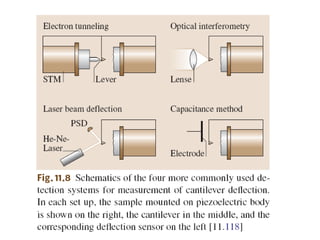
tiny tip made of a ceramic or semiconductor material as it travels over the surface of a material. When that tip, positioned at the end of a cantilever (a solid beam), is attracted to or pushed away from the sample’s surface, it deflects the cantilever beam — and a laser measures the deflection.
Features of AFMIt can get images of samples in air and underneath liquids. The fineness of the tip used in an AFM is an issue — the sharper the tip, the better the resolution.While STMs require that the surface to be measured be electrically conductive, AFMs are capable of investigating surfaces of both conductors and insulators on an atomic scale.
Contact modeKnown as static mode or repulsive mode.A sharp tip at the end of a cantilever is brought in contact with a sample surface.During initial contact, the atoms at the end of the tip experience a very weak repulsive force due to electronic orbital overlap with the atoms in the sample surface.
Dynamic mode AFMnoncontact imaging mode: the tip is brought in close proximity (within a few nm) to, and not in contact with the sample. The cantilever is deliberately vibrated either in amplitude modulation (AM) mode or frequency modulation (FM) mode.Very weak van der Waals attractive forces are present at the tip–sample interface. Although in this technique, the normal pressure exerted at the interface is zero (desirable to avoid any surface deformation), it is slow, and is difficult to use, and is rarely used outside research environments.
MoreIn the contact (static) mode, the interaction force between tip and sample is measured by measuring the cantilever deflection.In the noncontact (or dynamic) mode, the force gradient is obtained by vibrating the cantilever and measuring the shift of resonant frequency of the cantilever.In the contact mode, topographic images with a vertical resolution of less than 0.1nm (as low as 0.01 nm) and a lateral resolution of about 0.2 nm have been obtained
Measuring scaleWith a 0.01 nm displacement sensitivity, 10 nN to 1 pN forces are measurable. These forces are comparable to the forces associated with chemical bonding, e.g., 0.1μN for an ionic bond and 10 pN for a hydrogen bond.
AFM tips
Commercial AFMDigital Instruments Inc., a subsidiary of VeecoInstruments, Inc., Santa Barbara, CaliforniaTopometrix Corp., a subsidiary of Veeco Instruments, Inc., Santa Clara, California; Molecular Imaging Corp., Phoenix, ArizonaQuesantInstrument Corp., Agoura Hills, CaliforniaNanoscienceInstruments Inc., Phoenix, ArizonaSeiko Instruments, JapanOlympus, Japan. Omicron VakuumphysikGMBH, Taunusstein, Germany.
AFM tips
AFM tipsA schematic overview of the fabrication of Si and Si3N4 tip fabricationp.373 Springer Handbook of Nanotechnology
AFM tip :: electron beam depositionA pyramidal tip before (left,2-µm-scale bar) and after (right,1-µm-scale bar) electron beam depositionp.376 Springer Handbook of Nanotechnology
Carbon nanotubes for AFM tipsBecause the nanotube is a cylinder, rather than a pyramid, it can move more smoothly over surfaces. Thus the AFM tip can traverse hill-and- valley shapes without getting snagged or stopped by a too-narrow valley (which can be a problem for pyramid-shaped tips). Because a nanotube AFM tip is a cylinder, it’s more likely to be able to reach the bottom of the valley.Because the nanotube is stronger and more flexible, it won’t break when too much force is exerted on it (as some other tips will)
Carbon nanotube tips having small diameter and high aspect ratio are used for high resolution imaging of surfaces and of deep trenches, in the tapping mode or noncontact mode. Single-walled carbon nanotubes (SWNT) are microscopic graphitic cylinders that are 0.7 to 3 nm in diameter and up to many microns in length.
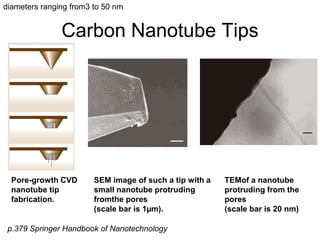
Carbon Nanotube Tipsdiameters ranging from3 to 50 nmTEMof a nanotube protruding from the pores (scale bar is 20 nm)Pore-growth CVD nanotube tip fabrication.SEM image of such a tip with a small nanotube protruding fromthe pores (scale bar is 1µm).p.379 Springer Handbook of Nanotechnology
Surface-growth nanotube tip fabricationSchematic represents the surface growth process in which nanotubes growing on the pyramidal tip are guided to the tip apex. SEM(200-nm-scale bar) (c) TEM (20-nm-scale bar) images of a surface growth tipp.380 Springer Handbook of Nanotechnology
Application of AFMAFM imagingMolecular Recognition AFMSingle-molecule recognition eventNanofabrication/Nanomachining
AFM imageDNA on mica by MAC mode AFM (scale 500 nm) The constant frequency-shift topography of aDNAhelix on a mica surface. Source: MSc thesis of Mashiur Rahman, Toyohashi University of Technologyp.404 Springer Handbook of Nanotechnology
Molecular Recognition AFMp.475 Springer Handbook of Nanotechnology
Single-molecule recognition eventRaw data from a force-distance cycle with 100 nm z-amplitude at 1Hz sweep frequency measured in PBS. Binding of the antibody on the tip to the antigen on the surface during approach (trace points 1 to 5) physically connectstip to probe. This causes a distinct force signal of distinct shape (points 6 to 7) during tip retraction, reflecting extension of the distensible crosslinker-antibody-antigen connection. The force increases until unbinding occurs at an unbinding force of 268 pN (points 7 to 2).
Nanofabrication/Nanomachining

ETE444-lec2-atomic_scale_characterization_techniques.pptx

  • 1.
    Book: Nanotechnology ForDummies Page 54 – 62
  • 2.
    Springer Handbookof Nanotechnology Page 331 - 369 Atomic scale characterization techniquesAFM & STMETE444 / ETE544 NanotechnologyLecture 222 June 2009 at NSU Bosundhora Campus
  • 3.
    IntroductionSeeing is believing.Wewant to see what is happening in mol
  • 4.
  • 5.
    SPM histrory1981: TheScanning Tunneling Microscope (STM) developed byDr.Gerd Binnig and his colleagues at the IBM Zurich Research Laboratory, Rueschlikon, Switzerland.1985: Binnig et al. developed an Atomic Force Microscope (AFM) to measure ultra-small forces (less than 1µN) present between the AFM tip surface and the sample surface1986: Binnig and Rohrer received a Nobel Prize in Physics
  • 6.
    Rohrer in aConference at Japan
  • 7.
    Atomic force microscope(AFM)phonograph recordcrystal-tipped stylus (“needle”) spinning vinyl platterwhen the motion vibrated the needle, the machine translated that vibration into sound.
  • 8.
    tiny tip madeof a ceramic or semiconductor material as it travels over the surface of a material. When that tip, positioned at the end of a cantilever (a solid beam), is attracted to or pushed away from the sample’s surface, it deflects the cantilever beam — and a laser measures the deflection.
  • 9.
    Features of AFMItcan get images of samples in air and underneath liquids. The fineness of the tip used in an AFM is an issue — the sharper the tip, the better the resolution.While STMs require that the surface to be measured be electrically conductive, AFMs are capable of investigating surfaces of both conductors and insulators on an atomic scale.
  • 10.
    Contact modeKnown asstatic mode or repulsive mode.A sharp tip at the end of a cantilever is brought in contact with a sample surface.During initial contact, the atoms at the end of the tip experience a very weak repulsive force due to electronic orbital overlap with the atoms in the sample surface.
  • 11.
    Dynamic mode AFMnoncontactimaging mode: the tip is brought in close proximity (within a few nm) to, and not in contact with the sample. The cantilever is deliberately vibrated either in amplitude modulation (AM) mode or frequency modulation (FM) mode.Very weak van der Waals attractive forces are present at the tip–sample interface. Although in this technique, the normal pressure exerted at the interface is zero (desirable to avoid any surface deformation), it is slow, and is difficult to use, and is rarely used outside research environments.
  • 12.
    MoreIn the contact(static) mode, the interaction force between tip and sample is measured by measuring the cantilever deflection.In the noncontact (or dynamic) mode, the force gradient is obtained by vibrating the cantilever and measuring the shift of resonant frequency of the cantilever.In the contact mode, topographic images with a vertical resolution of less than 0.1nm (as low as 0.01 nm) and a lateral resolution of about 0.2 nm have been obtained
  • 13.
    Measuring scaleWith a0.01 nm displacement sensitivity, 10 nN to 1 pN forces are measurable. These forces are comparable to the forces associated with chemical bonding, e.g., 0.1μN for an ionic bond and 10 pN for a hydrogen bond.
  • 15.
  • 16.
    Commercial AFMDigital InstrumentsInc., a subsidiary of VeecoInstruments, Inc., Santa Barbara, CaliforniaTopometrix Corp., a subsidiary of Veeco Instruments, Inc., Santa Clara, California; Molecular Imaging Corp., Phoenix, ArizonaQuesantInstrument Corp., Agoura Hills, CaliforniaNanoscienceInstruments Inc., Phoenix, ArizonaSeiko Instruments, JapanOlympus, Japan. Omicron VakuumphysikGMBH, Taunusstein, Germany.
  • 17.
  • 18.
    AFM tipsA schematicoverview of the fabrication of Si and Si3N4 tip fabricationp.373 Springer Handbook of Nanotechnology
  • 19.
    AFM tip ::electron beam depositionA pyramidal tip before (left,2-µm-scale bar) and after (right,1-µm-scale bar) electron beam depositionp.376 Springer Handbook of Nanotechnology
  • 20.
    Carbon nanotubes forAFM tipsBecause the nanotube is a cylinder, rather than a pyramid, it can move more smoothly over surfaces. Thus the AFM tip can traverse hill-and- valley shapes without getting snagged or stopped by a too-narrow valley (which can be a problem for pyramid-shaped tips). Because a nanotube AFM tip is a cylinder, it’s more likely to be able to reach the bottom of the valley.Because the nanotube is stronger and more flexible, it won’t break when too much force is exerted on it (as some other tips will)
  • 21.
    Carbon nanotube tipshaving small diameter and high aspect ratio are used for high resolution imaging of surfaces and of deep trenches, in the tapping mode or noncontact mode. Single-walled carbon nanotubes (SWNT) are microscopic graphitic cylinders that are 0.7 to 3 nm in diameter and up to many microns in length.
  • 23.
    Carbon Nanotube Tipsdiametersranging from3 to 50 nmTEMof a nanotube protruding from the pores (scale bar is 20 nm)Pore-growth CVD nanotube tip fabrication.SEM image of such a tip with a small nanotube protruding fromthe pores (scale bar is 1µm).p.379 Springer Handbook of Nanotechnology
  • 24.
    Surface-growth nanotube tipfabricationSchematic represents the surface growth process in which nanotubes growing on the pyramidal tip are guided to the tip apex. SEM(200-nm-scale bar) (c) TEM (20-nm-scale bar) images of a surface growth tipp.380 Springer Handbook of Nanotechnology
  • 25.
    Application of AFMAFMimagingMolecular Recognition AFMSingle-molecule recognition eventNanofabrication/Nanomachining
  • 26.
    AFM imageDNA onmica by MAC mode AFM (scale 500 nm) The constant frequency-shift topography of aDNAhelix on a mica surface. Source: MSc thesis of Mashiur Rahman, Toyohashi University of Technologyp.404 Springer Handbook of Nanotechnology
  • 27.
    Molecular Recognition AFMp.475Springer Handbook of Nanotechnology
  • 28.
    Single-molecule recognition eventRawdata from a force-distance cycle with 100 nm z-amplitude at 1Hz sweep frequency measured in PBS. Binding of the antibody on the tip to the antigen on the surface during approach (trace points 1 to 5) physically connectstip to probe. This causes a distinct force signal of distinct shape (points 6 to 7) during tip retraction, reflecting extension of the distensible crosslinker-antibody-antigen connection. The force increases until unbinding occurs at an unbinding force of 268 pN (points 7 to 2).
  • 29.