Microscopy:
Magnified Observation and Instruments
A microscope is an optical instrument used to view small objects by enlarging them with two
convex lenses. Optical microscopes, used for research, illuminate samples with visible or
ultraviolet light. Depending on its structure, a biological microscope is categorized as an
upright or inverted with a magnification ranging from 10x to 1500x.
Different types of microscopes are used based on the desired level of magnification.
Magnifying glasses or loupes are used for quick inspection with a low magnification;
binocular microscopes are used to observe from 10x to 50x, and upright/inverted
microscopes are used to observe from 50x to 1500x
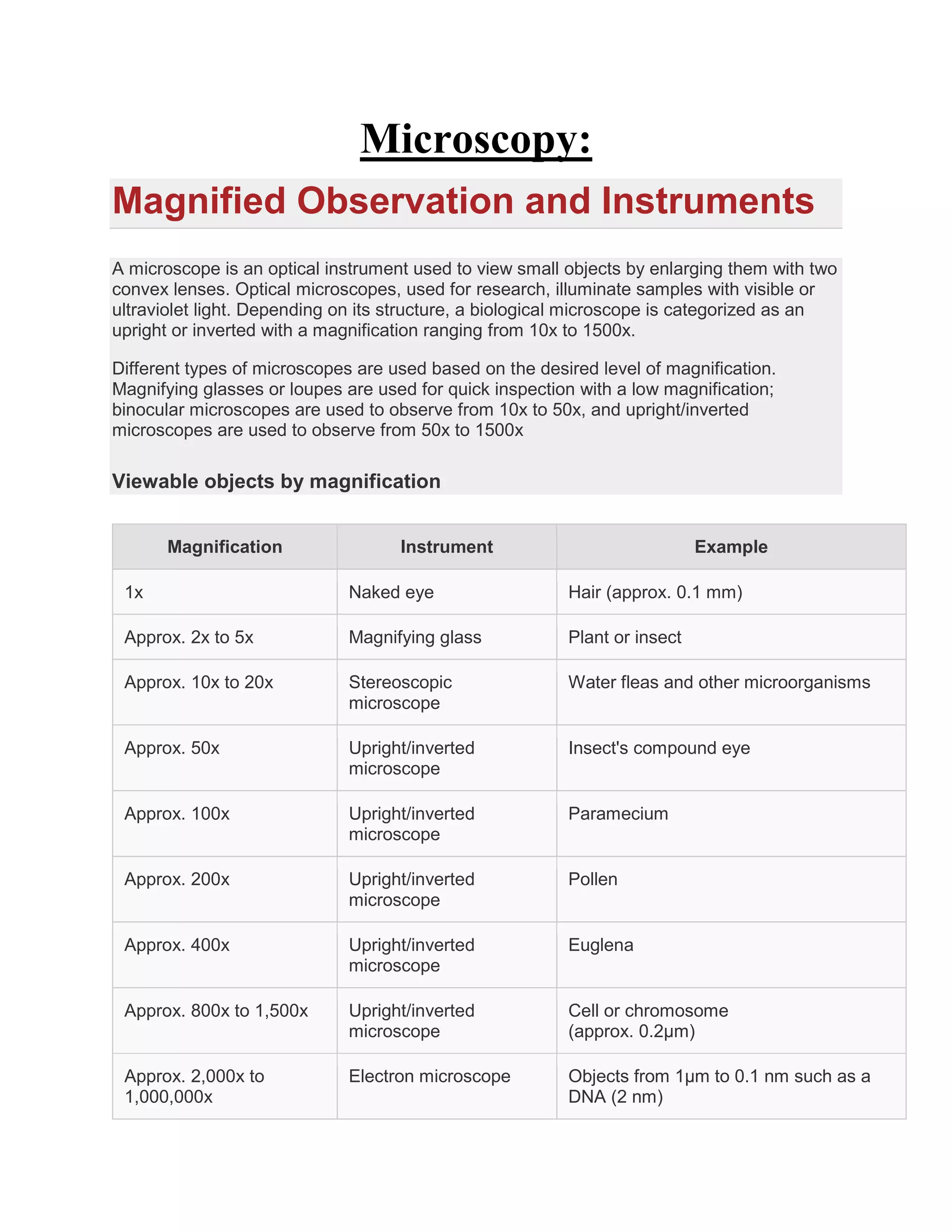
Viewable objects by magnification
Magnification Instrument Example
1x Naked eye Hair (approx. 0.1 mm)
Approx. 2x to 5x Magnifying glass Plant or insect
Approx. 10x to 20x Stereoscopic
microscope
Water fleas and other microorganisms
Approx. 50x Upright/inverted
microscope
Insect's compound eye
Approx. 100x Upright/inverted
microscope
Paramecium
Approx. 200x Upright/inverted
microscope
Pollen
Approx. 400x Upright/inverted
microscope
Euglena
Approx. 800x to 1,500x Upright/inverted
microscope
Cell or chromosome
(approx. 0.2µm)
Approx. 2,000x to
1,000,000x
Electron microscope Objects from 1μm to 0.1 nm such as a
DNA (2 nm)
Trivia: What is the reference for a magnification of 1x?
A magnification of 1x is based on the point where a nearby object can clearly be observed
by the human eye. Because this distance is 250 mm (distance of distinct vision), the size
that can be observed at this distance is specified as 1x.
Main Types of Microscopes
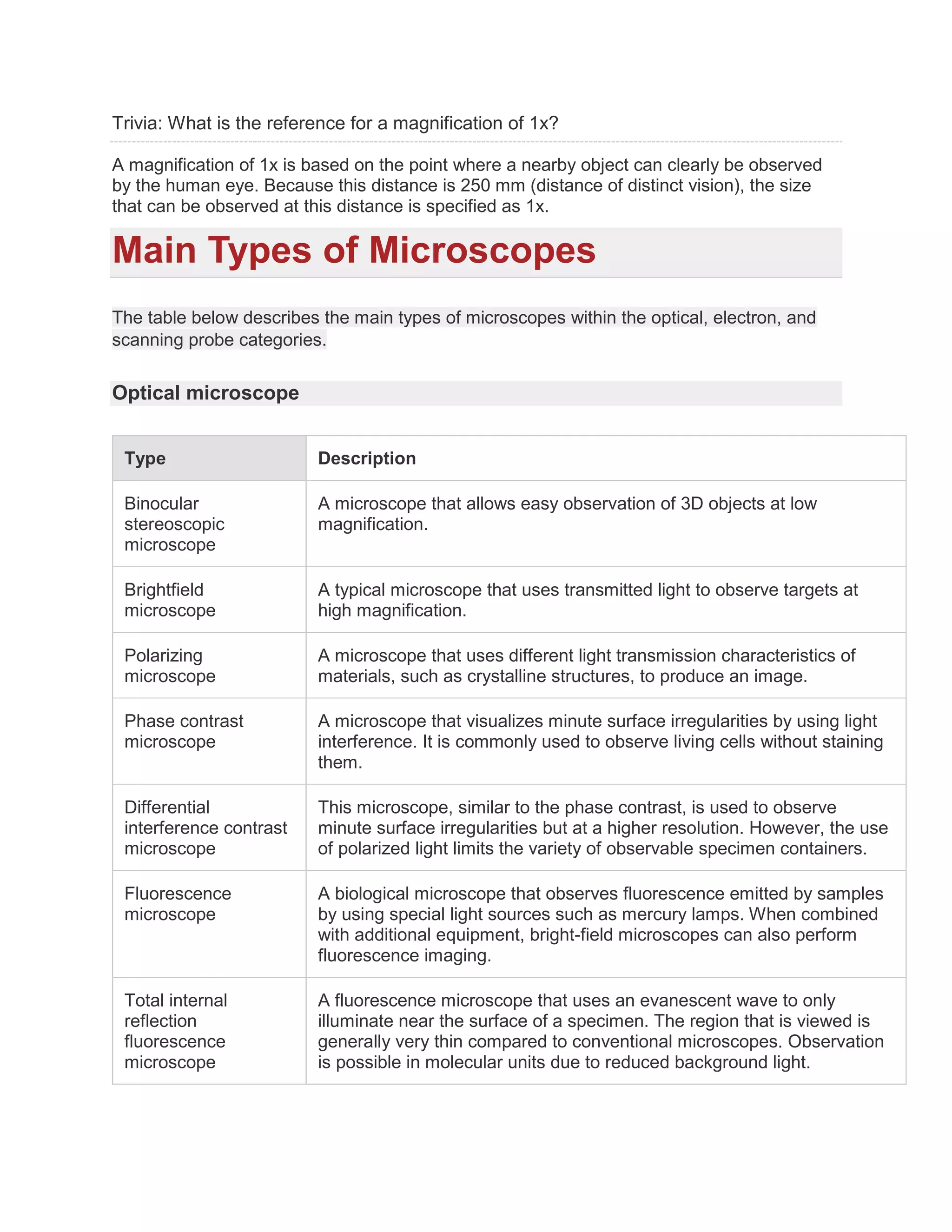
The table below describes the main types of microscopes within the optical, electron, and
scanning probe categories.
Optical microscope
Type Description
Binocular
stereoscopic
microscope
A microscope that allows easy observation of 3D objects at low
magnification.
Brightfield
microscope
A typical microscope that uses transmitted light to observe targets at
high magnification.
Polarizing
microscope
A microscope that uses different light transmission characteristics of
materials, such as crystalline structures, to produce an image.
Phase contrast
microscope
A microscope that visualizes minute surface irregularities by using light
interference. It is commonly used to observe living cells without staining
them.
Differential
interference contrast
microscope
This microscope, similar to the phase contrast, is used to observe
minute surface irregularities but at a higher resolution. However, the use
of polarized light limits the variety of observable specimen containers.
Fluorescence
microscope
A biological microscope that observes fluorescence emitted by samples
by using special light sources such as mercury lamps. When combined
with additional equipment, bright-field microscopes can also perform
fluorescence imaging.
Total internal
reflection
fluorescence
microscope
A fluorescence microscope that uses an evanescent wave to only
illuminate near the surface of a specimen. The region that is viewed is
generally very thin compared to conventional microscopes. Observation
is possible in molecular units due to reduced background light.
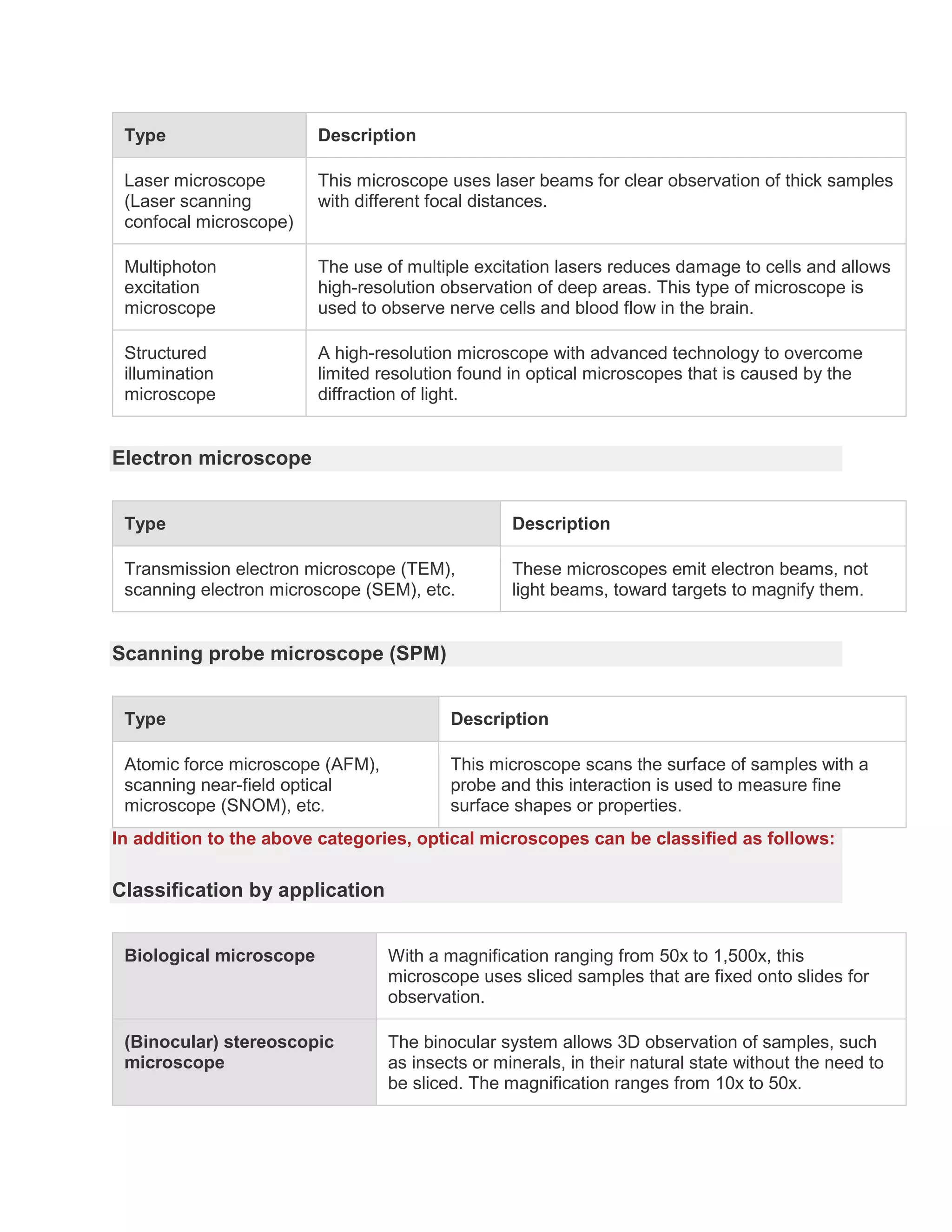
Type Description
Laser microscope
(Laser scanning
confocal microscope)
This microscope uses laser beams for clear observation of thick samples
with different focal distances.
Multiphoton
excitation
microscope
The use of multiple excitation lasers reduces damage to cells and allows
high-resolution observation of deep areas. This type of microscope is
used to observe nerve cells and blood flow in the brain.
Structured
illumination
microscope
A high-resolution microscope with advanced technology to overcome
limited resolution found in optical microscopes that is caused by the
diffraction of light.
Electron microscope
Type Description
Transmission electron microscope (TEM),
scanning electron microscope (SEM), etc.
These microscopes emit electron beams, not
light beams, toward targets to magnify them.
Scanning probe microscope (SPM)
Type Description
Atomic force microscope (AFM),
scanning near-field optical
microscope (SNOM), etc.
This microscope scans the surface of samples with a
probe and this interaction is used to measure fine
surface shapes or properties.
In addition to the above categories, optical microscopes can be classified as follows:
Classification by application
Biological microscope With a magnification ranging from 50x to 1,500x, this
microscope uses sliced samples that are fixed onto slides for
observation.
(Binocular) stereoscopic
microscope
The binocular system allows 3D observation of samples, such
as insects or minerals, in their natural state without the need to
be sliced. The magnification ranges from 10x to 50x.
Classification by structure
Upright microscope Observes targets from above. This type of microscope is used
to observe specimens on slides.
Inverted microscope Observes targets from below. This microscope is used to
observe, for example, cells soaked with culture in a dish.
Basic Structure and Principle of
Microscopes
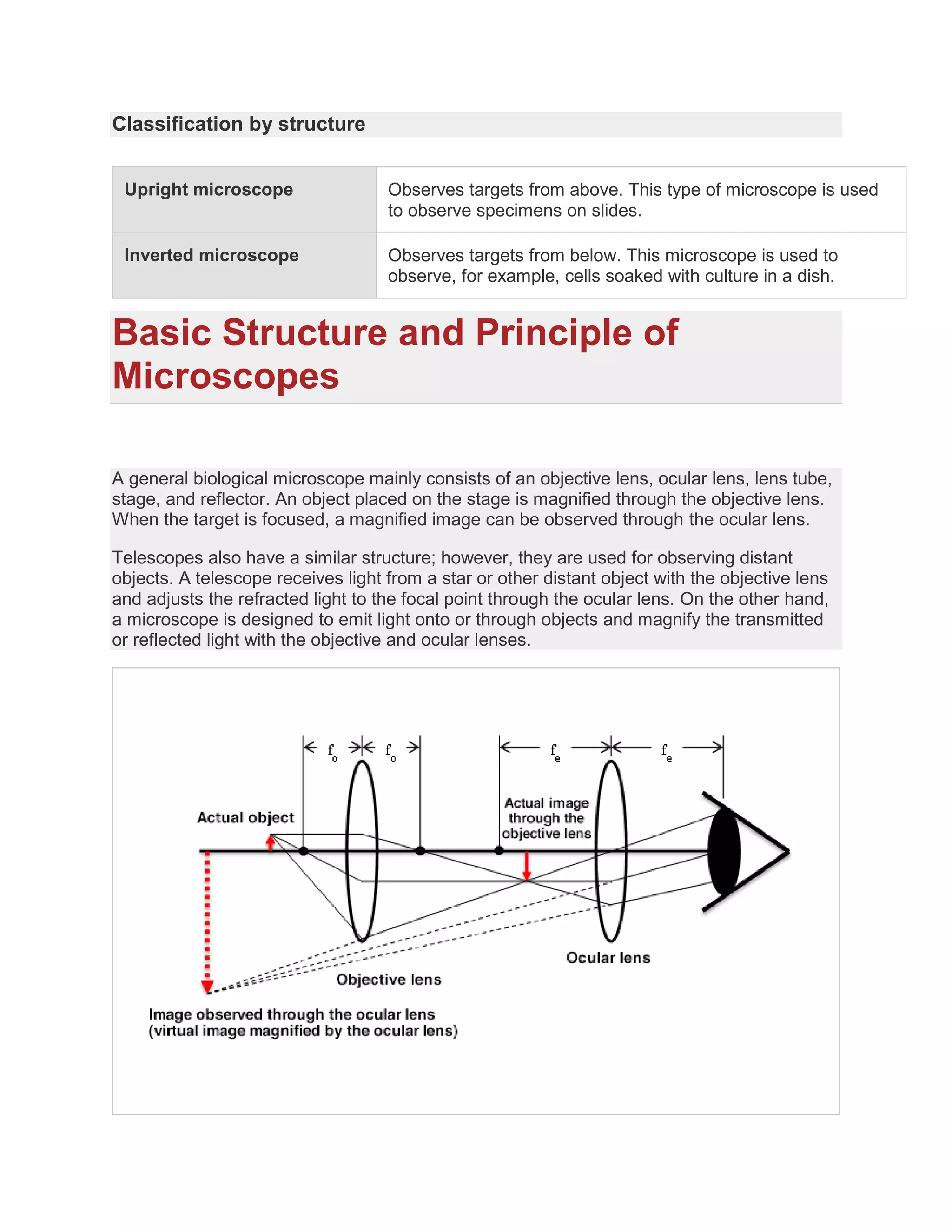
A general biological microscope mainly consists of an objective lens, ocular lens, lens tube,
stage, and reflector. An object placed on the stage is magnified through the objective lens.
When the target is focused, a magnified image can be observed through the ocular lens.
Telescopes also have a similar structure; however, they are used for observing distant
objects. A telescope receives light from a star or other distant object with the objective lens
and adjusts the refracted light to the focal point through the ocular lens. On the other hand,
a microscope is designed to emit light onto or through objects and magnify the transmitted
or reflected light with the objective and ocular lenses.
Figure: Principle that enables magnified observation with a biological microscope
Microscope Abilities
Biological microscopes have multiple objective lenses with different magnifications to image
samples with precision. The magnification of the microscope is the product of the objective
and ocular lens magnifications.
The performance of a microscope, however, is not determined only by the magnification;
the resolution is another important factor. Resolution is the ability to identify two light spots
separately and is expressed as the shortest distance between two points that can still be
distinguished as distinct entities. While a high magnification is needed in order to visualize
small objects, the resolution will determine just how clearly they can be seen. For an optical
microscope, the highest resolution is theoretically limited to approximately 100 to 200 nm
due to the effect of the wavelength of visible light (400 to 800 nm). Consider using an
electron microscope if you need higher resolution.
The numerical aperture (NA) is an important factor when considering the performance of the
objective lens. As the NA increases, the resolution and brightness of the lens improves.
When selecting a microscope, the user must check the NA of the lens, the magnification,
and the resolution based on the samples intended for imaging.
Aberration, the distortion or blurring of an image caused by imperfections in the lens' shape,
is another factor that influences lens performance. The more thoroughly the aberration is
corrected, the higher the performance of the lens.

Microscopy all types of microscope

  • 1.
    Microscopy: Magnified Observation andInstruments A microscope is an optical instrument used to view small objects by enlarging them with two convex lenses. Optical microscopes, used for research, illuminate samples with visible or ultraviolet light. Depending on its structure, a biological microscope is categorized as an upright or inverted with a magnification ranging from 10x to 1500x. Different types of microscopes are used based on the desired level of magnification. Magnifying glasses or loupes are used for quick inspection with a low magnification; binocular microscopes are used to observe from 10x to 50x, and upright/inverted microscopes are used to observe from 50x to 1500x Viewable objects by magnification Magnification Instrument Example 1x Naked eye Hair (approx. 0.1 mm) Approx. 2x to 5x Magnifying glass Plant or insect Approx. 10x to 20x Stereoscopic microscope Water fleas and other microorganisms Approx. 50x Upright/inverted microscope Insect's compound eye Approx. 100x Upright/inverted microscope Paramecium Approx. 200x Upright/inverted microscope Pollen Approx. 400x Upright/inverted microscope Euglena Approx. 800x to 1,500x Upright/inverted microscope Cell or chromosome (approx. 0.2µm) Approx. 2,000x to 1,000,000x Electron microscope Objects from 1μm to 0.1 nm such as a DNA (2 nm)
  • 2.
    Trivia: What isthe reference for a magnification of 1x? A magnification of 1x is based on the point where a nearby object can clearly be observed by the human eye. Because this distance is 250 mm (distance of distinct vision), the size that can be observed at this distance is specified as 1x. Main Types of Microscopes The table below describes the main types of microscopes within the optical, electron, and scanning probe categories. Optical microscope Type Description Binocular stereoscopic microscope A microscope that allows easy observation of 3D objects at low magnification. Brightfield microscope A typical microscope that uses transmitted light to observe targets at high magnification. Polarizing microscope A microscope that uses different light transmission characteristics of materials, such as crystalline structures, to produce an image. Phase contrast microscope A microscope that visualizes minute surface irregularities by using light interference. It is commonly used to observe living cells without staining them. Differential interference contrast microscope This microscope, similar to the phase contrast, is used to observe minute surface irregularities but at a higher resolution. However, the use of polarized light limits the variety of observable specimen containers. Fluorescence microscope A biological microscope that observes fluorescence emitted by samples by using special light sources such as mercury lamps. When combined with additional equipment, bright-field microscopes can also perform fluorescence imaging. Total internal reflection fluorescence microscope A fluorescence microscope that uses an evanescent wave to only illuminate near the surface of a specimen. The region that is viewed is generally very thin compared to conventional microscopes. Observation is possible in molecular units due to reduced background light.
  • 3.
    Type Description Laser microscope (Laserscanning confocal microscope) This microscope uses laser beams for clear observation of thick samples with different focal distances. Multiphoton excitation microscope The use of multiple excitation lasers reduces damage to cells and allows high-resolution observation of deep areas. This type of microscope is used to observe nerve cells and blood flow in the brain. Structured illumination microscope A high-resolution microscope with advanced technology to overcome limited resolution found in optical microscopes that is caused by the diffraction of light. Electron microscope Type Description Transmission electron microscope (TEM), scanning electron microscope (SEM), etc. These microscopes emit electron beams, not light beams, toward targets to magnify them. Scanning probe microscope (SPM) Type Description Atomic force microscope (AFM), scanning near-field optical microscope (SNOM), etc. This microscope scans the surface of samples with a probe and this interaction is used to measure fine surface shapes or properties. In addition to the above categories, optical microscopes can be classified as follows: Classification by application Biological microscope With a magnification ranging from 50x to 1,500x, this microscope uses sliced samples that are fixed onto slides for observation. (Binocular) stereoscopic microscope The binocular system allows 3D observation of samples, such as insects or minerals, in their natural state without the need to be sliced. The magnification ranges from 10x to 50x.
  • 4.
    Classification by structure Uprightmicroscope Observes targets from above. This type of microscope is used to observe specimens on slides. Inverted microscope Observes targets from below. This microscope is used to observe, for example, cells soaked with culture in a dish. Basic Structure and Principle of Microscopes A general biological microscope mainly consists of an objective lens, ocular lens, lens tube, stage, and reflector. An object placed on the stage is magnified through the objective lens. When the target is focused, a magnified image can be observed through the ocular lens. Telescopes also have a similar structure; however, they are used for observing distant objects. A telescope receives light from a star or other distant object with the objective lens and adjusts the refracted light to the focal point through the ocular lens. On the other hand, a microscope is designed to emit light onto or through objects and magnify the transmitted or reflected light with the objective and ocular lenses.
  • 5.
    Figure: Principle thatenables magnified observation with a biological microscope Microscope Abilities Biological microscopes have multiple objective lenses with different magnifications to image samples with precision. The magnification of the microscope is the product of the objective and ocular lens magnifications. The performance of a microscope, however, is not determined only by the magnification; the resolution is another important factor. Resolution is the ability to identify two light spots separately and is expressed as the shortest distance between two points that can still be distinguished as distinct entities. While a high magnification is needed in order to visualize small objects, the resolution will determine just how clearly they can be seen. For an optical microscope, the highest resolution is theoretically limited to approximately 100 to 200 nm due to the effect of the wavelength of visible light (400 to 800 nm). Consider using an electron microscope if you need higher resolution. The numerical aperture (NA) is an important factor when considering the performance of the objective lens. As the NA increases, the resolution and brightness of the lens improves. When selecting a microscope, the user must check the NA of the lens, the magnification, and the resolution based on the samples intended for imaging. Aberration, the distortion or blurring of an image caused by imperfections in the lens' shape, is another factor that influences lens performance. The more thoroughly the aberration is corrected, the higher the performance of the lens.