Continuous Flow Chemistry
Recent Advances in Organic Chemistry
              Part 8
                           Dom Hebrault, Ph.D.
                         Principal Technology and
                          Application Consultant


                              May 16th 2012
Background & Literature

 References cited in following case studies (4)

 Continuous Flow Chemistry: Recent Advances in Organic Chemistry Part 7
 Information Sharing Event:
    -   Continuous Flow Chemistry and Crystallization Development, New Brunswick, NJ,
        September 2012

    -   Chemical and Crystallization Research & Development, Cambridge, MA, May 2012


 Mettler Toledo articles & conference presentations: Chim. Oggi, White
  Papers, FloHet, Flow Chemistry Congress, AIChE…

 Other peer-reviewed scientific articles and references available on request
Flow Production of Unstable Intermediates
                                                                                  Vol. 92 μL, channel W 600 μm, D 500 μm, L 360 mm
Continuous Flow Production of Thermally
Unstable Intermediates in a Microreactor
with   Inline  IR-Analysis:   Controlled
Vilsmeier−Haack

       Introduction
  Vilsmeier−Haack formylation hazardous
  to scale-up: Unstable chloroiminium
  intermediate                                                                1- Formation of the VH-reagent

  Enhanced safety in microreactors thanks                                     2- Arene oxidation – Iminium formation
  to better heat dissipation and smaller
  volume                                                                      3- Quench of iminium salt


                                                                                                                         FlowStart Evo
                                                                                                                         FutureChemistry


A. M. W. van den Broek, J. R. Leliveld, R. Becker, M. M. E. Delville, P. J. Nieuwland, Kaspar Koch, F. P. J. T. Rutjes; FutureChemistry Holding BV,
Institute for Molecules and Materials, Radboud University Nijmegen; The Netherlands; Organic Process Research and Development, 2012, 16, 5,
934-938
Flow Production of Unstable Intermediates

   Formation of the VH-reagent
  At-line measurement required to prevent
  partial conversion of POCl3: Pyrrole →
  polymers → clogging
  At-line UV unpractical because DMF
  shows absorbance around 300 nm
  Problem overcome using inline FlowIR                                                                           P-O-C


                                                                                                       Rt 10 s
                                                                                                                          C-Cl
                                        FlowIRTM`

                                                                                                        180 s


A. M. W. van den Broek, J. R. Leliveld, R. Becker, M. M. E. Delville, P. J. Nieuwland, Kaspar Koch, F. P. J. T. Rutjes; FutureChemistry Holding BV,
Institute for Molecules and Materials, Radboud University Nijmegen; The Netherlands; Organic Process Research and Development, 2012, 16, 5,
934-938
Flow Production of Unstable Intermediates

   Formation of the VH-reagent
  Plot [2] and [3] as a function of residence
  time
  Higher [3] level at Rt>100s possibly due
  to higher [Cl-] resulting from counterion                                                2                                  3
  degradation

                                                                               Conclusions
                                                          IR 769 cm-1         VH formylation proved to be readily
                                                          IR 804 cm-1         conducted in flow microreactor system
                 2                                                            FlowIR essential to solve at-line UV
                                                                              limitations
                                                      3                       Optimization of reaction time (180 s),
                                                                              temperature (60 °C, molar ratio (1.5 eq.)
                                                                              → 5.98 g/h

A. M. W. van den Broek, J. R. Leliveld, R. Becker, M. M. E. Delville, P. J. Nieuwland, Kaspar Koch, F. P. J. T. Rutjes; FutureChemistry Holding BV,
Institute for Molecules and Materials, Radboud University Nijmegen; The Netherlands; Organic Process Research and Development, 2012, 16, 5,
934-938
High-Pressure G/L Flow Homogeneous Catalysis
A Microreactor System for High-Pressure
Continuous Flow Homogeneous Catalysis                                                           Lab made silicon or Pyrex microreactor
                                                                                                    Square channel 500 x 500 μm
Measurements                                                                                                  Vol. 220 μl


     Introduction
 Hydroformylation     of                      alpha-olefins
 commercially     used                      to    produce
 aldehydes/alcohols
 However, few and contradictory kinetics
 data under relevant industrial conditions
 (high P, T)

                            Toluene
                          100 °C, 30 b                                    Microreactors for segmented flow for

1-octene                                                                  1- Enhanced gas/liquid mass transfer

                                                                          2- Isothermal operation → kinetics

Jaroslav Keybl and Klavs F. Jensen; Department of Chemical Engineering, MIT, Cambridge, MA, USA, Ind. Eng. Chem. Res., 2011, 50, 11013–11022
High-Pressure G/L Flow Homogeneous Catalysis
  Sampling issues with GC

  1- Volatile alkene → sample loss
                                                                                                                                 & 910 cm-1

  2- Poor GC mass balance

  3- Sampling reproducibility (carry-over)


                                                                         Sampling issues resolved with inline
                                                                         ATR-FTIR:
                                                                         ReactIR 10 with DiComp DS Micro Flow
                                                                         Cell; Vol. 50 μl
Jaroslav Keybl and Klavs F. Jensen; Department of Chemical Engineering, MIT, Cambridge, MA, USA, Ind. Eng. Chem. Res., 2011, 50, 11013–11022
High-Pressure G/L Flow Homogeneous Catalysis


                                                                                                   National
                                                       T° control                             Instruments, v7.1
                                                    J‐Kem, Gemini‐K                               LabVIEW

                                                                                     ReactIR           GC


                                                                                                                     Teflon


  Teledyne Isco, 100DM                               Up to 350 °C, 100 b                                            Bronkhorst,
 Teledyne Isco, Controller                            Rt: s to 15 min.                                            EL‐PRESS series


Jaroslav Keybl and Klavs F. Jensen; Department of Chemical Engineering, MIT, Cambridge, MA, USA, Ind. Eng. Chem. Res., 2011, 50, 11013–11022
High-Pressure G/L Flow Homogeneous Catalysis
     Results
 Confirm kinetic regime and analytical
 mass balance
 Detailed kinetic study using a non-linear
 least square regression


                                                                         ReactIR provided:
                                                                         - Verification of proper operation
                                                                         - Direct confirmation of steady state
                                                                              after change of variable
                                                                         - Real time component assay after
                                                                              calibration
                                                                         - Segmented G/L flow manageable
Jaroslav Keybl and Klavs F. Jensen; Department of Chemical Engineering, MIT, Cambridge, MA, USA, Ind. Eng. Chem. Res., 2011, 50, 11013–11022
Automated Optimization using Microreactors
                                                                                       Fluid flow

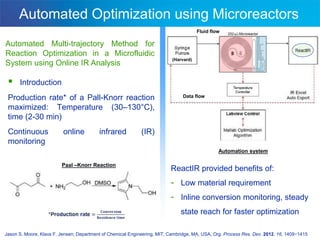
Automated Multi-trajectory Method for
Reaction Optimization in a Microfluidic
                                                                           (Harvard)
System using Online IR Analysis

     Introduction
 Production rate* of a Pall-Knorr reaction                                      Data flow

 maximized: Temperature (30–130°C),
 time (2-30 min)
 Continuous               online          infrared           (IR)
 monitoring
                                                                                                Automation system

                         Paal –Knorr Reaction
                                                                          ReactIR provided benefits of:
                                                                          - Low material requirement
                                                                          - Inline conversion monitoring, steady
                                                                               state reach for faster optimization

Jason S. Moore, Klavs F. Jensen; Department of Chemical Engineering, MIT, Cambridge, MA, USA, Org. Process Res. Dev. 2012, 16, 1409−1415
Automated Optimization using Microreactors
 Goal:
 - Compare performance of automated
     optimization algorithms
 - “Similar” optimum: T 130°C, t 4.5 min
 - Large difference in number of runs (38
     versus 126) and time required
                      Optimum for each algorithm
                                                                                IR spectrum of the Paal−Knorr reaction species
         Armijo                                                                              (solvent subtracted)
       conjugate
                                      Conjugate gradient
        gradient
                                                                           Algorithm designed for
                                                Steepest descent           - Steps: 2°C, 1 min
                                                                           - Single path to optimum
                                                                           - Intelligently updating reaction conditions
                                                                               based on inline analytics
                                                                           - Automatically performing DOE towards
      Comparison of optimum reach for each algorithms
          (number of runs, reaction conversion)                                optimum
Jason S. Moore, Klavs F. Jensen; Department of Chemical Engineering, MIT, Cambridge, MA, USA, Org. Process Res. Dev. 2012, 16, 1409−1415
Automated Optimization using Microreactors
 Conclusions:
 - Pall-Knorr production rate maximized within
     30–130°C, t 2-30 min
 - Conjugate gradient with addition of Armijo-
     type algorithm provides better optimization
     efficiency
 - Future development: Stoichiometry,                                           Production rate optimization strategies above 130°C
     selectivity, impurity profile optimization
                                                                         ReactIR provided:
                                                                         - Real time info about steady state reach
                                                                         - Exportable data for feedback control →
                                                                              dynamic experiment duration
                                                                         - Non destructive analytical method and low
                                                                              material requirement
                                                                         - Total reaction mixture : No sampling, no
  Production rate optimization using Armijo conjugate gradient                dilution
Jason S. Moore, Klavs F. Jensen; Department of Chemical Engineering, MIT, Cambridge, MA, USA, Org. Process Res. Dev. 2012, 16, 1409−1415
Continuous Asymmetric Hydrogenation
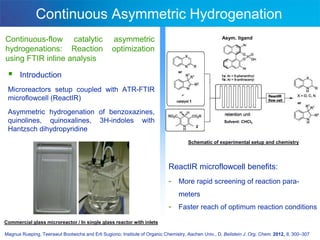
Continuous-flow catalytic                        asymmetric                                          Asym. ligand

hydrogenations: Reaction                         optimization
using FTIR inline analysis

      Introduction
 Microreactors setup coupled with ATR-FTIR
 microflowcell (ReactIR)
 Asymmetric hydrogenation of benzoxazines,
 quinolines, quinoxalines, 3H-indoles with                                                            Solvent: CHCl3

 Hantzsch dihydropyridine
                                                                                     Schematic of experimental setup and chemistry


                                                                            ReactIR microflowcell benefits:
                                                                            - More rapid screening of reaction para-
                                                                                 meters
                                                                            - Faster reach of optimum reaction conditions
Commercial glass microreactor / In single glass reactor with inlets

Magnus Rueping, Teerawut Bootwicha and Erli Sugiono; Institute of Organic Chemistry, Aachen Univ., D, Beilstein J. Org. Chem. 2012, 8, 300–307
Continuous Asymmetric Hydrogenation
                                                                                                                     IR spectra for substrate
                                                                                                                        consumption and
 Method and results:                                                                                                   product formation at
                                                                                                                      different temperature

 - Collection of reference spectra for solvent,
     starting material, and reagents

 - Optimum conditions after fast screening
     thanks to real time analytics: T 60°C, t 20
     min, flow rate 0.1 mL.min-1


                                                                              Further reported investigations
                                                                              - Scope
                                                                              - Conditions optimization: Flow conditions,
  Trend curve of product formation at different temperatures
                                                                                  catalyst loading, reagent
Magnus Rueping, Teerawut Bootwicha and Erli Sugiono; Institute of Organic Chemistry, Aachen Univ., D, Beilstein J. Org. Chem. 2012, 8, 300–307
Continuous Asymmetric Hydrogenation
 Conclusions:
 - Microreactors setup coupled with ATR-FTIR
     microflowcell (ReactIR)
 - Inline real time analysis of the microreactor
     reaction stream right at the outlet
 - Faster, more precise feedback or reaction
     mixture composition and component
     concentration
                                                                            - More rapid screening of reaction
                                                                                 parameters
                                                                            - Faster reach of optimum reaction
                                                                                 conditions
                                                                            - Ongoing development: automated
                                                                                 integration and feedback optimization of
                                                                                 reaction parameters

Magnus Rueping, Teerawut Bootwicha and Erli Sugiono; Institute of Organic Chemistry, Aachen Univ., D, Beilstein J. Org. Chem. 2012, 8, 300–307
Preparation of Arylmagnesium in Flow
Continuous Preparation of Arylmagne-
sium Reagents in Flow with Inline IR
Monitoring

     Introduction
 Continuous flow reaction setup (Vapourtec
 R2+) with inline ATR-FTIR FlowIR:
 1. Grignard exchange                                                            Schematic of experimental setup and chemistry

 2. Coupling with carbonyl compounds                                       FlowIR benefits:
 Comparison ATR-FTIR / GC / I2 titration
                                                                           - Conversion, by-products in real time
                                                                           - In situ determination of absolute concen-
                                                                               tration after calibration

                                                                           - Elucidation of mechanistic details
                                                                           - Ensure / facilitate product high quality
                   ATR-FTIR FlowIR instrument                              - Faster optimization
Tobias Brodmann, Peter Koos, Albrecht Metzger, Paul Knochel, Steven V. Ley, Beilstein Org. Process Res. Dev. 2012, 16, 1102−1114
Preparation of Arylmagnesium in Flow
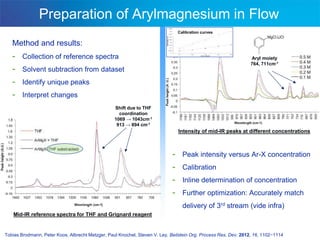
                                                                               Calibration curves

   Method and results:
   - Collection of reference spectra                                                                             Aryl moiety
                                                                                                                 764, 711cm-1
   - Solvent subtraction from dataset
   - Identify unique peaks
   - Interpret changes
                                                  Shift due to THF
                                                    coordination
                                                  1069 → 1043cm-1
                                                   913 → 894 cm-1
                                                                               Intensity of mid-IR peaks at different concentrations


                                                                             - Peak intensity versus Ar-X concentration
                                                                             - Calibration
                                                                             - Inline determination of concentration
                                                                             - Further optimization: Accurately match
                                                                                 delivery of 3rd stream (vide infra)
    Mid-IR reference spectra for THF and Grignard reagent


Tobias Brodmann, Peter Koos, Albrecht Metzger, Paul Knochel, Steven V. Ley, Beilstein Org. Process Res. Dev. 2012, 16, 1102−1114
Preparation of Arylmagnesium in Flow
 - Identify unique peaks for reaction
     components
 - Use 2nd derivative spectra as advanced
     interpretation tool
 - Trend component(s) of interest versus time


                                                ArMgX                           Real time intensity of mid-IR peak of Grignard reagent
                                             767, 1043cm-1

                                                             Wurtz
                                               Toluene    side-product       - Diffusion in the flow stream
                                                                             - Timing and feed rate for 3rd stream
                                                                                 adjusted automatically and in real time to
                                                                                 mid-IR readout
                                                                             - Screen of reaction parameters
  Fingerprint region for solvent, starting material, (side)-products
                                                                             - Scope (aryl halide, carbonyl derivative)

Tobias Brodmann, Peter Koos, Albrecht Metzger, Paul Knochel, Steven V. Ley, Beilstein Org. Process Res. Dev. 2012, 16, 1102−1114
Preparation of Arylmagnesium in Flow
  Role of LiCl/THF by IR spectroscopy
  - Shift, intensity changes due to complex
  Role of THF as solvent
  - 1, 2, 4, 10 eq dry THF added to Grignard
      reagent in toluene
  - IR clearly indicates coordination of THF to
      Mg in Grignard species
                                                                            IR spectrum of Grignard reagent solution in toluene with THF

                                             iPrMgCl.LiCl
                                                                            With ReactIR, it became possible to:
                                                            iPrMgCl
                                                                            - Ensure quality of Ar-MgX in solution, in situ
                                                                            - Determine concentration of active
                                                                                reagents, composition of reaction stream to
                                                                                quickly optimize process
                                                                            - Further used to monitor/optimize reaction
           IR spectra of iPrMgCl and iPrMgCl.LiCl complex
                                                                                with carbonyl compounds

Tobias Brodmann, Peter Koos, Albrecht Metzger, Paul Knochel, Steven V. Ley, Beilstein Org. Process Res. Dev. 2012, 16, 1102−1114
Acknowledgements
 Institute for Molecules and Materials, Radboud University (The Netherlands)
    -   Pr. Floris P. J. T. Rutjes et al.

 Department of Chemical Engineering, MIT (USA)
    -   Pr. Klavs Jensen, Dr. Jerry Keybl, Dr. Jason Moore

 University of Cambridge, UK
    -   Pr. Steven V. Ley et al.

 Department of Chemistry, Ludwig Maximilians-Universität München, Germany
    -   Pr. Paul Knochel et al.

 Institute of Organic Chemistry, Aachen University, Germany
    -   Pr. Magnus Rueping et al.

 Mettler Toledo Autochem
    -   Will Kowalchyk, Wes Walker, Paul Scholl (USA), Jon Goode (U.K.)

Recent Advances Webinar Part 8

  • 1.
    Continuous Flow Chemistry RecentAdvances in Organic Chemistry Part 8 Dom Hebrault, Ph.D. Principal Technology and Application Consultant May 16th 2012
  • 2.
    Background & Literature References cited in following case studies (4)  Continuous Flow Chemistry: Recent Advances in Organic Chemistry Part 7  Information Sharing Event: - Continuous Flow Chemistry and Crystallization Development, New Brunswick, NJ, September 2012 - Chemical and Crystallization Research & Development, Cambridge, MA, May 2012  Mettler Toledo articles & conference presentations: Chim. Oggi, White Papers, FloHet, Flow Chemistry Congress, AIChE…  Other peer-reviewed scientific articles and references available on request
  • 3.
    Flow Production ofUnstable Intermediates Vol. 92 μL, channel W 600 μm, D 500 μm, L 360 mm Continuous Flow Production of Thermally Unstable Intermediates in a Microreactor with Inline IR-Analysis: Controlled Vilsmeier−Haack  Introduction Vilsmeier−Haack formylation hazardous to scale-up: Unstable chloroiminium intermediate 1- Formation of the VH-reagent Enhanced safety in microreactors thanks 2- Arene oxidation – Iminium formation to better heat dissipation and smaller volume 3- Quench of iminium salt FlowStart Evo FutureChemistry A. M. W. van den Broek, J. R. Leliveld, R. Becker, M. M. E. Delville, P. J. Nieuwland, Kaspar Koch, F. P. J. T. Rutjes; FutureChemistry Holding BV, Institute for Molecules and Materials, Radboud University Nijmegen; The Netherlands; Organic Process Research and Development, 2012, 16, 5, 934-938
  • 4.
    Flow Production ofUnstable Intermediates  Formation of the VH-reagent At-line measurement required to prevent partial conversion of POCl3: Pyrrole → polymers → clogging At-line UV unpractical because DMF shows absorbance around 300 nm Problem overcome using inline FlowIR P-O-C Rt 10 s C-Cl FlowIRTM` 180 s A. M. W. van den Broek, J. R. Leliveld, R. Becker, M. M. E. Delville, P. J. Nieuwland, Kaspar Koch, F. P. J. T. Rutjes; FutureChemistry Holding BV, Institute for Molecules and Materials, Radboud University Nijmegen; The Netherlands; Organic Process Research and Development, 2012, 16, 5, 934-938
  • 5.
    Flow Production ofUnstable Intermediates  Formation of the VH-reagent Plot [2] and [3] as a function of residence time Higher [3] level at Rt>100s possibly due to higher [Cl-] resulting from counterion 2 3 degradation  Conclusions IR 769 cm-1 VH formylation proved to be readily IR 804 cm-1 conducted in flow microreactor system 2 FlowIR essential to solve at-line UV limitations 3 Optimization of reaction time (180 s), temperature (60 °C, molar ratio (1.5 eq.) → 5.98 g/h A. M. W. van den Broek, J. R. Leliveld, R. Becker, M. M. E. Delville, P. J. Nieuwland, Kaspar Koch, F. P. J. T. Rutjes; FutureChemistry Holding BV, Institute for Molecules and Materials, Radboud University Nijmegen; The Netherlands; Organic Process Research and Development, 2012, 16, 5, 934-938
  • 6.
    High-Pressure G/L FlowHomogeneous Catalysis A Microreactor System for High-Pressure Continuous Flow Homogeneous Catalysis Lab made silicon or Pyrex microreactor Square channel 500 x 500 μm Measurements Vol. 220 μl  Introduction Hydroformylation of alpha-olefins commercially used to produce aldehydes/alcohols However, few and contradictory kinetics data under relevant industrial conditions (high P, T) Toluene 100 °C, 30 b Microreactors for segmented flow for 1-octene 1- Enhanced gas/liquid mass transfer 2- Isothermal operation → kinetics Jaroslav Keybl and Klavs F. Jensen; Department of Chemical Engineering, MIT, Cambridge, MA, USA, Ind. Eng. Chem. Res., 2011, 50, 11013–11022
  • 7.
    High-Pressure G/L FlowHomogeneous Catalysis Sampling issues with GC 1- Volatile alkene → sample loss & 910 cm-1 2- Poor GC mass balance 3- Sampling reproducibility (carry-over) Sampling issues resolved with inline ATR-FTIR: ReactIR 10 with DiComp DS Micro Flow Cell; Vol. 50 μl Jaroslav Keybl and Klavs F. Jensen; Department of Chemical Engineering, MIT, Cambridge, MA, USA, Ind. Eng. Chem. Res., 2011, 50, 11013–11022
  • 8.
    High-Pressure G/L FlowHomogeneous Catalysis National T° control Instruments, v7.1 J‐Kem, Gemini‐K LabVIEW ReactIR GC Teflon Teledyne Isco, 100DM Up to 350 °C, 100 b Bronkhorst, Teledyne Isco, Controller Rt: s to 15 min. EL‐PRESS series Jaroslav Keybl and Klavs F. Jensen; Department of Chemical Engineering, MIT, Cambridge, MA, USA, Ind. Eng. Chem. Res., 2011, 50, 11013–11022
  • 9.
    High-Pressure G/L FlowHomogeneous Catalysis  Results Confirm kinetic regime and analytical mass balance Detailed kinetic study using a non-linear least square regression ReactIR provided: - Verification of proper operation - Direct confirmation of steady state after change of variable - Real time component assay after calibration - Segmented G/L flow manageable Jaroslav Keybl and Klavs F. Jensen; Department of Chemical Engineering, MIT, Cambridge, MA, USA, Ind. Eng. Chem. Res., 2011, 50, 11013–11022
  • 10.
    Automated Optimization usingMicroreactors Fluid flow Automated Multi-trajectory Method for Reaction Optimization in a Microfluidic (Harvard) System using Online IR Analysis  Introduction Production rate* of a Pall-Knorr reaction Data flow maximized: Temperature (30–130°C), time (2-30 min) Continuous online infrared (IR) monitoring Automation system Paal –Knorr Reaction ReactIR provided benefits of: - Low material requirement - Inline conversion monitoring, steady state reach for faster optimization Jason S. Moore, Klavs F. Jensen; Department of Chemical Engineering, MIT, Cambridge, MA, USA, Org. Process Res. Dev. 2012, 16, 1409−1415
  • 11.
    Automated Optimization usingMicroreactors Goal: - Compare performance of automated optimization algorithms - “Similar” optimum: T 130°C, t 4.5 min - Large difference in number of runs (38 versus 126) and time required Optimum for each algorithm IR spectrum of the Paal−Knorr reaction species Armijo (solvent subtracted) conjugate Conjugate gradient gradient Algorithm designed for Steepest descent - Steps: 2°C, 1 min - Single path to optimum - Intelligently updating reaction conditions based on inline analytics - Automatically performing DOE towards Comparison of optimum reach for each algorithms (number of runs, reaction conversion) optimum Jason S. Moore, Klavs F. Jensen; Department of Chemical Engineering, MIT, Cambridge, MA, USA, Org. Process Res. Dev. 2012, 16, 1409−1415
  • 12.
    Automated Optimization usingMicroreactors Conclusions: - Pall-Knorr production rate maximized within 30–130°C, t 2-30 min - Conjugate gradient with addition of Armijo- type algorithm provides better optimization efficiency - Future development: Stoichiometry, Production rate optimization strategies above 130°C selectivity, impurity profile optimization ReactIR provided: - Real time info about steady state reach - Exportable data for feedback control → dynamic experiment duration - Non destructive analytical method and low material requirement - Total reaction mixture : No sampling, no Production rate optimization using Armijo conjugate gradient dilution Jason S. Moore, Klavs F. Jensen; Department of Chemical Engineering, MIT, Cambridge, MA, USA, Org. Process Res. Dev. 2012, 16, 1409−1415
  • 13.
    Continuous Asymmetric Hydrogenation Continuous-flowcatalytic asymmetric Asym. ligand hydrogenations: Reaction optimization using FTIR inline analysis  Introduction Microreactors setup coupled with ATR-FTIR microflowcell (ReactIR) Asymmetric hydrogenation of benzoxazines, quinolines, quinoxalines, 3H-indoles with Solvent: CHCl3 Hantzsch dihydropyridine Schematic of experimental setup and chemistry ReactIR microflowcell benefits: - More rapid screening of reaction para- meters - Faster reach of optimum reaction conditions Commercial glass microreactor / In single glass reactor with inlets Magnus Rueping, Teerawut Bootwicha and Erli Sugiono; Institute of Organic Chemistry, Aachen Univ., D, Beilstein J. Org. Chem. 2012, 8, 300–307
  • 14.
    Continuous Asymmetric Hydrogenation IR spectra for substrate consumption and Method and results: product formation at different temperature - Collection of reference spectra for solvent, starting material, and reagents - Optimum conditions after fast screening thanks to real time analytics: T 60°C, t 20 min, flow rate 0.1 mL.min-1 Further reported investigations - Scope - Conditions optimization: Flow conditions, Trend curve of product formation at different temperatures catalyst loading, reagent Magnus Rueping, Teerawut Bootwicha and Erli Sugiono; Institute of Organic Chemistry, Aachen Univ., D, Beilstein J. Org. Chem. 2012, 8, 300–307
  • 15.
    Continuous Asymmetric Hydrogenation Conclusions: - Microreactors setup coupled with ATR-FTIR microflowcell (ReactIR) - Inline real time analysis of the microreactor reaction stream right at the outlet - Faster, more precise feedback or reaction mixture composition and component concentration - More rapid screening of reaction parameters - Faster reach of optimum reaction conditions - Ongoing development: automated integration and feedback optimization of reaction parameters Magnus Rueping, Teerawut Bootwicha and Erli Sugiono; Institute of Organic Chemistry, Aachen Univ., D, Beilstein J. Org. Chem. 2012, 8, 300–307
  • 16.
    Preparation of Arylmagnesiumin Flow Continuous Preparation of Arylmagne- sium Reagents in Flow with Inline IR Monitoring  Introduction Continuous flow reaction setup (Vapourtec R2+) with inline ATR-FTIR FlowIR: 1. Grignard exchange Schematic of experimental setup and chemistry 2. Coupling with carbonyl compounds FlowIR benefits: Comparison ATR-FTIR / GC / I2 titration - Conversion, by-products in real time - In situ determination of absolute concen- tration after calibration - Elucidation of mechanistic details - Ensure / facilitate product high quality ATR-FTIR FlowIR instrument - Faster optimization Tobias Brodmann, Peter Koos, Albrecht Metzger, Paul Knochel, Steven V. Ley, Beilstein Org. Process Res. Dev. 2012, 16, 1102−1114
  • 17.
    Preparation of Arylmagnesiumin Flow Calibration curves Method and results: - Collection of reference spectra Aryl moiety 764, 711cm-1 - Solvent subtraction from dataset - Identify unique peaks - Interpret changes Shift due to THF coordination 1069 → 1043cm-1 913 → 894 cm-1 Intensity of mid-IR peaks at different concentrations - Peak intensity versus Ar-X concentration - Calibration - Inline determination of concentration - Further optimization: Accurately match delivery of 3rd stream (vide infra) Mid-IR reference spectra for THF and Grignard reagent Tobias Brodmann, Peter Koos, Albrecht Metzger, Paul Knochel, Steven V. Ley, Beilstein Org. Process Res. Dev. 2012, 16, 1102−1114
  • 18.
    Preparation of Arylmagnesiumin Flow - Identify unique peaks for reaction components - Use 2nd derivative spectra as advanced interpretation tool - Trend component(s) of interest versus time ArMgX Real time intensity of mid-IR peak of Grignard reagent 767, 1043cm-1 Wurtz Toluene side-product - Diffusion in the flow stream - Timing and feed rate for 3rd stream adjusted automatically and in real time to mid-IR readout - Screen of reaction parameters Fingerprint region for solvent, starting material, (side)-products - Scope (aryl halide, carbonyl derivative) Tobias Brodmann, Peter Koos, Albrecht Metzger, Paul Knochel, Steven V. Ley, Beilstein Org. Process Res. Dev. 2012, 16, 1102−1114
  • 19.
    Preparation of Arylmagnesiumin Flow Role of LiCl/THF by IR spectroscopy - Shift, intensity changes due to complex Role of THF as solvent - 1, 2, 4, 10 eq dry THF added to Grignard reagent in toluene - IR clearly indicates coordination of THF to Mg in Grignard species IR spectrum of Grignard reagent solution in toluene with THF iPrMgCl.LiCl With ReactIR, it became possible to: iPrMgCl - Ensure quality of Ar-MgX in solution, in situ - Determine concentration of active reagents, composition of reaction stream to quickly optimize process - Further used to monitor/optimize reaction IR spectra of iPrMgCl and iPrMgCl.LiCl complex with carbonyl compounds Tobias Brodmann, Peter Koos, Albrecht Metzger, Paul Knochel, Steven V. Ley, Beilstein Org. Process Res. Dev. 2012, 16, 1102−1114
  • 20.
    Acknowledgements  Institute forMolecules and Materials, Radboud University (The Netherlands) - Pr. Floris P. J. T. Rutjes et al.  Department of Chemical Engineering, MIT (USA) - Pr. Klavs Jensen, Dr. Jerry Keybl, Dr. Jason Moore  University of Cambridge, UK - Pr. Steven V. Ley et al.  Department of Chemistry, Ludwig Maximilians-Universität München, Germany - Pr. Paul Knochel et al.  Institute of Organic Chemistry, Aachen University, Germany - Pr. Magnus Rueping et al.  Mettler Toledo Autochem - Will Kowalchyk, Wes Walker, Paul Scholl (USA), Jon Goode (U.K.)