TETRAHEDRON
                                                                                                             LETTERS
                                          Tetrahedron Letters 39 (1998) 2695-2696
Pergamon


                      One-Pot Synthesis of Nitroolefins Using Zeolite.
                        R. Sreekumar* a, Raghavakaimal Padmakumar b and P. Rugmini b


                        a Department of Physiology, University of Wisconsin, Madison, USA.
                   b Department of Chemistry &Biochemistry, University of Nebraska, Lincoln, USA.


                                  Received 29 September 1997; accepted 11 February 1998


             Abstract: Nitroolefins,versatileintermediatesin organic synthesis, are convenientlyprepared in good
             yieldsby nitrationof olefinsusingnitricoxideand zeoliteas described. © 1998ElsevierScienceLtd. All rights reserved.

      In recent years, there has been a tremendous resurgence of interest in various selective organic
   transformations mediated by zeolites. L2 Nitroalkenes are an important class of compounds in organic
   synthesis, as powerful electrophiles that readily undergo conjugate addition reactions with nucleophiles or
   radicals and as potent dienophiles in the Diels-Alder reactions. In addition, the nitro group is particularly
   interesting in synthesis since it can be transformed into a variety of diverse functionalities.3 Nitroalkenes are
   prepared either from aldehydes and ketones or from alkenes itself. 4 Although the reaction of nitric oxide with
   olefins has already been reported, the reaction conditions were rather severe to form several undesirable by-
   products, and yields and selectivities of nitroolefins were not satisfactory. 5 However, no report is available in
   the literature in which a zeolite is employed to promote the conversion of olefins to the corresponding
   nitroolefins.
      In this communication, we wish to report a convenient and simple heterogeneous catalytic method for the
   synthesis of nitroolefins from various olefins with nitric oxide under mild conditions using HY-zeolite and
   HEMT (hexagonal analog of faujasite-type zeolite).
                                              NO (1 a t m . ) ,     ~      N      O      2
                                              CC14,2h

                                            H-Zeolite, 75 °C
     The olefins were purchased from Aldrich or Fluka chemical Co. and zeolites (Y-Zeolite and EMT) were
   synthesized as reported elsewhere.6 Prior to use, zeolites were calcined at 500 °C for 5h in the presence of
   air.   The reaction on HY-Zeolite was optimized with respect to temperature, reaction time and catalyst to
   substrate ratio.
     A typical procedure is described for the nitration of 4-phenyl-l-butene; the R.B.flask containing a solution
   of olefin (132 rag, 1.0 mmol) in CC14 (25 mL) and HY-Zeolite (2.0 g) was evacuated and filled with nitric
   oxide gas (1.0 atmospheric pressure). Then the solution was stirred at 75 °C for 2 h. The reaction mixture
   was filtered after 2h through a Celite pad and the zeolite was washed with CC14 (3 x 25 mE), followed by


0040-4039/98/$19.00 © 1998 Elsevier Science Ltd. All rights reserved.
PII: S0040-4039(98)00408-0
2696


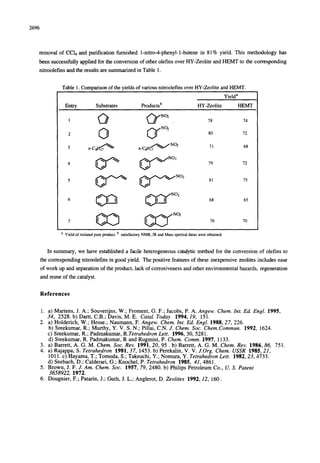
   removal of CCI4 and purification furnished 1-nitro-4-phenyl-l-butene in 81% yield. This methodology has
   been successfully applied for the conversion of other olefins over HY-Zeolite and HEMT to the corresponding
   nitroolefins and the results are summarized in Table 1.


                 Table l. Comparison of the yields of various nitroolefins over HY-Zeolite and HEMT.
                                                                                                Yield a
                  Entry             Substrates         Products b                  HY-Zeolite         HEMT

                    1               O                     ~NO2                           78               74

                                     ©                    O
                   3         n.C8H~                        ~,~,,,'~,f NO2
                                                      n_C8HI7                            71               68

                   4            ~                     ~.,'~,/NO2                         79               72

                                                                                         8,


                    6               ~                    ~            NO2                68               65


                    7               ~                    ~             NO2                76              70

                a Yieldofisolatedpureproduct,b satisfactory
                                                          NMR,IRandMassspectraldataswereobtained.

          In summary, we have established a facile heterogeneous catalytic method for the conversion of olefins to
       the corresponding nitroolefins in good yield. The positive features of these inexpensive zeolites includes ease
       of work up and separation of the product, lack of corrosiveness and other environmental hazards, regeneration
       and reuse of the catalyst.


       References


       1. a) Martens, J. A.; Souverijns, W.; Froment, G. F.; Jacobs, P. A. Angew. Chem. Int. Ed. Engl. 1995,
          34, 2528. b) Dartt, C.B.; Davis, M. E. Catal. Today 1994, 19, 151.
       2. a) Holderich, W.; Hesse.; Naumann, F. Angew. Chem. Int. Ed. Engl. 1988, 27, 226.
          b) Sreekumar, R.; Murthy, Y. V. S. N.; Pillai, C.N.J. Chem. Soc. Chem.Commun. 1992, 1624.
          c) Sreekumar, R.; Padmakumar, R.Tetrahedron Lett. 1996, 30, 5281.
          d) Sreekumar, R. Padmakumar, R and Rugmini, P. Chem. Comm. 1997, 1133.
       3. a) Barrett, A. G. M. Chem. Soc. Rev. 1991, 20, 95. b) Barrett, A. G. M. Chem. Rev. 1986, 86, 751.
       4. a) Rajappa, S. Tetrahedron 1981, 37, 1453. b) Perekalin, V. V. J.Org. Chem. USSR 1985, 21,
          1011. c) Hayama, T.; Tomoda, S.; Takeuchi, Y.; Nomura, Y. Tetrahedron Lett. 1982, 23, 4733.
          d) Seebach, D.; Calderari, G.; Knochel, P. Tetrahedron 1985, 41, 4861.
       5. Brown, J. F. J. Am. Chem. Soc. 1957, 79, 2480. b) Philips Petroleum Co., U. S. Patent
           3658922, 1972.
       6. Dougnier, F.; Patarin, J.; Guth, J. L.; Anglerot, D. Zeolites 1992, 12, 160.

nitrolefine

  • 1.
    TETRAHEDRON LETTERS Tetrahedron Letters 39 (1998) 2695-2696 Pergamon One-Pot Synthesis of Nitroolefins Using Zeolite. R. Sreekumar* a, Raghavakaimal Padmakumar b and P. Rugmini b a Department of Physiology, University of Wisconsin, Madison, USA. b Department of Chemistry &Biochemistry, University of Nebraska, Lincoln, USA. Received 29 September 1997; accepted 11 February 1998 Abstract: Nitroolefins,versatileintermediatesin organic synthesis, are convenientlyprepared in good yieldsby nitrationof olefinsusingnitricoxideand zeoliteas described. © 1998ElsevierScienceLtd. All rights reserved. In recent years, there has been a tremendous resurgence of interest in various selective organic transformations mediated by zeolites. L2 Nitroalkenes are an important class of compounds in organic synthesis, as powerful electrophiles that readily undergo conjugate addition reactions with nucleophiles or radicals and as potent dienophiles in the Diels-Alder reactions. In addition, the nitro group is particularly interesting in synthesis since it can be transformed into a variety of diverse functionalities.3 Nitroalkenes are prepared either from aldehydes and ketones or from alkenes itself. 4 Although the reaction of nitric oxide with olefins has already been reported, the reaction conditions were rather severe to form several undesirable by- products, and yields and selectivities of nitroolefins were not satisfactory. 5 However, no report is available in the literature in which a zeolite is employed to promote the conversion of olefins to the corresponding nitroolefins. In this communication, we wish to report a convenient and simple heterogeneous catalytic method for the synthesis of nitroolefins from various olefins with nitric oxide under mild conditions using HY-zeolite and HEMT (hexagonal analog of faujasite-type zeolite). NO (1 a t m . ) , ~ N O 2 CC14,2h H-Zeolite, 75 °C The olefins were purchased from Aldrich or Fluka chemical Co. and zeolites (Y-Zeolite and EMT) were synthesized as reported elsewhere.6 Prior to use, zeolites were calcined at 500 °C for 5h in the presence of air. The reaction on HY-Zeolite was optimized with respect to temperature, reaction time and catalyst to substrate ratio. A typical procedure is described for the nitration of 4-phenyl-l-butene; the R.B.flask containing a solution of olefin (132 rag, 1.0 mmol) in CC14 (25 mL) and HY-Zeolite (2.0 g) was evacuated and filled with nitric oxide gas (1.0 atmospheric pressure). Then the solution was stirred at 75 °C for 2 h. The reaction mixture was filtered after 2h through a Celite pad and the zeolite was washed with CC14 (3 x 25 mE), followed by 0040-4039/98/$19.00 © 1998 Elsevier Science Ltd. All rights reserved. PII: S0040-4039(98)00408-0
  • 2.
    2696 removal of CCI4 and purification furnished 1-nitro-4-phenyl-l-butene in 81% yield. This methodology has been successfully applied for the conversion of other olefins over HY-Zeolite and HEMT to the corresponding nitroolefins and the results are summarized in Table 1. Table l. Comparison of the yields of various nitroolefins over HY-Zeolite and HEMT. Yield a Entry Substrates Products b HY-Zeolite HEMT 1 O ~NO2 78 74 © O 3 n.C8H~ ~,~,,,'~,f NO2 n_C8HI7 71 68 4 ~ ~.,'~,/NO2 79 72 8, 6 ~ ~ NO2 68 65 7 ~ ~ NO2 76 70 a Yieldofisolatedpureproduct,b satisfactory NMR,IRandMassspectraldataswereobtained. In summary, we have established a facile heterogeneous catalytic method for the conversion of olefins to the corresponding nitroolefins in good yield. The positive features of these inexpensive zeolites includes ease of work up and separation of the product, lack of corrosiveness and other environmental hazards, regeneration and reuse of the catalyst. References 1. a) Martens, J. A.; Souverijns, W.; Froment, G. F.; Jacobs, P. A. Angew. Chem. Int. Ed. Engl. 1995, 34, 2528. b) Dartt, C.B.; Davis, M. E. Catal. Today 1994, 19, 151. 2. a) Holderich, W.; Hesse.; Naumann, F. Angew. Chem. Int. Ed. Engl. 1988, 27, 226. b) Sreekumar, R.; Murthy, Y. V. S. N.; Pillai, C.N.J. Chem. Soc. Chem.Commun. 1992, 1624. c) Sreekumar, R.; Padmakumar, R.Tetrahedron Lett. 1996, 30, 5281. d) Sreekumar, R. Padmakumar, R and Rugmini, P. Chem. Comm. 1997, 1133. 3. a) Barrett, A. G. M. Chem. Soc. Rev. 1991, 20, 95. b) Barrett, A. G. M. Chem. Rev. 1986, 86, 751. 4. a) Rajappa, S. Tetrahedron 1981, 37, 1453. b) Perekalin, V. V. J.Org. Chem. USSR 1985, 21, 1011. c) Hayama, T.; Tomoda, S.; Takeuchi, Y.; Nomura, Y. Tetrahedron Lett. 1982, 23, 4733. d) Seebach, D.; Calderari, G.; Knochel, P. Tetrahedron 1985, 41, 4861. 5. Brown, J. F. J. Am. Chem. Soc. 1957, 79, 2480. b) Philips Petroleum Co., U. S. Patent 3658922, 1972. 6. Dougnier, F.; Patarin, J.; Guth, J. L.; Anglerot, D. Zeolites 1992, 12, 160.