08.12.2018sindre.langaas@niva.no 1
Microplastics (MP) in sewage
sludge and agriculture
Sindre Langaas,
with contributions from Luca Nizzetto, Rachel Hurley and Sissel Ranneklev,
Norwegian Institute for Water Research (NIVA)
08.12.2018Forfatternavn 2
Massive global (media) interest in
marine plastics and microplastics
pollution
Agricultural (macro)plastics
08.12.2018 3
Pictures: www.grontpunkt.no
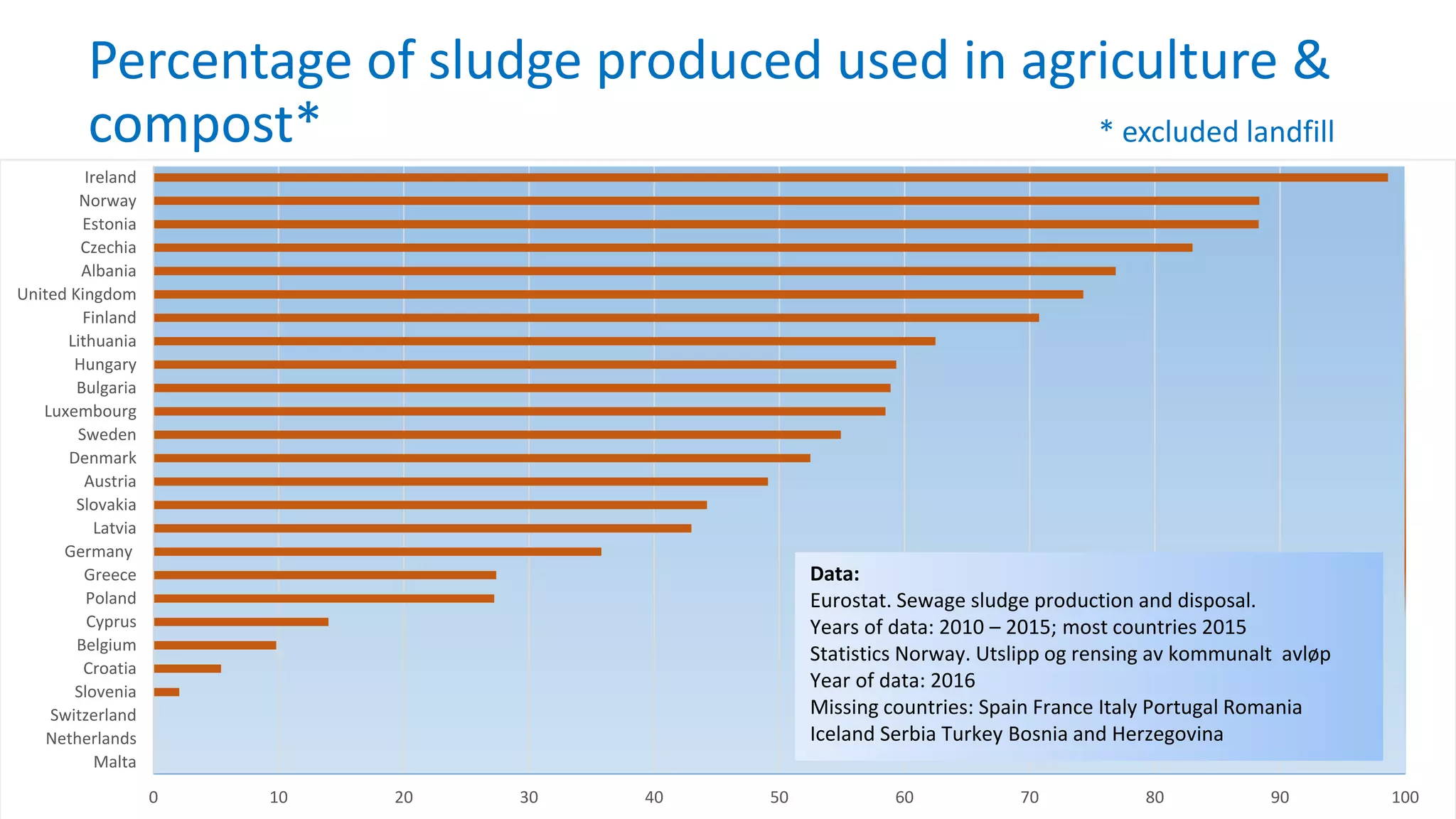
Percentage of sludge produced used in agriculture &
compost* * excluded landfill
08.12.2018Forfatternavn 40 10 20 30 40 50 60 70 80 90 100
Malta
Netherlands
Switzerland
Slovenia
Croatia
Belgium
Cyprus
Poland
Greece
Germany
Latvia
Slovakia
Austria
Denmark
Sweden
Luxembourg
Bulgaria
Hungary
Lithuania
Finland
United Kingdom
Albania
Czechia
Estonia
Norway
Ireland
Data:
Eurostat. Sewage sludge production and disposal.
Years of data: 2010 – 2015; most countries 2015
Statistics Norway. Utslipp og rensing av kommunalt avløp
Year of data: 2016
Missing countries: Spain France Italy Portugal Romania
Iceland Serbia Turkey Bosnia and Herzegovina
08.12.2018Forfatternavn 5
“…A rough extrapolation from data in
refs 1−3 produces a total yearly input of
63 000−430 000 and 44 000−300 000
tons MPs to European and North
American farmlands, respectively….”
Transfer of microplastics to sludge
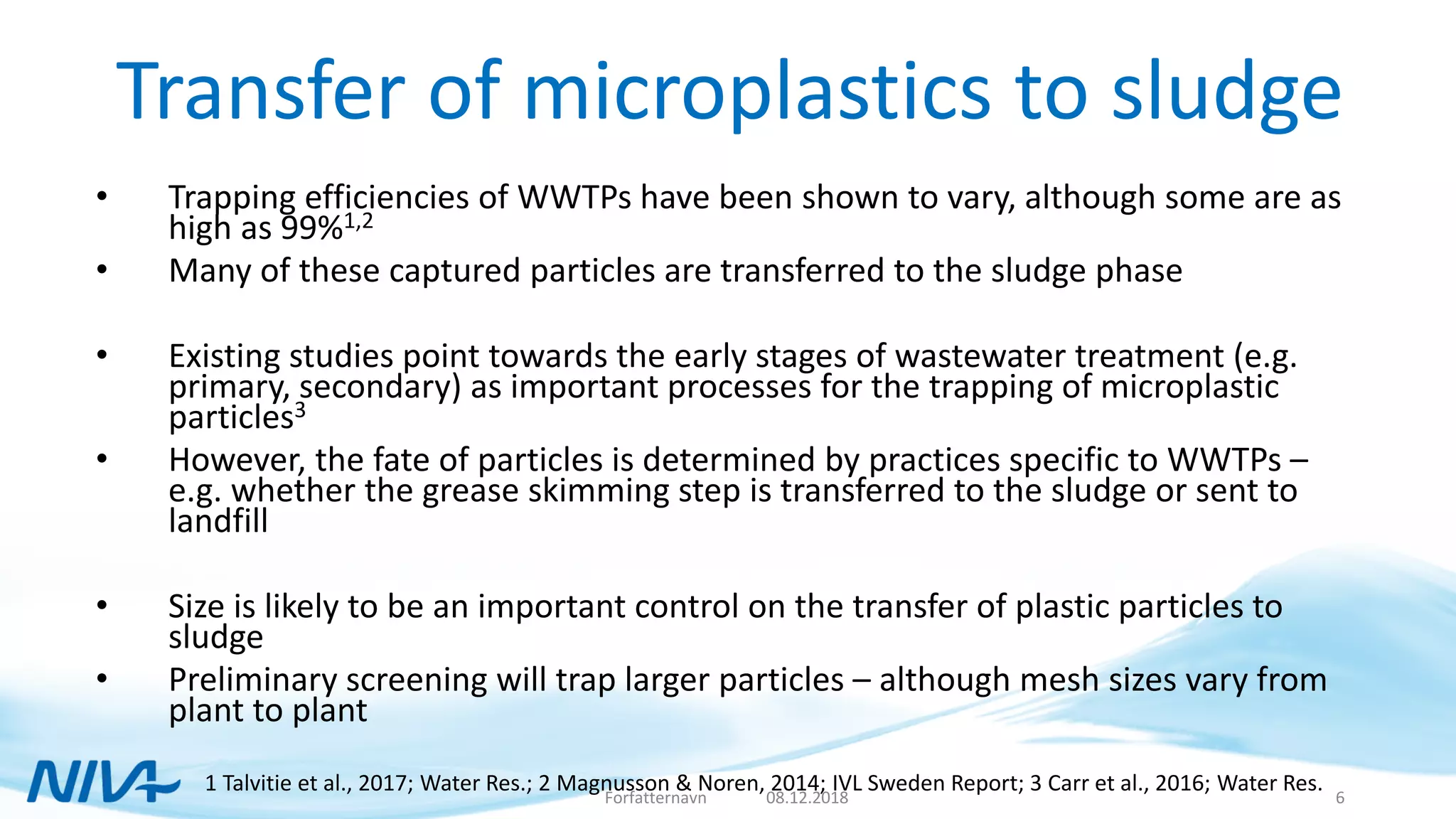
• Trapping efficiencies of WWTPs have been shown to vary, although some are as
high as 99%1,2
• Many of these captured particles are transferred to the sludge phase
• Existing studies point towards the early stages of wastewater treatment (e.g.
primary, secondary) as important processes for the trapping of microplastic
particles3
• However, the fate of particles is determined by practices specific to WWTPs –
e.g. whether the grease skimming step is transferred to the sludge or sent to
landfill
• Size is likely to be an important control on the transfer of plastic particles to
sludge
• Preliminary screening will trap larger particles – although mesh sizes vary from
plant to plant
1 Talvitie et al., 2017; Water Res.; 2 Magnusson & Noren, 2014; IVL Sweden Report; 3 Carr et al., 2016; Water Res.
08.12.2018Forfatternavn 6
Method for
extraction and
quantification
of MP from
complex
matrices
08.12.2018Forfatternavn 7
Concentrations of microplastics in
sewage sludge
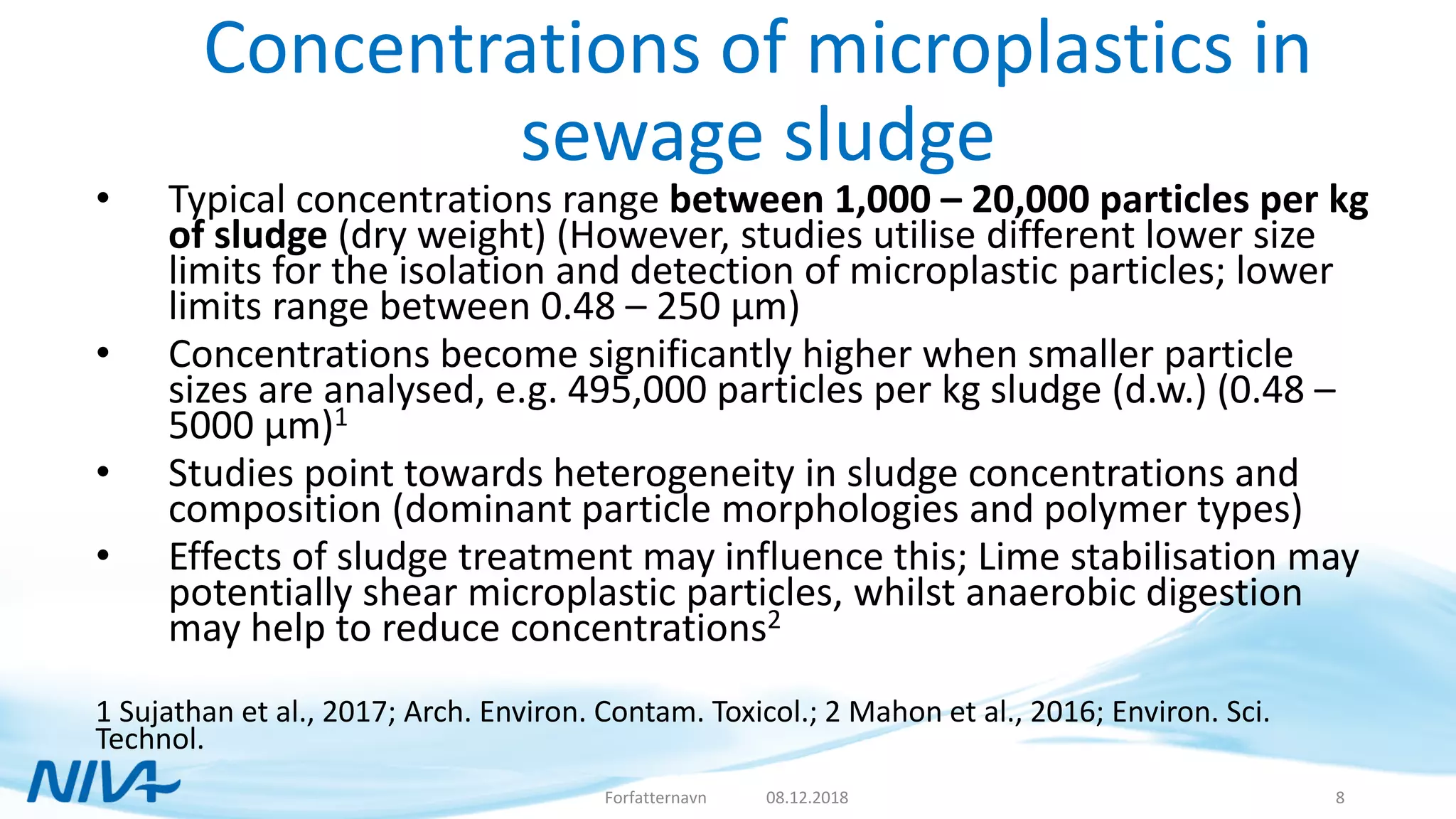
• Typical concentrations range between 1,000 – 20,000 particles per kg
of sludge (dry weight) (However, studies utilise different lower size
limits for the isolation and detection of microplastic particles; lower
limits range between 0.48 – 250 µm)
• Concentrations become significantly higher when smaller particle
sizes are analysed, e.g. 495,000 particles per kg sludge (d.w.) (0.48 –
5000 µm)1
• Studies point towards heterogeneity in sludge concentrations and
composition (dominant particle morphologies and polymer types)
• Effects of sludge treatment may influence this; Lime stabilisation may
potentially shear microplastic particles, whilst anaerobic digestion
may help to reduce concentrations2
1 Sujathan et al., 2017; Arch. Environ. Contam. Toxicol.; 2 Mahon et al., 2016; Environ. Sci.
Technol.
08.12.2018Forfatternavn 8
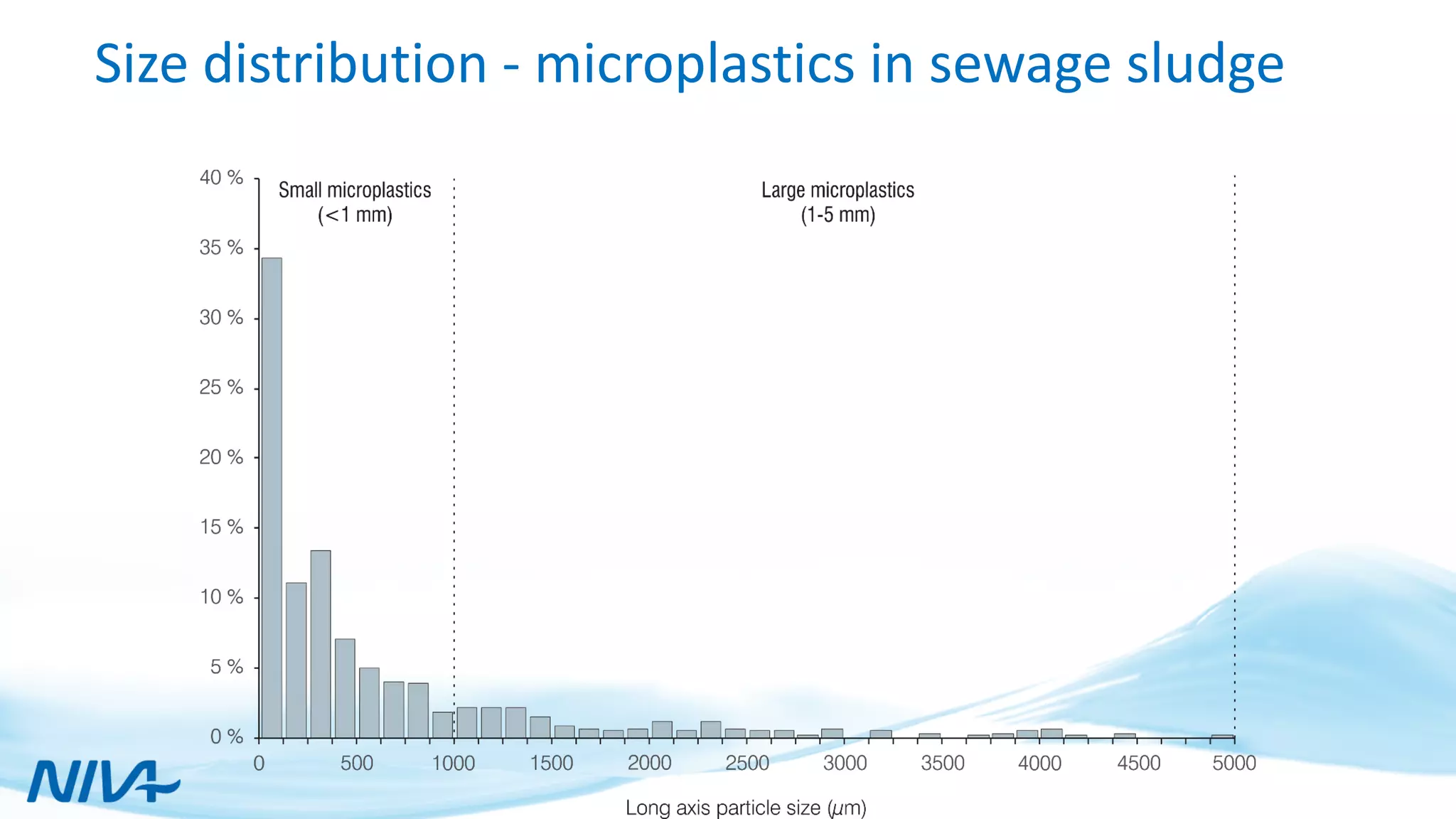
Size distribution - microplastics in sewage sludge
Microbeads Fragments
GlitterFibres
Types of microplastics in sewage sludge - Norway
Key challenges and knowledge gaps
• No two WWTPs are identical:
• Population equivalent/influent volumes
• Connectivity of wastewater system
• Wastewater treatment processes
• Sludge treatment process
• Sources of microplastics to WWTPs are likely to be numerous and
may operate across different temporal timescales
• The effect of different wastewater and sludge treatment processes
on determining microplastic concentrations, morphologies, or sizes
delivered to sludge is still under-investigated
• The potential to compare between studies is hindered by lack of
standardised methodologies
• A full size distribution of plastic particles in sludge has not been
established – where nanoplastics may also be relevant
08.12.2018Forfatternavn 11
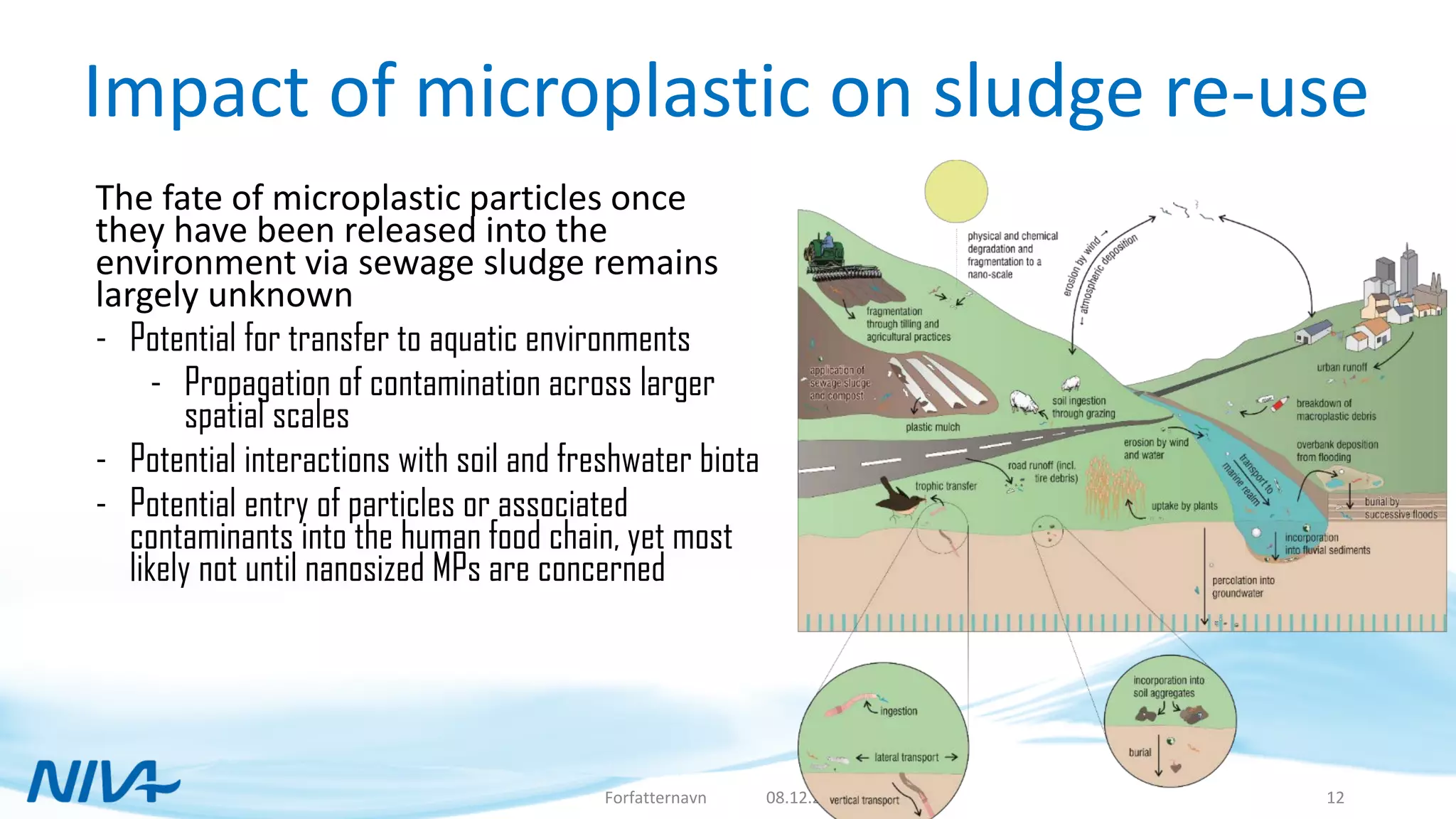
Impact of microplastic on sludge re-use
The fate of microplastic particles once
they have been released into the
environment via sewage sludge remains
largely unknown
- Potential for transfer to aquatic environments
- Propagation of contamination across larger
spatial scales
- Potential interactions with soil and freshwater biota
- Potential entry of particles or associated
contaminants into the human food chain, yet most
likely not until nanosized MPs are concerned
08.12.2018Forfatternavn 12
08.12.2018Forfatternavn 13
0
100
200
300
400
500
600
2005 2007 2009 2011 2013 2015 2017
Number of new science documents found annually containing
“microplastics AND sludge”
Thank you for listening
Further information: sindre.langaas@niva.no
Supported by:

Microplastics in sewage sludge and agriculture - Sindre Langaas - NIVA Norway

  • 1.
    08.12.2018sindre.langaas@niva.no 1 Microplastics (MP)in sewage sludge and agriculture Sindre Langaas, with contributions from Luca Nizzetto, Rachel Hurley and Sissel Ranneklev, Norwegian Institute for Water Research (NIVA)
  • 2.
    08.12.2018Forfatternavn 2 Massive global(media) interest in marine plastics and microplastics pollution
  • 3.
  • 4.
    Percentage of sludgeproduced used in agriculture & compost* * excluded landfill 08.12.2018Forfatternavn 40 10 20 30 40 50 60 70 80 90 100 Malta Netherlands Switzerland Slovenia Croatia Belgium Cyprus Poland Greece Germany Latvia Slovakia Austria Denmark Sweden Luxembourg Bulgaria Hungary Lithuania Finland United Kingdom Albania Czechia Estonia Norway Ireland Data: Eurostat. Sewage sludge production and disposal. Years of data: 2010 – 2015; most countries 2015 Statistics Norway. Utslipp og rensing av kommunalt avløp Year of data: 2016 Missing countries: Spain France Italy Portugal Romania Iceland Serbia Turkey Bosnia and Herzegovina
  • 5.
    08.12.2018Forfatternavn 5 “…A roughextrapolation from data in refs 1−3 produces a total yearly input of 63 000−430 000 and 44 000−300 000 tons MPs to European and North American farmlands, respectively….”
  • 6.
    Transfer of microplasticsto sludge • Trapping efficiencies of WWTPs have been shown to vary, although some are as high as 99%1,2 • Many of these captured particles are transferred to the sludge phase • Existing studies point towards the early stages of wastewater treatment (e.g. primary, secondary) as important processes for the trapping of microplastic particles3 • However, the fate of particles is determined by practices specific to WWTPs – e.g. whether the grease skimming step is transferred to the sludge or sent to landfill • Size is likely to be an important control on the transfer of plastic particles to sludge • Preliminary screening will trap larger particles – although mesh sizes vary from plant to plant 1 Talvitie et al., 2017; Water Res.; 2 Magnusson & Noren, 2014; IVL Sweden Report; 3 Carr et al., 2016; Water Res. 08.12.2018Forfatternavn 6
  • 7.
    Method for extraction and quantification ofMP from complex matrices 08.12.2018Forfatternavn 7
  • 8.
    Concentrations of microplasticsin sewage sludge • Typical concentrations range between 1,000 – 20,000 particles per kg of sludge (dry weight) (However, studies utilise different lower size limits for the isolation and detection of microplastic particles; lower limits range between 0.48 – 250 µm) • Concentrations become significantly higher when smaller particle sizes are analysed, e.g. 495,000 particles per kg sludge (d.w.) (0.48 – 5000 µm)1 • Studies point towards heterogeneity in sludge concentrations and composition (dominant particle morphologies and polymer types) • Effects of sludge treatment may influence this; Lime stabilisation may potentially shear microplastic particles, whilst anaerobic digestion may help to reduce concentrations2 1 Sujathan et al., 2017; Arch. Environ. Contam. Toxicol.; 2 Mahon et al., 2016; Environ. Sci. Technol. 08.12.2018Forfatternavn 8
  • 9.
    Size distribution -microplastics in sewage sludge
  • 10.
    Microbeads Fragments GlitterFibres Types ofmicroplastics in sewage sludge - Norway
  • 11.
    Key challenges andknowledge gaps • No two WWTPs are identical: • Population equivalent/influent volumes • Connectivity of wastewater system • Wastewater treatment processes • Sludge treatment process • Sources of microplastics to WWTPs are likely to be numerous and may operate across different temporal timescales • The effect of different wastewater and sludge treatment processes on determining microplastic concentrations, morphologies, or sizes delivered to sludge is still under-investigated • The potential to compare between studies is hindered by lack of standardised methodologies • A full size distribution of plastic particles in sludge has not been established – where nanoplastics may also be relevant 08.12.2018Forfatternavn 11
  • 12.
    Impact of microplasticon sludge re-use The fate of microplastic particles once they have been released into the environment via sewage sludge remains largely unknown - Potential for transfer to aquatic environments - Propagation of contamination across larger spatial scales - Potential interactions with soil and freshwater biota - Potential entry of particles or associated contaminants into the human food chain, yet most likely not until nanosized MPs are concerned 08.12.2018Forfatternavn 12
  • 13.
    08.12.2018Forfatternavn 13 0 100 200 300 400 500 600 2005 20072009 2011 2013 2015 2017 Number of new science documents found annually containing “microplastics AND sludge”
  • 14.
    Thank you forlistening Further information: sindre.langaas@niva.no Supported by: