ENG’s 13th AnnualSustainable Development in the Food & Beverage Industry,
4-5 February 2025, Brussels
Nutrient circularity: the agri-food sector
and the EU Circular Economy Act
3.
Phosphorus is essentialfor life
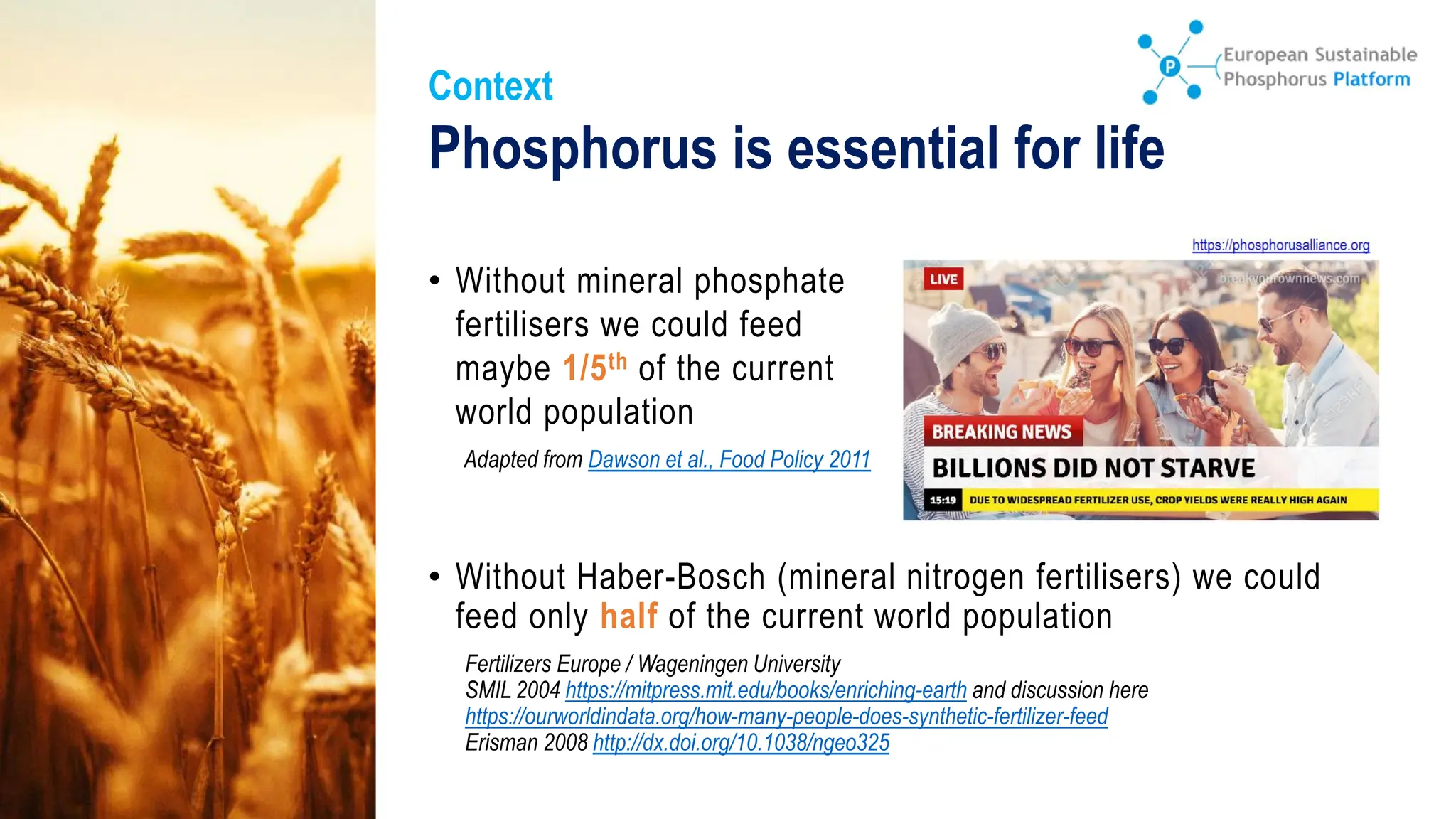
• Without mineral phosphate
fertilisers we could feed
maybe 1/5th of the current
world population
Adapted from Dawson et al., Food Policy 2011
Context
Fertilizers Europe / Wageningen University
SMIL 2004 https://mitpress.mit.edu/books/enriching-earth and discussion here
https://ourworldindata.org/how-many-people-does-synthetic-fertilizer-feed
Erisman 2008 http://dx.doi.org/10.1038/ngeo325
• Without Haber-Bosch (mineral nitrogen fertilisers) we could
feed only half of the current world population
4.
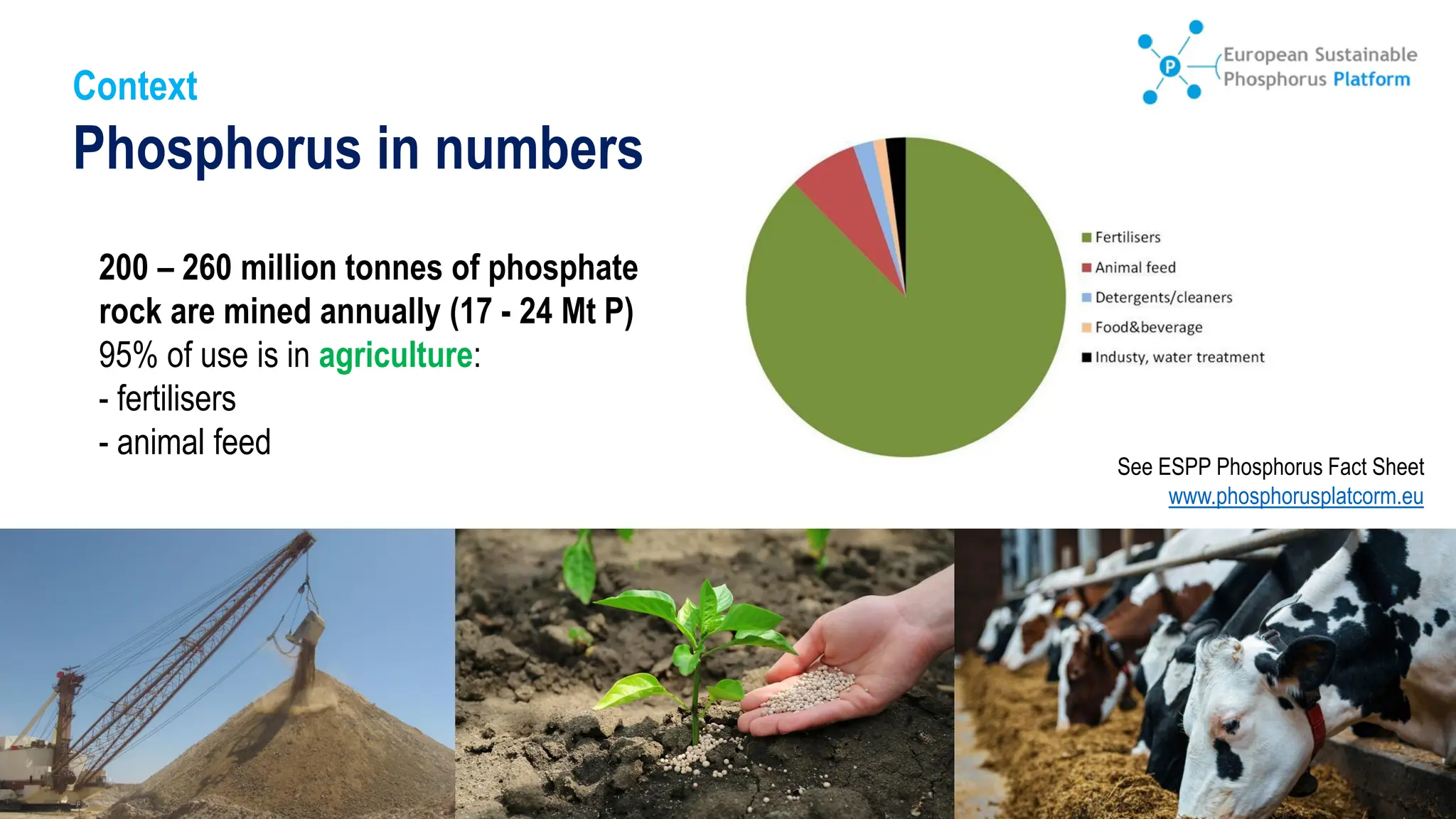
200 – 260million tonnes of phosphate
rock are mined annually (17 - 24 Mt P)
95% of use is in agriculture:
- fertilisers
- animal feed
See ESPP Phosphorus Fact Sheet
www.phosphorusplatcorm.eu
Phosphorus in numbers
Context
5.
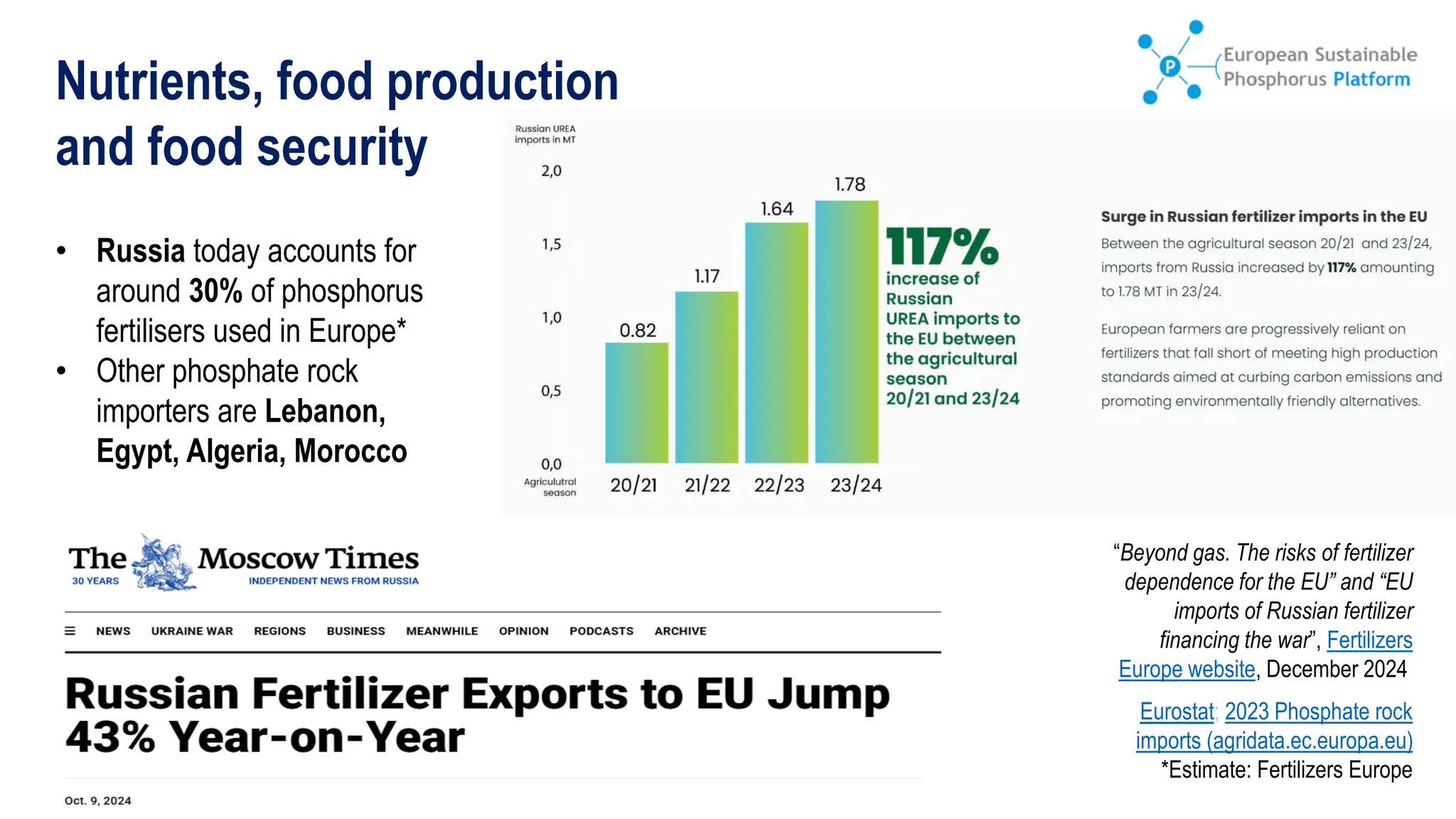
• Russia todayaccounts for
around 30% of phosphorus
fertilisers used in Europe*
• Other phosphate rock
importers are Lebanon,
Egypt, Algeria, Morocco
“Beyond gas. The risks of fertilizer
dependence for the EU” and “EU
imports of Russian fertilizer
financing the war”, Fertilizers
Europe website, December 2024
Eurostat; 2023 Phosphate rock
imports (agridata.ec.europa.eu)
*Estimate: Fertilizers Europe
Nutrients, food production
and food security
6.
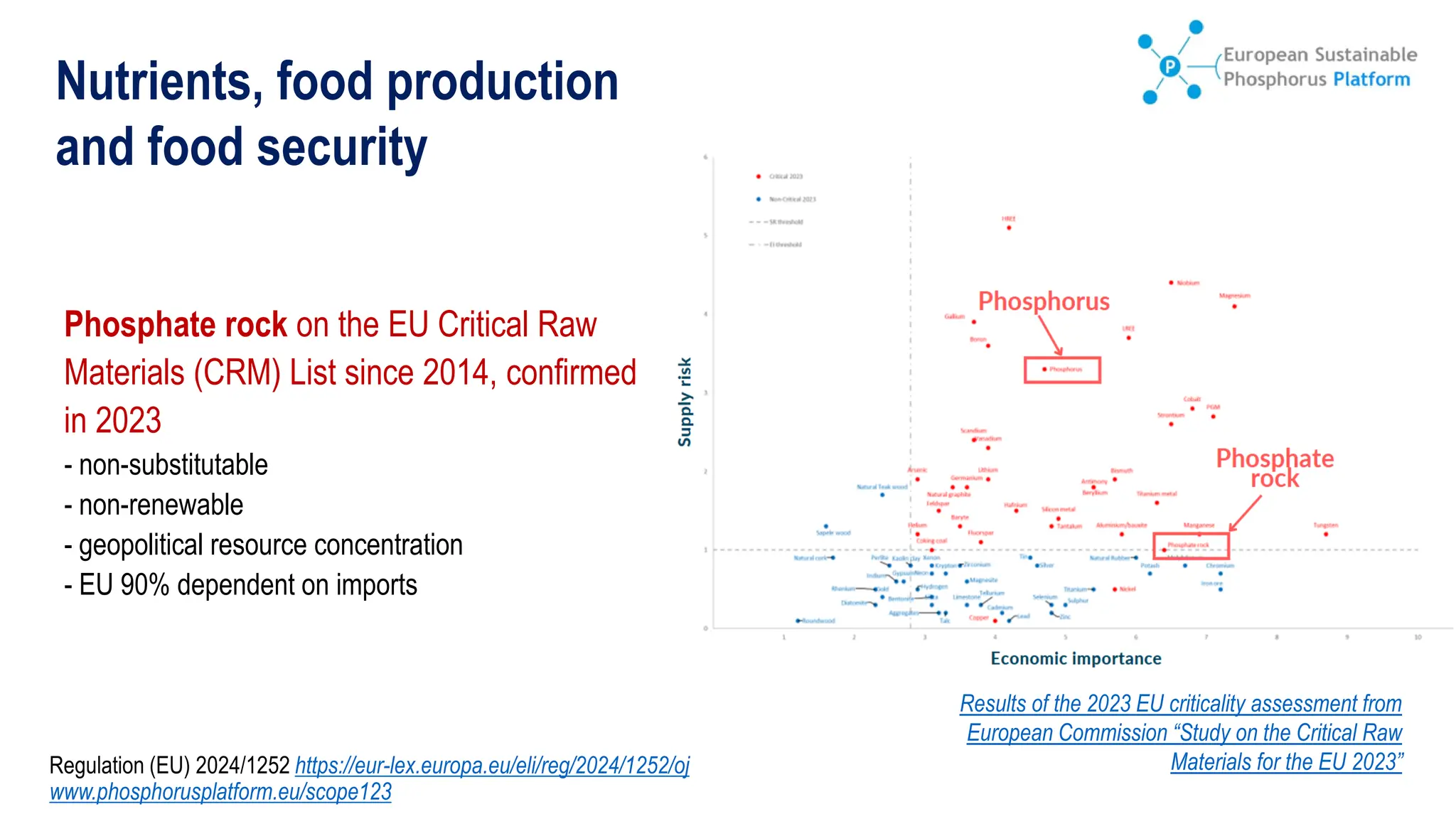
Phosphate rock onthe EU Critical Raw
Materials (CRM) List since 2014, confirmed
in 2023
- non-substitutable
- non-renewable
- geopolitical resource concentration
- EU 90% dependent on imports
Results of the 2023 EU criticality assessment from
European Commission “Study on the Critical Raw
Materials for the EU 2023”
Regulation (EU) 2024/1252 https://eur-lex.europa.eu/eli/reg/2024/1252/oj
www.phosphorusplatform.eu/scope123
Nutrients, food production
and food security
7.
EU Critical RawMaterials (CRM)
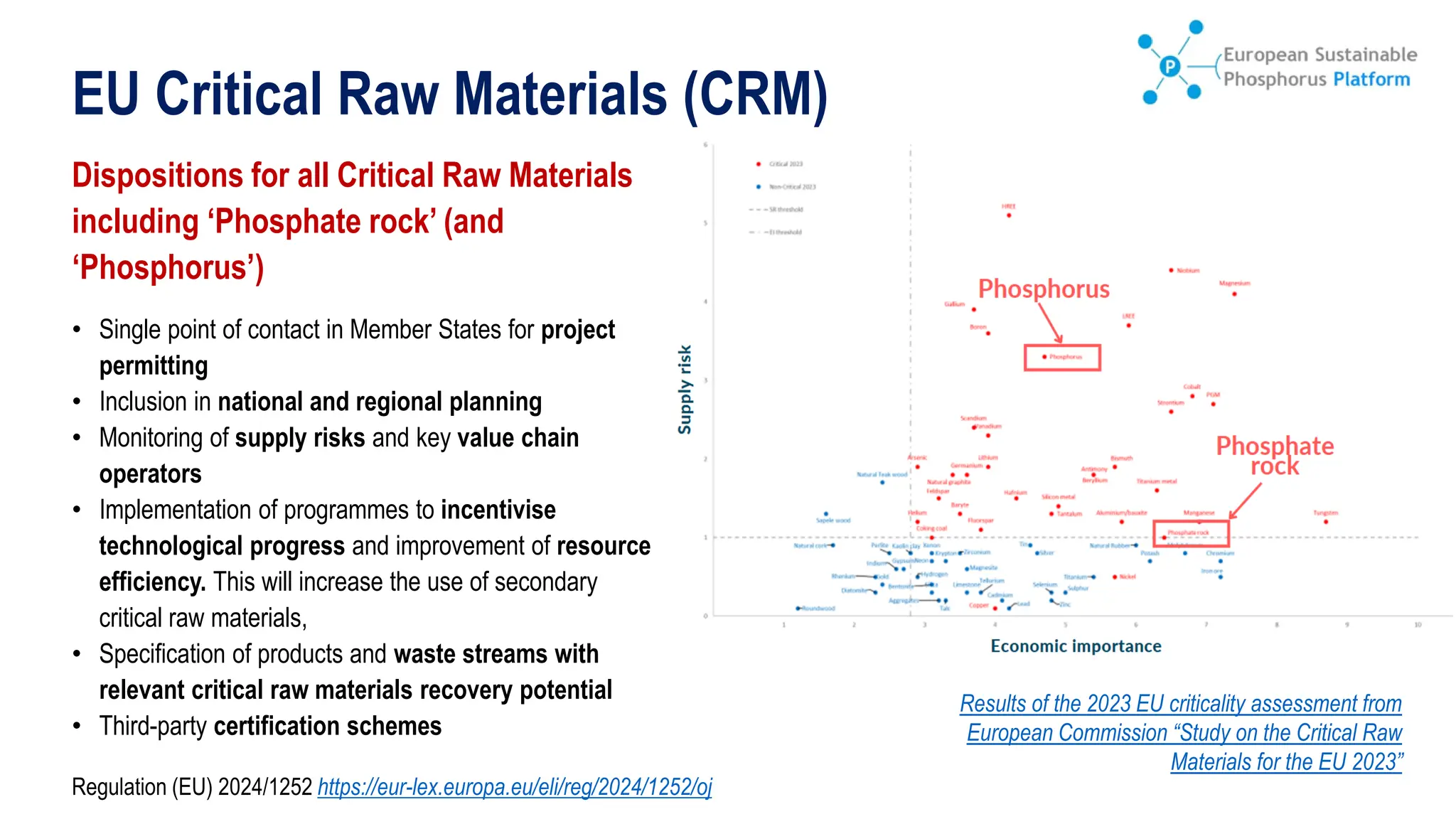
Results of the 2023 EU criticality assessment from
European Commission “Study on the Critical Raw
Materials for the EU 2023”
Regulation (EU) 2024/1252 https://eur-lex.europa.eu/eli/reg/2024/1252/oj
Dispositions for all Critical Raw Materials
including ‘Phosphate rock’ (and
‘Phosphorus’)
• Single point of contact in Member States for project
permitting
• Inclusion in national and regional planning
• Monitoring of supply risks and key value chain
operators
• Implementation of programmes to incentivise
technological progress and improvement of resource
efficiency. This will increase the use of secondary
critical raw materials,
• Specification of products and waste streams with
relevant critical raw materials recovery potential
• Third-party certification schemes
8.
Phosphorus in food
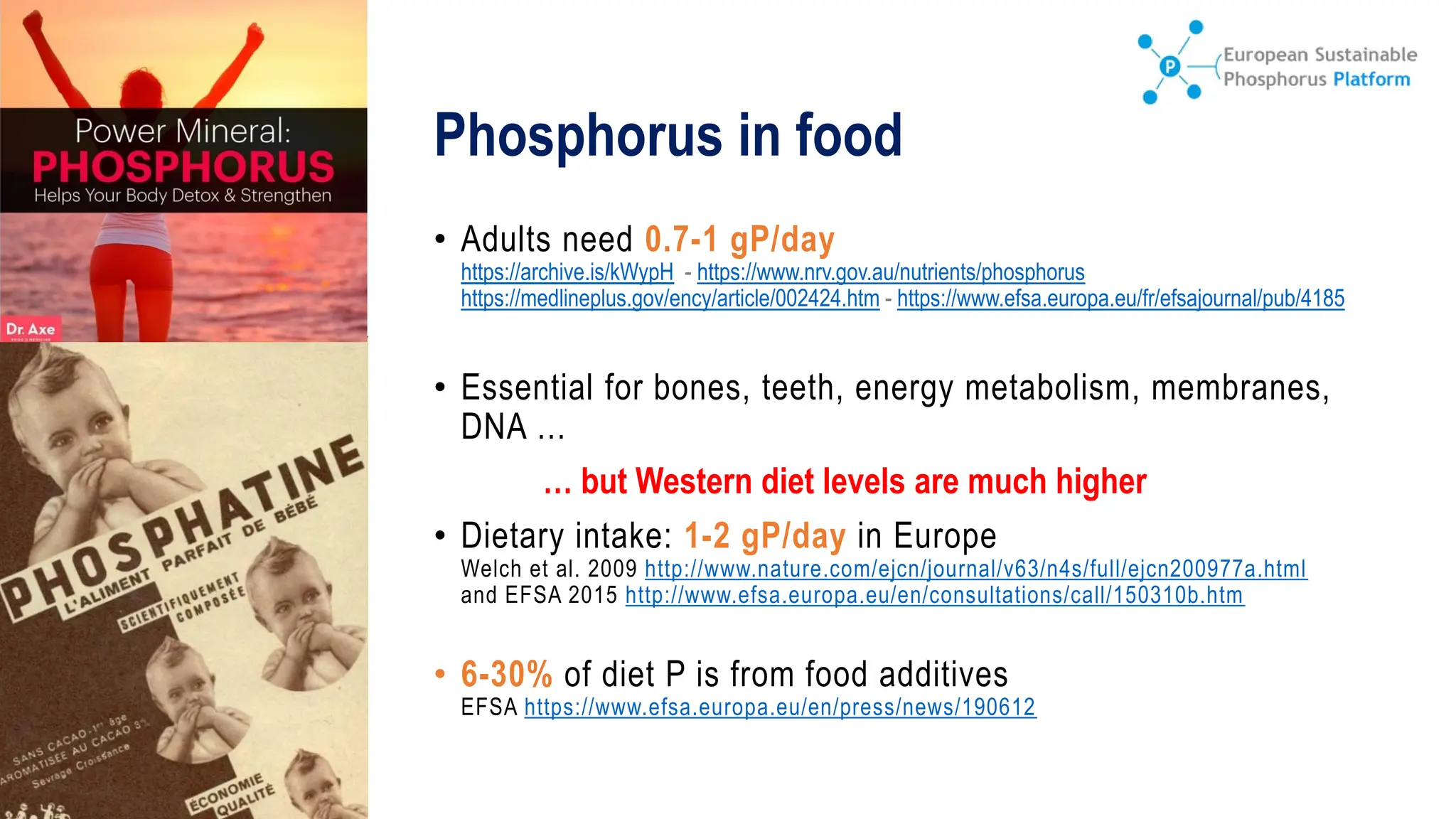
•Adults need 0.7-1 gP/day
https://archive.is/kWypH - https://www.nrv.gov.au/nutrients/phosphorus
https://medlineplus.gov/ency/article/002424.htm - https://www.efsa.europa.eu/fr/efsajournal/pub/4185
• Essential for bones, teeth, energy metabolism, membranes,
DNA …
… but Western diet levels are much higher
• Dietary intake: 1-2 gP/day in Europe
Welch et al. 2009 http://www.nature.com/ejcn/journal/v63/n4s/full/ejcn200977a.html
and EFSA 2015 http://www.efsa.europa.eu/en/consultations/call/150310b.htm
• 6-30% of diet P is from food additives
EFSA https://www.efsa.europa.eu/en/press/news/190612
9.
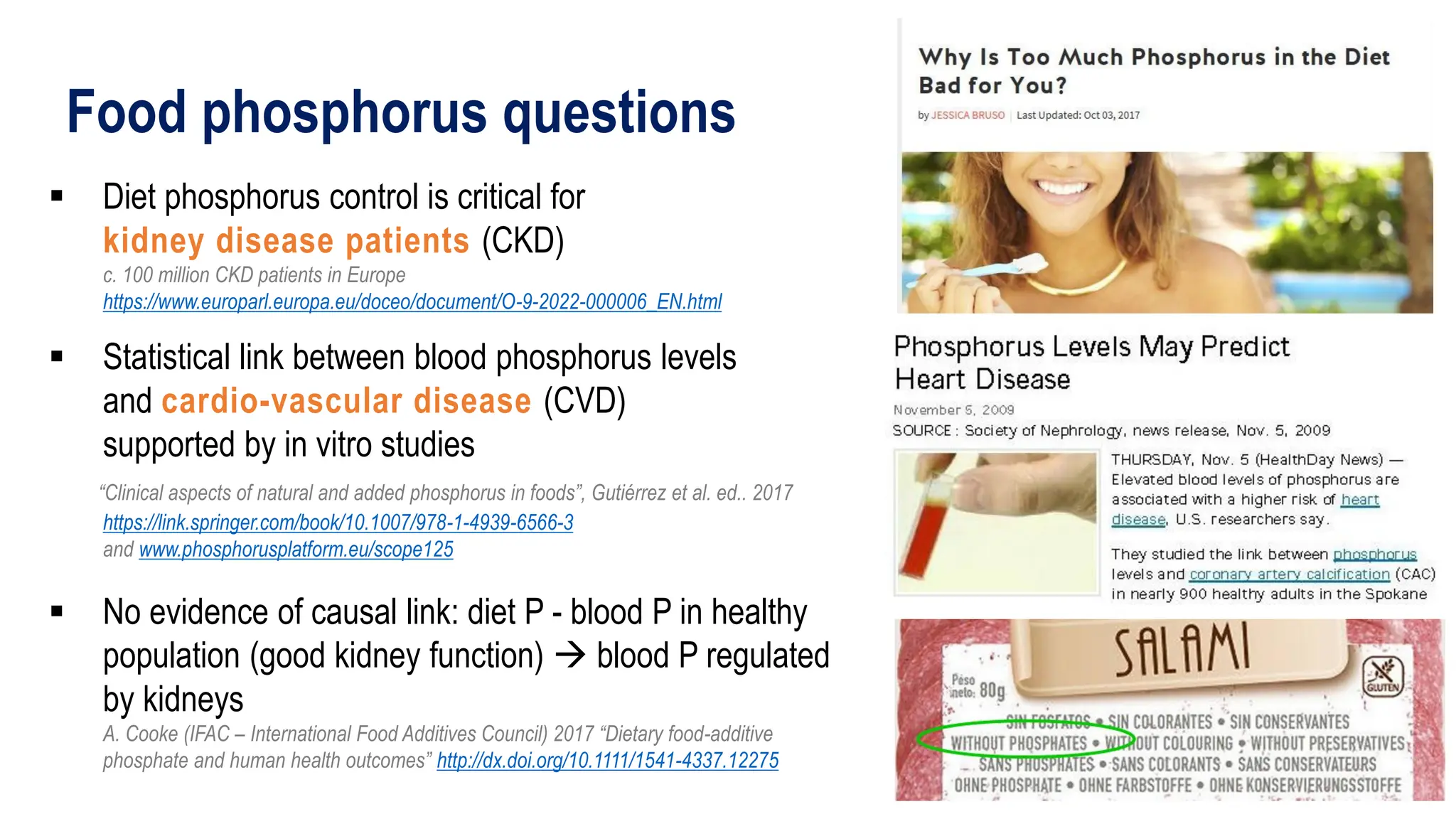
Food phosphorus questions
▪Diet phosphorus control is critical for
kidney disease patients (CKD)
c. 100 million CKD patients in Europe
https://www.europarl.europa.eu/doceo/document/O-9-2022-000006_EN.html
▪ Statistical link between blood phosphorus levels
and cardio-vascular disease (CVD)
supported by in vitro studies
“Clinical aspects of natural and added phosphorus in foods”, Gutiérrez et al. ed.. 2017
https://link.springer.com/book/10.1007/978-1-4939-6566-3
and www.phosphorusplatform.eu/scope125
▪ No evidence of causal link: diet P - blood P in healthy
population (good kidney function) → blood P regulated
by kidneys
A. Cooke (IFAC – International Food Additives Council) 2017 “Dietary food-additive
phosphate and human health outcomes” http://dx.doi.org/10.1111/1541-4337.12275
10.
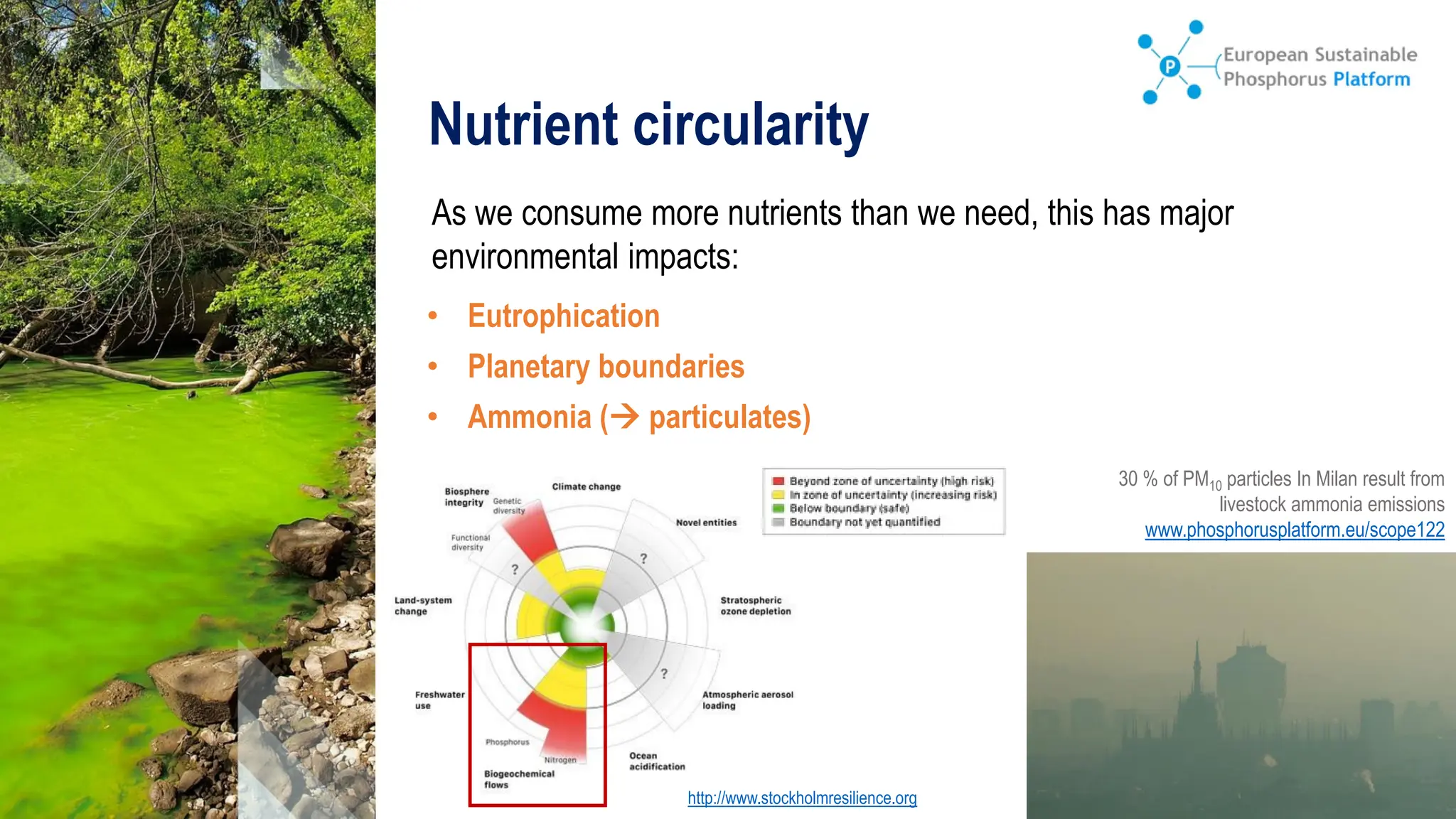
As we consumemore nutrients than we need, this has major
environmental impacts:
Nutrient circularity
• Eutrophication
• Planetary boundaries
• Ammonia (→ particulates)
30 % of PM10 particles In Milan result from
livestock ammonia emissions
www.phosphorusplatform.eu/scope122
http://www.stockholmresilience.org
11.
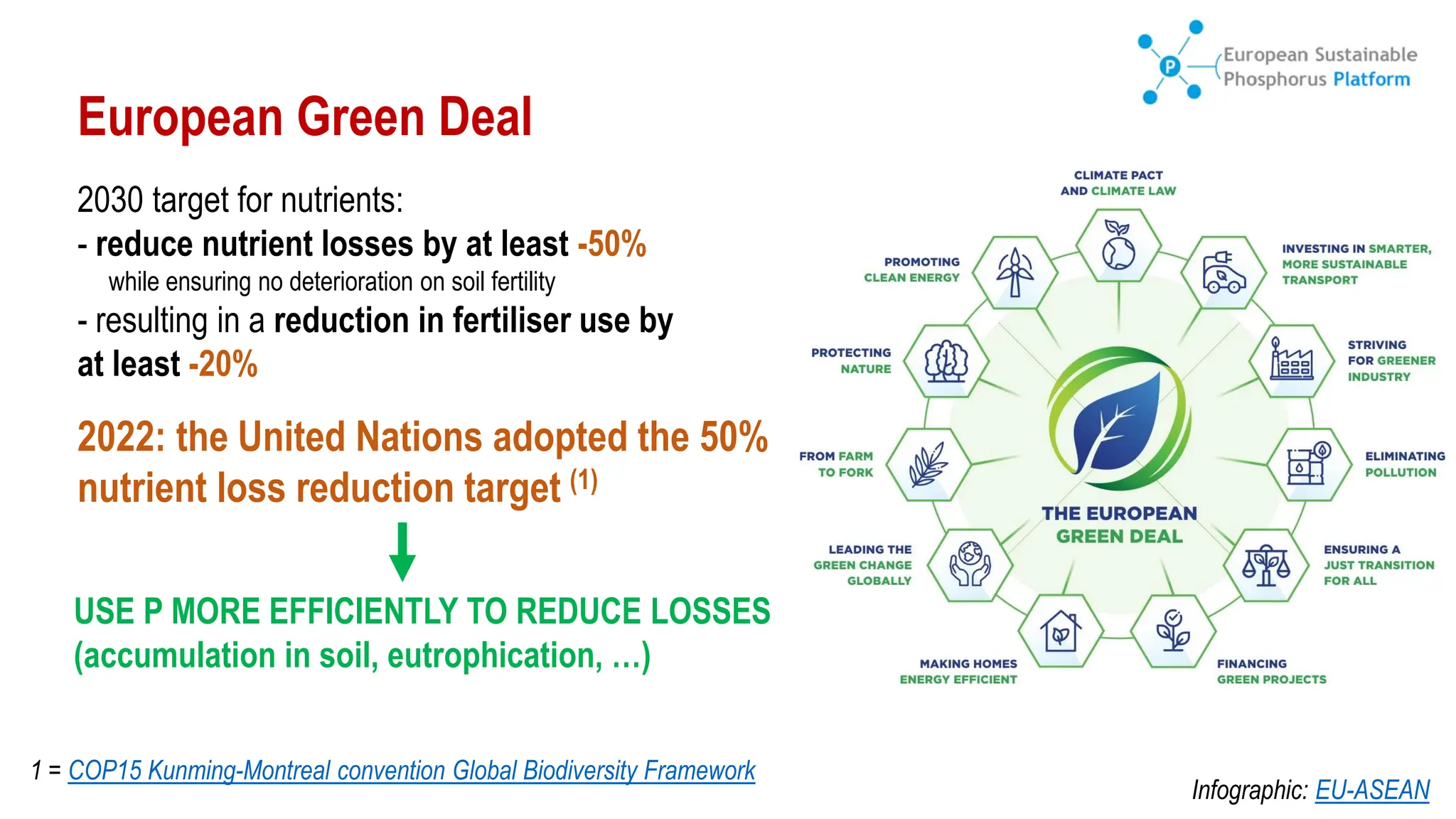
European Green Deal
2030target for nutrients:
- reduce nutrient losses by at least -50%
while ensuring no deterioration on soil fertility
- resulting in a reduction in fertiliser use by
at least -20%
2022: the United Nations adopted the 50%
nutrient loss reduction target (1)
USE P MORE EFFICIENTLY TO REDUCE LOSSES
(accumulation in soil, eutrophication, …)
1 = COP15 Kunming-Montreal convention Global Biodiversity Framework
Infographic: EU-ASEAN
12.
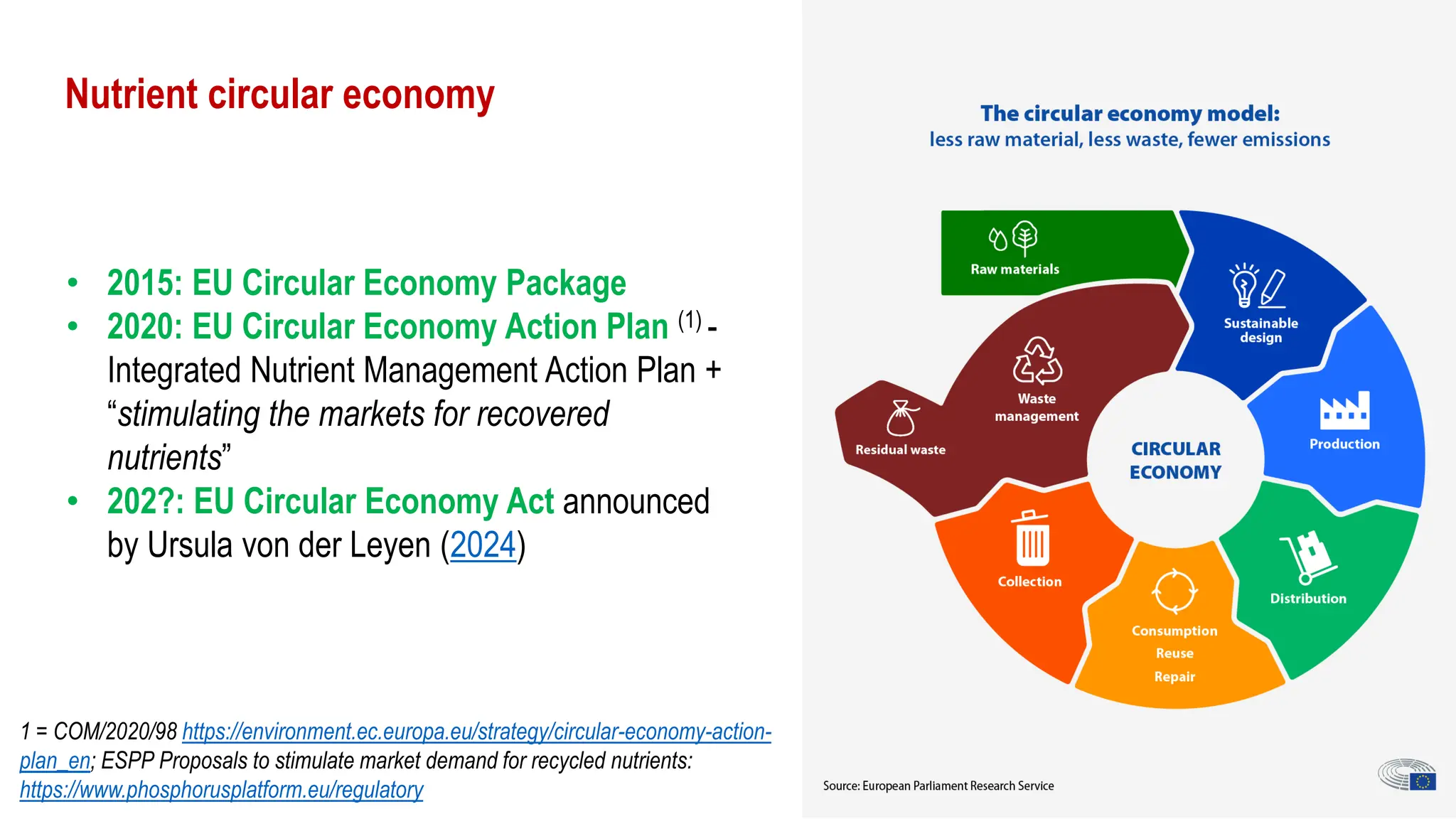
Nutrient circular economy
•2015: EU Circular Economy Package
• 2020: EU Circular Economy Action Plan (1) -
Integrated Nutrient Management Action Plan +
“stimulating the markets for recovered
nutrients”
• 202?: EU Circular Economy Act announced
by Ursula von der Leyen (2024)
1 = COM/2020/98 https://environment.ec.europa.eu/strategy/circular-economy-action-
plan_en; ESPP Proposals to stimulate market demand for recycled nutrients:
https://www.phosphorusplatform.eu/regulatory Infographic: EU-ASEAN
13.
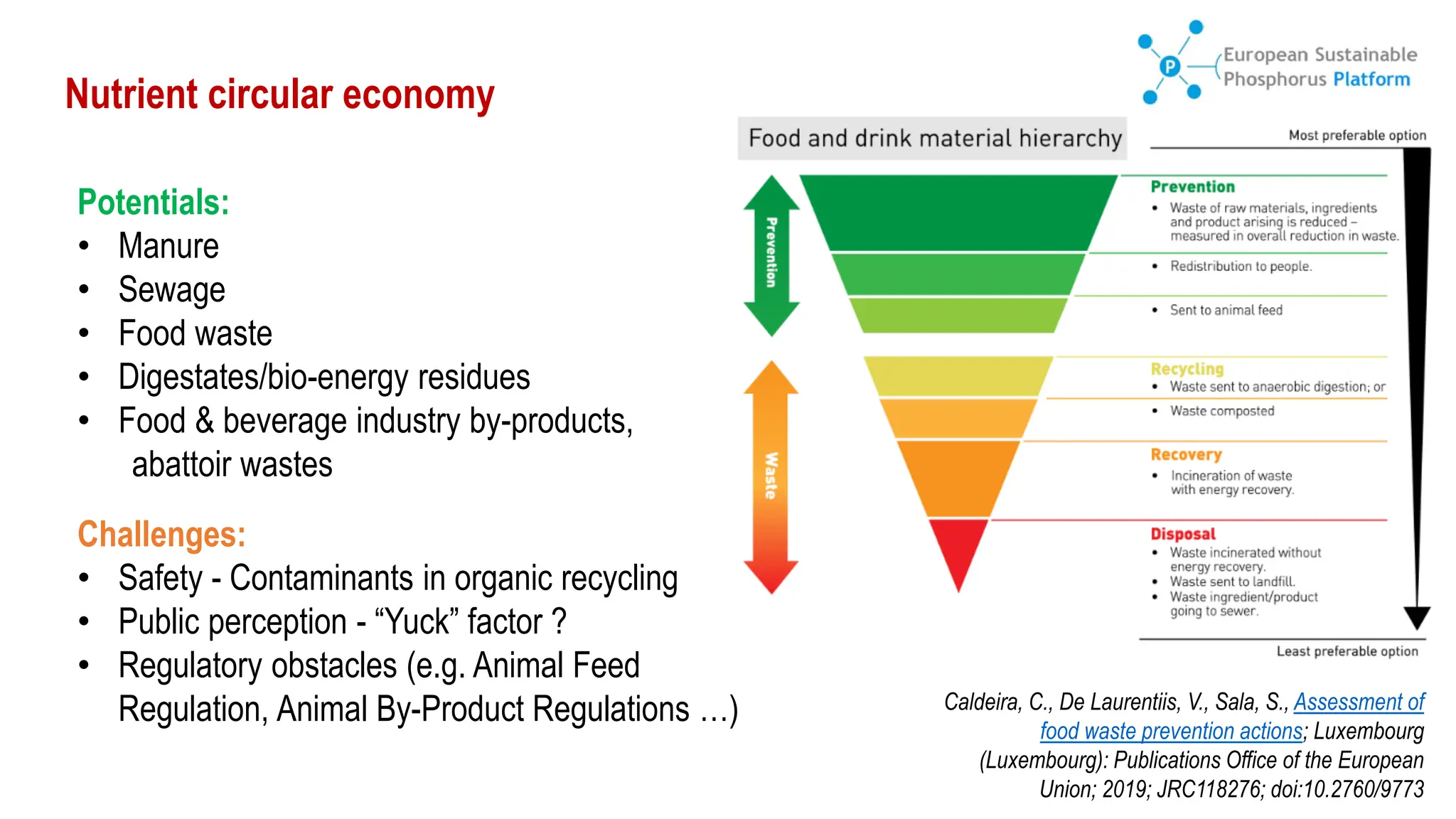
Challenges:
• Safety -Contaminants in organic recycling
• Public perception - “Yuck” factor ?
• Regulatory obstacles (e.g. Animal Feed
Regulation, Animal By-Product Regulations …)
Potentials:
• Manure
• Sewage
• Food waste
• Digestates/bio-energy residues
• Food & beverage industry by-products,
abattoir wastes
Caldeira, C., De Laurentiis, V., Sala, S., Assessment of
food waste prevention actions; Luxembourg
(Luxembourg): Publications Office of the European
Union; 2019; JRC118276; doi:10.2760/9773
Nutrient circular economy
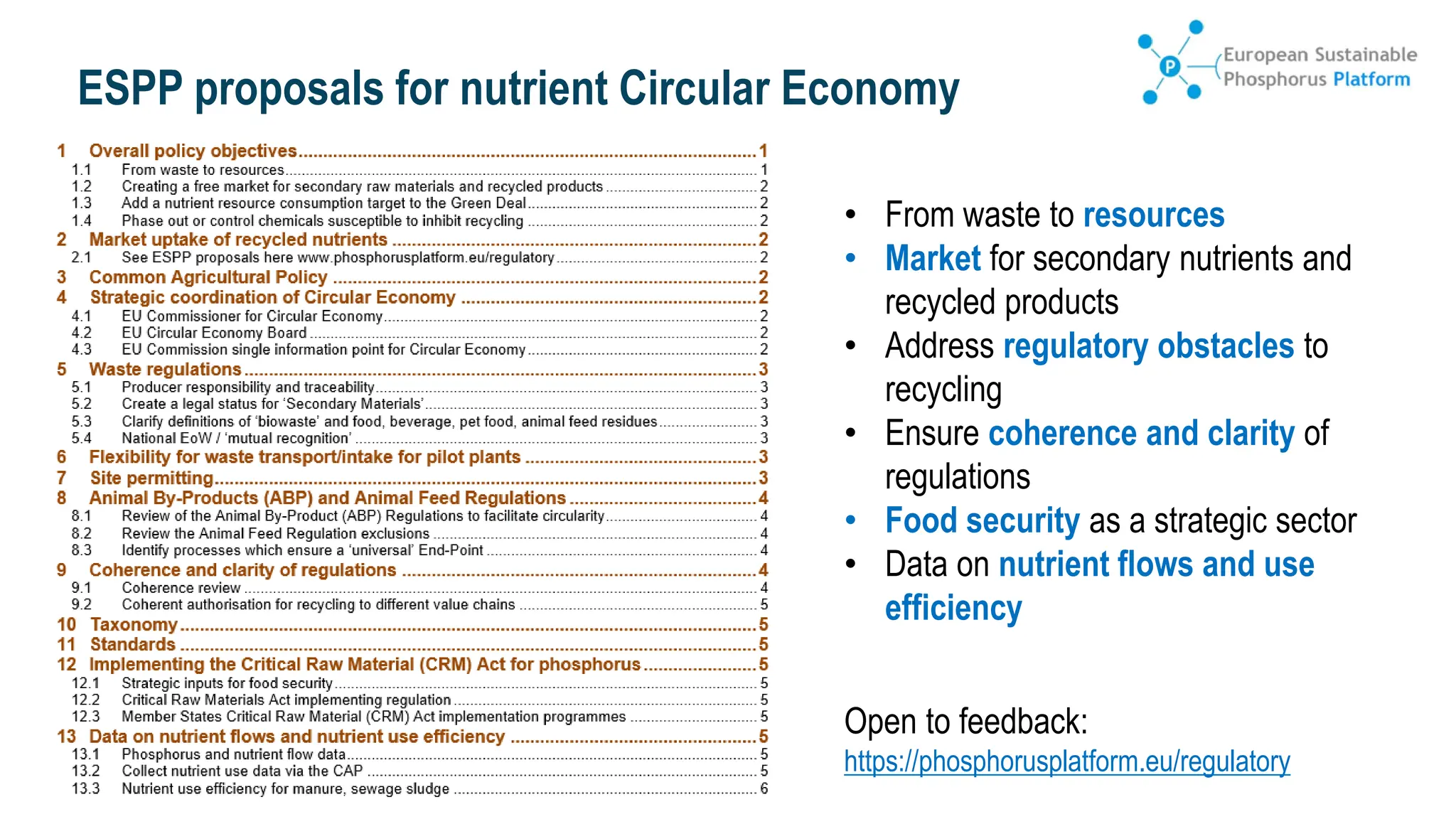
ESPP proposals fornutrient Circular Economy
Open to feedback:
https://phosphorusplatform.eu/regulatory
• From waste to resources
• Market for secondary nutrients and
recycled products
• Address regulatory obstacles to
recycling
• Ensure coherence and clarity of
regulations
• Food security as a strategic sector
• Data on nutrient flows and use
efficiency
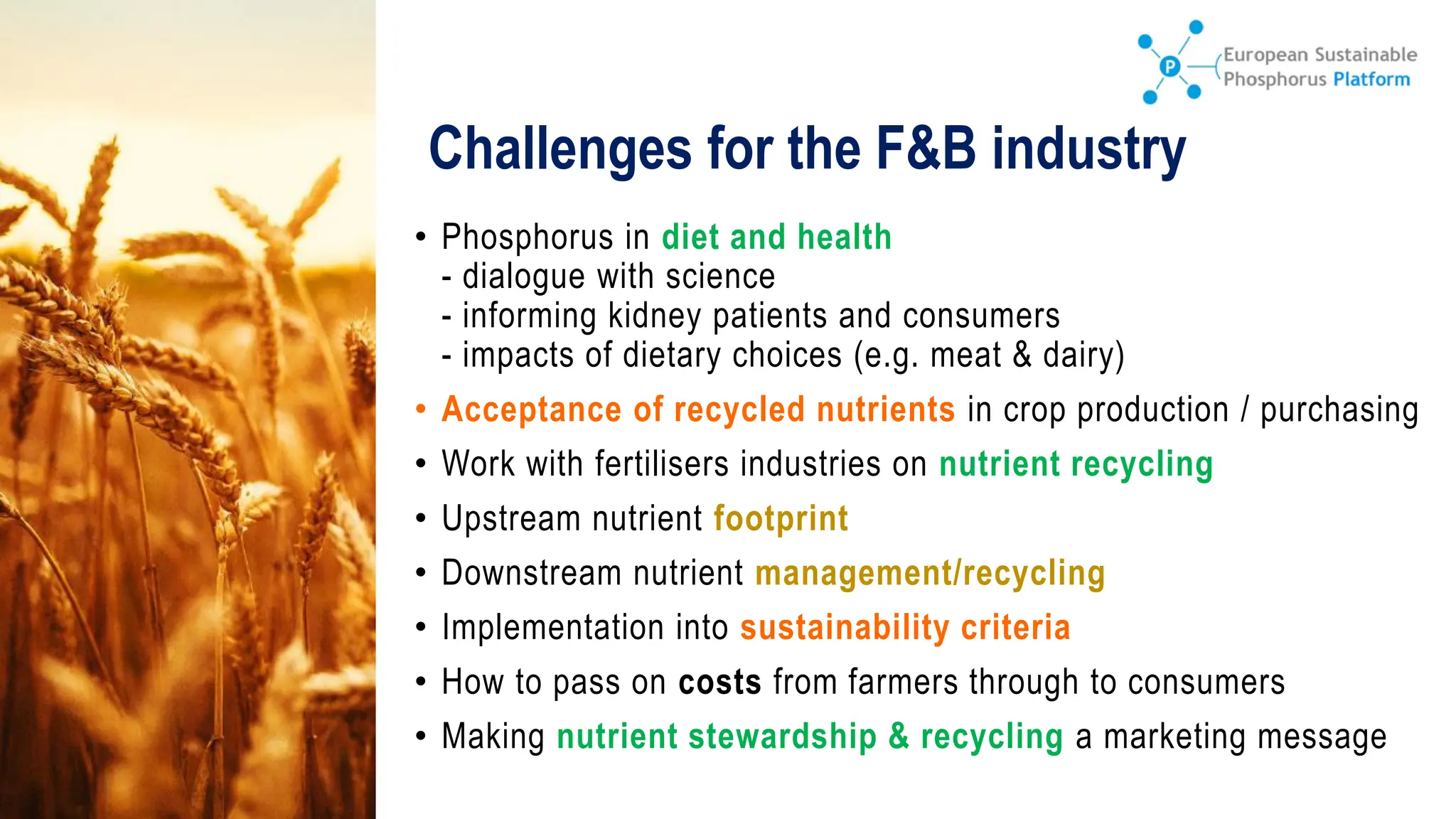
Challenges for theF&B industry
• Phosphorus in diet and health
- dialogue with science
- informing kidney patients and consumers
- impacts of dietary choices (e.g. meat & dairy)
• Acceptance of recycled nutrients in crop production / purchasing
• Work with fertilisers industries on nutrient recycling
• Upstream nutrient footprint
• Downstream nutrient management/recycling
• Implementation into sustainability criteria
• How to pass on costs from farmers through to consumers
• Making nutrient stewardship & recycling a marketing message