Introduction to
Microplastics
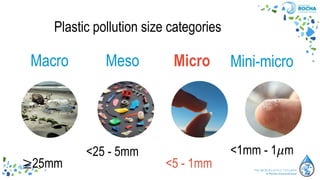
Plastic pollution size categories
≥25mm
<25 - 5mm
<5 - 1mm
<1mm - 1𝜇m
Macro Meso Micro Mini-micro
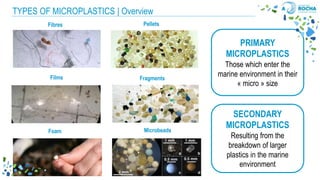
PRIMARY
MICROPLASTICS
Those which enter the
marine environment in their
« micro » size
SECONDARY
MICROPLASTICS
Resulting from the
breakdown of larger
plastics in the marine
environment
Fibres Pellets
Microbeads
Fragments
Foam
Films
TYPES OF MICROPLASTICS | Overview
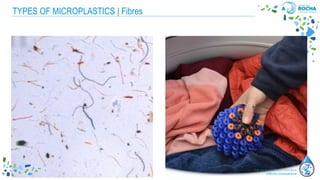
TYPES OF MICROPLASTICS | Fibres
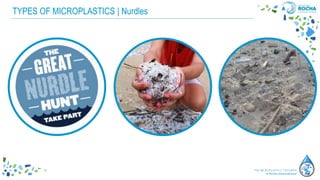
TYPES OF MICROPLASTICS | Nurdles
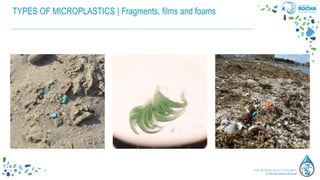
TYPES OF MICROPLASTICS | Fragments, films and foams
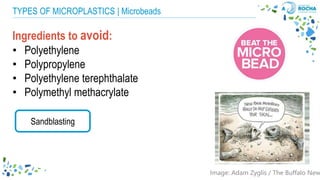
Image: Adam Zyglis / The Buffalo New
Ingredients to avoid:
• Polyethylene
• Polypropylene
• Polyethylene terephthalate
• Polymethyl methacrylate
Sandblasting
TYPES OF MICROPLASTICS | Microbeads
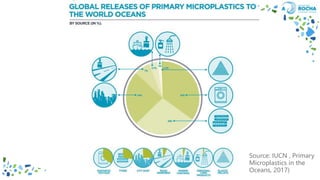
Source: IUCN , Primary
Microplastics in the
Oceans, 2017)
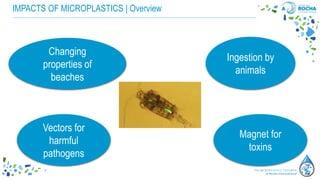
Ingestion by
animals
Changing
properties of
beaches
Vectors for
harmful
pathogens
Magnet for
toxins
IMPACTS OF MICROPLASTICS | Overview
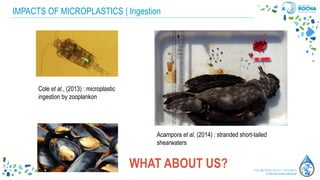
Acampora et al. (2014) : stranded short-tailed
shearwaters
Cole et al., (2013) : microplastic
ingestion by zooplankon
WHAT ABOUT US?
IMPACTS OF MICROPLASTICS | Ingestion

Introduction-to-microplastics-v1.1.pptx

Editor's Notes

  • #2 Version 1.1 – 29 May 2018 With thanks for revision to: Laurel D. Kearns Professor, Sociology of Religion and Environmental Studies Drew Theological School and the Graduate Division of Religion Drew University
  • #3 Microplastics are defined as those between .5 and 1 mm in every dimension. Below this are mini-microplastics, and size classes continue below these with nanoplastics.
  • #4 Microplastics can be divided into two categories: primary and secondary. Primary microplastics are those which enter the environment already in this size category either because they have been manufactured that size (eg. pre-industrial pellets or “nurdles”) or resulting from the abrasion of larger plastic items during manufacturing or use (e.g. clothes fibres released during washing process). 98% of losses of primary microplastics are from land-based activities. Secondary microplastics are those which originate from larger plastic objects degrading in the marine environment through the effect of wind, waves or sunlight, such as fragments, films and foams. Microbeads, famous for their presence in cosmetics, but also used in sandblasting, are mini-microplastics of the primary kind.
  • #5 More and more clothing is being made from synthetic fibres: polyester, polyethylene, nylon, acrylic, elastane. These are all names you may recognise. Fibres can be released from these clothing items during the manufacturing process and also the washing process: most household washing machines are not equipped with filters for the fibres. Washing a polyester fleece can release nearly 2000 fibres into the marine environment. These are carried in wastewater and discharged into the ocean. In a recent study of microplastics in the Atlantic ocean, 94% of all microplastics sampled in the sub-surface water column were fibres. (Kanhai et al., 2017) INTERACTION: In pairs or small groups: can you name the type of fibre of the clothes you are wearing right now? What can you do about it? Wash clothes less often, use a “coraball” (pictured) to capture the fibres, or Patagonia sells “Guppyfriends” which are bags in which you place your laundry before putting them into the washing machine that capture the fibres, or even install a filter on your washing machine.
  • #6 Plastic pellets are the form in which plastic is transported between the place that produces the plastic material, and the place that will transform it into the items we see on shop shelves. They are typically between 2-5mm in diameter and shaped like a disk or lentil. They come in a rainbow of colours. Pellets (also known as nurdles) are sometimes spilled into the marine environment during any of the stages from manufacturing, transporting and transforming. They can be found along coastlines and waterways, or floating on the ocean’s surface. 257,000 kilotons of plastic pellets are consumed globally per year – that’s the weight of 2.5 million blue whales! They represent 0.3% of the global release of primary microplastics in the world ocean, and can be released through road runoff, wastewater, and directly into the ocean. Take part in the nurdle hunt! See in the Toolkit or on https://www.nurdlehunt.org.uk/ for more information
  • #7 Large plastics break down in the environment by the action of UV light, wind and waves. Plastics are made to be durable and to resist decomposition. Therefore, this breaking down process undergone in the marine environment doesn’t cause the plastic to disappear: it only makes it smaller, and therefore more problematic- we will explain why later in the presentation. The middle picture is of a broken-down fragment of fishing net.
  • #8 Microbeads are intentionally manufactured in their “micro” size. In cosmetics, they are present in a variety of products for different purposes. They can be used to create films, such as face masks, to aid deep cleansing and exfoliating, as tooth-whiteners in toothpaste and in deodorants to block pores. Many countries have or are making steps to ban microbeads in cosmetics, but there is still a way to go! The main ingredients to avoid are: Polyethylene, polypropylene, polyethylene terephthalate and polymethyl methacrylate. For more information see: www.beatthemicrobead.com campaign. Microbeads have replaced traditional sand in industrial sandblasting activities because of their durability. Sandblasting can be used, for example, to clean ships. This results in microbeads entering waterways.
  • #9 As we can see in this chart from the International Union for the Conservation of Nature, 28% of the primary microplastics (not including microplastic broken down from larger plastic) are from car tyres: today, many car tyres are made either entirely or partially from synthetic rubber which is plastic. As they wear down, small fragments are detached and released into road run-off, eventually finding their way into rivers, lakes or the ocean. City dust is made up of many sources of plastics from abrasion of objects such as shoe soles, artificial turfs, and building coatings and intentional pouring of detergents. On the list you can also see road markings and marine coatings- for which acrylic paints are often used. Road markings can also be applied with thermoplastics, which are common in Europe. For entire document from which this visual is taken, see https://portals.iucn.org/library/sites/library/files/documents/2017-002.pdf
  • #10 Some studies suggest that the presence of microplastics in sand can alter the permeability (how easily water passes through) and temperature of the sand, which could have impacts on sea turtles which have temperature-dependent sex-determination e.g. Carson et al.(2011) Microplastics can also act as vectors for harmful pathogens and invasive species which latch on and use the plastic as a floating raft. The smaller the plastic item, the larger the surface-area-to-volume ratio, allowing more microorganisms to attach to one piece of plastic. These floating rafts can then transport pathogens and invasive species to new geographic areas. The properties of plastic make them so they act as magnets for toxins present in the marine environment, notably Persistent Organic Pollutants (POPs). These are pollutants present in run-off from agricultural fields, for example, which have difficultly breaking down in the marine environment. Studies have found that these pollutants can be present on and in microplastics at a concentration of 1 million times the background concentration in surrounding seawater. This is also a problem when microplastics are ingested, as these toxins are carried into the bodies…. (see next slide)
  • #11 A study by Acampora et al. (2014) examined bodies of stranded short-tailed shearwaters for the presence of microplastics. More than 2/3 of birds in their study had ingested microplastics. Juveniles were more likely to ingest microplastics than adults. It seemed these birds especially like hard plastics, rubber and balloons. Studies are also showing that microplastics are being ingested by zooplankton. Zooplankton, such as the copepod pictured above, are at the very base of the marine foodweb. The earlier in the foodweb microplastics are ingested, the more severe the problem as toxins are concentrated each time an organism (which has already ingested microplastic) is ingested by another organism through a process called “bioaccumulation”. It is likely that microplastics are making it all the way up the food chain to humans. Synthetic fibres have been discovered in the soft tissue of mussels on sale in supermarkets in Belgium (De Witte et al, 2014) and 33% of oysters sampled from markets in California were found to contain microplastics (Rochman et al, 2014). Microplastics have been found in the digestive system of aquatic invertebrates, such as molluscs and shrimp, as well as in seabirds, marine turtles, seals, sea otters, whales and fish. The impact of the plastic and associated toxins on biological organisms is still a very active area of research science, with findings pointing to impacts on the endocrine system (hormones) and interaction with DNA leading to cancer.