ROLE OF MICRO GRID IN
POWER SECTOR
Sushil Aggarwal
Research Scholar
National Chiao Tung University
Hsinchu, Taiwan (R.O.C.)
Micro Grid ….?
 Micro means small
 Grid means integration of many generation
units and loads.
 Hence micro grid means integration of many
small power generation units and loads at
small scale .
 Each generation unit called distributed energy
resource (DER) or Distributed generator (DG).
 In a single microgrid many DERs(distributed
energy resources) or DGs.
2
Sushil Aggarwal, Research Scholar, NCTU, Taiwan (R.O.C.)-
30013
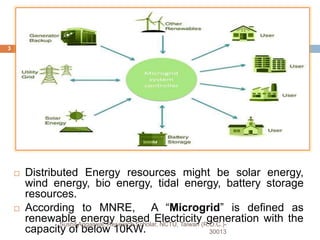
 Distributed Energy resources might be solar energy,
wind energy, bio energy, tidal energy, battery storage
resources.
 According to MNRE, A “Microgrid” is defined as
renewable energy based Electricity generation with the
capacity of below 10KW.
3
Sushil Aggarwal, Research Scholar, NCTU, Taiwan (R.O.C.)-
30013
Why Microgrid ???
Sushil Aggarwal, Research Scholar, NCTU, Taiwan (R.O.C.)-
30013
4
 Non conventional energy resources like coal diesel,
gas etc. degrading day by day.
 In last few years, we have invented various
Renewable energy like bio, wind, solar, tidal etc.
 We need to take energy from all renewable sources
to overcome the energy demand and avoid energy
crisis.
 These resources produces very small amount of
electrical energy that is not possible to take
individually
 Hence to integrate all these energy resources
Microgrid invented.
Sushil Aggarwal, Research Scholar, NCTU, Taiwan (R.O.C.)-
30013
5
 According to study by Stanford University top
leading countries that moves completely towards
renewable energy are
 Iceland-100 % energy from renewable resources
 Sweden- almost 100 % from renewable resources
 Cost Rica- almost 100 % from renewable resources
 Nicaragua- 90 % from renewable resources
 UK, Germany, Uruguay, Denmark, China , Morocco,
USA and Kenya.
Components of a Microgrid
Sushil Aggarwal, Research Scholar, NCTU, Taiwan (R.O.C.)-
30013
6
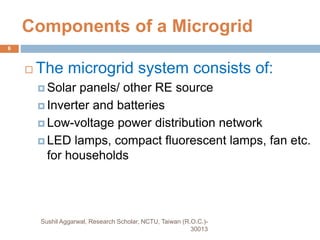
 The microgrid system consists of:
 Solar panels/ other RE source
 Inverter and batteries
 Low-voltage power distribution network
 LED lamps, compact fluorescent lamps, fan etc.
for households
Some other related information
Sushil Aggarwal, Research Scholar, NCTU, Taiwan (R.O.C.)-
30013
7
 In 1882, Thomas Edison invented the first
Microgrid in The Manhattan, USA.
 The aim of India Government is achieve the target
of 500 MW of total capacity over next five years
 To set up 10000 units of microgrid by using solar,
wind, and biomass power.
Types of Microgrid
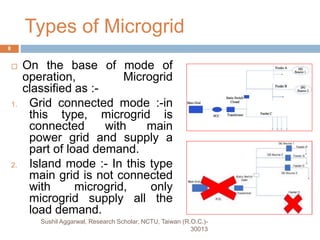
 On the base of mode of
operation, Microgrid
classified as :-
1. Grid connected mode :-in
this type, microgrid is
connected with main
power grid and supply a
part of load demand.
2. Island mode :- In this type
main grid is not connected
with microgrid, only
microgrid supply all the
load demand.
8
Sushil Aggarwal, Research Scholar, NCTU, Taiwan (R.O.C.)-
30013
Sushil Aggarwal, Research Scholar, NCTU, Taiwan (R.O.C.)-
30013
9
1.AC Microgrid :- The
working supply is AC
and if any Load and
generation unit working
with DC then the supply
Converted into AC by
using
FACTS devices.
On the basis of power supply,
Microgrid classified as :-
Sushil Aggarwal, Research Scholar, NCTU, Taiwan (R.O.C.)-
30013
10
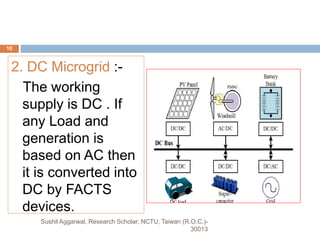
2. DC Microgrid :-
The working
supply is DC . If
any Load and
generation is
based on AC then
it is converted into
DC by FACTS
devices.
Importance of Microgrid
 It provides backup to the grid in case of
emergency.
 To make energy independent to a community.
 To reduce the cost of electrical energy.
 Connect the grid to a very small local resources
that is not to be connected directly to the grid and
many more…..
11
Sushil Aggarwal, Research Scholar, NCTU, Taiwan (R.O.C.)-
30013
Sushil Aggarwal, Research Scholar, NCTU, Taiwan (R.O.C.)-
30013
12
Objectives of Microgrid control
Structure
Sushil Aggarwal, Research Scholar, NCTU, Taiwan (R.O.C.)-
30013
13
 Voltage and frequency regulation in Both the
modes (Grid connected and island mode)
 Proper load sharing and DER coordination
 Microgrid resynchronization with main grid
 Power flow control between Microgrid and
Main grid
 Optimizing the microgrid operating cost
Control Hierarchy of
Microgrid
Sushil Aggarwal, Research Scholar, NCTU, Taiwan (R.O.C.)-
30013
14
Sushil Aggarwal, Research Scholar, NCTU, Taiwan (R.O.C.)-
30013
15
 Primary Control
Voltage, frequency and circulating current
among DERs of the microgrid including in
primary control
 Secondary control
voltage and frequency deviation due to primary
control in between microgrid is under this
control
 Territory control
it handles power flow control between main
grid and microgrid, responsible for optimal
oeration
Control Techniques of
Microgrid
 Centralized control
 Decentralized control
 Distributed control
16
Sushil Aggarwal, Research Scholar, NCTU, Taiwan (R.O.C.)-
30013
1.Centralized Control Technique
 In this type, all the DERs connected by a
central server or controller (MGCC) that is
connected by a communication link like cable.
17
Sushil Aggarwal, Research Scholar, NCTU, Taiwan (R.O.C.)-
30013
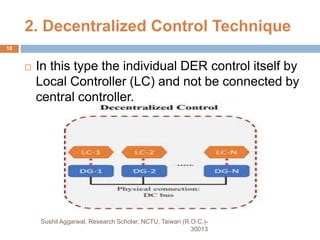
 In this type the individual DER control itself by
Local Controller (LC) and not be connected by
central controller.
18
Sushil Aggarwal, Research Scholar, NCTU, Taiwan (R.O.C.)-
30013
2. Decentralized Control Technique
3. Distributed Control Technique
Sushil Aggarwal, Research Scholar, NCTU, Taiwan (R.O.C.)-
30013
19
 This is same like centralized control
 Central controller are absent in this type
 Each DERs connected by each other by
communication link
Primary Control of Microgrid
Sushil Aggarwal, Research Scholar, NCTU, Taiwan (R.O.C.)-
30013
20
 For primary control there is further two types:-
1. Centralized Control or Active Load Sharing
2. Decentralized Control or Droop based Control
Sushil Aggarwal, Research Scholar, NCTU, Taiwan (R.O.C.)-
30013
21
 Centralized control having some limitations
like
 1. Requirement of communication channels
hence cost increased
 2. Communication link is not feasible for large
network.
 3. Possibility of error if communication channels is
faulty.
Limitations of Centralized
Control
Droop based control
Sushil Aggarwal, Research Scholar, NCTU, Taiwan (R.O.C.)-
30013
22
 There are several method based on droop
based:-
1. Conventional Droop control method :-
 Droop control module provide amplitude and
phase control signal to PWM and PWM
controller send the control signals to the
inverter .
 There is no information sharing between the
DERs hence control s
Sushil Aggarwal, Research Scholar, NCTU, Taiwan (R.O.C.)-
30013
23
1. Advantages and disadvantages of the
a) Only one control variable hence not satisfy more
than one control variables.
b) Independent, wireless and autonomous control
type
c) Highly inductive effective impedance between VSC
and AC bus.
d) Not beneficial for nonlinear loads, cannot
differentiate harmonics from the current.
e) large droop coefficients tend to reduce stability of
microgrid while small droop coefficients result in
slow responding of inverter.
Sushil Aggarwal, Research Scholar, NCTU, Taiwan (R.O.C.)-
30013
24
1. Virtual impedance method
2. Adaptive voltage control method
3. Signal injection Method
4. Non Linear load sharing method
5. Adjustable load sharing method
6. Virtual frame transformation method
Current Trends
Sushil Aggarwal, Research Scholar, NCTU, Taiwan (R.O.C.)-
30013
25
 General Microgrid replaced by Prosumer
Microgrid
 Prosumer mean Consumer cum Producer
 By this Microgrid become more smart
 Each consumer produce energy and give return
back to the Grid and earn money
 A smart energy meter record all the incoming and
outgoing energy data.
 In Switzerland, first power project of this kind is
running as pilot project.
 In India, in Kerala state first Prosumer based
project.
Research Trendz
Sushil Aggarwal, Research Scholar, NCTU, Taiwan (R.O.C.)-
30013
26
 My aim is that each and every household of
our country should be independent in electrical
energy
 Energy production should be a profession like
agriculture
 Each household can produce energy
 We all have to convinced them that energy
production be a good earning source
FREE ENERGY FOR
ALL………..!
Software Tool- PSIM
Sushil Aggarwal, Research Scholar, NCTU, Taiwan (R.O.C.)-
30013
27
 PSIM- Electronics ckt simulation software
 Developed by Powersim
 Easy to design and implementation
 Much faster simulation speed
 Automatic C code generation
 All Power system circuit component library
 Simple and easy than MATLAB
 Fault identification is easy.
28
Sushil Aggarwal, Research Scholar, NCTU, Taiwan (R.O.C.)-
30013

Microgrid brief introduction

  • 1.
    ROLE OF MICROGRID IN POWER SECTOR Sushil Aggarwal Research Scholar National Chiao Tung University Hsinchu, Taiwan (R.O.C.)
  • 2.
    Micro Grid ….? Micro means small  Grid means integration of many generation units and loads.  Hence micro grid means integration of many small power generation units and loads at small scale .  Each generation unit called distributed energy resource (DER) or Distributed generator (DG).  In a single microgrid many DERs(distributed energy resources) or DGs. 2 Sushil Aggarwal, Research Scholar, NCTU, Taiwan (R.O.C.)- 30013
  • 3.
     Distributed Energyresources might be solar energy, wind energy, bio energy, tidal energy, battery storage resources.  According to MNRE, A “Microgrid” is defined as renewable energy based Electricity generation with the capacity of below 10KW. 3 Sushil Aggarwal, Research Scholar, NCTU, Taiwan (R.O.C.)- 30013
  • 4.
    Why Microgrid ??? SushilAggarwal, Research Scholar, NCTU, Taiwan (R.O.C.)- 30013 4  Non conventional energy resources like coal diesel, gas etc. degrading day by day.  In last few years, we have invented various Renewable energy like bio, wind, solar, tidal etc.  We need to take energy from all renewable sources to overcome the energy demand and avoid energy crisis.  These resources produces very small amount of electrical energy that is not possible to take individually  Hence to integrate all these energy resources Microgrid invented.
  • 5.
    Sushil Aggarwal, ResearchScholar, NCTU, Taiwan (R.O.C.)- 30013 5  According to study by Stanford University top leading countries that moves completely towards renewable energy are  Iceland-100 % energy from renewable resources  Sweden- almost 100 % from renewable resources  Cost Rica- almost 100 % from renewable resources  Nicaragua- 90 % from renewable resources  UK, Germany, Uruguay, Denmark, China , Morocco, USA and Kenya.
  • 6.
    Components of aMicrogrid Sushil Aggarwal, Research Scholar, NCTU, Taiwan (R.O.C.)- 30013 6  The microgrid system consists of:  Solar panels/ other RE source  Inverter and batteries  Low-voltage power distribution network  LED lamps, compact fluorescent lamps, fan etc. for households
  • 7.
    Some other relatedinformation Sushil Aggarwal, Research Scholar, NCTU, Taiwan (R.O.C.)- 30013 7  In 1882, Thomas Edison invented the first Microgrid in The Manhattan, USA.  The aim of India Government is achieve the target of 500 MW of total capacity over next five years  To set up 10000 units of microgrid by using solar, wind, and biomass power.
  • 8.
    Types of Microgrid On the base of mode of operation, Microgrid classified as :- 1. Grid connected mode :-in this type, microgrid is connected with main power grid and supply a part of load demand. 2. Island mode :- In this type main grid is not connected with microgrid, only microgrid supply all the load demand. 8 Sushil Aggarwal, Research Scholar, NCTU, Taiwan (R.O.C.)- 30013
  • 9.
    Sushil Aggarwal, ResearchScholar, NCTU, Taiwan (R.O.C.)- 30013 9 1.AC Microgrid :- The working supply is AC and if any Load and generation unit working with DC then the supply Converted into AC by using FACTS devices. On the basis of power supply, Microgrid classified as :-
  • 10.
    Sushil Aggarwal, ResearchScholar, NCTU, Taiwan (R.O.C.)- 30013 10 2. DC Microgrid :- The working supply is DC . If any Load and generation is based on AC then it is converted into DC by FACTS devices.
  • 11.
    Importance of Microgrid It provides backup to the grid in case of emergency.  To make energy independent to a community.  To reduce the cost of electrical energy.  Connect the grid to a very small local resources that is not to be connected directly to the grid and many more….. 11 Sushil Aggarwal, Research Scholar, NCTU, Taiwan (R.O.C.)- 30013
  • 12.
    Sushil Aggarwal, ResearchScholar, NCTU, Taiwan (R.O.C.)- 30013 12
  • 13.
    Objectives of Microgridcontrol Structure Sushil Aggarwal, Research Scholar, NCTU, Taiwan (R.O.C.)- 30013 13  Voltage and frequency regulation in Both the modes (Grid connected and island mode)  Proper load sharing and DER coordination  Microgrid resynchronization with main grid  Power flow control between Microgrid and Main grid  Optimizing the microgrid operating cost
  • 14.
    Control Hierarchy of Microgrid SushilAggarwal, Research Scholar, NCTU, Taiwan (R.O.C.)- 30013 14
  • 15.
    Sushil Aggarwal, ResearchScholar, NCTU, Taiwan (R.O.C.)- 30013 15  Primary Control Voltage, frequency and circulating current among DERs of the microgrid including in primary control  Secondary control voltage and frequency deviation due to primary control in between microgrid is under this control  Territory control it handles power flow control between main grid and microgrid, responsible for optimal oeration
  • 16.
    Control Techniques of Microgrid Centralized control  Decentralized control  Distributed control 16 Sushil Aggarwal, Research Scholar, NCTU, Taiwan (R.O.C.)- 30013
  • 17.
    1.Centralized Control Technique In this type, all the DERs connected by a central server or controller (MGCC) that is connected by a communication link like cable. 17 Sushil Aggarwal, Research Scholar, NCTU, Taiwan (R.O.C.)- 30013
  • 18.
     In thistype the individual DER control itself by Local Controller (LC) and not be connected by central controller. 18 Sushil Aggarwal, Research Scholar, NCTU, Taiwan (R.O.C.)- 30013 2. Decentralized Control Technique
  • 19.
    3. Distributed ControlTechnique Sushil Aggarwal, Research Scholar, NCTU, Taiwan (R.O.C.)- 30013 19  This is same like centralized control  Central controller are absent in this type  Each DERs connected by each other by communication link
  • 20.
    Primary Control ofMicrogrid Sushil Aggarwal, Research Scholar, NCTU, Taiwan (R.O.C.)- 30013 20  For primary control there is further two types:- 1. Centralized Control or Active Load Sharing 2. Decentralized Control or Droop based Control
  • 21.
    Sushil Aggarwal, ResearchScholar, NCTU, Taiwan (R.O.C.)- 30013 21  Centralized control having some limitations like  1. Requirement of communication channels hence cost increased  2. Communication link is not feasible for large network.  3. Possibility of error if communication channels is faulty. Limitations of Centralized Control
  • 22.
    Droop based control SushilAggarwal, Research Scholar, NCTU, Taiwan (R.O.C.)- 30013 22  There are several method based on droop based:- 1. Conventional Droop control method :-  Droop control module provide amplitude and phase control signal to PWM and PWM controller send the control signals to the inverter .  There is no information sharing between the DERs hence control s
  • 23.
    Sushil Aggarwal, ResearchScholar, NCTU, Taiwan (R.O.C.)- 30013 23 1. Advantages and disadvantages of the a) Only one control variable hence not satisfy more than one control variables. b) Independent, wireless and autonomous control type c) Highly inductive effective impedance between VSC and AC bus. d) Not beneficial for nonlinear loads, cannot differentiate harmonics from the current. e) large droop coefficients tend to reduce stability of microgrid while small droop coefficients result in slow responding of inverter.
  • 24.
    Sushil Aggarwal, ResearchScholar, NCTU, Taiwan (R.O.C.)- 30013 24 1. Virtual impedance method 2. Adaptive voltage control method 3. Signal injection Method 4. Non Linear load sharing method 5. Adjustable load sharing method 6. Virtual frame transformation method
  • 25.
    Current Trends Sushil Aggarwal,Research Scholar, NCTU, Taiwan (R.O.C.)- 30013 25  General Microgrid replaced by Prosumer Microgrid  Prosumer mean Consumer cum Producer  By this Microgrid become more smart  Each consumer produce energy and give return back to the Grid and earn money  A smart energy meter record all the incoming and outgoing energy data.  In Switzerland, first power project of this kind is running as pilot project.  In India, in Kerala state first Prosumer based project.
  • 26.
    Research Trendz Sushil Aggarwal,Research Scholar, NCTU, Taiwan (R.O.C.)- 30013 26  My aim is that each and every household of our country should be independent in electrical energy  Energy production should be a profession like agriculture  Each household can produce energy  We all have to convinced them that energy production be a good earning source FREE ENERGY FOR ALL………..!
  • 27.
    Software Tool- PSIM SushilAggarwal, Research Scholar, NCTU, Taiwan (R.O.C.)- 30013 27  PSIM- Electronics ckt simulation software  Developed by Powersim  Easy to design and implementation  Much faster simulation speed  Automatic C code generation  All Power system circuit component library  Simple and easy than MATLAB  Fault identification is easy.
  • 28.
    28 Sushil Aggarwal, ResearchScholar, NCTU, Taiwan (R.O.C.)- 30013