Introduction to Bioinformatics
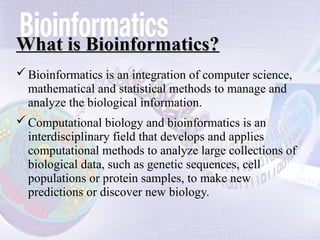
What is Bioinformatics?
Bioinformatics is an integration of computer science,
mathematical and statistical methods to manage and
analyze the biological information.
Computational biology and bioinformatics is an
interdisciplinary field that develops and applies
computational methods to analyze large collections of
biological data, such as genetic sequences, cell
populations or protein samples, to make new
predictions or discover new biology.
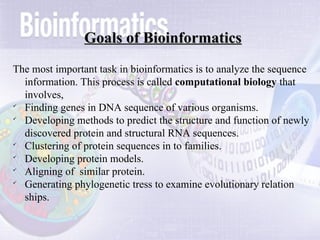
Goals of Bioinformatics
The most important task in bioinformatics is to analyze the sequence
information. This process is called computational biology that
involves,

Finding genes in DNA sequence of various organisms.

Developing methods to predict the structure and function of newly
discovered protein and structural RNA sequences.

Clustering of protein sequences in to families.

Developing protein models.

Aligning of similar protein.

Generating phylogenetic tress to examine evolutionary relation
ships.
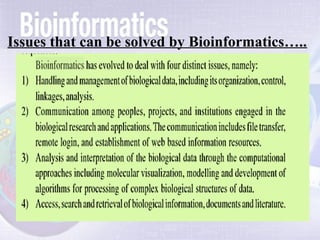
Issues that can be solved by Bioinformatics…..
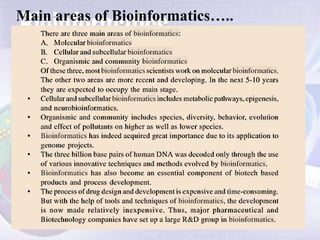
Main areas of Bioinformatics…..
Timeline of Bioinformatics
l
1955- Bovine insulin is the 1st
protein to be sequenced.
l
1965- Atlas of protein sequence
and structure by Margarat Day
hoff et al was a printed book.
l
1978- the term 'bioinformatics'
coined.
l
1986- The term "Genomics"
appeared for the first time to
describe the scientific discipline of
mapping, sequencing, and
analyzing genes. The term was
coined by Thomas Roderick.
l
The SWISS-PROT database was
created.
l
The PCR reaction was described
by Kary Mullis and co-workers.
l
l
l
l
1987- The use of yeast artifical
chromosomes
l
The physical map of E. coli was
published.
l
1988 - National Center for
Biotechnology Information
(NCBI) created.
l
The Human Genome Initiative
was started.
l
1990 - The BLAST program was
implemented.
l
1995 - The Haemophilus
influenzea genome was
sequenced. The Mycoplasma
genitalium genome was
sequenced.
l
1996 - The genome for
Saccharomyces cerevisiae (baker's
yeast) was sequenced.
l
Timeline (contd.)
1996- Methanococcus jannaschii genome sequenced.
Sequence of the human T-cell receptor region completed.
1997 - The genome for E.coli was published.
1998 - The genomes for Caenorhabitis elegans and baker's yeast were
published.
The Swiss Institute of Bioinformatics was established as a non-profit
foundation.
1999 - First Human Chromosome Completely Sequenced! On December 1,
researchers in the Human Genome Project announced the complete
sequencing of the DNA making up human chromosome 22
2000 - The genome for Pseudomonas aeruginosa was published.
The A.thaliana genome was sequenced
The D.melanogaster genome was sequenced.
2003 -Human Genome Project Completion, April 2003.
l
introduction to bioinformatics (1)-2.ppt

introduction to bioinformatics (1)-2.ppt

  • 1.
  • 2.
    What is Bioinformatics? Whatis Bioinformatics? Bioinformatics is an integration of computer science, mathematical and statistical methods to manage and analyze the biological information. Computational biology and bioinformatics is an interdisciplinary field that develops and applies computational methods to analyze large collections of biological data, such as genetic sequences, cell populations or protein samples, to make new predictions or discover new biology.
  • 3.
    Goals of Bioinformatics Goalsof Bioinformatics The most important task in bioinformatics is to analyze the sequence information. This process is called computational biology that involves,  Finding genes in DNA sequence of various organisms.  Developing methods to predict the structure and function of newly discovered protein and structural RNA sequences.  Clustering of protein sequences in to families.  Developing protein models.  Aligning of similar protein.  Generating phylogenetic tress to examine evolutionary relation ships.
  • 4.
    Issues that canbe solved by Bioinformatics…..
  • 5.
    Main areas ofBioinformatics…..
  • 31.
    Timeline of Bioinformatics l 1955-Bovine insulin is the 1st protein to be sequenced. l 1965- Atlas of protein sequence and structure by Margarat Day hoff et al was a printed book. l 1978- the term 'bioinformatics' coined. l 1986- The term "Genomics" appeared for the first time to describe the scientific discipline of mapping, sequencing, and analyzing genes. The term was coined by Thomas Roderick. l The SWISS-PROT database was created. l The PCR reaction was described by Kary Mullis and co-workers. l l l l 1987- The use of yeast artifical chromosomes l The physical map of E. coli was published. l 1988 - National Center for Biotechnology Information (NCBI) created. l The Human Genome Initiative was started. l 1990 - The BLAST program was implemented. l 1995 - The Haemophilus influenzea genome was sequenced. The Mycoplasma genitalium genome was sequenced. l 1996 - The genome for Saccharomyces cerevisiae (baker's yeast) was sequenced.
  • 32.
    l Timeline (contd.) 1996- Methanococcusjannaschii genome sequenced. Sequence of the human T-cell receptor region completed. 1997 - The genome for E.coli was published. 1998 - The genomes for Caenorhabitis elegans and baker's yeast were published. The Swiss Institute of Bioinformatics was established as a non-profit foundation. 1999 - First Human Chromosome Completely Sequenced! On December 1, researchers in the Human Genome Project announced the complete sequencing of the DNA making up human chromosome 22 2000 - The genome for Pseudomonas aeruginosa was published. The A.thaliana genome was sequenced The D.melanogaster genome was sequenced. 2003 -Human Genome Project Completion, April 2003. l