Opportunities to integrate
and optimize CHWs in
health systems: Global and
local perspectives
CORE Group
Global Health Practitioner Conference
May 7, 2019 | 11:00am-12:30pm
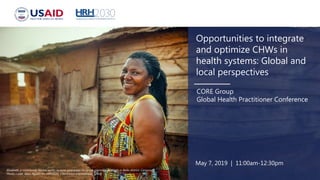
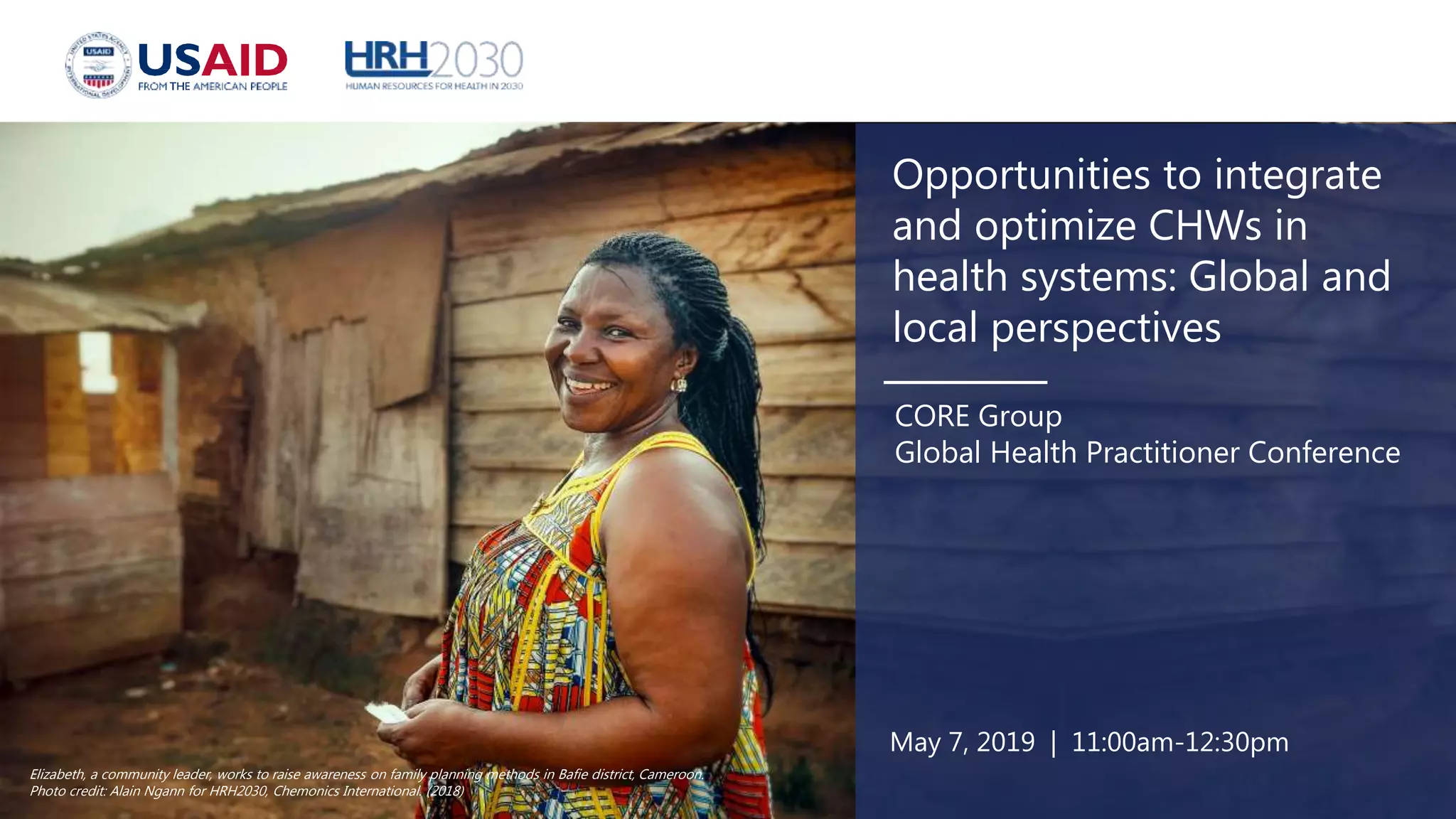
Elizabeth, a community leader, works to raise awareness on family planning methods in Bafie district, Cameroon.
Photo credit: Alain Ngann for HRH2030, Chemonics International. (2018)
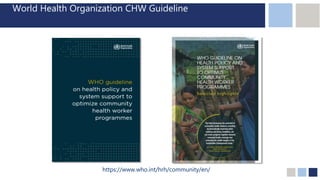
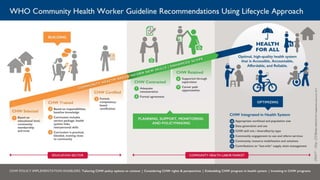
World Health Organization CHW Guideline
https://www.who.int/hrh/community/en/
DRAFT–May2019
“Fishbowl-style” Debate
We want to hear from you!
Come on up!
• Stand behind a chair occupied
by someone who already
responded to the question.
• Current discussant shall vacate
the seat for you.
• Introduce yourself first.
• Exit the fishbowl when
someone stands behind your
#GHPC19 #OptimizeCHWs
5
Question 1
What is the first and most
critical action country leaders
should be taking now to
implement the WHO CHW
Guideline recommendations?
#GHPC19 #OptimizeCHWs
Question 2: Building
What is the most
important partnership to
ensure we train the right
CHWs in the right health
areas?
#GHPC19 #OptimizeCHWs
7
Question 3: Managing & Supporting
What is the number #1
priority to create a better
system to manage and
support newly recognized
CHWs?
#GHPC19 #OptimizeCHWs
8
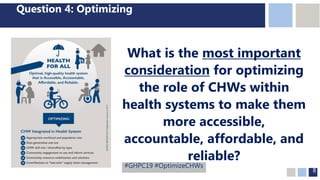
Question 4: Optimizing
What is the most important
consideration for optimizing
the role of CHWs within
health systems to make them
more accessible,
accountable, affordable, and
reliable?
#GHPC19 #OptimizeCHWs
9
Question 5: Sustaining
What is the most important
innovation needed to shape and
sustain the role of CHWs in health
systems by 2030 and beyond?
#GHPC19 #OptimizeCHWs
10
DRAFT
DRAFT–May2019
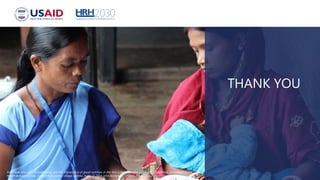
THANK YOU
Sima Naik discusses breastfeeding and the importance of good nutrition in the first 1,000 days after birth with Rebati Naik, Accredited Social
Health Activist (ASHA), in Badamahuladhia village, Odisha, India. © 2014 John Nicholson, SPRING Project, Courtesy of Photoshare.

Presentation_HRH2030 - Opportunities to optimize and integrate CHW

  • 1.
    Opportunities to integrate andoptimize CHWs in health systems: Global and local perspectives CORE Group Global Health Practitioner Conference May 7, 2019 | 11:00am-12:30pm Elizabeth, a community leader, works to raise awareness on family planning methods in Bafie district, Cameroon. Photo credit: Alain Ngann for HRH2030, Chemonics International. (2018)
  • 2.
    World Health OrganizationCHW Guideline https://www.who.int/hrh/community/en/
  • 3.
  • 4.
    “Fishbowl-style” Debate We wantto hear from you! Come on up! • Stand behind a chair occupied by someone who already responded to the question. • Current discussant shall vacate the seat for you. • Introduce yourself first. • Exit the fishbowl when someone stands behind your #GHPC19 #OptimizeCHWs
  • 5.
    5 Question 1 What isthe first and most critical action country leaders should be taking now to implement the WHO CHW Guideline recommendations? #GHPC19 #OptimizeCHWs
  • 6.
    Question 2: Building Whatis the most important partnership to ensure we train the right CHWs in the right health areas? #GHPC19 #OptimizeCHWs
  • 7.
    7 Question 3: Managing& Supporting What is the number #1 priority to create a better system to manage and support newly recognized CHWs? #GHPC19 #OptimizeCHWs
  • 8.
    8 Question 4: Optimizing Whatis the most important consideration for optimizing the role of CHWs within health systems to make them more accessible, accountable, affordable, and reliable? #GHPC19 #OptimizeCHWs
  • 9.
    9 Question 5: Sustaining Whatis the most important innovation needed to shape and sustain the role of CHWs in health systems by 2030 and beyond? #GHPC19 #OptimizeCHWs
  • 10.
  • 11.
    THANK YOU Sima Naikdiscusses breastfeeding and the importance of good nutrition in the first 1,000 days after birth with Rebati Naik, Accredited Social Health Activist (ASHA), in Badamahuladhia village, Odisha, India. © 2014 John Nicholson, SPRING Project, Courtesy of Photoshare.

Editor's Notes

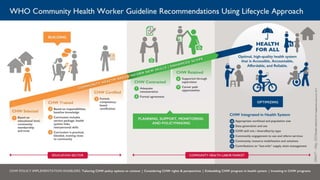
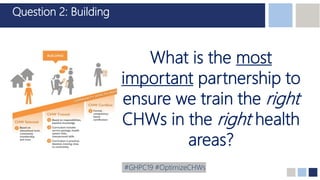
  • #7 WHO Rec #1: Selection - How do you consider context? CHW type (Full-time vs. seasonal or part-time?) WHO Rec #2: PSE Duration WHO Rec #3: Curriculum to develop competencies WHO Rec #4: Training modalities Who develops? MOH-MOHE? Role of TVETs or existing structures? WHO Rec #5: Offer competency-based formal certification upon successful completion of training Who oversees? Professional assoc? Who should be regulating CHW training programs? Who accredits the schools? Should CHWs have professional associations like other types of health workers?
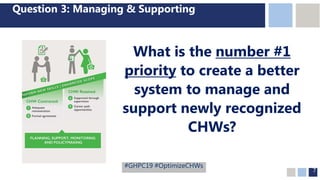
  • #8  WHO Rec #7: Remuneration What job incentives? How sustained? WHO Rec #8: Contracting agreements What about the informal / Unpaid? How do you track? Hold accountable? WHO Rec #6: Supportive supervision How to reach CHWs? WHO Rec #9: Career ladder Leadership? What are the tracks? To effectively retain CHWs, what are the most feasible CHW career paths that we should pursue? Do we really expect CHWs to remain CHWs forever, or can they become health workers? Who will pay for this?   What is the community health labor market? Career ladder: for example: CHW > Enhanced CHW responsibility > CHW peer supervisor > CHW trainer > “New, specialized position” > Senior consultant position OR CHW > More training  / Enhanced CHW responsibility in specialized area: Supply chain / pharmacy / nursing / lab / digital-mHealth data mgmt / managing referral systems / medical scribes > Vocational training  > Low to mid-level facility-based role? Leah Comment:  - What about something that combines the two into one ladder with two tracks? One for those that "stay in the community" and one for those going into specialized roles at a facility after more vocational training?  - I'm  not sure what Senior Consultant means? Maybe we can phrase that a little differently? - One of the other common issues is that CHWs become a catch all for everything from malaria to OVC services- how can we make sure that the management and support includes consideration of appropriate workload? I know that's sort of embedded in a couple of recommendations but this slide just made me think this. Maybe this is under Optimization....
  • #9 WHO Rec #10: Population size Tracking workloads? WHO Rec #11: Data WHO Rec #12: CHW types WHO Rec #13: Community engagement WHO Rec #14: Mobilizing community resources Referral systems? WHO Rec #15: Supply chain