The Maternal and Child
Survival Program
Acting to End Preventable Maternal Mortality
CORE Group Global Health Practitioner Conference
April 16, 2015
www.mcsprogram.org
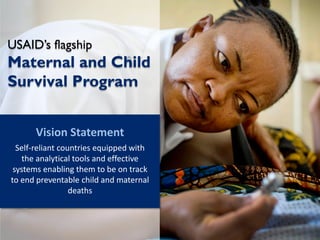
Vision Statement
Self-reliant countries equipped with
the analytical tools and effective
systems enabling them to be on track
to end preventable child and maternal
deaths
USAID’s flagship
Maternal and Child
Survival Program
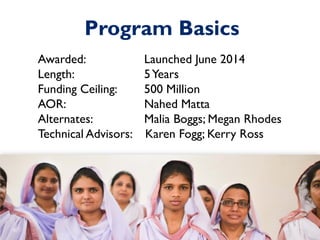
Awarded: Launched June 2014
Length: 5Years
Funding Ceiling: 500 Million
AOR: Nahed Matta
Alternates: Malia Boggs; Megan Rhodes
Technical Advisors: Karen Fogg; Kerry Ross
Program Basics
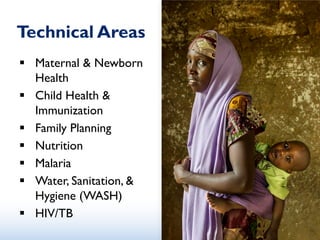
 Maternal & Newborn
Health
 Child Health &
Immunization
 Family Planning
 Nutrition
 Malaria
 Water, Sanitation, &
Hygiene (WASH)
 HIV/TB
Technical Areas
Cross-Cutting Issues
 Quality
 Innovation
 Partnerships (private sector, civil society, etc.)
 Gender
 Equity
 Measurement and Analytics
 Behavior Change Communication
 e/mHealth
 Community Approaches
 WASH
 Health Systems Strengthening
Partners
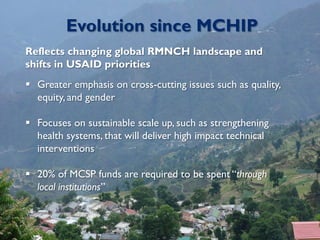
Evolution since MCHIP
Reflects changing global RMNCH landscape and
shifts in USAID priorities
 Greater emphasis on cross-cutting issues such as quality,
equity, and gender
 Focuses on sustainable scale up, such as strengthening
health systems, that will deliver high impact technical
interventions
 20% of MCSP funds are required to be spent “through
local institutions”
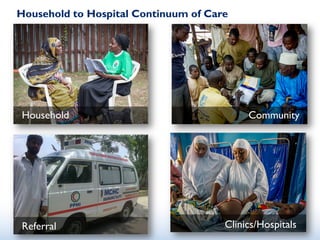
Household to Hospital Continuum of Care
Household
Clinics/Hospitals
Community
Referral
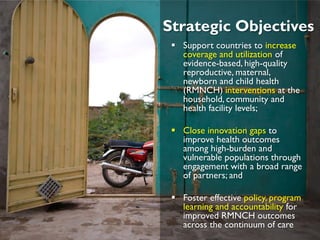
Strategic Objectives
 Support countries to increase
coverage and utilization of
evidence-based, high-quality
reproductive, maternal,
newborn and child health
(RMNCH) interventions at the
household, community and
health facility levels;
 Close innovation gaps to
improve health outcomes
among high-burden and
vulnerable populations through
engagement with a broad range
of partners; and
 Foster effective policy, program
learning and accountability for
improved RMNCH outcomes
across the continuum of care
IntegratedThemes
Scaling up RMNCH coverage in 24 priority countries
 Maximize potential for public and private sector—including
civil society
 Addressing equity through a community health strengthening
approach
 Strengthening integrated community health platforms
Integrating services across the continuum of care
 Better care on the Day of Birth
 Maternal newborn health and infectious disease
Rigorous focus on monitoring, evaluation, and learning
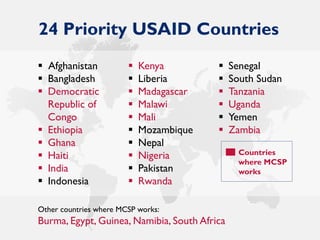
24 Priority USAID Countries
Other countries where MCSP works:
Burma, Egypt, Guinea, Namibia, South Africa
Countries
where MCSP
works
 Afghanistan
 Bangladesh
 Democratic
Republic of
Congo
 Ethiopia
 Ghana
 Haiti
 India
 Indonesia
 Kenya
 Liberia
 Madagascar
 Malawi
 Mali
 Mozambique
 Nepal
 Nigeria
 Pakistan
 Rwanda
 Senegal
 South Sudan
 Tanzania
 Uganda
 Yemen
 Zambia
Translating theVision into Action
• Enabling and Mobilizing Individuals and Communities
• Improve behaviors and norms, equity
• Advancing Quality, Respectful Care
• Integration of maternal health and family planning
• Scale up quality maternal health care
• Address indirect causes of maternal mortality, poor birth
outcomes
• Increase focus on maternal morbidity and disability
• Respectful Maternity Care and improving work environment
• Strengthening Health Systems and Continuous
Learning
• Health systems strengthening, data use, innovation and research
Enabling and Mobilizing Individuals and
Communities
• Improve individual, household, and
community behaviors and norms
• Community engagement, advocacy
• Strengthening community-based counseling and
empowerment of community health workers
• Improve equity of access to and use of
services by the most vulnerable
• Reaching rural populations with uterotonics for
prevention of postpartum hemorrhage
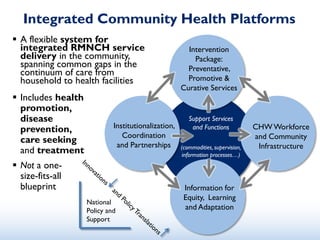
Integrated Community Health Platforms
 A flexible system for
integrated RMNCH service
delivery in the community,
spanning common gaps in the
continuum of care from
household to health facilities
CHW Workforce
and Community
Infrastructure
Information for
Equity, Learning
and Adaptation
Institutionalization,
Coordination
and Partnerships
Intervention
Package:
Preventative,
Promotive &
Curative Services
Support Services
and Functions
(commodities, supervision,
information processes…)
National
Policy and
Support
 Includes health
promotion,
disease
prevention,
care seeking
and treatment
 Not a one-
size-fits-all
blueprint
Advancing Quality, Respectful Care
• Integration of maternal services & family planning
• Postpartum family planning as essential component of
both antenatal and postnatal care
• Scale up quality care
• Comprehensive approach to prevention of
postpartum hemorrhage
• Address indirect causes of maternal mortality and
poor birth outcomes
• Infectious disease management as critical component
of antenatal care
Advancing Quality, Respectful Care
• Averting and addressing maternal morbidity and
disability
• Prevention and management of obstetric fistula
• Advance choice and respectful maternity care (RMC)
• RMC: Bangladesh, Mozambique, South Sudan,Tanzania,
Rwanda, Kenya, Ethiopia, Haiti, Indonesia, Madagascar,
Burma, Nigeria
• Alternative birth positions: Ethiopia, Mozambique, Burma,
Pakistan, Rwanda, South Sudan,Tanzania
Address Gender Issues
• Antenatal care (ANC)
• Engagement of men in counseling & birth planning
• Gender-based violence (GBV): identification, safety planning
& harm reduction, counseling re effects on MCH outcomes
• Labor and birth
• Respectful and gender-sensitive care during birth
• Deploying female skilled birth attendants (SBA)
• Making services affordable to women
• Bringing SBA to women who lack mobility or transport
• Participatory women’s groups to foster social support for
maternal and neonatal health problems
Strengthening Health Systems and
Continuous Learning
• Systems to track stock-outs of life-saving
drugs
• Human resources for health
• Clinical governance and focus on
measurement as driver for improving quality
and coverage of services
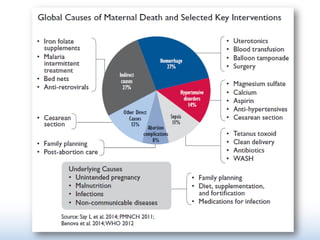
• Strengthen maternal death surveillance
• Operations research and learning agenda
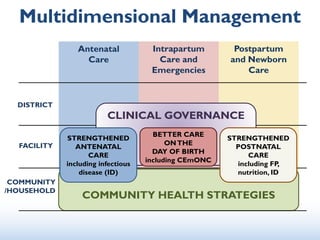
Multidimensional Management
Antenatal
Care
DISTRICT
FACILITY
COMMUNITY HEALTH STRATEGIES
COMMUNITY
/HOUSEHOLD
Intrapartum
Care and
Emergencies
Postpartum
and Newborn
Care
CLINICAL GOVERNANCE
BETTER CARE
ONTHE
DAY OF BIRTH
including CEmONC
STRENGTHENED
ANTENATAL
CARE
including infectious
disease (ID)
STRENGTHENED
POSTNATAL
CARE
including FP,
nutrition, ID
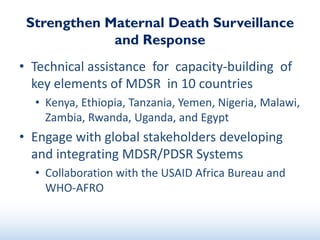
Strengthen Maternal Death Surveillance
and Response
• Technical assistance for capacity-building of
key elements of MDSR in 10 countries
• Kenya, Ethiopia, Tanzania, Yemen, Nigeria, Malawi,
Zambia, Rwanda, Uganda, and Egypt
• Engage with global stakeholders developing
and integrating MDSR/PDSR Systems
• Collaboration with the USAID Africa Bureau and
WHO-AFRO
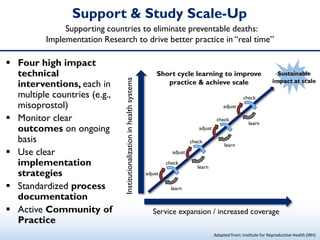
Support & Study Scale-Up
 Four high impact
technical
interventions, each in
multiple countries (e.g.,
misoprostol)
 Monitor clear
outcomes on ongoing
basis
 Use clear
implementation
strategies
 Standardized process
documentation
 Active Community of
Practice
Supporting countries to eliminate preventable deaths:
Implementation Research to drive better practice in “real time”
Sustainable
impact at scale
Service expansion / increased coverage
Institutionalizationinhealthsystems
Short cycle learning to improve
practice & achieve scale
check
adjust
learn
check
adjust
learn
check
adjust
learn
check
adjust
learn
Adapted from: Institute for Reproductive Health (IRH)
ThankYou
Learn more at:
www.mcsprogram.org
Twitter.com/MCSPglobal
Facebook.com/MCSPglobal
Acknowledgements
• Ali Abdelmegeid
• Kate Brickson
• Myra Betron
• Stephanie Suhowatsky
• CicelyThomas
For more information, please visit
www.mcsprogram.org
This presentation was made possible by the generous support of the American people through the
United States Agency for International Development (USAID), under the terms of the Cooperative
Agreement AID-OAA-A-14-00028. The contents are the responsibility of the authors and do not
necessarily reflect the views of USAID or the United States Government.
facebook.com/MCSPglobal twitter.com/MCSPglobal
Extra Slides
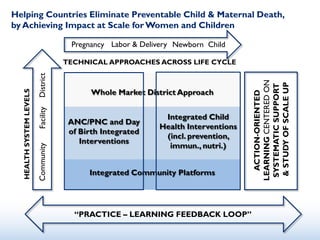
Pregnancy Labor & Delivery Newborn Child
TECHNICAL APPROACHES ACROSS LIFE CYCLE
HEALTHSYSTEMLEVELS
CommunityDistrictFacility
ACTION-ORIENTED
LEARNINGCENTEREDON
SYSTEMATICSUPPORT
&STUDYOFSCALEUP
Integrated Community Platforms
Whole Market District Approach
ANC/PNC and Day
of Birth Integrated
Interventions
Integrated Child
Health Interventions
(incl. prevention,
immun., nutri.)
“PRACTICE – LEARNING FEEDBACK LOOP”
Helping Countries Eliminate Preventable Child & Maternal Death,
by Achieving Impact at Scale for Women and Children
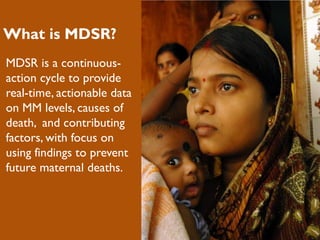
What is MDSR?
MDSR is a continuous-
action cycle to provide
real-time, actionable data
on MM levels, causes of
death, and contributing
factors, with focus on
using findings to prevent
future maternal deaths.

Prevention of Maternal Mortality_

  • 1.
    The Maternal andChild Survival Program Acting to End Preventable Maternal Mortality CORE Group Global Health Practitioner Conference April 16, 2015 www.mcsprogram.org
  • 2.
    Vision Statement Self-reliant countriesequipped with the analytical tools and effective systems enabling them to be on track to end preventable child and maternal deaths USAID’s flagship Maternal and Child Survival Program
  • 3.
    Awarded: Launched June2014 Length: 5Years Funding Ceiling: 500 Million AOR: Nahed Matta Alternates: Malia Boggs; Megan Rhodes Technical Advisors: Karen Fogg; Kerry Ross Program Basics
  • 4.
     Maternal &Newborn Health  Child Health & Immunization  Family Planning  Nutrition  Malaria  Water, Sanitation, & Hygiene (WASH)  HIV/TB Technical Areas
  • 5.
    Cross-Cutting Issues  Quality Innovation  Partnerships (private sector, civil society, etc.)  Gender  Equity  Measurement and Analytics  Behavior Change Communication  e/mHealth  Community Approaches  WASH  Health Systems Strengthening
  • 6.
  • 7.
    Evolution since MCHIP Reflectschanging global RMNCH landscape and shifts in USAID priorities  Greater emphasis on cross-cutting issues such as quality, equity, and gender  Focuses on sustainable scale up, such as strengthening health systems, that will deliver high impact technical interventions  20% of MCSP funds are required to be spent “through local institutions”
  • 8.
    Household to HospitalContinuum of Care Household Clinics/Hospitals Community Referral
  • 9.
    Strategic Objectives  Supportcountries to increase coverage and utilization of evidence-based, high-quality reproductive, maternal, newborn and child health (RMNCH) interventions at the household, community and health facility levels;  Close innovation gaps to improve health outcomes among high-burden and vulnerable populations through engagement with a broad range of partners; and  Foster effective policy, program learning and accountability for improved RMNCH outcomes across the continuum of care
  • 10.
    IntegratedThemes Scaling up RMNCHcoverage in 24 priority countries  Maximize potential for public and private sector—including civil society  Addressing equity through a community health strengthening approach  Strengthening integrated community health platforms Integrating services across the continuum of care  Better care on the Day of Birth  Maternal newborn health and infectious disease Rigorous focus on monitoring, evaluation, and learning
  • 11.
    24 Priority USAIDCountries Other countries where MCSP works: Burma, Egypt, Guinea, Namibia, South Africa Countries where MCSP works  Afghanistan  Bangladesh  Democratic Republic of Congo  Ethiopia  Ghana  Haiti  India  Indonesia  Kenya  Liberia  Madagascar  Malawi  Mali  Mozambique  Nepal  Nigeria  Pakistan  Rwanda  Senegal  South Sudan  Tanzania  Uganda  Yemen  Zambia
  • 13.
    Translating theVision intoAction • Enabling and Mobilizing Individuals and Communities • Improve behaviors and norms, equity • Advancing Quality, Respectful Care • Integration of maternal health and family planning • Scale up quality maternal health care • Address indirect causes of maternal mortality, poor birth outcomes • Increase focus on maternal morbidity and disability • Respectful Maternity Care and improving work environment • Strengthening Health Systems and Continuous Learning • Health systems strengthening, data use, innovation and research
  • 14.
    Enabling and MobilizingIndividuals and Communities • Improve individual, household, and community behaviors and norms • Community engagement, advocacy • Strengthening community-based counseling and empowerment of community health workers • Improve equity of access to and use of services by the most vulnerable • Reaching rural populations with uterotonics for prevention of postpartum hemorrhage
  • 15.
    Integrated Community HealthPlatforms  A flexible system for integrated RMNCH service delivery in the community, spanning common gaps in the continuum of care from household to health facilities CHW Workforce and Community Infrastructure Information for Equity, Learning and Adaptation Institutionalization, Coordination and Partnerships Intervention Package: Preventative, Promotive & Curative Services Support Services and Functions (commodities, supervision, information processes…) National Policy and Support  Includes health promotion, disease prevention, care seeking and treatment  Not a one- size-fits-all blueprint
  • 16.
    Advancing Quality, RespectfulCare • Integration of maternal services & family planning • Postpartum family planning as essential component of both antenatal and postnatal care • Scale up quality care • Comprehensive approach to prevention of postpartum hemorrhage • Address indirect causes of maternal mortality and poor birth outcomes • Infectious disease management as critical component of antenatal care
  • 17.
    Advancing Quality, RespectfulCare • Averting and addressing maternal morbidity and disability • Prevention and management of obstetric fistula • Advance choice and respectful maternity care (RMC) • RMC: Bangladesh, Mozambique, South Sudan,Tanzania, Rwanda, Kenya, Ethiopia, Haiti, Indonesia, Madagascar, Burma, Nigeria • Alternative birth positions: Ethiopia, Mozambique, Burma, Pakistan, Rwanda, South Sudan,Tanzania
  • 18.
    Address Gender Issues •Antenatal care (ANC) • Engagement of men in counseling & birth planning • Gender-based violence (GBV): identification, safety planning & harm reduction, counseling re effects on MCH outcomes • Labor and birth • Respectful and gender-sensitive care during birth • Deploying female skilled birth attendants (SBA) • Making services affordable to women • Bringing SBA to women who lack mobility or transport • Participatory women’s groups to foster social support for maternal and neonatal health problems
  • 19.
    Strengthening Health Systemsand Continuous Learning • Systems to track stock-outs of life-saving drugs • Human resources for health • Clinical governance and focus on measurement as driver for improving quality and coverage of services • Strengthen maternal death surveillance • Operations research and learning agenda
  • 20.
    Multidimensional Management Antenatal Care DISTRICT FACILITY COMMUNITY HEALTHSTRATEGIES COMMUNITY /HOUSEHOLD Intrapartum Care and Emergencies Postpartum and Newborn Care CLINICAL GOVERNANCE BETTER CARE ONTHE DAY OF BIRTH including CEmONC STRENGTHENED ANTENATAL CARE including infectious disease (ID) STRENGTHENED POSTNATAL CARE including FP, nutrition, ID
  • 21.
    Strengthen Maternal DeathSurveillance and Response • Technical assistance for capacity-building of key elements of MDSR in 10 countries • Kenya, Ethiopia, Tanzania, Yemen, Nigeria, Malawi, Zambia, Rwanda, Uganda, and Egypt • Engage with global stakeholders developing and integrating MDSR/PDSR Systems • Collaboration with the USAID Africa Bureau and WHO-AFRO
  • 22.
    Support & StudyScale-Up  Four high impact technical interventions, each in multiple countries (e.g., misoprostol)  Monitor clear outcomes on ongoing basis  Use clear implementation strategies  Standardized process documentation  Active Community of Practice Supporting countries to eliminate preventable deaths: Implementation Research to drive better practice in “real time” Sustainable impact at scale Service expansion / increased coverage Institutionalizationinhealthsystems Short cycle learning to improve practice & achieve scale check adjust learn check adjust learn check adjust learn check adjust learn Adapted from: Institute for Reproductive Health (IRH)
  • 24.
  • 25.
    Acknowledgements • Ali Abdelmegeid •Kate Brickson • Myra Betron • Stephanie Suhowatsky • CicelyThomas
  • 26.
    For more information,please visit www.mcsprogram.org This presentation was made possible by the generous support of the American people through the United States Agency for International Development (USAID), under the terms of the Cooperative Agreement AID-OAA-A-14-00028. The contents are the responsibility of the authors and do not necessarily reflect the views of USAID or the United States Government. facebook.com/MCSPglobal twitter.com/MCSPglobal
  • 27.
  • 28.
    Pregnancy Labor &Delivery Newborn Child TECHNICAL APPROACHES ACROSS LIFE CYCLE HEALTHSYSTEMLEVELS CommunityDistrictFacility ACTION-ORIENTED LEARNINGCENTEREDON SYSTEMATICSUPPORT &STUDYOFSCALEUP Integrated Community Platforms Whole Market District Approach ANC/PNC and Day of Birth Integrated Interventions Integrated Child Health Interventions (incl. prevention, immun., nutri.) “PRACTICE – LEARNING FEEDBACK LOOP” Helping Countries Eliminate Preventable Child & Maternal Death, by Achieving Impact at Scale for Women and Children
  • 29.
    What is MDSR? MDSRis a continuous- action cycle to provide real-time, actionable data on MM levels, causes of death, and contributing factors, with focus on using findings to prevent future maternal deaths.