Your Money, Your Goals
A FINANCIAL EMPOWERMENT TOOLKIT FOR SOCIAL SERVICE PROGRAMS
Your Money, Your Goals
Introduction
2
Money and Me
List all of the words, phrases, sayings,
songs, or other associations you have
with the word money.
3
Money and Me
4
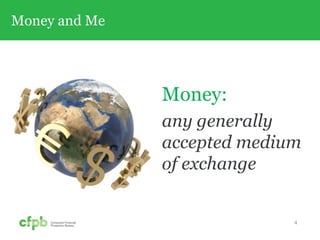
Money:
any generally
accepted medium
of exchange
Money: What does it mean?
 Where do our associations about money come from?
 How do these associations reflect our attitudes and
feelings about money?
 How are our attitudes and feelings related to our
behaviors and actions?
 What does this mean when
we are working with clients?
5
Your Money, Your Goals
Overview of the training and introductions
6
Training purpose
7
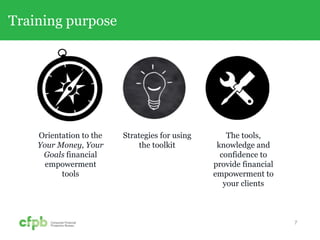
Orientation to the
Your Money, Your
Goals financial
empowerment
tools
Strategies for using
the toolkit
The tools,
knowledge and
confidence to
provide financial
empowerment to
your clients
Training objectives
By the end of the training, you will be able to:
 Connect financial empowerment with your program
and client outcomes.
 Demonstrate increased confidence in your own
knowledge about core financial management topics.
 Assess clients’ financial condition or situation.
 Provide the right financial content at the right time
in the context of your case work with clients based
on assessment.
8
Training objectives
By the end of the training, you will be able to:
 Use specific tools to help your clients reach their own
goals in different cultural and situational contexts.
 Access and use tools and materials available at
www.consumerfinance.gov.
 Make appropriate and specific referrals to help clients
manage their financial challenges.
 Know where to go for unbiased information or help in
working with clients.
9
Training presenter
The Consumer Financial Protection Bureau created
the Your Money, Your Goals toolkit for consumers,
as well as the training materials presented today.
These materials are being presented to you by a
local non-profit organization. The organizations or
individuals presenting these materials are not
agents or employees of the CFPB, and their views
do not represent the views of the Bureau. The CFPB
is not responsible for the advice or actions of these
individuals or entities. The Bureau appreciates the
opportunity to work with the organizations that are
presenting these materials.
10
Introductions
 Share name
 Organization
 “What do you expect or hope to
get from this training?”
11
12
Your Money, Your Goals
Introduction to the CFPB and financial empowerment
Introduction to the CFPB
The CFPB’s mission is to make markets for consumer financial
products and services work for Americans.
13
Introduction to the CFPB
14
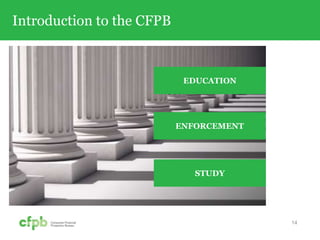
EDUCATION
ENFORCEMENT
STUDY
Why case managers?
15
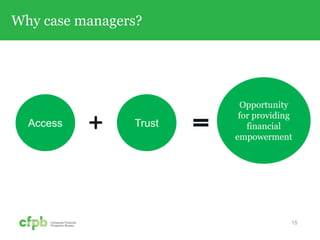
Access Trust
Opportunity
for providing
financial
empowerment
Financial empowerment
16
What is financial empowerment?
How is it different than financial education,
financial literacy, financial capacity, or other
commonly used terms?
Benefit / Cost analysis
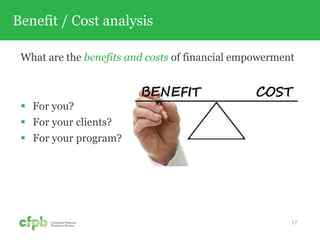
What are the benefits and costs of financial empowerment
 For you?
 For your clients?
 For your program?
17
18
Your Money, Your Goals
An orientation to the toolkit
Organization of Your Money, Your Goals
Introductory modules
 Module 1: Introduction to the toolkit
 Module 2: Assessing the situation
 Module 3: Starting the conversation
 Module 4: Emotional & cultural influences on
financial decisions
 Module 5: Using the toolkit
19
Organization of Your Money, Your Goals
Content modules
 Module 6: Setting goals
 Module 7: Saving for the unexpected, emergencies, & goals
 Module 8: Managing income & benefits
 Module 9: Paying bills & other expenses
 Module 10: Managing cash flow
 Module 11: Dealing with debt
 Module 12: Improving credit reports & scores
 Module 13 Evaluating financial service providers, products, & services
 Module 14: Protecting consumers rights
20
Organization of Your Money, Your Goals
21
Where would you start if your client...
1. Felt overwhelmed by debt?
2. Felt like she couldn’t make ends meet?
3. Wants to buy a car and get the best rate she can for the
money she must borrow?
4. Wants to understand direct deposit and payroll cards?
5. May qualify for Earned Income Tax Credit (EITC)?
22
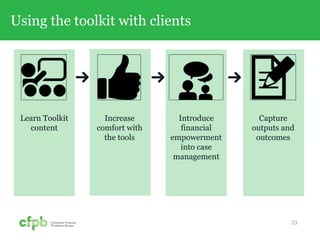
Using the toolkit with clients
23
Learn Toolkit
content
Increase
comfort with
the tools
Introduce
financial
empowerment
into case
management
Capture
outputs and
outcomes
What would you do if your client...
1. Wants to file for bankruptcy?
2. Wants to know how to respond to a creditor’s threat to sue?
3. Is facing eviction?
4. Is facing foreclosure?
5. Is not able to provide enough food for herself and other
members of her household?
6. Is in danger of losing her car due to nonpayment?
7. Wants to take out a debt consolidation loan?
8. Wants to know how to finance her child’s college?
24
Your Money, Your Goals
The role of referral
25
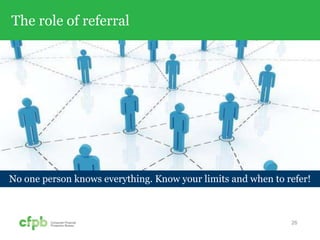
The role of referral
No one person knows everything. Know your limits and when to refer!
26
27
Your Money, Your Goals
Assessing the situation and starting
the conversation
Self-Assessment
Complete Tool 1: Financial empowerment self-assessment
Reflection Questions
 How did you feel about completing this assessment?
 Were there topics you knew more about than you thought
you would?
 What topics would you like to learn more about?
 How can you learn more about them?
28
Situation Assessment
A picture of conditions today used
to inform and plan for actions to
change conditions in the future
29
Workflow Analysis
30
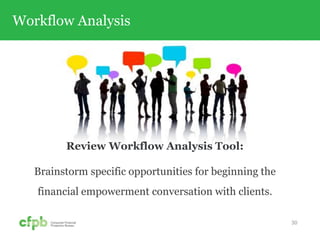
Review Workflow Analysis Tool:
Brainstorm specific opportunities for beginning the
financial empowerment conversation with clients.
31
Your Money, Your Goals
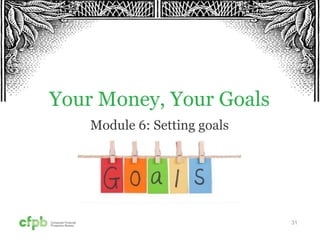
Module 6: Setting goals
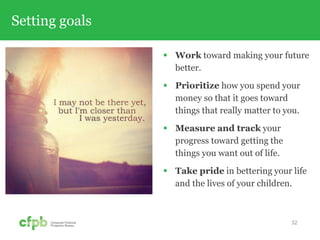
Setting goals
 Work toward making your future
better.
 Prioritize how you spend your
money so that it goes toward
things that really matter to you.
 Measure and track your
progress toward getting the
things you want out of life.
 Take pride in bettering your life
and the lives of your children.
32
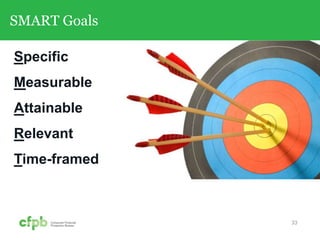
SMART Goals
33
Specific
Measurable
Attainable
Relevant
Time-framed
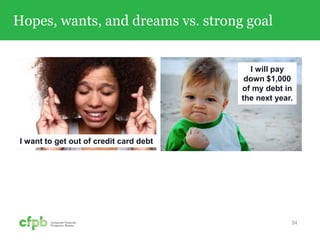
Hopes, wants, and dreams vs. strong goal
34
I want to get out of credit card debt
I will pay
down $1,000
of my debt in
the next year.
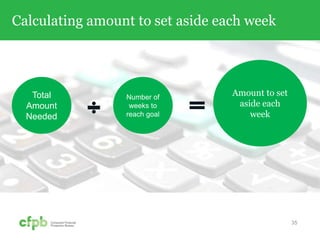
Calculating amount to set aside each week
35
Total
Amount
Needed
Number of
weeks to
reach goal
Amount to set
aside each
week
36
Your Money, Your Goals
Module 11: Dealing with debt
Dealing with debt
 What is debt?
 How is debt different from credit?
 How is secured debt different from
unsecured debt?
37
Good debt, bad debt
38
Tool 1: Debt management worksheet
On the debt management worksheet, you will include:
 The person, business, or organization you own money to;
 The amount you owe them;
 The amount of your monthly payment; and
 The interest rate you are paying and other important terms.
To complete this worksheet, you may need to get all of your bills
together in one place.
39
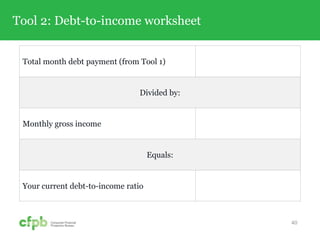
Tool 2: Debt-to-income worksheet
40
Total month debt payment (from Tool 1)
Divided by:
Monthly gross income
Equals:
Your current debt-to-income ratio
Tool 2: Debt-to-income worksheet
Renters
 Consider maintaining a debt-to-income ratio of .15 - .20, or 15% -
20%, or less.
Homeowners
 Consider maintaining a debt-to-income ratio of .28, or 28%, or
less for just the mortgage (home loan), taxes, and insurance.
 Consider maintaining a debt-to-income ratio for all debts of .36,
or 36%, or less.
41
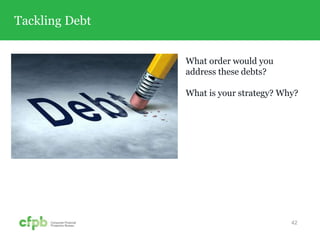
Tackling Debt
42
What order would you
address these debts?
What is your strategy? Why?
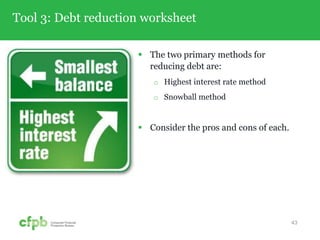
Tool 3: Debt reduction worksheet
 The two primary methods for
reducing debt are:
 Highest interest rate method
 Snowball method
 Consider the pros and cons of each.
43
Tool 4: Student loan debt
 Federal student loans versus private student loans
 Options for federal student loan repayment
 Standard payment
 Graduated payment
 Extended payment
 IBR
 Pay as you earn
 Consolidated loan
44
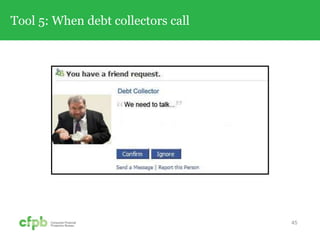
Tool 5: When debt collectors call
45
Know your rights
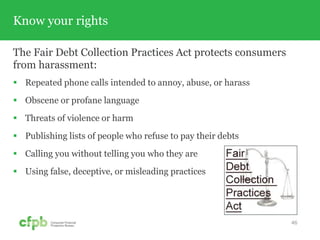
The Fair Debt Collection Practices Act protects consumers
from harassment:
 Repeated phone calls intended to annoy, abuse, or harass
 Obscene or profane language
 Threats of violence or harm
 Publishing lists of people who refuse to pay their debts
 Calling you without telling you who they are
 Using false, deceptive, or misleading practices
46
47
Your Money, Your Goals
Module 12: Understanding credit reports
and scores
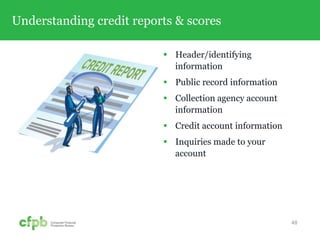
Understanding credit reports & scores
 Header/identifying
information
 Public record information
 Collection agency account
information
 Credit account information
 Inquiries made to your
account
48
Reading a credit report
1. Who does this credit report belong to?
2. Where does this person live?
3. Where does he work? How long has he worked there?
4. Does he have public records? If yes, describe it (them).
5. Is he late on any of his accounts? If yes, describe.
49
Reading a credit report
6. Are any of his accounts in good standing? If yes,
describe.
7. What are the balances of his accounts in the account
information section?
8. Does he have accounts in collection? What is the
balance owed in collections?
9. What do his inquiries tell you?
10. What is your opinion of this person’s credit history. Is
it positive or negative?
50
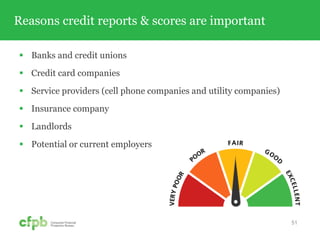
 Banks and credit unions
 Credit card companies
 Service providers (cell phone companies and utility companies)
 Insurance company
 Landlords
 Potential or current employers
Reasons credit reports & scores are important
51
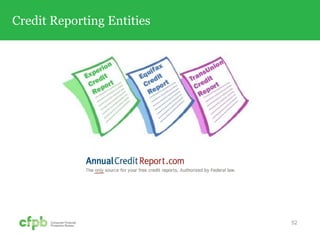
Credit Reporting Entities
52
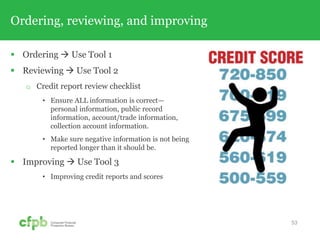
Ordering, reviewing, and improving
 Ordering  Use Tool 1
 Reviewing  Use Tool 2
 Credit report review checklist
• Ensure ALL information is correct—
personal information, public record
information, account/trade information,
collection account information.
• Make sure negative information is not being
reported longer than it should be.
 Improving  Use Tool 3
• Improving credit reports and scores
53
54
Your Money, Your Goals
Self-Study Modules
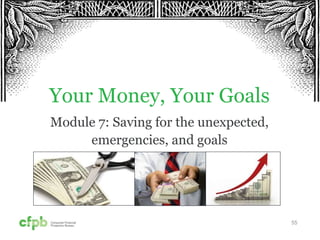
Your Money, Your Goals
Module 7: Saving for the unexpected,
emergencies, and goals
55
56
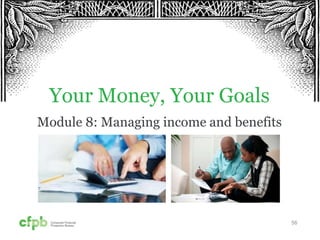
Your Money, Your Goals
Module 8: Managing income and benefits
57
Your Money, Your Goals
Module 9: Paying bills and other expenses
58
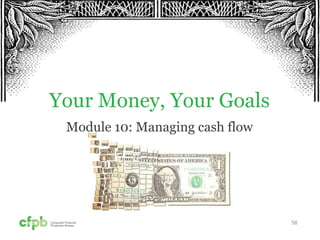
Your Money, Your Goals
Module 10: Managing cash flow
59
Your Money, Your Goals
Module 13: Evaluating financial service
providers, products, and services
60
Your Money, Your Goals
Module 14: Protecting consumer rights
Additional resources
For additional resources, visit the Consumer
Financial Protection Bureau website:
http://www.consumerfinance.gov/
If you have a consumer complaint, visit:
http://www.consumerfinance.gov/complaint/
61
62
Your Money, Your Goals
Closing
Closing
 What is the most important
thing you are taking away
from this training?
 What is something you would
like to learn more about?
63

CFPB Your Money Your Goals Toolkit Training

  • 1.
    Your Money, YourGoals A FINANCIAL EMPOWERMENT TOOLKIT FOR SOCIAL SERVICE PROGRAMS
  • 2.
    Your Money, YourGoals Introduction 2
  • 3.
    Money and Me Listall of the words, phrases, sayings, songs, or other associations you have with the word money. 3
  • 4.
    Money and Me 4 Money: anygenerally accepted medium of exchange
  • 5.
    Money: What doesit mean?  Where do our associations about money come from?  How do these associations reflect our attitudes and feelings about money?  How are our attitudes and feelings related to our behaviors and actions?  What does this mean when we are working with clients? 5
  • 6.
    Your Money, YourGoals Overview of the training and introductions 6
  • 7.
    Training purpose 7 Orientation tothe Your Money, Your Goals financial empowerment tools Strategies for using the toolkit The tools, knowledge and confidence to provide financial empowerment to your clients
  • 8.
    Training objectives By theend of the training, you will be able to:  Connect financial empowerment with your program and client outcomes.  Demonstrate increased confidence in your own knowledge about core financial management topics.  Assess clients’ financial condition or situation.  Provide the right financial content at the right time in the context of your case work with clients based on assessment. 8
  • 9.
    Training objectives By theend of the training, you will be able to:  Use specific tools to help your clients reach their own goals in different cultural and situational contexts.  Access and use tools and materials available at www.consumerfinance.gov.  Make appropriate and specific referrals to help clients manage their financial challenges.  Know where to go for unbiased information or help in working with clients. 9
  • 10.
    Training presenter The ConsumerFinancial Protection Bureau created the Your Money, Your Goals toolkit for consumers, as well as the training materials presented today. These materials are being presented to you by a local non-profit organization. The organizations or individuals presenting these materials are not agents or employees of the CFPB, and their views do not represent the views of the Bureau. The CFPB is not responsible for the advice or actions of these individuals or entities. The Bureau appreciates the opportunity to work with the organizations that are presenting these materials. 10
  • 11.
    Introductions  Share name Organization  “What do you expect or hope to get from this training?” 11
  • 12.
    12 Your Money, YourGoals Introduction to the CFPB and financial empowerment
  • 13.
    Introduction to theCFPB The CFPB’s mission is to make markets for consumer financial products and services work for Americans. 13
  • 14.
    Introduction to theCFPB 14 EDUCATION ENFORCEMENT STUDY
  • 15.
    Why case managers? 15 AccessTrust Opportunity for providing financial empowerment
  • 16.
    Financial empowerment 16 What isfinancial empowerment? How is it different than financial education, financial literacy, financial capacity, or other commonly used terms?
  • 17.
    Benefit / Costanalysis What are the benefits and costs of financial empowerment  For you?  For your clients?  For your program? 17
  • 18.
    18 Your Money, YourGoals An orientation to the toolkit
  • 19.
    Organization of YourMoney, Your Goals Introductory modules  Module 1: Introduction to the toolkit  Module 2: Assessing the situation  Module 3: Starting the conversation  Module 4: Emotional & cultural influences on financial decisions  Module 5: Using the toolkit 19
  • 20.
    Organization of YourMoney, Your Goals Content modules  Module 6: Setting goals  Module 7: Saving for the unexpected, emergencies, & goals  Module 8: Managing income & benefits  Module 9: Paying bills & other expenses  Module 10: Managing cash flow  Module 11: Dealing with debt  Module 12: Improving credit reports & scores  Module 13 Evaluating financial service providers, products, & services  Module 14: Protecting consumers rights 20
  • 21.
    Organization of YourMoney, Your Goals 21
  • 22.
    Where would youstart if your client... 1. Felt overwhelmed by debt? 2. Felt like she couldn’t make ends meet? 3. Wants to buy a car and get the best rate she can for the money she must borrow? 4. Wants to understand direct deposit and payroll cards? 5. May qualify for Earned Income Tax Credit (EITC)? 22
  • 23.
    Using the toolkitwith clients 23 Learn Toolkit content Increase comfort with the tools Introduce financial empowerment into case management Capture outputs and outcomes
  • 24.
    What would youdo if your client... 1. Wants to file for bankruptcy? 2. Wants to know how to respond to a creditor’s threat to sue? 3. Is facing eviction? 4. Is facing foreclosure? 5. Is not able to provide enough food for herself and other members of her household? 6. Is in danger of losing her car due to nonpayment? 7. Wants to take out a debt consolidation loan? 8. Wants to know how to finance her child’s college? 24
  • 25.
    Your Money, YourGoals The role of referral 25
  • 26.
    The role ofreferral No one person knows everything. Know your limits and when to refer! 26
  • 27.
    27 Your Money, YourGoals Assessing the situation and starting the conversation
  • 28.
    Self-Assessment Complete Tool 1:Financial empowerment self-assessment Reflection Questions  How did you feel about completing this assessment?  Were there topics you knew more about than you thought you would?  What topics would you like to learn more about?  How can you learn more about them? 28
  • 29.
    Situation Assessment A pictureof conditions today used to inform and plan for actions to change conditions in the future 29
  • 30.
    Workflow Analysis 30 Review WorkflowAnalysis Tool: Brainstorm specific opportunities for beginning the financial empowerment conversation with clients.
  • 31.
    31 Your Money, YourGoals Module 6: Setting goals
  • 32.
    Setting goals  Worktoward making your future better.  Prioritize how you spend your money so that it goes toward things that really matter to you.  Measure and track your progress toward getting the things you want out of life.  Take pride in bettering your life and the lives of your children. 32
  • 33.
  • 34.
    Hopes, wants, anddreams vs. strong goal 34 I want to get out of credit card debt I will pay down $1,000 of my debt in the next year.
  • 35.
    Calculating amount toset aside each week 35 Total Amount Needed Number of weeks to reach goal Amount to set aside each week
  • 36.
    36 Your Money, YourGoals Module 11: Dealing with debt
  • 37.
    Dealing with debt What is debt?  How is debt different from credit?  How is secured debt different from unsecured debt? 37
  • 38.
  • 39.
    Tool 1: Debtmanagement worksheet On the debt management worksheet, you will include:  The person, business, or organization you own money to;  The amount you owe them;  The amount of your monthly payment; and  The interest rate you are paying and other important terms. To complete this worksheet, you may need to get all of your bills together in one place. 39
  • 40.
    Tool 2: Debt-to-incomeworksheet 40 Total month debt payment (from Tool 1) Divided by: Monthly gross income Equals: Your current debt-to-income ratio
  • 41.
    Tool 2: Debt-to-incomeworksheet Renters  Consider maintaining a debt-to-income ratio of .15 - .20, or 15% - 20%, or less. Homeowners  Consider maintaining a debt-to-income ratio of .28, or 28%, or less for just the mortgage (home loan), taxes, and insurance.  Consider maintaining a debt-to-income ratio for all debts of .36, or 36%, or less. 41
  • 42.
    Tackling Debt 42 What orderwould you address these debts? What is your strategy? Why?
  • 43.
    Tool 3: Debtreduction worksheet  The two primary methods for reducing debt are:  Highest interest rate method  Snowball method  Consider the pros and cons of each. 43
  • 44.
    Tool 4: Studentloan debt  Federal student loans versus private student loans  Options for federal student loan repayment  Standard payment  Graduated payment  Extended payment  IBR  Pay as you earn  Consolidated loan 44
  • 45.
    Tool 5: Whendebt collectors call 45
  • 46.
    Know your rights TheFair Debt Collection Practices Act protects consumers from harassment:  Repeated phone calls intended to annoy, abuse, or harass  Obscene or profane language  Threats of violence or harm  Publishing lists of people who refuse to pay their debts  Calling you without telling you who they are  Using false, deceptive, or misleading practices 46
  • 47.
    47 Your Money, YourGoals Module 12: Understanding credit reports and scores
  • 48.
    Understanding credit reports& scores  Header/identifying information  Public record information  Collection agency account information  Credit account information  Inquiries made to your account 48
  • 49.
    Reading a creditreport 1. Who does this credit report belong to? 2. Where does this person live? 3. Where does he work? How long has he worked there? 4. Does he have public records? If yes, describe it (them). 5. Is he late on any of his accounts? If yes, describe. 49
  • 50.
    Reading a creditreport 6. Are any of his accounts in good standing? If yes, describe. 7. What are the balances of his accounts in the account information section? 8. Does he have accounts in collection? What is the balance owed in collections? 9. What do his inquiries tell you? 10. What is your opinion of this person’s credit history. Is it positive or negative? 50
  • 51.
     Banks andcredit unions  Credit card companies  Service providers (cell phone companies and utility companies)  Insurance company  Landlords  Potential or current employers Reasons credit reports & scores are important 51
  • 52.
  • 53.
    Ordering, reviewing, andimproving  Ordering  Use Tool 1  Reviewing  Use Tool 2  Credit report review checklist • Ensure ALL information is correct— personal information, public record information, account/trade information, collection account information. • Make sure negative information is not being reported longer than it should be.  Improving  Use Tool 3 • Improving credit reports and scores 53
  • 54.
    54 Your Money, YourGoals Self-Study Modules
  • 55.
    Your Money, YourGoals Module 7: Saving for the unexpected, emergencies, and goals 55
  • 56.
    56 Your Money, YourGoals Module 8: Managing income and benefits
  • 57.
    57 Your Money, YourGoals Module 9: Paying bills and other expenses
  • 58.
    58 Your Money, YourGoals Module 10: Managing cash flow
  • 59.
    59 Your Money, YourGoals Module 13: Evaluating financial service providers, products, and services
  • 60.
    60 Your Money, YourGoals Module 14: Protecting consumer rights
  • 61.
    Additional resources For additionalresources, visit the Consumer Financial Protection Bureau website: http://www.consumerfinance.gov/ If you have a consumer complaint, visit: http://www.consumerfinance.gov/complaint/ 61
  • 62.
    62 Your Money, YourGoals Closing
  • 63.
    Closing  What isthe most important thing you are taking away from this training?  What is something you would like to learn more about? 63

Editor's Notes

  • #2 Brief welcome from United Way Financial Stability Partnership – 5 minutes Thank participants for their time. Introduce idea of “beta testing’ – solicit their help in testing and applying this project
  • #4 ACTIVITY #1: Money and Me (slides 3-5) Estimated Time: 15 Minutes Methodology: Opener—Contest Corresponding Section in Toolkit: No corresponding section in Toolkit Instructions for Facilitator: Instruct participants to work in small groups. Give each group a flip chart and marker. Instruct them to brainstorm all of the associations they have with money per the flip chart. Tell them the winning group is the one with the most associations. Give them 2 minutes. Call time and ask groups to count up total items listed and write the number on their flip charts. Congratulate winning team. Hang up their flip chart. Ask other teams to add items they feel are missing from the list. Go through many of the ideas and ask group to indicate whether the association is positive or negative with a thumbs up or thumbs down, respectively. Based on majority vote, write “+” or “-” next to each entry on the flip chart. If there is a lot of disagreement about an entry, facilitate a short discussion about the disagreement and write “?” next to those about which there does not seem to be agreement.
  • #5 ACTIVITY #1: Money and Me CONTINUED Opener Show and read the definition of “Money.” Contrast the definition of money to the list of associations generated by the team by asking: “How did we get from this simple definition of money to all of these positive and negative associations?”
  • #6 ACTIVITY #1: Money and Me CONTINUED Opener Ask each question listed to facilitate a discussion. Where do our associations about money come from? Be sure to add the following if not contributed by participants: family, peers, school, media, government, businesses, communities of faith, social and service organizations. Ask people for specificity including examples of how family or peers or media, for example, may create lasting associations about money for people. How do these associations reflect our attitudes and feelings about money? Be sure to add the following if not contributed by participants: Our attitudes and feelings about money may be rooted in some of these associations. How are our attitudes and feelings related to our behaviors and actions? Be sure to add the following if not contributed by participants: Our behaviors and actions are often driven by our attitudes and feelings. This is part of the reason our knowledge—what we know is good practice with money—and our actions do not line up. So what does this mean when we are working with clients? Be sure to add the following if not contributed by participants: While it’s easy to think about financial empowerment as providing people to develop financial management knowledge and skills, financial empowerment must also consider and help people understand some of the underlying attitudes and feelings about money and how these impact practices and behaviors today. Attitudes and feelings may drive practices and actions. Understanding the origins of attitudes and feelings about money can help people understand the reasons behind some of their actions and may changes if they want to make changes. Be sure to highlight cultural differences based on socio-economic status, ethnicity, region, and age. Note: See Module 4: Emotional and cultural influences on financial decisions for more information on this topic. (Pages 39-41) Take a moment to look at that section. Summarize by sharing: Attitudes and beliefs about money drive behavior. Understanding origins of these attitudes and beliefs can help you better understand what influences some of your as well as your clients’ productive and unproductive money practices. As case managers, it’s also important to understand your own attitudes or biases around money and financial issues—this can help ensure you do not judge your clients for their: Financial situations; Current financial practices; Past financial decisions; or Their current financial goals.
  • #8 ACTIVITY #2: Overview of the Training and Introductions Estimated Time: 10 Minutes Methodology: Presentation / Icebreaker (Introduction Activity) Corresponding Section in Toolkit: Module 1: Introduction to the Toolkit (Page 1), Section 2 Financial Empowerment and Your Life (Page 4) Instructions for Facilitator: Review training purpose: To provide you with an orientation to Your Money, Your Goals, strategies for using the Toolkit, and the tools, knowledge and confidence to provide financial empowerment services to your clients. Review goals of Financial Stability Partnership: To determine if the toolkit is a useful pathway to giving families the tools and resource necessary to get on track with finances.
  • #9 ACTIVITY #2: Overview of the Training and Introductions CONTINUED Presentation (Module 1) Explain that the purpose of the training is like the mission—overall what the training is trying to do. Explain that objectives are the specific things they will know or be able to do as a result of the training. Review objectives. Be sure to paraphrase, not read.
  • #10 ACTIVITY #2: Overview of the Training and Introductions CONTINUED Presentation (Module 1) Review objectives. Be sure to paraphrase, not read.
  • #11 ACTIVITY #2: Overview of the Training and Introductions CONTINUED Presenter (Module 1) Paraphrase this disclaimer for the group and briefly share information on the organization with which you are associated. Note: Even though this slide has a lot of text, the entire disclaimer should be included visually during the training.
  • #12 ACTIVITY #2: Overview of the Training and Introductions CONTINUED Icebreaker (Module 1) Invite participants to introduce themselves to the group by sharing their name, their organization, and sharing: “What do you expect or hope to get from this training?” Write their expectations or hopes on flip chart paper. NOTE: Try to keep people from sharing the details of their roles and responsibilities at work as well as details about what their organization does. It is important NOT TO SKIP introductions because you are concerned about time. Participants are accustomed to some level of introduction in convenings. This is even more important if the group represents a heterogeneous mix of participants and organizations.
  • #14 ACTIVITY #3: Introduction to the CFPB and Financial Empowerment Estimated Time: 30 Minutes Methodology: Presentation/Facilitated Discussion / Debate or Large Group Brainstorm / Carousel Corresponding Sections in Toolkit: Module 1: Introduction to the Toolkit (Page 1), Section 1: An Introduction to the CFPB (Page 2) Section 2: Financial Empowerment and Your Life (Page 4) Section 3: Financial Empowerment: A way to improve client and organization/program outcomes (Page 4) Instructions for Facilitator: Introduce key facts about the CFPB using information from Section 1 in Module 1 and the slides. Share additional information about the CFPB: The CFBP is working to ensure that consumers get the information they need to make financial decisions they believe are best for themselves and their families – that prices are clear up front, that risks are visible, and that nothing is buried in fine print.
  • #15 ACTIVITY #3: Introduction to the CFPB and Financial Empowerment CONTINUED Presentation (Module 1) Introduce key facts about the CFPB using information from Section 2 in Module 1 (Page 3) and the slides: Education. An informed consumer is the first line of defense against harmful practices. Enforcement. CFPB supervises banks, credit unions, and other financial companies, and enforces federal consumer financial laws. Study. The CFPB gathers and analyzes available information to better understand consumers, financial services providers, and consumer financial markets.
  • #16 ACTIVITY #3: Introduction to the CFPB and Financial Empowerment CONTINUED Presentation (Module 1) Explain rationale for Your Money, Your Goals for social services programs using slide and information from Module 1: Introduction to the Toolkit. (Page 1) Be sure to highlight that case managers and nonprofit staff members: Meet with consumers that need high quality, unbiased financial information and tools to help them become financially empowered. Have the trust of the people they work with In this context, a “case manager” is anyone who works directly with people with low or moderate income in a wide range of organizations and on a broad range of issues. Case managers generally do one or more of the following with clients: Conduct needs assessments Develop action plans Provide education, information, resources, and referrals needed to implement action plans Monitor progress Evaluate results After reviewing this definition, ask participants: “Given this definition, are you within the target audience for this Toolkit even if your job title is not case manager?” Instruct participants to raise their hands if the answer to this question is “yes.” Facilitate a dialogue with those participants who do not see themselves reflected in this definition using questions such as: “How is your job fundamentally different from the functions described in this definition?” “How do you feel this kind of Toolkit may benefit your work even though you see yourself as outside the target audience for the Toolkit?” NOTE: In all likelihood, participants may not identify as being within the target audience if they have a supervisory role to case managers and other staff that provide direct service, or they see their job as encompassing more than the broad functions listed here. It is important to help them identify how they are within the target audience for the Toolkit. *** NOTE: This is a pre-transition to next slide. Ask these questions first before moving on. ASK: What is financial empowerment? Write their ideas on flip chart paper. ASK: How is it different from financial education, financial literacy, financial capability, or other commonly used terms? Ask them how financial empowerment is different from other commonly used terms: financial education, financial literacy, financial capability, financial fitness, financial coaching, and so on. If they don’t know – see if anyone has a guess. NOTE: It may be helpful to differentiate strategy terms (financial education, financial coaching, financial counseling) from outcome-based terms (financial literacy, financial capability, financial fitness).
  • #17 ACTIVITY #3: Introduction to the CFPB and Financial Empowerment CONTINUED Facilitated Discussion and Presentation (Module 1) Share definition of financial empowerment using the slide and information from the Introduction to the Toolkit and Module 1, Section 3: Financial Empowerment: A way to improve client and program outcomes. (page 4) Having the ability to use financial management knowledge, skills, and tools to access resources, products, and services to achieve your goals. Share the relationship of financial empowerment to financial education and financial literacy using the slide and information from Module 1, Section 3: Financial Empowerment: A way to improve client and program outcomes. (page 4) Explain that financial education, which is inclusive of other strategies, such as coaching, counseling, technology-based approaches, and so on, leads to financial literacy and that financial literacy plus confidence—the confidence to make decisions and use knowledge, skills, and tools including financial products and services—is financial empowerment.
  • #18 ACTIVITY #3: Introduction to the CFPB and Financial Empowerment CONTINUED Benefit/Cost Analysis Discussion (Module 1, Section 2 and 3) (Page 4) Using flip charts (one for benefits, one for costs (challenges)), have participants brainstorm the benefits and costs of providing financial empowerment. Summarize
  • #20 ACTIVITY #4: Your Money, Your Goals: An orientation to the Toolkit Estimated Time: 45 Minutes Methodology: Presentation / Scavenger Hunt / Large Group or Small Group Discussion Corresponding Sections in Toolkit: Module 1: Introduction to the Toolkit (pages 1-8), Section 3: Financial Empowerment: A way to improve client and organization/program outcomes; (page 4) and Section 5: An Overview of Your Money, Your Goals (page 7) Instructions for Facilitator: Review organization of the toolkit using slide and information in Module 1. Review the purpose of the toolkit: The goal of Your Money, Your Goals is to improve client outcomes by making it easier for you as a case manager to help clients become more financially empowered.
  • #21 Instructions for Facilitator: Review organization of the toolkit using slide and information in Module 1. Review the purpose of the toolkit: The goal of Your Money, Your Goals is to improve client outcomes by making it easier for you as a case manager to help clients become more financially empowered. Review which modules we will go in-depth on Module 6, Module 7, Module 9
  • #22 ACTIVITY #4: Your Money, Your Goals: An orientation to the Toolkit CONTINUED Presentation (Module 1) Review key principles of using the Toolkit. Do not treat like a curriculum—the goal is not to get through all of the materials in the order they are presented. Provide the right content and tools at the right time. Access only those parts of the Toolkit that match your clients’ needs. Use discussions with clients or assessments to figure out where to start. Explain in particular the difference between the Toolkit and a financial education/coaching curriculum. A toolkit has tools in it. It can be used in any order based on the problem trying to be fixed. If you are hanging a picture, you may only use a hammer. But if someone is trying to build a house, she/he will use a hammer, saw, and so on. As with any toolkit, a case manager may only use one tool or many depending on the magnitude of the issue being addressed. A curriculum is generally designed to help people develop specific competencies. Often has the expectation that all or most of the curriculum will be taught and that one concept builds on another. The toolkit is designed to help case managers match content with the specific needs of the clients or individuals they serve on a just-in-time basis. If someone needs to build their credit to qualify for an auto loan, you can go to the module on building credit without going through the modules on goal setting, saving, managing cash flow, and dealing with debt that come before it. It’s not that these topics are not important, it’s just not what the person needs at that time. Explain that to make the best use of the Toolkit, it’s best to not give clients all of the tools at once. Getting all of the tools at once –or even five tools at one time – is likely be overwhelming for most clients. A better approach is to identify the topic and tool that will make the biggest difference for each client. When sending tools home with clients, limit it to one or two that have been reviewed and discussed during case management sessions. If a client receives too many tools at once, none of the tools are likely to be used.
  • #23 ACTIVITY #4: Your Money, Your Goals: An orientation to the Toolkit CONTINUED Scavenger Hunt (Module 1) Explain that they will be going on a scavenger hunt through the Toolkit. Instruct small groups to review each question and to locate the module and specific tools within the module that address each question. Instruct participants to write their answers to each question on the slide on a flip chart using markers. Provide teams 15 minutes to complete. Ask participants to share answers; Use answer key to augment their solutions. Following answers, ask participants to share reactions or questions they may have regarding the Toolkit, given the scavenger hunt through it. NOTE: Answer key follows. Participants may have answers that vary. If they do, ask them to explain the reason they chose the module and tool. Your client felt overwhelmed by debt? Module 11, Tool 3 (page 177) Your client felt like she couldn’t make ends meet? (ANY OF THESE ANSWERS IS ACCEPTABLE) Module 8, Tool 2 (page 97) Module 9, Tool 1, 3 and 4 (pages 115, 125, 129) Module 10, Tools 1, 2, and 3 (pages 135, 145, 149) Your client wants to buy a car and get the best rate she can for the money she must borrow? Module 12, Tool 2, then Tools 1 and 3 (pages 217, 211, 223) Your client wants to understand direct deposit and payroll cards? Module 8, Tool 3 (page 101) You think your client may qualify for EITC? Module 7, the narrative and Tool 4 (page 83)
  • #24 ACTIVITY #4: Your Money, Your Goals: An orientation to the Toolkit CONTINUED Presentation (Module 5) (pages 43-48) Explain that the Toolkit is to be integrated into existing work not considered an add on service. Explain the reasons for integration: It builds on established relationships you may have with clients. Clients are busy—there is efficiency in addressing many issues in one stop. Financial and economic issues cut across situations and challenges: basic needs housing, health and health care, child rearing and care, work, transportation, and so on. Financial empowerment integration may present a more holistic approach to working with clients. It provides opportunities for reinforcement during “natural” discussions with clients. It may result in better outcomes for the clients and programs. ASK: What other benefits can you think of? Acknowledge their time investment and thank participants for their willingness to jump into the work with us. We know that the time to do this is front-loaded because time must be invested to: Learn the Toolkit content Become comfortable with the topics and the tools in the Toolkit Think about ways to introduce financial empowerment in the context of the case management you provide Potentially capture the outcomes of financial empowerment in the work you do United Way will provide follow up surveys so you can give us feedback on which tools you like, which you don’t, and what additional information you need to be successful. Highlight the Client Financial Empowerment Checklist. (page 45) Explain that the purpose of this tool is to provide case managers with a tracking template for use with each client—it’s a simple way to keep track of the tools or information shared with a particular client collect output level data, and connect one meeting with a client to the next. Ask participants to refer to the Tool in Module 5 (page 45) and review the form with the participants.
  • #25 ACTIVITY #4: Your Money, Your Goals: An orientation to the Toolkit CONTINUED Large Group Discussion (Module 1) ASK: Have our clients ever casually or specifically brought up these topics? What did you do? If not, what would you do? Have participants determine what they would do in each situation: Discuss as a large group. Write their ideas for each question on a flip chart (this will begin the process of them seeing their resource and referral network as well as when they should refer on). Summarize by sharing: You can make a big difference in the lives of your clients by introducing them to financial empowerment and providing them with some new information and tools to help them solve specific financial challenges. But some of your clients may need more help—help you may not feel comfortable providing—because it is technical, beyond what you feel comfortable addressing, or not available within your organization. We do not expect anyone to become a financial expert however, because your clients trust you, they look to you for quality information and referrals on topics. This is where a high quality resource and referral network will be essential to your work in the community.
  • #27 ACTIVITY #5: The Role of Referral Estimated Time: 15 Minutes Methodology: Presentation Corresponding Section in Toolkit: Module 1: Introduction to the Toolkit, Section 5: Making Referrals (page 6) and Special Module on Making Referrals: Creating a strong resources and referral network (Supplemental module for trainers only) Instructions for Facilitator: Review the key points related to the role of referral. Explore the concept of knowing your limits by asking: “How will you know when you have reached your limits in providing financial empowerment services to clients?” Write their responses on flip chart paper. NOTE: There will be more information on the referral guide available at the training.
  • #29 ACTIVITY #6: Assessing the Situation and Starting the Conversation Estimated Time: 45 Minutes Methodology: Presentation / Individual Activity and Discussion in Pairs /Role Play / Skit or Large Group Brainstorm Corresponding Section in Toolkit: Modules 2 (pages 9-26) and 3 (pages 27-38) Instructions for Facilitator: Individual Activity and Discussion in Pairs (Module 2) Provide rationale for assessment tool 1 (page 11). Tool 1: Financial Empowerment Case Manager Self-Assessment (page 11) is a four-part tool designed to help you understand how much financial knowledge you already have. Learning more will not only benefit your clients, but it may also benefit you as you apply what you learn to your own life. This tool will help you see how much you know and where you may need to learn more. Invite participants to complete this assessment tool. Provide 7 minutes. Review the answers in a participatory way. NOTE: In the toolkit, the answer key immediately follows the tool. Be sure to ask participants to not look ahead when completing the Assessment 1. Ask participants to get into pairs and discuss the reflection questions—be sure to review one question at a time.
  • #30 ACTIVITY #6: Assessing the Situation and Starting the Conversation CONTINUED Presentation (Module 2) (pages 9-26) Review the purpose of the client assessment. Tool 2: Client Goals and Financial Situation Assessment (page 21) is designed to help the case worker and the client understand the client’s goals and financial situation. This information can help you target the right module of the toolkit for each client. For example, if a client has a goal to buy a car or a home, learning about how to improve their credit history and scores may help your clients qualify for a lower cost loan. You can target Module 12: Understanding Credit Reports and Scores (pages 193 – 226). If you have a client that is unable to make ends meet every month, you can target Module 10: Managing Cash Flow (pages 133-156). This tool will help you match each client’s goals and financial situation with specific modules and tools within the toolkit. Define situation assessment using slide. Briefly review the contents of and analysis procedure for Assessment Two. Be sure to state that using this assessment is NOT MANDATORY. It is a tool they can use to more effectively and efficiently match client need with information and tools in the Toolkit. Share options for using the assessment: When clients fill out intake paperwork for your organization or program When meeting with clients for an initial assessment or When clients are waiting for other services (such as waiting to have their tax returns prepared at a Volunteer Income Tax Assistance site) Send this home with clients to fill out privately Use it as a guide to ask questions in a conversational style to better understand the financial concerns and goals of clients Ask the questions over several sessions with client ASK: How else can you use the assessment?
  • #31 ACTIVITY #6: Assessing the Situation and Starting the Conversation CONTINUED UPDATE: Utilize CFED Building Financial Integration Workflow Analysis tool here. https://www.acf.hhs.gov/sites/default/files/ocs/afi_resource_guide_building_financial_capability_final.pdf NOTE: Select Option A: Brainstorm or Option B: Skit in advance of the training Skit (Module 3) (pages 27-38) Invite pairs of participants to “read” and act out scripts provided in the toolkit in Module 3. Solicit feedback from participants about what worked well and how they would change the discussion. Brainstorm a list of ways they can initiate the financial empowerment discussion with clients. NOTE: This can be done as a large group or in small groups with a large group report out.
  • #33 ACTIVITY #7: Setting Goals Estimated Time: 15 Minutes Methodology: Presentation, Facilitated Discussion Corresponding Section in Toolkit: Module 6 (pages 49-60) Instructions for Facilitator: Presentation (Module 6) (pages 49-60) Encourage participants to follow along in Module 6 in the Toolkit. Describe the role of goal setting in financial management and financial planning. Explain the rationale for setting goals.
  • #34 ACTIVITY #7: Setting Goals CONTINUED Presentation (Module 6) (page 50) Explain the qualities of strong goals. Specific When setting a goal, ask yourself the questions: Who? What? Why? A specific goal has a much greater chance of being met than a general goal. Measurable You should be able to track your progress toward meeting the goal. Ask yourself questions like: How much? How many? How will I know when it is done? Able to be reached Is this goal something that you can actually reach? You might want to get out of high credit card debt tomorrow or become a millionaire in a year, but for most of us, that's a totally impossible goal! That doesn't mean that your goals should be easy. Your goal may be a stretch for you, but it should not be extreme or impossible. Relevant Set goals that matter to you and are a priority in your life. Ask yourself the questions: Is this something that I really want? Is now the right time to do this? Time-framed Goals should have a clearly defined time frame, including a target or deadline date.
  • #35 ACTIVITY #7: Setting Goals CONTINUED Facilitated Discussion (Module 6) (page 51) Review examples by asking: “Why is the hope, want and dream NOT a goal?” “What makes a strong goal strong?” Ask participants to list the things clients need to reach goals. Write their responses on flip chart paper. Be sure to add the following: Every goal requires commitment and time. To reach goals, you may also need: Information Tools Assistance from a professional Transportation Other resources Money An action plan—small steps needed to reach a goal For goals that require money to reach, you will want to know: How much do I need to set aside every week (or month) to meet my goal? This applies to both debt reduction and savings goals.
  • #36 ACTIVITY #7: Setting Goals CONTINUED Presentation (Module 6) (pages 52) When figuring out how much to set aside every week to meet the goal, two pieces of information are needed: the total amount needed to reach the goal and the number of weeks to reach the goal. Explain how to get a monthly amount. Go through an example on a flip chart using a participant’s goal, the one in the Toolkit, or one you create. Discuss how this monthly set-aside can be used in developing a budget or cash flow.
  • #38 ACTIVITY #12: Dealing with Debt Estimated Time: 20 Minutes Methodology: Facilitated Discussion / Stand Up-Sit Down / Activity in Pairs / Presentation / Exercise in Small Groups / Personal Stories Corresponding Section in Toolkit: Module 11 Instructions for Facilitator: Facilitated Discussion (Module 11, Begins on Toolkit Page 133) ASK: What is a debt? After participants offer some ideas, share definition: Money you owe to another person or business. Debt is a liability. Debt may obligate future income. ASK: How is debt different from credit? After participants offer some ideas, share definition: Credit means you can borrow money. Debt is the result of using credit. Credit is not a liability. When you use it, though, you create a liability. ASK: How is secured debt different from unsecured debt? After participants offer some ideas, share definitions: Secured debt is debt that has an asset attached to it. When debt is secured, a lender can collect that asset if you do not pay. Ask participants for examples of secured debt. After participants offer some ideas, share examples: A home loan—the debt is secured with the home you are buying. If you do not pay your loan, the lender will foreclose on your home, sell it, and use the money from the sale to cover your loan. An auto loan—the debt is secured with your car. If you do not pay your loan, the lender will repossess (repo) your car and sell it to cover the loan. A payday loan—the debt is secured with your post-dated check. If you do not renew the loan, the check will be cashed. A pawn loan—the debt is secured with the item you have pawned. If you do not make payment when it is due, the pawned item is sold to the general public. A rent-to-own loan—the debt is secured with the items (furniture, fixtures, electronics, appliances) you are making payments on. If you do not make your payments, the item is repossessed and made available to someone else to rent. You do not get back any rental payments you have made. Unsecured debt does not have an asset attached to it. Ask participants for examples of unsecured debt. After participants offer some ideas, share examples: Credit card debt Department store charge card debt Signature loans Medical debt Student loan debt If these loans are not paid as agreed, they often go to collections.
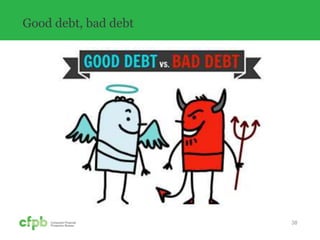
  • #39 ACTIVITY #12: Dealing with Debt CONTINUED Stand Up, Sit Down (Module 11) Explain that some people think of some debt as good debt and some debt as bad debt. Explain that, as each type of debt appears on the screen, they should stand up if they think the debt is bad debt and stay seated if they think it is good debt. Reveal the debts listed above one at a time. Facilitate a discussion about the reasons people think the debt is good or bad. NOTE: Be sure to challenge them a bit around “conventional wisdom.” For example, people have long believed student loan debt is “good debt.” Is this always the case? The same was true with mortgages in the past. Are pawn shop loans always bad? If someone is short of money, given a payday loan versus a pawn shop loan, do they think one is a better option than the other ? Use the following points to augment the discussion: Loan from friend or family member Car loan Student loan Payday loan Mortgage (loan for a home) Car title loan Pawn shop loan Loan from friend or family member GOOD—Likely to have flexible terms; may be low or no interest; missed payments not reported to credit reporting agencies BAD—Can create family conflict; cannot be used to build credit history Car loan: GOOD—Can help you get needed transportation for job, school, life; secured with the car so will likely not need additional collateral; regular payment can help build credit history BAD—Depending on loan, terms can be unfavorable; borrowing full value of car can lead to being upside down in loan (owing more than the car is worth); missed payment can result in repossession—no transportation for job and negative entry on credit reports Student loan: GOOD—Can help you access postsecondary education or training, which can lead to a higher paying job; federal student loans have repayment options; regular payment can help build credit history BAD—Borrowing more to pay for education than likely wages within career can support in terms of repayment; borrowing for education but not completing degree (created a liability without the benefit of a potentially higher paying job); terms and conditions misunderstood (allowing interest to accrue); likely to not be forgiven even in bankruptcy except under extreme circumstances Payday loan: GOOD—Can help you get needed cash quickly and with little hassle BAD—High-cost; may not to be able to pay in full within initial term (generally 14 days) and may need to renew; often leads to repeat loans; if renewal not paid, post-dated check will be cashed and can deplete your accounts and/or overdraft them and lead to overdraft charges Mortgage (loan for a home): GOOD—Can help you get a home of your own; currently, interest rates are low, so the loans is less expensive than in decades past; secured with the house so will likely not need additional collateral; regular payment can help build credit history BAD—Depending on loan, terms can be unfavorable; if you borrow the full value of the home and home values decrease, you could be upside down in the loan (owing more than the home is worth); missed payments can result in foreclosure—no home and negative entry on credit reports; selling the home can be difficult depending on the market and the condition of the home Car title loan: GOOD—Can help you get needed cash quickly and with little hassle BAD—Can lead to loss of your car title if the loan not paid as agreed Pawn shop loan: GOOD—Can help you get needed cash quickly and with little hassle BAD—Can lead to loss of asset pawned if loan not paid as agreed
  • #40 ACTIVITY #12: Dealing with Debt CONTINUED Presentation (Module 11) Explain how to use the debt management worksheet (Tool begins on page 169.)
  • #41 ACTIVITY #12 Dealing with Debt CONTINUED Presentation (Module 11, Page 173) Explain how to calculate the DTI ratio. How much debt is too much? Debt-to-income ratio This simple calculation shows you how much of your income goes toward paying your debt. It is a good measure of how much of your income is obligated to debt.
  • #42 ACTIVITY #12: Dealing with Debt CONTINUED Presentation (Module 11, page 173) Explain how to interpret the DTI ratio – remember these are guides, not rules. Renters: Consider maintaining a debt-to-income ratio of .15 - .20, or 15% - 20%, or less. This means that monthly credit card payments, student loan payments, auto loan payments, and other debts should take up 20% or less of your gross income. Homeowners: Consider maintaining a debt-to-income ratio of .28, or 28%, or less for just the mortgage (home loan), taxes, and insurance. This means that if you have a mortgage, the mortgage alone should take up no more than 28% of your income. This includes the monthly principal, interest, taxes, and insurance (called PITI). Homeowners: Consider maintaining a debt-to-income ratio for all debts of .36, or 36%, or less. This means that if you have a mortgage and other debts—credit card payments, student loan payments, auto loan payment, and payday loan payments–your debt-to-income ratio should be below 36%. If you have court-ordered, fixed payments, such as child support, count these as debt for this purpose. Some lenders will go up to 43% or higher for all debt. Instruct participants to share their answers and whether they felt the individual should get the new loan. Explain that if Shawna gets the loan, that $.41 out of every $1 she earns will be committed each month to cover her debts. Explain that this leaves $.59 out of every dollar to cover everything else. Ask participants what everything else includes. Write their ideas on a flip chart. Be sure to add the following if not shared by the participants: Savings Taxes Insurance – Car and Health Utilities Food Clothing Childcare Health care (that has not turned into debt) Child support Charitable contributions and gifts and Other family expenses What can Shawna do to lower her DTI?
  • #43 ACTIVITY: Have group create plan for how to pay down debt.
  • #44 ACTIVITY #12: Dealing with Debt CONTINUED Presentation (Module 11, Page 177) Review two primary methods for reducing debt – emphasize choice and what works best for the individual. Highest Interest Rate Method List your debts from highest rate to lowest rate. In the column labeled additional payment, list the extra payment you will dedicate to the debt with the highest interest rate until you have it paid off. When this debt is eliminated, allocate the entire payment (monthly payment + extra payment) to the next debt on the list. Focus on the unsecured debt with the highest rate of interest, and eliminate it as quickly as possible, because it is costing you the most. Once it is paid off, focus on the next most expensive debt. PRO You eliminate the most costly debt first. CON You may not feel like you are making progress very quickly especially if this debt is costly. Snowball Method List your debts from smallest to largest in terms of the amount outstanding. In the column labeled additional payment, list the extra payment you will dedicate to the smallest debt until you have it paid off. When this debt is eliminated, allocate the entire payment (monthly payment + extra payment) to the next debt on the list. Focus on the smallest debt. Get rid of it as soon as possible. Once you have paid it off in full, continue with the payment, but now dedicate it to the next smallest debt. This is called the “snow ball method.” You create “a snow ball of debt payments” that keeps getting bigger as you eliminate each debt. How? You keep making the payments, but you are redirecting them to the next debt as each debt is paid off. PRO You may see progress quickly, especially if you have many small debts; in theory, this creates momentum and motivation. CON You may pay more in total because you are not necessarily eliminating your most costly debt. Review other ways to reduce debt Call your creditors to see if they will lower your interest rates. If you have paid all of your bills on time, they may lower it to maintain your loyalty. If you are in a difficult position, you could explain your hardship and ask them to lower the rate. Get another job in the short-term. Use all of your additional earnings to eliminate debts. Sell something, and use the income to pay off a debt or debts. If you are eligible, file for tax credits, and use your refund to pay down or eliminate debts.
  • #45 ACTIVITY #12: Dealing with Debt CONTINUED Personal Stories and Presentation (Module 11, Page 181) Discuss student loan debt with the participants using information from Tool 4 (Page 181). Ask participants to share stories from their work with clients (without naming them) or their own student loan stories. Keep track of themes from stories. Share how many seem to stem from not understanding terms completely or not matching borrowing level with earning potential. Explain the difference between Federal Student Loans and Private Student Loans. Federal student loans are loans that are funded by the federal government. Private student loans are nonfederal loans made by a lender such as a bank, credit union, state agency, or a school. In both federal and private student loans, delinquent payment will impact your credit history and scores and may result in collections. Private student loans do not offer the flexible repayment terms or borrower protections featured by federal student loans. Explain the options for paying back federal student loans. Standard repayment—this is the payment plan most borrowers start with. This repayment plan has fixed payment of at least $50/month for up to 10 years. Graduated repayment—the payment is lower the first year and then gradually increased every 2 years for up to 10 years. Extended repayment—the payment is fixed or graduated for up to 25 years. The monthly payments are lower than the standard or graduated repayment plans, but you will pay more interest over the life the loan(s). Income-based repayment (IBR)—payment is limited to 15% of discretionary income, which is the difference between your adjusted gross income and 150% of the Federal Poverty Guidelines. Payments change as income changes and the terms can last up to 25 years. To qualify for IBR, you must be able to show partial hardship. After 25 years of consistent payment (you have missed no payments or caught up with payments), the loan will be forgiven. You will have to pay income tax on the portion of the loan that is forgiven. Pay as you earn—payment is limited to 10% of discretionary income as defined above, payment changes as income changes, and the loan term is 20 years. To qualify. you must be able to show partial hardship. After 20 years of payments, the loan is forgiven as described above, and taxes will be owed on the amount forgiven. Consolidation loan—you pay off all of your existing federal student loans with a new loan. This simplifies paperwork and payment for you—you go from monthly payments on multiple loans to one payment per month on the one new loan. Your loans must be in good standing to qualify. This results in lower monthly payments as the term is 30 years; however, you will pay more interest over the life of the loan. Be sure to state the following: Do not ignore student loan paperwork—nonpayment and delinquency reduces options for payment plans as many require loans in good standing to qualify. Explain deferment and forbearance. In deferment, payment of both principal and interest is delayed. If you have a subsidized federal loan, the government pays your interest during the deferment. Otherwise you must pay interest or it accrues, which means builds up. When interest accrues on student loans, it becomes part of what you owe. This means you ultimately end up paying interest on the interest. Deferments are only granted for specific circumstances including: enrollment in college, a trade school, a graduate fellowship, or a rehabilitation program for individuals with disabilities; during unemployment; during military services; and during times of economic hardship, including Peace Corps service. Forbearance means that you stop paying or pay a lesser amount on your loan for a 12-month period. Interest accrues during forbearance. When applying for a repayment option, be sure to continue making your loan payments until you receive written notification that you have been approved for IBR or forbearance, for example. This ensures your loan continues to be in good standing. Explain the situations where loan forgiveness, cancellation, or discharge may be an option: Total and permanent disability Death (someone would apply on your behalf) Closed school Teacher loan forgiveness—you are eligible for this if you are a teacher working in certain educational settings. Public services loan forgiveness—you are eligible for this if you work in a public service sector and have made 120 loan payments Except for the above circumstances, it is nearly impossible to eliminate federal student loan debt even in bankruptcy. And your wages and bank accounts can be garnished for nonpayment. CFPB’s “Paying for College” online tool: Researching schools Filling out the Free Application for Federal Student Aid (FAFSA), a first step in figuring out how to pay for college Choosing a loan Comparing financial aid packages and college costs across more than one school Managing your money while in college Repaying your student loans
  • #46 ACTIVITY #12: Dealing with Debt CONTINUED Presentation (Module 11, page 185) Review Tool 5 with participants. Do not send money or even acknowledge the debt the first time you are contacted. Why? You want to make sure you actually owe the debt and You want to make sure the individual contacting you really has the authority to collect the debt
  • #47 ACTIVITY #12: Dealing with Debt CONTINUED Presentation (Module 11, Page 167. Tool is on pages 185-190. It includes example letters to debt collectors. – also Module 14) Explain highlights of the Fair Debt Collection Practices Act. The Fair Debt Collection Practices Act (FDCPA) says what debt collectors can and cannot do. This law covers businesses or individuals that collect the debt of other businesses. These are often called “third party debt collectors.” This law does not apply to businesses trying to collect their own debts. The law states that debt collectors may not harass, oppress, or abuse you or any other people they contact. Some examples of harassment are: Repeated phone calls that are intended to annoy, abuse, or harass you or any person answering the phone Obscene or profane language Threats of violence or harm Publishing lists of people who refuse to pay their debts (this does not include reporting information to a credit reporting company) Calling you without telling you who they are The law also says debt collectors cannot use false, deceptive, or misleading practices. This includes misrepresentations about: The debt, including the amount owed That the person on the phone is an attorney Threats to have you arrested Threats to do things that cannot legally be done Threats to do things that the debt collector has no intention of doing Keep a file of all letters or documents a debt collector sends you and copies of anything you send to a debt collector. Write down dates and times of conversations along with notes about what you discussed. These records can help you if you have a dispute with a debt collector, meet with a lawyer, or go to court. Show the example letters in Tool 5. Summarize by sharing: After lack of income, debt is likely to be the most common concern your clients share. Understanding what debt is, how to manage debt, and how to reduce it not only improves individual and family financial stability (less income is being eaten up by debt every month), but also reduces stress. Understanding rights around debt collection and dealing with special debts like student loans is also important to many clients. As with reaching a goal, however, getting out of debt takes time and commitment. Clients often have many things going on in their lives, so if this is their biggest concern, focusing on this area can make a big difference in their lives. Dealing with debt today gives people more options tomorrow.
  • #48 Provide a brief overview of what participants will find in this section.
  • #49 ACTIVITY #13: Understanding Credit Reports and Scores Estimated Time: 45 Minutes Methodology: Facilitated Discussion / Exercise in Groups of Three / Presentation Corresponding Section in Toolkit: Module 12 (Begins on Page 193) Instructions for Facilitator: Facilitated Discussion (Module 12) ASK: What is a credit report? After people share their ideas, explain that it is a consumer report that is a written history of some of your bill paying history, including loans, credit cards, and other credit accounts you have or have had in the past. Your credit report also includes accounts that have gone to collection, public record information, and a record of how much credit you have applied for. Explain that credit reports are divided into sections: Header/identifying information—This includes your name and current address, as well as other information that can be used to distinguish or trace your identity, either by itself, like your Social Security number, or when combined with other personal information, including date and place of birth. This information may not be complete—all of the jobs you have held, for example, may not be listed. But what is listed should be accurate. A credit report does not include some personal information such as race or ethnicity. Public record information—This section includes public record data of a financial nature, including consumer bankruptcies, judgments, and state and federal tax liens. Records of arrests and convictions generally do not appear on your credit file, but other types of consumer reporting agencies, such as employment background screening agencies, often include them. Other public records that usually do not appear in credit reports are marriage records, adoptions, and records of civil suits that have not resulted in judgments. Collection agency account information—This section will show if you have any accounts with a collection agency and the status of those accounts. Credit account information—This section may include accounts you have now or that you had before with creditors. This includes: The company name Account number Date opened Last activity Type of account and status Date closed if the account is no longer open Credit limit Items as of date (any amount currently owed and whether you are current or late with payments) The balance Whether you have a past due amount The date information was reported to the credit bureau. Some accounts may not be listed, especially older accounts or those you have closed. So there may be inconsistencies across credit files and credit reporting agencies in the contents of this section. It is important to make sure what is listed, however, does or did belong to you. Inquiries made to your account—Companies look at your credit report when you apply for credit, when they review your account, or when they offer you a special promotional rate. When you apply for credit and a lender reviews your credit report, it is listed as an “inquiry” on your report. Promotional inquiries, periodic reviews of your credit history by one of your creditors, and your requests for a copy of your report aren’t listed as an “inquiry.”
  • #50 ACTIVITY #13: Understanding Credit Reports and Scores CONTINUED Exercise in Groups of Three (Module 12) Instruct participants to get into groups of 3. Instruct them to answer the questions on the slide using the example credit report on pages 198-203 in the Toolkit. Explain that the credit report is an example and is not based solely on any one of the formats used by the three major credit reporting agencies. After 7 – 10 minutes, solicit answers from participants. Who does this credit report belong to? Miguel Simon Smith Where does this person live? 457 First Street, Littleton, MI 90876 Where does he work? How long has he worked there? Riveria Restaurant Group; 2 years and 4 months Does he have public records? If yes, describe it (them). Yes. Chapter 7 Bankruptcy and Civil Judgment Is he late on any of his accounts? If yes, describe. Yes. He is 30 days late on his auto loan with Littletown Community Bank NOTE: If time allows, cover some of the key terms used in credit reporting found on pages 203 and 204 of the Toolkit immediately following the credit report example. Ask participants if they know the definition before providing the explanation. Focus specifically on: Authorized User Delinquent Default Charge Off Discharge
  • #51 ACTIVITY #13: Understanding Credit Reports and Scores CONTINUED Exercise in Groups of Three (Module 12) Instruct participants to get into groups of 3. Instruct them to answer the questions on the slide using the example credit report in the Toolkit. Explain that the credit report is an example and is not based solely on any one of the formats used by the three major credit reporting agencies. After 7 – 10 minutes, solicit answers from participants. Are any of his accounts in good standing? If yes, describe. Yes. His credit card payment. What are the balances of his accounts in the account information section? Auto loan balance is $14,680; Credit card balance is $3,626 Does he have accounts in collection? What kind of debt was sent to collections? Yes. $1,000. What do his inquiries tell you? He explored an auto loan and likely a store credit/debit card. What is your opinion of this person’s credit history. Is it positive or negative? NOTE: If time allows, cover some of the key terms used in credit reporting found in the Toolkit immediately following the credit report example. Ask participants if they know the definition before providing the explanation. Focus specifically on: Authorized User Delinquent Default Charge Off Discharge
  • #52 ACTIVITY #13: Understanding Credit Reports and Scores CONTINUED Presentation (Module 12) Review the reasons credit reports and scores are important. (page 193) A bank or credit card company will use them to decide whether to give you a loan. A lender may use them to decide what interest rate you will pay for the loan if you are approved. Other service providers, like cell phone companies and utility companies, may use them to screen you for deposit levels and cost of service. An insurance company may use your reports or scores to determine whether to give you insurance coverage and the rates you will pay for coverage. A landlord may use your reports or scores to determine whether to rent an apartment to you. A potential employer may use your reports to determine whether you will get a job. (Note: According to the credit reporting agencies, scores are not used by employers; a special version of the credit reports is used by employers.)
  • #53 ACTIVITY #13: Improving Credit Reports and Scores CONTINUED Presentation (Module 12, Page 211) Review the three largest companies that create credit reports. Explain FACT Act and www.annualcreditreport.com. Be sure to inform people to be aware of imposter websites. Explain how they get their information—from information furnishers and to whom they sell the information once compiled. Tool 1: Annual Credit Report To order through the website, visit: https://www.annualcreditreport.com Complete a form with basic information (name, Social Security number, address, etc.). Select the report(s) you want—Equifax, Experian, and/or TransUnion. Answer security questions: former addresses, amount of a loan you have, phone numbers that have belonged to you, counties you may have lived in, etc. If you are unable to answer these questions, you will have to use another method. You will save a PDF version of your report, print the report, or both. Be sure you do this in a safe and secure location. Avoid doing this on public computers (library).
  • #54 ACTIVITY #13: Improving Credit Reports and Scores CONTINUED Presentation (Module 12) Explain the tools listed on the slide above. Explain the importance of filing a dispute if there are any errors on their credit reports and the reason for checking all three reports. Review the dispute letter and process on Pages 204 – 207 of the Toolkit. Discuss reasons to hold on to copies of all items sent in for dispute, records of when disputes sent in, and the reasons for sending disputes certified mail with return receipt. Be sure to discuss the reasons to send to both credit reporting agencies and the information furnisher. Go through each point on Tool 3 – Improving your credit reports and scores (Page 223 – 225) . Ask participants if they have any tips to add. Provide brief overview of the new rule around young people in foster care—case managers must review credit reports each year starting at age 16 and until they turn 18. Explain that young people in most cases cannot enter into a credit contract under the age of 18; therefore, if a young person under 18 has a credit file, there is a chance identify theft and financial fraud have been committed. Note the exceptions to this. Discuss challenges related to credit reporting and young people in general. Summarize by sharing: Taking care of your credit history is important. Why? Because credit reports and scores are not only used to determine whether you will get a loan or credit card. This information can be used to determine access to and costs of other services like utilities, insurance and cell phones, ability to rent apartments, and employment. While there are laws ensuring the information that is reported about you is fair and accurate, it is your responsibility to ensure the information is accurate. The best way to do this is to regularly review your credit reports—at least one time per year. Use these tools to get, review and then improve your credit reports and scores.
  • #55 Introduce idea of self-study and how each module is set up: Background (for case manager) Tools (for client)
  • #56 Take time to acknowledge that for very low-income clients, savings may not be their main goal. Remember, Your Money, Your Goals is a toolkit, not a curriculum. The fact that we’re covering this before other modules isn’t meant to imply that it’s what you should begin with when you work with clients. The concepts that are discussed in this module are applicable to other types of goals that require someone to “find” money that they can apply it to a goal such as debt repayment.
  • #57 Provide a brief overview of what participants will find in this section.
  • #60 Provide a brief overview of what participants will find in this section.
  • #61 Provide a brief overview of what participants will find in this section.
  • #62 ACTIVITY #15: Protecting Consumer Rights CONTINUED Presentation (Module 14) Review resources available at the CFPB as well as how to file a consumer complaint. Lists of resources are included at the end of each module.
  • #64 ACTIVITY #16: Closing Estimated Time: 20 Minutes Methodology: Closing, Individual Activity Corresponding Section in Toolkit: None Instructions for Facilitator: Ask each participant to share “the most important take away” from the training and “something they would like to learn more about.” Write responses on flip chart. Administer post-training assessment and evaluation. Conclude with thanks to host and participants.