JOB EVALUATION METHODS
P EARNESWAR KUMAR
18331E0079
HUMANRESOURCE MANAGEMENT:It Is The Strategic
Approach To The Effective Management Of People In An
Organization, So That They Help The Business Gain In
Competitive Advantage. It Is Designed To Maximize
Employee Performance In Service Of An Employer’s
Strategic
JOB EVALUATION A Job Evaluation Is A Systematic Way Of
Determining The Value Or Worth Of A Job In Relation To Other Jobs
In An Organization. It Tries To Make A Systematic Comparison
Between Jobs To Assess Their Relative Worth For The Purpose Of
Establishing A Rational Pay Structure. Job Analysis Is A Systematic
Way Of Gathering Information About A Job
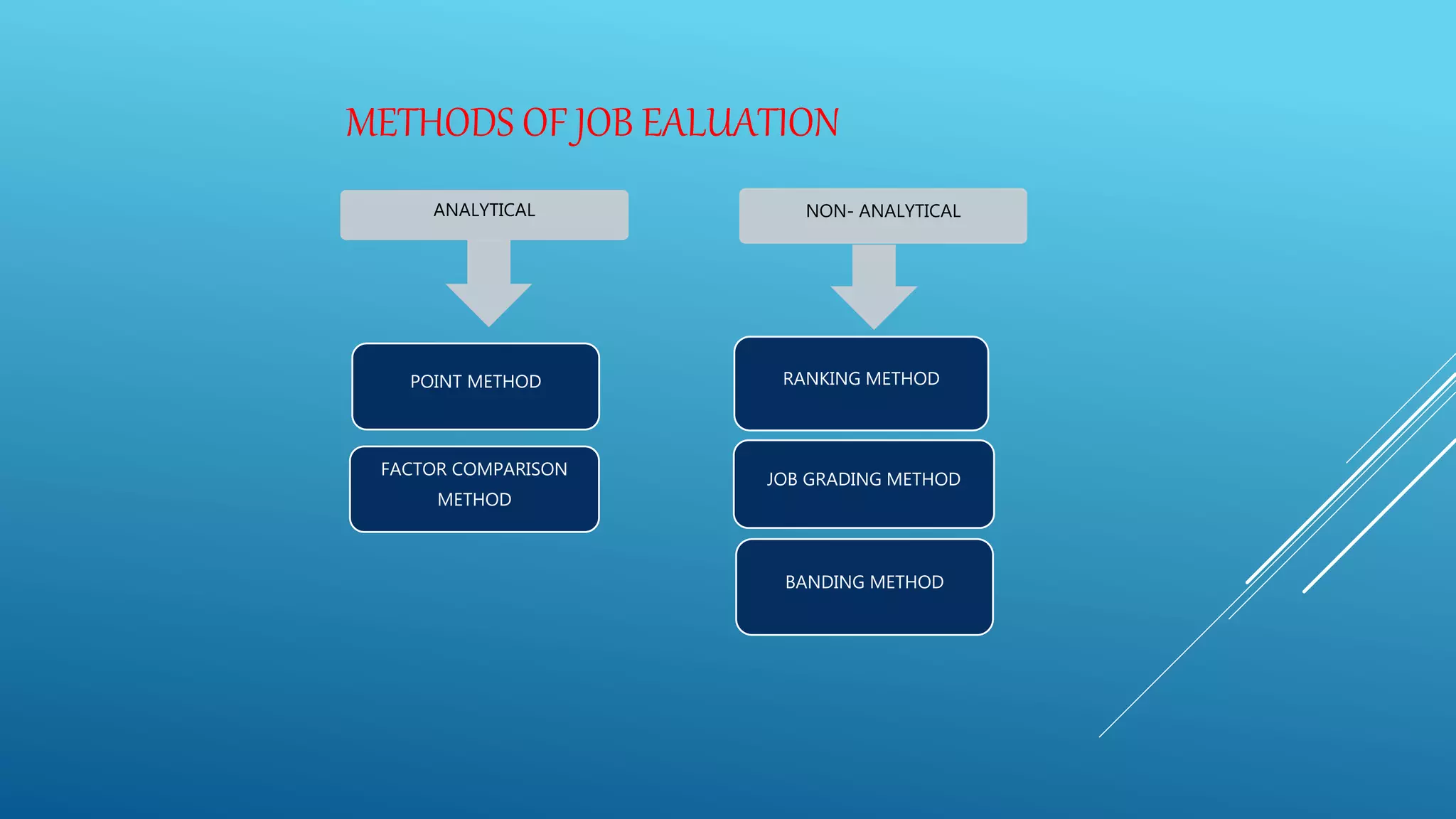
ANALYTICAL NON- ANALYTICAL
BANDING METHOD
JOB GRADING METHOD
RANKING METHOD
FACTOR COMPARISON
METHOD
POINT METHOD
METHODS OF JOB EALUATION
POINT METHOD: This Method Is Widely Used In Organization's. It Is An Analytical
And Quantitative Method Which Determines The Relative Worth Of A Job On The
Basis Of Points Allotted To Each Specific Factor Of A Job.
The System Starts With The Selection Of Job Factors, construction Of Degrees For
Each Factor,& Assignment Of Points To Each Degree.
SKILL: Education, Experience, Initiative & Ingenuity.
EFFORT: Physical Demand, Mental Or Visual Demand
RESPONSIBILITY: Responsibility For Process, Responsibility For Safety
JOB CONDITIONS: Working Conditions, Hazards.
Factor comparison method: Under This Method, one Begins With Selection Of Factors;
Usually Five Of Them Assumed To Be Constant For All The Jobs. Each Factor Is Ranked
Individually With Other Jobs. For Example, All The Jobs May Be Compared First By
Factor ‘Mental Requirements, Responsibility, And Working Conditions Are Ranked. The
Worth Of The Job Is Then Obtained By Adding Together All The Points Values.
Advantages:
 It Provides More Accurate Information About The Relative Worth Of A Job As
Different Comparable Factors Are Compared With Key Jobs.
 Since The Evaluation Is More Systematic And Analytical, Its Logic Can Be Accepted
By Trade Unions & Workers.
Disadvantages:
 it is costly and time consuming and difficult to understand
 It is considers only limited factors of job for comparison
Ranking method: This Is The Simplest, The Most Inexpensive And The Most Expedient
Method Of Evaluation. In Ranking Method A Whole Job Is Compared With Others And
Rank Is Provided On The Basis Of This Comparison. But The Job Is Not Broken Down
Into Elements Or Factors. Each Job Is Compared With Others And Its Place Is
Determined.
Advantages:
 Simple To Use If There Is A Small Number Of Jobs, People Or Teams To Evaluate.
 Requires Little Time.
 Minimal Administration Required.
Disadvantages:
 May Invite Perceptions Of Inequity.
 This Method Is Judgemental And Therefore It Is Affected By Personal Preferences Of
Job Evaluators.
 Very Difficult To Use If There Are Large Number Of Jobs.
Job grading method: This Method Is Also Know As Job Classification Method It
Establishes Various Grades For Different Categories Of Jobs. For Example, Jobs Of An
Operative May Be Classified As Unskilled, Semiskilled, Skilled And Highly-skilled.
Advantages:
 It Is Quite Simple To Operate And Understand As The Relevant Information Is Provided
By Job Analysis.
 Job Evaluation Is Done On Grading Method Makes Wage And Salary Determination
Easier As These Are Fixed In Terms Of Various Grades Of Jobs.
Disadvantages:
 Job Grading Description Is Vague And Personal Biases May Distort Job Grading, As The
Method Is Not Based On Any Scientific Analysis.
Job evaluation methods

Job evaluation methods

  • 1.
    JOB EVALUATION METHODS PEARNESWAR KUMAR 18331E0079
  • 2.
    HUMANRESOURCE MANAGEMENT:It IsThe Strategic Approach To The Effective Management Of People In An Organization, So That They Help The Business Gain In Competitive Advantage. It Is Designed To Maximize Employee Performance In Service Of An Employer’s Strategic
  • 3.
    JOB EVALUATION AJob Evaluation Is A Systematic Way Of Determining The Value Or Worth Of A Job In Relation To Other Jobs In An Organization. It Tries To Make A Systematic Comparison Between Jobs To Assess Their Relative Worth For The Purpose Of Establishing A Rational Pay Structure. Job Analysis Is A Systematic Way Of Gathering Information About A Job
  • 4.
    ANALYTICAL NON- ANALYTICAL BANDINGMETHOD JOB GRADING METHOD RANKING METHOD FACTOR COMPARISON METHOD POINT METHOD METHODS OF JOB EALUATION
  • 5.
    POINT METHOD: ThisMethod Is Widely Used In Organization's. It Is An Analytical And Quantitative Method Which Determines The Relative Worth Of A Job On The Basis Of Points Allotted To Each Specific Factor Of A Job. The System Starts With The Selection Of Job Factors, construction Of Degrees For Each Factor,& Assignment Of Points To Each Degree. SKILL: Education, Experience, Initiative & Ingenuity. EFFORT: Physical Demand, Mental Or Visual Demand RESPONSIBILITY: Responsibility For Process, Responsibility For Safety JOB CONDITIONS: Working Conditions, Hazards.
  • 6.
    Factor comparison method:Under This Method, one Begins With Selection Of Factors; Usually Five Of Them Assumed To Be Constant For All The Jobs. Each Factor Is Ranked Individually With Other Jobs. For Example, All The Jobs May Be Compared First By Factor ‘Mental Requirements, Responsibility, And Working Conditions Are Ranked. The Worth Of The Job Is Then Obtained By Adding Together All The Points Values. Advantages:  It Provides More Accurate Information About The Relative Worth Of A Job As Different Comparable Factors Are Compared With Key Jobs.  Since The Evaluation Is More Systematic And Analytical, Its Logic Can Be Accepted By Trade Unions & Workers. Disadvantages:  it is costly and time consuming and difficult to understand  It is considers only limited factors of job for comparison
  • 7.
    Ranking method: ThisIs The Simplest, The Most Inexpensive And The Most Expedient Method Of Evaluation. In Ranking Method A Whole Job Is Compared With Others And Rank Is Provided On The Basis Of This Comparison. But The Job Is Not Broken Down Into Elements Or Factors. Each Job Is Compared With Others And Its Place Is Determined. Advantages:  Simple To Use If There Is A Small Number Of Jobs, People Or Teams To Evaluate.  Requires Little Time.  Minimal Administration Required. Disadvantages:  May Invite Perceptions Of Inequity.  This Method Is Judgemental And Therefore It Is Affected By Personal Preferences Of Job Evaluators.  Very Difficult To Use If There Are Large Number Of Jobs.
  • 8.
    Job grading method:This Method Is Also Know As Job Classification Method It Establishes Various Grades For Different Categories Of Jobs. For Example, Jobs Of An Operative May Be Classified As Unskilled, Semiskilled, Skilled And Highly-skilled. Advantages:  It Is Quite Simple To Operate And Understand As The Relevant Information Is Provided By Job Analysis.  Job Evaluation Is Done On Grading Method Makes Wage And Salary Determination Easier As These Are Fixed In Terms Of Various Grades Of Jobs. Disadvantages:  Job Grading Description Is Vague And Personal Biases May Distort Job Grading, As The Method Is Not Based On Any Scientific Analysis.