Presented By –
Tanvir Ahmed
A.E,
Energy Auditing Unit ,
BPDB,Dhaka
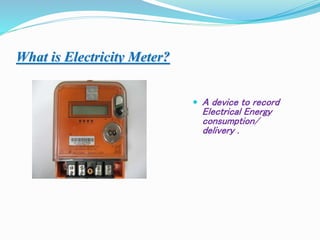
What is Electricity Meter?
 A device to record
Electrical Energy
consumption/
delivery .
3
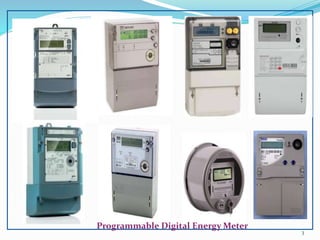
Programmable Digital Energy Meter
4
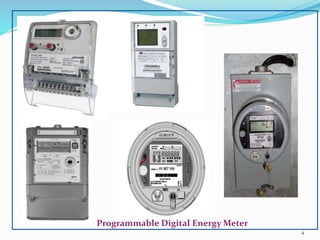
Programmable Digital Energy Meter
Meter Terminology:
Starting Current
Current Range
Influence parameters
Specifications of Energy Meter:
 Rating :
In : 3x5; Vn : 3x110V(L-L),
In : 3x30(100); Vn : 3x230/400V(L-L),
 Starting Current :0.2%
 Kwh, KVARH and MD in KW
 TOU, 6 Tariff and 6 time zone
 6 Month Billing data
 RS232C
Why Mechanical meters read less?
 Influence Parameters
 Age
 Wear and Tear
 Narrow Range
 Mounting
 Dust and Oil effect
 Mechanical Counters
Why electronic meters are preferred ?
 Wide Range
 Low starting current
 Less effect of Influence
parameters
 More accurate
 Tamper proof
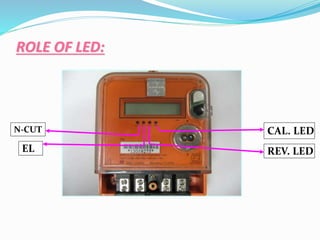
ROLE OF LED:
CAL. LED
REV. LED
N-CUT
EL
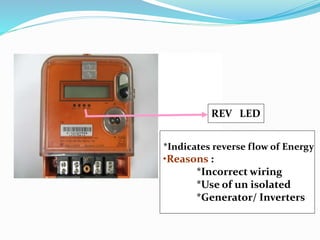
REV LED
*Indicates reverse flow of Energy
•Reasons :
*Incorrect wiring
*Use of un isolated
*Generator/ Inverters
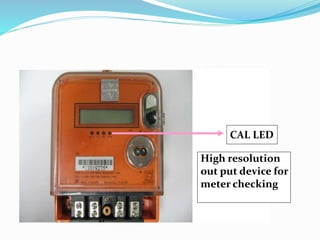
CAL LED
High resolution
out put device for
meter checking
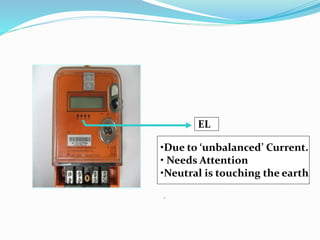
EL
•Due to ‘unbalanced’ Current.
• Needs Attention
•Neutral is touching the earth
.
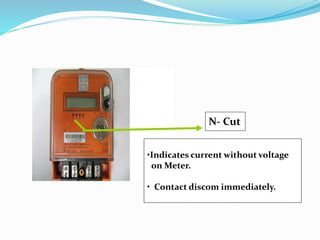
N- Cut
•Indicates current without voltage
on Meter.
• Contact discom immediately.
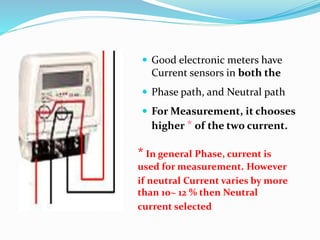
* In general Phase, current is
used for measurement. However
if neutral Current varies by more
than 10~ 12 % then Neutral
current selected
 Good electronic meters have
Current sensors in both the
 Phase path, and Neutral path
 For Measurement, it chooses
higher * of the two current.
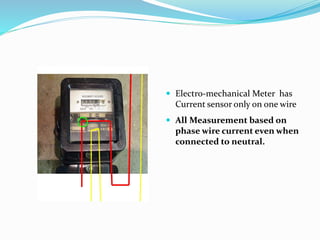
 Electro-mechanical Meter has
Current sensor only on one wire
 All Measurement based on
phase wire current even when
connected to neutral.
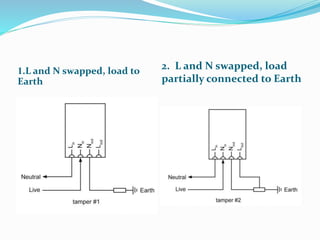
1.L and N swapped, load to
Earth
2. L and N swapped, load
partially connected to Earth
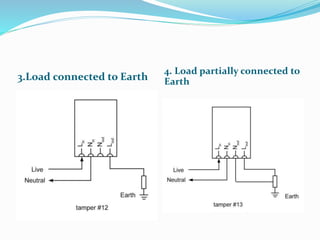
3.Load connected to Earth
4. Load partially connected to
Earth
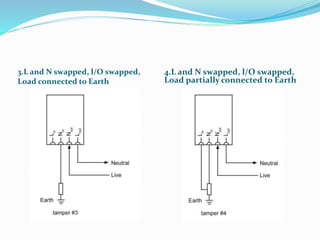
3.L and N swapped, l/O swapped,
Load connected to Earth
4.L and N swapped, l/O swapped,
Load partially connected to Earth
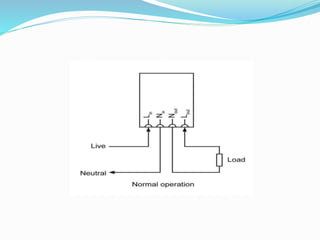
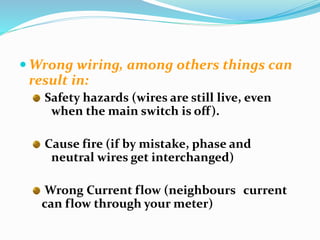
 Wrong wiring, among others things can
result in:
Safety hazards (wires are still live, even
when the main switch is off).
Cause fire (if by mistake, phase and
neutral wires get interchanged)
Wrong Current flow (neighbours current
can flow through your meter)
21
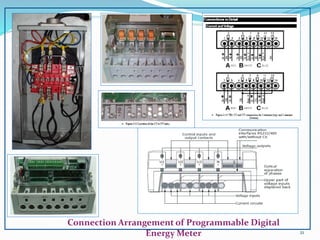
Connection Arrangement of Programmable Digital
Energy Meter
1 2 3 4 1 5 6 7 8 9 10 11
LOAD
R
Y
B
N
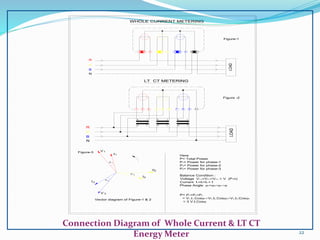
WHOLE CURRENT METERING
Figure-1
N
Y
B
R
4
K L
k
1 2
i
3
K L K
6
k l
5
k
7
L
l
8 9 11
LT CT METERING
LOAD
Figure -2
Figure-3
Vector diagram of Figure-1 & 2
3
I
V 3
1
I
3

 1
V 1
 2
I2
2
V
Here
P= Total Power
P1= Power for phase-1
P2= Power for phase-2
P3= Power for phase-3
Balance Condition :
Voltage V1-n=V2-n=V3-n = V (P-n)
Current I1=I2=I3 = I
Phase Angle 1=23 
P= P1+P2+P3
= V1.I1.Cos1V2.I2.Cos2V3.I3.Cos3
= 3 V.I.Cos
22
Connection Diagram of Whole Current & LT CT
Energy Meter
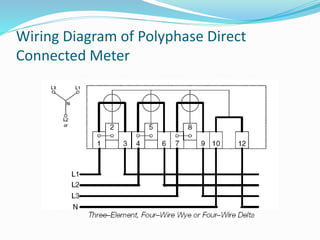
Wiring Diagram of Polyphase Direct
Connected Meter
3-Element 4-Wire
Figure-3.1
3
1 2
N
R
Y
B
v
V
u
v
u
U V U
v
u k
U V K L
l
11
8 9
6 7
4 5
LOAD
k
l
k
K L K L
l
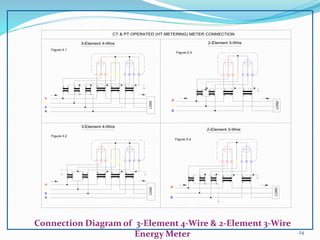
CT & PT OPERATED (HT METERING) METER CONNECTION
3-Element 4-Wire
Figure-3.2
3
1 2
N
R
Y
B
v
u
U V
v
u k
U V K L
l
11
8 9
6 7
4 5
LOAD
k
l
k
K L K L
l
Y
B
R
2
v
u
v
u k
U V U V K
1
k l
i
L K L
7
5
3 8 9
LOAD
Figure-3.3
2-Element 3-Wire
Y
B
R
2
k
K
1
k l
i
L K L
7
5
3 8 9
LOAD
Figure-3.4
2-Element 3-Wire
v
V
u
v
u
U V U
v
u
U V
24
Connection Diagram of 3-Element 4-Wire & 2-Element 3-Wire
Energy Meter
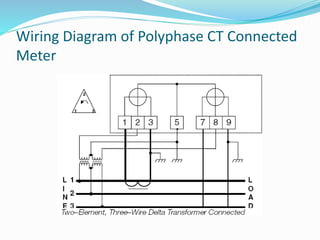
Wiring Diagram of Polyphase CT Connected
Meter
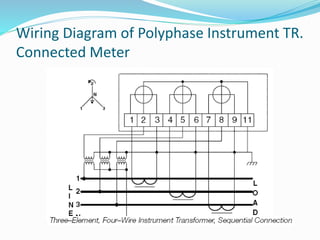
Wiring Diagram of Polyphase Instrument TR.
Connected Meter
27
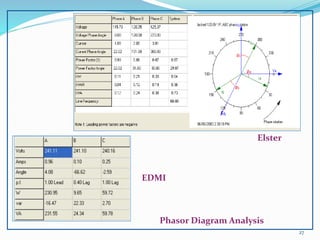
Phasor Diagram Analysis
EDMI
Elster
Proper connection of 3-Element 4-Wire Energy Meter
R
B
N
Y
2
1
LOAD
5
3 4 7
6 9
8 11
k l k l k l
K L K L K L
U V
u v
U V
u v
U V
u v
CONNECTION CIRCUIT OF METER VECTOR DIAGRAM
Fig.-5-1
Voltage RED Phase open circuited
B
N
Y
R
U
u
V
v
U
u
V
v
LOAD
2
U
u
V
v
K
k
1
L
l
3
K
k
4 5 9
7
L
l k
6
K L
l
8 11
B
N
Y
R
U
u
V
v
U
u
V
v
LOAD
2
U
u
V
v
K
k
1
L
l
3
K
k
4 5 9
7
L
l k
6
K L
l
8 11
V 3
3
I
 3
1
I
2

V
2
I
2
Similar for Yellow & Blue phase
V 3
3
I
 3
1
V
2

V
2
I
2
Current RED Phase open circuited
V 3
3
I
 3
1
I
 1
1
V
2

V
2
I
2
CALCULATION
P= P1+P2+P3
= V1.I1.Cos1V2.I2.Cos2V3.I3.Cos3
= 3 V.I.Cos
Here
P= Total Power
P1= Power for phase-1
P2= Power for phase-2
P3=Power for phase-3
V1-n,V2-n ,V3-n = Phase voltage
1,2,3 = Phase angle between V & I
Balance Condition :
V1-n=V2-n =V3-n =V (p-n)
I1=I2 =I3 =I
1 =2 =3 =
P= 3.V.I. Cos
PF=2.V.I. Cos
CF=1.5
PF= P1+P2+P3
= 0V2.I2.Cos2V3.I3.Cos3
= 2 V.I.Cos
PF=2.V.I. Cos
CF=1.5
PF= P1+P2+P3
= 0V2.I2.Cos2V3.I3.Cos3
= 2 V.I.Cos
Balance Condition :
V1=V2 =V3 =V
I1=I2 =I3 =I
1 =2 =3 =
Balance Condition :
V1=V2 =V3 =V
I1=I2 =I3 =I
1 =2 =3 =
Similar for Yellow & Blue phase
Fig.-5-2
Fig.-5-3
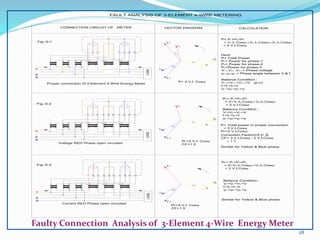
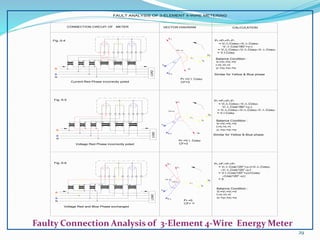
FAULT ANALYSIS OF 3-ELEMENT 4-WIRE METERING
P= Total power in proper connection
= 3 V.I.Cos
PF=2 V.I.Cos
Correction Factor(CF)= P
PF
CF= 3 V.I.Cos2 V.I.Cos

28
Faulty Connection Analysis of 3-Element 4-Wire Energy Meter
Fig.-5-6
V
Fig.-5-5
Fig.-5-4
V
V
B
N
R
Y
U
u
Y
N
B
R
U
u
Y
N
B
R
U
u
Voltage Red and Blue Phase exchanged
V
v
v v
V
u
U
u
U
k
l
k
K L K
1 2 3 4
l
k
l
K
L L
6
5 7 8 9
LOAD
11
Current Red Phase incorrectly poled
Voltage Red Phase incorrectly poled
V
v
V
v
U
u
U
u v k
K L
l
K
k
1 2 3 4
V
v
V
v
U
u
U
u v k
K L
l
K
k
1 2 3 4
K
L
l k
L
l
6
5 7 8 9
LOAD
11
K
L
l k
L
l
6
5 7 8 9
LOAD
11
PF =P1+P2+P3
= V3.I1.Cos(120°+1)+V2.I2.Cos2
V1.I3.Cos(120°-3)
= V.I Cos(120°+)+Cos
Cos(120°-)
= 0
Similar for Yellow & Blue phase
PF =P2+P3-P1
= V2.I2.Cos2V3.I3.Cos3
-V1.I1.Cos(180°+1)
= V2.I2.Cos2V3.I3.Cos3-V1.I1.Cos1
= V.I.Cos
PF =P2+P3-P1
= V2.I2.Cos2V3.I3.Cos3
-V1.I1.Cos(180°+1)
= V2.I2.Cos2V3.I3.Cos3-V1.I1.Cos1
= V.I.Cos
PF =V.I. Cos

I3
V 3
 3
3
V 1
2

CF=
PF =0

1
1
I
I2
2
V
PF =V.I. Cos
CF=3
CF=3
-V
I3
3
V
 3
1
1
I
 2

3
I
3
V
 3
1
V

-I1
2
1
1
I2
V2
I2
V2
CONNECTION CIRCUIT OF METER VECTOR DIAGRAM CALCULATION
Balance Condition :
V1=V2 =V3 =V
I1=I2 =I3 =I
1 =2 =3 =
Balance Condition :
V1=V2 =V3 =V
I1=I2 =I3 =I
1 =2 =3 =
Balance Condition :
V1=V2 =V3 =V
I1=I2 =I3 =I
1 =2 =3 =
FAULT ANALYSIS OF 3-ELEMENT 4-WIRE METERING
29
Faulty Connection Analysis of 3-Element 4-Wire Energy Meter
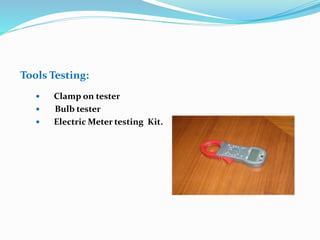
Tools Testing:
 Clamp on tester
 Bulb tester
 Electric Meter testing Kit.
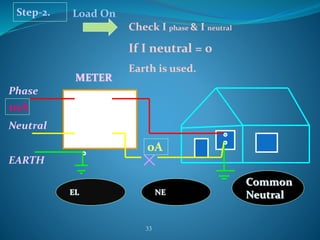
Typical Pts. Where Earth gets common with neutral
 Metallic body Appliances.
 Appliances connected with metal pipe line.
 Building RCC.
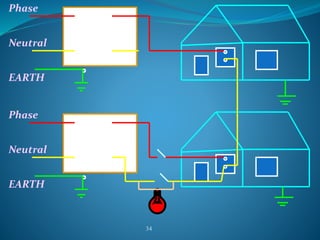
Wiring Defect:
 If number of meters in one premise is only one,
then there is no common Neutral problem.
33
Step-2. Load On
Check I phase & I neutral
If I neutral = 0
Earth is used.
Phase
Neutral
METER
EARTH
EL NE
Common
Neutral
10A
0A
34
Phase
Neutral
EARTH
Phase
Neutral
EARTH
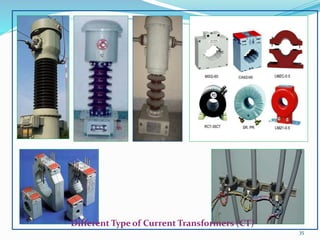
35
Different Type of Current Transformers (CT)
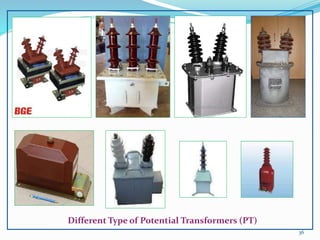
36
Different Type of Potential Transformers (PT)
History of Energy Meter:
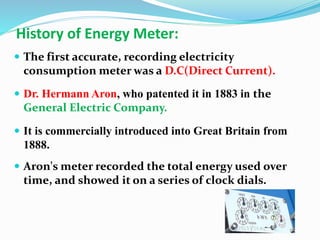
 The first accurate, recording electricity
consumption meter was a D.C(Direct Current).
 Dr. Hermann Aron, who patented it in 1883 in the
General Electric Company.
 It is commercially introduced into Great Britain from
1888.
 Aron's meter recorded the total energy used over
time, and showed it on a series of clock dials.
History of Energy Meter:
 The first specimen of the AC kilowatt-hour meter produced
on the basis of Hungarian Ottó Bláthy's patent and named
after him was presented by the Ganz Works at the
Frankfurt Fair in the autumn of 1889, and the first
induction kilowatt-hour meter was already marketed by the
factory at the end of the same year. These were the first
alternating-current wattmeters, known by the name of
Bláthy-meters.
History of Electromechanical Energy Meter:
 The most common type of electricity meter is the Thomson
or electromechanical induction watt-hour meter, invented
by Elihu Thomson in 1888.
 The electromechanical induction meter operates by
counting the revolutions of an aluminum disc which is
made to rotate at a speed proportional to the power. The
number of revolutions is thus proportional to the energy
usage.
 It consumes a small amount of power, typically around 2
watts
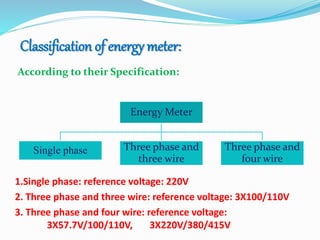
Classification of energy meter:
According to their Specification:
Energy Meter
Single phase Three phase and
three wire
Three phase and
four wire
1.Single phase: reference voltage: 220V
2. Three phase and three wire: reference voltage: 3X100/110V
3. Three phase and four wire: reference voltage:
3X57.7V/100/110V, 3X220V/380/415V
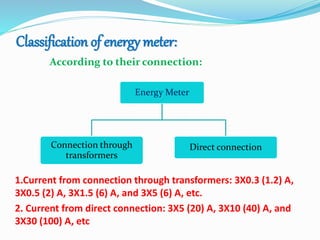
Classification of energy meter:
According to their connection:
Energy Meter
Connection through
transformers
Direct connection
1.Current from connection through transformers: 3X0.3 (1.2) A,
3X0.5 (2) A, 3X1.5 (6) A, and 3X5 (6) A, etc.
2. Current from direct connection: 3X5 (20) A, 3X10 (40) A, and
3X30 (100) A, etc
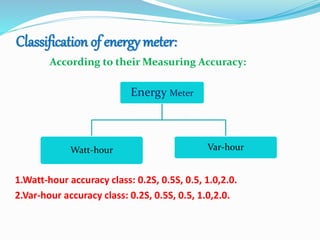
Classification of energy meter:
According to their Measuring Accuracy:
Energy Meter
Watt-hour Var-hour
1.Watt-hour accuracy class: 0.2S, 0.5S, 0.5, 1.0,2.0.
2.Var-hour accuracy class: 0.2S, 0.5S, 0.5, 1.0,2.0.
Classification of energy meter:
According to purposes, energy meters can be divided
into:
 Single phase energy meter
 Three-phase watt-hour energy meter
 Three-phase var-hour energy meter
 Maximum demand meter
 Multi-rate energy meter (time-based)
 Multifunctional watthour meter
 Copper loss meter
 Iron loss meter
 Prepayment energy meter
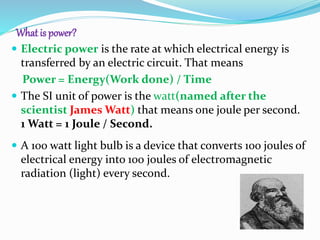
What is power?
 Electric power is the rate at which electrical energy is
transferred by an electric circuit. That means
Power = Energy(Work done) / Time
 The SI unit of power is the watt(named after the
scientist James Watt) that means one joule per second.
1 Watt = 1 Joule / Second.
 A 100 watt light bulb is a device that converts 100 joules of
electrical energy into 100 joules of electromagnetic
radiation (light) every second.
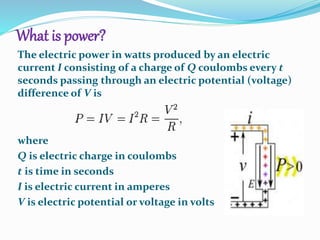
What is power?
The electric power in watts produced by an electric
current I consisting of a charge of Q coulombs every t
seconds passing through an electric potential (voltage)
difference of V is
where
Q is electric charge in coulombs
t is time in seconds
I is electric current in amperes
V is electric potential or voltage in volts
What is Energy?
 The term energy defines the amount of power consumed
/delivered over the period. That means..
Energy = Power x Time.
 1 kilo-watt hour = the energy delivered by 1000 watts of
power over over a one hour time period. That means…
Energy = Power x Time
= (1000 Joules/Second) x (3600 Seconds)
= 3,600,000 Joules = 3.6 million Joules!
That's a lot of Joules! So you see that kilo-watt hours is a
much better unit for large amounts of energy a one hour
time period.
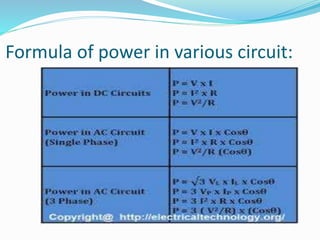
Formula of power in various circuit:
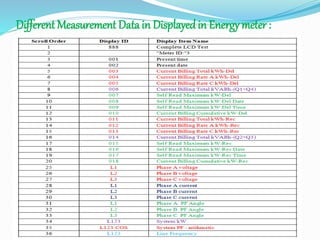
Different Measurement Data in Displayedin Energy meter :
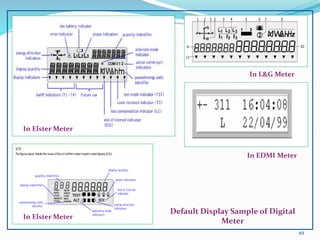
49
In EDMI Meter
In L&G Meter
In Elster Meter
In Elster Meter
Default Display Sample of Digital
Meter
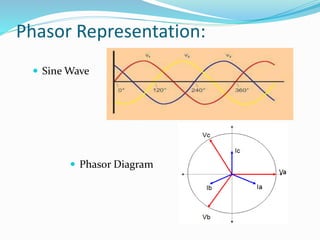
Phasor Representation:
 Phasor Diagram
 Sine Wave
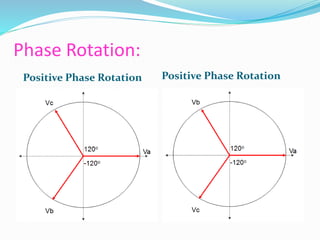
Phase Rotation:
Positive Phase Rotation
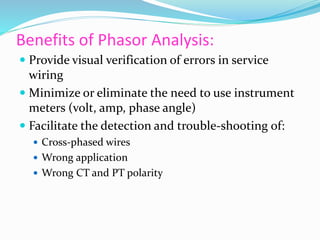
Benefits of Phasor Analysis:
 Provide visual verification of errors in service
wiring
 Minimize or eliminate the need to use instrument
meters (volt, amp, phase angle)
 Facilitate the detection and trouble-shooting of:
 Cross-phased wires
 Wrong application
 Wrong CT and PT polarity
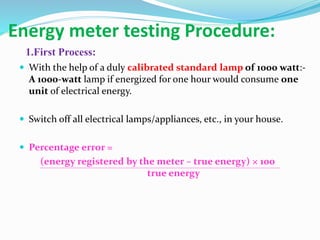
Energy meter testing Procedure:
1.First Process:
 With the help of a duly calibrated standard lamp of 1000 watt:-
A 1000-watt lamp if energized for one hour would consume one
unit of electrical energy.
 Switch off all electrical lamps/appliances, etc., in your house.
 Percentage error =
(energy registered by the meter – true energy) × 100
true energy
Energy meter testing Procedure:
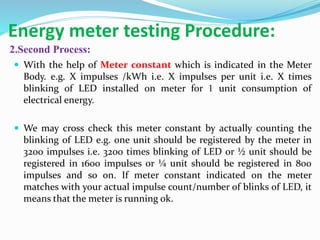
2.Second Process:
 With the help of Meter constant which is indicated in the Meter
Body. e.g. X impulses /kWh i.e. X impulses per unit i.e. X times
blinking of LED installed on meter for 1 unit consumption of
electrical energy.
 We may cross check this meter constant by actually counting the
blinking of LED e.g. one unit should be registered by the meter in
3200 impulses i.e. 3200 times blinking of LED or ½ unit should be
registered in 1600 impulses or ¼ unit should be registered in 800
impulses and so on. If meter constant indicated on the meter
matches with your actual impulse count/number of blinks of LED, it
means that the meter is running ok.
Energy meter testing Procedure:
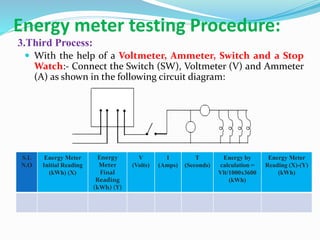
3.Third Process:
 With the help of a Voltmeter, Ammeter, Switch and a Stop
Watch:- Connect the Switch (SW), Voltmeter (V) and Ammeter
(A) as shown in the following circuit diagram:
S.L
N.O
Energy Meter
Initial Reading
(kWh) (X)
Energy
Meter
Final
Reading
(kWh) (Y)
V
(Volts)
I
(Amps)
T
(Seconds)
Energy by
calculation =
Vlt/1000x3600
(kWh)
Energy Meter
Reading (X)-(Y)
(kWh)
Energy meter testing Procedure:
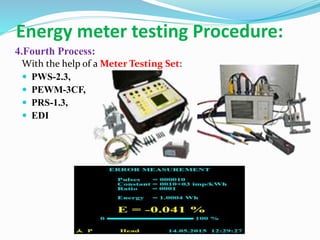
4.Fourth Process:
With the help of a Meter Testing Set:
 PWS-2.3,
 PEWM-3CF,
 PRS-1.3,
 EDI
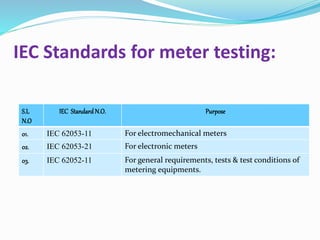
IEC Standards for meter testing:
S.L
N.O
IEC Standard N.O. Purpose
01. IEC 62053-11 For electromechanical meters
02. IEC 62053-21 For electronic meters
03. IEC 62052-11 For general requirements, tests & test conditions of
metering equipments.
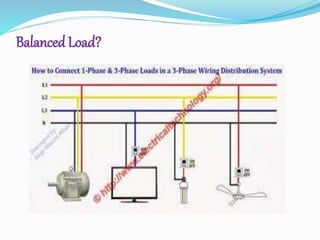
Balanced Load?
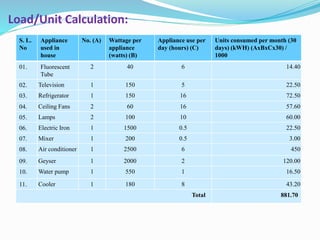
Load/Unit Calculation:
S. L.
No
Appliance
used in
house
No. (A) Wattage per
appliance
(watts) (B)
Appliance use per
day (hours) (C)
Units consumed per month (30
days) (kWH) (AxBxCx30) /
1000
01. Fluorescent
Tube
2 40 6 14.40
02. Television 1 150 5 22.50
03. Refrigerator 1 150 16 72.50
04. Ceiling Fans 2 60 16 57.60
05. Lamps 2 100 10 60.00
06. Electric Iron 1 1500 0.5 22.50
07. Mixer 1 200 0.5 3.00
08. Air conditioner 1 2500 6 450
09. Geyser 1 2000 2 120.00
10. Water pump 1 550 1 16.50
11. Cooler 1 180 8 43.20
Total 881.70
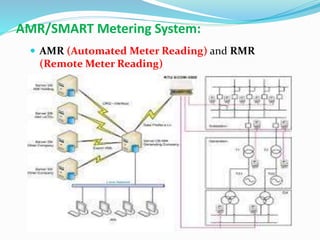
AMR/SMART Metering System:
 AMR (Automated Meter Reading) and RMR
(Remote Meter Reading)
`
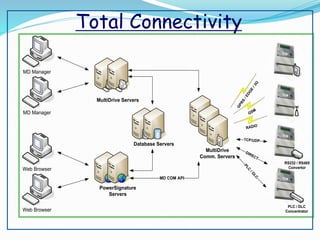
MD Manager
`
MD Manager
`
Web Browser
`
Web Browser
MultiDrive Servers
PowerSignature
Servers
MultiDrive
Comm. Servers
MD COM API
RADIO
DIRECT
P
L
C
/
D
L
C
G
P
R
S
/
E
D
G
E
/
3
G
GSM
Database Servers
PLC / DLC
Concentrator
RS232 / RS485
Convertor
TCP/UDP
Total Connectivity
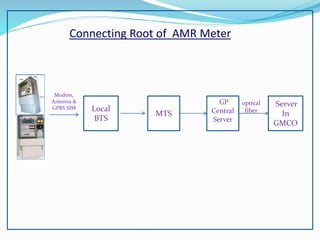
Local
BTS
MTS
GP
Central
Server
Connecting Root of AMR Meter
Modem,
Antenna &
GPRS SIM
Server
In
GMCO
optical
fiber
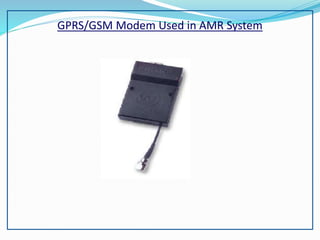
GPRS/GSM Modem Used in AMR System
Frequently Answer Question:
Q. Why are electricity bills getting inflated after replacement of old
electromechanical meters by new electronic meters by the utilities?
A : 01: Energy consumed by the consumer is actually high.
02. New meter is working satisfactorily but the wiring to meter,
which was done earlier as per old electromechanical meter was
not correct.
Presented By –
Tanvir Ahmed
A.E, Energy Auditing Unit ,
BPDB,Dhaka

meter.pptx

  • 1.
    Presented By – TanvirAhmed A.E, Energy Auditing Unit , BPDB,Dhaka
  • 2.
    What is ElectricityMeter?  A device to record Electrical Energy consumption/ delivery .
  • 3.
  • 4.
  • 5.
  • 6.
    Specifications of EnergyMeter:  Rating : In : 3x5; Vn : 3x110V(L-L), In : 3x30(100); Vn : 3x230/400V(L-L),  Starting Current :0.2%  Kwh, KVARH and MD in KW  TOU, 6 Tariff and 6 time zone  6 Month Billing data  RS232C
  • 7.
    Why Mechanical metersread less?  Influence Parameters  Age  Wear and Tear  Narrow Range  Mounting  Dust and Oil effect  Mechanical Counters
  • 8.
    Why electronic metersare preferred ?  Wide Range  Low starting current  Less effect of Influence parameters  More accurate  Tamper proof
  • 9.
    ROLE OF LED: CAL.LED REV. LED N-CUT EL
  • 10.
    REV LED *Indicates reverseflow of Energy •Reasons : *Incorrect wiring *Use of un isolated *Generator/ Inverters
  • 11.
    CAL LED High resolution output device for meter checking
  • 12.
    EL •Due to ‘unbalanced’Current. • Needs Attention •Neutral is touching the earth .
  • 13.
    N- Cut •Indicates currentwithout voltage on Meter. • Contact discom immediately.
  • 14.
    * In generalPhase, current is used for measurement. However if neutral Current varies by more than 10~ 12 % then Neutral current selected  Good electronic meters have Current sensors in both the  Phase path, and Neutral path  For Measurement, it chooses higher * of the two current.
  • 15.
     Electro-mechanical Meterhas Current sensor only on one wire  All Measurement based on phase wire current even when connected to neutral.
  • 17.
    1.L and Nswapped, load to Earth 2. L and N swapped, load partially connected to Earth
  • 18.
    3.Load connected toEarth 4. Load partially connected to Earth
  • 19.
    3.L and Nswapped, l/O swapped, Load connected to Earth 4.L and N swapped, l/O swapped, Load partially connected to Earth
  • 20.
     Wrong wiring,among others things can result in: Safety hazards (wires are still live, even when the main switch is off). Cause fire (if by mistake, phase and neutral wires get interchanged) Wrong Current flow (neighbours current can flow through your meter)
  • 21.
    21 Connection Arrangement ofProgrammable Digital Energy Meter
  • 22.
    1 2 34 1 5 6 7 8 9 10 11 LOAD R Y B N WHOLE CURRENT METERING Figure-1 N Y B R 4 K L k 1 2 i 3 K L K 6 k l 5 k 7 L l 8 9 11 LT CT METERING LOAD Figure -2 Figure-3 Vector diagram of Figure-1 & 2 3 I V 3 1 I 3   1 V 1  2 I2 2 V Here P= Total Power P1= Power for phase-1 P2= Power for phase-2 P3= Power for phase-3 Balance Condition : Voltage V1-n=V2-n=V3-n = V (P-n) Current I1=I2=I3 = I Phase Angle 1=23  P= P1+P2+P3 = V1.I1.Cos1V2.I2.Cos2V3.I3.Cos3 = 3 V.I.Cos 22 Connection Diagram of Whole Current & LT CT Energy Meter
  • 23.
    Wiring Diagram ofPolyphase Direct Connected Meter
  • 24.
    3-Element 4-Wire Figure-3.1 3 1 2 N R Y B v V u v u UV U v u k U V K L l 11 8 9 6 7 4 5 LOAD k l k K L K L l CT & PT OPERATED (HT METERING) METER CONNECTION 3-Element 4-Wire Figure-3.2 3 1 2 N R Y B v u U V v u k U V K L l 11 8 9 6 7 4 5 LOAD k l k K L K L l Y B R 2 v u v u k U V U V K 1 k l i L K L 7 5 3 8 9 LOAD Figure-3.3 2-Element 3-Wire Y B R 2 k K 1 k l i L K L 7 5 3 8 9 LOAD Figure-3.4 2-Element 3-Wire v V u v u U V U v u U V 24 Connection Diagram of 3-Element 4-Wire & 2-Element 3-Wire Energy Meter
  • 25.
    Wiring Diagram ofPolyphase CT Connected Meter
  • 26.
    Wiring Diagram ofPolyphase Instrument TR. Connected Meter
  • 27.
  • 28.
    Proper connection of3-Element 4-Wire Energy Meter R B N Y 2 1 LOAD 5 3 4 7 6 9 8 11 k l k l k l K L K L K L U V u v U V u v U V u v CONNECTION CIRCUIT OF METER VECTOR DIAGRAM Fig.-5-1 Voltage RED Phase open circuited B N Y R U u V v U u V v LOAD 2 U u V v K k 1 L l 3 K k 4 5 9 7 L l k 6 K L l 8 11 B N Y R U u V v U u V v LOAD 2 U u V v K k 1 L l 3 K k 4 5 9 7 L l k 6 K L l 8 11 V 3 3 I  3 1 I 2  V 2 I 2 Similar for Yellow & Blue phase V 3 3 I  3 1 V 2  V 2 I 2 Current RED Phase open circuited V 3 3 I  3 1 I  1 1 V 2  V 2 I 2 CALCULATION P= P1+P2+P3 = V1.I1.Cos1V2.I2.Cos2V3.I3.Cos3 = 3 V.I.Cos Here P= Total Power P1= Power for phase-1 P2= Power for phase-2 P3=Power for phase-3 V1-n,V2-n ,V3-n = Phase voltage 1,2,3 = Phase angle between V & I Balance Condition : V1-n=V2-n =V3-n =V (p-n) I1=I2 =I3 =I 1 =2 =3 = P= 3.V.I. Cos PF=2.V.I. Cos CF=1.5 PF= P1+P2+P3 = 0V2.I2.Cos2V3.I3.Cos3 = 2 V.I.Cos PF=2.V.I. Cos CF=1.5 PF= P1+P2+P3 = 0V2.I2.Cos2V3.I3.Cos3 = 2 V.I.Cos Balance Condition : V1=V2 =V3 =V I1=I2 =I3 =I 1 =2 =3 = Balance Condition : V1=V2 =V3 =V I1=I2 =I3 =I 1 =2 =3 = Similar for Yellow & Blue phase Fig.-5-2 Fig.-5-3 FAULT ANALYSIS OF 3-ELEMENT 4-WIRE METERING P= Total power in proper connection = 3 V.I.Cos PF=2 V.I.Cos Correction Factor(CF)= P PF CF= 3 V.I.Cos2 V.I.Cos  28 Faulty Connection Analysis of 3-Element 4-Wire Energy Meter
  • 29.
    Fig.-5-6 V Fig.-5-5 Fig.-5-4 V V B N R Y U u Y N B R U u Y N B R U u Voltage Red andBlue Phase exchanged V v v v V u U u U k l k K L K 1 2 3 4 l k l K L L 6 5 7 8 9 LOAD 11 Current Red Phase incorrectly poled Voltage Red Phase incorrectly poled V v V v U u U u v k K L l K k 1 2 3 4 V v V v U u U u v k K L l K k 1 2 3 4 K L l k L l 6 5 7 8 9 LOAD 11 K L l k L l 6 5 7 8 9 LOAD 11 PF =P1+P2+P3 = V3.I1.Cos(120°+1)+V2.I2.Cos2 V1.I3.Cos(120°-3) = V.I Cos(120°+)+Cos Cos(120°-) = 0 Similar for Yellow & Blue phase Similar for Yellow & Blue phase PF =P2+P3-P1 = V2.I2.Cos2V3.I3.Cos3 -V1.I1.Cos(180°+1) = V2.I2.Cos2V3.I3.Cos3-V1.I1.Cos1 = V.I.Cos PF =P2+P3-P1 = V2.I2.Cos2V3.I3.Cos3 -V1.I1.Cos(180°+1) = V2.I2.Cos2V3.I3.Cos3-V1.I1.Cos1 = V.I.Cos PF =V.I. Cos  I3 V 3  3 3 V 1 2  CF= PF =0  1 1 I I2 2 V PF =V.I. Cos CF=3 CF=3 -V I3 3 V  3 1 1 I  2  3 I 3 V  3 1 V  -I1 2 1 1 I2 V2 I2 V2 CONNECTION CIRCUIT OF METER VECTOR DIAGRAM CALCULATION Balance Condition : V1=V2 =V3 =V I1=I2 =I3 =I 1 =2 =3 = Balance Condition : V1=V2 =V3 =V I1=I2 =I3 =I 1 =2 =3 = Balance Condition : V1=V2 =V3 =V I1=I2 =I3 =I 1 =2 =3 = FAULT ANALYSIS OF 3-ELEMENT 4-WIRE METERING 29 Faulty Connection Analysis of 3-Element 4-Wire Energy Meter
  • 30.
    Tools Testing:  Clampon tester  Bulb tester  Electric Meter testing Kit.
  • 31.
    Typical Pts. WhereEarth gets common with neutral  Metallic body Appliances.  Appliances connected with metal pipe line.  Building RCC.
  • 32.
    Wiring Defect:  Ifnumber of meters in one premise is only one, then there is no common Neutral problem.
  • 33.
    33 Step-2. Load On CheckI phase & I neutral If I neutral = 0 Earth is used. Phase Neutral METER EARTH EL NE Common Neutral 10A 0A
  • 34.
  • 35.
    35 Different Type ofCurrent Transformers (CT)
  • 36.
    36 Different Type ofPotential Transformers (PT)
  • 37.
    History of EnergyMeter:  The first accurate, recording electricity consumption meter was a D.C(Direct Current).  Dr. Hermann Aron, who patented it in 1883 in the General Electric Company.  It is commercially introduced into Great Britain from 1888.  Aron's meter recorded the total energy used over time, and showed it on a series of clock dials.
  • 38.
    History of EnergyMeter:  The first specimen of the AC kilowatt-hour meter produced on the basis of Hungarian Ottó Bláthy's patent and named after him was presented by the Ganz Works at the Frankfurt Fair in the autumn of 1889, and the first induction kilowatt-hour meter was already marketed by the factory at the end of the same year. These were the first alternating-current wattmeters, known by the name of Bláthy-meters.
  • 39.
    History of ElectromechanicalEnergy Meter:  The most common type of electricity meter is the Thomson or electromechanical induction watt-hour meter, invented by Elihu Thomson in 1888.  The electromechanical induction meter operates by counting the revolutions of an aluminum disc which is made to rotate at a speed proportional to the power. The number of revolutions is thus proportional to the energy usage.  It consumes a small amount of power, typically around 2 watts
  • 40.
    Classification of energymeter: According to their Specification: Energy Meter Single phase Three phase and three wire Three phase and four wire 1.Single phase: reference voltage: 220V 2. Three phase and three wire: reference voltage: 3X100/110V 3. Three phase and four wire: reference voltage: 3X57.7V/100/110V, 3X220V/380/415V
  • 41.
    Classification of energymeter: According to their connection: Energy Meter Connection through transformers Direct connection 1.Current from connection through transformers: 3X0.3 (1.2) A, 3X0.5 (2) A, 3X1.5 (6) A, and 3X5 (6) A, etc. 2. Current from direct connection: 3X5 (20) A, 3X10 (40) A, and 3X30 (100) A, etc
  • 42.
    Classification of energymeter: According to their Measuring Accuracy: Energy Meter Watt-hour Var-hour 1.Watt-hour accuracy class: 0.2S, 0.5S, 0.5, 1.0,2.0. 2.Var-hour accuracy class: 0.2S, 0.5S, 0.5, 1.0,2.0.
  • 43.
    Classification of energymeter: According to purposes, energy meters can be divided into:  Single phase energy meter  Three-phase watt-hour energy meter  Three-phase var-hour energy meter  Maximum demand meter  Multi-rate energy meter (time-based)  Multifunctional watthour meter  Copper loss meter  Iron loss meter  Prepayment energy meter
  • 44.
    What is power? Electric power is the rate at which electrical energy is transferred by an electric circuit. That means Power = Energy(Work done) / Time  The SI unit of power is the watt(named after the scientist James Watt) that means one joule per second. 1 Watt = 1 Joule / Second.  A 100 watt light bulb is a device that converts 100 joules of electrical energy into 100 joules of electromagnetic radiation (light) every second.
  • 45.
    What is power? Theelectric power in watts produced by an electric current I consisting of a charge of Q coulombs every t seconds passing through an electric potential (voltage) difference of V is where Q is electric charge in coulombs t is time in seconds I is electric current in amperes V is electric potential or voltage in volts
  • 46.
    What is Energy? The term energy defines the amount of power consumed /delivered over the period. That means.. Energy = Power x Time.  1 kilo-watt hour = the energy delivered by 1000 watts of power over over a one hour time period. That means… Energy = Power x Time = (1000 Joules/Second) x (3600 Seconds) = 3,600,000 Joules = 3.6 million Joules! That's a lot of Joules! So you see that kilo-watt hours is a much better unit for large amounts of energy a one hour time period.
  • 47.
    Formula of powerin various circuit:
  • 48.
    Different Measurement Datain Displayedin Energy meter :
  • 49.
    49 In EDMI Meter InL&G Meter In Elster Meter In Elster Meter Default Display Sample of Digital Meter
  • 50.
    Phasor Representation:  PhasorDiagram  Sine Wave
  • 51.
    Phase Rotation: Positive PhaseRotation Positive Phase Rotation
  • 52.
    Benefits of PhasorAnalysis:  Provide visual verification of errors in service wiring  Minimize or eliminate the need to use instrument meters (volt, amp, phase angle)  Facilitate the detection and trouble-shooting of:  Cross-phased wires  Wrong application  Wrong CT and PT polarity
  • 53.
    Energy meter testingProcedure: 1.First Process:  With the help of a duly calibrated standard lamp of 1000 watt:- A 1000-watt lamp if energized for one hour would consume one unit of electrical energy.  Switch off all electrical lamps/appliances, etc., in your house.  Percentage error = (energy registered by the meter – true energy) × 100 true energy
  • 54.
    Energy meter testingProcedure: 2.Second Process:  With the help of Meter constant which is indicated in the Meter Body. e.g. X impulses /kWh i.e. X impulses per unit i.e. X times blinking of LED installed on meter for 1 unit consumption of electrical energy.  We may cross check this meter constant by actually counting the blinking of LED e.g. one unit should be registered by the meter in 3200 impulses i.e. 3200 times blinking of LED or ½ unit should be registered in 1600 impulses or ¼ unit should be registered in 800 impulses and so on. If meter constant indicated on the meter matches with your actual impulse count/number of blinks of LED, it means that the meter is running ok.
  • 55.
    Energy meter testingProcedure: 3.Third Process:  With the help of a Voltmeter, Ammeter, Switch and a Stop Watch:- Connect the Switch (SW), Voltmeter (V) and Ammeter (A) as shown in the following circuit diagram: S.L N.O Energy Meter Initial Reading (kWh) (X) Energy Meter Final Reading (kWh) (Y) V (Volts) I (Amps) T (Seconds) Energy by calculation = Vlt/1000x3600 (kWh) Energy Meter Reading (X)-(Y) (kWh)
  • 56.
    Energy meter testingProcedure: 4.Fourth Process: With the help of a Meter Testing Set:  PWS-2.3,  PEWM-3CF,  PRS-1.3,  EDI
  • 57.
    IEC Standards formeter testing: S.L N.O IEC Standard N.O. Purpose 01. IEC 62053-11 For electromechanical meters 02. IEC 62053-21 For electronic meters 03. IEC 62052-11 For general requirements, tests & test conditions of metering equipments.
  • 58.
  • 59.
    Load/Unit Calculation: S. L. No Appliance usedin house No. (A) Wattage per appliance (watts) (B) Appliance use per day (hours) (C) Units consumed per month (30 days) (kWH) (AxBxCx30) / 1000 01. Fluorescent Tube 2 40 6 14.40 02. Television 1 150 5 22.50 03. Refrigerator 1 150 16 72.50 04. Ceiling Fans 2 60 16 57.60 05. Lamps 2 100 10 60.00 06. Electric Iron 1 1500 0.5 22.50 07. Mixer 1 200 0.5 3.00 08. Air conditioner 1 2500 6 450 09. Geyser 1 2000 2 120.00 10. Water pump 1 550 1 16.50 11. Cooler 1 180 8 43.20 Total 881.70
  • 60.
    AMR/SMART Metering System: AMR (Automated Meter Reading) and RMR (Remote Meter Reading)
  • 61.
    ` MD Manager ` MD Manager ` WebBrowser ` Web Browser MultiDrive Servers PowerSignature Servers MultiDrive Comm. Servers MD COM API RADIO DIRECT P L C / D L C G P R S / E D G E / 3 G GSM Database Servers PLC / DLC Concentrator RS232 / RS485 Convertor TCP/UDP Total Connectivity
  • 62.
    Local BTS MTS GP Central Server Connecting Root ofAMR Meter Modem, Antenna & GPRS SIM Server In GMCO optical fiber
  • 63.
    GPRS/GSM Modem Usedin AMR System
  • 64.
    Frequently Answer Question: Q.Why are electricity bills getting inflated after replacement of old electromechanical meters by new electronic meters by the utilities? A : 01: Energy consumed by the consumer is actually high. 02. New meter is working satisfactorily but the wiring to meter, which was done earlier as per old electromechanical meter was not correct.
  • 66.
    Presented By – TanvirAhmed A.E, Energy Auditing Unit , BPDB,Dhaka