Scalability, Fidelity and Stealth in the 
DRAKVUF Dynamic Malware Analysis 
System 
Tamas K. Lengyel 
@tklengyel 
tamas@tklengyel.com
Agenda 
1. Motivation 
2. System design 
a. Scalability 
b. Fidelity 
c. Stealth 
3. Experimental results 
4. Conclusion
Motivation 
● Large and continuously growing set of malware samples 
day-by-day 
● Human analysts are expensive and limited 
● Static analysis is thwarted by packers / metamorphic 
malware 
● Malware is trying to stay under the radar
Motivation 
● Dynamic analysis 
– Observe the execution of the sample in a sandbox 
– Collect behavioral characteristcs 
– Collect artifacts (PCAP, unpacked binaries, etc.) 
– Analyst can quickly find the outliers 
● Linear hardware requirements 
● Rootkits 
● Sandbox detection
System design 
● Mitigate linear hardware requirements with on-demand 
resource allocation 
– Scalability 
● Monitor execution of both user- and kernel-mode malware 
without the potential of tampering 
– Fidelity 
● Hide monitoring environment from the executing malware 
– Stealth
System design 
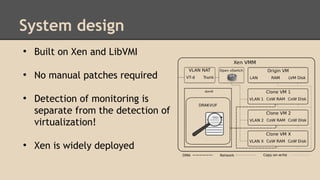
● Built on Xen and LibVMI 
● No manual patches required 
● Detection of monitoring is 
separate from the detection of 
virtualization! 
● Xen is widely deployed
Scalability 
Use copy-on-write (CoW) disk and 
memory 
● Extra resources allocated 
only when used 
VLAN isolation 
● Avoid IP/MAC address 
collisions 
Strong isolation of analysis 
sessions
Fidelity 
Detect when 
● New process is scheduled, syscalls executed, files 
accessed / created / deleted, etc. 
Monitor guest OS execution and memory utilization with 
hardware virtualization extensions 
● Breakpoint injection 
● Extended Page Tables (EPT) violations 
● Monitor Trap Flag (MTF) singlestepping 
● MOV-TO-CR trapping
Tamper resistance 
Map OS without using heuristics 
● Use debug data to find internal kernel functions 
● FS/GS → _KPCR → Kernel! 
● Syscalls vs. internal functions 
● Allows monitoring kernel-mode rootkits as well 
Monitor kernel heap allocations 
● Kernel meta-info about processes, files, threads, 
mutexes, etc. 
● Direct state reconstruction without scanning!
Heap tracing 
1. Heap allocation request trapped 
2. Extract return address from stack 
3. Trap when return address is called 
4. Retrieve structure address 
5. Monitor structure initialization with 
EPT permissions and MTF 
singlestepping
Stealth 
No in-guest agents 
● No in-guest artifacts 
Protect injected breakpoints with EPT 
permissions 
How to start the execution of the 
sample? 
● Hijack a running a process! 
● Can use any active process 
● No artifacts left afterwards
Experimental results 
Malwares analyzed 
● Zeus, TDL4, SpyBot, Careto, etc. 
● 1000 samples from ShadowServer 
Heap allocations are clearly in the fast-path of 
the kernel execution 
In-memory only files 
● Never flushed to disk 
● Only accessible via memory 
● Only for a short period of time
Experimental results 
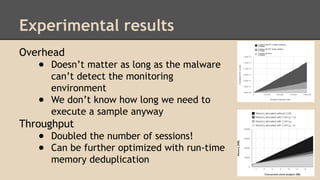
Overhead 
● Doesn’t matter as long as the malware 
can’t detect the monitoring 
environment 
● We don’t know how long we need to 
execute a sample anyway 
Throughput 
● Doubled the number of sessions! 
● Can be further optimized with run-time 
memory deduplication
Future work 
● DRAKVUF specific 
– Multi-vCPU support 
– Linux support 
● General dynamic malware analysis problems 
– Stalling code 
– Record & Replay 
– Branch exploration 
– Timing attacks
Conclusion 
● Dynamic analysis can aid in sorting through large sets 
of malware 
● Existing tools are limited and can be tampered with 
● DRAKVUF raises the bar 
– Open source (GPLv2) 
– http://drakvuf.com 
● Thanks! Questions?

Scalability, Fidelity and Stealth in the DRAKVUF Dynamic Malware Analysis System

  • 1.
    Scalability, Fidelity andStealth in the DRAKVUF Dynamic Malware Analysis System Tamas K. Lengyel @tklengyel tamas@tklengyel.com
  • 2.
    Agenda 1. Motivation 2. System design a. Scalability b. Fidelity c. Stealth 3. Experimental results 4. Conclusion
  • 3.
    Motivation ● Largeand continuously growing set of malware samples day-by-day ● Human analysts are expensive and limited ● Static analysis is thwarted by packers / metamorphic malware ● Malware is trying to stay under the radar
  • 4.
    Motivation ● Dynamicanalysis – Observe the execution of the sample in a sandbox – Collect behavioral characteristcs – Collect artifacts (PCAP, unpacked binaries, etc.) – Analyst can quickly find the outliers ● Linear hardware requirements ● Rootkits ● Sandbox detection
  • 5.
    System design ●Mitigate linear hardware requirements with on-demand resource allocation – Scalability ● Monitor execution of both user- and kernel-mode malware without the potential of tampering – Fidelity ● Hide monitoring environment from the executing malware – Stealth
  • 6.
    System design ●Built on Xen and LibVMI ● No manual patches required ● Detection of monitoring is separate from the detection of virtualization! ● Xen is widely deployed
  • 7.
    Scalability Use copy-on-write(CoW) disk and memory ● Extra resources allocated only when used VLAN isolation ● Avoid IP/MAC address collisions Strong isolation of analysis sessions
  • 8.
    Fidelity Detect when ● New process is scheduled, syscalls executed, files accessed / created / deleted, etc. Monitor guest OS execution and memory utilization with hardware virtualization extensions ● Breakpoint injection ● Extended Page Tables (EPT) violations ● Monitor Trap Flag (MTF) singlestepping ● MOV-TO-CR trapping
  • 9.
    Tamper resistance MapOS without using heuristics ● Use debug data to find internal kernel functions ● FS/GS → _KPCR → Kernel! ● Syscalls vs. internal functions ● Allows monitoring kernel-mode rootkits as well Monitor kernel heap allocations ● Kernel meta-info about processes, files, threads, mutexes, etc. ● Direct state reconstruction without scanning!
  • 10.
    Heap tracing 1.Heap allocation request trapped 2. Extract return address from stack 3. Trap when return address is called 4. Retrieve structure address 5. Monitor structure initialization with EPT permissions and MTF singlestepping
  • 11.
    Stealth No in-guestagents ● No in-guest artifacts Protect injected breakpoints with EPT permissions How to start the execution of the sample? ● Hijack a running a process! ● Can use any active process ● No artifacts left afterwards
  • 12.
    Experimental results Malwaresanalyzed ● Zeus, TDL4, SpyBot, Careto, etc. ● 1000 samples from ShadowServer Heap allocations are clearly in the fast-path of the kernel execution In-memory only files ● Never flushed to disk ● Only accessible via memory ● Only for a short period of time
  • 13.
    Experimental results Overhead ● Doesn’t matter as long as the malware can’t detect the monitoring environment ● We don’t know how long we need to execute a sample anyway Throughput ● Doubled the number of sessions! ● Can be further optimized with run-time memory deduplication
  • 14.
    Future work ●DRAKVUF specific – Multi-vCPU support – Linux support ● General dynamic malware analysis problems – Stalling code – Record & Replay – Branch exploration – Timing attacks
  • 15.
    Conclusion ● Dynamicanalysis can aid in sorting through large sets of malware ● Existing tools are limited and can be tampered with ● DRAKVUF raises the bar – Open source (GPLv2) – http://drakvuf.com ● Thanks! Questions?