Mechanical Technology
1. Rolling
2. Forging
3. Extrusion
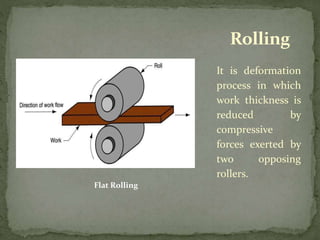
It is deformation
process in which
work thickness is
reduced by
compressive
forces exerted by
two opposing
rollers.
Rolling
Flat Rolling
Rollers perform two main functions:
1. Pull the work into the gap between them by friction
between work piece and rollers.
2. Simultaneously squeeze the work to reduce it’s cross
section.
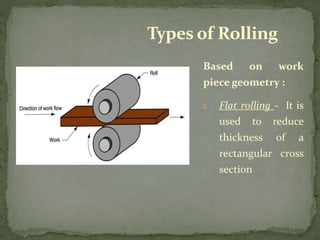
Based on work
piece geometry :
1. Flat rolling - It is
used to reduce
thickness of a
rectangular cross
section
Types of Rolling
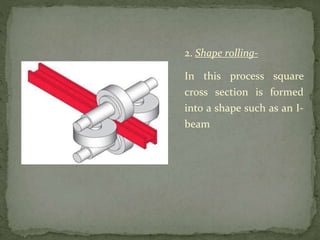
2. Shape rolling-
In this process square
cross section is formed
into a shape such as an I-
beam
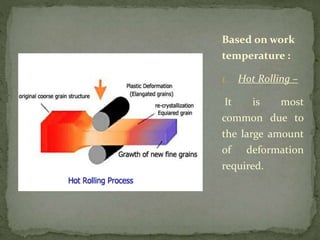
Based on work
temperature :
1. Hot Rolling –
It is most
common due to
the large amount
of deformation
required.
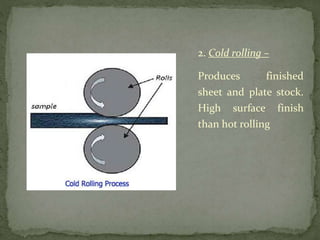
2. Cold rolling –
Produces finished
sheet and plate stock.
High surface finish
than hot rolling
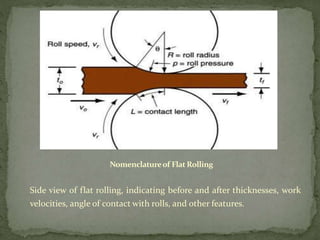
Nomenclatureof FlatRolling
Side view of flat rolling, indicating before and after thicknesses, work
velocities, angle of contact with rolls, and other features.
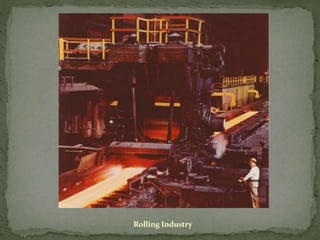
Rolling Industry
 It has been suggested that Leonardo Da Vinci
invented the first rolling mill.
 But what exactly is a rolling mill?
A rolling mill is a unit in which a metal forming
process takes place. During this process various metal
materials get passed through a massive pair of rolls, or
material handling equipment.
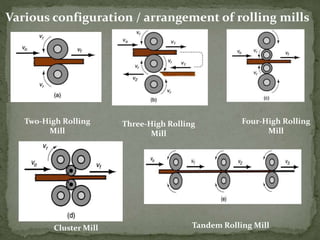
Various configuration / arrangement of rolling mills
Tandem Rolling MillCluster Mill
Four-High Rolling
Mill
Three-High Rolling
Mill
Two-High Rolling
Mill
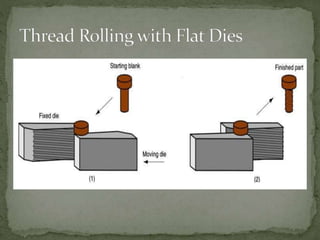
 Bulk deformation process used to form threads on
cylindrical parts by rolling them between two dies.
 Performed by cold working in thread rolling machines
 Advantages over thread cutting (machining):
1. Higher production rates
2. Better material utilization
3. Stronger threads and better fatigue resistance due to
work hardening
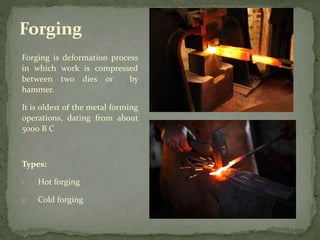
Forging is deformation process
in which work is compressed
between two dies or by
hammer.
It is oldest of the metal forming
operations, dating from about
5000 B C
Types:
1. Hot forging
2. Cold forging
Forging
 Engine crankshafts
 Connecting rods
 Gears
 Aircraft structural components
 Jet engine turbine parts
Advantages
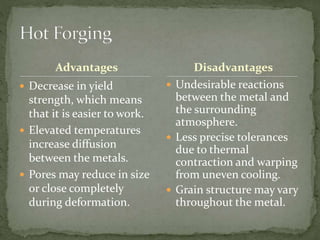
 Decrease in yield
strength, which means
that it is easier to work.
 Elevated temperatures
increase diffusion
between the metals.
 Pores may reduce in size
or close completely
during deformation.
 Undesirable reactions
between the metal and
the surrounding
atmosphere.
 Less precise tolerances
due to thermal
contraction and warping
from uneven cooling.
 Grain structure may vary
throughout the metal.
Disadvantages
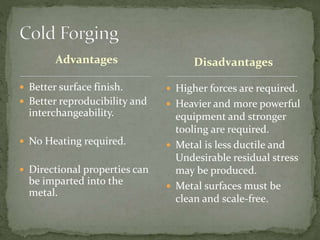
Advantages
 Better surface finish.
 Better reproducibility and
interchangeability.
 No Heating required.
 Directional properties can
be imparted into the
metal.
 Higher forces are required.
 Heavier and more powerful
equipment and stronger
tooling are required.
 Metal is less ductile and
Undesirable residual stress
may be produced.
 Metal surfaces must be
clean and scale-free.
Disadvantages
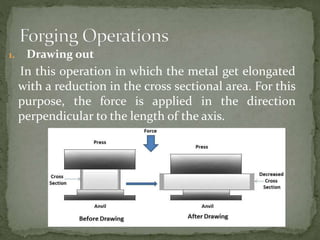
1. Drawing out
In this operation in which the metal get elongated
with a reduction in the cross sectional area. For this
purpose, the force is applied in the direction
perpendicular to the length of the axis.
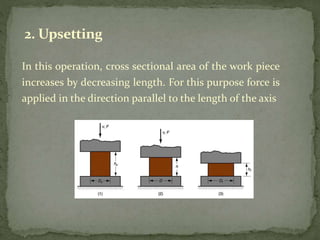
In this operation, cross sectional area of the work piece
increases by decreasing length. For this purpose force is
applied in the direction parallel to the length of the axis
2. Upsetting
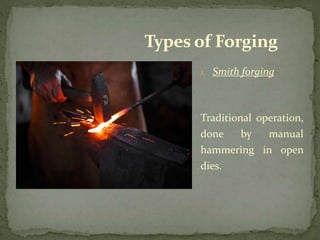
1. Smith forging
Traditional operation,
done by manual
hammering in open
dies.
Types of Forging
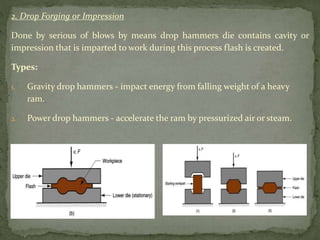
2. Drop Forging or Impression
Done by serious of blows by means drop hammers die contains cavity or
impression that is imparted to work during this process flash is created.
Types:
1. Gravity drop hammers - impact energy from falling weight of a heavy
ram.
2. Power drop hammers - accelerate the ram by pressurized air or steam.
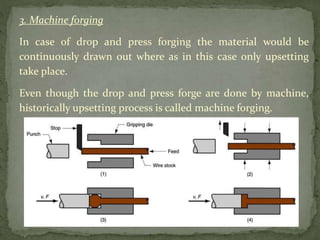
3. Machine forging
In case of drop and press forging the material would be
continuously drawn out where as in this case only upsetting
take place.
Even though the drop and press forge are done by machine,
historically upsetting process is called machine forging.
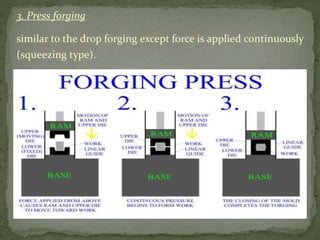
3. Press forging
similar to the drop forging except force is applied continuously
(squeezing type).
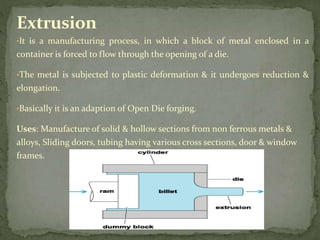
•It is a manufacturing process, in which a block of metal enclosed in a
container is forced to flow through the opening of a die.
•The metal is subjected to plastic deformation & it undergoes reduction &
elongation.
•Basically it is an adaption of Open Die forging.
Uses: Manufacture of solid & hollow sections from non ferrous metals &
alloys, Sliding doors, tubing having various cross sections, door & window
frames.
Extrusion
 By Direction:
i. Direct / Forward
ii. Indirect / Backward
 By operating temperature:
i. Hot
ii. Cold
 By equipment:
i. Horizontal
ii. Vertical
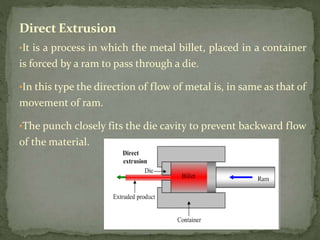
•It is a process in which the metal billet, placed in a container
is forced by a ram to pass through a die.
•In this type the direction of flow of metal is, in same as that of
movement of ram.
•The punch closely fits the die cavity to prevent backward flow
of the material.
Direct Extrusion
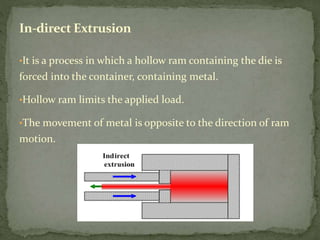
•It is a process in which a hollow ram containing the die is
forced into the container, containing metal.
•Hollow ram limits the applied load.
•The movement of metal is opposite to the direction of ram
motion.
In-direct Extrusion
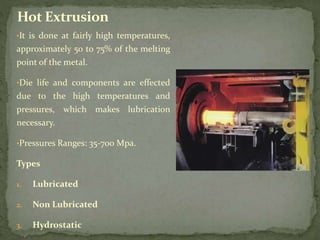
•It is done at fairly high temperatures,
approximately 50 to 75% of the melting
point of the metal.
•Die life and components are effected
due to the high temperatures and
pressures, which makes lubrication
necessary.
•Pressures Ranges: 35-700 Mpa.
Types
1. Lubricated
2. Non Lubricated
3. Hydrostatic
Hot Extrusion
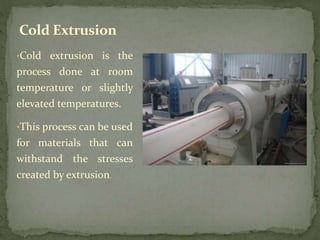
•Cold extrusion is the
process done at room
temperature or slightly
elevated temperatures.
•This process can be used
for materials that can
withstand the stresses
created by extrusion.
Cold Extrusion
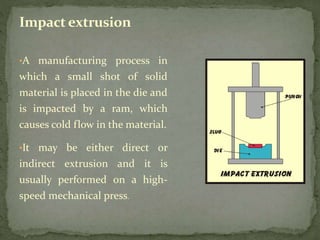
•A manufacturing process in
which a small shot of solid
material is placed in the die and
is impacted by a ram, which
causes cold flow in the material.
•It may be either direct or
indirect extrusion and it is
usually performed on a high-
speed mechanical press.
Impact extrusion
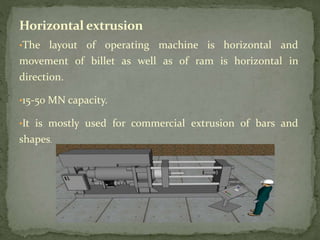
•The layout of operating machine is horizontal and
movement of billet as well as of ram is horizontal in
direction.
•15-50 MN capacity.
•It is mostly used for commercial extrusion of bars and
shapes.
Horizontal extrusion
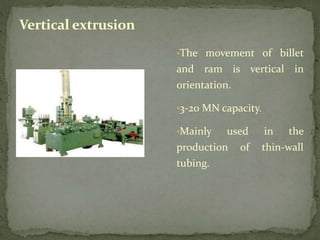
•The movement of billet
and ram is vertical in
orientation.
•3-20 MN capacity.
•Mainly used in the
production of thin-wall
tubing.
Vertical extrusion
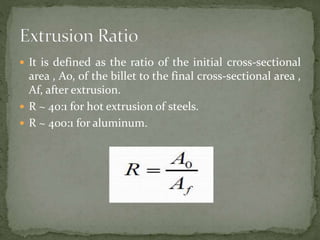
 It is defined as the ratio of the initial cross-sectional
area , Ao, of the billet to the final cross-sectional area ,
Af, after extrusion.
 R ~ 40:1 for hot extrusion of steels.
 R ~ 400:1 for aluminum.
 Like
 Share
 Subscribe

Metal forming process, Non chip forming machining process

  • 1.
  • 2.
  • 3.
    It is deformation processin which work thickness is reduced by compressive forces exerted by two opposing rollers. Rolling Flat Rolling
  • 4.
    Rollers perform twomain functions: 1. Pull the work into the gap between them by friction between work piece and rollers. 2. Simultaneously squeeze the work to reduce it’s cross section.
  • 5.
    Based on work piecegeometry : 1. Flat rolling - It is used to reduce thickness of a rectangular cross section Types of Rolling
  • 6.
    2. Shape rolling- Inthis process square cross section is formed into a shape such as an I- beam
  • 7.
    Based on work temperature: 1. Hot Rolling – It is most common due to the large amount of deformation required.
  • 8.
    2. Cold rolling– Produces finished sheet and plate stock. High surface finish than hot rolling
  • 9.
    Nomenclatureof FlatRolling Side viewof flat rolling, indicating before and after thicknesses, work velocities, angle of contact with rolls, and other features.
  • 10.
  • 11.
     It hasbeen suggested that Leonardo Da Vinci invented the first rolling mill.  But what exactly is a rolling mill? A rolling mill is a unit in which a metal forming process takes place. During this process various metal materials get passed through a massive pair of rolls, or material handling equipment.
  • 12.
    Various configuration /arrangement of rolling mills Tandem Rolling MillCluster Mill Four-High Rolling Mill Three-High Rolling Mill Two-High Rolling Mill
  • 13.
     Bulk deformationprocess used to form threads on cylindrical parts by rolling them between two dies.  Performed by cold working in thread rolling machines  Advantages over thread cutting (machining): 1. Higher production rates 2. Better material utilization 3. Stronger threads and better fatigue resistance due to work hardening
  • 15.
    Forging is deformationprocess in which work is compressed between two dies or by hammer. It is oldest of the metal forming operations, dating from about 5000 B C Types: 1. Hot forging 2. Cold forging Forging
  • 16.
     Engine crankshafts Connecting rods  Gears  Aircraft structural components  Jet engine turbine parts
  • 17.
    Advantages  Decrease inyield strength, which means that it is easier to work.  Elevated temperatures increase diffusion between the metals.  Pores may reduce in size or close completely during deformation.  Undesirable reactions between the metal and the surrounding atmosphere.  Less precise tolerances due to thermal contraction and warping from uneven cooling.  Grain structure may vary throughout the metal. Disadvantages
  • 18.
    Advantages  Better surfacefinish.  Better reproducibility and interchangeability.  No Heating required.  Directional properties can be imparted into the metal.  Higher forces are required.  Heavier and more powerful equipment and stronger tooling are required.  Metal is less ductile and Undesirable residual stress may be produced.  Metal surfaces must be clean and scale-free. Disadvantages
  • 19.
    1. Drawing out Inthis operation in which the metal get elongated with a reduction in the cross sectional area. For this purpose, the force is applied in the direction perpendicular to the length of the axis.
  • 20.
    In this operation,cross sectional area of the work piece increases by decreasing length. For this purpose force is applied in the direction parallel to the length of the axis 2. Upsetting
  • 21.
    1. Smith forging Traditionaloperation, done by manual hammering in open dies. Types of Forging
  • 22.
    2. Drop Forgingor Impression Done by serious of blows by means drop hammers die contains cavity or impression that is imparted to work during this process flash is created. Types: 1. Gravity drop hammers - impact energy from falling weight of a heavy ram. 2. Power drop hammers - accelerate the ram by pressurized air or steam.
  • 23.
    3. Machine forging Incase of drop and press forging the material would be continuously drawn out where as in this case only upsetting take place. Even though the drop and press forge are done by machine, historically upsetting process is called machine forging.
  • 24.
    3. Press forging similarto the drop forging except force is applied continuously (squeezing type).
  • 25.
    •It is amanufacturing process, in which a block of metal enclosed in a container is forced to flow through the opening of a die. •The metal is subjected to plastic deformation & it undergoes reduction & elongation. •Basically it is an adaption of Open Die forging. Uses: Manufacture of solid & hollow sections from non ferrous metals & alloys, Sliding doors, tubing having various cross sections, door & window frames. Extrusion
  • 26.
     By Direction: i.Direct / Forward ii. Indirect / Backward  By operating temperature: i. Hot ii. Cold  By equipment: i. Horizontal ii. Vertical
  • 27.
    •It is aprocess in which the metal billet, placed in a container is forced by a ram to pass through a die. •In this type the direction of flow of metal is, in same as that of movement of ram. •The punch closely fits the die cavity to prevent backward flow of the material. Direct Extrusion
  • 28.
    •It is aprocess in which a hollow ram containing the die is forced into the container, containing metal. •Hollow ram limits the applied load. •The movement of metal is opposite to the direction of ram motion. In-direct Extrusion
  • 29.
    •It is doneat fairly high temperatures, approximately 50 to 75% of the melting point of the metal. •Die life and components are effected due to the high temperatures and pressures, which makes lubrication necessary. •Pressures Ranges: 35-700 Mpa. Types 1. Lubricated 2. Non Lubricated 3. Hydrostatic Hot Extrusion
  • 30.
    •Cold extrusion isthe process done at room temperature or slightly elevated temperatures. •This process can be used for materials that can withstand the stresses created by extrusion. Cold Extrusion
  • 31.
    •A manufacturing processin which a small shot of solid material is placed in the die and is impacted by a ram, which causes cold flow in the material. •It may be either direct or indirect extrusion and it is usually performed on a high- speed mechanical press. Impact extrusion
  • 32.
    •The layout ofoperating machine is horizontal and movement of billet as well as of ram is horizontal in direction. •15-50 MN capacity. •It is mostly used for commercial extrusion of bars and shapes. Horizontal extrusion
  • 33.
    •The movement ofbillet and ram is vertical in orientation. •3-20 MN capacity. •Mainly used in the production of thin-wall tubing. Vertical extrusion
  • 34.
     It isdefined as the ratio of the initial cross-sectional area , Ao, of the billet to the final cross-sectional area , Af, after extrusion.  R ~ 40:1 for hot extrusion of steels.  R ~ 400:1 for aluminum.
  • 35.