Nucleic Acid
Metabolism
PRESENTED BY KAWALYA STEVEN
Types of Nitrogen base
Nucleotides consist of a
• Nitrogen base
• Pentose sugar
• Phosphate
The pentose sugar is D-ribose in ribonucleotides of
RNA while in deoxyribonucleotides (deoxynucleotides)
of DNA, the sugar is 2-deoxy D-ribose.
Based on structure nitrogen base are classified into
two groups.
1. Purines
2. Pyrimidines
Biosynthesis of purine ribonucleotides
(De novo pathway)
The synthesis of purine in body is done by de novo pathway, in
which the parent molecule inosine monophosphate is synthesized
and later converted to respective purines.
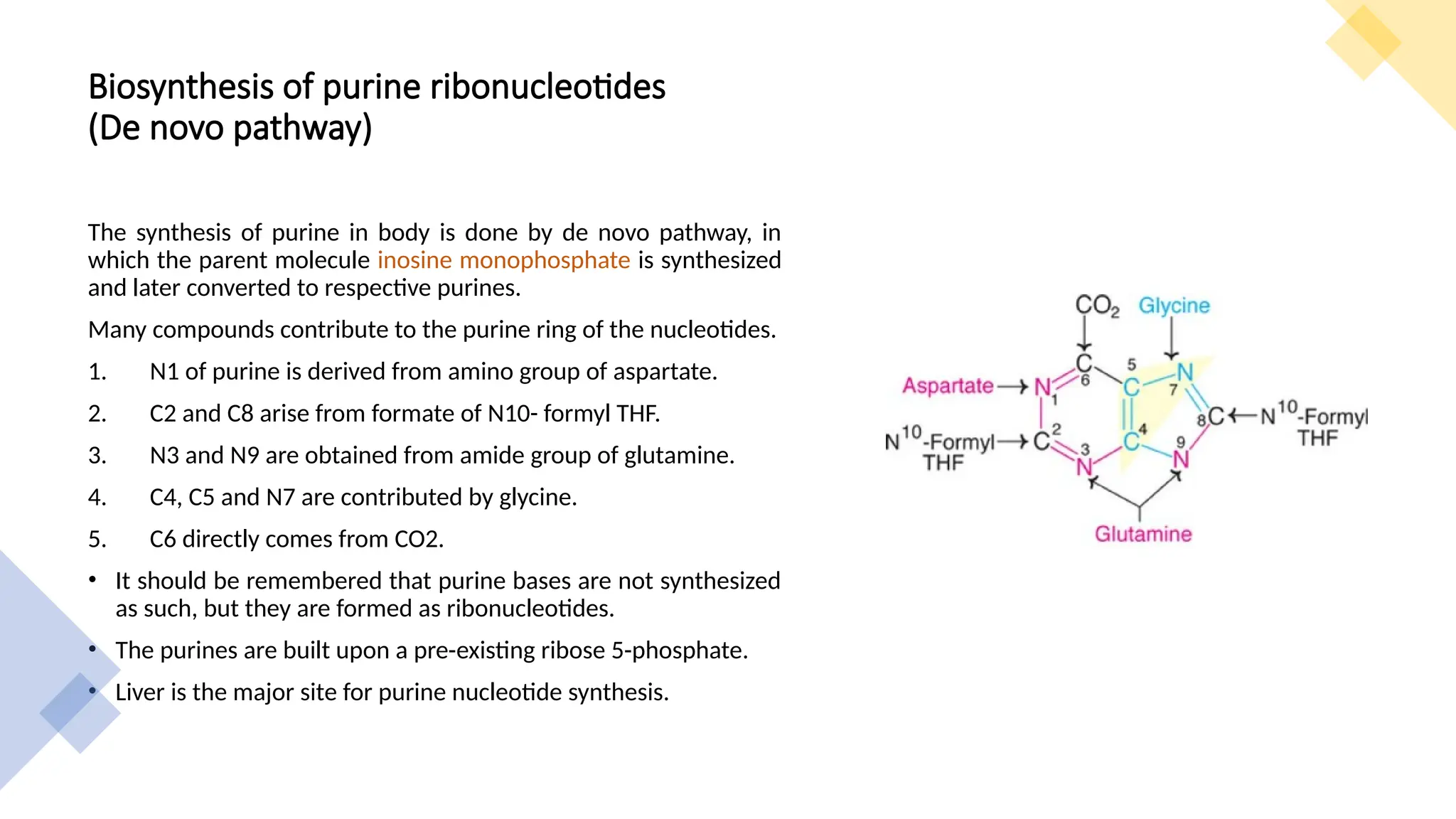
Many compounds contribute to the purine ring of the nucleotides.
1. N1 of purine is derived from amino group of aspartate.
2. C2 and C8 arise from formate of N10- formyl THF.
3. N3 and N9 are obtained from amide group of glutamine.
4. C4, C5 and N7 are contributed by glycine.
5. C6 directly comes from CO2.
• It should be remembered that purine bases are not synthesized
as such, but they are formed as ribonucleotides.
• The purines are built upon a pre-existing ribose 5-phosphate.
• Liver is the major site for purine nucleotide synthesis.
De novo synthesis of Purines.
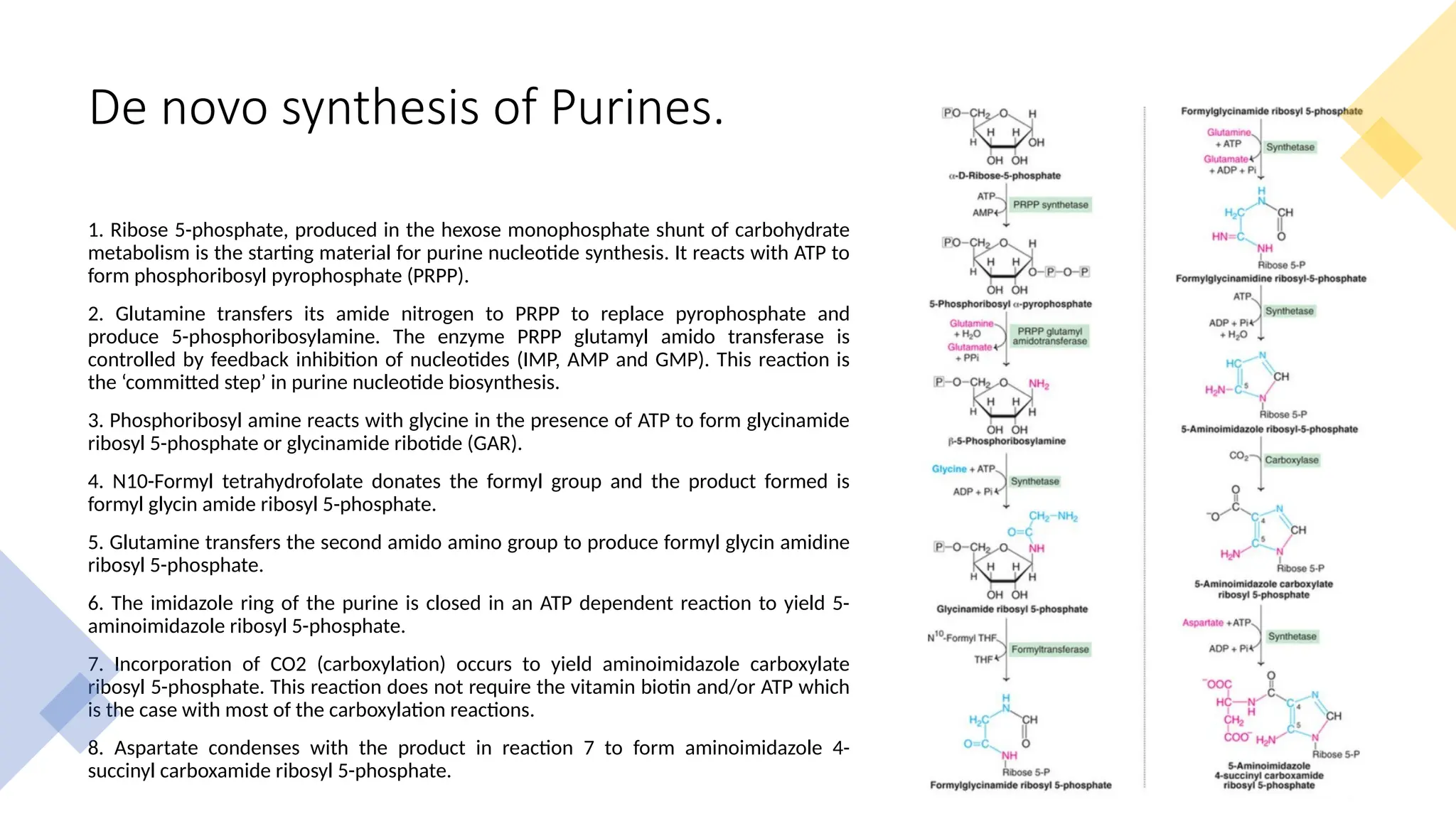
1. Ribose 5-phosphate, produced in the hexose monophosphate shunt of carbohydrate
metabolism is the starting material for purine nucleotide synthesis. It reacts with ATP to
form phosphoribosyl pyrophosphate (PRPP).
2. Glutamine transfers its amide nitrogen to PRPP to replace pyrophosphate and
produce 5-phosphoribosylamine. The enzyme PRPP glutamyl amido transferase is
controlled by feedback inhibition of nucleotides (IMP, AMP and GMP). This reaction is
the ‘committed step’ in purine nucleotide biosynthesis.
3. Phosphoribosyl amine reacts with glycine in the presence of ATP to form glycinamide
ribosyl 5-phosphate or glycinamide ribotide (GAR).
4. N10-Formyl tetrahydrofolate donates the formyl group and the product formed is
formyl glycin amide ribosyl 5-phosphate.
5. Glutamine transfers the second amido amino group to produce formyl glycin amidine
ribosyl 5-phosphate.
6. The imidazole ring of the purine is closed in an ATP dependent reaction to yield 5-
aminoimidazole ribosyl 5-phosphate.
7. Incorporation of CO2 (carboxylation) occurs to yield aminoimidazole carboxylate
ribosyl 5-phosphate. This reaction does not require the vitamin biotin and/or ATP which
is the case with most of the carboxylation reactions.
8. Aspartate condenses with the product in reaction 7 to form aminoimidazole 4-
succinyl carboxamide ribosyl 5-phosphate.
9. Adeno succinate lyase cleaves off fumarate and only the amino group of
aspartate is retained to yield aminoimidazole 4-carboxamide ribosyl 5-
phosphate.
10. N10-Formyl tetrahydrofolate donates a one-carbon moiety to produce
form amino imidazole 4-carboxamide ribosyl 5-phosphate. With this
reaction, all the carbon and nitrogen atoms of purine ring are contributed by
the respective sources.
11.The final reaction catalysed by cyclohydrolase leads to ring closure with
an elimination of water molecule. The product obtained is inosine
monophosphate (IMP), the parent purine nucleotide from which other
purine nucleotides can be synthesized.
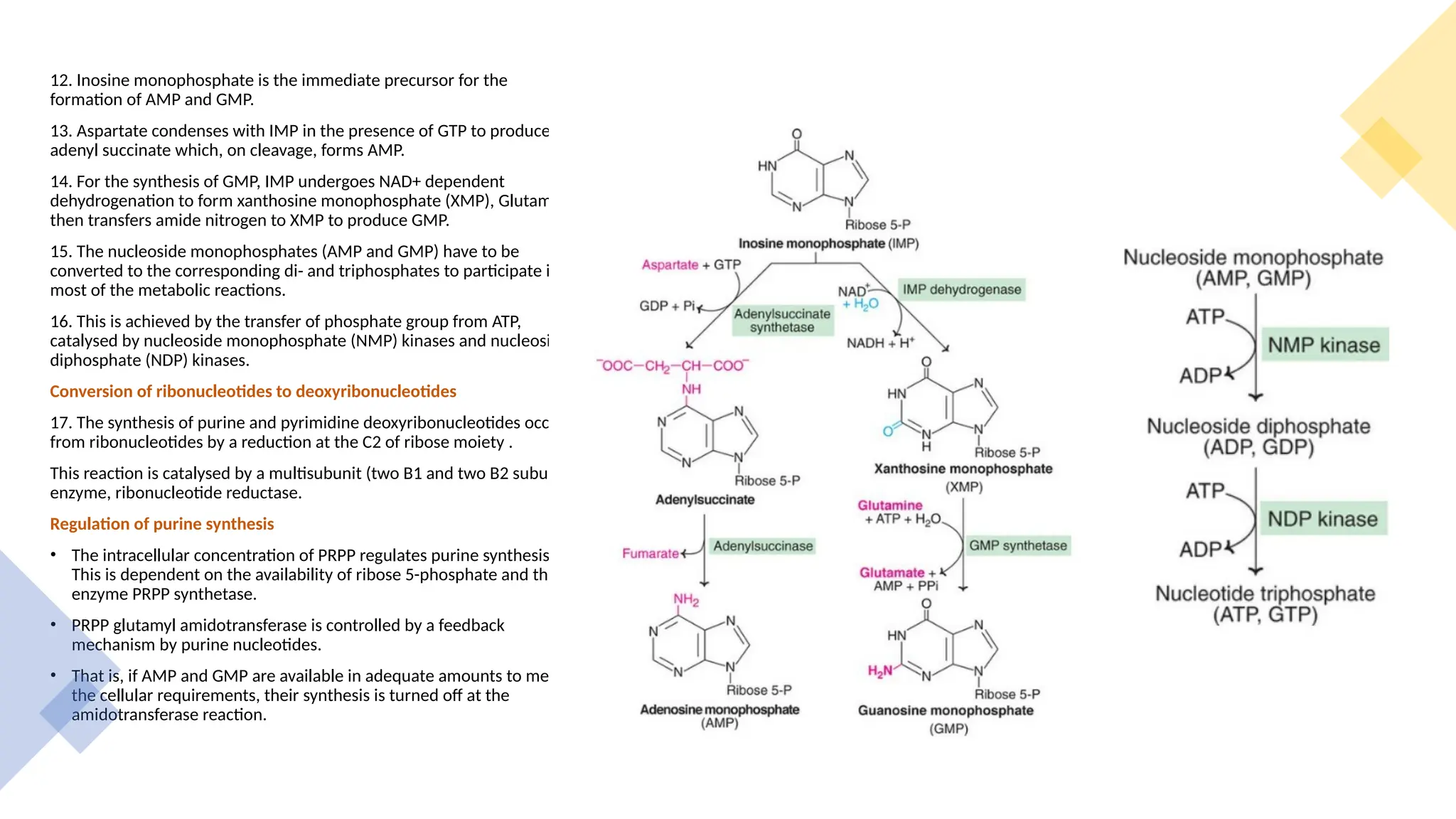
12. Inosine monophosphate is the immediate precursor for the formation of
AMP and GMP.
12. Inosine monophosphate is the immediate precursor for the
formation of AMP and GMP.
13. Aspartate condenses with IMP in the presence of GTP to produce
adenyl succinate which, on cleavage, forms AMP.
14. For the synthesis of GMP, IMP undergoes NAD+ dependent
dehydrogenation to form xanthosine monophosphate (XMP), Glutamine
then transfers amide nitrogen to XMP to produce GMP.
15. The nucleoside monophosphates (AMP and GMP) have to be
converted to the corresponding di- and triphosphates to participate in
most of the metabolic reactions.
16. This is achieved by the transfer of phosphate group from ATP,
catalysed by nucleoside monophosphate (NMP) kinases and nucleoside
diphosphate (NDP) kinases.
Conversion of ribonucleotides to deoxyribonucleotides
17. The synthesis of purine and pyrimidine deoxyribonucleotides occurs
from ribonucleotides by a reduction at the C2 of ribose moiety .
This reaction is catalysed by a multisubunit (two B1 and two B2 subunits)
enzyme, ribonucleotide reductase.
Regulation of purine synthesis
• The intracellular concentration of PRPP regulates purine synthesis.
This is dependent on the availability of ribose 5-phosphate and the
enzyme PRPP synthetase.
• PRPP glutamyl amidotransferase is controlled by a feedback
mechanism by purine nucleotides.
• That is, if AMP and GMP are available in adequate amounts to meet
the cellular requirements, their synthesis is turned off at the
amidotransferase reaction.
Salvage pathway of purine synthesis
• The free purines (adenine, guanine and hypoxanthine) are
formed in the normal turnover of nucleic acids (particularly
RNA), and also obtained from the dietary sources.
• The purines can be directly converted to the corresponding
nucleotides, and this process is known as ‘salvage pathway’
• Adenine phosphoribosyl transferase catalyses the formation of
AMP from adenine. Hypoxanthine-guanine phosphoribosyl
transferase (HGPRT) converts guanine and hypoxanthine,
respectively, to GMP and IMP.
• Phosphoribosyl pyrophosphate (PRPP) is the donor of ribose 5-
phosphate in the salvage pathway.
Degradation of purine nucleotides
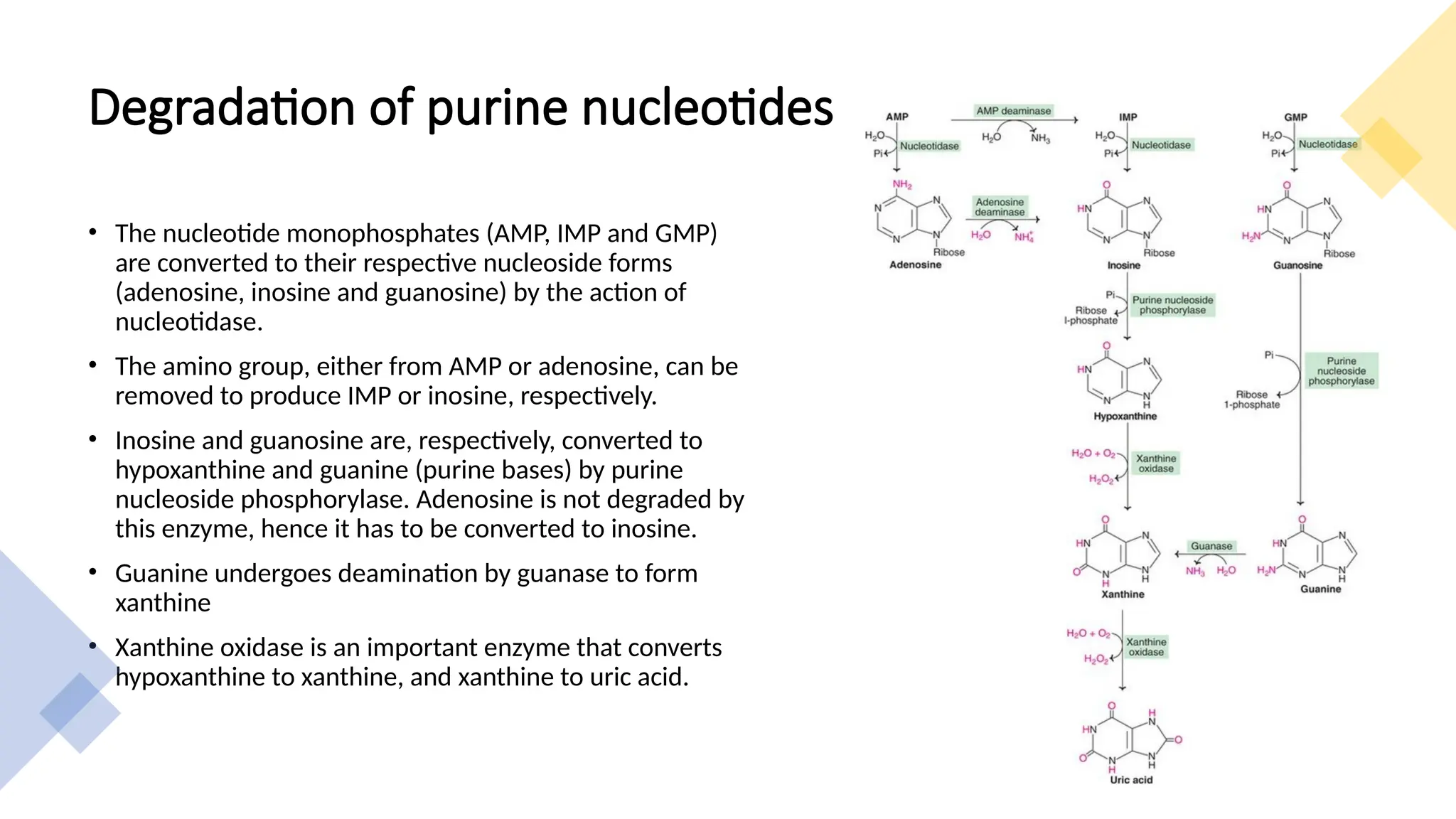
• The nucleotide monophosphates (AMP, IMP and GMP)
are converted to their respective nucleoside forms
(adenosine, inosine and guanosine) by the action of
nucleotidase.
• The amino group, either from AMP or adenosine, can be
removed to produce IMP or inosine, respectively.
• Inosine and guanosine are, respectively, converted to
hypoxanthine and guanine (purine bases) by purine
nucleoside phosphorylase. Adenosine is not degraded by
this enzyme, hence it has to be converted to inosine.
• Guanine undergoes deamination by guanase to form
xanthine
• Xanthine oxidase is an important enzyme that converts
hypoxanthine to xanthine, and xanthine to uric acid.
Biosynthesis of pyrimidine ribonucleotides
• The synthesis of pyrimidines is a simpler
process Aspartate, glutamine (amide group)
and CO2 contribute to atoms in the
formation of pyrimidine ring.
• Pyrimidine ring is first synthesized and then
attached to ribose 5-phosphate.
THANKS FOR LISTENING
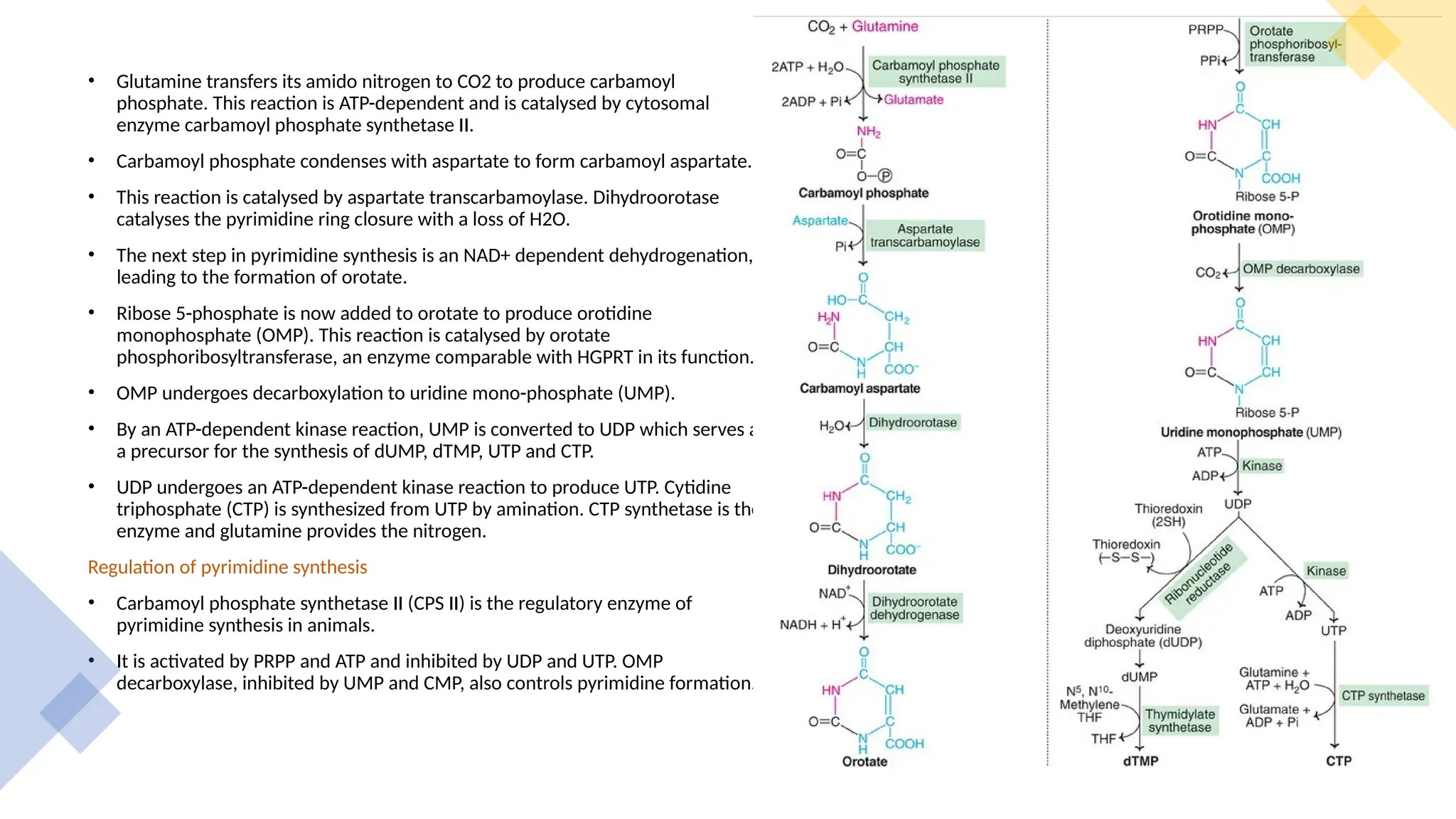
• Glutamine transfers its amido nitrogen to CO2 to produce carbamoyl
phosphate. This reaction is ATP-dependent and is catalysed by cytosomal
enzyme carbamoyl phosphate synthetase II.
• Carbamoyl phosphate condenses with aspartate to form carbamoyl aspartate.
• This reaction is catalysed by aspartate transcarbamoylase. Dihydroorotase
catalyses the pyrimidine ring closure with a loss of H2O.
• The next step in pyrimidine synthesis is an NAD+ dependent dehydrogenation,
leading to the formation of orotate.
• Ribose 5-phosphate is now added to orotate to produce orotidine
monophosphate (OMP). This reaction is catalysed by orotate
phosphoribosyltransferase, an enzyme comparable with HGPRT in its function.
• OMP undergoes decarboxylation to uridine mono-phosphate (UMP).
• By an ATP-dependent kinase reaction, UMP is converted to UDP which serves as
a precursor for the synthesis of dUMP, dTMP, UTP and CTP.
• UDP undergoes an ATP-dependent kinase reaction to produce UTP. Cytidine
triphosphate (CTP) is synthesized from UTP by amination. CTP synthetase is the
enzyme and glutamine provides the nitrogen.
Regulation of pyrimidine synthesis
• Carbamoyl phosphate synthetase II (CPS II) is the regulatory enzyme of
pyrimidine synthesis in animals.
• It is activated by PRPP and ATP and inhibited by UDP and UTP. OMP
decarboxylase, inhibited by UMP and CMP, also controls pyrimidine formation.
Degradation of
pyrimidine nucleotides
• The pyrimidine nucleotides undergo reactions
(dephosphorylation, deamination and cleavage of
glycosidic bond) like that of purine nucleotides to
liberate the nitrogenous bases—cytosine, uracil and
thymine.
• The bases are then degraded to highly soluble
products—β-alanine and β-aminoisobutyrate.
• These are the amino acids which undergo
transamination and other reactions to finally produce
acetyl CoA and succinyl CoA.
THANKS FOR LISTENING

Metabolism of nucleic acids and relevance.pptx

  • 1.
  • 2.
    Types of Nitrogenbase Nucleotides consist of a • Nitrogen base • Pentose sugar • Phosphate The pentose sugar is D-ribose in ribonucleotides of RNA while in deoxyribonucleotides (deoxynucleotides) of DNA, the sugar is 2-deoxy D-ribose. Based on structure nitrogen base are classified into two groups. 1. Purines 2. Pyrimidines
  • 3.
    Biosynthesis of purineribonucleotides (De novo pathway) The synthesis of purine in body is done by de novo pathway, in which the parent molecule inosine monophosphate is synthesized and later converted to respective purines. Many compounds contribute to the purine ring of the nucleotides. 1. N1 of purine is derived from amino group of aspartate. 2. C2 and C8 arise from formate of N10- formyl THF. 3. N3 and N9 are obtained from amide group of glutamine. 4. C4, C5 and N7 are contributed by glycine. 5. C6 directly comes from CO2. • It should be remembered that purine bases are not synthesized as such, but they are formed as ribonucleotides. • The purines are built upon a pre-existing ribose 5-phosphate. • Liver is the major site for purine nucleotide synthesis.
  • 4.
    De novo synthesisof Purines. 1. Ribose 5-phosphate, produced in the hexose monophosphate shunt of carbohydrate metabolism is the starting material for purine nucleotide synthesis. It reacts with ATP to form phosphoribosyl pyrophosphate (PRPP). 2. Glutamine transfers its amide nitrogen to PRPP to replace pyrophosphate and produce 5-phosphoribosylamine. The enzyme PRPP glutamyl amido transferase is controlled by feedback inhibition of nucleotides (IMP, AMP and GMP). This reaction is the ‘committed step’ in purine nucleotide biosynthesis. 3. Phosphoribosyl amine reacts with glycine in the presence of ATP to form glycinamide ribosyl 5-phosphate or glycinamide ribotide (GAR). 4. N10-Formyl tetrahydrofolate donates the formyl group and the product formed is formyl glycin amide ribosyl 5-phosphate. 5. Glutamine transfers the second amido amino group to produce formyl glycin amidine ribosyl 5-phosphate. 6. The imidazole ring of the purine is closed in an ATP dependent reaction to yield 5- aminoimidazole ribosyl 5-phosphate. 7. Incorporation of CO2 (carboxylation) occurs to yield aminoimidazole carboxylate ribosyl 5-phosphate. This reaction does not require the vitamin biotin and/or ATP which is the case with most of the carboxylation reactions. 8. Aspartate condenses with the product in reaction 7 to form aminoimidazole 4- succinyl carboxamide ribosyl 5-phosphate.
  • 5.
    9. Adeno succinatelyase cleaves off fumarate and only the amino group of aspartate is retained to yield aminoimidazole 4-carboxamide ribosyl 5- phosphate. 10. N10-Formyl tetrahydrofolate donates a one-carbon moiety to produce form amino imidazole 4-carboxamide ribosyl 5-phosphate. With this reaction, all the carbon and nitrogen atoms of purine ring are contributed by the respective sources. 11.The final reaction catalysed by cyclohydrolase leads to ring closure with an elimination of water molecule. The product obtained is inosine monophosphate (IMP), the parent purine nucleotide from which other purine nucleotides can be synthesized. 12. Inosine monophosphate is the immediate precursor for the formation of AMP and GMP.
  • 6.
    12. Inosine monophosphateis the immediate precursor for the formation of AMP and GMP. 13. Aspartate condenses with IMP in the presence of GTP to produce adenyl succinate which, on cleavage, forms AMP. 14. For the synthesis of GMP, IMP undergoes NAD+ dependent dehydrogenation to form xanthosine monophosphate (XMP), Glutamine then transfers amide nitrogen to XMP to produce GMP. 15. The nucleoside monophosphates (AMP and GMP) have to be converted to the corresponding di- and triphosphates to participate in most of the metabolic reactions. 16. This is achieved by the transfer of phosphate group from ATP, catalysed by nucleoside monophosphate (NMP) kinases and nucleoside diphosphate (NDP) kinases. Conversion of ribonucleotides to deoxyribonucleotides 17. The synthesis of purine and pyrimidine deoxyribonucleotides occurs from ribonucleotides by a reduction at the C2 of ribose moiety . This reaction is catalysed by a multisubunit (two B1 and two B2 subunits) enzyme, ribonucleotide reductase. Regulation of purine synthesis • The intracellular concentration of PRPP regulates purine synthesis. This is dependent on the availability of ribose 5-phosphate and the enzyme PRPP synthetase. • PRPP glutamyl amidotransferase is controlled by a feedback mechanism by purine nucleotides. • That is, if AMP and GMP are available in adequate amounts to meet the cellular requirements, their synthesis is turned off at the amidotransferase reaction.
  • 7.
    Salvage pathway ofpurine synthesis • The free purines (adenine, guanine and hypoxanthine) are formed in the normal turnover of nucleic acids (particularly RNA), and also obtained from the dietary sources. • The purines can be directly converted to the corresponding nucleotides, and this process is known as ‘salvage pathway’ • Adenine phosphoribosyl transferase catalyses the formation of AMP from adenine. Hypoxanthine-guanine phosphoribosyl transferase (HGPRT) converts guanine and hypoxanthine, respectively, to GMP and IMP. • Phosphoribosyl pyrophosphate (PRPP) is the donor of ribose 5- phosphate in the salvage pathway.
  • 8.
    Degradation of purinenucleotides • The nucleotide monophosphates (AMP, IMP and GMP) are converted to their respective nucleoside forms (adenosine, inosine and guanosine) by the action of nucleotidase. • The amino group, either from AMP or adenosine, can be removed to produce IMP or inosine, respectively. • Inosine and guanosine are, respectively, converted to hypoxanthine and guanine (purine bases) by purine nucleoside phosphorylase. Adenosine is not degraded by this enzyme, hence it has to be converted to inosine. • Guanine undergoes deamination by guanase to form xanthine • Xanthine oxidase is an important enzyme that converts hypoxanthine to xanthine, and xanthine to uric acid.
  • 9.
    Biosynthesis of pyrimidineribonucleotides • The synthesis of pyrimidines is a simpler process Aspartate, glutamine (amide group) and CO2 contribute to atoms in the formation of pyrimidine ring. • Pyrimidine ring is first synthesized and then attached to ribose 5-phosphate.
  • 10.
  • 11.
    • Glutamine transfersits amido nitrogen to CO2 to produce carbamoyl phosphate. This reaction is ATP-dependent and is catalysed by cytosomal enzyme carbamoyl phosphate synthetase II. • Carbamoyl phosphate condenses with aspartate to form carbamoyl aspartate. • This reaction is catalysed by aspartate transcarbamoylase. Dihydroorotase catalyses the pyrimidine ring closure with a loss of H2O. • The next step in pyrimidine synthesis is an NAD+ dependent dehydrogenation, leading to the formation of orotate. • Ribose 5-phosphate is now added to orotate to produce orotidine monophosphate (OMP). This reaction is catalysed by orotate phosphoribosyltransferase, an enzyme comparable with HGPRT in its function. • OMP undergoes decarboxylation to uridine mono-phosphate (UMP). • By an ATP-dependent kinase reaction, UMP is converted to UDP which serves as a precursor for the synthesis of dUMP, dTMP, UTP and CTP. • UDP undergoes an ATP-dependent kinase reaction to produce UTP. Cytidine triphosphate (CTP) is synthesized from UTP by amination. CTP synthetase is the enzyme and glutamine provides the nitrogen. Regulation of pyrimidine synthesis • Carbamoyl phosphate synthetase II (CPS II) is the regulatory enzyme of pyrimidine synthesis in animals. • It is activated by PRPP and ATP and inhibited by UDP and UTP. OMP decarboxylase, inhibited by UMP and CMP, also controls pyrimidine formation.
  • 12.
    Degradation of pyrimidine nucleotides •The pyrimidine nucleotides undergo reactions (dephosphorylation, deamination and cleavage of glycosidic bond) like that of purine nucleotides to liberate the nitrogenous bases—cytosine, uracil and thymine. • The bases are then degraded to highly soluble products—β-alanine and β-aminoisobutyrate. • These are the amino acids which undergo transamination and other reactions to finally produce acetyl CoA and succinyl CoA.
  • 13.