Message Authentication
messageauthentication is concerned with:
protecting the integrity of a message
validating identity of originator
non-repudiation of origin (dispute resolution)
will consider the security requirements
then three alternative functions used:
message encryption
message authentication code (MAC)
hash function
3.
Message Encryption
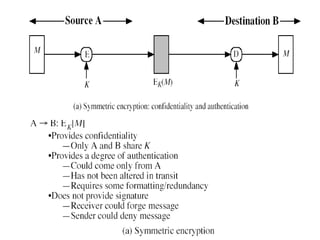
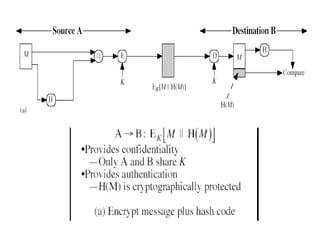
messageencryption by itself also provides
a measure of authentication
if symmetric encryption is used then:
receiver know sender must have created it
since only sender and receiver now key used
know content cannot of been altered
if message has suitable structure, redundancy
or a checksum to detect any changes
5.
Digital Signatures
havelooked at message authentication
but does not address issues of lack of trust
digital signatures provide the ability to:
verify author, date & time of signature
authenticate message contents
be verified by third parties to resolve disputes
hence include authentication function
with additional capabilities
6.
Digital Signature Properties
must depend on the message signed
must use information unique to sender
to prevent both forgery and denial
must be relatively easy to produce
must be relatively easy to recognize & verify
be computationally infeasible to forge
with new message for existing digital signature
with fraudulent digital signature for given message
be practical save digital signature in storage
7.
Message Encryption
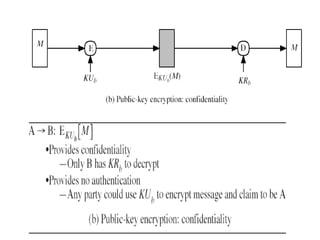
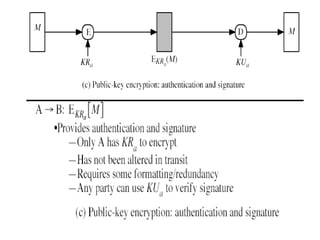
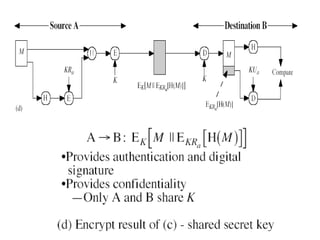
ifpublic-key encryption is used:
encryption provides no confidence of sender
since anyone potentially knows public-key
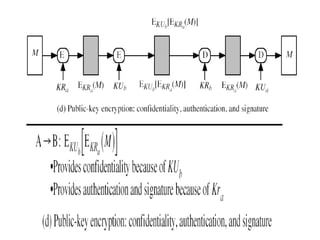
however if
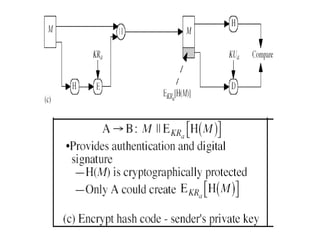
sender signs message using their private-key
then encrypts with recipients public key
have both secrecy and authentication
again need to recognize corrupted messages
but at cost of two public-key uses on message
11.
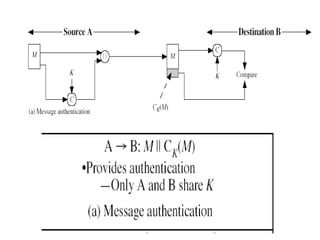
Message Authentication Code
(MAC)
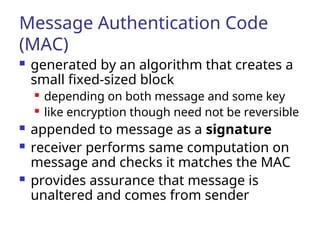
generated by an algorithm that creates a
small fixed-sized block
depending on both message and some key
like encryption though need not be reversible
appended to message as a signature
receiver performs same computation on
message and checks it matches the MAC
provides assurance that message is
unaltered and comes from sender
12.
Message Authentication
Codes
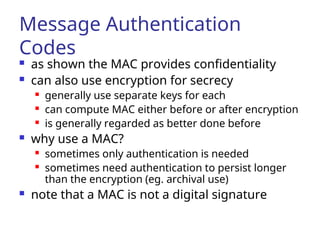
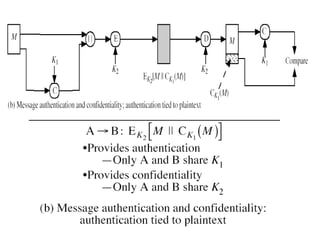
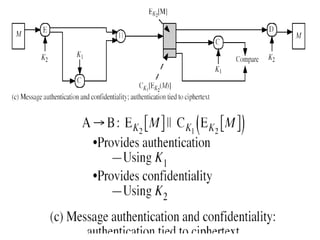
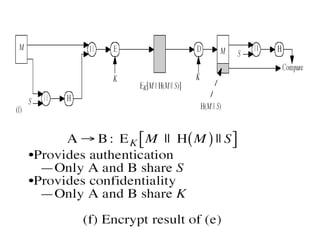
asshown the MAC provides confidentiality
can also use encryption for secrecy
generally use separate keys for each
can compute MAC either before or after encryption
is generally regarded as better done before
why use a MAC?
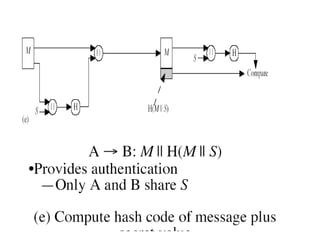
sometimes only authentication is needed
sometimes need authentication to persist longer
than the encryption (eg. archival use)
note that a MAC is not a digital signature
16.
MAC Properties
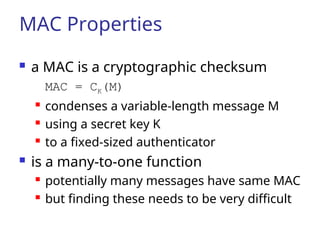
aMAC is a cryptographic checksum
MAC = CK(M)
condenses a variable-length message M
using a secret key K
to a fixed-sized authenticator
is a many-to-one function
potentially many messages have same MAC
but finding these needs to be very difficult
17.
Requirements for MACs
taking into account the types of
attacks
need the MAC to satisfy the following:
1. knowing a message and MAC, is infeasible
to find another message with same MAC
2. MACs should be uniformly distributed
3. MAC should depend equally on all bits of
the message
18.
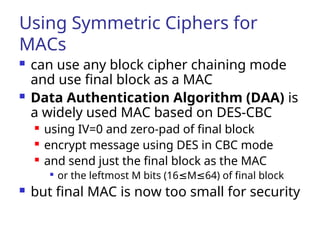
Using Symmetric Ciphersfor
MACs
can use any block cipher chaining mode
and use final block as a MAC
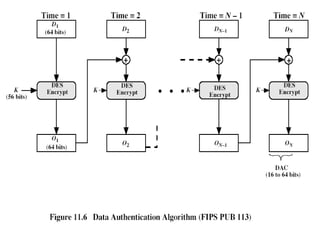
Data Authentication Algorithm (DAA) is
a widely used MAC based on DES-CBC
using IV=0 and zero-pad of final block
encrypt message using DES in CBC mode
and send just the final block as the MAC
or the leftmost M bits (16 M 64) of final block
≤ ≤
but final MAC is now too small for security
20.
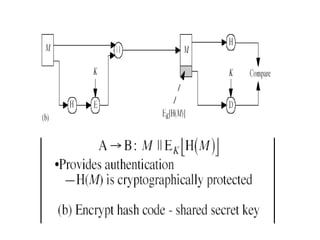
Hash Functions
condensesarbitrary message to fixed size
usually assume that the hash function is
public and not keyed
cf. MAC which is keyed
hash used to detect changes to message
can use in various ways with message
most often to create a digital signature
21.
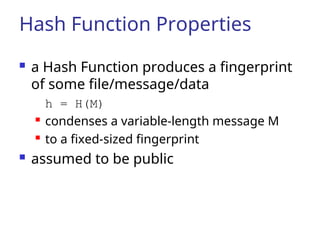
Hash Function Properties
a Hash Function produces a fingerprint
of some file/message/data
h = H(M)
condenses a variable-length message M
to a fixed-sized fingerprint
assumed to be public
28.
Requirements for HashFunctions
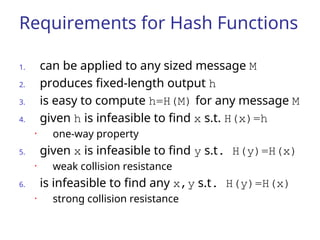
1. can be applied to any sized message M
2. produces fixed-length output h
3. is easy to compute h=H(M) for any message M
4. given h is infeasible to find x s.t. H(x)=h
• one-way property
5. given x is infeasible to find y s.t. H(y)=H(x)
• weak collision resistance
6. is infeasible to find any x,y s.t. H(y)=H(x)
• strong collision resistance
Editor's Notes
#2 Up till now, have been concerned with protecting message content (ie secrecy) by encrypting the message. Will now consider how to protect message integrity (ie protection from modification), as well as confirming the identity of the sender. Generically this is the problem of message authentication, and in eCommerce applications is arguably more important than secrecy.
#3 The first two requirements belong in the realm of message confidentiality, and are handled using the encryption techniques already discussed.
The remaining requirements belong in the realm of message authentication. At its core this addresses the issue of ensuring that a message comes from the alleged source and has not been altered. It may also address sequencing and timeliness. The use of a digital signature can also address issues of repudiation.
#19 Can also use block cipher chaining modes to create a separate authenticator, by just sending the last block. However this suffers from being a bit too small for acceptable use today.
#29 These are the specifications for good hash functions. Essentially it must be extremely difficult to find 2 messages with the same hash, and the hash should not be related to the message in any obvious way (ie it should be a complex non-linear function of the message). There are quite a few similarities in the evolution of hash functions & block ciphers, and in the evolution of the design requirements on both.
#31 The Birthday Attack exploits the birthday paradox – the chance that in a group of people two will share the same birthday – only 23 people are needed for a Pr>0.5 of this. Can generalize the problem to one wanting a matching pair from any two sets, and show need 2m/2 in each to get a matching m-bit hash.
Note that creating many message variants is relatively easy, either by rewording or just varying the amount of white-space in the message.