Merging Traffic: Planning for and implementing a combined reference and access services deskTom Burns, Research & Instruction Librarian, UMKCburnstg@umkc.eduMelanie Church, Graduate Student Assistant, UMKCmjc4gb@mail.mizzou.eduFu Zhuo, Research & Instruction Librarian, UMKCzhuof@umkc.eduMay 21, 2011
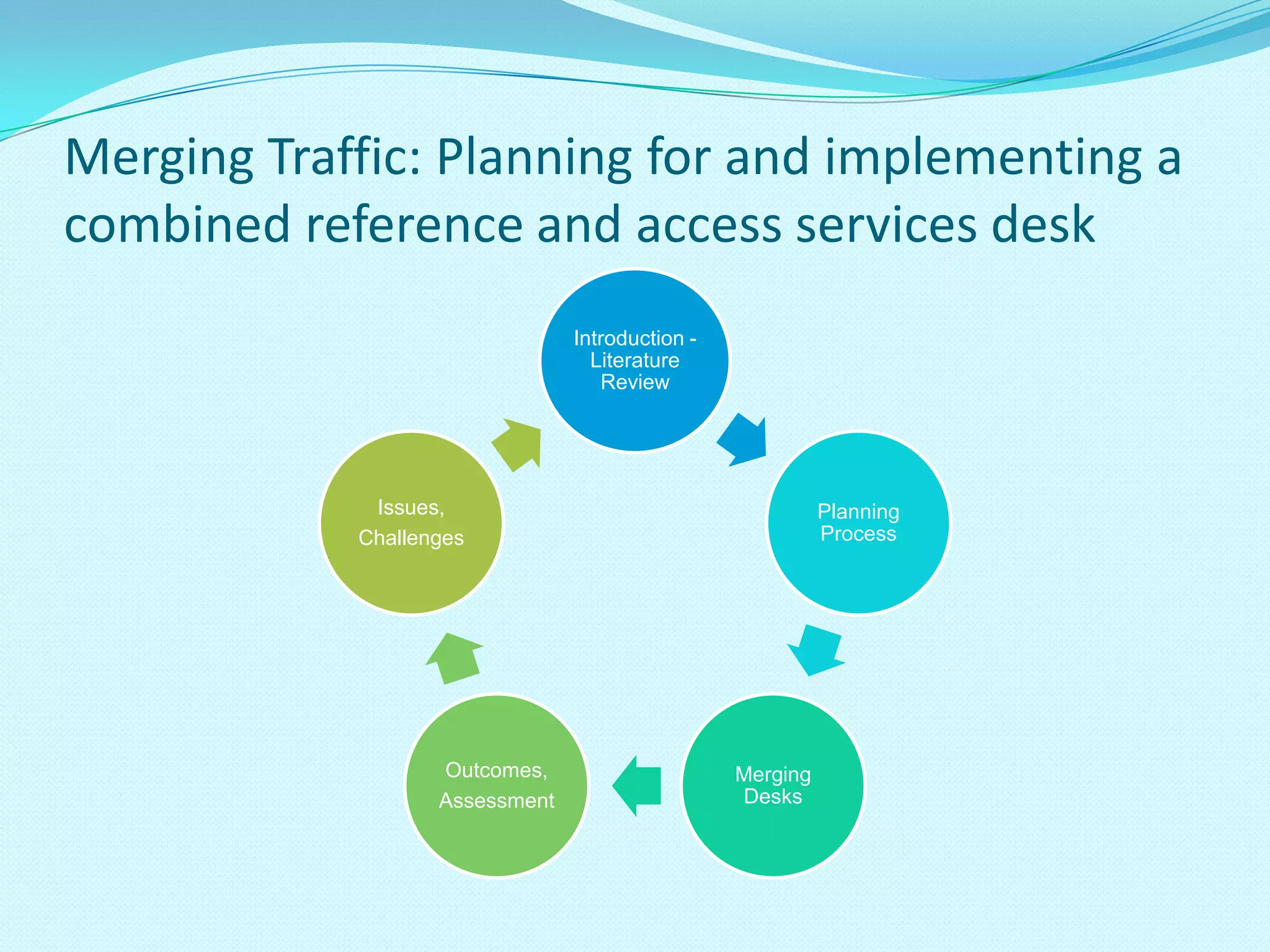
Merging Traffic: Planning for and implementing a combined reference and access services desk
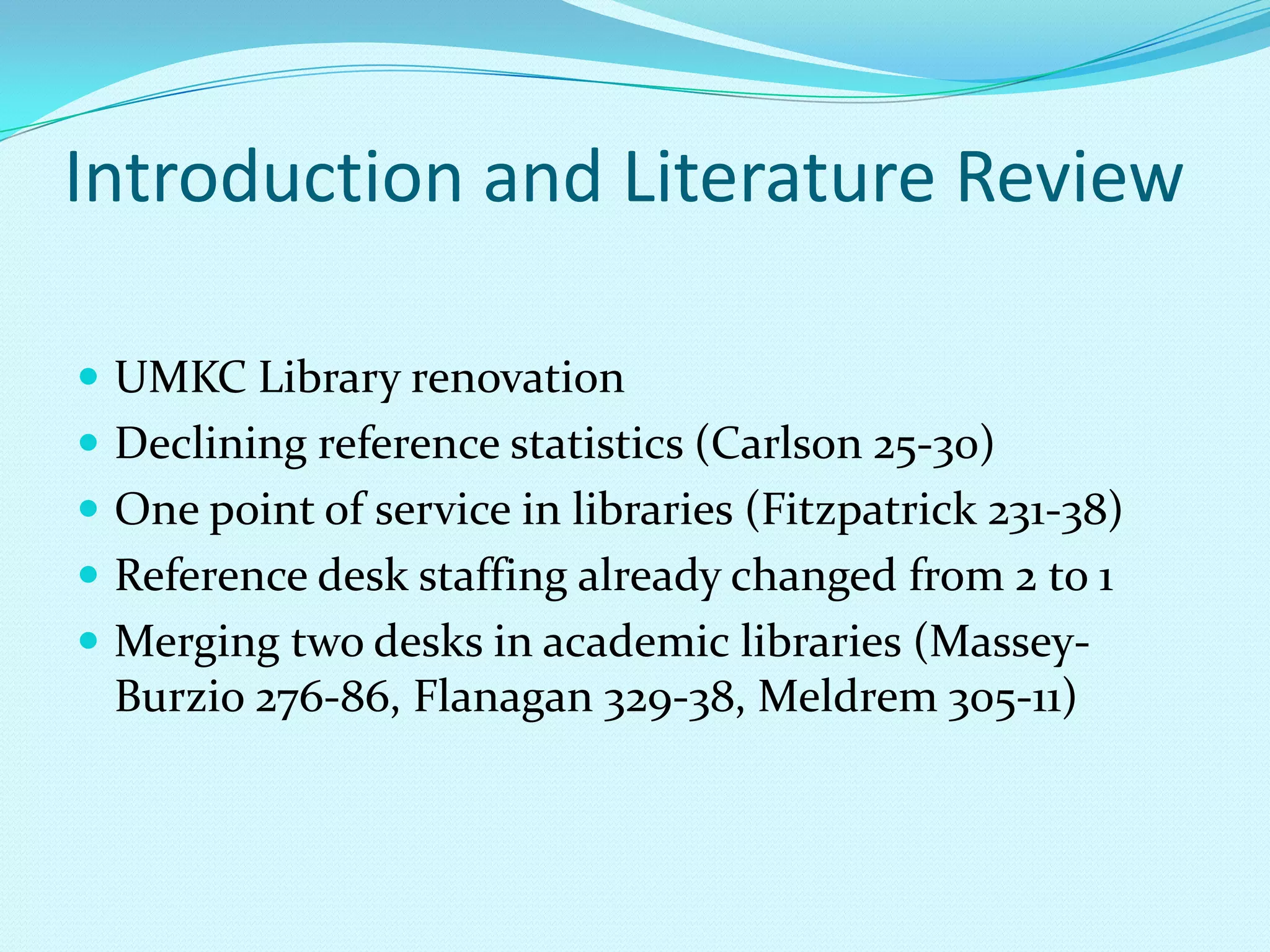
Introduction and Literature ReviewUMKC Library renovationDeclining reference statistics (Carlson 25-30)One point of service in libraries (Fitzpatrick 231-38)Reference desk staffing already changed from 2 to 1Merging two desks in academic libraries (Massey-Burzio 276-86, Flanagan 329-38, Meldrem 305-11)
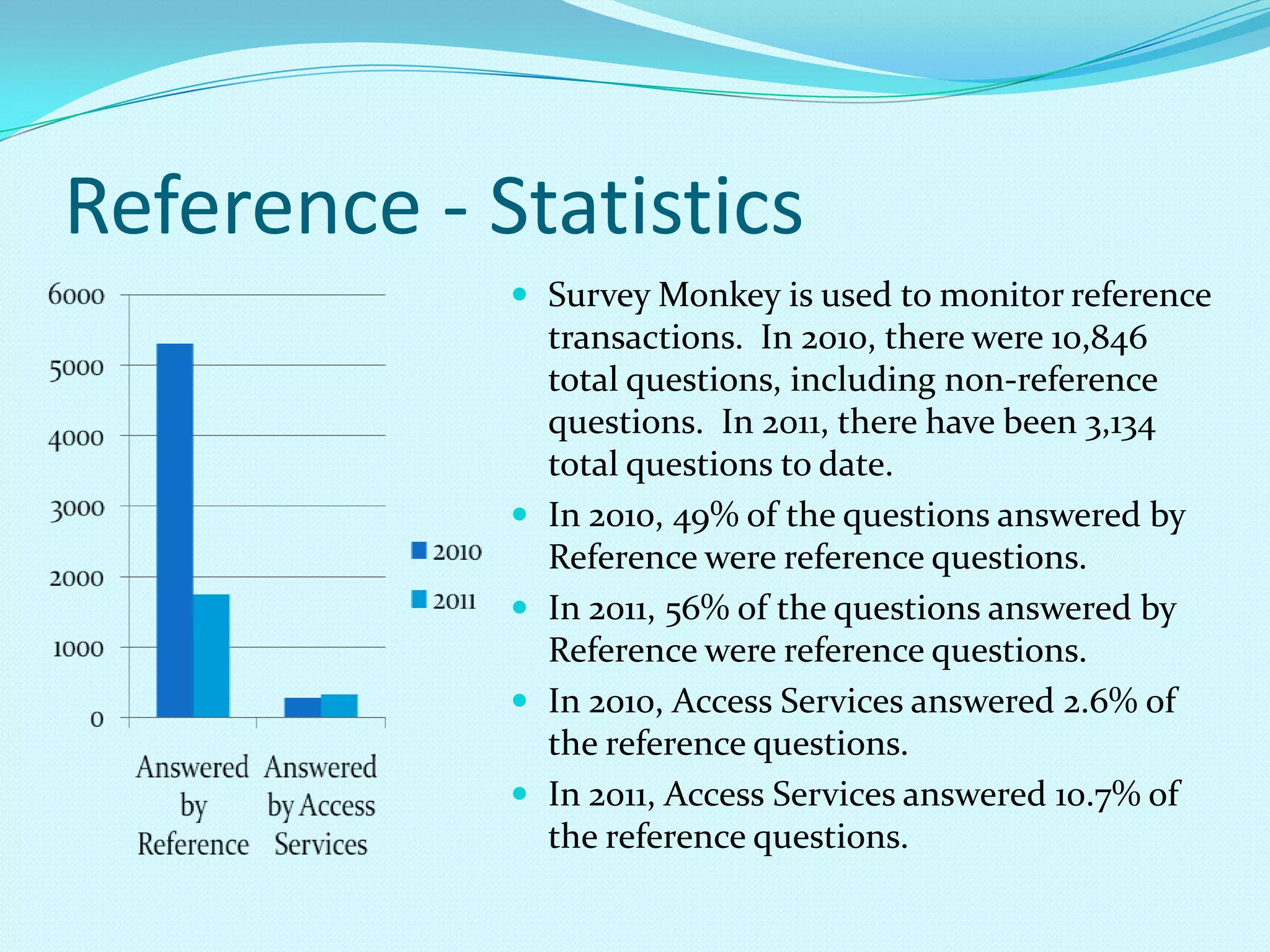
Reference - StatisticsSurvey Monkey is used to monitor reference transactions.  In 2010, there were 10,846 total questions, including non-reference questions.  In 2011, there have been 3,134 total questions to date.In 2010, 49% of the questions answered by Reference were reference questions.In 2011, 56% of the questions answered by Reference were reference questions.In 2010, Access Services answered 2.6% of the reference questions.In 2011, Access Services answered 10.7% of the reference questions.
Planning ProcessBegan in December 2009 with a planning committee and a “Final” version was approved January 2011Document categoriesQuick Reference Questions“On call” Referral Telephone, Text-a-Librarian, & Email QuestionsTechnical Assistance Evening & Weekend ServiceCross trainingLibrariansStaff
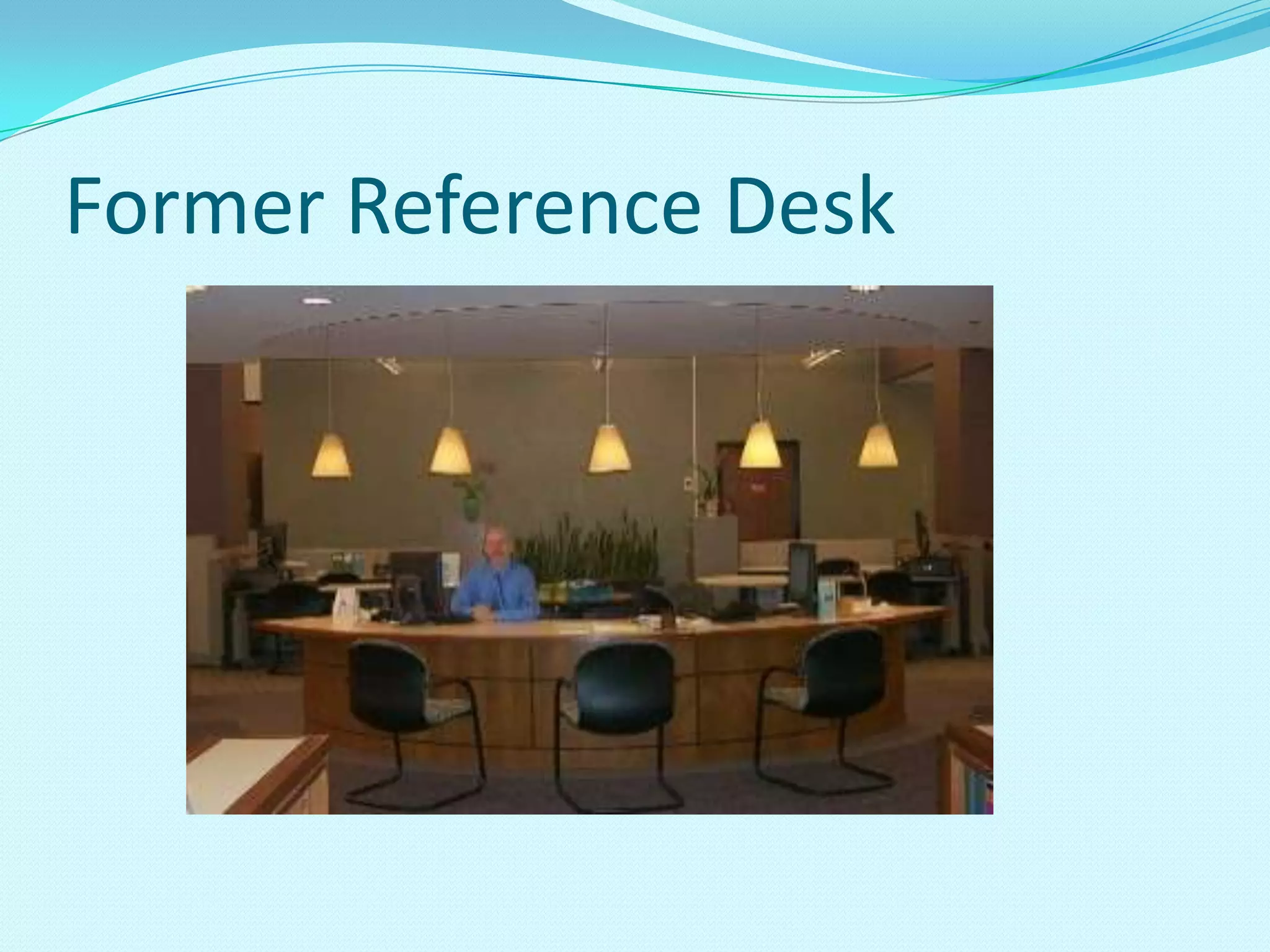
Former Reference Desk
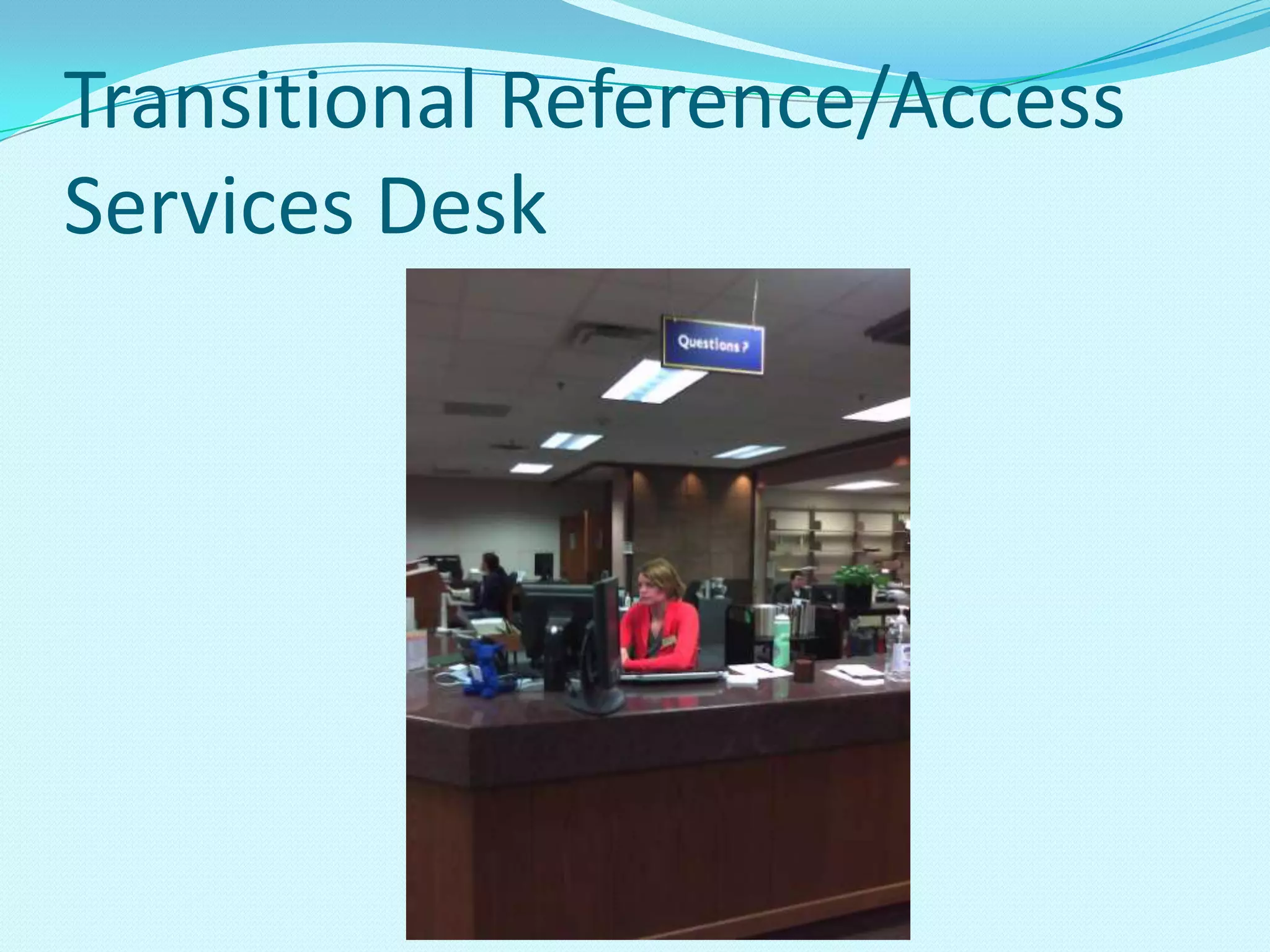
Merging DesksWhen the traffic merged: November 2010 – February 2011 (transitional phase)Moved to the new desk in February 2011 – present
Transitional Reference/Access Services Desk
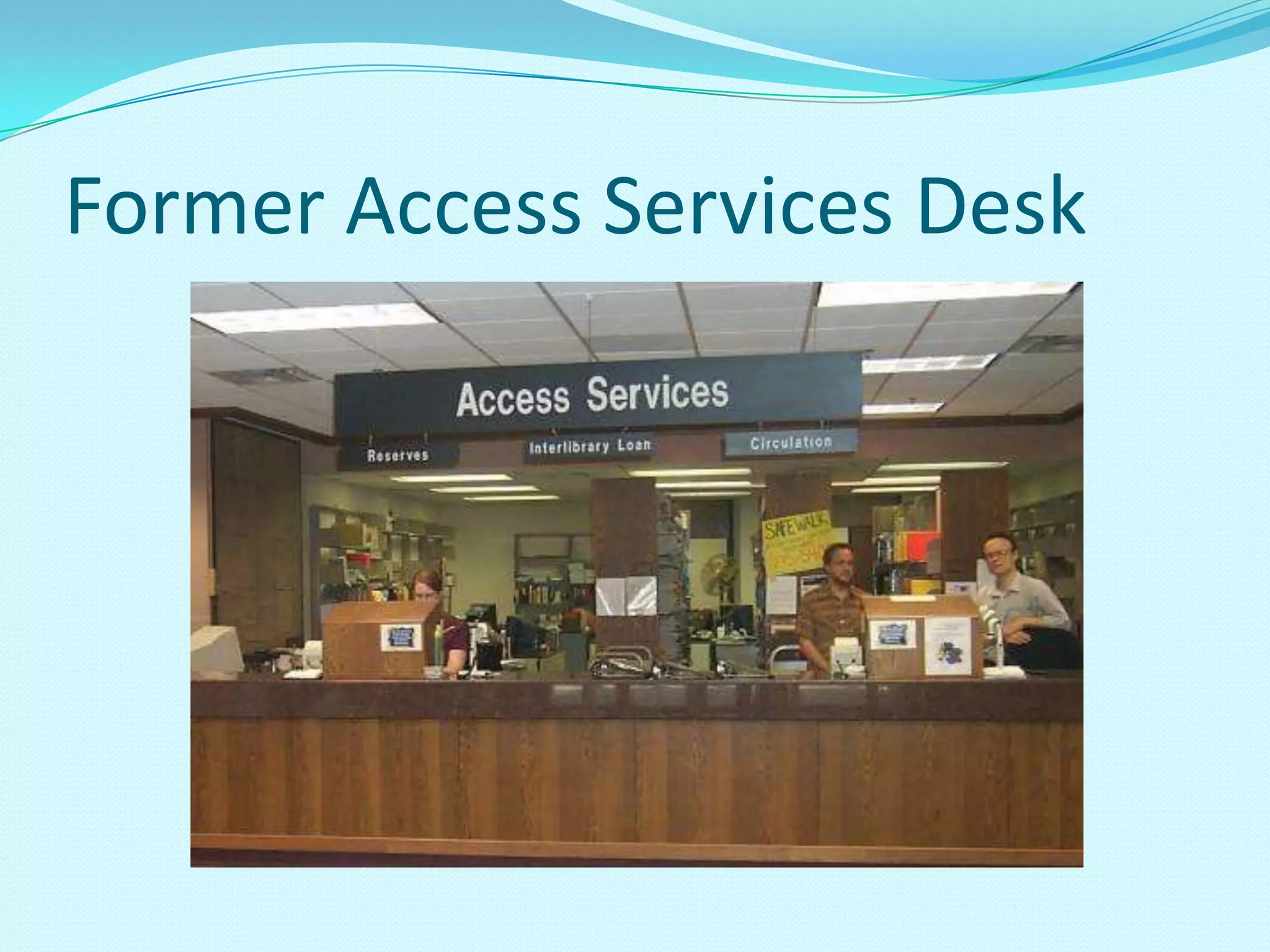
Former Access Services Desk
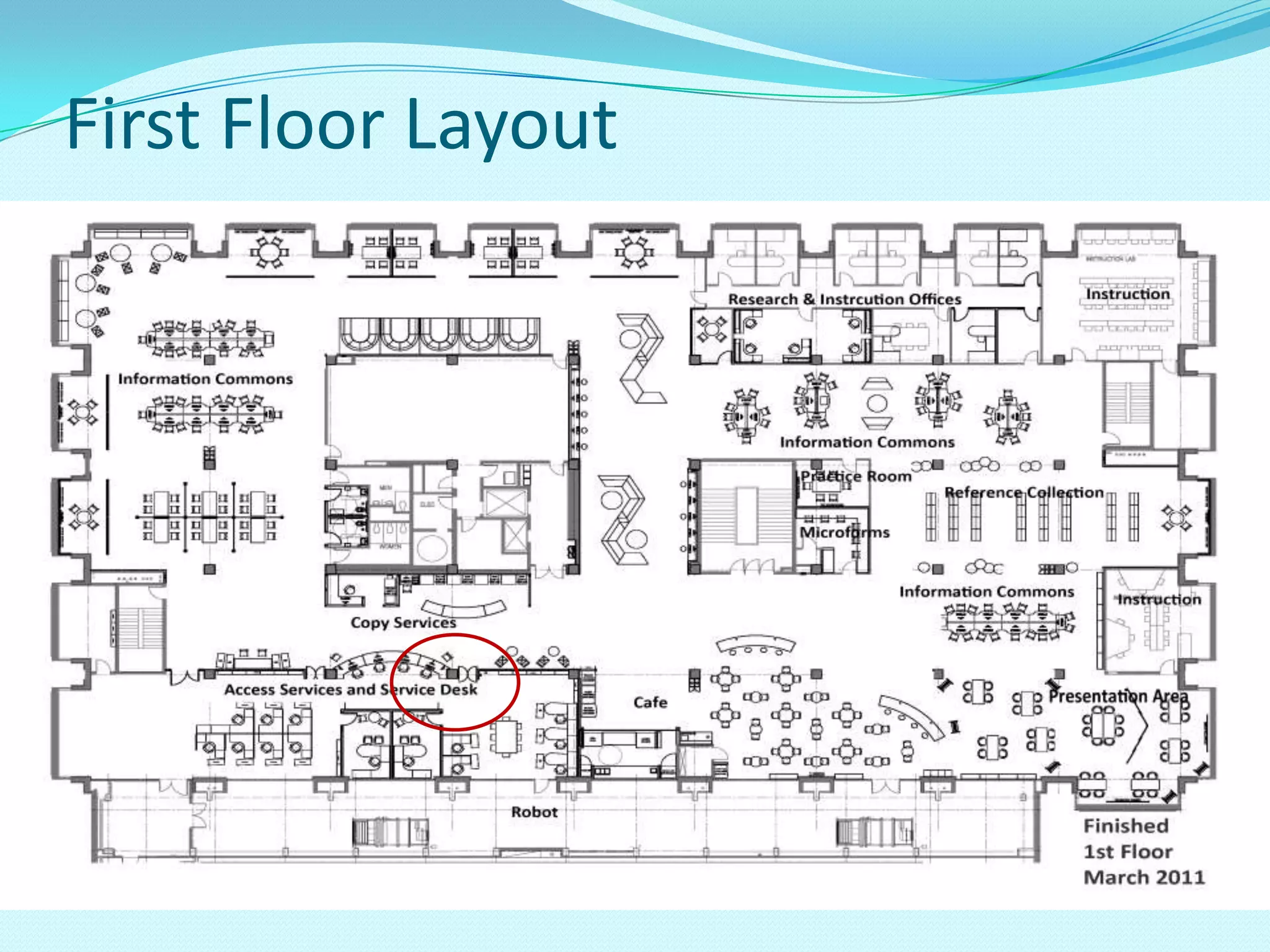
First Floor Layout
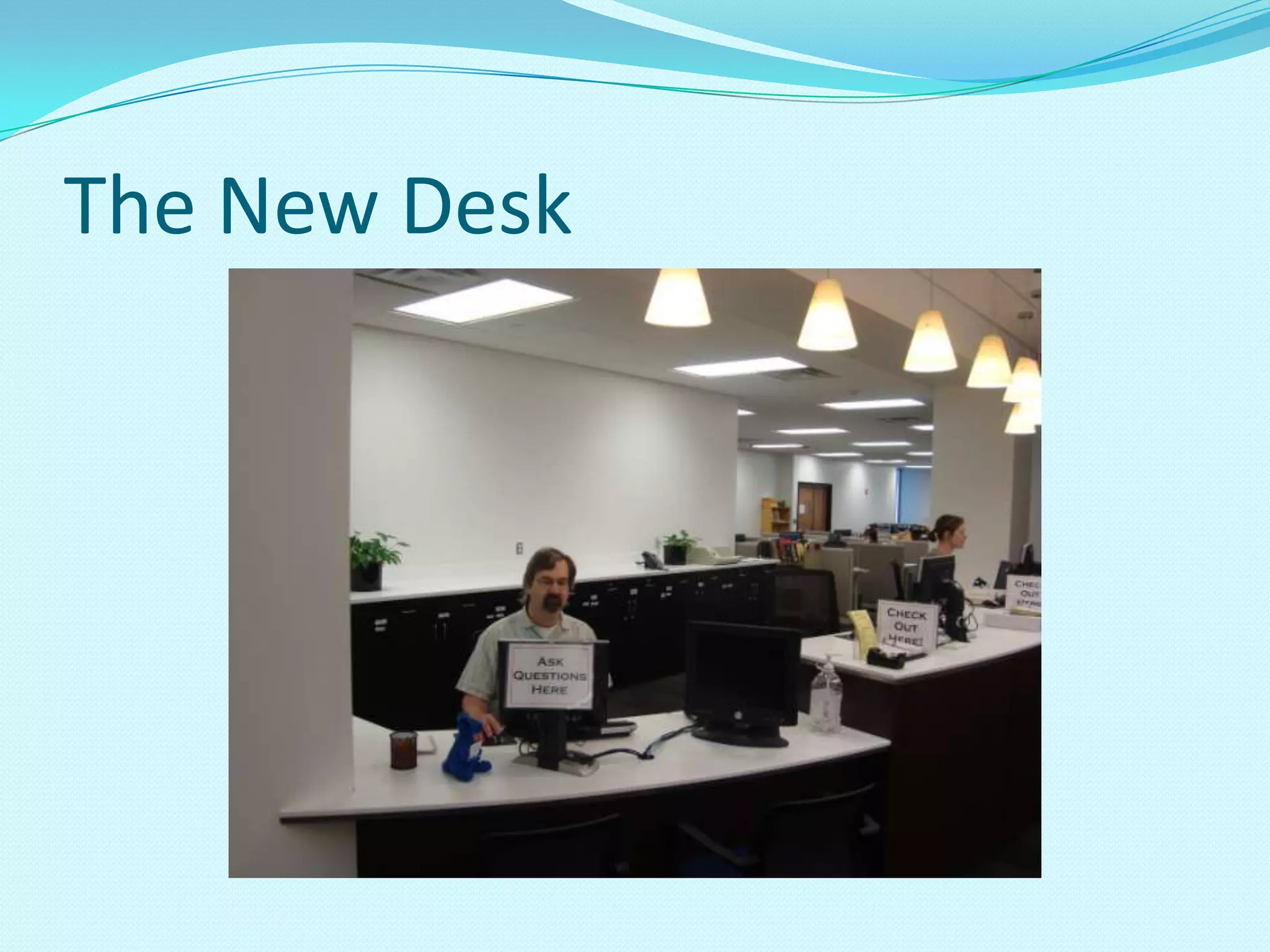
The New Desk
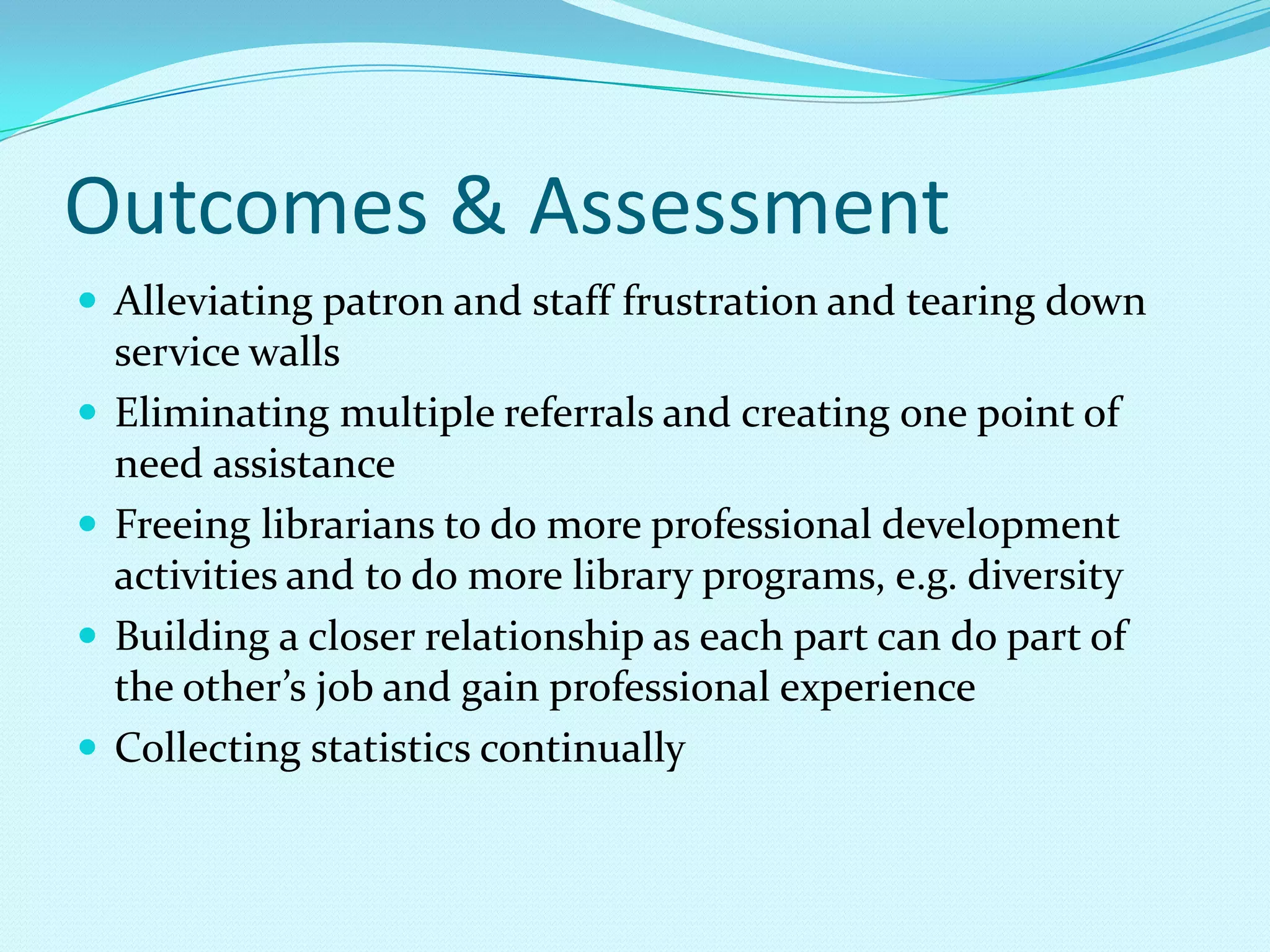
Outcomes & AssessmentAlleviating patron and staff frustration and tearing down service walls
Eliminating multiple referrals and creating one point of need assistance
Freeing librarians to do more professional development activities and to do more library programs, e.g. diversity
Building a closer relationship as each part can do part of the other’s job and gain professional experience
Collecting statistics continuallyIssues and ChallengesLimitations on some service evaluation, e.g. no statistics for “on call” referral.

Merging Traffic: A Combined Reference and Access Services Desk

  • 1.
    Merging Traffic: Planningfor and implementing a combined reference and access services deskTom Burns, Research & Instruction Librarian, UMKCburnstg@umkc.eduMelanie Church, Graduate Student Assistant, UMKCmjc4gb@mail.mizzou.eduFu Zhuo, Research & Instruction Librarian, UMKCzhuof@umkc.eduMay 21, 2011
  • 2.
    Merging Traffic: Planningfor and implementing a combined reference and access services desk
  • 3.
    Introduction and LiteratureReviewUMKC Library renovationDeclining reference statistics (Carlson 25-30)One point of service in libraries (Fitzpatrick 231-38)Reference desk staffing already changed from 2 to 1Merging two desks in academic libraries (Massey-Burzio 276-86, Flanagan 329-38, Meldrem 305-11)
  • 4.
    Reference - StatisticsSurveyMonkey is used to monitor reference transactions. In 2010, there were 10,846 total questions, including non-reference questions. In 2011, there have been 3,134 total questions to date.In 2010, 49% of the questions answered by Reference were reference questions.In 2011, 56% of the questions answered by Reference were reference questions.In 2010, Access Services answered 2.6% of the reference questions.In 2011, Access Services answered 10.7% of the reference questions.
  • 5.
    Planning ProcessBegan inDecember 2009 with a planning committee and a “Final” version was approved January 2011Document categoriesQuick Reference Questions“On call” Referral Telephone, Text-a-Librarian, & Email QuestionsTechnical Assistance Evening & Weekend ServiceCross trainingLibrariansStaff
  • 6.
  • 7.
    Merging DesksWhen thetraffic merged: November 2010 – February 2011 (transitional phase)Moved to the new desk in February 2011 – present
  • 8.
  • 9.
  • 10.
  • 11.
  • 12.
    Outcomes & AssessmentAlleviatingpatron and staff frustration and tearing down service walls
  • 13.
    Eliminating multiple referralsand creating one point of need assistance
  • 14.
    Freeing librarians todo more professional development activities and to do more library programs, e.g. diversity
  • 15.
    Building a closerrelationship as each part can do part of the other’s job and gain professional experience
  • 16.
    Collecting statistics continuallyIssuesand ChallengesLimitations on some service evaluation, e.g. no statistics for “on call” referral.
  • 17.
    Is it appropriatefor Access Service Staff to answer some reference questions such as catalog searching?
  • 18.
    Is it appropriatefor RIS staff to handle some Access Service functions?
  • 19.
    How much trainingis needed for each team?
  • 20.
    Who is moreresponsible for more complex technical questions?
  • 21.
    When should AccessService staff call for help when the scheduled reference staff is away to help a patron?
  • 22.
    Will RIS librariansand Access Services staff have two jobs?
  • 23.
    Will the increasedresponsibilities jeopardize both librarians and Access Services staff job security?SummaryThe transition has been mostly smoothThe new combined desk has provided opportunities for both librarians and staff to learn the automation system and serve their patrons betterTechnical problems are solved mainly by Access Services staff, so that librarians can focus more on research questions or consultationsLibrarians can do more outreach and marketing to engage faculty and studentsThe move has brought reference team and Access Service team closer, literally and figuratively
  • 24.
    Works Cited andConsultedBugg, Kimberley L., and Rosaline Y. Odom. "Extreme Makeover Reference Edition: Restructuring Reference Services at the Robert W. Woodruff Library, Atlanta University Center." Reference Librarian 50.2 (2009): 193-204. Library, Information Science & Technology Abstracts. EBSCO. Web. 4 May 2011.Carlson, Scott. “Are Reference Desks Dying Out? Librarians Struggle to Redefine—and in Some Cases Eliminate—the Venerable Institution.” The Reference Librarian 48.2 (2008): 25-30. Web. 4 May 2011. Fitzpatrick, Elizabeth B., Anne C. Moore, and Beth W. Lang. "Reference Librarians at the Reference Desk in a Learning Commons: A Mixed Methods Evaluation." The Journal of Academic Librarianship 34.3 (2008): 231-38. Education Full Text. Web. 12 May 2011.Flanagan, Pat and Lisa Horowitz.  “Exploring New Service Models: Can Consolidating Public Service Points Improve Response to Customer Needs.”  Journal of Academic Librarianship 26.5 (2000): 329-38.  Web. 11 May 2011.Lubker, Irene, Margaret Henderson, Catherine Canevari, and Barbara Wright. "Refocusing Reference Services Outside the Library Building: One Library's Experience." Medical Reference Services Quarterly 29.3 (2010): 218-228. Academic Search Premier. EBSCO. Web. 4 May 2011.Massey-Burzio, Virginia. “Reference Encounters of a Different Kind: A Symposium.” Journal of Academic Librarianship 18.5 (1992): 276-80.  Web.  12 May 2011.Meldrem, Joyce, Lori Mardis, and Carolyn Johnson. “Redesign Your Reference Desk: Get Rid of It!” ACRL Twelfth National Conference. Association of College & Research Libraries. Minneapolis, MN. 7 Apr. 2005. Web. 11 May 2011.Ryan, Susan M. “Reference Transactions Analysis: The Cost-Effectiveness of Staffing a Traditional Academic Reference Desk.” Journal of Academic Librarianship 34.5 (2008): 389-399. Web. 4 May 2011.
  • 25.
    Thanks!Special thanks toCindy Thompson and Diane Hunter for their contributions to this project.