LEVERAGINGAND INTERPRETING LIBRARY ASSESSMENT DATA
PULLINGTHEWHEAT FROMTHE CHAFF
Elizabeth Brown
Director of Assessment and Scholarly Communications
Binghamton University Libraries
April 20, 2016
Image Source: Flickr Public Domain
GATHERINGAND USINGASSESSMENT DATA
¡ Library assessment data – the basics
¡ Special Projects Data
¡ Local Qualitative Data
¡ Benchmarking Data
¡ Telling a story – some advice
Image Source: https://www.flickr.com/photos/woolgenie/16140095136/in/album-72157631115747450/
COLLECTINGASSESSMENT DATA –THE BASICS
¡ Service point activity – reference, instruction, ILL, circulation, institutional repository
input,gate counts for buildings, course reserves
¡ Collections – items added, electronic and print format, media and audiovisual items,
linear feet manuscripts
¡ Staffing – FTE, salaries and wages, fringe benefits, librarians, paraprofessional, student
levels
¡ Infrastructure – preservation, computers and technology, catalog and supporting
tools to access collections
ACRL,ARL,AND IPEDS
¡ Major statistical reports requestedof
U.S. academic libraries
¡ Annual collection periods based on
most recent fiscal year data
¡ Varying levels of public data available
for non-members
¡ Analysis and comparison tools for
benchmarkinglibrary services,
collections,andstaffing support
Image Source: https://www.flickr.com/photos/woolgenie/19176634162/in/album-72157631115747450/
ACRL ANNUAL STATISTICS
¡ AnnualWorksheet anddirections information:
https://acrl.countingopinions.com/
¡ ACRL Metrics – analysis tool to compare institutions
¡ General Information:http://www.acrlmetrics.com/
¡ Subscription Information:http://www.acrlmetrics.com/package.php
ARL STATISTICS & SALARY SURVEYS
¡ More information: http://www.arlstatistics.org/about/survey_pp
¡ AnnualARL Statistics Report published in print and as an ebook:
http://arlstatistics.org/home
¡ ARL Statistics Analytics available as a subscription: http://arlstatistics.org/analytics
¡ Selected statistics and table data are open access: http://arlstatistics.org/publications
IPEDSANNUAL LIBRARY STATISTICS
¡ IPEDS = Integrated Post-Secondary Education Data System
¡ NCES = National Center for Education Statistics
¡ Use collected IPEDs data (2013-2014):http://nces.ed.gov/ipeds/Home/UseTheData
Note: academic library data is currently provisional – final data not yet released
¡ Library Statistics Program (2000-2012):
https://nces.ed.gov/surveys/libraries/academic.asp
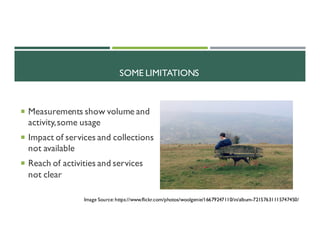
SOME LIMITATIONS
¡ Measurements show volume and
activity,some usage
¡ Impact of services and collections
not available
¡ Reach of activities and services
not clear
Image Source: https://www.flickr.com/photos/woolgenie/16679247110/in/album-72157631115747450/
SPECIAL PROJECTS DATA
¡ How are students using computer areas (information commons) in the
library?
¡ How can stacks overflow be reduced by analyzing circulation and
acquisition patterns by call number?
¡ Large lecture classes – what are they and are we reaching them?
¡ Publication activity of faculty and potential journal hosting opportunities
– where are they?
¡ How are collection needs changing with new faculty hires?
LOCAL QUALITATIVE DATA – SOME EXAMPLES
¡ Focus group information from specific users
¡ Secret shopper and other techniques for
measuring quality of service
¡ LibQUAL+ and LibQUAL+ lite surveys:
https://www.libqual.org/home
¡ Individualized library surveys:Triennial Survey
(University of Washington):
http://www.lib.washington.edu/assessment/surveys/
triennial
¡ Individualized topical surveys
Image Source: https://www.flickr.com/photos/woolgenie/16251173169/in/album-72157631115747450/
BENCHMARKING DATA SOURCES
¡ Library Journal’s Periodical Price Survey (Annual) :
http://lj.libraryjournal.com/2015/04/publishing/whole-lotta-
shakin-goin-on-periodicals-price-survey-2015/
¡ Library and Book Trade Almanac (formerly Bowker Annual):
http://books.infotoday.com/directories/Library-and-Book-
Trade-Almanac.shtml
¡ Institutional and Student ROI for library services
(Robert Dugan,University ofWest Florida):
http://libguides.uwf.edu/c.php?g=215171&p=1420704
¡ Annual Library Systems Report (Marshall Breeding):
http://americanlibrariesmagazine.org/2015/05/01/library-
systems-report/
Image Source:
https://www.flickr.com/photos/woolgenie/16200135443/in/album-
72157631115747450/
TELLINGA STORYWITH DATA – SOME ADVICE
¡ Remember your audience
¡ Match content to knowledge level
¡ Make message succinct
¡ Link analysis to existing data
¡ Show trends clearly – use simple
graphs and charts
¡ Make quotes for qualitative data –
intersperse with data to emphasize
messageImage Source:
https://www.flickr.com/photos/woolgenie/16140094366/in/album-
72157631115747450/
THANKYOU!
Elizabeth Brown
ebrown@binghamton.edu
607-777-4882
Slideshare: http://www.slideshare.net/ebrown
Thanks to Heather at flickr for images:
https://www.flickr.com/photos/woolgenie/
Image Source: Flckr, https://www.flickr.com/photos/woolgenie/21001156006/in/album-72157631115747450/

Brown apr20-3

  • 1.
    LEVERAGINGAND INTERPRETING LIBRARYASSESSMENT DATA PULLINGTHEWHEAT FROMTHE CHAFF Elizabeth Brown Director of Assessment and Scholarly Communications Binghamton University Libraries April 20, 2016 Image Source: Flickr Public Domain
  • 2.
    GATHERINGAND USINGASSESSMENT DATA ¡Library assessment data – the basics ¡ Special Projects Data ¡ Local Qualitative Data ¡ Benchmarking Data ¡ Telling a story – some advice Image Source: https://www.flickr.com/photos/woolgenie/16140095136/in/album-72157631115747450/
  • 3.
    COLLECTINGASSESSMENT DATA –THEBASICS ¡ Service point activity – reference, instruction, ILL, circulation, institutional repository input,gate counts for buildings, course reserves ¡ Collections – items added, electronic and print format, media and audiovisual items, linear feet manuscripts ¡ Staffing – FTE, salaries and wages, fringe benefits, librarians, paraprofessional, student levels ¡ Infrastructure – preservation, computers and technology, catalog and supporting tools to access collections
  • 4.
    ACRL,ARL,AND IPEDS ¡ Majorstatistical reports requestedof U.S. academic libraries ¡ Annual collection periods based on most recent fiscal year data ¡ Varying levels of public data available for non-members ¡ Analysis and comparison tools for benchmarkinglibrary services, collections,andstaffing support Image Source: https://www.flickr.com/photos/woolgenie/19176634162/in/album-72157631115747450/
  • 5.
    ACRL ANNUAL STATISTICS ¡AnnualWorksheet anddirections information: https://acrl.countingopinions.com/ ¡ ACRL Metrics – analysis tool to compare institutions ¡ General Information:http://www.acrlmetrics.com/ ¡ Subscription Information:http://www.acrlmetrics.com/package.php
  • 6.
    ARL STATISTICS &SALARY SURVEYS ¡ More information: http://www.arlstatistics.org/about/survey_pp ¡ AnnualARL Statistics Report published in print and as an ebook: http://arlstatistics.org/home ¡ ARL Statistics Analytics available as a subscription: http://arlstatistics.org/analytics ¡ Selected statistics and table data are open access: http://arlstatistics.org/publications
  • 7.
    IPEDSANNUAL LIBRARY STATISTICS ¡IPEDS = Integrated Post-Secondary Education Data System ¡ NCES = National Center for Education Statistics ¡ Use collected IPEDs data (2013-2014):http://nces.ed.gov/ipeds/Home/UseTheData Note: academic library data is currently provisional – final data not yet released ¡ Library Statistics Program (2000-2012): https://nces.ed.gov/surveys/libraries/academic.asp
  • 8.
    SOME LIMITATIONS ¡ Measurementsshow volume and activity,some usage ¡ Impact of services and collections not available ¡ Reach of activities and services not clear Image Source: https://www.flickr.com/photos/woolgenie/16679247110/in/album-72157631115747450/
  • 9.
    SPECIAL PROJECTS DATA ¡How are students using computer areas (information commons) in the library? ¡ How can stacks overflow be reduced by analyzing circulation and acquisition patterns by call number? ¡ Large lecture classes – what are they and are we reaching them? ¡ Publication activity of faculty and potential journal hosting opportunities – where are they? ¡ How are collection needs changing with new faculty hires?
  • 10.
    LOCAL QUALITATIVE DATA– SOME EXAMPLES ¡ Focus group information from specific users ¡ Secret shopper and other techniques for measuring quality of service ¡ LibQUAL+ and LibQUAL+ lite surveys: https://www.libqual.org/home ¡ Individualized library surveys:Triennial Survey (University of Washington): http://www.lib.washington.edu/assessment/surveys/ triennial ¡ Individualized topical surveys Image Source: https://www.flickr.com/photos/woolgenie/16251173169/in/album-72157631115747450/
  • 11.
    BENCHMARKING DATA SOURCES ¡Library Journal’s Periodical Price Survey (Annual) : http://lj.libraryjournal.com/2015/04/publishing/whole-lotta- shakin-goin-on-periodicals-price-survey-2015/ ¡ Library and Book Trade Almanac (formerly Bowker Annual): http://books.infotoday.com/directories/Library-and-Book- Trade-Almanac.shtml ¡ Institutional and Student ROI for library services (Robert Dugan,University ofWest Florida): http://libguides.uwf.edu/c.php?g=215171&p=1420704 ¡ Annual Library Systems Report (Marshall Breeding): http://americanlibrariesmagazine.org/2015/05/01/library- systems-report/ Image Source: https://www.flickr.com/photos/woolgenie/16200135443/in/album- 72157631115747450/
  • 12.
    TELLINGA STORYWITH DATA– SOME ADVICE ¡ Remember your audience ¡ Match content to knowledge level ¡ Make message succinct ¡ Link analysis to existing data ¡ Show trends clearly – use simple graphs and charts ¡ Make quotes for qualitative data – intersperse with data to emphasize messageImage Source: https://www.flickr.com/photos/woolgenie/16140094366/in/album- 72157631115747450/
  • 13.
    THANKYOU! Elizabeth Brown ebrown@binghamton.edu 607-777-4882 Slideshare: http://www.slideshare.net/ebrown Thanksto Heather at flickr for images: https://www.flickr.com/photos/woolgenie/ Image Source: Flckr, https://www.flickr.com/photos/woolgenie/21001156006/in/album-72157631115747450/