Working with campus partners to
integrate the library into students’
academic experience
Jan Fransen (fransen@umn.edu)
Service Lead for Researcher & Discovery Systems
University of Minnesota Libraries
Justifying the Library
NISOVirtual Conference
April 20, 2016
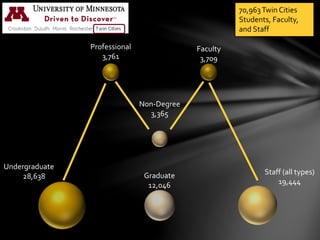
Undergraduate
28,638
Professional
3,761
Non-Degree
3,365
Graduate
12,046
Faculty
3,709
Staff (all types)
19,444
70,963Twin Cities
Students, Faculty,
and Staff
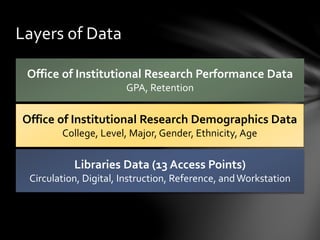
Layers of Data
Libraries Data (13 Access Points)
Circulation, Digital, Instruction, Reference, andWorkstation
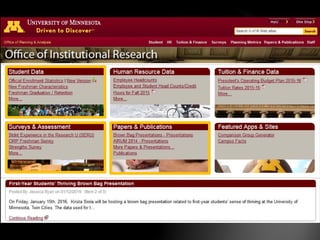
Office of Institutional Research Demographics Data
College, Level, Major, Gender, Ethnicity, Age
Office of Institutional Research Performance Data
GPA, Retention
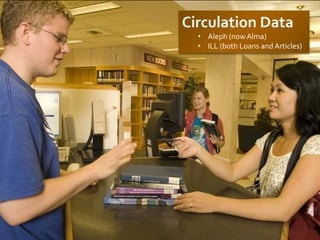
Circulation Data
• Aleph (now Alma)
• ILL (both Loans and Articles)
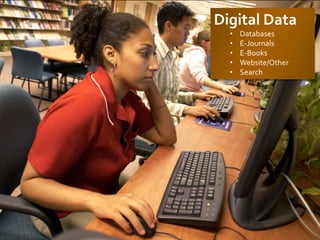
Digital Data
• Databases
• E-Journals
• E-Books
• Website/Other
• Search
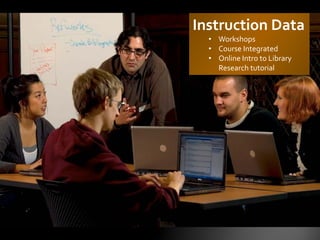
Instruction Data
• Workshops
• Course Integrated
• Online Intro to Library
Research tutorial
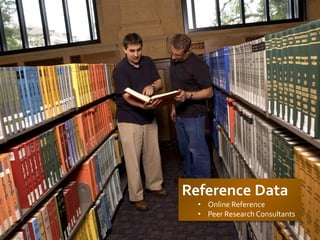
Reference Data
• Online Reference
• Peer Research Consultants
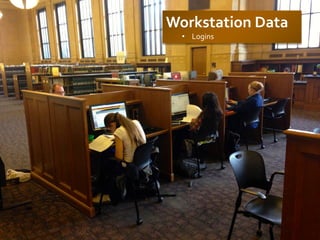
Workstation Data
• Logins
Institutional Research Partnership
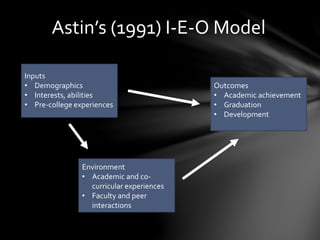
Astin’s (1991) I-E-O Model
Inputs
• Demographics
• Interests, abilities
• Pre-college experiences
Environment
• Academic and co-
curricular experiences
• Faculty and peer
interactions
Outcomes
• Academic achievement
• Graduation
• Development
2.784
2.628
2.854
2.926
3.016
3.258
2.755
2.932
3.079
3.141
3.224
3.503
2.5
2.7
2.9
3.1
3.3
3.5
3.7
Below 19 19-22 23-24 25-27 28-30 31-36
ACT Score
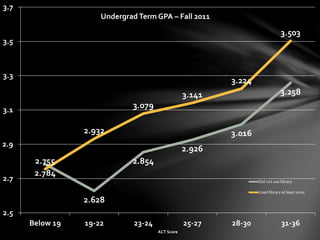
UndergradTerm GPA – Fall 2011
Did not use library
Used library at least once
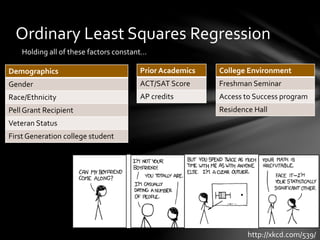
Ordinary Least Squares Regression
Demographics
Gender
Race/Ethnicity
Pell Grant Recipient
Veteran Status
First Generation college student
Prior Academics
ACT/SAT Score
AP credits
College Environment
Freshman Seminar
Access to Success program
Residence Hall
Holding all of these factors constant…
http://xkcd.com/539/
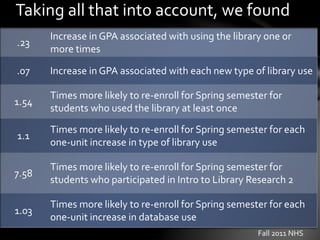
Taking all that into account, we found
.23
Increase in GPA associated with using the library one or
more times
.07 Increase in GPA associated with each new type of library use
1.54
Times more likely to re-enroll for Spring semester for
students who used the library at least once
1.1
Times more likely to re-enroll for Spring semester for each
one-unit increase in type of library use
7.58
Times more likely to re-enroll for Spring semester for
students who participated in Intro to Library Research 2
1.03
Times more likely to re-enroll for Spring semester for each
one-unit increase in database use
Fall 2011 NHS
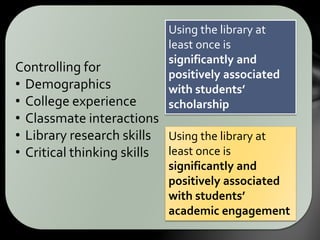
Controlling for
• Demographics
• College experience
• Classmate interactions
• Library research skills
• Critical thinking skills
Using the library at
least once is
significantly and
positively associated
with students’
scholarship
Using the library at
least once is
significantly and
positively associated
with students’
academic engagement
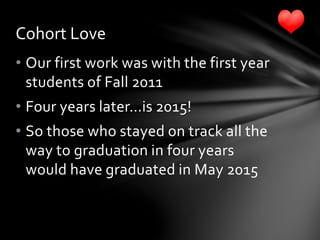
• Our first work was with the first year
students of Fall 2011
• Four years later…is 2015!
• So those who stayed on track all the
way to graduation in four years
would have graduated in May 2015
Cohort Love
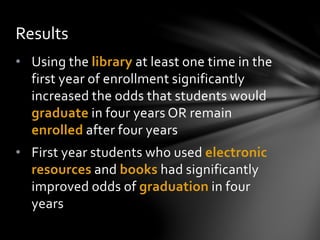
• Using the library at least one time in the
first year of enrollment significantly
increased the odds that students would
graduate in four years OR remain
enrolled after four years
• First year students who used electronic
resources and books had significantly
improved odds of graduation in four
years
Results
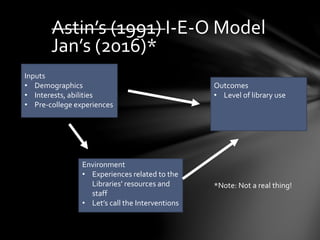
Astin’s (1991) I-E-O Model
Inputs
• Demographics
• Interests, abilities
• Pre-college experiences
Environment
• Experiences related to the
Libraries’ resources and
staff
• Let’s call the Interventions
Outcomes
• Level of library use
Jan’s (2016)*
*Note: Not a real thing!
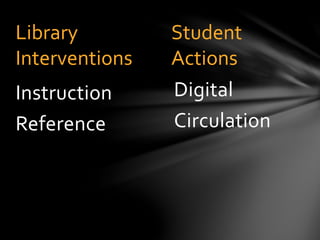
Digital
Circulation
Instruction
Reference
Library
Interventions
Student
Actions
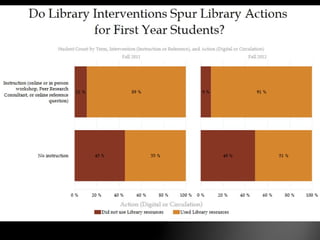
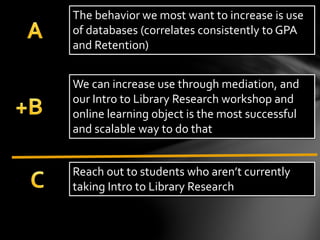
The behavior we most want to increase is use
of databases (correlates consistently to GPA
and Retention)
We can increase use through mediation, and
our Intro to Library Research workshop and
online learning object is the most successful
and scalable way to do that
Reach out to students who aren’t currently
taking Intro to Library Research
Working with Academic Advisers and
First Year Experience staff in the
Colleges
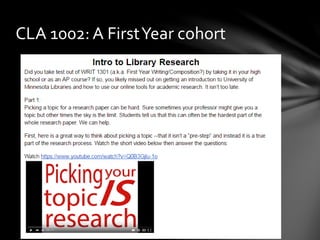
CLA 1002: A FirstYear cohort
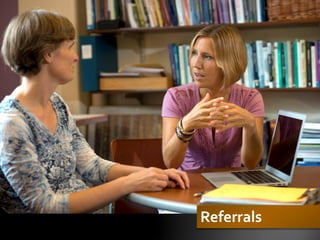
Referrals
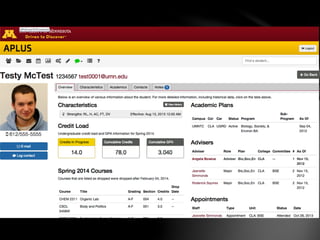
• Begin using APLUS for Libraries interactions with students
• More information enables us to provide the most appropriate help
to the student
• Closes the loop:Advisers can see what happens when they refer
• Allows us to refer to other campus partners
• Other ways to use the data
• Get to know the user community in aggregate (by college,
department, level…)
• Find out who’s NOT using our resources (but should be) and figure
out best ways to reach them
• Go beyond undergrads
Possible next steps
Library Data & Student Success
A project of the University of Minnesota Libraries, in collaboration with the
University of Minnesota Office of Institutional Research
Krista Soria (OIR)
Shane Nackerud (Libraries)
Jan Fransen (Libraries)
Kate Peterson (Libraries)
Kristen Mastel (Libraries)
More information about the project on our blog at z.umn.edu/LDSS
Find a list of our publications at z.umn.edu/LDSSPubs

Fransen apr20-5

  • 1.
    Working with campuspartners to integrate the library into students’ academic experience Jan Fransen (fransen@umn.edu) Service Lead for Researcher & Discovery Systems University of Minnesota Libraries Justifying the Library NISOVirtual Conference April 20, 2016
  • 2.
  • 3.
    Layers of Data LibrariesData (13 Access Points) Circulation, Digital, Instruction, Reference, andWorkstation Office of Institutional Research Demographics Data College, Level, Major, Gender, Ethnicity, Age Office of Institutional Research Performance Data GPA, Retention
  • 4.
    Circulation Data • Aleph(now Alma) • ILL (both Loans and Articles)
  • 5.
    Digital Data • Databases •E-Journals • E-Books • Website/Other • Search
  • 6.
    Instruction Data • Workshops •Course Integrated • Online Intro to Library Research tutorial
  • 7.
    Reference Data • OnlineReference • Peer Research Consultants
  • 8.
  • 9.
  • 11.
    Astin’s (1991) I-E-OModel Inputs • Demographics • Interests, abilities • Pre-college experiences Environment • Academic and co- curricular experiences • Faculty and peer interactions Outcomes • Academic achievement • Graduation • Development
  • 12.
    2.784 2.628 2.854 2.926 3.016 3.258 2.755 2.932 3.079 3.141 3.224 3.503 2.5 2.7 2.9 3.1 3.3 3.5 3.7 Below 19 19-2223-24 25-27 28-30 31-36 ACT Score UndergradTerm GPA – Fall 2011 Did not use library Used library at least once
  • 13.
    Ordinary Least SquaresRegression Demographics Gender Race/Ethnicity Pell Grant Recipient Veteran Status First Generation college student Prior Academics ACT/SAT Score AP credits College Environment Freshman Seminar Access to Success program Residence Hall Holding all of these factors constant… http://xkcd.com/539/
  • 14.
    Taking all thatinto account, we found .23 Increase in GPA associated with using the library one or more times .07 Increase in GPA associated with each new type of library use 1.54 Times more likely to re-enroll for Spring semester for students who used the library at least once 1.1 Times more likely to re-enroll for Spring semester for each one-unit increase in type of library use 7.58 Times more likely to re-enroll for Spring semester for students who participated in Intro to Library Research 2 1.03 Times more likely to re-enroll for Spring semester for each one-unit increase in database use Fall 2011 NHS
  • 15.
    Controlling for • Demographics •College experience • Classmate interactions • Library research skills • Critical thinking skills Using the library at least once is significantly and positively associated with students’ scholarship Using the library at least once is significantly and positively associated with students’ academic engagement
  • 16.
    • Our firstwork was with the first year students of Fall 2011 • Four years later…is 2015! • So those who stayed on track all the way to graduation in four years would have graduated in May 2015 Cohort Love
  • 17.
    • Using thelibrary at least one time in the first year of enrollment significantly increased the odds that students would graduate in four years OR remain enrolled after four years • First year students who used electronic resources and books had significantly improved odds of graduation in four years Results
  • 19.
    Astin’s (1991) I-E-OModel Inputs • Demographics • Interests, abilities • Pre-college experiences Environment • Experiences related to the Libraries’ resources and staff • Let’s call the Interventions Outcomes • Level of library use Jan’s (2016)* *Note: Not a real thing!
  • 20.
  • 22.
    The behavior wemost want to increase is use of databases (correlates consistently to GPA and Retention) We can increase use through mediation, and our Intro to Library Research workshop and online learning object is the most successful and scalable way to do that Reach out to students who aren’t currently taking Intro to Library Research
  • 23.
    Working with AcademicAdvisers and First Year Experience staff in the Colleges
  • 24.
    CLA 1002: AFirstYear cohort
  • 26.
  • 27.
    • Begin usingAPLUS for Libraries interactions with students • More information enables us to provide the most appropriate help to the student • Closes the loop:Advisers can see what happens when they refer • Allows us to refer to other campus partners • Other ways to use the data • Get to know the user community in aggregate (by college, department, level…) • Find out who’s NOT using our resources (but should be) and figure out best ways to reach them • Go beyond undergrads Possible next steps
  • 28.
    Library Data &Student Success A project of the University of Minnesota Libraries, in collaboration with the University of Minnesota Office of Institutional Research Krista Soria (OIR) Shane Nackerud (Libraries) Jan Fransen (Libraries) Kate Peterson (Libraries) Kristen Mastel (Libraries) More information about the project on our blog at z.umn.edu/LDSS Find a list of our publications at z.umn.edu/LDSSPubs