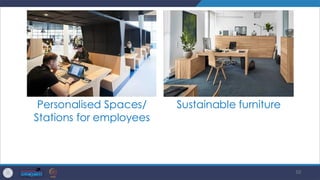
5
What is VisualMerchandising?
o Visual merchandising is the
practice of strategically
arranging product displays
and other visual elements to
attract customers.
Source:
https://www.iiad.edu.in/the-circle/the-role-of-interior-designing-and-visual-merchandising-in-retail-
spaces/#:~:text=Visual%20merchandising%20is%20the%20practice,customer%20experience%20to
%20drive%20sales.
6.
6
What is VisualMerchandising?
o The main goal of visual
merchandising is to provide
a positive and impactful
customer experience to
drive sales.
Source:
https://www.iiad.edu.in/the-circle/the-role-of-interior-designing-and-visual-merchandising-in-retail-
spaces/#:~:text=Visual%20merchandising%20is%20the%20practice,customer%20experience%20to
%20drive%20sales.
7.
7
ZARA Stores Emphasizingon
Experiential Design
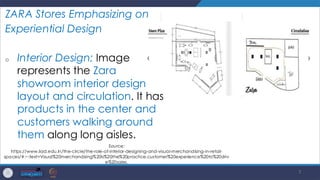
o Interior Design: Image
represents the Zara
showroom interior design
layout and circulation. It has
products in the center and
customers walking around
them along long aisles.
Source:
https://www.iiad.edu.in/the-circle/the-role-of-interior-designing-and-visual-merchandising-in-retail-
spaces/#:~:text=Visual%20merchandising%20is%20the%20practice,customer%20experience%20to%20driv
e%20sales.
8.
8
ZARA Stores Emphasizingon
Experiential Design
• Visual Merchandise:
The showroom showcases
complementary attires
together to create a complete
outfit. It focuses on arranging
products in mannequins and
interactive clothing displays.
Source:
https://www.iiad.edu.in/the-circle/the-role-of-interior-designing-and-visual-merchandising-in-retail-
spaces/#:~:text=Visual%20merchandising%20is%20the%20practice,customer%20experience%20to%20drive%20sales.
9.
9
Types of VisualMerchandising
_ Display Windows
Display windows catch the attention
of potential customers at the street
level to draw them into the store.
They often help retailers highlight
new stock and promotions while
communicating the kinds of products
shoppers can expect upon entering.
10.
10
Types of VisualMerchandising
_ Interior Displays
Interior displays are smaller, in-store
presentations that showcase specific
products or shopper needs. They can
take many forms, from glass cases
containing jewelry to mannequins
displaying clothing items.
11.
11
Types of VisualMerchandising
_ Point-of-Purchase Displays
These displays present impulse offers
to customers as they approach the
checkout counter. For example,
supermarkets have specialized
shelving for magazines, candy, or
soda. Some retailers also feature a
“deal of the day” display that a
cashier can retrieve upon request.
12.
12
Types of VisualMerchandising
_ Seasonal displays
Seasonal products often require
specialized promotions and signage.
Seasonal displays meet these needs
by showcasing promotions and
products that shoppers need within a
specific timeframe. Some common
examples include summer swimwear,
back-to-school promotions, or
elaborate Christmas decorations.
13.
13
Types of VisualMerchandising
_ Category displays
Many retailers arrange products by
categories, in ways that highlight
distinct features.
In a grocery store, openly displaying
fruits and vegetables emphasizes
their freshness compared to other
packaged goods.
14.
14
Types of VisualMerchandising
_ Interactive displays
Many displays can engage
shopper attention directly.
In-store demonstrations and
free samples accomplish this
by encouraging customers to
interact with them in passing.
15.
15
Types of VisualMerchandising
_Interactive displays
In the 2020s, the cutting edge of
visual merchandising uses
technology to enhance the
shopping experience.
For example, retailers can use
display screens that give directions
or showcase promotional items.
16.
16
Types of VisualMerchandising
_ E-commerce and in-App
Storefronts
Many customers may not enter
brick-and-mortar stores at all.
But, visual merchandising
applies to online shopping too.
Source:
https://www.resonai.com/blog/visual-
merchandising
17.
17
Types of VisualMerchandising
_E-commerce and in-app
storefronts
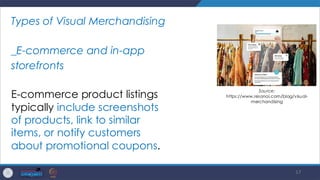
E-commerce product listings
typically include screenshots
of products, link to similar
items, or notify customers
about promotional coupons.
Source:
https://www.resonai.com/blog/visual-
merchandising
18.
18
Types of VisualMerchandising
_ E-commerce and in-app
storefronts
Retailers cannot afford to
overlook visual merchandising
techniques that will make their
shopping apps and websites
more appealing to visitors.
Source:
https://www.resonai.com/blog/visual-
merchandising
19.
19
Best Practices ofVisual Merchandising
Make effective use of light and color
Given the visual nature of visual
merchandising, it’s no surprise that
light and colour are significant
ingredients to draw from.
According to one retailer, simply
updating the lighting fixtures
increased their sales by 12 %.
20.
20
Best Practices ofVisual Merchandising
• Colour, is very effective at
communicating subtle details.
Sometimes a lack of light or color
can have a surprising impact.
Spotlights can help customers
focus on certain products.
• Framing products with specific
colors can help contextual
details pop out.
21.
21
Communicate Details withSigns
Signage is immensely helpful when
communicating specific details that
might help shoppers choose
between different products.
The key is placing signs in ways that
supplement the product without
disrupting the overall presentation.
22.
22
Communicate Details withSigns
Following are some excellent
examples:
Banners: Hanging banner is an
excellent technique for grouping
related products together.
Consider using them to promote
seasonal sales or direct attention
to each in-store category.
23.
23
Always avoid Clutter
Makingeffective use of floor space
is a vital technique. Give your visual
merchandising displays a little extra
room to breathe. Retailers can use
the space around a product display,
for signs instead of additional items.
Outside of visual aesthetics, minimal
displays have other benefits.
24.
24
Always avoid Clutter
Inthe wake of COVID-19, many
retailers reduced the shelf space and
cut back on the number of display
areas. By making the best use of limited
space, it was easier to implement social
distancing practices. To make up the
difference, they considered digital signs
or AR technology that presented all
items on a local screen.
25.
25
Store Layout asVisual Merchandising
While product displays are an essential
part of visual merchandising, one does
not want them to clash with the rest of
the store.
Taking a step back to consider overall
floor layout is essential. Along with
ensuring that there is enough space for
displays, it also aligns the entire in-store
experience with the brand.
26.
26
Store Layout asVisual Merchandising
_ Common Examples
1. Grid
Perhaps the most recognizable store
layout is the grid, where products fit
into densely-packed aisles.
This technique is common in
supermarkets, grocery stores,
pharmacies, and many more.
27.
27
Store Layout asVisual Merchandising
_ Common Examples
1. Grid
Grids benefit retail locations that
need to maximize merchandise on
display, while supporting optimal foot
traffic.
28.
28
Store Layout asVisual Merchandising
_ Common Examples
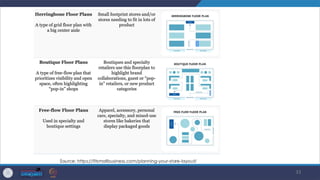
2. Herringbone
While grids are useful in large retail
stores, they tend to feel overcrowded
in smaller locations. The herringbone
grid variant opens the floor with a
central pathway to the checkout
that branches into grids on each size.
29.
29
Store Layout asVisual Merchandising
_ Common Examples
2. Herringbone
It even creates opportunities for
interior displays at aisle entrances,
although they can limit the visibility
of products within each aisle.
30.
30
Store Layout asVisual Merchandising
_ Common Examples
3. Loop
• Loops guide customers along a
fixed path to see all products and
categories before reaching the
checkout counters.
• This layout maximizes product
visibility and streamlines customer
traffic but can disrupt a casual
browsing experience.
31.
31
Store Layout asVisual Merchandising
_ Common Examples
3. Loop
Loops are often found in
museums and gift shops,
although some retailers like
IKEA have been able to
implement them successfully.
35
Future of VisualMerchandising
● The future of visual merchandising
is likely to be focused on the use
of technology to create
interactive experiences for
customers.
● This includes the use of
augmented reality, virtual reality,
and other technologies to create
immersive environments that
draw customers in.
36.
36
Future of VisualMerchandising
● AI-driven technologies are
also being used to better
understand customer
preferences and tailor displays
and promotions accordingly.
● Additionally, retailers are likely
to leverage data-driven
insights to better inform the
visual merchandising decisions.
38
Modularity in InteriorDesign
refers to the design principle
of subdividing a space into
smaller parts called
modules.
These modules can be
independently created,
modified, replaced, or
exchanged with other
components.
3D Printed
Connectors of Tobias
Lugmeier’s + Wood
Furniture System
39.
39
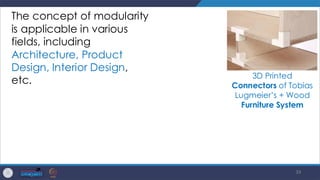
The concept ofmodularity
is applicable in various
fields, including
Architecture, Product
Design, Interior Design,
etc. 3D Printed
Connectors of Tobias
Lugmeier’s + Wood
Furniture System
40.
40
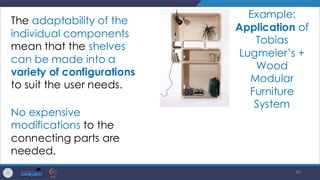
The adaptability ofthe
individual components
mean that the shelves
can be made into a
variety of configurations
to suit the user needs.
No expensive
modifications to the
connecting parts are
needed.
Example:
Application of
Tobias
Lugmeier’s +
Wood
Modular
Furniture
System
41.
41
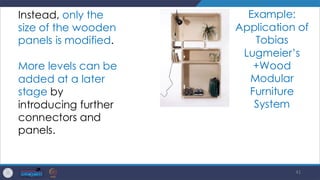
Instead, only the
sizeof the wooden
panels is modified.
More levels can be
added at a later
stage by
introducing further
connectors and
panels.
Example:
Application of
Tobias
Lugmeier’s
+Wood
Modular
Furniture
System
42.
42
In Interior Design,Modularity offers
several Benefits and Opportunities
● Flexibility
○ Modular interiors allow for
flexibility in design and
layout.
43.
43
In Interior Design,Modularity offers
several Benefits and Opportunities
● Flexibility
○ The modular components can
be rearranged or reconfigured
to adapt to changing needs or
preferences.
44.
44
In Interior Design,Modularity offers
several Benefits and Opportunities
● Functionality
○ Modular interiors are
designed to maximize the
functionality of a room.
45.
45
In Interior Design,Modularity offers
several Benefits and Opportunities
● Functionality
○ Clever storage solutions and
modular storage units are
incorporated to optimize
space and organization.
46.
46
In Interior Design,Modularity offers
several Benefits and Opportunities
● Efficiency
○ Modular interiors can be
more efficient in terms of
resource utilization and
construction.
47.
47
In Interior Design,Modularity offers
several Benefits and Opportunities
● Efficiency
○ Modular components can
be prefabricated in a
factory setup, resulting in
reduced waste and a lower
carbon footprint.
48.
48
In Interior Design,Modularity offers
several Benefits and Opportunities
● Customization
○ The modules can be tailored to
reflect the owner's personality
and style preferences.
○ Modular interiors offer the
opportunity for customization.
49.
49
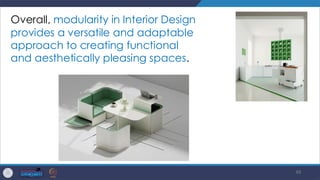
Overall, modularity inInterior Design
provides a versatile and adaptable
approach to creating functional
and aesthetically pleasing spaces.
52
The concept ofPortability in
Interior Design refers to the ability
to easily move or reconfigure
furniture, decor, and other
elements within a space.
It emphasizes flexibility and
adaptability, allowing one to
change the layout, style, or
function of a room to suit the
evolving needs or preferences.
53.
53
Portability in InteriorDesign can be
achieved through various means
● Furniture
○ Choosing lightweight and
modular furniture pieces that
are easy to move and
rearrange.
54.
54
● Furniture
○ Thisallows to quickly
transform the layout and
functionality of a space
without much effort.
○ Examples include chairs
with handles, folding tables,
stackable stools, and
wheeled storage units.
55.
55
● Multi-Purpose and
ConvertibleFurniture
○ Furniture items that
serve multiple functions
or can be transformed
into different
configurations
56.
56
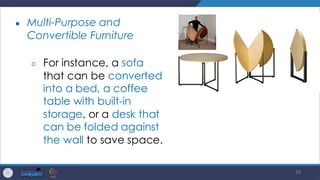
● Multi-Purpose and
ConvertibleFurniture
○ For instance, a sofa
that can be converted
into a bed, a coffee
table with built-in
storage, or a desk that
can be folded against
the wall to save space.
57.
57
● Portable Storage
Solutions
○Using freestanding
storage units, such
as bookshelves,
cabinets, or
wardrobes, that
can be easily
moved around.
58.
58
● Portable Storage
Solutions
○This allows to adapt
the storage layout
according to the
changing needs or
relocate them when
moving to a new
space.
59.
59
● Decorative Elements
○Opting for portable
decor items like floor
lamps, movable
screens, room
dividers, and
lightweight artwork.
60.
60
● Decorative Elements
○These can be shifted
to create new focal
points, divide spaces,
or update the
ambiance of a room.
61.
61
● Temporary Installations
○Utilizing removable
wallpaper, peel-and-
stick tiles, or modular
wall panels that can
be easily installed
and removed without
causing damage to
the existing surfaces.
62.
62
● Temporary Installations
○This gives the freedom to
experiment with different
patterns, textures, and
colors without committing
to a permanent change.
63.
63
The benefits ofincorporating
portability in Interior Design are
numerous.
It allows to maximize space
utilization, adapt to different
activities or events,
accommodate guests, and
create a fresh look whenever
desired.
64.
64
The benefits ofincorporating
portability in Interior Design are
numerous.
Portable design elements can be
particularly useful for those living
in rental spaces or frequently
changing environments.
66
The concept ofFoldability in
Interior Design refers to the
ability of furniture and
architectural elements to fold
or collapse into a more
compact form when not in use.
It focuses on space-saving
solutions that optimize
functionality and allow for
efficient storage or
easy transportation.
67.
67
Foldability can beapplied to various
aspects of Interior Design, including
furniture, partitions, and fixtures.
Some examples
● Folding Furniture
○ This can include foldable
tables, chairs, beds, and even
shelving units.
68.
68
● Folding Furniture
○Foldable furniture pieces
are designed to be easily
folded or collapsed when
not needed, minimizing
their footprint and making
them convenient for
storage or transport.
69.
69
● Folding Furniture
○These versatile pieces
are especially useful in
small spaces where
maximizing floor area is
crucial.
70.
70
● Folding Partitionsand Screens
○ Folding partitions or
screens can be used to
divide or create separate
areas within a room.
○ They can be folded and
expanded as needed,
allowing for flexible spatial
arrangements.
71.
71
● Foldable StorageSolutions
○ Foldable storage
solutions provide a
compact and efficient
way to organize
belongings.
○ This helps in keeping
the space tidy and
clutter-free.
72.
72
● Foldable StorageSolutions
○ For example, collapsible
fabric storage bins or
hanging organizers that
can be folded and put
away when not in use.
73.
73
● Foldable Fixtures
○Certain fixtures in
interior design, such as
folding countertops or
built-in ironing boards
that can be folded out
and tucked away
when not in use,
exemplify the concept
of foldability.
74.
74
● Foldable Fixtures
○These fixtures are designed
to maximize functionality
while minimizing the space
they occupy.
75.
75
● Foldable Wallsor Ceilings
○ In some cases, foldable
walls or ceilings can be
employed to create
convertible spaces.
○ These architectural
elements can be folded or
expanded to modify the
size and layout of a room.
76.
76
The concept offoldability
in interior design offers
practical advantages,
particularly in compact
living spaces or
environments where
flexibility is essential.
77.
77
By incorporating
foldable elements,one
can optimize space
utilization, easily adapt
to different needs or
occasions, and create a
more versatile and
functional interior
environment.
79
DIY (Do-It-Yourself) Interior
Designrefers to the practice
of designing and decorating
space, without hiring a
professional designer or
contractor.
It allows to unleash creativity,
personalize space, and often
save money in the process.
80.
80
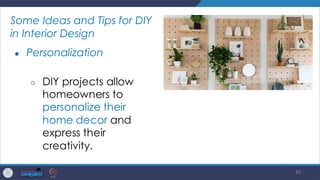
Some Ideas andTips for DIY
in Interior Design
● Personalization
○ DIY projects allow
homeowners to
personalize their
home decor and
express their
creativity.
81.
81
● Personalization
○ Frompainting
walls to creating
unique art pieces,
DIY projects can
add a personal
touch to spaces.
82.
82
● Cost -Saving
○ DIY projects can be a cost-
effective way to decorate or
renovate a space/ project.
○ By using recycled or
repurposed materials, one can
save money while creating
unique and eco-friendly
designs.
83.
83
● Inspiration
○ Magazines,websites, and social
media platforms offer a wealth of
inspiration and ideas for DIY
projects.
○ From color schemes to furniture
arrangements, homeowners can
find inspiration for their DIY projects
and create a cohesive design.
84.
84
● Design Principles
○Understanding basic design
principles, such as color,
texture, and balance, can
help users create successful
DIY projects.
85.
85
● Design Principles
○By following these
principles, users can
create harmonious
and visually
appealing designs.
86.
86
● Skill Level
○DIY projects can range from
simple to complex, depending
on the homeowner's skill level
and experience.
○ Starting with small, easy
projects can help build
confidence and skills for more
challenging projects.
88
● By integratingModularity,
Portability, Foldability, and
DIY in Interior Design, one
can achieve a dynamic
and adaptable space.
● For example, one could
choose modular furniture
systems that can be easily
disassembled and
reconfigured according to
the changing needs.
89.
89
● They empowerto optimize
spaces, adapt to different
activities or occasions, and
express creativity through
hands-on DIY projects.
● The integration of Modularity,
Portability, Foldability, and DIY
offers endless possibilities for
transforming interior environment
according to evolving needs and
desires.