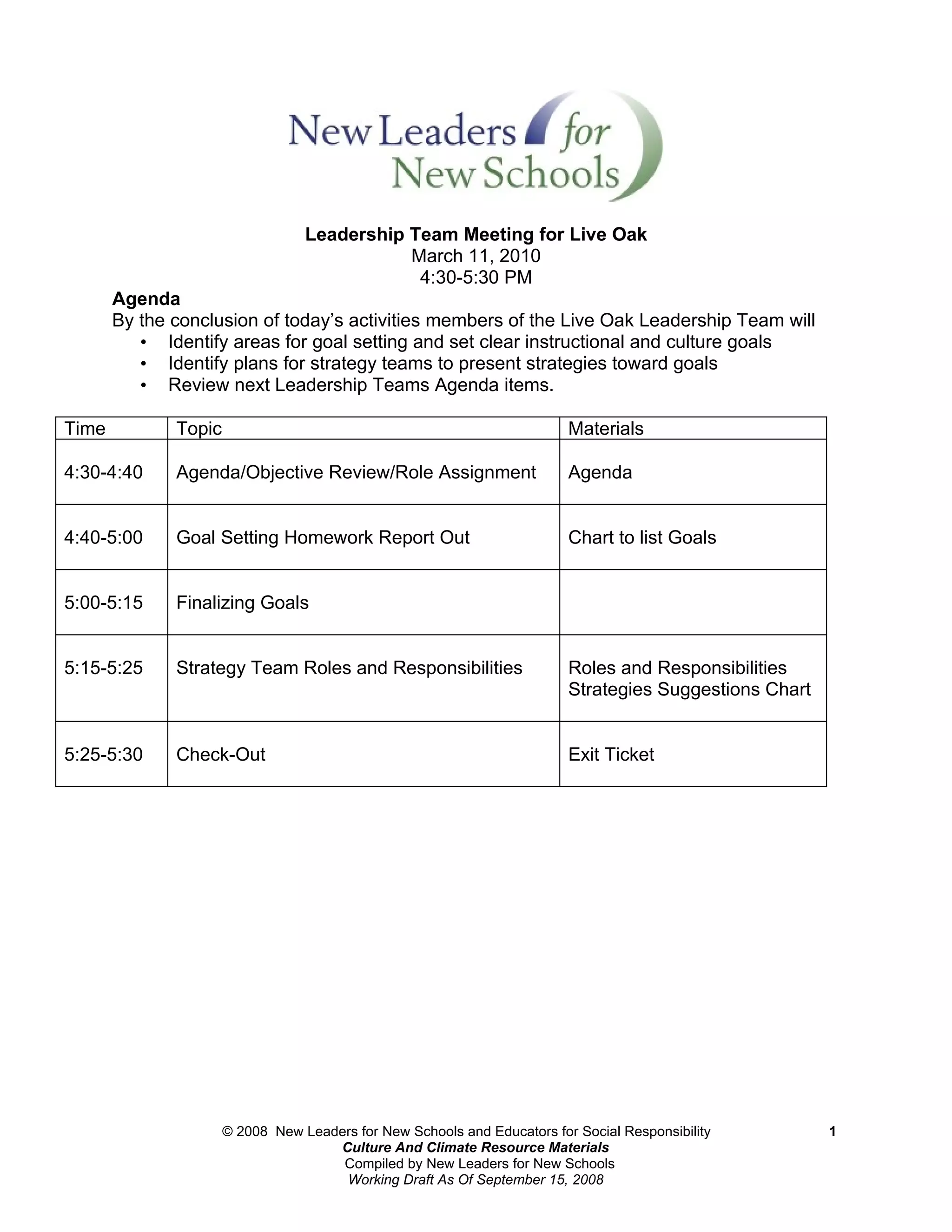
Leadership Team Meeting for Live Oak
                                             March 11, 2010
                                              4:30-5:30 PM
       Agenda
       By the conclusion of today’s activities members of the Live Oak Leadership Team will
          • Identify areas for goal setting and set clear instructional and culture goals
          • Identify plans for strategy teams to present strategies toward goals
          • Review next Leadership Teams Agenda items.

Time          Topic                                                       Materials

4:30-4:40     Agenda/Objective Review/Role Assignment                     Agenda


4:40-5:00     Goal Setting Homework Report Out                            Chart to list Goals


5:00-5:15     Finalizing Goals


5:15-5:25     Strategy Team Roles and Responsibilities                    Roles and Responsibilities
                                                                          Strategies Suggestions Chart


5:25-5:30     Check-Out                                                   Exit Ticket


                      © 2008 New Leaders for New Schools and Educators for Social Responsibility         1
                                     Culture And Climate Resource Materials
                                      Compiled by New Leaders for New Schools
                                      Working Draft As Of September 15, 2008
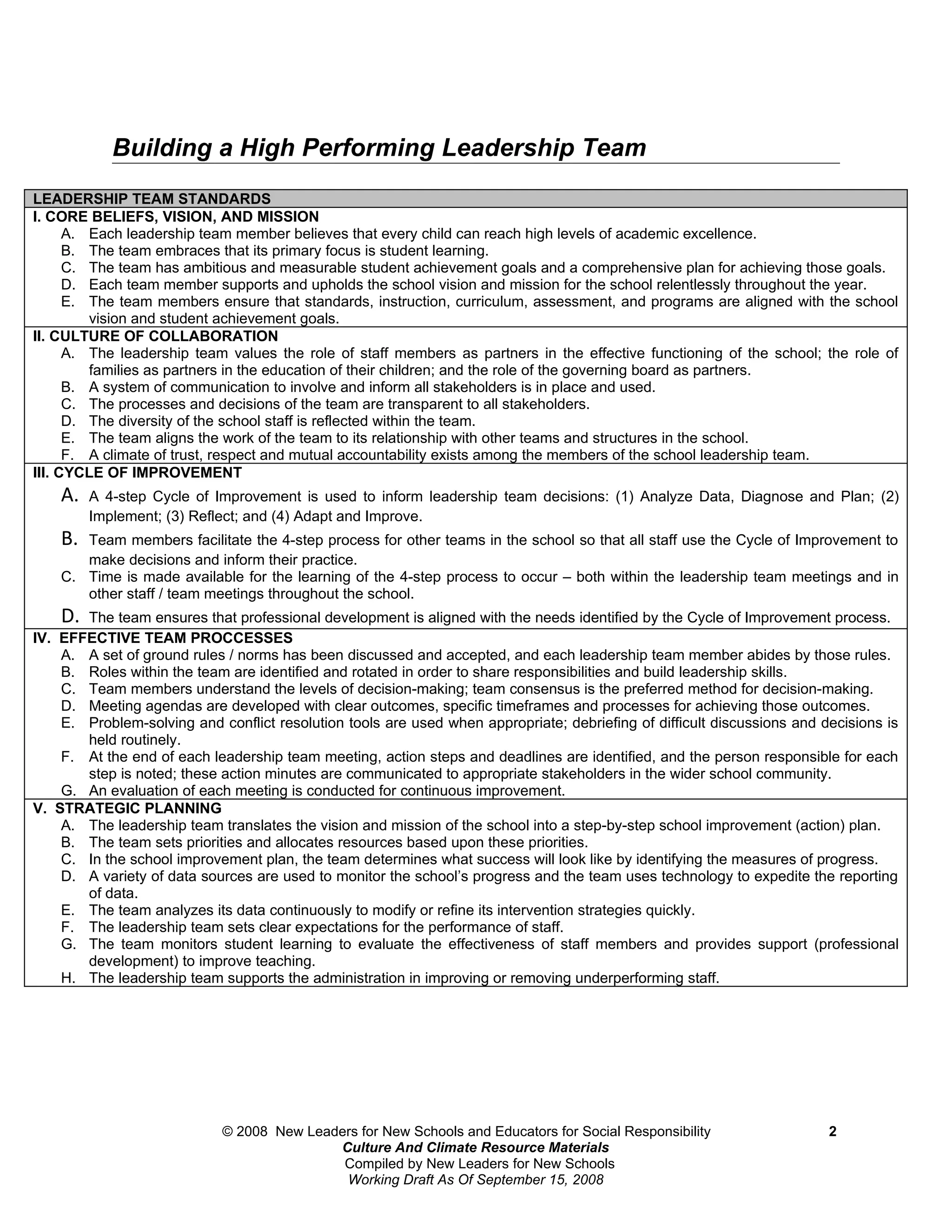
Building a High Performing Leadership Team
LEADERSHIP TEAM STANDARDS
I. CORE BELIEFS, VISION, AND MISSION
      A. Each leadership team member believes that every child can reach high levels of academic excellence.
      B. The team embraces that its primary focus is student learning.
      C. The team has ambitious and measurable student achievement goals and a comprehensive plan for achieving those goals.
      D. Each team member supports and upholds the school vision and mission for the school relentlessly throughout the year.
      E. The team members ensure that standards, instruction, curriculum, assessment, and programs are aligned with the school
         vision and student achievement goals.
II. CULTURE OF COLLABORATION
      A. The leadership team values the role of staff members as partners in the effective functioning of the school; the role of
         families as partners in the education of their children; and the role of the governing board as partners.
      B. A system of communication to involve and inform all stakeholders is in place and used.
      C. The processes and decisions of the team are transparent to all stakeholders.
      D. The diversity of the school staff is reflected within the team.
      E. The team aligns the work of the team to its relationship with other teams and structures in the school.
      F. A climate of trust, respect and mutual accountability exists among the members of the school leadership team.
III. CYCLE OF IMPROVEMENT
    A.   A 4-step Cycle of Improvement is used to inform leadership team decisions: (1) Analyze Data, Diagnose and Plan; (2)
         Implement; (3) Reflect; and (4) Adapt and Improve.
    B. Team members facilitate the 4-step process for other teams in the school so that all staff use the Cycle of Improvement to
       make decisions and inform their practice.
    C. Time is made available for the learning of the 4-step process to occur – both within the leadership team meetings and in
       other staff / team meetings throughout the school.
    D. The team ensures that professional development is aligned with the needs identified by the Cycle of Improvement process.
IV. EFFECTIVE TEAM PROCCESSES
    A. A set of ground rules / norms has been discussed and accepted, and each leadership team member abides by those rules.
    B. Roles within the team are identified and rotated in order to share responsibilities and build leadership skills.
    C. Team members understand the levels of decision-making; team consensus is the preferred method for decision-making.
    D. Meeting agendas are developed with clear outcomes, specific timeframes and processes for achieving those outcomes.
    E. Problem-solving and conflict resolution tools are used when appropriate; debriefing of difficult discussions and decisions is
       held routinely.
    F. At the end of each leadership team meeting, action steps and deadlines are identified, and the person responsible for each
       step is noted; these action minutes are communicated to appropriate stakeholders in the wider school community.
    G. An evaluation of each meeting is conducted for continuous improvement.
V. STRATEGIC PLANNING
    A. The leadership team translates the vision and mission of the school into a step-by-step school improvement (action) plan.
    B. The team sets priorities and allocates resources based upon these priorities.
    C. In the school improvement plan, the team determines what success will look like by identifying the measures of progress.
    D. A variety of data sources are used to monitor the school’s progress and the team uses technology to expedite the reporting
       of data.
    E. The team analyzes its data continuously to modify or refine its intervention strategies quickly.
    F. The leadership team sets clear expectations for the performance of staff.
    G. The team monitors student learning to evaluate the effectiveness of staff members and provides support (professional
       development) to improve teaching.
    H. The leadership team supports the administration in improving or removing underperforming staff.


                            © 2008 New Leaders for New Schools and Educators for Social Responsibility                   2
                                           Culture And Climate Resource Materials
                                            Compiled by New Leaders for New Schools
                                            Working Draft As Of September 15, 2008
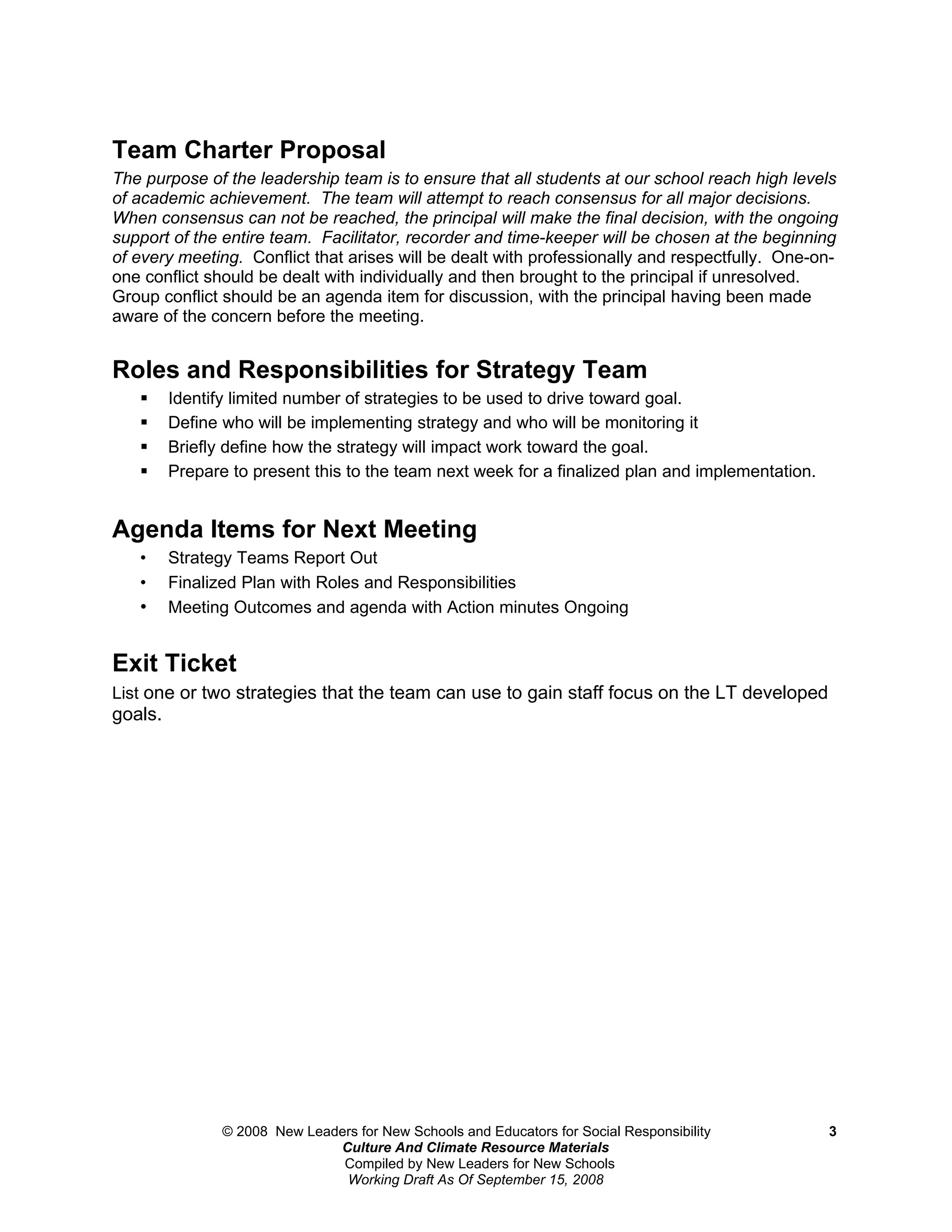
Team Charter Proposal
The purpose of the leadership team is to ensure that all students at our school reach high levels
of academic achievement. The team will attempt to reach consensus for all major decisions.
When consensus can not be reached, the principal will make the final decision, with the ongoing
support of the entire team. Facilitator, recorder and time-keeper will be chosen at the beginning
of every meeting. Conflict that arises will be dealt with professionally and respectfully. One-on-
one conflict should be dealt with individually and then brought to the principal if unresolved.
Group conflict should be an agenda item for discussion, with the principal having been made
aware of the concern before the meeting.


Roles and Responsibilities for Strategy Team
        Identify limited number of strategies to be used to drive toward goal.
        Define who will be implementing strategy and who will be monitoring it
        Briefly define how the strategy will impact work toward the goal.
        Prepare to present this to the team next week for a finalized plan and implementation.


Agenda Items for Next Meeting
   •     Strategy Teams Report Out
   •     Finalized Plan with Roles and Responsibilities
   •     Meeting Outcomes and agenda with Action minutes Ongoing


Exit Ticket
List one or two strategies that the team can use to gain staff focus on the LT developed
goals.


                © 2008 New Leaders for New Schools and Educators for Social Responsibility        3
                               Culture And Climate Resource Materials
                                Compiled by New Leaders for New Schools
                                Working Draft As Of September 15, 2008
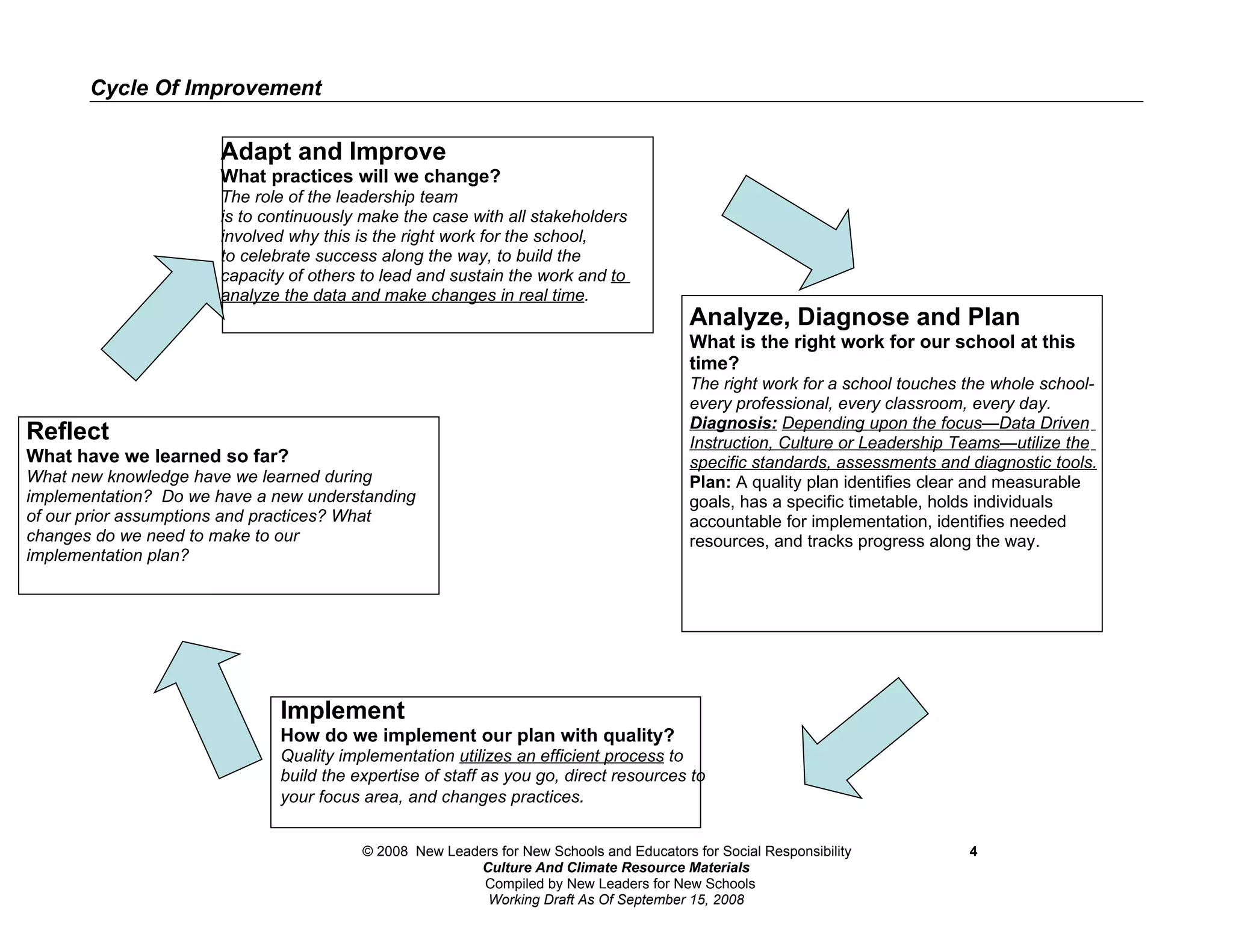
Cycle Of Improvement

                      Adapt and Improve
                      What practices will we change?
                      The role of the leadership team
                      is to continuously make the case with all stakeholders
                      involved why this is the right work for the school,
                      to celebrate success along the way, to build the
                      capacity of others to lead and sustain the work and to
                      analyze the data and make changes in real time.
                                                                                          Analyze, Diagnose and Plan
                                                                                          What is the right work for our school at this
                                                                                          time?
                                                                                          The right work for a school touches the whole school-
                                                                                          every professional, every classroom, every day.
                                                                                          Diagnosis: Depending upon the focus—Data Driven
Reflect                                                                                   Instruction, Culture or Leadership Teams—utilize the
What have we learned so far?                                                              specific standards, assessments and diagnostic tools.
What new knowledge have we learned during                                                 Plan: A quality plan identifies clear and measurable
implementation? Do we have a new understanding                                            goals, has a specific timetable, holds individuals
of our prior assumptions and practices? What                                              accountable for implementation, identifies needed
changes do we need to make to our                                                         resources, and tracks progress along the way.
implementation plan?


                              Implement
                              How do we implement our plan with quality?
                              Quality implementation utilizes an efficient process to
                              build the expertise of staff as you go, direct resources to
                              your focus area, and changes practices.


                                         © 2008 New Leaders for New Schools and Educators for Social Responsibility           4
                                                        Culture And Climate Resource Materials
                                                         Compiled by New Leaders for New Schools
                                                         Working Draft As Of September 15, 2008
© 2008 New Leaders for New Schools and Educators for Social Responsibility   5
               Culture And Climate Resource Materials
                Compiled by New Leaders for New Schools
                Working Draft As Of September 15, 2008

Lt meeting 3

  • 1.
    Leadership Team Meetingfor Live Oak March 11, 2010 4:30-5:30 PM Agenda By the conclusion of today’s activities members of the Live Oak Leadership Team will • Identify areas for goal setting and set clear instructional and culture goals • Identify plans for strategy teams to present strategies toward goals • Review next Leadership Teams Agenda items. Time Topic Materials 4:30-4:40 Agenda/Objective Review/Role Assignment Agenda 4:40-5:00 Goal Setting Homework Report Out Chart to list Goals 5:00-5:15 Finalizing Goals 5:15-5:25 Strategy Team Roles and Responsibilities Roles and Responsibilities Strategies Suggestions Chart 5:25-5:30 Check-Out Exit Ticket © 2008 New Leaders for New Schools and Educators for Social Responsibility 1 Culture And Climate Resource Materials Compiled by New Leaders for New Schools Working Draft As Of September 15, 2008
  • 2.
    Building a HighPerforming Leadership Team LEADERSHIP TEAM STANDARDS I. CORE BELIEFS, VISION, AND MISSION A. Each leadership team member believes that every child can reach high levels of academic excellence. B. The team embraces that its primary focus is student learning. C. The team has ambitious and measurable student achievement goals and a comprehensive plan for achieving those goals. D. Each team member supports and upholds the school vision and mission for the school relentlessly throughout the year. E. The team members ensure that standards, instruction, curriculum, assessment, and programs are aligned with the school vision and student achievement goals. II. CULTURE OF COLLABORATION A. The leadership team values the role of staff members as partners in the effective functioning of the school; the role of families as partners in the education of their children; and the role of the governing board as partners. B. A system of communication to involve and inform all stakeholders is in place and used. C. The processes and decisions of the team are transparent to all stakeholders. D. The diversity of the school staff is reflected within the team. E. The team aligns the work of the team to its relationship with other teams and structures in the school. F. A climate of trust, respect and mutual accountability exists among the members of the school leadership team. III. CYCLE OF IMPROVEMENT A. A 4-step Cycle of Improvement is used to inform leadership team decisions: (1) Analyze Data, Diagnose and Plan; (2) Implement; (3) Reflect; and (4) Adapt and Improve. B. Team members facilitate the 4-step process for other teams in the school so that all staff use the Cycle of Improvement to make decisions and inform their practice. C. Time is made available for the learning of the 4-step process to occur – both within the leadership team meetings and in other staff / team meetings throughout the school. D. The team ensures that professional development is aligned with the needs identified by the Cycle of Improvement process. IV. EFFECTIVE TEAM PROCCESSES A. A set of ground rules / norms has been discussed and accepted, and each leadership team member abides by those rules. B. Roles within the team are identified and rotated in order to share responsibilities and build leadership skills. C. Team members understand the levels of decision-making; team consensus is the preferred method for decision-making. D. Meeting agendas are developed with clear outcomes, specific timeframes and processes for achieving those outcomes. E. Problem-solving and conflict resolution tools are used when appropriate; debriefing of difficult discussions and decisions is held routinely. F. At the end of each leadership team meeting, action steps and deadlines are identified, and the person responsible for each step is noted; these action minutes are communicated to appropriate stakeholders in the wider school community. G. An evaluation of each meeting is conducted for continuous improvement. V. STRATEGIC PLANNING A. The leadership team translates the vision and mission of the school into a step-by-step school improvement (action) plan. B. The team sets priorities and allocates resources based upon these priorities. C. In the school improvement plan, the team determines what success will look like by identifying the measures of progress. D. A variety of data sources are used to monitor the school’s progress and the team uses technology to expedite the reporting of data. E. The team analyzes its data continuously to modify or refine its intervention strategies quickly. F. The leadership team sets clear expectations for the performance of staff. G. The team monitors student learning to evaluate the effectiveness of staff members and provides support (professional development) to improve teaching. H. The leadership team supports the administration in improving or removing underperforming staff. © 2008 New Leaders for New Schools and Educators for Social Responsibility 2 Culture And Climate Resource Materials Compiled by New Leaders for New Schools Working Draft As Of September 15, 2008
  • 3.
    Team Charter Proposal Thepurpose of the leadership team is to ensure that all students at our school reach high levels of academic achievement. The team will attempt to reach consensus for all major decisions. When consensus can not be reached, the principal will make the final decision, with the ongoing support of the entire team. Facilitator, recorder and time-keeper will be chosen at the beginning of every meeting. Conflict that arises will be dealt with professionally and respectfully. One-on- one conflict should be dealt with individually and then brought to the principal if unresolved. Group conflict should be an agenda item for discussion, with the principal having been made aware of the concern before the meeting. Roles and Responsibilities for Strategy Team  Identify limited number of strategies to be used to drive toward goal.  Define who will be implementing strategy and who will be monitoring it  Briefly define how the strategy will impact work toward the goal.  Prepare to present this to the team next week for a finalized plan and implementation. Agenda Items for Next Meeting • Strategy Teams Report Out • Finalized Plan with Roles and Responsibilities • Meeting Outcomes and agenda with Action minutes Ongoing Exit Ticket List one or two strategies that the team can use to gain staff focus on the LT developed goals. © 2008 New Leaders for New Schools and Educators for Social Responsibility 3 Culture And Climate Resource Materials Compiled by New Leaders for New Schools Working Draft As Of September 15, 2008
  • 4.
    Cycle Of Improvement Adapt and Improve What practices will we change? The role of the leadership team is to continuously make the case with all stakeholders involved why this is the right work for the school, to celebrate success along the way, to build the capacity of others to lead and sustain the work and to analyze the data and make changes in real time. Analyze, Diagnose and Plan What is the right work for our school at this time? The right work for a school touches the whole school- every professional, every classroom, every day. Diagnosis: Depending upon the focus—Data Driven Reflect Instruction, Culture or Leadership Teams—utilize the What have we learned so far? specific standards, assessments and diagnostic tools. What new knowledge have we learned during Plan: A quality plan identifies clear and measurable implementation? Do we have a new understanding goals, has a specific timetable, holds individuals of our prior assumptions and practices? What accountable for implementation, identifies needed changes do we need to make to our resources, and tracks progress along the way. implementation plan? Implement How do we implement our plan with quality? Quality implementation utilizes an efficient process to build the expertise of staff as you go, direct resources to your focus area, and changes practices. © 2008 New Leaders for New Schools and Educators for Social Responsibility 4 Culture And Climate Resource Materials Compiled by New Leaders for New Schools Working Draft As Of September 15, 2008
  • 5.
    © 2008 NewLeaders for New Schools and Educators for Social Responsibility 5 Culture And Climate Resource Materials Compiled by New Leaders for New Schools Working Draft As Of September 15, 2008