Mendel and Heredity 7-1 Fundamental of Genetics 7-2 Analyzing Heredity 7-3 Human Genetics
Fundamentals of Genetics List four characteristics that make  Pisum sativum  a good subject for genetic studies. Outline the three major steps of Gregor Mendel’s garden pea experiments. Explain how Mendel derived ratios from his observations. Compare and contrast Mendel’s two laws of heredity.
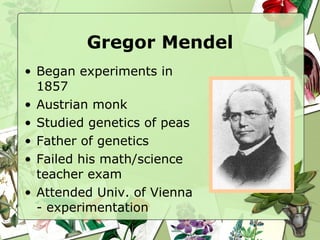
Gregor Mendel Began experiments in 1857 Austrian monk Studied genetics of peas Father of genetics Failed his math/science teacher exam Attended Univ. of Vienna - experimentation
Why the Garden Pea? Many varieties – 32 to start – used 7 More than one form of the same trait Small, easy to grow, matures quickly, large numbers of offspring… Ability to cross-pollinate and self-pollinate
Experimental Design Step 1 – allow self-pollination to produce plants that are true-breeding. P generation. Step 2 – cross-pollination.  F1 generation. Step 3 – self-pollination of F1 generation. F2 generatoin.
Two ratios observed Dominant trait  – expressed trait in F1 generation. Recessive trait  – not expressed in F1 generation. Self-pollination of F1 yields a 3:1 phenotypic ratio, but a 1:2:1 genotypic ratio.
Mendel’s proposed Theory Parent’s pass factors(genes) to their offspring that produce traits. Two alleles for each trait –  heterozygous (Tt) or homozygous (TT, tt) Phenotype  = physical appearance Genotype  = set of alleles Dominant is expressed over recessive
Mendel’s Laws Law of segregation  – member of each pair of alleles are separated when gametes are formed. Law of Independent Assortment  – pairs of alleles separate independently of one another during gamete formation.
Interpreting Mendel’s Model Capital letters= dominant alleles Lower case letters = recessive alleles Two alleles for each trait Homozygous dominant = DD Heterozygous dominant = Dd (hybrid) Homozygous recessive - dd
Probability The likelihood that an event will take place. =  number of one kind of possible outcome total number of possible outcomes
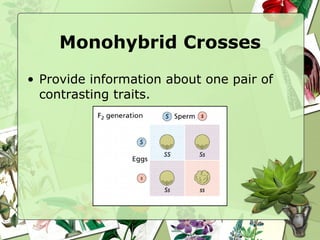
Monohybrid Crosses Provide information about one pair of contrasting traits.
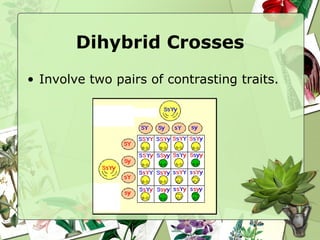
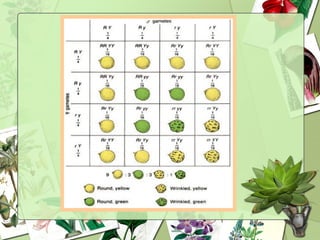
Dihybrid Crosses Involve two pairs of contrasting traits.
 
Review Questions: Write the formula used to determine the likelihood that an event will occur.  How is probability used in genetics? Construct a Punnett Square to predict the outcome of a monohybrid cross between two heterozygous tall pea plants.  What are the expected phenotypic and genotypic ratios? What is a dihybrid cross?  What is the expected phenotypic ratio for a heterozygous dihybrid cross?
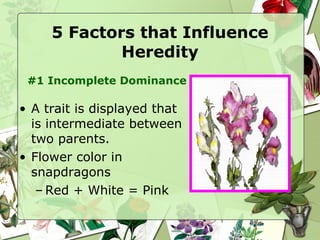
5 Factors that Influence Heredity A trait is displayed that is intermediate between two parents. Flower color in snapdragons Red + White = Pink #1 Incomplete Dominance
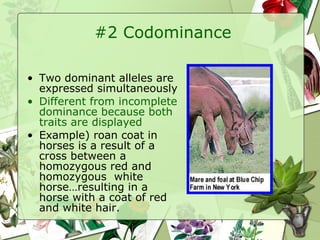
#2 Codominance Two dominant alleles are expressed simultaneously Different from incomplete dominance because both traits are displayed Example) roan coat in horses is a result of a cross between a homozygous red and homozygous  white horse…resulting in a horse with a coat of red and white hair.
#3  Multiple Alleles Genes with more than one allele Example) three alleles can determine  blood type (A, B, and O) A and B are dominant over O Neither A nor B are dominant over each other When A and B are present…they are codominant
#4  Continuous Variation Several genes influence a trait Examples) height and weight A variety of phenotypes exist from one extreme to another
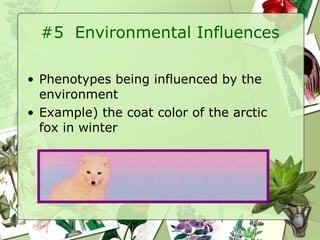
#5  Environmental Influences Phenotypes being influenced by the environment Example) the coat color of the arctic fox in winter
Review Questions What are dominant and recessive alleles? Why were true-breeding plants important in Mendel’s experiments? What is a Punnett Square? What is the difference between Phenotype and Genotype? Describe two inheritance patterns besides simple dominance.

Mendel and heredity

  • 1.
    Mendel and Heredity7-1 Fundamental of Genetics 7-2 Analyzing Heredity 7-3 Human Genetics
  • 2.
    Fundamentals of GeneticsList four characteristics that make Pisum sativum a good subject for genetic studies. Outline the three major steps of Gregor Mendel’s garden pea experiments. Explain how Mendel derived ratios from his observations. Compare and contrast Mendel’s two laws of heredity.
  • 3.
    Gregor Mendel Beganexperiments in 1857 Austrian monk Studied genetics of peas Father of genetics Failed his math/science teacher exam Attended Univ. of Vienna - experimentation
  • 4.
    Why the GardenPea? Many varieties – 32 to start – used 7 More than one form of the same trait Small, easy to grow, matures quickly, large numbers of offspring… Ability to cross-pollinate and self-pollinate
  • 5.
    Experimental Design Step1 – allow self-pollination to produce plants that are true-breeding. P generation. Step 2 – cross-pollination. F1 generation. Step 3 – self-pollination of F1 generation. F2 generatoin.
  • 6.
    Two ratios observedDominant trait – expressed trait in F1 generation. Recessive trait – not expressed in F1 generation. Self-pollination of F1 yields a 3:1 phenotypic ratio, but a 1:2:1 genotypic ratio.
  • 7.
    Mendel’s proposed TheoryParent’s pass factors(genes) to their offspring that produce traits. Two alleles for each trait – heterozygous (Tt) or homozygous (TT, tt) Phenotype = physical appearance Genotype = set of alleles Dominant is expressed over recessive
  • 8.
    Mendel’s Laws Lawof segregation – member of each pair of alleles are separated when gametes are formed. Law of Independent Assortment – pairs of alleles separate independently of one another during gamete formation.
  • 9.
    Interpreting Mendel’s ModelCapital letters= dominant alleles Lower case letters = recessive alleles Two alleles for each trait Homozygous dominant = DD Heterozygous dominant = Dd (hybrid) Homozygous recessive - dd
  • 10.
    Probability The likelihoodthat an event will take place. = number of one kind of possible outcome total number of possible outcomes
  • 11.
    Monohybrid Crosses Provideinformation about one pair of contrasting traits.
  • 12.
    Dihybrid Crosses Involvetwo pairs of contrasting traits.
  • 13.
  • 14.
    Review Questions: Writethe formula used to determine the likelihood that an event will occur. How is probability used in genetics? Construct a Punnett Square to predict the outcome of a monohybrid cross between two heterozygous tall pea plants. What are the expected phenotypic and genotypic ratios? What is a dihybrid cross? What is the expected phenotypic ratio for a heterozygous dihybrid cross?
  • 15.
    5 Factors thatInfluence Heredity A trait is displayed that is intermediate between two parents. Flower color in snapdragons Red + White = Pink #1 Incomplete Dominance
  • 16.
    #2 Codominance Twodominant alleles are expressed simultaneously Different from incomplete dominance because both traits are displayed Example) roan coat in horses is a result of a cross between a homozygous red and homozygous white horse…resulting in a horse with a coat of red and white hair.
  • 17.
    #3 MultipleAlleles Genes with more than one allele Example) three alleles can determine blood type (A, B, and O) A and B are dominant over O Neither A nor B are dominant over each other When A and B are present…they are codominant
  • 18.
    #4 ContinuousVariation Several genes influence a trait Examples) height and weight A variety of phenotypes exist from one extreme to another
  • 19.
    #5 EnvironmentalInfluences Phenotypes being influenced by the environment Example) the coat color of the arctic fox in winter
  • 20.
    Review Questions Whatare dominant and recessive alleles? Why were true-breeding plants important in Mendel’s experiments? What is a Punnett Square? What is the difference between Phenotype and Genotype? Describe two inheritance patterns besides simple dominance.